

ISO/IEC 23090-15:2024
(Main)Information technology — Coded representation of immersive media — Part 15: Conformance testing for versatile video coding
General Information
- Abstract
This document specifies a set of tests and procedures designed to indicate whether encoders or decoders meet the requirements specified in Rec. ITU-T H.266 | ISO/IEC 23090-3.
- Status
- Withdrawn
- Publication Date
- 04-Jul-2024
- Current Stage
- 9599 - Withdrawal of International Standard
- Start Date
- 24-Aug-2026
- Completion Date
- 29-Aug-2026


Overview
ISO/IEC 23090-15:2024 - "Information technology - Coded representation of immersive media - Part 15: Conformance testing for versatile video coding" specifies a normative test suite and procedures to determine whether VVC (Versatile Video Coding) encoders and decoders comply with the syntax and decoding requirements of Rec. ITU‑T H.266 / ISO/IEC 23090‑3. The document defines bitstream conformance, decoder conformance, test bitstream contents, and static and dynamic test procedures. Test data and reference implementations are provided as electronic attachments and via the ISO standards site.
Key topics and requirements
- Scope and purpose: Tests and procedures to indicate conformance of encoders/decoders to H.266 / ISO/IEC 23090‑3.
- Bitstream conformance: Definitions and normative tests to verify that a produced bitstream follows VVC syntax and profile/level constraints.
- Decoder conformance: Tests to check that decoder implementations reproduce required outputs and meet timing requirements.
- Test procedures: Step‑by‑step procedures to test bitstreams and decoders, including requirements on bitstream files and decoding outputs.
- Static vs dynamic tests:
- Static tests validate output order and format (frame ordering, pixel formats, metadata).
- Dynamic tests validate runtime behavior and output timing.
- Conformance bitstreams: A comprehensive set of test bitstreams covering multiple profiles, chroma formats, bit depths, tools and high-level syntax features.
- Profiles and formats covered: Main 10 (4:2:0, 10‑bit), Main 10 4:4:4, Main 12, Main 16, multilayer and still picture profiles, with additional bitstreams for 12‑bit and 16‑bit added in this second edition.
- Reference software: Use of the reference software decoder (see ISO/IEC 23090‑16) as a baseline for testing and comparison.
- Test data availability: Electronic test suites available via ISO’s publication portal.
Practical applications
- Codec developers use the standard to verify encoder/decoder compliance during development and regression testing.
- Test labs and certification bodies apply the documented test suites to certify products for interoperability.
- Device and chipset manufacturers ensure firmware and hardware decoders meet VVC conformance requirements.
- Streaming platforms, broadcasters and content providers use conformance testing to guarantee playback compatibility across ecosystems.
- R&D and QA teams leverage the static/dynamic tests and reference software for debugging, compliance, and quality assurance.
Who should use this standard
- Codec implementers and vendors
- Interoperability test labs and conformity assessors
- System integrators, hardware vendors, and streaming service engineers
- Standards committees and researchers working on VVC/H.266 implementations
Related standards
- Rec. ITU‑T H.266 | ISO/IEC 23090‑3 - Versatile Video Coding (VVC) specification
- ISO/IEC 23090‑16 - Reference software for VVC
For test data and the conformance bitstream suites, see ISO’s online publication for ISO/IEC 23090‑15:2024 (standards.iso.org/iso-iec/23090/-15/ed-2/en/).
Relations
- Effective Date
- 01-Feb-2025
- Effective Date
- 18-Feb-2023
Get Certified
Connect with accredited certification bodies for this standard

BSI Group
BSI (British Standards Institution) is the business standards company that helps organizations make excellence a habit.

NYCE
Mexican standards and certification body.
Sponsored listings
Frequently Asked Questions
ISO/IEC 23090-15:2024 is a standard published by the International Organization for Standardization (ISO). Its full title is "Information technology — Coded representation of immersive media — Part 15: Conformance testing for versatile video coding". This standard covers: This document specifies a set of tests and procedures designed to indicate whether encoders or decoders meet the requirements specified in Rec. ITU-T H.266 | ISO/IEC 23090-3.
This document specifies a set of tests and procedures designed to indicate whether encoders or decoders meet the requirements specified in Rec. ITU-T H.266 | ISO/IEC 23090-3.
ISO/IEC 23090-15:2024 is classified under the following ICS (International Classification for Standards) categories: 35.040.40 - Coding of audio, video, multimedia and hypermedia information. The ICS classification helps identify the subject area and facilitates finding related standards.
ISO/IEC 23090-15:2024 has the following relationships with other standards: It is inter standard links to ISO/IEC 23090-15:2026, ISO/IEC 23090-15:2022. Understanding these relationships helps ensure you are using the most current and applicable version of the standard.
ISO/IEC 23090-15:2024 is available in PDF format for immediate download after purchase. The document can be added to your cart and obtained through the secure checkout process. Digital delivery ensures instant access to the complete standard document.
Standards Content (Sample)
International
Standard
ISO/IEC 23090-15
Second edition
Information technology — Coded
2024-07
representation of immersive media —
Part 15:
Conformance testing for versatile
video coding
Technologies de l'information — Représentation codée de média
immersifs —
Partie 15: Essai de conformité pour le codage vidéo polyvalent
Reference number
© ISO/IEC 2024
All rights reserved. Unless otherwise specified, or required in the context of its implementation, no part of this publication may
be reproduced or utilized otherwise in any form or by any means, electronic or mechanical, including photocopying, or posting on
the internet or an intranet, without prior written permission. Permission can be requested from either ISO at the address below
or ISO’s member body in the country of the requester.
ISO copyright office
CP 401 • Ch. de Blandonnet 8
CH-1214 Vernier, Geneva
Phone: +41 22 749 01 11
Email: copyright@iso.org
Website: www.iso.org
Published in Switzerland
© ISO/IEC 2024 – All rights reserved
ii
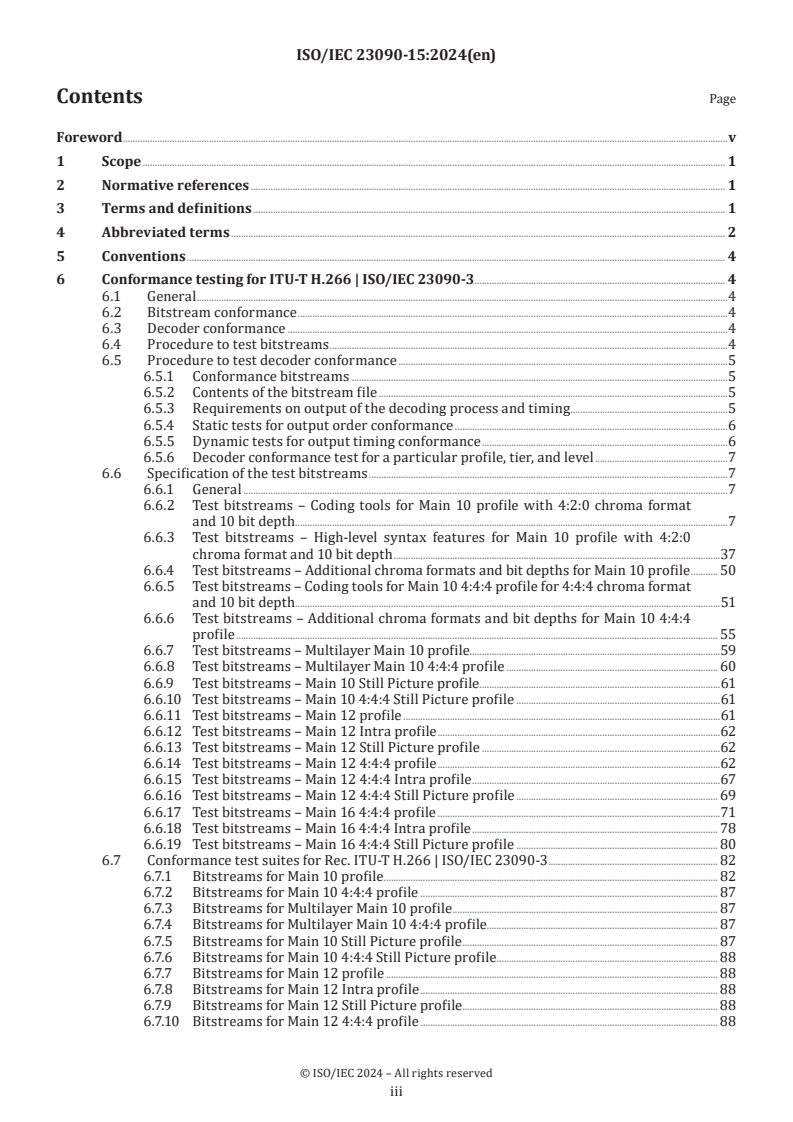
Contents Page
Foreword .v
1 Scope . 1
2 Normative references . 1
3 Terms and definitions . 1
4 Abbreviated terms . 2
5 Conventions . 4
6 Conformance testing for ITU-T H.266 | ISO/IEC 23090-3 . 4
6.1 General .4
6.2 Bitstream conformance .4
6.3 Decoder conformance .4
6.4 Procedure to test bitstreams .4
6.5 Procedure to test decoder conformance .5
6.5.1 Conformance bitstreams .5
6.5.2 Contents of the bitstream file .5
6.5.3 Requirements on output of the decoding process and timing .5
6.5.4 Static tests for output order conformance .6
6.5.5 Dynamic tests for output timing conformance .6
6.5.6 Decoder conformance test for a particular profile, tier, and level .7
6.6 Specification of the test bitstreams .7
6.6.1 General .7
6.6.2 Test bitstreams – Coding tools for Main 10 profile with 4:2:0 chroma format
and 10 bit depth.7
6.6.3 Test bitstreams – High-level syntax features for Main 10 profile with 4:2:0
chroma format and 10 bit depth .37
6.6.4 Test bitstreams – Additional chroma formats and bit depths for Main 10 profile . 50
6.6.5 Test bitstreams – Coding tools for Main 10 4:4:4 profile for 4:4:4 chroma format
and 10 bit depth.51
6.6.6 Test bitstreams – Additional chroma formats and bit depths for Main 10 4:4:4
profile . 55
6.6.7 Test bitstreams – Multilayer Main 10 profile.59
6.6.8 Test bitstreams – Multilayer Main 10 4:4:4 profile . 60
6.6.9 Test bitstreams – Main 10 Still Picture profile .61
6.6.10 Test bitstreams – Main 10 4:4:4 Still Picture profile .61
6.6.11 Test bitstreams – Main 12 profile .61
6.6.12 Test bitstreams – Main 12 Intra profile .62
6.6.13 Test bitstreams – Main 12 Still Picture profile .62
6.6.14 Test bitstreams – Main 12 4:4:4 profile .62
6.6.15 Test bitstreams – Main 12 4:4:4 Intra profile .67
6.6.16 Test bitstreams – Main 12 4:4:4 Still Picture profile . 69
6.6.17 Test bitstreams – Main 16 4:4:4 profile .71
6.6.18 Test bitstreams – Main 16 4:4:4 Intra profile . 78
6.6.19 Test bitstreams – Main 16 4:4:4 Still Picture profile . 80
6.7 Conformance test suites for Rec. ITU-T H.266 | ISO/IEC 23090-3 . 82
6.7.1 Bitstreams for Main 10 profile. 82
6.7.2 Bitstreams for Main 10 4:4:4 profile . 87
6.7.3 Bitstreams for Multilayer Main 10 profile . 87
6.7.4 Bitstreams for Multilayer Main 10 4:4:4 profile. 87
6.7.5 Bitstreams for Main 10 Still Picture profile . 87
6.7.6 Bitstreams for Main 10 4:4:4 Still Picture profile . 88
6.7.7 Bitstreams for Main 12 profile . 88
6.7.8 Bitstreams for Main 12 Intra profile . 88
6.7.9 Bitstreams for Main 12 Still Picture profile. 88
6.7.10 Bitstreams for Main 12 4:4:4 profile . 88
© ISO/IEC 2024 – All rights reserved
iii
6.7.11 Bitstreams for Main 12 4:4:4 Intra profile . 89
6.7.12 Bitstreams for Main 12 4:4:4 Still Picture profile . 89
6.7.13 Bitstreams for Main 16 4:4:4 profile . 89
6.7.14 Bitstreams for Main 16 4:4:4 Intra profile . 90
6.7.15 Bitstreams for Main 16 4:4:4 Still Picture profile . 90
© ISO/IEC 2024 – All rights reserved
iv
Foreword
ISO (the International Organization for Standardization) and IEC (the International Electrotechnical
Commission) form the specialized system for worldwide standardization. National bodies that are
members of ISO or IEC participate in the development of International Standards through technical
committees established by the respective organization to deal with particular fields of technical activity.
ISO and IEC technical committees collaborate in fields of mutual interest. Other international organizations,
governmental and non-governmental, in liaison with ISO and IEC, also take part in the work.
The procedures used to develop this document and those intended for its further maintenance are described
in the ISO/IEC Directives, Part 1. In particular, the different approval criteria needed for the different types
of document should be noted. This document was drafted in accordance with the editorial rules of the ISO/
IEC Directives, Part 2 (see www.iso.org/directives or www.iec.ch/members_experts/refdocs).
ISO and IEC draw attention to the possibility that the implementation of this document may involve the
use of (a) patent(s). ISO and IEC take no position concerning the evidence, validity or applicability of any
claimed patent rights in respect thereof. As of the date of publication of this document, ISO and IEC had not
received notice of (a) patent(s) which may be required to implement this document. However, implementers
are cautioned that this may not represent the latest information, which may be obtained from the patent
database available at www.iso.org/patents and https://patents.iec.ch. ISO and IEC shall not be held
responsible for identifying any or all such patent rights.
Any trade name used in this document is information given for the convenience of users and does not
constitute an endorsement.
For an explanation of the voluntary nature of standards, the meaning of ISO specific terms and expressions
related to conformity assessment, as well as information about ISO's adherence to the World Trade
Organization (WTO) principles in the Technical Barriers to Trade (TBT) see www.iso.org/iso/foreword.html.
In the IEC, see www.iec.ch/understanding-standards.
This document was prepared by Joint Technical Committee ISO/IEC JTC 1, Information technology,
Subcommittee SC 29, Coding of audio, picture, multimedia and hypermedia information, in collaboration with
ITU-T Study Group 16 (as Rec. ITU-T H.266.1).
This second edition cancels and replaces the first edition (ISO/IEC 23090-15:2022), which has been
technically revised.
The main changes are as follows:
— addition of bitstreams for the 12-bit and 16-bit profiles that were added in ISO/IEC 23090-3:2022.
A list of all parts in the ISO/IEC 23090 series can be found on the ISO and IEC websites.
Any feedback or questions on this document should be directed to the user’s national standards
body. A complete listing of these bodies can be found at www.iso.org/members.html and
www.iec.ch/national-committees.
© ISO/IEC 2024 – All rights reserved
v
International Standard ISO/IEC 23090-15:2024(en)
Information technology — Coded representation of
immersive media —
Part 15:
Conformance testing for versatile video coding
1 Scope
This document specifies a set of tests and procedures designed to indicate whether encoders or decoders
meet the requirements specified in Rec. ITU-T H.266 | ISO/IEC 23090-3.
2 Normative references
The following documents are referred to in the text in such a way that some or all of their content constitutes
requirements of this document. For dated references, only the edition cited applies. For undated references,
the latest edition of the referenced document (including any amendments) applies.
Rec. ITU-T H.266 | ISO/IEC 23090-3:2022, Information technology – Coded representation of immersive media–
Part 3: Versatile video coding
Rec. ITU-T H.266.2 | ISO/IEC 23090-16, Information technology – Coded representation of immersive media –
Part 16: Reference software for versatile video coding
3 Terms and definitions
For the purposes of this document, the terms and definitions given in Rec. ITU-T H.266 | ISO/IEC 23090-3
and the following apply.
ISO and IEC maintain terminology databases for use in standardization at the following addresses:
— ISO Online browsing platform: available at https:// www .iso .org/ obp
— IEC Electropedia: available at https:// www .electropedia .org/
3.1
bitstream
sequence of bits that conforms to specified syntax requirements or sequence of bits to be tested for
conformance to such syntax requirements
3.2
decoder
embodiment of a specified decoding process or process to be tested for conformance to such a decoding
process specification
3.3
encoder
embodiment of a process that produces a bitstream (3.1)
© ISO/IEC 2024 – All rights reserved
3.4
reference software decoder
particular decoder (3.2) provided as a software package for use as an example available for study, as
a potential starting basis for the development of other decoders, as a way of testing bitstreams (3.1) for
conformance to a decoding process specification, or as a reference for comparison with the behaviour of
other decoders
3.5
reference software encoder
particular encoder (3.3) provided as a software package for use as an example available for study, as a
potential starting basis for the development of other encoders, or as a reference for comparison with the
behaviour of other encoders
3.6
VVCv1 tools
coding tools included in the Multilayer Main 10 4:4:4 profile of versatile video coding (VVC)
Note 1 to entry: Specified in Rec. ITU-T H.266 | ISO/IEC 23090-3.
3.7
VVCv2 tools
EPP, ERRC, PRRC, ETSRC, and RLSCP coding tools added in the VVC operation range extensions
Note 1 to entry: Specified in Rec. ITU-T H.266 | ISO/IEC 23090-3:2022.
4 Abbreviated terms
AFF Affine motion model
ALF Adaptive loop filter
AMVP Adaptive motion vector prediction
AMVR Adaptive motion vector resolution
BDOF Bi-directional optical flow
BCW Bi-predictive with CU weights
CABAC context-adaptive binary arithmetic coding
CCALF Cross-component ALF
CCLM Cross-component linear model
CIIP Combined inter/intra prediction
CST Chroma separate tree
CTC Common test conditions
DCT Discrete cosine transform
DMVR Decoder-side motion vector refinement
DPB Decoded picture buffer
DQ Dependent quantization
DST Discrete sine transform
© ISO/IEC 2024 – All rights reserved
EPP Extended precision processing
ERRC Extended regular residual coding
ETSRC Extended transform skip residual coding
FTP File transfer protocol
GPM Geometric partitioning mode
IBC Intra block copy mode
ISP Intra sub-partitioning
JCCR Joint coding of chroma residuals
LFNST Low frequency non-separable transform
LMCS Luma mapping with chroma scaling
MIP Matrix based intra prediction
MMVD Merge with MVD
MPM Most probable mode
MRL Multiple reference line
MTS Multi transform selection
MVCOMP Motion vector compression
MVD Motion vector difference
NUT NAL unit type
PDPC Position-dependent (intra) prediction combination
PERP Padded equirectangular projection
PROF Prediction refinement using optical flow
PRRC Persistent regular residual coding
RA Random access
RLSCP Reversed last significant coefficient position
RPR Reference picture resampling
RRC Regular residual coding
SAD Sum of absolute differences
SAO Sampled adaptive offset
SBT Sub-block transform
SCC Screen content coding
SDH Sign data hiding
© ISO/IEC 2024 – All rights reserved
SbTMVP Sub-block-based temporal motion vector prediction
SMVD Symmetric MVD
TMVP Temporal motion vector prediction
VVC Versatile video coding
WP Weighted prediction
WPP Wavefront parallel processing
5 Conventions
The conventions in Clause 5 of Rec. ITU-T H.266 | ISO/IEC 23090-3:2022 apply.
6 Conformance testing for ITU-T H.266 | ISO/IEC 23090-3
6.1 General
The conformance testing data for Rec. ITU-T H.266 | ISO/IEC 23090-3 is available at: https:// standards .iso
.org/ iso -iec/ 23090/ -15/ ed -2/ en/
The following subclauses specify normative tests for verifying conformance of video bitstreams as well
as decoders. Those normative tests make use of test data (bitstream test suites) provided as an electronic
attachment to this document and the reference software decoder specified in Rec. ITU-T H.266.2 |
ISO/IEC 23090-16.
6.2 Bitstream conformance
Bitstream conformance for Rec. ITU-T H.266 | ISO/IEC 23090-3 is specified by Clause C.4 of Rec. ITU-T
H.266 | ISO/IEC 23090-3:2022.
6.3 Decoder conformance
Decoder conformance for Rec. ITU-T H.266 | ISO/IEC 23090-3 is specified by Clause C.5 of Rec. ITU-T H.266 |
ISO/IEC 23090-3:2022.
6.4 Procedure to test bitstreams
A bitstream that is claimed to conform to Rec. ITU-T H.266 | ISO/IEC 23090-3 shall pass the following
normative test. This test should not be applied to bitstreams that are known to contain errors introduced
by transmission, as such errors are highly likely to result in bitstreams that lack conformance to Rec. ITU-T
H.266 | ISO/IEC 23090-3.
The bitstream under test shall be decoded by processing it with the reference software decoder specified in
Rec. ITU-T H.266.2 | ISO/IEC 23090-16. When processed by the reference software decoder, the bitstream
shall not cause any error or non-conformance messages to be reported by the reference software decoder.
When the bitstream under test contains decoded picture hash SEI messages, the hash values signalled in the
decoded picture hash SEI messages in the bitstream shall match those calculated by the reference software
decoder.
Successfully passing this test provides only a strong presumption that the bitstream under test does indeed
meet all the requirements specified in Rec. ITU-T H.266 | ISO/IEC 23090-3 that are tested by the reference
software decoder.
Additional tests may be necessary to more thoroughly check that the bitstream properly meets all the
requirements specified in Rec. ITU-T H.266 | ISO/IEC 23090-3, including hypothetical reference decoder
© ISO/IEC 2024 – All rights reserved
(HRD) conformance (based on Annexes C and D). Such complementary tests may be performed using other
video bitstream verifiers that perform more complete tests than those implemented by the reference
software decoder.
Rec. ITU-T H.266 | ISO/IEC 23090-3 contains several informative recommendations that are not an integral
part of that Recommendation | International Standard. When testing a bitstream for conformance, it may
also be useful to test whether or not the bitstream follows those recommendations.
To check the correctness of a bitstream, it is necessary to parse the entire bitstream and to extract all the
syntax elements and other values derived from those syntactic elements and used by the decoding process
specified in Rec. ITU-T H.266 | ISO/IEC 23090-3.
A bitstream verifier may not necessarily perform all stages of the decoding process specified in Rec. ITU-T
H.266 | ISO/IEC 23090-3 in order to verify bitstream correctness. Many tests can be performed on syntax
elements in a state prior to their use in some processing stages.
6.5 Procedure to test decoder conformance
6.5.1 Conformance bitstreams
A bitstream that conforms to Rec. ITU-T H.266 | ISO/IEC 23090-3 has values of general_profile_idc, general_
tier_flag, and general_level_idc corresponding to a set of specified constraints on a bitstream for which a
decoder conforming to a corresponding specified profile, tier, and level is required in Annex A of Rec. ITU-T
H.266 | ISO/IEC 23090-3:2022 to properly perform the decoding process.
6.5.2 Contents of the bitstream file
The associated conformance testing bitstreams are included with this document as an electronic attachment.
The following information is included in a single zipped file for each such bitstream.
— *.bit – bitstream (provided for all bitstreams)
— *.txt – description (provided for all bitstreams)
— *.yuv.md5 – MD5 checksum of the complete decoded yuv file (provided for all bitstreams)
— *.md5 – MD5 checksum of the bitstream file (provided for all bitstreams)
— *.opl – output picture log (provided for all bitstreams)
— *.cfg – config file used to generate bitstream with VTM encoder software (not provided for all bitstreams,
not applicable if a VTM encoder release version was not used)
6.5.3 Requirements on output of the decoding process and timing
Two classes of decoder conformance are specified:
— output order conformance; and
— output timing conformance.
The output of the decoding process is specified in Clause 8 and Annex C of Rec. ITU-T H.266 |
ISO/IEC 23090-3:2022.
For output order conformance, it is a requirement that all of the cropped decoded pictures specified for
output in Annex C of Rec. ITU-T H.266 | ISO/IEC 23090-3:2022 shall be output by a conforming decoder in the
specified order and that the values of the decoded samples of the cropped decoded pictures that are output
shall be (exactly equal to) the values specified in Clause 8 of Rec. ITU-T H.266 | ISO/IEC 23090-3:2022.
© ISO/IEC 2024 – All rights reserved
For output timing conformance, it is a requirement that a conforming decoder shall also output the
cropped decoded pictures at the picture rates and times specified in Annex C of Rec. ITU-T H.266 |
ISO/IEC 23090-3:2022.
The display process, which ordinarily follows the output of the decoding process, is outside the scope of this
document.
6.5.4 Static tests for output order conformance
Static tests of a video decoder require testing of the samples of the cropped decoded pictures that are output
from the decoder and can be accomplished when the decoded samples at the output of the decoding process
are available. It may not be possible to perform this type of test with a production decoder (due to the lack
of an appropriate accessible interface in the design at which to perform the test). In such a case this test
should be performed by the manufacturer during the design and development phase. Static tests are used
for testing the decoding process.
The pictures that are output by the decoder under test are checked to ensure that the following requirements
are fulfilled:
— The cropped decoded pictures that are output by the decoder under test shall correspond to those that
are output by the reference software decoder.
— The cropped decoded pictures that are output by the decoder under test shall be output in the same
order as those that are output by the reference software decoder.
— The values of the samples of the cropped decoded pictures that are output by the decoder under test
shall be identical to those that are output by the reference software decoder.
To assist with the checking of the decoding process and the cropped decoded pictures, hash values for the
cropped decoded pictures that are output by conforming decoders are provided in a corresponding output
picture log file for each test bitstream that is used in the specified conformance tests, and most of these test
bitstreams also contain decoded picture hash SEI messages that may be used for checking the results of the
decoding process of the decoder under test.
6.5.5 Dynamic tests for output timing conformance
Dynamic tests are applied to check that all the decoded samples of the cropped decoded pictures are output
and that the timing of the output of the decoder's decoded samples conforms to the specifications of Clause 8
and Annex C of Rec. ITU-T H.266 | ISO/IEC 23090-3:2022, and to verify that the decoder under test can
operate according to bitstream flow characteristics prescribed by the specified HRD models (as specified by
the CPB and DPB specification in Annex C of Rec. ITU-T H.266 | ISO/IEC 23090-3:2022) when the bits of the
bitstream are delivered at the proper rate.
The dynamic test is often easier to perform on a complete decoding system, which may include a systems
decoder, a video decoder and a display process. It may be possible to record the output of the display process
and to check that display order and timing of the cropped decoded pictures are correct at the output of the
display process. However, since the display process is not within the normative scope of Rec. ITU-T H.266
| ISO/IEC 23090-3, there may be cases where the output of the display process differs in timing or value
even though the video decoder is conforming. In this case, the output of the video decoder itself (before the
display process) would need to be captured in order to perform the dynamic tests on the video decoder. In
particular the output order and timing of the output of the cropped decoded pictures shall be correct.
If buffering period and picture timing SEI messages are included in the test bitstream, HRD conformance
shall be verified using the values of nal_initial_cpb_removal_delay, nal_initial_cpb_removal_offset, au_cpb_
removal_delay_minus1 and pic_dpb_output_delay that are included in the bitstream.
If buffering period and picture timing SEI messages are not included in the bitstream, the following
inferences shall be made to generate the missing parameters:
— fixed_pic_rate_general_flag[ i ] shall be inferred to be equal to 1.
© ISO/IEC 2024 – All rights reserved
— low_delay_hrd_flag[ i ] shall be inferred to be equal to 0.
— cbr_flag[ subLayerId ][ j ] shall be inferred to be equal to 0.
— The frame rate of the bitstream shall be inferred to be equal to the frame rate value specified in the .txt
file for the bitstream. If this is missing, then a frame rate of either 25 or 30000 ÷ 1001 can be inferred.
— The bit rate of the bitstream shall be inferred to be equal to the maximum value for the level specified in
Table 136 in Rec. ITU-T H.266 | ISO/IEC 23090-3:2022.
— CPB and DPB sizes shall be inferred to be equal to the maximum value for the level specified in Table 135
in Rec. ITU-T H.266 | ISO/IEC 23090-3:2022.
With the above inferences, the HRD shall be operated as follows:
— The CPB is filled starting at time t = 0, until it is full, before removal of the first access unit. This means
that the bp_nal_initial_cpb_removal_delay[ i ][ j ] shall be inferred to be equal to the total CPB buffer size
divided by the bit rate divided by 90000 (rounded downwards) and bp_vcl_initial_cpb_removal_offset[ i ]
[ j ] shall be inferred to be equal to zero.
— The first access unit is removed at time t = bp_nal_initial_cpb_removal_delay[ i ][ j ] ÷ 90000 and
subsequent access units are removed at intervals based on the picture distance.
— Using these inferences with the accompanying bitstreams, the CPB will not overflow or underflow and
the DPB will not overflow.
6.5.6 Decoder conformance test for a particular profile, tier, and level
In order for a decoder for a particular profile, tier, and level to claim output order conformance to Rec. ITU-T
H.266 | ISO/IEC 23090-3, the decoder shall successfully pass the static test specified in subclause 6.5.4 with
all the bitstreams of the normative test suite specified for testing decoders of this particular profile, tier,
and level combination.
In order for a decoder of a particular profile, tier, and level to claim output timing conformance to Rec. ITU-T
H.266 | ISO/IEC 23090-3, the decoder shall successfully pass both the static test specified in subclause 6.5.4
and the dynamic test specified in subclause 6.5.5 with all the bitstreams of the normative test suite specified
for testing decoders of this particular profile, tier, and level.
Tables 1 through 19 specify the normative test suites. The profile, tier, and level combinations are described
in the tables or in the .txt file associated with the bitstream.
6.6 Specification of the test bitstreams
6.6.1 General
Some characteristics of each bitstream are described in this clause.
6.6.2 Test bitstreams – Coding tools for Main 10 profile with 4:2:0 chroma format and 10 bit depth
6.6.2.1 Chroma separate tree (CST)
6.6.2.1.1 Test bitstream CST_A
Specification: All pictures are coded in I slices with CST enabled. CST is tested with all possible luma and
chroma block sizes, and luma-chroma block size combinations (e.g., luma block size is larger than, equal to,
or smaller than the corresponding chroma block size).
Functional stage: Reconstruction process.
Purpose: Check that the decoder can properly decode slices with CST enabled.
© ISO/IEC 2024 – All rights reserved
6.6.2.2 Dependent quantization (DQ)
6.6.2.2.1 Test bitstream DQ_A
Specification: The bitstream consists of three CVSs, with the following properties:
— The first CVS uses dependent quantization for all pictures, all non-related features (inter tools, ALF, .)
are disabled, and MTS and LFNST are disabled.
— The second CVS uses dependent quantization for all pictures, all non-related features (inter tools, ALF, .)
are disabled, and MTS (for intra) and LFNST are enabled.
— The third CVS exercises a picture-level selection between dependent quantization, sign data hiding, and
standard quantization, all non-related features (inter tools, ALF, .) are disabled, and MTS (for intra) and
LFNST are enabled.
Functional stage: Dependent quantization.
Purpose: Check that the decoder can properly decode slices with DQ enabled.
6.6.2.2.2 Test bitstream DQ_B
Specification: The bitstream consists of three CVSs of resolution 1920 x 1080, with the following properties:
— The first CVS uses dependent quantization for all pictures, all non-related features (inter tools, ALF, .)
are disabled, and MTS and LFNST are disabled.
— The second CVS uses dependent quantization for all pictures, all non-related features (inter tools, ALF, .)
are disabled, and MTS (for intra) and LFNST are enabled.
— The third CVS exercises a picture-level selection between dependent quantization, sign data hiding, and
standard quantization, all non-related features (inter tools, ALF, .) are disabled, and MTS (for intra) and
LFNST are enabled.
Functional stage: Dependent quantization.
Purpose: Check that the decoder can properly decode slices with DQ enabled.
6.6.2.3 Cross-component linear model (CCLM)
6.6.2.3.1 Test bitstream CCLM_A
Specification: The bitstream exercises corner cases for coding structures using CCLM with the following
properties:
— POC0: Chroma CU size is 64x64.
— POC1: First split of CU is horizontal, i.e. CU size is 64x32.
— POC2: First split of CU is quad, i.e. CU size is 32x32.
— POC3: First and second split of CU are horizontal and vertical, respectively.
— POC4: First split of CU is vertical or ternary, i.e. none of condition is satisfied for CCLM.
— POC5: CU size is 64x64 and ISP is enabled.
— POC6: First luma split is something else than quad.
Functional stage: Intra prediction.
Purpose: Check that the decoder can properly decode slices with CCLM enabled.
© ISO/IEC 2024 – All rights reserved
6.6.2.4 Multiple transform set (MTS)
6.6.2.4.1 Test bitstream MTS_A
Specification: The bitstream exercises the following transform features:
— 1st part
— Explicit intra MTS on and explicit inter MTS off with low frequency non-separable transform (LFNST)
disabled.
— Include all test cases for ISP, MIP, luma tree, and CST.
— Include all candidates of explicit MTS, i.e. DCT2-DCT2, DST7-DST7, DCT8-DST7, DST7-DCT8, and
DCT8-DCT8.
— Include all possible block sizes and partitions where all MTS combinations can happen.
— 2nd part
— Implicit MTS on and explicit inter MTS off with LFNST disabled.
— Include all test cases for ISP, MIP, luma tree, and CST.
— Include all possible block sizes and partitions (especially for ISP) for all allowable MTS combinations.
Functional stage: Transform.
Purpose: Check that the decoder can properly decode slices with MTS enabled.
6.6.2.4.2 Test bitstream MTS_B
Specification: The bitstream exercises the following transform features:
— 1st part
— Explicit intra MTS on and explicit inter MTS off with LFNST disabled.
— Include all test cases for SBT, single tree and TU-tiling based on maximum transform size (64).
— Include all candidates of explicit MTS, i.e., DCT2-DCT2, DST7-DST7, DCT8-DST7, DST7-DCT8, and
DCT8-DCT8.
— Include all possible block sizes and partitions (especially for SBT) where all MTS combinations
can happen.
— 2nd part
— Implicit intra MTS on and explicit inter MTS off with LFNST disabled.
— Include all test cases for SBT, single tree, and TU-tiling based on maximum transform size (64).
— Include all possible block sizes and partitions (especially for SBT) where all MTS combinations
can happen.
— 3rd part
— Implicit MTS on and explicit inter MTS off with LFNST disabled.
— Include all test cases for SBT and single tree.
© ISO/IEC 2024 – All rights reserved
— Include all possible block sizes and partitions (especially for SBT) where all MTS combinations
can happen.
— 4th part
— Explicit intra MTS on and explicit inter MTS on with LFNST disabled.
— Include all test cases for SBT and single tree.
— Include all possible block sizes and partitions (especially for SBT) where all MTS combinations
can happen.
Functional stage: Transform.
Purpose: Check that the decoder can properly decode slices with MTS enabled.
6.6.2.5 Adaptive loop filter (ALF)
6.6.2.5.1 Test bitstream ALF_A
Specification: This bitstream uses both ALF and virtual boundary, as follows:
— Applies ALF virtual boundary (VB) at non-CTC CTU sizes (CTU size of 64 is used).
— Positions luma VB at 4 lines (Pos : 60) and chroma VB at 2 lines (Pos : 62) above the CTU height.
Functional stage: Adaptive loop filter.
Purpose: Check that the decoder can properly decode slices with ALF enabled.
6.6.2.5.2 Test bitstream ALF_B
Specification: This bitstream uses both ALF and virtual boundary, as follows:
— Applies ALF virtual boundary (VB) to sequences whose picture height is 1 CTU (CTU size of 128 is used
as per CTC).
— Positions luma VB at 4 lines (Pos : 124) and chroma VB at 2 lines (Pos : 62) above the CTU height.
Functional stage: Adaptive loop filter.
Purpose: Check that the decoder can properly decode slices with ALF enabled.
6.6.2.5.3 Test bitstream ALF_C
Specification: Bitstream exercises clipping values of non-linear ALF.
Functional stage: Adaptive loop filter.
Purpose: Check that the decoder can properly decode slices with ALF enabled.
6.6.2.5.4 Test bitstream ALF_D
Specification: Bitstream uses multiple ALF APSs with LMCS enabled.
Functional stage: Adaptive loop filter.
Purpose: Check that the decoder can properly decode slices with ALF enabled.
© ISO/IEC 2024 – All rights reserved
6.6.2.6 Affine motion model (AFF)
6.6.2.6.1 Test bitstream AFF_A
Specification: The bitstream enables 6-parameter affine mode by SPS flag. All allowed blocks sizes of
Affine merge mode are exercised multiple times. All allowed blocks sizes of Affine AMVP mode, including
4-parameter and 6-parameter Affine mode, are exercised multiple times. All allowed candidates for Affine
merge mode, including two inherited candidates, four 6-parameter constructed candidates, two 4-parameter
constructed candidates, and zero padding candidate are exercised multiple times. Inheritance of affine
model from top CTU are exercised multiple times. Fallback mode for affine memory bandwidth restriction is
triggered multiple times.
Functional stage: Affine mode inter prediction.
Purpose: Check that the decoder can properly decode slices with affine mode enabled.
6.6.2.6.2 Test bitstream AFF_B
Specification: The bitstream uses affine mode, with 6-parameter affine mode disabled by SPS flag.
All allowed blocks sizes of Affine merge mode are exercised multiple times. All allowed blocks sizes of
4-parameter Affine AMVP mode are exercised multiple times. All allowed candidates for Affine merge mode,
including two inherited candidates, two 4-parameter constructed candidates, and zero padding candidate
are exercised multiple times. Inheritance of affine model from top CTU are exercised multiple times. Fallback
mode for affine memory bandwidth restriction is triggered multiple times. All allowed blocks sizes of Affine
merge mode are exercised multiple times. All allowed blocks sizes of 4-parameter Affine AMVP mode are
exercised multiple times. All allowed candidates for Affine merge mode, including two inherited candidates,
two 4-parameter constructed candidates, and zero padding candidate are exercised multiple times.
Inheritance of affine model from top CTU are exercised multiple times. Fallback mode for affine memory
bandwidth restriction is triggered multiple times.
Functional stage: Affine mode inter prediction.
Purpose: Check that the decoder can properly decode slices with affine mode enabled.
6.6.2.7 Sub-block-based temporal merging candidates (SbTMVP)
6.6.2.7.1 Test bitstream SbTMVP_A
Specification: The bitstream uses SbTMVP when affine is disabled.
Functional stage: Inter prediction process.
Purpose: Check that the decoder can properly decode PUs with SbTMVP on and affine off.
6.6.2.7.2 Test bitstream SbTMVP_B
Specification: This bitstream disables SbTMVP.
Functional stage: Inter prediction process.
Purpose: Check that the decoder can properly decode PUs with SbTMVP off.
© ISO/IEC 2024 – All rights reserved
6.6.2.8 Adaptive motion vector resolution (AMVR)
6.6.2.8.1 Test bitstream AMVR_A
Specification: The bitstream exercises translational and affine AMVR with different settings. It represents
a concatenation of 5 CVSs with the following properties:
— The first CVS exercises translational AMVR with amvr_precision_idx equal to 1 (i.e., 1 luma sample
motion vector resolution).
— The second CVS exercises translational AMVR with amvr_precision_idx equal to 2 (i.e., 4 luma samples
motion vector resolution).
— The third CVS exercises translational AMVR with amvr_precision_idx equal to 0 (i.e., 1/2 luma sample
motion vector resolution). This implies application of the Switchable Interpolation Filter (SIF).
— The fourth CVS exercises affine AMVR with amvr_precision_idx equal to 0 (i.e., 1/16 luma sample motion
vector resolution).
— The fifth CVS exercises affine AMVR with amvr_precision_idx equal to 1 (i.e., 1 luma sample motion
vector resolution).
Functional stage: Inter prediction.
Purpose: Check that the decoder can properly decode bitstreams with AMVR enabled.
6.6.2.8.2 Test bitstream AMVR_B
Specification: The bitstream exercises AMVR. It cycles frame-by-frame between the following variants:
— Translational AMVR with amvr_precision_idx equal to 1 (i.e., 1 luma sample motion vector resolution).
— Translational AMVR with amvr_precision_idx equal to 2 (i.e., 4 luma samples motion vector resolution).
— Translational AMVR with amvr_precision_idx equal to 0 (i.e., 1/2 luma sample motion vector resolution),
this implies application of the Switchable Interpolation Filter (SIF).
— Affine AMVR with amvr_precision_idx equal to 0 (i.e., 1/16 luma sample motion vector resolution).
— Affine AMVR with amvr_precision_idx equal to 1 (i.e., 1 luma sample motion vector resolution).
Functional stage: Inter prediction.
Purpose: Check that the decoder can properly decode bitstreams with AMVR enabled.
6.6.2.9 Bi-directional optical flow (BDOF)
6.6.2.9.1 Test bitstream BDOF_A
Specification: Bitstream exercises all possible implicit BDOF on/off conditions and sub-block usages.
Functional stage: Inter prediction process.
Purpose: Check that the decoder can properly decode CUs with BDOF enabled.
6.6.2.10 Combined intra/inter prediction (CIIP)
6.6.2.10.1 Test bitstream CIIP_A
Specification: The bitstream exercises all possible inter direction, block sizes, and combining weights for CIIP.
Functional stage: Inter prediction process.
© ISO/IEC 2024 – All rights reserved
Purpose: Check that the decoder can properly decode CUs with CIIP enabled.
6.6.2.11 Merge with MVD (MMVD)
6.6.2.11.1 Test bitstream MMVD_A
Specification: The bitstream uses MMVD with different numbers of MMVD distance entries.
Functional stage: Inter prediction process.
Purpose: Check that the decoder can properly decode bitstreams with merge with MMVD enabled.
6.6.2.12 Bi-predictive with CU weights (BCW)
6.6.2.12.1 Test bitstream BCW_A
Specification: The bitstream exercises all possible combining weights for BCW.
Functional stage: Inter prediction process.
Purpose: Check that the decoder can properly decode CUs with BCW enabled.
6.6.2.13 Multi-reference line prediction (MRLP)
6.6.2.13.1 Test bitstream MRLP_A
Specification: The bitstream contains all possible combinations of extended intra reference lines for luma
indicated by intra_luma_ref_idx = {1, 2} and most probable modes except the DC, indicated by intra_luma_
mpm_idx ={0, 1, 2, 3, 4}. For the CUs at the top border of a CTU, extended references lines are not used in the
MRL index is not present in the
...