

ISO/IEC 23090-34:2025
(Main)Information technology — Coded representation of immersive media — Part 34: Immersive audio reference software
General Information
- Abstract
This document contains simulation software for the MPEG-Immersive Audio standard as defined in ISO/IEC 23090-4.
- Status
- Published
- Publication Date
- 04-Nov-2025
- Current Stage
- 6060 - International Standard published
- Start Date
- 05-Nov-2025
- Due Date
- 08-Feb-2026
- Completion Date
- 05-Nov-2025
Overview
ISO/IEC 23090-34:2025 specifies immersive audio reference software that accompanies the MPEG‑Immersive Audio specification (ISO/IEC 23090‑4). The document contains simulation and reference implementations - primarily a normative bitstream decoding and rendering implementation and an informative bitstream encoder - intended as a practical example and development starting point for compliant MPEG‑I immersive audio products.
Key topics and requirements
- Reference software derived from development reference models used while creating ISO/IEC 23090‑4.
- Bitstream decoding and rendering: a normative reference implementation that accepts ISO/IEC 23090‑4‑compliant bitstreams, decodes them and renders audio signals based on listener input (including support for 6DoF metadata). Build instructions and implementation details are provided in the renderer README.
- Bitstream encoding (informative): example encoder that produces compressed bitstreams using the normative syntax; encoding techniques, performance and complexity are not prescribed and the provided encoder is not fully optimized.
- Support files and formats:
- Encoder Input Format (EIF) - describes input formats for the reference encoder.
- Listener Space Information (LSI) - describes listening space metadata used by the renderer.
- Interoperability and compliance: the decoding software is considered a complying implementation of ISO/IEC 23090‑4, but other implementations need not follow its internal algorithms or programming techniques.
- Dependencies and audio coding: while metadata and rendering follow ISO/IEC 23090‑4, audio asset coding is based on ISO/IEC 23008‑3 (MPEG‑H 3D Audio).
- Licensing and copyright: source modules include copyright disclaimers and top‑level license files; software is provided as an electronic attachment and via the ISO standards website.
Applications
- Rapid prototyping and proof‑of‑concept implementations for immersive audio systems (VR/AR, games, live events, cinema, streaming).
- Interoperability testing, conformance checks and validation of ISO/IEC 23090‑4 compliant decoders and renderers.
- Reference for implementers to interpret ambiguous or complex aspects of the MPEG‑I immersive audio standard.
- Educational and research use in spatial audio, 6DoF rendering and immersive media processing.
Who should use this standard
- Audio codec and renderer developers building MPEG‑I immersive audio products.
- System integrators and platform providers implementing immersive audio playback.
- Content creators and tool vendors producing EIF streams or LSI metadata.
- Researchers and QA engineers performing testing, validation and performance comparisons.
Related standards
- ISO/IEC 23090‑4 - MPEG‑I Immersive Audio (normative reference).
- ISO/IEC 23008‑3 - MPEG‑H 3D Audio (used for audio asset coding).
Keywords: ISO/IEC 23090‑34:2025, immersive audio reference software, MPEG‑I immersive audio, bitstream decoding, bitstream encoding, EIF, LSI, 6DoF, MPEG‑H 3D Audio, reference implementation.
Get Certified
Connect with accredited certification bodies for this standard

BSI Group
BSI (British Standards Institution) is the business standards company that helps organizations make excellence a habit.

NYCE
Mexican standards and certification body.
Sponsored listings
Frequently Asked Questions
ISO/IEC 23090-34:2025 is a standard published by the International Organization for Standardization (ISO). Its full title is "Information technology — Coded representation of immersive media — Part 34: Immersive audio reference software". This standard covers: This document contains simulation software for the MPEG-Immersive Audio standard as defined in ISO/IEC 23090-4.
This document contains simulation software for the MPEG-Immersive Audio standard as defined in ISO/IEC 23090-4.
ISO/IEC 23090-34:2025 is classified under the following ICS (International Classification for Standards) categories: 35.040.40 - Coding of audio, video, multimedia and hypermedia information. The ICS classification helps identify the subject area and facilitates finding related standards.
ISO/IEC 23090-34:2025 is available in PDF format for immediate download after purchase. The document can be added to your cart and obtained through the secure checkout process. Digital delivery ensures instant access to the complete standard document.
Standards Content (Sample)
International
Standard
ISO/IEC 23090-34
First edition
Information technology — Coded
2025-11
representation of immersive media —
Part 34:
Immersive audio reference software
Technologies de l'information — Représentation codée de médias
immersifs —
Partie 34: Logiciel de référence audio immersif
Reference number
© ISO/IEC 2025
All rights reserved. Unless otherwise specified, or required in the context of its implementation, no part of this publication may
be reproduced or utilized otherwise in any form or by any means, electronic or mechanical, including photocopying, or posting on
the internet or an intranet, without prior written permission. Permission can be requested from either ISO at the address below
or ISO’s member body in the country of the requester.
ISO copyright office
CP 401 • Ch. de Blandonnet 8
CH-1214 Vernier, Geneva
Phone: +41 22 749 01 11
Email: copyright@iso.org
Website: www.iso.org
Published in Switzerland
© ISO/IEC 2025 – All rights reserved
ii
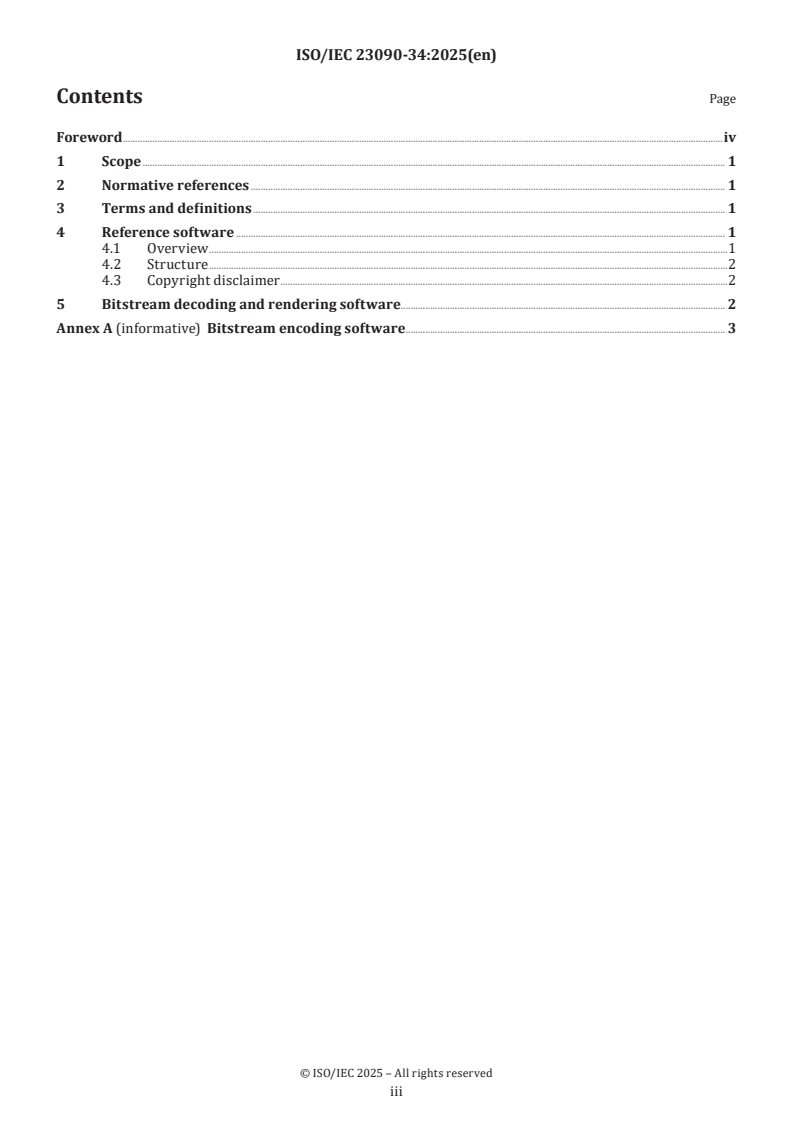
Contents Page
Foreword .iv
1 Scope . 1
2 Normative references . 1
3 Terms and definitions . 1
4 Reference software . 1
4.1 Overview .1
4.2 Structure .2
4.3 Copyright disclaimer .2
5 Bitstream decoding and rendering software. 2
Annex A (informative) Bitstream encoding software . 3
© ISO/IEC 2025 – All rights reserved
iii
Foreword
ISO (the International Organization for Standardization) and IEC (the International Electrotechnical
Commission) form the specialized system for worldwide standardization. National bodies that are
members of ISO or IEC participate in the development of International Standards through technical
committees established by the respective organization to deal with particular fields of technical activity.
ISO and IEC technical committees collaborate in fields of mutual interest. Other international organizations,
governmental and non-governmental, in liaison with ISO and IEC, also take part in the work.
The procedures used to develop this document and those intended for its further maintenance are described
in the ISO/IEC Directives, Part 1. In particular, the different approval criteria needed for the different types
of document should be noted. This document was drafted in accordance with the editorial rules of the ISO/
IEC Directives, Part 2 (see www.iso.org/directives or www.iec.ch/members_experts/refdocs).
ISO and IEC draw attention to the possibility that the implementation of this document may involve the
use of (a) patent(s). ISO and IEC take no position concerning the evidence, validity or applicability of any
claimed patent rights in respect thereof. As of the date of publication of this document, ISO and IEC had not
received notice of (a) patent(s) which may be required to implement this document. However, implementers
are cautioned that this may not represent the latest information, which may be obtained from the patent
database available at www.iso.org/patents and https://patents.iec.ch. ISO and IEC shall not be held
responsible for identifying any or all such patent rights.
Any trade name used in this document is information given for the convenience of users and does not
constitute an endorsement.
For an explanation of the voluntary nature of standards, the meaning of ISO specific terms and expressions
related to conformity assessment, as well as information about ISO's adherence to the World Trade
Organization
...