

ISO/FDIS 15686-1
(Main)Buildings and civil engineering works — Service life planning — Part 1: General principles and framework
- Abstract
This International Standard identifies and establishes Concepts, Principles and terminology for service life planning and a systematic framework for undertaking service life planning of a planned building or construction work throughout its life cycle (or remaining life cycle for existing buildings or construction works). The life cycle incorporates initiation, project definition, design, construction, commissioning, operation, maintenance, refurbishment, replacement, deconstruction and ultimate disposal, recycling or re-use of the asset (or parts thereof), including its components, systems and building services. This International Standard is applicable to the service life planning of individual buildings. A series of service life plans, developed in accordance with this International Standard, can be used as input data to the strategic property management of a number of buildings.
- Status
- Not Published
- Technical Committee
- ISO/TC 59/SC 14 - Design life
- Drafting Committee
- ISO/TC 59/SC 14 - Design life
- Current Stage
- 5020 - FDIS ballot initiated: 2 months. Proof sent to secretariat
- Start Date
- 01-Oct-2026
- Completion Date
- 01-Oct-2026
Buy Documents


ISO/FDIS 15686-1 - Buildings and civil engineering works — Service life planning — Part 1: General principles and framework
REDLINE ISO/FDIS 15686-1 - Buildings and civil engineering works — Service life planning — Part 1: General principles and framework
ISO/FDIS 15686-1 is an ISO International Standard for service life planning in buildings and civil engineering works. It sets out the general principles, terminology and framework for planning the service life of a building or other constructed asset across its life cycle, including design, construction, operation, maintenance, refurbishment, replacement and end-of-life actions. It is written for owners, designers, construction and facilities management teams, manufacturers, maintainers, auditors, clients and regulators who need to decide whether a building or component will last as intended.
What does ISO/FDIS 15686-1 specify?
ISO/FDIS 15686-1 specifies the general principles of service life planning and a systematic framework for applying them to individual buildings, civil engineering works and other constructed assets. The document also says it is applicable to individual construction products, so it supports planning at both whole-asset and component level.
The document is organized into eight clauses and two informative annexes:
| Part | What it covers |
|---|---|
| Clause 1 | Scope |
| Clause 2 | Normative references |
| Clause 3 | Terms, definitions and abbreviated terms |
| Clause 4 | Service life planning for constructed assets |
| Clause 5 | Service life prediction and estimation |
| Clause 6 | Financial and environmental costs over time |
| Clause 7 | Anticipated effects of climate change |
| Clause 8 | Obsolescence, adaptability and re-use |
| Annex A | Agents affecting service life of components |
| Annex B | Service life planning in the design process |
Clause 4 sets out the planning principles, Clause 5 covers how service life is predicted or estimated, and Clauses 6 to 8 connect service life planning to cost, climate change, obsolescence and re-use. Annex A and Annex B support the main text with supplementary guidance for environment and design process decisions.
What are the key requirements of ISO/FDIS 15686-1?
ISO/FDIS 15686-1 requires service life planning to start early, be evidence based and be tied to the intended design life of the asset. In practice, the document is about showing, with documented reasoning, that the planned service life can meet the project brief and that maintenance, replacement and end-of-life choices have been thought through.
Service life must be planned against the design life
Clause 4.3 says the key aim is to demonstrate that the service life of the proposed building or constructed asset will exceed the intended design life. If life-cycle cost or environmental limits are part of the brief, the estimated service life has to be achieved within those constraints. For a buyer or designer, this means service life is not a vague aspiration - it is something to check against project objectives.
The process starts at briefing and design concept
Clause 4.5 says service life planning should be integrated into the design process from the earliest stages, when the client brief is developed. As the design becomes more detailed, the estimated service life should also become more detailed and be compared with the required design life. In practice, this means service life considerations belong in early decisions on materials, details, maintenance access and replacement strategy, not only at handover.
Maintenance, replacement and records are part of the plan
Clause 4.3 and 4.6 require service life planning to include projected maintenance and replacement over the life cycle, and to keep records of the data sources, assumptions and uncertainty. The written report should state the basis for the estimated service life. That matters because the plan must be auditable later and usable by the people who will operate and maintain the asset.
Service life estimation must use suitable data and methods
Clause 5 explains that service life estimation draws on service life prediction, reference service lives, practical performance data and adjusted estimates for specific in-use conditions. The document refers to reference service life (RSL), estimated service life (ESL), the factor method and service life prediction (SLP). In practice, the designer has to compare the reference conditions with the actual project conditions and adjust the estimate accordingly.
Data quality and uncertainty must be considered
Clause 5.7 and 5.8 say the quality of the estimate depends on the quality of the data, the assumptions and the way uncertainty is handled. The document notes that service life cannot be predicted with precision because of variability in environment, workmanship and future maintenance. For users, that means estimates should be treated as informed planning data, not as exact guarantees.
Climate change, obsolescence and re-use are part of the assessment
Clause 7 requires the anticipated effects of climate change to be considered, including effects on longevity, resilience and maintainability. Clause 8 distinguishes obsolescence from defective performance and covers functional, technological and economic obsolescence, as well as adaptability, future use, demolition and re-use. This matters because an asset can become unsuitable before it physically wears out, and the plan should anticipate that risk.
Annexes support environmental and design review decisions
Annex A lists the main categories of agents that can affect service life, such as mechanical, thermal, chemical and biological agents. Annex B shows how service life planning fits into briefing, environmental characterization, conceptual design, detailed design, specification, site work, maintenance planning and performance acceptability. In practice, these annexes help teams check what can damage the asset and where to look for service life risks during design.
What terms does ISO/FDIS 15686-1 define?
ISO/FDIS 15686-1 defines a shared vocabulary so that project teams use the same meaning for service life planning terms.
- Service life - the period after installation during which a building, civil engineering works or other constructed asset, or part of it, meets or exceeds performance requirements.
- Design life (DL) - the service life intended by the designer and stated to support specification decisions.
- Estimated service life (ESL) - the service life expected for a building or component under specific in-use conditions, after adjusting reference service life data.
- Reference service life (RSL) - the service life of a product, component, assembly or system under reference in-use conditions that can be used as the basis for estimation.
- Service life planning - the process of preparing the brief and design so the building and its parts perform during the intended building life stages.
- Service life prediction (SLP) - the generic methodology used to predict the distribution of service life for a building or its parts in a particular environment.
- Obsolescence - inability to perform satisfactorily because performance requirements have changed.
- Stakeholder - any person or organization that can affect, be affected by, or perceive itself to be affected by a decision or activity.
Who uses ISO/FDIS 15686-1?
ISO/FDIS 15686-1 is intended mainly for people who plan, design, build, operate or assess buildings and other constructed assets. The foreword and introduction name these main user groups:
- building owners and users
- design, construction and facilities management teams
- manufacturers supplying long-term performance data
- maintainers
- value appraisers
- insurers
- technical auditors
- developers of product standards
- clients, funders and sponsors
- users of reference service life data for EPDs, LCA and LCC
- regulators
In practice, these groups use the standard to set design life targets, select components, plan maintenance and replacement, document assumptions, and support long-term cost, sustainability and risk decisions.
What changed in ISO/FDIS 15686-1 from the previous edition?
ISO/FDIS 15686-1 is described as a third edition that cancels and replaces ISO 15686-1:2011 and several other parts of the ISO 15686 series, including ISO 15686-2:2012, ISO 15686-3:2002, ISO 15686-4:2014, ISO 15686-8:2008, ISO/TS 15686-9:2008, ISO 15686-10:2010 and ISO/TR 15686-11:2014.
The foreword states two main changes:
- the relationship to the revised text in this document, ISO 15686-3 and the retained parts of the series is indicated
- processes for performance audits and reviews, reference service life and estimation, and some service life prediction processes are described here, while the detailed methodology is in ISO 15686-3
Which standards are used with ISO/FDIS 15686-1?
ISO/FDIS 15686-1 normatively references ISO 6707-1, which supplies the general vocabulary for buildings and civil engineering works. The main text and bibliography also identify companion standards that support the framework:
- ISO 15686-2 - guidance on service life prediction procedures, reference service-life data and the factor method
- ISO 15686-3 - methods, data and communication for service life planning, including performance audits and reviews
- ISO 15686-5 - life-cycle costing procedures and cost terms used in the financial analysis of service life planning
- ISO 15686-7 - performance evaluation for feedback of service life data from practice
- ISO 14040 - the life-cycle assessment framework referred to when environmental impacts are considered
- ISO 55000 - asset management vocabulary and principles referenced when discussing the asset life cycle
- ISO 6241 - cited in Annex B and Annex A notes for performance and environmental characterization context
What does the ISO/FDIS 15686-1 document contain?
ISO/FDIS 15686-1 contains a vocabulary section, a planning framework, methods for estimating and predicting service life, and guidance on cost, climate change and obsolescence. It also contains informative annexes that support practical use in design and review.
Annex A provides a categorized list of agents that can degrade components, grouped by nature such as mechanical, thermal, chemical and biological action. Annex B gives a design-process view of service life planning, including the brief, environmental characterization, conceptual design, detailed design, specification, site work, maintenance planning and acceptability checks.
The document also includes tables that illustrate topics such as types of obsolescence, suggested minimum design lives for component categories, hierarchy of safety consequences and examples of functional and economic critical properties. These tables are used to support design decisions, maintenance planning, audits and reviews without turning the standard into a single fixed recipe for every project.
Relations
- Effective Date
- 22-Oct-2022
- Effective Date
- 22-Oct-2022
- Effective Date
- 22-Oct-2022
- Effective Date
- 22-Oct-2022
- Effective Date
- 22-Oct-2022
- Effective Date
- 22-Oct-2022
- Effective Date
- 22-Oct-2022
- Effective Date
- 22-Oct-2022
Buy Documents
ISO/FDIS 15686-1 - Buildings and civil engineering works — Service life planning — Part 1: General principles and framework
REDLINE ISO/FDIS 15686-1 - Buildings and civil engineering works — Service life planning — Part 1: General principles and framework
Get Certified
Connect with accredited certification bodies for this standard

DIBt (Deutsches Institut für Bautechnik)
German Institute for Building Technology.
DIN CERTCO
DIN Group product certification.

Aboma Certification B.V.
Specialized in construction, metal, and transport sectors.
Sponsored listings
Frequently Asked Questions
ISO/FDIS 15686-1 is a draft published by the International Organization for Standardization (ISO). Its full title is "Buildings and civil engineering works — Service life planning — Part 1: General principles and framework". This standard covers: This International Standard identifies and establishes Concepts, Principles and terminology for service life planning and a systematic framework for undertaking service life planning of a planned building or construction work throughout its life cycle (or remaining life cycle for existing buildings or construction works). The life cycle incorporates initiation, project definition, design, construction, commissioning, operation, maintenance, refurbishment, replacement, deconstruction and ultimate disposal, recycling or re-use of the asset (or parts thereof), including its components, systems and building services. This International Standard is applicable to the service life planning of individual buildings. A series of service life plans, developed in accordance with this International Standard, can be used as input data to the strategic property management of a number of buildings.
This International Standard identifies and establishes Concepts, Principles and terminology for service life planning and a systematic framework for undertaking service life planning of a planned building or construction work throughout its life cycle (or remaining life cycle for existing buildings or construction works). The life cycle incorporates initiation, project definition, design, construction, commissioning, operation, maintenance, refurbishment, replacement, deconstruction and ultimate disposal, recycling or re-use of the asset (or parts thereof), including its components, systems and building services. This International Standard is applicable to the service life planning of individual buildings. A series of service life plans, developed in accordance with this International Standard, can be used as input data to the strategic property management of a number of buildings.
ISO/FDIS 15686-1 is classified under the following ICS (International Classification for Standards) categories: 91.040.01 - Buildings in general. The ICS classification helps identify the subject area and facilitates finding related standards.
ISO/FDIS 15686-1 has the following relationships with other standards: It is inter standard links to ISO 15686-2:2012, ISO 15686-10:2010, ISO 15686-3:2002, ISO/TR 15686-11:2014, ISO 15686-4:2014, ISO 15686-8:2008, ISO/TS 15686-9:2008, ISO 15686-1:2011. Understanding these relationships helps ensure you are using the most current and applicable version of the standard.
ISO/FDIS 15686-1 is available in PDF format for immediate download after purchase. The document can be added to your cart and obtained through the secure checkout process. Digital delivery ensures instant access to the complete standard document.
Standards Content (Sample)
FINAL DRAFT
International
Standard
ISO/TC 59/SC 14
Buildings and civil engineering
Secretariat: BSI
works — Service life planning —
Voting begins on:
2026-10-01
Part 1:
General principles and framework
Voting terminates on:
2026-11-26
Bâtiments et biens immobiliers construits — Prévision de la
durée de vie —
Partie 1: Principes généraux et cadre
RECIPIENTS OF THIS DRAFT ARE INVITED TO SUBMIT,
WITH THEIR COMMENTS, NOTIFICATION OF ANY
RELEVANT PATENT RIGHTS OF WHICH THEY ARE AWARE
AND TO PROVIDE SUPPOR TING DOCUMENTATION.
IN ADDITION TO THEIR EVALUATION AS
BEING ACCEPTABLE FOR INDUSTRIAL, TECHNO-
LOGICAL, COMMERCIAL AND USER PURPOSES, DRAFT
INTERNATIONAL STANDARDS MAY ON OCCASION HAVE
TO BE CONSIDERED IN THE LIGHT OF THEIR POTENTIAL
TO BECOME STAN DARDS TO WHICH REFERENCE MAY BE
MADE IN NATIONAL REGULATIONS.
Reference number
FINAL DRAFT
International
Standard
ISO/TC 59/SC 14
Buildings and civil engineering
Secretariat: BSI
works — Service life planning —
Voting begins on:
Part 1:
General principles and framework
Voting terminates on:
Bâtiments et biens immobiliers construits — Prévision de la
durée de vie —
Partie 1: Principes généraux et cadre
RECIPIENTS OF THIS DRAFT ARE INVITED TO SUBMIT,
WITH THEIR COMMENTS, NOTIFICATION OF ANY
RELEVANT PATENT RIGHTS OF WHICH THEY ARE AWARE
AND TO PROVIDE SUPPOR TING DOCUMENTATION.
© ISO 2026
IN ADDITION TO THEIR EVALUATION AS
All rights reserved. Unless otherwise specified, or required in the context of its implementation, no part of this publication may
BEING ACCEPTABLE FOR INDUSTRIAL, TECHNO-
LOGICAL, COMMERCIAL AND USER PURPOSES, DRAFT
be reproduced or utilized otherwise in any form or by any means, electronic or mechanical, including photocopying, or posting on
INTERNATIONAL STANDARDS MAY ON OCCASION HAVE
the internet or an intranet, without prior written permission. Permission can be requested from either ISO at the address below
TO BE CONSIDERED IN THE LIGHT OF THEIR POTENTIAL
or ISO’s member body in the country of the requester.
TO BECOME STAN DARDS TO WHICH REFERENCE MAY BE
MADE IN NATIONAL REGULATIONS.
ISO copyright office
CP 401 • Ch. de Blandonnet 8
CH-1214 Vernier, Geneva
Phone: +41 22 749 01 11
Email: copyright@iso.org
Website: www.iso.org
Published in Switzerland Reference number
ii
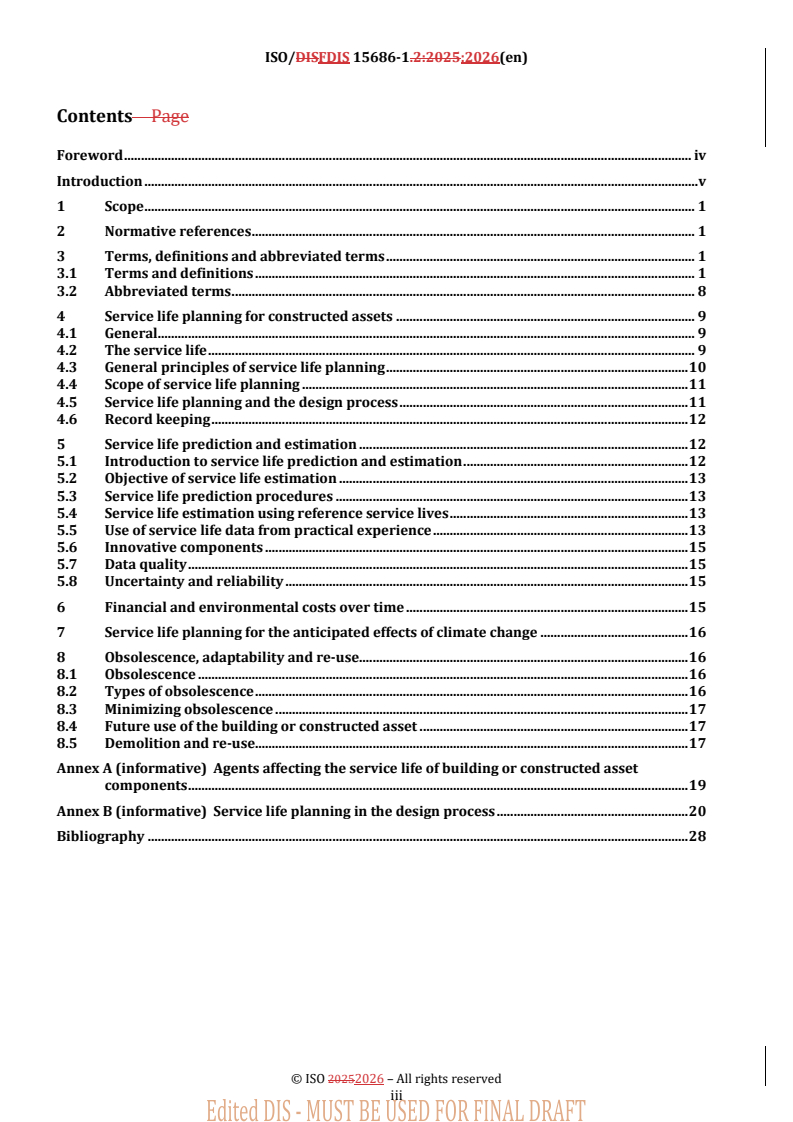
Contents Page
Foreword .iv
Introduction .v
1 Scope . 1
2 Normative references . 1
3 Terms, definitions and abbreviated terms . 1
3.1 Terms and definitions .1
3.2 Abbreviated terms .7
4 Service life planning for constructed assets . 7
4.1 General .7
4.2 The service life.7
4.3 General principles of service life planning .8
4.4 Scope of service life planning .9
4.5 Service life planning and the design process .9
4.6 Record keeping .10
5 Service life prediction and estimation .10
5.1 Introduction to service life prediction and estimation .10
5.2 Objective of service life estimation .10
5.3 Service life prediction procedures .11
5.4 Service life estimation using reference service lives .11
5.5 Use of service life data from practical experience .11
5.6 Innovative components .11
5.7 Data quality . 12
5.8 Uncertainty and reliability . 12
6 Financial and environmental costs over time .12
7 Service life planning for the anticipated effects of climate change.13
8 Obsolescence, adaptability and re-use .13
8.1 Obsolescence . 13
8.2 Types of obsolescence . 13
8.3 Minimizing obsolescence .14
8.4 Future use of the building or constructed asset . .14
8.5 Demolition and re-use .14
Annex A (informative) Agents affecting the service life of building or constructed asset
components .15
Annex B (informative) Service life planning in the design process .16
Bibliography .23
iii
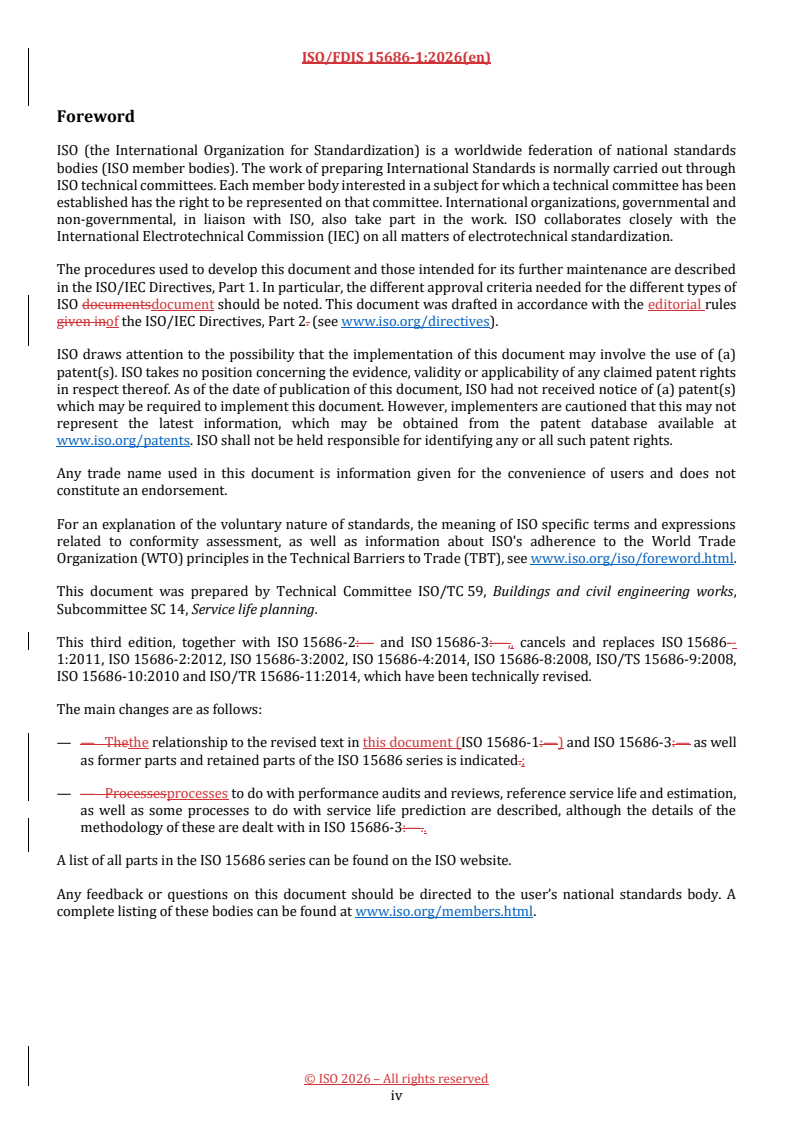
Foreword
ISO (the International Organization for Standardization) is a worldwide federation of national standards
bodies (ISO member bodies). The work of preparing International Standards is normally carried out through
ISO technical committees. Each member body interested in a subject for which a technical committee
has been established has the right to be represented on that committee. International organizations,
governmental and non-governmental, in liaison with ISO, also take part in the work. ISO collaborates closely
with the International Electrotechnical Commission (IEC) on all matters of electrotechnical standardization.
The procedures used to develop this document and those intended for its further maintenance are described
in the ISO/IEC Directives, Part 1. In particular, the different approval criteria needed for the different types
of ISO document should be noted. This document was drafted in accordance with the editorial rules of the
ISO/IEC Directives, Part 2 (see www.iso.org/directives).
ISO draws attention to the possibility that the implementation of this document may involve the use of (a)
patent(s). ISO takes no position concerning the evidence, validity or applicability of any claimed patent
rights in respect thereof. As of the date of publication of this document, ISO had not received notice of (a)
patent(s) which may be required to implement this document. However, implementers are cautioned that
this may not represent the latest information, which may be obtained from the patent database available at
www.iso.org/patents. ISO shall not be held responsible for identifying any or all such patent rights.
Any trade name used in this document is information given for the convenience of users and does not
constitute an endorsement.
For an explanation of the voluntary nature of standards, the meaning of ISO specific terms and expressions
related to conformity assessment, as well as information about ISO's adherence to the World Trade
Organization (WTO) principles in the Technical Barriers to Trade (TBT), see www.iso.org/iso/foreword.html.
This document was prepared by Technical Committee ISO/TC 59, Buildings and civil engineering works,
Subcommittee SC 14, Service life planning.
This third edition, together with ISO 15686-2 and ISO 15686-3, cancels and replaces ISO 15686-1:2011,
ISO 15686-2:2012, ISO 15686-3:2002, ISO 15686-4:2014, ISO 15686-8:2008, ISO/TS 15686-9:2008,
ISO 15686-10:2010 and ISO/TR 15686-11:2014, which have been technically revised.
The main changes are as follows:
— the relationship to the revised text in this document (ISO 15686-1) and ISO 15686-3 as well as former
parts and retained parts of the ISO 15686 series is indicated;
— processes to do with performance audits and reviews, reference service life and estimation, as well as
some processes to do with service life prediction are described, although the details of the methodology
of these are dealt with in ISO 15686-3.
A list of all parts in the ISO 15686 series can be found on the ISO website.
Any feedback or questions on this document should be directed to the user’s national standards body. A
complete listing of these bodies can be found at www.iso.org/members.html.
iv
Introduction
0.1 Service life planning
Service life planning is a design process that seeks to ensure that the service life of a building, civil
engineering works, or other constructed asset will equal or exceed its design life. If required, service
life planning can take into account the life-cycle cost(s) of the building or constructed asset and its life-
cycle environmental impact(s). Service life planning provides a means of comparing different buildings
constructed asset options. During the project delivery phase, to ensure that the design meets the functional
requirement levels, consideration of different conceptual design solutions can be used to assess the impact
of design changes on the design life.
This document is intended primarily, but not exclusively, for the following user groups, who are also the
primary actors in the processes described:
a) building owners and users;
b) design, construction and facilities management teams;
c) manufacturers who provide data on long-term performance of buildings or constructed asset products;
d) maintainers of buildings or constructed assets;
e) value appraisers of buildings or constructed assets;
f) insurers of buildings or constructed assets;
g) technical auditors of buildings or constructed assets;
h) developers of buildings or constructed asset product standards;
i) clients, funders, and sponsors of buildings or constructed assets;
j) users of reference service life data as inputs to assessments of sustainability such as environmental
product declarations (EPDs), life-cycle assessment (LCA) or life-cycle costing (LCC);
k) regulators of any group listed above.
By requiring an estimate or prediction of how long each component of a building, or other constructed asset,
will last, service life planning aids the making of decisions concerning specifications and design detailing.
Also, when the service life of the building, or other constructed asset, and its components are estimated or
predicted, life-cycle cost and maintenance planning as well as value engineering techniques can be applied,
thereby increasing the reliability and flexibility of use of the building or other constructed asset, and as well,
reducing the likelihood of early obsolescence.
Figure 1 indicates how the parts of the ISO 15686 series relate to each other and their associated topics.
v
Figure 1 — Relationships between the parts of the ISO 15686 series and the service life planning of
buildings or constructed assets
0.2 Structure of the ISO 15686 series
This document specifies the general principles of service life planning of a building or other constructed
asset and presents a framework for undertaking service life planning. These general principles can also be
used to make decisions on maintenance and replacement requirements. This document serves as a guide to
other parts, including general principles to be applied. Together, they provide requirements and guidance on
the estimation or prediction of the building, or constructed asset, component service life, that contribute to
the service life of the building, or other constructed asset.
ISO 15686-2 provides guidance on use of service life predictions or reference service-life data and on the
application of these data for the purposes of calculating estimated service life using the factor method. It
does not give guidance on how to estimate the modification part or the values of factors A to G, using given
reference in-use conditions and the object-specific in-use conditions. The reliability of the predicted or
estimated service life will depend on the evidence it was based upon (see NOTE in this subclause).
ISO 15686-2 provides the means to establish when to specify or verify functional performance requirements
during the service life of buildings and civil engineering works, as well as when to check the capability of
buildings or constructed assets to meet identified requirements.
NOTE Service life predictions can be based on evidence from previous use, on comparisons with the known
service life of similar components, on tests of degradation in specific conditions or on a combination of these. These
predictions form the basis of Reference Service Lives, and therefore of estimates of service life also.
ISO 15686-2 is applicable to:
— any holdings, whether a set (or portfolio), a single building or constructed asset (large or small) or a
facility which is part of a building or constructed asset (such as one group of spaces, one floor or several
floors) or part of a network forming a civil engineering structure;
— the range of roles of stakeholders, from the owners and managers to the occupants, tenants or other
users.
ISO 15686-2 does not:
— describe specific test methods;
— cover limitation of service life due to obsolescence caused by changing performance requirements;
— consider other non-measurable or unpredictable performance states.
vi
In ISO 15686-3, information and guidance is provided on the methods, data and communication of service
life planning of facilities and constructed assets and their components as well as the required supporting
data.
The main audience is product, facility and information managers.
In ISO 15686-3, the structure and representation of service life data is specified. It is focused on key exchange
requirements underlying four common transactions.
This document may be used for a variety of purposes, including to:
a) achieve and maintain a common understanding within the national and project contexts;
b) establish the desired outcomes and to define appropriate quality;
c) identify appropriate management effort and tools;
d) identify necessary effort and resourcing.
In ISO 15686-5, procedures are specified for performing life-cycle cost (LCC) analyses of buildings or
constructed assets and their parts. These assessments take into account cost or cash flows, i.e., relevant
costs (and income and externalities if included in the agreed scope) arising from acquisition through
operation to disposal. This assessment typically includes a comparison between options or an estimate of
future costs at portfolio, project or component level. The assessment is over an agreed period of analysis,
which can be a time frame that is less than the full life cycle of the constructed asset.
ISO 15686-7 provides a generic basis for performance evaluation for feedback of service life data from
existing buildings or constructed assets, including a definition of the terms to be used and the description of
how the (technical) performance can be described and documented to ensure consistency.
0.3 Purpose of the ISO 15686 series
The ISO 15686 series is relevant to service life planning of new and existing buildings or constructed assets.
In existing buildings or constructed assets, service life planning applies principally to the estimation of
residual service lives of components that are already in service, and to the selection of components for, and
the detailing of, repairs and new work.
Annexes A and B provide supplementary information and illustrate the use of methods specified in this
document. Differences in climatic conditions and construction techniques in different parts of the world
require separate aspects of service life planning to be developed for specific circumstances, and to take
account of locality and microclimate.
NOTE 1 The approach to service life planning presented in the ISO 15686 series is based on documents published
by CIB and RILEM, standards published in the UK, Japan, Canada and the USA, and on practical studies carried out in
many countries.
NOTE 2 In the European Community, the Construction Products Directive includes a requirement that the “essential
requirements” of construction products be retained for an “economically reasonable working life”, if necessary, by
maintenance.
vii
FINAL DRAFT International Standard ISO/FDIS 15686-1:2026(en)
Buildings and civil engineering works — Service life
planning —
Part 1:
General principles and framework
1 Scope
This document identifies and establishes general principles for service life planning and a systematic
framework for undertaking service life planning of building, civil engineering works, or other constructed
assets, throughout their life cycle (or remaining life cycle).
This document is applicable to the service life planning of individual construction products.
2 Normative references
The following documents are referred to in the text in such a way that some or all of their content constitutes
requirements of this document. For dated references, only the edition cited applies. For undated references,
the latest edition of the referenced document (including any amendments) applies.
ISO 6707-1, Buildings and civil engineering works — Vocabulary — Part 1: General terms
3 Terms, definitions and abbreviated terms
For the purposes of this document, the terms and definitions given in ISO 6707-1 and the following apply.
ISO and IEC maintain terminology databases for use in standardization at the following addresses:
— ISO Online browsing platform: available at https:// www .iso .org/ obp
— IEC Electropedia: available at https:// www .electropedia .org/
3.1 Terms and definitions
3.1.1
agent
whatever acts on a building (3.1.3) or constructed asset (3.1.6) or its parts to adversely affect its performance
(3.1.34)
EXAMPLE Person, water load, heat.
3.1.2
asset
whole building (3.1.3) or structure or unit of construction works, or a system or a component or part thereof
[SOURCE: ISO 15686-5:2017, 3.4.1]
3.1.3
building
construction works that has the provision of shelter for its occupants or contents as one of its main purposes
and is usually enclosed and designed to stand permanently in one place
3.1.4
client
person or organization initiating and financing a project and approving the brief
[SOURCE: ISO 6707-2:2017, 3.8.2]
3.1.5
commissioning
systematic process of functional performance (3.1.21) testing, verification, documentation and training
intended to ensure that the building (3.1.3) and its systems operate in accordance with the defined objectives
and criteria of the project
Note 1 to entry: Commissioning is an integral part of the design and construction process and is also intended to be
undertaken throughout the service life (3.1.44).
[SOURCE: ISO 15686-7:2017, 3.1]
3.1.6
constructed asset
built asset
anything of value that is constructed or results from construction operations
[SOURCE: ISO 41011:2024, 3.2.4]
3.1.7
degradation
process whereby an action on an item causes a deterioration of one or more properties
Note 1 to entry: Properties affected can be, for example, physical, mechanical or electrical.
3.1.8
demand
requirement for functional performance (3.1.21)
3.1.9
design life
DL
DEPRECATED: intended service life
DEPRECATED: expected service life
service life (3.1.44) intended by the designer
Note 1 to entry: As stated by the designer to the client (3.1.4) to support specification decisions.
3.1.10
detailed design
drawings, data, calculations and specifications from which constructed works, components and assemblies
can be constructed
3.1.11
disposal
transfer of ownership of, or responsibility for, the object of consideration
[SOURCE: ISO 15686-5:2017, 3.4.3]
3.1.12
disposal
transformation of the state of a building (3.1.3) or facility (3.1.17) that is no longer of use
Note 1 to entry: Transformation can include, either individually or in some combination, the decommissioning,
deconstruction, recycling and demolition of the object of consideration.
[SOURCE: ISO 15686-5:2017, 3.4.2]
3.1.13
environmental aspect
element of an organization’s activities or products or services that can interact with the environment
[SOURCE: ISO 14001:2026, 3.2.2]
3.1.14
environmental impact
change to the environment, whether adverse or beneficial, wholly or partially resulting from an
organization’s environmental aspects (3.1.13)
[SOURCE: ISO 14001:2026, 3.2.4]
3.1.15
estimated service life
ESL
service life (3.1.44) that a building (3.1.3) or parts of a building or other construction works would be
expected to have in a set of specific in-use conditions (3.1.25), determined from reference service life (3.1.38)
data after taking into account any differences from the reference in-use conditions (3.1.37)
3.1.16
externality
quantifiable cost or benefit that occurs when the actions of organizations and individuals have an effect on
people other than themselves
EXAMPLE Non-construction costs, income and wider social and business costs.
Note 1 to entry: Externalities are positive if their effects are benefits to other people and negative, or external costs,
if the external effects are costs on other people. There may be external costs and benefits from both production and
consumption. Adding the externality to the private cost/benefit gives the total social cost or benefit.
[SOURCE: ISO 15686-5:2017, 3.4.4]
3.1.17
facility
physical setting used to serve a specific purpose
Note 1 to entry: A facility may be part of a building (3.1.3) a whole building or more than one building, and may include
related constructions (such as roads and walkways), which, taken as a whole, serve a specific function (3.1.20).
Note 2 to entry: The term encompasses both the physical object(s) and its (their) use.
3.1.18
factor method
modification of the reference service life (3.1.38) by several factors, to take into account the specific in-use
conditions (3.1.25)
3.1.19
failure
loss of the ability of a building (3.1.3) or its parts to perform a specific function (3.1.20)
3.1.20
function
purpose or activity of users (3.1.52) and other stakeholders (3.1.48) for which an asset (3.1.2) or a facility
(3.1.17) is designed, used or required to be used
[SOURCE: ISO 11863:2011, 3.12]
3.1.21
functional performance
performance (3.1.34) to support required function(s) (3.1.20) under specified use conditions
3.1.22
functional performance requirement
type and level of functionality (3.1.23) that is required by stakeholders (3.1.48) of a facility (3.1.17), building
(3.1.3) or other constructed asset (3.1.6), or of an assembly, component or product thereof, or a moveable
asset (3.1.2) for a specific activity or function (3.1.20)
[SOURCE: ISO 11863:2011, 3.14]
3.1.23
functionality
suitability or usefulness for a specific purpose, activity or need
[SOURCE: ISO 6707-3:2022, 3.6.4]
3.1.24
initial design
early stage in the development of a design before many of the materials, components or assemblies have
been selected
3.1.25
in-use condition
any circumstance that can impact the performance (3.1.34) under normal use
[SOURCE: ISO 6707-4:2021, 3.8.2]
3.1.26
life cycle
consecutive and interlinked stages of the object under consideration
Note 1 to entry: The life cycle comprises all stages from construction, operation and maintenance to end of life,
including decommissioning, deconstruction and disposal (3.1.12).
[SOURCE: ISO 15686-5:2017, 3.3.4]
3.1.27
life-cycle assessment
LCA
compilation and assessment of the inputs, outputs and the potential environmental impacts (3.1.14) of a
product system throughout its life cycle (3.1.26)
[SOURCE: ISO 14050:2020, 3.6.2]
3.1.28
life-cycle cost
LCC
cost of an asset (3.1.2) or its parts throughout its life cycle (3.1.26), while fulfilling the performance (3.1.34)
requirements
[SOURCE: ISO 15686-5:2017, 3.1.7]
3.1.29
life-cycle costing
methodology for systematic economic evaluation of life-cycle costs (3.1.28) over a period of analysis, as
defined in the agreed scope
[SOURCE: ISO 15686-5:2017, 3.1.8, modified — Note 1 to entry has been removed.]
3.1.30
maintenance cost
total cost of necessarily incurred labour, material and other related costs incurred to retain construction
works or its parts in a state in which it can perform its required function (3.1.20)
[SOURCE: ISO 6707-3:2022, 3.8.6]
3.1.31
observation
statement of fact made during an audit or review and substantiated by objective evidence
3.1.32
obsolescence
inability of an item to perform satisfactorily due to changes in performance (3.1.34) requirements
3.1.33
operation and maintenance cost
cost incurred in running and managing the facility (3.1.17) plus labour, material and other related costs
incurred to retain a building (3.1.3) or its parts in a state in which it can perform its required function (3.1.20)
3.1.34
performance
behaviour in service (3.1.9) of a facility (3.1.17) for a specified use
Note 1 to entry: The scope of this performance is of the facility as a system, including its subsystems, components and
materials (ISO 6707-1:2020, 3.4.1.1) , and their interactions, such as acoustical, hygrothermal, economic and so on, as
well as the relative importance of each performance requirement.
3.1.35
performance evaluation
evaluation of critical properties on the basis of measurement and inspection
3.1.36
period of analysis
period of time over which life-cycle costs (3.1.28) are analysed
Note 1 to entry: The period of analysis is determined by the client (3.1.4).
[SOURCE: ISO 15686-5:2017, 3.3.6, modified — "life-cycle costs or whole-life costs" has been replaced by
"life-cycle costs".]
3.1.37
reference in-use condition
in-use condition (3.1.25) under which the reference service life (3.1.38) data are valid
Note 1 to entry: The reference in-use conditions can be based upon information gathered through testing or from
recorded performance (3.1.34) and actual service life (3.1.44) data of a component.
3.1.38
reference service life
RSL
service life (3.1.44) of a product, component, assembly or system which is known to be expected under a
set of reference in-use conditions (3.1.37) and which can form the basis for estimating the service life under
other in-use conditions
3.1.39
refurbishment
modification and improvements to an existing item to bring it up to an acceptable condition
[SOURCE: ISO 15686-7:2017, 3.9]
3.1.40
reliability
probability that a component, assembly or system will perform its intended function (3.1.20) under stated
conditions for a stated period of time
3.1.41
replacement
change of parts of an existing item to regain its functionality (3.1.23)
[SOURCE: ISO 15686-7:2017, 3.12]
3.1.42
residual value
value assigned to an asset (3.1.2) at the end of the period of analysis
[SOURCE: ISO 15686-5:2017, 3.3.8]
3.1.43
risk
probability of an event multiplied by its consequences
Note 1 to entry: Examples of an event are failure (3.1.19) and damage.
Note 2 to entry: Examples of consequences are cost, fatalities and exposure to personal or environmental hazard.
[SOURCE: ISO 15686-5:2017, 3.4.6]
3.1.44
service life
period of time after installation during which a building (3.1.3), civil engineering works, or other constructed
asset (3.1.6) or its parts meet or exceed the performance (3.1.34) requirements
3.1.45
service life planning
process of preparing the brief and the design for the building (3.1.3) and its parts to perform during building
life stages as intended
[SOURCE: ISO 6707-3:2022, 3.8.12, modified — Note 1 to entry has been deleted.]
3.1.46
service life prediction
SLP
generic methodology which, for a particular or any appropriate performance (3.1.34) requirement, facilitates
a prediction of the service life (3.1.44) distribution of a building (3.1.3) or its parts for the use in a particular
or in any appropriate environment (3.1.30)
3.1.47
short-term exposure
ageing exposure with a duration considerably shorter than the service life (3.1.44) anticipated
Note 1 to entry: A term sometimes used and related to this type of exposure programme is ‘predictive service life
test’. A predictive service life test is a combination of a specifically designed short-term exposure and a performance
(3.1.34) evaluation procedure.
3.1.48
stakeholder
person or organization that can affect, be affected by, or perceive itself to be affected by a decision or activity
[SOURCE: ISO 55000:2024, 3.3.2, modified — The admitted term "interested party" has been removed.]
3.1.49
sustainability
state of the global system, including environmental, social and economic aspects, in which the needs of the
present are met without compromising the ability of future generations to meet their own needs
Note 1 to entry: to entry. The environmental, social and economic aspects interact, are interdependent and area often
referred to as the three dimensions of sustainability.
Note 2 to entry: Sustainability is the goal of sustainable development (3.1.50).
[SOURCE: ISO 15686-5: 2017, 3.4.7]
3.1.50
sustainable development
development that meets the environmental, social and economic needs of the present without compromising
the ability of future generations to meet their own needs
Note 1 to entry: Derived from the Brundtland Report.
[SOURCE: ISO 15686-5: 2017, 3.4.8]
3.1.51
uncertainty
lack of certain, deterministic values for the variable inputs used in a life-cycle cost (3.1.28) analysis of an
asset (3.1.2)
[SOURCE: ISO 15686-5:2017, 3.4.10]
3.1.52
user
organization, person, animal or object for which a building (3.1.3) or other construction works is designed
Note 1 to entry: This includes any person or entity who uses a facility (3.1.17), whether as occupant, visitor, member of
the public, or other stakeholder (3.1.48) with interest in the facility.
[SOURCE: ISO 6707-1:2020, 3.6.1, modified — Note 1 to entry was added.]
3.2 Abbreviated terms
DL design life
ESL estimated service life
FMEA failure mode and effect analysis
LCA life-cycle assessment
LCC life-cycle cost
RSL reference service life
SLP service life prediction
4 Service life planning for constructed assets
4.1 General
Clause 4 provides the objectives of service-life planning for constructed assets and presents issues that
should be considered in planning to ensure the adequacy of the service life of the building or constructed
asset or constructed asset.
4.2 The service life
In general, the critical area of focus within the ISO 15686 series is determining the service life of the
constructed asset. Different contexts use different terminology (see Figure 2) but the beginning and end of
the asset’s system boundary are, respectively, the identification of the need for an asset and, the decision
to dispose of, or replace, an asset. Service lives can be considered at different levels, including that of the
subsidiary parts of a constructed asset or civil engineering works, however, service life is often considered
in association with a construction project.
Two contrasting concepts of the service life can arise when scoping the service life planning process, as
exemplified in ISO 55000 on asset management (which focusses on the lifespan of the asset) and in many
design guides, that focus on the project delivery stage.
It should be noted that the asset can continue to exist and to perform a useful function at the end of the
original design life, rather than becoming part of a waste stream. In such cases, the service life should
be fully reviewed where the context for the use of the asset has changed such that the next stage of the
asset’s existence can be properly planned. Additionally, the service life of a subsidiary asset can trigger a
maintenance intervention or replacement in an assembly of assets (often termed a system or element).
When reviewing the service life, the reviewer should undertake a proportionate review of the evidence for
the level of criticality and sensitivity, or risk, that failures represent (principle of proportionality).
A fully comprehensive review of service life may rarely be justified because of the expense and time required
and it is therefore critical to identify the most important items based upon their proportional impact.
Reviewers shall consider the following aspects to determine the scope of any review of service life.
— A comprehensive service life review examines the evidence for service life performance for every system
or component in a building or constructed asset, even for minor components used in only one or two
places and for components that are known to be exceptionally long lasting.
— By careful targeting of the detailed design and implementation reviews on critical and sensitive items
(that is, on those components, assemblies and systems where deterioration presents the greatest threats
to the service life performance of the asset), it should be possible to ensure that the design conforms
broadly with the design life brief and that major problems caused by deterioration are avoided.
— One method of identifying the most critical components, covering each element of the constructed asset
in turn, is described in Annex B. However, it may be more relevant to select components that are subject
to specific environmental conditions or whose failure would have disastrous consequences.
Figure 2 — Different terms used for stages of the asset life cycle
4.3 General principles of service life planning
The key principle of service life planning is to demonstrate that the service life of a proposed building or
constructed asset are to exceed the intended design life. The following principles should guide the process.
— The service life plan should provide sufficient evidence to give reasonable assurance that the estimated
service life of a new constructed asset on a specific site, operated as specified in the design brief and with
appropriate maintenance and replacement, will be at least as long as the intended design life.
— Where the design brief places limits on the acceptable life-cycle cost or environmental impacts of the
constructed asset, the estimated service life shall be achieved within the specified constraints.
— The service life of a constructed asset is determined using available knowledge about the service life of
each component that is to be used in the constructed asset. Service life planning is a process of estimation
and/or prediction of future events, and therefore complete accuracy cannot be expected.
— If the estimated service life of any component is less than the design life of the constructed asset, a
decision should be made as to how the essential functions are to be adequately maintained over the life
of the constructed asset (e.g. by replacement or other maintenance).
— Service life planning should include projections of the needs for, and timing of, maintenance and
replacement activities over the life cycle of the constructed asset. The projections will be based on data
that should be assessed for robustness and reliability, and records of the data sources should be kept.
— For constructed assets that are designed to have very long design lives (e.g. important State buildings),
ease of maintenance is likely to determine the service life. If the service life of an essential component is
less than the design life of the constructed asset, it should be possible to replace, repair or maintain the
component.
NOTE 1 Service life planning provides input to the assessment of life-cycle cost and environmental impact of
the constructed asset over its life cycle. LCC methodology is specified in ISO 15686-5; assessment of environmental
impacts is specified in ISO 15686-2; and life-cycle assessment is the subject of ISO 14040.
NOTE 2 Service life planning facilitates the making of decisions regarding value engineering, cost planning,
maintenance planning and replacement cycles.
NOTE 3 Replaceable components include windows, boilers, and air-conditioning units.
4.4 Scope of service life planning
Service life planning should consider the following:
a) likely performance of the components of the building or constructed asset over the life cycle in the
expected external environment and conditions of occupancy and use;
b) expected external environment in proximity to the building or constructed asset over its life cycle and
takes into consideration the anticipated effects of climate change for the given location of interest;
c) construction of the whole building or constructed asset, installation of components and the maintenance
and replacement of short-life components;
d) need for repairs, replacements, dismantling, removal, re-use and disposal, and the costs of each;
e) life-cycle cost and environmental impact of the building or constructed asset over its life cycle;
f) other operation and maintenance costs.
NOTE 1 For most clients, service life planning is used to help achieve an advantageous combination of capital,
maintenance, and operating costs over the life of the constructed asset.
NOTE 2 Obsolescence inevitably results in waste, since the entire constructed asset, or parts that are still
functional, will be replaced, see Clause 8. A secondary objective of service life planning is to reduce the likelihood of
obsolescence and/or to maximize the re-use value of the obsolete asset or components.
NOTE 3 If the principles of this document are applied to existing constructed assets and components, many of the
choices will have been pre-determined, since the constructed asset will already be some way through its service life.
Therefore, service life planning would normally be focused on assessing the residual service lives of components and
programming of replacements so as to minimize costs.
4.5 Service life planning and the design process
Service life planning should be integrated into the design process, since most design decisions will affect
the service life. Service life shall be considered from the earliest stages of design, when the client brief is
being developed. As the design develops in more detail, the service life shall be estimated in more detail and
compared with the required design life identified in the client’s brief, to ensure that the predicted service
life is adequate. An overview of how service life planning is dealt with throughout the design process is
included in Annex B.
Service life planning usually requires iterations of the design process to identify the preferred way of
meeting the performance and maintenance requirements at an acceptable cost.
Service life planning requires access to relevant performance data on components at appropriate stages of
the design process. The generation and provision of this data are the subject of other parts of the ISO 15686
series, as shown in Figure 1.
The final stage of service life planning is the communication of results to parties who will occupy and
maintain the building or constructed asset so that they are aware of assumptions made a
...
ISO/DISFDIS 15686-1.2:2025(en)
ISO/TC 59/SC 14
Secretariat: BSI
Date: 2025-11-052026-09-15
Buildings and civil engineering works — Service life planning —
Part 1:
General principles and framework—
Part 1:
General principles and framework
Bâtiments et biens immobiliers construits — Prévision de la durée de vie —
Partie 1: Principes généraux et cadre
FDIS stage
All rights reserved. Unless otherwise specified, or required in the context of its implementation, no part of this publication
may be reproduced or utilized otherwise in any form or by any means, electronic or mechanical, including photocopying,
or posting on the internet or an intranet, without prior written permission. Permission can be requested from either ISO
at the address below or ISO'sISO’s member body in the country of the requester.
ISO Copyright Officecopyright office
CP 401 • Ch. de Blandonnet 8
CH-1214 Vernier, Geneva
Phone: + 41 22 749 01 11
Email: E-mail: copyright@iso.org
Website: www.iso.org
Published in Switzerland.
ii
ISO/DISFDIS 15686-1.2:2025:2026(en)
Contents Page
Foreword . iv
Introduction . v
1 Scope . 1
2 Normative references . 1
3 Terms, definitions and abbreviated terms . 1
3.1 Terms and definitions . 1
3.2 Abbreviated terms . 8
4 Service life planning for constructed assets . 9
4.1 General. 9
4.2 The service life . 9
4.3 General principles of service life planning . 10
4.4 Scope of service life planning . 11
4.5 Service life planning and the design process . 11
4.6 Record keeping . 12
5 Service life prediction and estimation . 12
5.1 Introduction to service life prediction and estimation . 12
5.2 Objective of service life estimation . 13
5.3 Service life prediction procedures . 13
5.4 Service life estimation using reference service lives . 13
5.5 Use of service life data from practical experience . 13
5.6 Innovative components . 15
5.7 Data quality . 15
5.8 Uncertainty and reliability . 15
6 Financial and environmental costs over time . 15
7 Service life planning for the anticipated effects of climate change . 16
8 Obsolescence, adaptability and re-use . 16
8.1 Obsolescence . 16
8.2 Types of obsolescence . 16
8.3 Minimizing obsolescence . 17
8.4 Future use of the building or constructed asset . 17
8.5 Demolition and re-use. 17
Annex A (informative) Agents affecting the service life of building or constructed asset
components . 19
Annex B (informative) Service life planning in the design process . 20
Bibliography . 28
iii
Foreword
ISO (the International Organization for Standardization) is a worldwide federation of national standards
bodies (ISO member bodies). The work of preparing International Standards is normally carried out through
ISO technical committees. Each member body interested in a subject for which a technical committee has been
established has the right to be represented on that committee. International organizations, governmental and
non-governmental, in liaison with ISO, also take part in the work. ISO collaborates closely with the
International Electrotechnical Commission (IEC) on all matters of electrotechnical standardization.
The procedures used to develop this document and those intended for its further maintenance are described
in the ISO/IEC Directives, Part 1. In particular, the different approval criteria needed for the different types of
ISO documentsdocument should be noted. This document was drafted in accordance with the editorial rules
given inof the ISO/IEC Directives, Part 2. (see www.iso.org/directives).
ISO draws attention to the possibility that the implementation of this document may involve the use of (a)
patent(s). ISO takes no position concerning the evidence, validity or applicability of any claimed patent rights
in respect thereof. As of the date of publication of this document, ISO had not received notice of (a) patent(s)
which may be required to implement this document. However, implementers are cautioned that this may not
represent the latest information, which may be obtained from the patent database available at
www.iso.org/patents. ISO shall not be held responsible for identifying any or all such patent rights.
Any trade name used in this document is information given for the convenience of users and does not
constitute an endorsement.
For an explanation of the voluntary nature of standards, the meaning of ISO specific terms and expressions
related to conformity assessment, as well as information about ISO's adherence to the World Trade
Organization (WTO) principles in the Technical Barriers to Trade (TBT), see www.iso.org/iso/foreword.html.
This document was prepared by Technical Committee ISO/TC 59, Buildings and civil engineering works,
Subcommittee SC 14, Service life planning.
This third edition, together with ISO 15686-2:— and ISO 15686-3:—,, cancels and replaces ISO 15686--
1:2011, ISO 15686-2:2012, ISO 15686-3:2002, ISO 15686-4:2014, ISO 15686-8:2008, ISO/TS 15686-9:2008,
ISO 15686-10:2010 and ISO/TR 15686-11:2014, which have been technically revised.
The main changes are as follows:
— — Thethe relationship to the revised text in this document (ISO 15686-1:—) and ISO 15686-3:— as well
as former parts and retained parts of the ISO 15686 series is indicated.;
— — Processesprocesses to do with performance audits and reviews, reference service life and estimation,
as well as some processes to do with service life prediction are described, although the details of the
methodology of these are dealt with in ISO 15686-3:—.
A list of all parts in the ISO 15686 series can be found on the ISO website.
Any feedback or questions on this document should be directed to the user’s national standards body. A
complete listing of these bodies can be found at www.iso.org/members.html.
iv
ISO/DISFDIS 15686-1.2:2025:2026(en)
Introduction
0.1 0.1 Service life planning
Service life planning is a design process that seeks to ensure that the service life of a building, civil engineering
works, or other constructed asset will equal or exceed its design life. If required, service life planning can take
into account the life-cycle cost(s) of the building or constructed asset and its life-cycle environmental
impact(s). Service life planning provides a means of comparing different buildings constructed asset options.
During the project delivery phase, to ensure that the design meets the functional requirement levels,
consideration of different conceptual design solutions can be used to assess the impact of design changes on
the design life.
This document is intended primarily, but not exclusively, for the following user groups, who are also the
primary actors in the processes described:
a) a) building owners and users;
b) b) design, construction and facilities management teams;
c) c) manufacturers who provide data on long-term performance of buildings or constructed asset
products;
d) d) maintainers of buildings or constructed assets;
e) e) value appraisers of buildings or constructed assets;
f) f) insurers of buildings or constructed assets;
g) g) technical auditors of buildings or constructed assets;
h) h) developers of buildings or constructed asset product standards;
i) i) clients, funders, and sponsors of buildings or constructed assets;
j) j) users of reference service life data as inputs to assessments of sustainability such as
environmental product declarations (EPDs), life-cycle assessment (LCA) or life-cycle costing (LCC);
k) k) regulators of any group listed above.
By requiring an estimate or prediction of how long each component of a building, or other constructed asset,
will last, service life planning aids the making of decisions concerning specifications and design detailing. Also,
when the service life of the building, or other constructed asset, and its components are estimated or
predicted, life-cycle cost and maintenance planning as well as value engineering techniques can be applied,
thereby increasing the reliability and flexibility of use of the building or other constructed asset, and as well,
reducing the likelihood of early obsolescence.
Figure 1 Figure 1 indicates how the parts of the ISO 15686 series relate to each other and their associated
topics.
v
Figure 1 — Relationships between the parts of the ISO 15686 series and the service life planning of
buildings or constructed assets
0.2 0.2 Structure of the ISO 15686 series
This document specifies the general principles of service life planning of a building or other constructed asset
and presents a framework for undertaking service life planning. These general principles can also be used to
vi
ISO/DISFDIS 15686-1.2:2025:2026(en)
make decisions on maintenance and replacement requirements. This document serves as a guide to other
parts, including general principles to be applied. Together, they provide requirements and guidance on the
estimation or prediction of the building, or constructed asset, component service life, that contribute to the
service life of the building, or other constructed asset.
ISO 15686-2 provides guidance on use of service life predictions or reference service-life data and on the
application of these data for the purposes of calculating estimated service life using the factor method. It does
not give guidance on how to estimate the modification part or the values of factors A to G, using given reference
in-use conditions and the object-specific in-use conditions. The reliability of the predicted or estimated service
life will depend on the evidence it was based upon (see NOTE belowin this subclause).
ISO 15686-2 provides the means to establish when to specify or verify functional performance requirements
during the service life of buildings and civil engineering works, as well as when to check the capability of
buildings or constructed assets to meet identified requirements.
NOTE Service life predictions can be based on evidence from previous use, on comparisons with the known service
life of similar components, on tests of degradation in specific conditions or on a combination of these. These predictions
form the basis of Reference Service Lives, and therefore of estimates of service life also.
ISO 15686-2 is applicable to:
— — any holdings, whether a set (or portfolio), a single building or constructed asset (large or small) or a
facility which is part of a building or constructed asset (such as one group of spaces, one floor or several
floors) or part of a network forming a civil engineering structure;
— — the range of roles of stakeholders, from the owners and managers to the occupants, tenants or other
users.
ISO 15686-2 does not:
— — describe specific test methods;
— — cover limitation of service life due to obsolescence caused by changing performance requirements;
— — consider other non-measurable or unpredictable performance states.
In ISO 15686-3, information and guidance is provided on the methods, data and communication of service life
planning of facilities and constructed assets and their components as well as the required supporting data.
The main audience is product, facility and information managers.
In ISO 15686-3, the structure and representation of service life data is specified. It is focused on key exchange
requirements underlying four common transactions.
This document may be used for a variety of purposes, including to:
l) a) achieve and maintain a common understanding within the national and project contexts;
m) b) establish the desired outcomes and to define appropriate quality;
n) c) identify appropriate management effort and tools;
o) d) identify necessary effort and resourcing.
In ISO 15686-5, procedures are specified for performing life-cycle cost (LCC) analyses of buildings or
constructed assets and their parts. These assessments take into account cost or cash flows, i.e., relevant costs
vii
(and income and externalities if included in the agreed scope) arising from acquisition through operation to
disposal. This assessment typically includes a comparison between options or an estimate of future costs at
portfolio, project or component level. The assessment is over an agreed period of analysis, which can be a time
frame that is less than the full life cycle of the constructed asset.
ISO 15686-7 provides a generic basis for performance evaluation for feedback of service life data from existing
buildings or constructed assets, including a definition of the terms to be used and the description of how the
(technical) performance can be described and documented to ensure consistency.
0.3 0.3 Purpose of the ISO 15686 series
The ISO 15686 series is relevant to service life planning of new and existing buildings or constructed assets.
In existing buildings or constructed assets, service life planning applies principally to the estimation of
residual service lives of components that are already in service, and to the selection of components for, and
the detailing of, repairs and new work.
Annex AAnnexes A and Annex BB provide supplementary information and illustrate the use of methods
specified in this document. Differences in climatic conditions and construction techniques in different parts of
the world require separate aspects of service life planning to be developed for specific circumstances, and to
take account of locality and microclimate.
NOTE 1 The approach to service life planning presented in the ISO 15686 series is based on documents published by
CIB and RILEM, standards published in the UK, Japan, Canada and the USA, and on practical studies carried out in many
countries.
NOTE 2 In the European Community, the Construction Products Directive includes a requirement that the “essential
requirements” of construction products be retained for an “economically reasonable working life”, if necessary, by
maintenance.
viii
DRAFT International Standard ISO/DIS 15686-1.2:2025(en)
Buildings and civil engineering works — Service life planning ——
Part 1:
General principles and framework
1 Scope
This document identifies and establishes general principles for service life planning and a systematic
framework for undertaking service life planning of building, civil engineering works, or other constructed
assets, throughout their life cycle (or remaining life cycle).
This document is applicable to the service life planning of individual construction products.
2 Normative references
The following documents are referred to in the text in such a way that some or all of their content constitutes
requirements of this document. For dated references, only the edition cited applies. For undated references,
the latest edition of the referenced document (including any amendments) applies.
ISO 6707--1, Buildings and civil engineering works — Vocabulary — Part 1: General terms
3 Terms, definitions and abbreviated terms
For the purposes of this document, the terms and definitions given in ISO 6707-1 and the following apply.
ISO and IEC maintain terminology databases for use in standardization at the following addresses:
— — ISO Online browsing platform: available at https://www.iso.org/obp
— — IEC Electropedia: available at https://www.electropedia.org/
3.1 Terms and definitions
[SOURCE: ISO 15686-5:2017, 3.1.1]
3.1.1 3.1.1
agent
whatever acts on a building (3.1.3) or constructed asset (3.1.6) or its parts to adversely affect its performance
(0)
EXAMPLE Person, water load, heat.
3.1.2 3.1.2
asset
whole building (3.1.3) or structure or unit of construction works, or a system or a component or part thereof.
[SOURCE: ISO 15686-5:2017, 3.4.1]
3.1.3 3.1.3
building
construction works that has the provision of shelter for its occupants or contents as one of its main purposes
and is usually enclosed and designed to stand permanently in one place
3.1.4 3.1.4
client
person or organization responsible initiating and financing a project and approving the brief
[SOURCE: ISO 6707-2:2017, 3.8.2]
3.1.5 3.1.5
commissioning
systematic process of functional performance (3.1.21) testing, verification, documentation and training
intended to ensure that the building (3.1.3) and its systems operate in accordance with the defined objectives
and criteria of the project
Note 1 to entry: Commissioning is an integral part of the design and construction process and is also intended to be
undertaken throughout the service life (3.1.44.).
[SOURCE: ISO 15686-7:2017, 3.1]
3.1.6 3.1.6
constructed asset
built asset
anything of value that is constructed or results from construction operations,
[SOURCE: ISO 41011:2024, 3.2.4]
3.1.7 3.1.7
degradation
process whereby an action on an item causes a deterioration of one or more properties
Note 1 to entry: Properties affected can be, for example, physical, mechanical or electrical.
3.1.8 3.1.8
demand
requirement for functional performance (3.1.21(3.1.21))
3.1.9 3.1.9
design life
DL
DEPRECATED: intended service life
DEPRECATED: expected service life
service life (3.1.44) intended by the designer
Note 1 to entry: As stated by the designer to the client (3.1.4(3.1.4)) to support specification decisions.
3.1.10 3.1.10
detailed design
drawings, data, calculations and specifications from which constructed works, components and assemblies
can be constructed
3.1.11 3.1.11
disposal
transfer of ownership of, or responsibility for, the object of consideration
ISO/DISFDIS 15686-1.2:2025:2026(en)
[SOURCE: ISO 15686-5:2017, 3.4.3]
3.1.12 3.1.12
disposal
transformation of the state of a building (3.1.3(3.1.3)) or facility (3.1.17(3.1.17)) that is no longer
of use
Note 1 to entry: Transformation can include, either individually or in some combination, the decommissioning,
deconstruction, recycling and demolition of the object of consideration.
[SOURCE: ISO 15686-5:2017, 3.4.2]
3.1.13 3.1.13
environmental aspect
element of an organization’s activities or products or services that can interact with the environment
[SOURCE: ISO 14001:20152026, 3.2.2,]]
3.1.14 3.1.14
environmental impact
change to the environment, whether adverse or beneficial, wholly or partially resulting from an organization’s
environmental aspects (3.1.13(3.1.13))
[SOURCE: ISO 14001:20152026, 3.2.4]
3.1.15 3.1.15
estimated service life
ESL
service life (3.1.44) that a building (3.1.3) or parts of a building or other construction works would be expected
to have in a set of specific in-use conditions (3.1.25,), determined from reference service life (3.1.38) data after
taking into account any differences from the reference in-use conditions (0)
[SOURCE: ISO 6707-3:2022, 3.8.2]
3.1.16 3.1.16
externality
quantifiable cost or benefit that occurs when the actions of organizations and individuals have an effect on
people other than themselves
EXAMPLE Non-construction costs, income and wider social and business costs.
Note 1 to entry: Externalities are positive if their effects are benefits to other people and negative, or external costs, if the
external effects are costs on other people. There may be external costs and benefits from both production and
consumption. Adding the externality to the private cost/benefit gives the total social cost or benefit.
[SOURCE: ISO 15686-5:2017, 3.4.4]
3.1.17 3.1.17
facility
physical setting used to serve a specific purpose
Note 1 to entry: A facility may be part of a building (3.1.3) a whole building or more than one building, and may include
related constructions (such as roads and walkways), which, taken as a whole, serve a specific function (3.1.20(3.1.20).).
Note 2 to entry: The term encompasses both the physical object(s) and its (their) use.
3.1.18 3.1.18
factor method
modification of the reference service life (3.1.38(3.1.38)) by several factors, to take into account of the specific
in-use conditions (3.1.25)
3.1.19 3.1.19
failure
loss of the ability of a building (3.1.3(3.1.3)) or its parts to perform a specific function (3.1.20(3.1.20))
3.1.20 3.1.20
function
purpose or activity of users (3.1.52) and other stakeholders (3.1.48(3.1.48)) for which an asset (3.1.2) or a
facility (3.1.17(3.1.37)) is designed, used, or required to be used
[SOURCE: ISO 11863:2011, 3.12]
3.1.21 3.1.21
functional performance
performance (0(3.1.78.1) (3.1.78.2)) to support required function(s) (3.1.20(3.1.43)) under specified use
conditions
3.1.22 3.1.22
functional performance requirement
type and level of functionality (3.1.23(3.1.56)) that is required by stakeholders (3.1.48(3.1.48)) of a facility
(3.1.17(3.1.17),), building (3.1.3(3.1.10)) or other constructed asset (3.1.6(3.1.15),), or of an assembly,
component or product (3.1.92) thereof, or a moveable asset (3.1.2(3.1.7.1) (3.1.7.2)) for a specific activity or
function (3.1.20(3.1.43))
[SOURCE: ISO 11863:2011, 3.14]
3.1.23 3.1.23
functionality
suitability or usefulness for a specific purpose, activity or need
[SOURCE: ISO 6707-3: 20212022, 3.6.4]
3.1.24 3.1.24
initial design
early stage in the development of a design before many of the materials, components or assemblies have been
selected
3.1.25 3.1.25
in-use condition
any circumstance that can impact the performance (0) under normal use
[SOURCE: ISO6707ISO 6707-4:2021, 3.8.2]
3.1.26 3.1.26
life cycle
consecutive and interlinked stages of the object under consideration
Note 1 to entry: The life cycle comprises all stages from construction, operation and maintenance (3.1.65) to end of life,
including decommissioning, deconstruction and disposal (3.1.12(3.1.26.2).).
Note 2 to entry: Adapted from the definition of “life cycle” contained in ISO 14040, 7.1.
ISO/DISFDIS 15686-1.2:2025:2026(en)
[SOURCE: ISO 15686-5:2017, 3.3.4]
3.1.27 3.1.27
life-cycle assessment
LCA
Compilationcompilation and assessment of the inputs, outputs and the potential environmental impacts
(3.1.14) of a product system throughout its life cycle (0)
[SOURCE: ISO 6707-14050:2020, 3:2022, 3.4.19.6.2]
3.1.28 3.1.28
life-cycle cost
LCC
cost of an asset (3.1.2(3.1.7.1) (3.1.7.2)) or its parts throughout its life cycle (0(3.1.60),), while fulfilling the
performance (0) requirements (3.1.85.2)
[SOURCE: ISO 15686-5:2017, 3.1.7]
3.1.29 3.1.29
life-cycle costing
methodology for systematic economic evaluation of life-cycle costs (3.1.28) over a period of analysis, as defined
in the agreed scope
[SOURCE: ISO 15686-5:2017, 3.1.8], modified — Note 1 to entry has been removed.]
3.1.30 3.1.30
maintenance cost
total cost of necessarily incurred labour, material and other related costs incurred to retain a construction
works (3.1.10) or its parts in a state in which it can perform its required function (3.1.20functions (3.1.43))
[SOURCE: ISO 6707-3:2022, 3.8.6]
3.1.31 3.1.31
observation
statement of fact made during an audit or review and substantiated by objective evidence
3.1.32 3.1.32
obsolescence
inability of an item to perform satisfactorily due to changes in performance (0) requirements
3.1.33 3.1.33
operation and maintenance cost
cost incurred in running and managing the facility (3.1.17) plus labour, material and other related costs
incurred to retain a building (3.1.3) or its parts in a state in which it can perform its required function
(3.1.20functions)
[SOURCE: ISO 15686-5:2017, 3.1.11]
3.1.34 3.1.34
performance
behaviour in service (3.1.9(3.1.9)) of a facility (3.1.17(3.1.17)) for a specified use
Note 1 to entry: The scope of this performance is of the facility as a system, including its subsystems, components and
materials (ISO 6707-1:2014, 62020, 3.4.1.1),) , and their interactions, such as acoustical, hygrothermal, economic and so
on, as well as the relative importance (3.1.104) of each performance requirement.
3.1.35 3.1.35
performance evaluation
evaluation of critical properties on the basis of measurement and inspection
3.1.36 3.1.36
period of analysis
period of time over which life-cycle costs (3.1.28) are analysed
Note 1 to entry: The period of analysis is determined by the client (3.1.4(3.1.12).).
[SOURCE: ISO 15686-5:2017, 3.3.6], modified — "life-cycle costs or whole-life costs" has been replaced by
"life-cycle costs".]
3.1.37 3.1.37
reference in-use condition
in-use condition (3.1.25(3.1.53.1) (3.1.53.2) (3.1.53.3)) under which the reference service life (3.1.38) data
(3.1.102.1) are valid
Note 1 to entry: The reference in-use conditions can be based upon information gathered through testing or from
recorded performance (0(3.1.78.1) (3.1.78.2)) and actual service life (3.1.44) data of a component.
3.1.38 3.1.38
reference service life
RSL
service life (3.1.44(3.1.113.1) (3.1.113.2)) of a product (3.1.92),, component, assembly or system which is
known to be expected under a set of reference in-use conditions (0(3.1.53.1) (3.1.53.2) (3.1.53.3)) and which
can form the basis for estimating the service life under other in-use conditions.
3.1.39 3.1.39
refurbishment
modification and improvements to an existing item to bring it up to an acceptable condition
[SOURCE: ISO15686ISO 15686-7:2017, 3.9.]]
3.1.40 3.1.40
reliability
probability that a component, assembly or system will perform its intended function (3.1.20(3.1.43)) under
stated conditions for a stated period of time
3.1.41 3.1.41
replacement
change of parts of an existing item to regain its functionality (3.1.23(3.1.46))
[SOURCE: ISO 15686-7:2017, 3.12]
3.1.42 3.1.42
residual value
value assigned to an asset (3.1.2) at the end of the period of analysis
[SOURCE: ISO 15686-5:2017, 3.3.8]
ISO/DISFDIS 15686-1.2:2025:2026(en)
3.1.43 3.1.43
risk
probability of an event multiplied by its consequences
Note 1 to entry: Examples of an event are failure (3.1.19) and damage.
Note 2 to entry: Examples of consequences are cost, fatalities and exposure to personal or environmental hazard.
[SOURCE: ISO 15686-5:2017, 3.4.6]
3.1.44 3.1.44
service life
period of time after installation during which a building (3.1.3,), civil engineering works, or other constructed
asset (3.1.6) or its parts meet or exceed the performance (0) requirements
3.1.45 3.1.45
service life planning
process of preparing the brief and the design for the building (3.1.3(3.1.10)) and its parts to perform during
building life stages as intended
[SOURCE: ISO 6707-3:2022, 3.8.12], modified — Note 1 to entry has been deleted.]
3.1.46 3.1.46
service life prediction
SLP
generic methodology which, for a particular or any appropriate performance (0) requirement (3.1.85.2),,
facilitates a prediction of the service life (3.1.44) distribution of a building (3.1.3(3.1.10)) or its parts for the
use in a particular or in any appropriate environment (3.1.30(3.1.30))
3.1.47 3.1.47
short-term exposure
ageing exposure with a duration considerably shorter than the service life (3.1.44) anticipated
Note 1 to entry: A term sometimes used and related to this type of exposure programme is ‘predictive service life test’. A
predictive service life test is a combination of a specifically designed short-term exposure and a performance (0)
evaluation procedure.
3.1.48 3.1.48
stakeholder
person or organization that can affect, be affected by, or perceive itself to be affected by a decision or activity
[SOURCE: ISO 55000:2024, 3.2]3.2, modified — The admitted term "interested party" has been removed.]
3.1.49 3.1.49
sustainability
state of the global system, including environmental, social and economic aspects, in which the needs of the
present are met without compromising the ability of future generations to meet their own needs.
Note 1 to entry: to entry. The environmental, social and economic aspects interact, are interdependent and area often
referred to as the three dimensions of sustainability.
Note 2 to entry: Sustainability is the goal of sustainable development (3.1.50.).
[SOURCE: ISO 15686-5: 2017, 3.4.7]
3.1.50 3.1.50
sustainable development
development that meets the environmental, social and economic needs of the present without compromising
the ability of future generations to meet their own needs.
Note 1 to entry: Derived from the Brundtland Report.
[SOURCE: ISO 15686-5: 2017, 3.4.8]
3.1.51
3.1.51
uncertainty
lack of certain, deterministic values for the variable inputs used in a life-cycle cost (3.1.28LCC (3.1.28)) analysis
of an asset (3.1.2)
[SOURCE: ISO 15686-5:2017, 3.4.10]
3.1.52 3.1.52
user
organization, person, animal or object for which a building (3.1.3(3.1.10)) or other construction works is
designed
Note 1 to entry: This includes any person or entity who uses a facility (3.1.17(3.1.17),), whether as occupant, visitor,
member of the public, or other stakeholder (3.1.48(3.1.48)) with interest in the facility.
[SOURCE: ISO 6707-1:2020, 3.6.1, modified — Note 1 to entry was added].]
3.2 Abbreviated terms
DL design life
ESL estimated service life
FMEA failure mode and effect analysis
LCA life-cycle assessment
LCC life-cycle cost
LCC life-cycle cost
ISO/DISFDIS 15686-1.2:2025:2026(en)
RSL reference service life
SLP service life prediction
4 Service life planning for constructed assets
4.1 General
4This clause gives provides the objectives of service-life planning for constructed assets and presents issues
that should be considered in planning to ensure the adequacy of the service life of the building or constructed
asset or constructed asset.
4.2 The service life
In general, the critical area of focus within the ISO 15686 series is determining the service life of the
constructed asset. Different contexts use different terminology (see Figure 2 ) but the beginning and end of
the asset’s system boundary are, respectively, the identification of the need for an asset and, the decision to
dispose of, or replace, an asset. Service lives can be considered at different levels, including that of the
subsidiary parts of a constructed asset or civil engineering works, however, service life is often considered in
association with a construction project.
Two contrasting concepts of the service life can arise when scoping the service life planning process, as
exemplified in ISO 55000 on asset management (which focusses on the lifespan of the asset) and in many
design guides, that focus on the project delivery stage.
It should be noted that the asset can continue to exist and to perform a useful function at the end of the original
design life, rather than becoming part of a waste stream. In such cases, the service life should be fully reviewed
where the context for the use of the asset has changed such that the next stage of the asset’s existence can be
properly planned. Additionally, the service life of a subsidiary asset can trigger a maintenance intervention or
replacement in an assembly of assets (often termed a system or element).
When reviewing the service life, the reviewer should undertake a proportionate review of the evidence for the
level of criticality and sensitivity, or risk, that failures represent (principle of proportionality).
A fully comprehensive review of service life may rarely be justified because of the expense and time required
and it is therefore critical to identify the most important items based upon their proportional impact.
Reviewers shall consider the following aspects to determine the scope of any review of service life:.
— — A comprehensive service life review examines the evidence for service life performance for every
system or component in a building or constructed asset, even for minor components used in only one or
two places and for components that are known to be exceptionally long lasting.
— — By careful targeting of the detailed design and implementation reviews on critical and sensitive items
(that is, on those components, assemblies and systems where deterioration presents the greatest threats
to the service life performance of the asset), it should be possible to ensure that the design conforms
broadly with the design life brief and that major problems caused by deterioration are avoided.
— — One method of identifying the most critical components, covering each element of the constructed
asset in turn, is described in Annex BAnnex B . However, it may be more relevant to select components
that are subject to specific environmental conditions or whose failure would have disastrous
consequences.
Figure 2 — Different terms used for stages of the asset Lifecyle life cycle
4.3 General principles of service life planning
The key principle of service life planning is to demonstrate that the service life of a proposed building or
constructed asset are to exceed the intended design life. The following principles should guide the process.
— — The service life plan should provide sufficient evidence to give reasonable assurance that the
estimated service life of a new constructed asset on a specific site, operated as specified in the design brief
and with appropriate maintenance and replacement, will be at least as long as the intended design life.
— — Where the design brief places limits on the acceptable life-cycle cost or environmental impacts of the
constructed asset, the estimated service life shall be achieved within the specified constraints.
— — The service life of a constructed asset is determined using available knowledge about the service life
of each component that is to be used in the constructed asset. Service life planning is a process of
estimation and/or prediction of future events, and therefore complete accuracy cannot be expected.
— — If the estimated service life of any component is less than the design life of the constructed asset, a
decision should be made as to how the essential functions are to be adequately maintained over the life of
the constructed asset (e.g. by replacement or other maintenance).
ISO/DISFDIS 15686-1.2:2025:2026(en)
— — Service life planning should include projections of the needs for, and timing of, maintenance and
replacement activities over the life cycle of the constructed asset. The projections will be based on data
that should be assessed for robustness and reliability, and records of the data sources should be kept.
— — For constructed assets that are designed to have very long design lives (e.g. important State buildings),
ease of maintenance is likely to determine the service life. If the service life of an essential component is
less than the design life of the constructed asset, it should be possible to replace, repair or maintain the
component.
NOTE 1 Service life planning provides input to the assessment of life-cycle cost and environmental impact of the
constructed asset over its life cycle. LCC methodology is specified in ISO 15686-5; assessment of environmental
impacts is specified in ISO 15686-2; and life-cycle assessment is the subject of ISO 14040.
NOTE 2 Service life planning facilitates the making of decisions regarding value engineering, cost planning,
maintenance planning and replacement cycles.
NOTE 3 Replaceable components include windows, boilers, and air-conditioning units.
4.4 Scope of service life planning
Service life planning should consider the following:
a) a) likely performance of the components of the building or constructed asset over the life cycle in
the expected external environment and conditions of occupancy and use;
b) b) expected external environment in proximity to the building or constructed asset over its life
cycle and takes into consideration the anticipated effects of climate change for the given location of
interest;
c) c) construction of the whole building or constructed asset, installation of components and the
maintenance and replacement of short-life components;
d) d) need for repairs, replacements, dismantling, removal, re-use and disposal, and the costs of
each;;;
e) e) life-cycle cost and environmental impact of the building or constructed asset over its life cycle;
f) f) other operation and maintenance costs.
NOTE 1 For most clients, service life planning is used to help achieve an advantageous combination of capital,
maintenance, and operating costs over the life of the constructed asset.
NOTE 2 Obsolescence inevitably results in waste, since the entire constructed asset, or parts that are still functional,
will be replaced, see 8Clause 8. A secondary objective of service life planning is to reduce the likelihood of obsolescence
and/or to maximize the re-use value of the obsolete asset or components.
NOTE 3 If the principles of this document are applied to existing constructed assets and components, many of the
choices will have been pre-determined, since the constructed asset will already be some way through its service life.
Therefore, service life planning would normally be focused on assessing the residual service lives of components and
programming of replacements so as to minimize costs.
4.5 Service life planning and the design process
Service life planning should be integrated into the design process, since most design decisions will affect the
service life. Service life shall be considered from the earliest stages of design, when the client brief is being
developed. As the design develops in more detail, the service life shall be estimated in more detail and
compared with the required design life identified in the client’s brief, to ensure that the predicted service life
is adequate. An overview of how service life planning is dealt with throughout the design process is included
in Annex BAnnex B.
Service life planning usually requires iterations of the design process to identify the preferred way of meeting
the performance and maintenance requirements at an acceptable cost.
Service life planning requires access to relevant performance data on components at appropriate stages of the
design process. The generation and provision of this data are the subject of other parts of the ISO 15686 series,
as shown in Figure 1 Figure 1.
The final stage of service life planning is the communication of results to parties who will occupy and maintain
the building or constructed asset so that they are aware of assumptions made about the in-use environment
and the maintenance needed to achieve the estimated service lives of the building’s components.
4.6 Record keeping
The basis for an estimated service life, including the sources and quality of the data used, should be clearly
stated in a written report. The report should also provide a conservative estimate of the uncertainty and the
assumptions underlying the estimations; further guidance is included in ISO 15686-3. These records can be
required for a subsequent review or audit of the service life planning, as described in ISO 15686-3.
5 Service life prediction and estimation
5.1 Introduction to service life prediction and estimation
The service live
...