


ISO 19230:2020
(Main)Gas analysis — Sampling guidelines
Gas analysis — Sampling guidelines
This document specifies the general provisions and gives the basic definitions of terms relating to sampling for gas analysis, including sampling devices, sampling methods, sampling technical considerations, and sampling safety. This document applies to both direct and indirect sampling of gas in pressure receptacles and pipelines, including pure gases and gas mixtures. Compressed and liquefied gases are both considered. This document applies to the sampling of processed gases and does not involve gas treatment processes. The sampling procedures specified are not intended for the sampling of special products which are the subject of other International Standards, such as liquefied petroleum gases (see ISO 4257) and gaseous natural gases (see ISO 10715).
Analyse des gaz — Lignes directrices pour le prélèvement des échantillons
General Information
- Status
- Published
- Publication Date
- 29-Nov-2020
- Technical Committee
- ISO/TC 158 - Analysis of gases
- Drafting Committee
- ISO/TC 158/WG 4 - Comparison methods and certificates
- Current Stage
- 9093 - International Standard confirmed
- Start Date
- 28-Apr-2026
- Completion Date
- 02-May-2026
Overview
ISO 19230:2020 - Gas analysis - Sampling guidelines provides general provisions, definitions and technical guidance for sampling gases for analytical purposes. The standard covers both direct and indirect sampling of gases in pressure receptacles (cylinders, tubes, tanks) and pipelines, and applies to compressed gases and liquefied gases used in processed gas analysis. It focuses on sampling devices, sampling methods, technical considerations (leaks, purging, adsorption, condensation), and sampling safety. ISO 19230:2020 does not cover specialized products already addressed by other standards (e.g., liquefied petroleum gases and natural gas).
Key topics and technical requirements
- Definitions and classification: clear terms for gas, compressed gas, liquefied gas, toxic gas, high/low pressure liquefied gas, and sampling system components.
- Sampling plan and classification: guidance on planning sampling campaigns for different packaging and delivery methods.
- Sampling technical considerations:
- Adsorption, reaction and permeation risks in sampling systems.
- Leak testing and prevention of atmospheric ingress.
- Purging procedures and estimation of purging time/cycles to avoid contamination.
- Homogeneity assessment of gas mixtures and avoiding condensation during sampling of compressed gases.
- Special considerations for liquefied gas sampling and handling evaporated samples.
- Sampling devices and components:
- Sample containers: material selection, structure and appropriate volumes.
- Sample probes, pressure reducers, flow controllers, pumps and lines: materials, length/diameter considerations, connectors and sealing.
- Cleaning, drying and connection procedures for sampling equipment.
- Sampling methods and quality assurance: block diagrams for compressed/liquefied sampling, direct vs indirect sampling, storage and leakage testing of sample containers.
- Safety guidance: general and substance-specific recommendations; identification of hazards and user responsibility for safety measures.
Applications and who uses this standard
ISO 19230:2020 is relevant to:
- Analytical laboratories performing gas composition and impurity testing.
- Gas manufacturers and suppliers designing sampling systems and protocols.
- Process engineers and quality managers in industries using compressed or liquefied gases.
- Metrology institutes, calibration and testing facilities establishing sampling quality assurance.
- Health, safety and environmental officers responsible for safe gas sampling procedures.
Practical uses include developing sampling plans, selecting appropriate sample containers and probes, defining purging and leak-testing routines, and documenting sampling records for traceable gas analysis.
Related standards
- ISO 4257 (liquefied petroleum gases) - not covered by ISO 19230
- ISO 10715 (gaseous natural gas) - not covered by ISO 19230
- ISO 3165 (Sampling of chemical products - Safety in sampling)
- ISO 16664 (Handling of calibration gases and gas mixtures - Guidelines)
Keywords: ISO 19230:2020, gas analysis, gas sampling, sampling guidelines, sampling devices, compressed gas, liquefied gas, sampling safety, purge, leak testing, sample container.


Get Certified
Connect with accredited certification bodies for this standard

ECOCERT
Organic and sustainability certification.

Eurofins Food Testing Global
Global leader in food, environment, and pharmaceutical product testing.

Intertek Bangladesh
Intertek certification and testing services in Bangladesh.
Sponsored listings
Frequently Asked Questions
ISO 19230:2020 is a standard published by the International Organization for Standardization (ISO). Its full title is "Gas analysis — Sampling guidelines". This standard covers: This document specifies the general provisions and gives the basic definitions of terms relating to sampling for gas analysis, including sampling devices, sampling methods, sampling technical considerations, and sampling safety. This document applies to both direct and indirect sampling of gas in pressure receptacles and pipelines, including pure gases and gas mixtures. Compressed and liquefied gases are both considered. This document applies to the sampling of processed gases and does not involve gas treatment processes. The sampling procedures specified are not intended for the sampling of special products which are the subject of other International Standards, such as liquefied petroleum gases (see ISO 4257) and gaseous natural gases (see ISO 10715).
This document specifies the general provisions and gives the basic definitions of terms relating to sampling for gas analysis, including sampling devices, sampling methods, sampling technical considerations, and sampling safety. This document applies to both direct and indirect sampling of gas in pressure receptacles and pipelines, including pure gases and gas mixtures. Compressed and liquefied gases are both considered. This document applies to the sampling of processed gases and does not involve gas treatment processes. The sampling procedures specified are not intended for the sampling of special products which are the subject of other International Standards, such as liquefied petroleum gases (see ISO 4257) and gaseous natural gases (see ISO 10715).
ISO 19230:2020 is classified under the following ICS (International Classification for Standards) categories: 71.040.40 - Chemical analysis. The ICS classification helps identify the subject area and facilitates finding related standards.
ISO 19230:2020 is available in PDF format for immediate download after purchase. The document can be added to your cart and obtained through the secure checkout process. Digital delivery ensures instant access to the complete standard document.
Standards Content (Sample)
INTERNATIONAL ISO
STANDARD 19230
First edition
2020-11
Gas analysis — Sampling guidelines
Analyse des gaz — Lignes directrices pour le prélèvement des
échantillons
Reference number
©
ISO 2020
© ISO 2020
All rights reserved. Unless otherwise specified, or required in the context of its implementation, no part of this publication may
be reproduced or utilized otherwise in any form or by any means, electronic or mechanical, including photocopying, or posting
on the internet or an intranet, without prior written permission. Permission can be requested from either ISO at the address
below or ISO’s member body in the country of the requester.
ISO copyright office
CP 401 • Ch. de Blandonnet 8
CH-1214 Vernier, Geneva
Phone: +41 22 749 01 11
Email: copyright@iso.org
Website: www.iso.org
Published in Switzerland
ii © ISO 2020 – All rights reserved
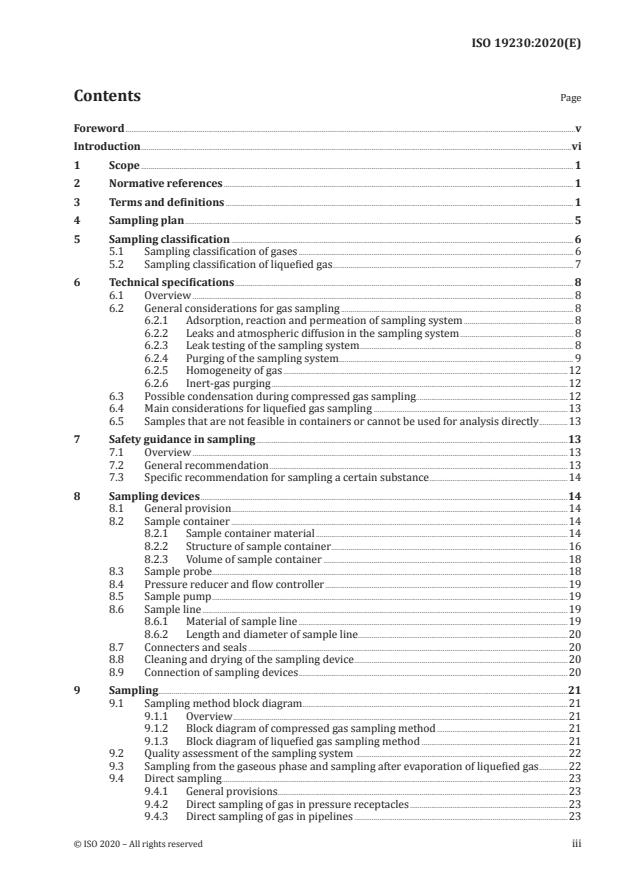
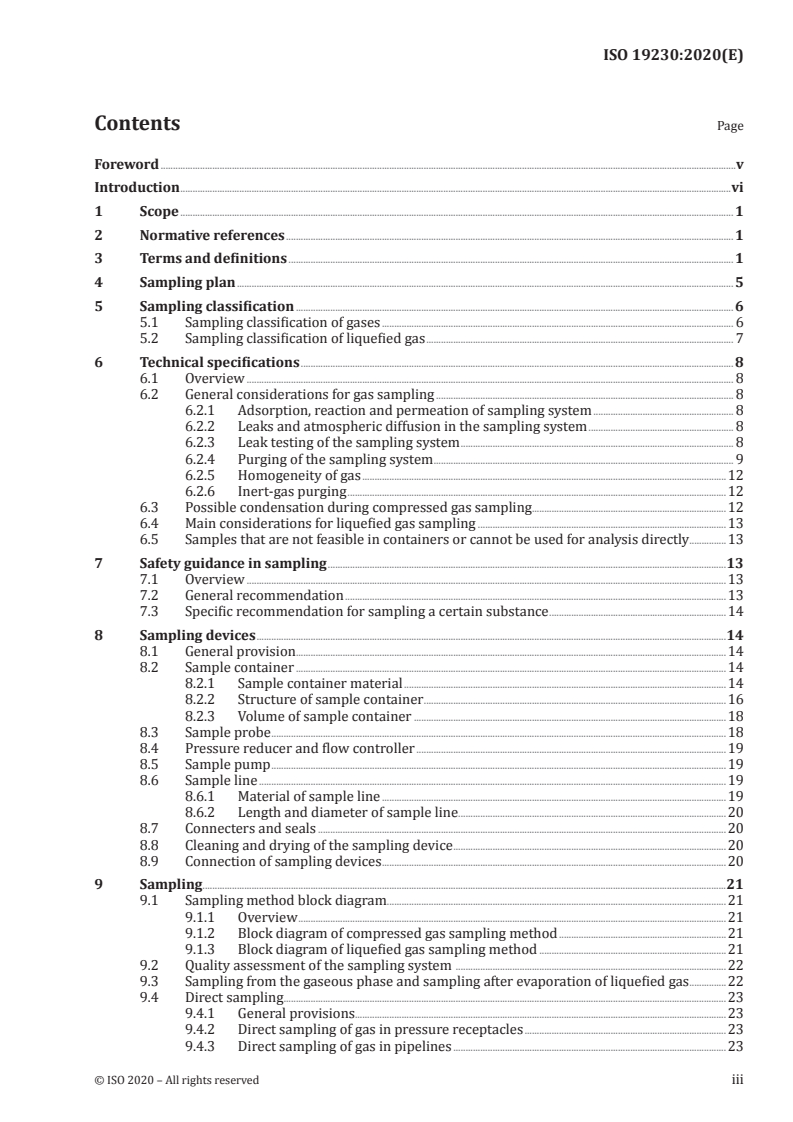
Contents Page
Foreword .v
Introduction .vi
1 Scope . 1
2 Normative references . 1
3 Terms and definitions . 1
4 Sampling plan . 5
5 Sampling classification . 6
5.1 Sampling classification of gases . 6
5.2 Sampling classification of liquefied gas . 7
6 Technical specifications . 8
6.1 Overview . 8
6.2 General considerations for gas sampling . 8
6.2.1 Adsorption, reaction and permeation of sampling system . 8
6.2.2 Leaks and atmospheric diffusion in the sampling system . 8
6.2.3 Leak testing of the sampling system . 8
6.2.4 Purging of the sampling system . 9
6.2.5 Homogeneity of gas .12
6.2.6 Inert-gas purging .12
6.3 Possible condensation during compressed gas sampling.12
6.4 Main considerations for liquefied gas sampling .13
6.5 Samples that are not feasible in containers or cannot be used for analysis directly .13
7 Safety guidance in sampling .13
7.1 Overview .13
7.2 General recommendation .13
7.3 Specific recommendation for sampling a certain substance .14
8 Sampling devices .14
8.1 General provision .14
8.2 Sample container .14
8.2.1 Sample container material .14
8.2.2 Structure of sample container .16
8.2.3 Volume of sample container .18
8.3 Sample probe .18
8.4 Pressure reducer and flow controller .19
8.5 Sample pump .19
8.6 Sample line .19
8.6.1 Material of sample line .19
8.6.2 Length and diameter of sample line .20
8.7 Connecters and seals .20
8.8 Cleaning and drying of the sampling device .20
8.9 Connection of sampling devices .20
9 Sampling .21
9.1 Sampling method block diagram .21
9.1.1 Overview .21
9.1.2 Block diagram of compressed gas sampling method .21
9.1.3 Block diagram of liquefied gas sampling method .21
9.2 Quality assessment of the sampling system .22
9.3 Sampling from the gaseous phase and sampling after evaporation of liquefied gas .22
9.4 Direct sampling .23
9.4.1 General provisions.23
9.4.2 Direct sampling of gas in pressure receptacles .23
9.4.3 Direct sampling of gas in pipelines .23
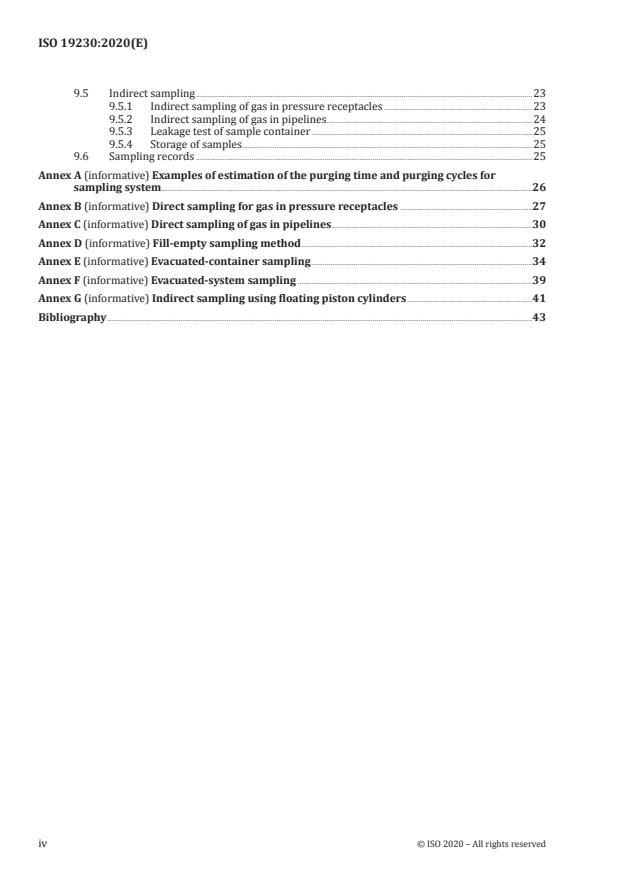
9.5 Indirect sampling .23
9.5.1 Indirect sampling of gas in pressure receptacles .23
9.5.2 Indirect sampling of gas in pipelines .24
9.5.3 Leakage test of sample container .25
9.5.4 Storage of samples . . .25
9.6 Sampling records .25
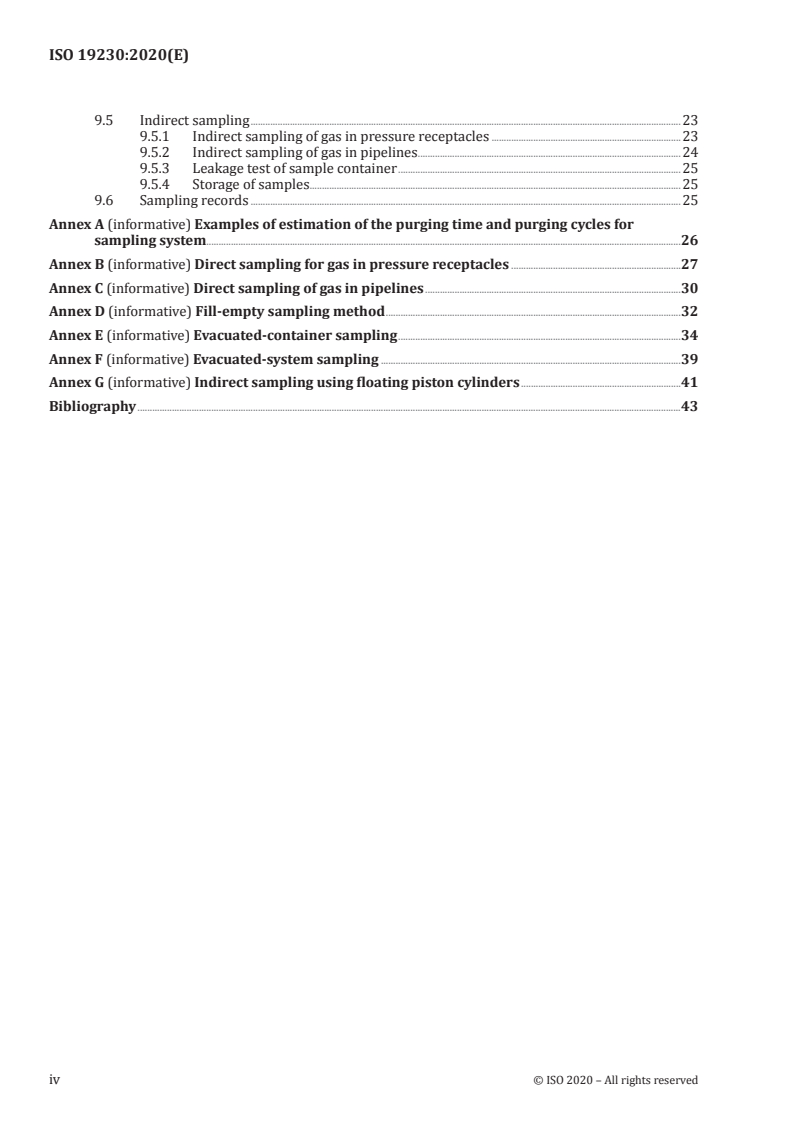
Annex A (informative) Examples of estimation of the purging time and purging cycles for
sampling system . .26
Annex B (informative) Direct sampling for gas in pressure receptacles .27
Annex C (informative) Direct sampling of gas in pipelines .30
Annex D (informative) Fill-empty sampling method .32
Annex E (informative) Evacuated-container sampling .34
Annex F (informative) Evacuated-system sampling .39
Annex G (informative) Indirect sampling using floating piston cylinders .41
Bibliography .43
iv © ISO 2020 – All rights reserved
Foreword
ISO (the International Organization for Standardization) is a worldwide federation of national standards
bodies (ISO member bodies). The work of preparing International Standards is normally carried out
through ISO technical committees. Each member body interested in a subject for which a technical
committee has been established has the right to be represented on that committee. International
organizations, governmental and non-governmental, in liaison with ISO, also take part in the work.
ISO collaborates closely with the International Electrotechnical Commission (IEC) on all matters of
electrotechnical standardization.
The procedures used to develop this document and those intended for its further maintenance are
described in the ISO/IEC Directives, Part 1. In particular, the different approval criteria needed for the
different types of ISO documents should be noted. This document was drafted in accordance with the
editorial rules of the ISO/IEC Directives, Part 2 (see www .iso .org/ directives).
Attention is drawn to the possibility that some of the elements of this document may be the subject of
patent rights. ISO shall not be held responsible for identifying any or all such patent rights. Details of
any patent rights identified during the development of the document will be in the Introduction and/or
on the ISO list of patent declarations received (see www .iso .org/ patents).
Any trade name used in this document is information given for the convenience of users and does not
constitute an endorsement.
For an explanation of the voluntary nature of standards, the meaning of ISO specific terms and
expressions related to conformity assessment, as well as information about ISO's adherence to
the World Trade Organization (WTO) principles in the Technical Barriers to Trade (TBT), see
www .iso .org/ iso/ foreword .html.
This document was prepared by Technical Committee ISO/TC 158, Analysis of gases.
Any feedback or questions on this document should be directed to the user’s national standards body. A
complete listing of these bodies can be found at www .iso .org/ members .html.
Introduction
The determination of gas composition, impurity concentration and physical properties depend, to a
large extent, on sampling technique. The use of correct sampling techniques is an important safety and
quality critical step in gas analysis. The design, construction and selection of the sampling equipment
to avoid hazardous situations and sampling errors are important and directly influence the results
obtained. Any slight carelessness, inexactitude or mistake will seriously influence safety and the results
obtained.
Gaseous products are stored and transported in pressure receptacles in the form of compressed or
liquefied gas or through gas pipelines. The sampling methods used differ depending upon the package,
composition and delivery methods.
This document provides technical guidelines for the sampling of gases in pressure receptacles and
pipelines for analytical purposes.
vi © ISO 2020 – All rights reserved
INTERNATIONAL STANDARD ISO 19230:2020(E)
Gas analysis — Sampling guidelines
WARNING — The use of this document can involve a number of hazards. This document does not
specify all the safety issues associated with its use. Users of this document are responsible for
establishing measures to ensure safety while gas sampling.
1 Scope
This document specifies the general provisions and gives the basic definitions of terms relating
to sampling for gas analysis, including sampling devices, sampling methods, sampling technical
considerations, and sampling safety.
This document applies to both direct and indirect sampling of gas in pressure receptacles and pipelines,
including pure gases and gas mixtures. Compressed and liquefied gases are both considered.
This document applies to the sampling of processed gases and does not involve gas treatment processes.
The sampling procedures specified are not intended for the sampling of special products which are the
subject of other International Standards, such as liquefied petroleum gases (see ISO 4257) and gaseous
natural gases (see ISO 10715).
2 Normative references
The following documents are referred to in the text in such a way that some or all of their content
constitutes requirements of this document. For dated references, only the edition cited applies. For
undated references, the latest edition of the referenced document (including any amendments) applies.
ISO 3165, Sampling of chemical products for industrial use — Safety in sampling
ISO 16664, Gas analysis — Handling of calibration gases and gas mixture — Guidelines
3 Terms and definitions
For the purposes of this document, the following terms and definitions apply.
ISO and IEC maintain terminological databases for use in standardization at the following addresses:
— ISO Online browsing platform: available at https:// www .iso .org/ obp
— IEC Electropedia: available at http:// www .electropedia .org/
3.1
gas
materials which are present completely in gaseous form at a temperature of 20 °C under the absolute
pressure of 0,101 3 MPa
Note 1 to entry: The materials here include single mediums and mixtures.
3.2
compressed gas
gas (3.1) which, when packaged under pressure for transport, is entirely gaseous at all temperatures
above −50 °C
Note 1 to entry: This category includes all gases with a critical temperature less than or equal to −50 °C.
[SOURCE: ISO 10286:2015, 705, modified — Modified to include all temperatures above −50 °C.]
3.3
liquefied gas
gas (3.1) which, when packaged under pressure for transport, is partially liquid at temperatures
above −50 °C
[SOURCE: ISO 10286:2015, 706, modified — Modified to specify that gas is packaged under pressure.]
3.4
high pressure liquefied gas
gas (3.1) with a critical temperature between −50 °C and +65 °C
[SOURCE: ISO 10286:2015, 708]
3.5
low pressure liquefied gas
gas (3.1) with a critical temperature above +65 °C
[SOURCE: ISO 10286:2015, 707]
3.6
toxic gas
gas (3.1) which is known to be so toxic or corrosive to humans to pose a health hazard or which is
presumed to be toxic or corrosive to humans because it has a lethal concentration 50 (3.38) value for
acute toxicity equal to or less than 5 000 ml/m (ppm)
Note 1 to entry: Other risks, such as tissue corrosiveness, are sometimes associated.
[SOURCE: ISO 10286:2015, 716]
3.7
gas in pressure receptacles
gas stored in closed cylinders, tube, pressure drums, tanks and other pressure receptacles
3.8
gas in pipelines
gas delivered in pipelines during the production process
3.9
sampling device
components that comprise the sampling system (3.10) mainly includes sample lines (3.26), pressure
regulators/reducers, flow controllers, connectors and sample containers
3.10
sampling system
gas transmission and control system constructed by gas storage container or sample point of gas in
pipelines (3.8) and various sampling devices (3.9)
3.11
representative sample
sample assumed to have the same composition as the material sampled when the latter is considered as
a homogeneous whole
[SOURCE: ISO 6206:1979, 3.3]
3.12
direct sampling
sampling in situations where there is a direct connection between the gas to be sampled and the
analytical unit
[SOURCE: ISO 10715:1997, 2.1, modified — The word "natural" has been omitted from the definition.]
2 © ISO 2020 – All rights reserved
3.13
indirect sampling
sampling in situations where there is no direct connection between the gas to be sampled and the
analytical unit
[SOURCE: ISO 10715:1997, 2.7, modified — The word "natural" has been omitted from the definition.]
3.14
sampling plan
planned procedure of selection, withdrawal and preparation of a sample or samples from a lot to yield
the required knowledge of the characteristic(s) from the final sample so that a decision can be made
regarding the lot
[SOURCE: ISO 6206:1979, 3.1.5]
3.15
spot sampling
indirect sampling (3.13) from a specific part of the stream of material with a certain volume at a
specific time
3.16
incremental sampling
indirect sampling (3.13) by collecting a series of spot samples into a combined sample
3.17
continuous sampling
direct sampling (3.12) taken continuously from a stream of material with a constant flow rate in a
certain period of time
3.18
intermittent sampling
direct sampling (3.12) from a stream of material with predetermined intervals
3.19
ullage
outage
space in the container not occupied by the material, or the distance between the material surface and a
fixed reference point at the top of the container
Note 1 to entry: This volume allows room for expansion.
[SOURCE: ISO 6206:1979, 3.3.14]
3.20
sampling error
part of the total estimation error of a characteristic due to known and acceptable deficiencies in the
sampling plan (3.14)
[SOURCE: ISO 6206:1979, 3.4.10]
3.21
incremental sampler
sampler which accumulates a series of spot samples into one composite sample
[SOURCE: ISO 10715:1997, 2.6]
3.22
low-pressure gas
gases with a pressure between 0 MPa and 0,2 MPa at sampling temperature
Note 1 to entry: Except for special provisions, all pressures mentioned in this standard are gauge pressures.
3.23
high-pressure gas
gases with a pressure exceeding 0,2 MPa at sampling temperature
3.24
lag time
time taken for a representative sample (3.11) to enter the instrument
[SOURCE: ISO 11042-2:1996, 3.5.1.1]
3.25
sample container
container for collecting the gas sample when indirect sampling (3.13) is necessary
[SOURCE: ISO 10715:1997, 2.14]
3.26
sample line
conduit to transfer a sample of gas from the sample place to the analytical unit or sample container (3.25)
Note 1 to entry: Another word used for sample line is transfer line.
[SOURCE: ISO 14532:2014, 2.3.2.5]
3.27
sample probe
device inserted into the gas pipelines so that a representative sample (3.11) of the flowing gas can be taken
Note 1 to entry: The sample probe will have a conduit to convey the sample from the flowing gas to a point
external to the pipeline.
[SOURCE: ISO 14532:2014, 2.3.2.6, modified — The second sentence has been formatted as a note to entry.]
3.28
sampling point
point in the gas stream where a representative sample (3.11) can be collected
[SOURCE: ISO 10715:1997, 2.17]
3.29
filling ratio
ratio of the mass of gas to the mass of water at 15 °C that would fill completely a pressure receptacle
fitted ready for use
Note 1 to entry: Synonyms are filling factor and filling degree, often expressed in kg/l or similar.
[SOURCE: ISO 10286:2015, 747]
3.30
continuous purging method
purging method by continually purging the sampling system (3.10) with sample gases
3.31
fill-empty cycle purging method
purging method by sequentially filling and emptying the sampling system (3.10) repeatedly with the gas
to be taken
3.32
evacuation-gas purging cycles
purging method by sequentially evacuating and pressurizing the sampling system (3.10) with the
sample to be taken
4 © ISO 2020 – All rights reserved
3.33
sampling from the gaseous phase
process that takes a sample from the gaseous phase of the liquefied gases (3.3)
3.34
sampling from the liquid phase
process that takes a sample from the liquid phase of the liquefied gases (3.3)
3.35
sampling in liquid form
process that takes a sample in liquid form directly from the liquid phase of the liquefied gas (3.3)
3.36
sampling after evaporation
process that takes a sample in gaseous form by vaporizing the sample from the liquid phase of the
liquefied gas (3.3)
3.37
liquid valve
device with an internal fixed sample loop, fitted to an analyser for the direct sampling (3.12) of liquefied
gas (3.3) in liquid form, which can keep the liquefied gas to be collected completely in the liquid phase
3.38
lethal concentration 50
LC
concentration of a substance in air exposure to which, for a specified length of time, it is expected to
cause the death of 50 % of the entire defined experimental animal population after a defined time period
[SOURCE: ISO 10298:2018, 3.1]
3.39
corrosive gas
gas (3.1) which, when dissolved in water or other liquid, causes corrosion of metal
[SOURCE: ISO 13703:2000, 3.1.4]
3.40
floating piston cylinder
sample container (3.25) that has a moving piston separating the sample from a precharge gas
Note 1 to entry: The pressures are in balance on both sides of the piston.
[SOURCE: ISO 14532:2014, 2.3.2.1, modified — The container has been specified as a "sample container"
and the second sentence was formatted as a note to entry.]
4 Sampling plan
A feasible and complete sampling plan should be developed before sampling as shown in Figure 1.
Figure 1 — Scheme of sampling plan
5 Sampling classification
5.1 Sampling classification of gases
In this document, the sampling classification is based on whether the gas is directly fed to the analyser
or not. In addition, the sampling methods vary among different gas packaging, storage methods and
sampling purposes.
Direct sampling, if possible, is strongly recommended. In the case of indirect sampling, the potential
loss of component during the time between sampling and analysis should be studied and incorporated
in the uncertainty budget.
In general, for gas in pressure receptacles, the internal composition is relatively uniform and constant.
For gases in pipelines, the purpose and controls required dictate the type of sampling used. The design
of a sampling plan should consider whether the objectives of sampling are to:
— determine the instantaneous gaseous composition;
— determine an average composition over a specified time interval;
— establish changes in concentration by repeated sampling over a specified time;
— pass continuous samples into the analyser to measure both limit and average composition.
A flow chart detailing the gas sampling classification is shown in Figure 2.
6 © ISO 2020 – All rights reserved
Figure 2 — Gas sampling classification
5.2 Sampling classification of liquefied gas
When sampling liquefied gases, a representative sample is obtained by sampling from the liquid phase,
however, it can also occasionally be necessary to sample the vapour phase.
Sampling from the liquid phase is further subdivided into sampling in liquid form or sampling after
evaporation. The method of sampling used is normally determined by a review of the physical
properties of the liquefied gas such as vapour pressure, etc. Generally, high pressure liquefied gases
require evaporation whereas low pressure liquefied gases may be sampled in liquid phase.
For the liquefied gas sampling classification, see Figure 3 which details the sampling methods that
should be used. Then, follow 5.1 to determine the specific sampling type.
Figure 3 — Liquefied gas sampling classification
6 Technical specifications
6.1 Overview
For gas sampling, attention should be paid to but not limited to the following technical aspects in order
to collect sufficient representative sample.
6.2 General considerations for gas sampling
6.2.1 Adsorption, reaction and permeation of sampling system
Such problems can be minimized by choosing sampling devices of suitable materials (see Clause 8 for
details).
However, some slight adsorption is difficult to overcome. In this case, the sampling system should be
heated or continuously purged for a long period of time. Quality assessment of the sampling system
should be carried out according to 9.2. The adsorption shall be considered in the uncertainty budget.
6.2.2 Leaks and atmospheric diffusion in the sampling system
Leaks in the sampling system not only result in a loss of gas from the system but also allow air to diffuse
into the system (the partial pressure of the component determines the direction of the diffusion)
thereby affecting the composition of the sample.
The sampling system should be leak tested (see 6.2.3) prior to use to ensure the sample will not be
contaminated, the composition changed, or hazardous conditions created by the ingress of air.
Furthermore, the back-diffusion of air into gas venting lines should be avoided by, for example, using
longer venting lines.
6.2.3 Leak testing of the sampling system
All connections and welds shall be tested prior to first use. During subsequent re-use of the sampling
system, re-connected parts should be retested for leaks. Other parts of the system should be regularly
retested, this is particularly important for corrosive gases. When sampling toxic gases, leak testing
shall be performed before each use of the sampling system. The integrity of the sampling containers
and their connection with the sampling system should also be tested.
The following test methods may be used.
a) Pressurization of the system, followed by monitoring of the static pressure with respect to time. A
pressure drop indicates a leak.
b) Evacuation of the system and monitoring the vacuum achieved. A deterioration in the vacuum
resulting in an increase in pressure indicates a leak.
c) Pressurize the system and check all connections with a leak detection solution. Following the use
of leak detection solution, the system should be purged out to ensure dryness prior to use.
d) Use of a leak detector (e.g. mass spectrometry, where the system is filled with helium and the
presence of helium outside the system is detected with the mass spectrometer).
The correct selection of a leak detection method depends upon the system requirements. For example,
leak detection solution might not detect small leaks, however, instrumentation such as a leak detecting
mass spectrometer having a high sensitivity can be used to determine the precise location of the leak(s).
It is common practice to use a combination of the methods specified to establish the integrity of the
sampling system, i.e. leak tightness.
8 © ISO 2020 – All rights reserved
Sampling systems for use in toxic gas service shall be thoroughly leak tested. A sensitive method of leak
detection such as evacuation followed by the monitoring of the vacuum or the use of a leak detecting
mass spectrometer should be used.
When leak detection solution as well as pressurization are used in the test, if pressurization by an inert
gas is required, the molecular size of the chosen inert gas should not be larger than that of samples to
be collected and the gas pressure shall not be less than the maximum filling pressure of the sample to
be collected.
For samples to be collected which require the analysis of trace water or water-soluble components, leak
detection solution cannot be used to avoid contamination of the sample.
6.2.4 Purging of the sampling system
6.2.4.1 Overview
To avoid contamination from previous samples or residual air in the sampling system, thorough purging
before use should be completed. Inadequate purging can result in inaccurate results being obtained.
Commonly used methods of purging include:
— continuous purging;
— evacuation-gas purging cycles;
— fill-empty cycle purging.
A combination of these methods may be used depending upon the design of the sampling system and
gas service.
For non-reactive components, 6.2.4.2 and 6.2.4.3 gives a detailed explanation of the methods used.
Annex A gives examples of calculations. Purging cycles and the times for effective purging should be
experimentally verified.
For reactive components, where adsorption can occur, more purging cycles or time is required.
6.2.4.2 Continuous purging method
Continuous purging is usually used for sampling systems with a small dead volume. It should be used
in combination with fill-empty cycle purging or evacuation-gas purging cycles for systems with larger
dead volumes.
The residual component concentration in the sampling system using continuous purging may be
described by the mathematical model for exponential dilution.
There are two factors determining the component of interest amount fraction change with time in
course of continuous purging: a decreasing amount due to removing residual analyte and an increasing
amount due to incoming sample containing this component. The purging time may be estimated using
the mathematical model shown in Formula (1):
Q Q
−−t t
V V
xx=+ex 1−e (1)
tx0
where
x is a fraction of the component of interest in the sampling system after purging time t, in %;
t
x is an initial fraction of the residual component in the sampling system, in %;
x is a fraction of the component in the gas the sample is taken from, in %;
x
Q is a continuous and constant purging flow rate of the sampling system, in ml/min;
V is a space volume of the sampling system to be purged, in ml;
t is purging time, in min.
A sampling relative error δ, %, is defined as in Formula (2):
xx−
tx
δ = ×100% (2)
x
x
and, by combining Formulae (1) and (2), we obtain Formula (3):
Q
x − t
V
δ =−1 e ×100% (3)
x
x
Formula (3) shows that when x > x , δ is positive, when x < x , δ is negative, and when x = x , δ
0 x 0 x 0 x
equals zero.
For a given sampling error, δ , minimal necessary purging time t may be evaluated as in Formula (4):
g min
x
−1
x
V
x
t =×ln 100% (4)
min
Q δ
g
Formula (4) shows that, with other conditions being fixed, the closer ratio x /x is to 1, the shorter
0 x
purging time is required. By increasing the flow rate of the purge gas and reducing the system volume,
the purging time can be reduced.
Formula (4) is meaningful, i.e. gives positive value for t , when |(x /x ) − 1| > |δ /100 %|, i.e. when δ at
min 0 x g
t = 0 is greater than δ , otherwise a sampling error is acceptable without purging.
g
6.2.4.3 Fill-empty cycle purging method
Generally, valves, lines and sample containers have a certain dead volume, especially for pressure
reducers and sample containers, so continuous purging is not very effective. Fill-empty cycle purging is
more effective by sequentially pressurizing and venting the system with the sample to be taken.
Annex D gives some sampling procedure examples using fill-empty cycle purging method.
It is important to open the gas source valve only partially and only for a very short time (i.e. 0,5 s), both
for safety reasons and in order to avoid back contamination.
10 © ISO 2020 – All rights reserved
Both the initial pressure and the maximum pressure are the same for each cycle of fill-empty purging.
After n cycles of fill-empty cycle purging, the residual components fraction x in the sampling system
n
may be derived according to Formula (5), the ideal gas under the isochoric conditions:
nn
p p
xx= +−x 1 (5)
nx0
p p
where
x is a fraction of the residual component in sampling system after purging cycle n, %;
n
x is an initial fraction of the residual component in the sampling system, %;
x is a fraction of the component in the gas the sample is taken from, %;
x
p is an initial absolute pressure of the sampling system;
p is the maximum absolute pressure achieved when the sampling system is pressurized;
n is a number of purging cycles;
p /p is a dilution ratio.
A sampling relative error δ, %, is defined as in Formula (6):
xx−
nx
δ = ×100% (6)
x
x
and, by combining Formulae (5) and (6), we obtain Formula (7):
n
x p
δ =−1 ×100% (7)
x p
x
For a given sampling error, δ , minimal necessary number of purging cycles n may be evaluated as in
g min
Formula (8):
x
−1
x
x
ln 100%×
δ
g
n = (8)
min
p
ln
p
Formula (8) shows that, with other conditions being fixed, the closer ratio x /x is to 1, the less number
0 x
of purging cycles is required.
Formula (8) is meaningful, i.e. gives positive value for n , when |(x /x ) − 1| > |δ /100 %|, i.e. when δ at
min 0 x g
n = 0 is greater than δ , otherwise a sampling error is acceptable without purging.
g
6.2.4.4 Evacuation-gas purging cycles
Evacuation-gas purging cycles are more suitable for gas samples with a limited available sample volume
and those that are toxic, expensive, ultra-pure, sensitive to oxygen and water, and with pressure equal
to or lower than atmospheric pressure.
Make sure that the pressure reducers used are suited for evacuation and that the purging cycle starts
with evacuation. And it is also important to open the gas source valve only partially and only for a very
short time (i.e. 0,5 s).
B.1.1 gives a sampling procedure example using evacuation-gas purging cycles.
6.2.5 Homogeneity of gas
Inhomogeneity of the gas will result in sampling errors.
Liquefied gas is not effectively or quickly mixed by diffusion. If the sample in the receptacle is not
homogeneous, it shall be homogenized before sampling.
Gas stratification across pipelines usually occurs at low flow velocities with large pipeline diameters.
Turbulence caused by bends or obstructions is beneficial for gas mixing, and it is advantageous to
sample downstream of a source of turbulence. Sampling at gas stagnation points should be avoided. In
addition, gas stratification can be investigated with the aid of an adjustable sample probe that collects
samples at different points in the pipeline cross section. Based on the results of these tests, the best
sampling position representative of the average composition of the sample is determined, generally
positioned one-third to halfway into the pipeline.
6.2.6 Inert-gas purging
For condensable, sensitive to oxygen and water, or toxic and corrosive gas sampling, inert-gas purging
should be used (see Figure C.1). For gases that can condense, if condensation occurs due to some
unexpected factors, inert-gas purging is required after sampling to remove any residual sample from
the system before taking the next sample. For gases that are sensitive to oxygen and water, inert-
gas purging is required before sampling to eliminate residual moisture and air (if a vacuum pump is
available, inert-gas purging is not necessary). For toxic and corrosive gas sampling, inert-gas purging is
used primarily for the purging of sampling system after sampling.
Inert-gas purging should be introduced downstream of the pressure reducer.
NOTE The inert gas mentioned in this document refers to gases that are not active and do not interfere with
sampling, for example nitrogen, helium and argon are commonly used.
6.3 Possible condensation during compressed gas sampling
For the sampling of condensable gases, condensation is one of the main factors that can affect the
collection of representative samples. Any of the following factors can cause condensation.
— Pressure and flow regulation by a pressure reducer or flow controller (needle valve, mass flow
regulator, capillary, etc.) can cause a temperature decrease due to Joule-Thomson cooling.
— The venting process in the sample line and container through the fill-empty cycle purging method
can cause condensation due to loss of pressure and flow rate.
— When sampling from a receptacle, condensation can occur inside the receptacle due to adiabatic
expansion.
To avoid the possible condensation mentioned above, the pressure drop across the flow regulator should
be minimized. Flow characteristics of a flow regulator are usually given by the manufacturer, and the
information is sufficient to judge whether the required flow rate can be controlled by the chosen flow
regulator. When calculating the pressure drop, tube sizing (inside diameter and length) shall also be
considered.
Using more than one pressure reducer to drop the pressure in stages, adding flow (or pressure) control
and/or indicator devices on venting lines, or adding an extension tube (see Figure D.1, typically 0,6 m to
1,2 m in length) to the outlet of sample containers and analysers, are advantageous to minimize the risk
of condensation.
Heating the sampling system is the most effective method. In the case of decompression, it should be
heated from upstream of the pressure reducer. In the case of indirect sampling, the sample container
also needs to be heated for transport and storage. The temperature should ensure that no condensation
12 © ISO 2020 – All rights reserved
of the condensable components is expected to occur. The required temperature depends on the gas
composition, drop of pressure, pressure, temperature and flow rate, etc.
6.4 Main considerations for liquefied gas sampling
When sampling liquefied gas after evaporation, it should be noted that if the liquid cannot be completely
vaporized, a representative sample cannot be collected.
For high pressure liquefied gases, the ambient temperature is sufficient to allow uniform evaporation.
For low pressure liquefied gases, suitable vaporizers, such as water baths, flashers, etc., should be used
to ensure the uniform and complete evaporation of all components.
During the process of sampling liquid directly, after the liquid sample is flowing out of the sample line,
the pressure in the line should always be controlled to a higher pressure than the saturated vapour
pressure of the sample so as to avoid partial evaporation of the components.
6.5 Samples that are not feasible in containers or cannot be used for analysis directly
If suitable sampling vessels are not available or direct sampling is not feasible, sorption tubes or
impingers should be considered for sampling.
7 Safety guidance in sampling
7.1 Overview
Before taking samples, a risk assessment shall be performed to ensure that hazardous conditions are
not created, and any potentially dangerous conditions are recognized and mitigated. This chapter
is intended to provide safety warnings for gas sampling, subsequent sample preservation and
transportation. Because of the complexity and diversity of the actual situation, only general guidance is
given in this document. Users should be aware of all safety precautions to ensure sampling safety and
perform risk assessments prior to beginning sampling.
7.2 General recommendation
Generally, gas sampling shall be in accordance with the general recommendation given in ISO 3165 and
the following.
a) Sampling personnel: The sampling personnel should be professionally trained, familiar with
the nature of the sample to be collected, as well as any possible hazards involved, the protective
measures and the precautions to be taken when sampling, and the actions and protective measures
that should be taken in an emergency.
b) Sampling operation: Sampling should be performed strictly in accordance with the documented
operating procedures. The nature of the material and the risks associated with it should be marked
on the sample container. The sample container may be disconnected from the sampling system after
the pressure is released to vacuum for toxic and hazardous samples or to atmospheric pressure for
...
INTERNATIONAL ISO
STANDARD 19230
First edition
2020-11
Gas analysis — Sampling guidelines
Analyse des gaz — Lignes directrices pour le prélèvement des
échantillons
Reference number
©
ISO 2020
© ISO 2020
All rights reserved. Unless otherwise specified, or required in the context of its implementation, no part of this publication may
be reproduced or utilized otherwise in any form or by any means, electronic or mechanical, including photocopying, or posting
on the internet or an intranet, without prior written permission. Permission can be requested from either ISO at the address
below or ISO’s member body in the country of the requester.
ISO copyright office
CP 401 • Ch. de Blandonnet 8
CH-1214 Vernier, Geneva
Phone: +41 22 749 01 11
Email: copyright@iso.org
Website: www.iso.org
Published in Switzerland
ii © ISO 2020 – All rights reserved
Contents Page
Foreword .v
Introduction .vi
1 Scope . 1
2 Normative references . 1
3 Terms and definitions . 1
4 Sampling plan . 5
5 Sampling classification . 6
5.1 Sampling classification of gases . 6
5.2 Sampling classification of liquefied gas . 7
6 Technical specifications . 8
6.1 Overview . 8
6.2 General considerations for gas sampling . 8
6.2.1 Adsorption, reaction and permeation of sampling system . 8
6.2.2 Leaks and atmospheric diffusion in the sampling system . 8
6.2.3 Leak testing of the sampling system . 8
6.2.4 Purging of the sampling system . 9
6.2.5 Homogeneity of gas .12
6.2.6 Inert-gas purging .12
6.3 Possible condensation during compressed gas sampling.12
6.4 Main considerations for liquefied gas sampling .13
6.5 Samples that are not feasible in containers or cannot be used for analysis directly .13
7 Safety guidance in sampling .13
7.1 Overview .13
7.2 General recommendation .13
7.3 Specific recommendation for sampling a certain substance .14
8 Sampling devices .14
8.1 General provision .14
8.2 Sample container .14
8.2.1 Sample container material .14
8.2.2 Structure of sample container .16
8.2.3 Volume of sample container .18
8.3 Sample probe .18
8.4 Pressure reducer and flow controller .19
8.5 Sample pump .19
8.6 Sample line .19
8.6.1 Material of sample line .19
8.6.2 Length and diameter of sample line .20
8.7 Connecters and seals .20
8.8 Cleaning and drying of the sampling device .20
8.9 Connection of sampling devices .20
9 Sampling .21
9.1 Sampling method block diagram .21
9.1.1 Overview .21
9.1.2 Block diagram of compressed gas sampling method .21
9.1.3 Block diagram of liquefied gas sampling method .21
9.2 Quality assessment of the sampling system .22
9.3 Sampling from the gaseous phase and sampling after evaporation of liquefied gas .22
9.4 Direct sampling .23
9.4.1 General provisions.23
9.4.2 Direct sampling of gas in pressure receptacles .23
9.4.3 Direct sampling of gas in pipelines .23
9.5 Indirect sampling .23
9.5.1 Indirect sampling of gas in pressure receptacles .23
9.5.2 Indirect sampling of gas in pipelines .24
9.5.3 Leakage test of sample container .25
9.5.4 Storage of samples . . .25
9.6 Sampling records .25
Annex A (informative) Examples of estimation of the purging time and purging cycles for
sampling system . .26
Annex B (informative) Direct sampling for gas in pressure receptacles .27
Annex C (informative) Direct sampling of gas in pipelines .30
Annex D (informative) Fill-empty sampling method .32
Annex E (informative) Evacuated-container sampling .34
Annex F (informative) Evacuated-system sampling .39
Annex G (informative) Indirect sampling using floating piston cylinders .41
Bibliography .43
iv © ISO 2020 – All rights reserved
Foreword
ISO (the International Organization for Standardization) is a worldwide federation of national standards
bodies (ISO member bodies). The work of preparing International Standards is normally carried out
through ISO technical committees. Each member body interested in a subject for which a technical
committee has been established has the right to be represented on that committee. International
organizations, governmental and non-governmental, in liaison with ISO, also take part in the work.
ISO collaborates closely with the International Electrotechnical Commission (IEC) on all matters of
electrotechnical standardization.
The procedures used to develop this document and those intended for its further maintenance are
described in the ISO/IEC Directives, Part 1. In particular, the different approval criteria needed for the
different types of ISO documents should be noted. This document was drafted in accordance with the
editorial rules of the ISO/IEC Directives, Part 2 (see www .iso .org/ directives).
Attention is drawn to the possibility that some of the elements of this document may be the subject of
patent rights. ISO shall not be held responsible for identifying any or all such patent rights. Details of
any patent rights identified during the development of the document will be in the Introduction and/or
on the ISO list of patent declarations received (see www .iso .org/ patents).
Any trade name used in this document is information given for the convenience of users and does not
constitute an endorsement.
For an explanation of the voluntary nature of standards, the meaning of ISO specific terms and
expressions related to conformity assessment, as well as information about ISO's adherence to
the World Trade Organization (WTO) principles in the Technical Barriers to Trade (TBT), see
www .iso .org/ iso/ foreword .html.
This document was prepared by Technical Committee ISO/TC 158, Analysis of gases.
Any feedback or questions on this document should be directed to the user’s national standards body. A
complete listing of these bodies can be found at www .iso .org/ members .html.
Introduction
The determination of gas composition, impurity concentration and physical properties depend, to a
large extent, on sampling technique. The use of correct sampling techniques is an important safety and
quality critical step in gas analysis. The design, construction and selection of the sampling equipment
to avoid hazardous situations and sampling errors are important and directly influence the results
obtained. Any slight carelessness, inexactitude or mistake will seriously influence safety and the results
obtained.
Gaseous products are stored and transported in pressure receptacles in the form of compressed or
liquefied gas or through gas pipelines. The sampling methods used differ depending upon the package,
composition and delivery methods.
This document provides technical guidelines for the sampling of gases in pressure receptacles and
pipelines for analytical purposes.
vi © ISO 2020 – All rights reserved
INTERNATIONAL STANDARD ISO 19230:2020(E)
Gas analysis — Sampling guidelines
WARNING — The use of this document can involve a number of hazards. This document does not
specify all the safety issues associated with its use. Users of this document are responsible for
establishing measures to ensure safety while gas sampling.
1 Scope
This document specifies the general provisions and gives the basic definitions of terms relating
to sampling for gas analysis, including sampling devices, sampling methods, sampling technical
considerations, and sampling safety.
This document applies to both direct and indirect sampling of gas in pressure receptacles and pipelines,
including pure gases and gas mixtures. Compressed and liquefied gases are both considered.
This document applies to the sampling of processed gases and does not involve gas treatment processes.
The sampling procedures specified are not intended for the sampling of special products which are the
subject of other International Standards, such as liquefied petroleum gases (see ISO 4257) and gaseous
natural gases (see ISO 10715).
2 Normative references
The following documents are referred to in the text in such a way that some or all of their content
constitutes requirements of this document. For dated references, only the edition cited applies. For
undated references, the latest edition of the referenced document (including any amendments) applies.
ISO 3165, Sampling of chemical products for industrial use — Safety in sampling
ISO 16664, Gas analysis — Handling of calibration gases and gas mixture — Guidelines
3 Terms and definitions
For the purposes of this document, the following terms and definitions apply.
ISO and IEC maintain terminological databases for use in standardization at the following addresses:
— ISO Online browsing platform: available at https:// www .iso .org/ obp
— IEC Electropedia: available at http:// www .electropedia .org/
3.1
gas
materials which are present completely in gaseous form at a temperature of 20 °C under the absolute
pressure of 0,101 3 MPa
Note 1 to entry: The materials here include single mediums and mixtures.
3.2
compressed gas
gas (3.1) which, when packaged under pressure for transport, is entirely gaseous at all temperatures
above −50 °C
Note 1 to entry: This category includes all gases with a critical temperature less than or equal to −50 °C.
[SOURCE: ISO 10286:2015, 705, modified — Modified to include all temperatures above −50 °C.]
3.3
liquefied gas
gas (3.1) which, when packaged under pressure for transport, is partially liquid at temperatures
above −50 °C
[SOURCE: ISO 10286:2015, 706, modified — Modified to specify that gas is packaged under pressure.]
3.4
high pressure liquefied gas
gas (3.1) with a critical temperature between −50 °C and +65 °C
[SOURCE: ISO 10286:2015, 708]
3.5
low pressure liquefied gas
gas (3.1) with a critical temperature above +65 °C
[SOURCE: ISO 10286:2015, 707]
3.6
toxic gas
gas (3.1) which is known to be so toxic or corrosive to humans to pose a health hazard or which is
presumed to be toxic or corrosive to humans because it has a lethal concentration 50 (3.38) value for
acute toxicity equal to or less than 5 000 ml/m (ppm)
Note 1 to entry: Other risks, such as tissue corrosiveness, are sometimes associated.
[SOURCE: ISO 10286:2015, 716]
3.7
gas in pressure receptacles
gas stored in closed cylinders, tube, pressure drums, tanks and other pressure receptacles
3.8
gas in pipelines
gas delivered in pipelines during the production process
3.9
sampling device
components that comprise the sampling system (3.10) mainly includes sample lines (3.26), pressure
regulators/reducers, flow controllers, connectors and sample containers
3.10
sampling system
gas transmission and control system constructed by gas storage container or sample point of gas in
pipelines (3.8) and various sampling devices (3.9)
3.11
representative sample
sample assumed to have the same composition as the material sampled when the latter is considered as
a homogeneous whole
[SOURCE: ISO 6206:1979, 3.3]
3.12
direct sampling
sampling in situations where there is a direct connection between the gas to be sampled and the
analytical unit
[SOURCE: ISO 10715:1997, 2.1, modified — The word "natural" has been omitted from the definition.]
2 © ISO 2020 – All rights reserved
3.13
indirect sampling
sampling in situations where there is no direct connection between the gas to be sampled and the
analytical unit
[SOURCE: ISO 10715:1997, 2.7, modified — The word "natural" has been omitted from the definition.]
3.14
sampling plan
planned procedure of selection, withdrawal and preparation of a sample or samples from a lot to yield
the required knowledge of the characteristic(s) from the final sample so that a decision can be made
regarding the lot
[SOURCE: ISO 6206:1979, 3.1.5]
3.15
spot sampling
indirect sampling (3.13) from a specific part of the stream of material with a certain volume at a
specific time
3.16
incremental sampling
indirect sampling (3.13) by collecting a series of spot samples into a combined sample
3.17
continuous sampling
direct sampling (3.12) taken continuously from a stream of material with a constant flow rate in a
certain period of time
3.18
intermittent sampling
direct sampling (3.12) from a stream of material with predetermined intervals
3.19
ullage
outage
space in the container not occupied by the material, or the distance between the material surface and a
fixed reference point at the top of the container
Note 1 to entry: This volume allows room for expansion.
[SOURCE: ISO 6206:1979, 3.3.14]
3.20
sampling error
part of the total estimation error of a characteristic due to known and acceptable deficiencies in the
sampling plan (3.14)
[SOURCE: ISO 6206:1979, 3.4.10]
3.21
incremental sampler
sampler which accumulates a series of spot samples into one composite sample
[SOURCE: ISO 10715:1997, 2.6]
3.22
low-pressure gas
gases with a pressure between 0 MPa and 0,2 MPa at sampling temperature
Note 1 to entry: Except for special provisions, all pressures mentioned in this standard are gauge pressures.
3.23
high-pressure gas
gases with a pressure exceeding 0,2 MPa at sampling temperature
3.24
lag time
time taken for a representative sample (3.11) to enter the instrument
[SOURCE: ISO 11042-2:1996, 3.5.1.1]
3.25
sample container
container for collecting the gas sample when indirect sampling (3.13) is necessary
[SOURCE: ISO 10715:1997, 2.14]
3.26
sample line
conduit to transfer a sample of gas from the sample place to the analytical unit or sample container (3.25)
Note 1 to entry: Another word used for sample line is transfer line.
[SOURCE: ISO 14532:2014, 2.3.2.5]
3.27
sample probe
device inserted into the gas pipelines so that a representative sample (3.11) of the flowing gas can be taken
Note 1 to entry: The sample probe will have a conduit to convey the sample from the flowing gas to a point
external to the pipeline.
[SOURCE: ISO 14532:2014, 2.3.2.6, modified — The second sentence has been formatted as a note to entry.]
3.28
sampling point
point in the gas stream where a representative sample (3.11) can be collected
[SOURCE: ISO 10715:1997, 2.17]
3.29
filling ratio
ratio of the mass of gas to the mass of water at 15 °C that would fill completely a pressure receptacle
fitted ready for use
Note 1 to entry: Synonyms are filling factor and filling degree, often expressed in kg/l or similar.
[SOURCE: ISO 10286:2015, 747]
3.30
continuous purging method
purging method by continually purging the sampling system (3.10) with sample gases
3.31
fill-empty cycle purging method
purging method by sequentially filling and emptying the sampling system (3.10) repeatedly with the gas
to be taken
3.32
evacuation-gas purging cycles
purging method by sequentially evacuating and pressurizing the sampling system (3.10) with the
sample to be taken
4 © ISO 2020 – All rights reserved
3.33
sampling from the gaseous phase
process that takes a sample from the gaseous phase of the liquefied gases (3.3)
3.34
sampling from the liquid phase
process that takes a sample from the liquid phase of the liquefied gases (3.3)
3.35
sampling in liquid form
process that takes a sample in liquid form directly from the liquid phase of the liquefied gas (3.3)
3.36
sampling after evaporation
process that takes a sample in gaseous form by vaporizing the sample from the liquid phase of the
liquefied gas (3.3)
3.37
liquid valve
device with an internal fixed sample loop, fitted to an analyser for the direct sampling (3.12) of liquefied
gas (3.3) in liquid form, which can keep the liquefied gas to be collected completely in the liquid phase
3.38
lethal concentration 50
LC
concentration of a substance in air exposure to which, for a specified length of time, it is expected to
cause the death of 50 % of the entire defined experimental animal population after a defined time period
[SOURCE: ISO 10298:2018, 3.1]
3.39
corrosive gas
gas (3.1) which, when dissolved in water or other liquid, causes corrosion of metal
[SOURCE: ISO 13703:2000, 3.1.4]
3.40
floating piston cylinder
sample container (3.25) that has a moving piston separating the sample from a precharge gas
Note 1 to entry: The pressures are in balance on both sides of the piston.
[SOURCE: ISO 14532:2014, 2.3.2.1, modified — The container has been specified as a "sample container"
and the second sentence was formatted as a note to entry.]
4 Sampling plan
A feasible and complete sampling plan should be developed before sampling as shown in Figure 1.
Figure 1 — Scheme of sampling plan
5 Sampling classification
5.1 Sampling classification of gases
In this document, the sampling classification is based on whether the gas is directly fed to the analyser
or not. In addition, the sampling methods vary among different gas packaging, storage methods and
sampling purposes.
Direct sampling, if possible, is strongly recommended. In the case of indirect sampling, the potential
loss of component during the time between sampling and analysis should be studied and incorporated
in the uncertainty budget.
In general, for gas in pressure receptacles, the internal composition is relatively uniform and constant.
For gases in pipelines, the purpose and controls required dictate the type of sampling used. The design
of a sampling plan should consider whether the objectives of sampling are to:
— determine the instantaneous gaseous composition;
— determine an average composition over a specified time interval;
— establish changes in concentration by repeated sampling over a specified time;
— pass continuous samples into the analyser to measure both limit and average composition.
A flow chart detailing the gas sampling classification is shown in Figure 2.
6 © ISO 2020 – All rights reserved
Figure 2 — Gas sampling classification
5.2 Sampling classification of liquefied gas
When sampling liquefied gases, a representative sample is obtained by sampling from the liquid phase,
however, it can also occasionally be necessary to sample the vapour phase.
Sampling from the liquid phase is further subdivided into sampling in liquid form or sampling after
evaporation. The method of sampling used is normally determined by a review of the physical
properties of the liquefied gas such as vapour pressure, etc. Generally, high pressure liquefied gases
require evaporation whereas low pressure liquefied gases may be sampled in liquid phase.
For the liquefied gas sampling classification, see Figure 3 which details the sampling methods that
should be used. Then, follow 5.1 to determine the specific sampling type.
Figure 3 — Liquefied gas sampling classification
6 Technical specifications
6.1 Overview
For gas sampling, attention should be paid to but not limited to the following technical aspects in order
to collect sufficient representative sample.
6.2 General considerations for gas sampling
6.2.1 Adsorption, reaction and permeation of sampling system
Such problems can be minimized by choosing sampling devices of suitable materials (see Clause 8 for
details).
However, some slight adsorption is difficult to overcome. In this case, the sampling system should be
heated or continuously purged for a long period of time. Quality assessment of the sampling system
should be carried out according to 9.2. The adsorption shall be considered in the uncertainty budget.
6.2.2 Leaks and atmospheric diffusion in the sampling system
Leaks in the sampling system not only result in a loss of gas from the system but also allow air to diffuse
into the system (the partial pressure of the component determines the direction of the diffusion)
thereby affecting the composition of the sample.
The sampling system should be leak tested (see 6.2.3) prior to use to ensure the sample will not be
contaminated, the composition changed, or hazardous conditions created by the ingress of air.
Furthermore, the back-diffusion of air into gas venting lines should be avoided by, for example, using
longer venting lines.
6.2.3 Leak testing of the sampling system
All connections and welds shall be tested prior to first use. During subsequent re-use of the sampling
system, re-connected parts should be retested for leaks. Other parts of the system should be regularly
retested, this is particularly important for corrosive gases. When sampling toxic gases, leak testing
shall be performed before each use of the sampling system. The integrity of the sampling containers
and their connection with the sampling system should also be tested.
The following test methods may be used.
a) Pressurization of the system, followed by monitoring of the static pressure with respect to time. A
pressure drop indicates a leak.
b) Evacuation of the system and monitoring the vacuum achieved. A deterioration in the vacuum
resulting in an increase in pressure indicates a leak.
c) Pressurize the system and check all connections with a leak detection solution. Following the use
of leak detection solution, the system should be purged out to ensure dryness prior to use.
d) Use of a leak detector (e.g. mass spectrometry, where the system is filled with helium and the
presence of helium outside the system is detected with the mass spectrometer).
The correct selection of a leak detection method depends upon the system requirements. For example,
leak detection solution might not detect small leaks, however, instrumentation such as a leak detecting
mass spectrometer having a high sensitivity can be used to determine the precise location of the leak(s).
It is common practice to use a combination of the methods specified to establish the integrity of the
sampling system, i.e. leak tightness.
8 © ISO 2020 – All rights reserved
Sampling systems for use in toxic gas service shall be thoroughly leak tested. A sensitive method of leak
detection such as evacuation followed by the monitoring of the vacuum or the use of a leak detecting
mass spectrometer should be used.
When leak detection solution as well as pressurization are used in the test, if pressurization by an inert
gas is required, the molecular size of the chosen inert gas should not be larger than that of samples to
be collected and the gas pressure shall not be less than the maximum filling pressure of the sample to
be collected.
For samples to be collected which require the analysis of trace water or water-soluble components, leak
detection solution cannot be used to avoid contamination of the sample.
6.2.4 Purging of the sampling system
6.2.4.1 Overview
To avoid contamination from previous samples or residual air in the sampling system, thorough purging
before use should be completed. Inadequate purging can result in inaccurate results being obtained.
Commonly used methods of purging include:
— continuous purging;
— evacuation-gas purging cycles;
— fill-empty cycle purging.
A combination of these methods may be used depending upon the design of the sampling system and
gas service.
For non-reactive components, 6.2.4.2 and 6.2.4.3 gives a detailed explanation of the methods used.
Annex A gives examples of calculations. Purging cycles and the times for effective purging should be
experimentally verified.
For reactive components, where adsorption can occur, more purging cycles or time is required.
6.2.4.2 Continuous purging method
Continuous purging is usually used for sampling systems with a small dead volume. It should be used
in combination with fill-empty cycle purging or evacuation-gas purging cycles for systems with larger
dead volumes.
The residual component concentration in the sampling system using continuous purging may be
described by the mathematical model for exponential dilution.
There are two factors determining the component of interest amount fraction change with time in
course of continuous purging: a decreasing amount due to removing residual analyte and an increasing
amount due to incoming sample containing this component. The purging time may be estimated using
the mathematical model shown in Formula (1):
Q Q
−−t t
V V
xx=+ex 1−e (1)
tx0
where
x is a fraction of the component of interest in the sampling system after purging time t, in %;
t
x is an initial fraction of the residual component in the sampling system, in %;
x is a fraction of the component in the gas the sample is taken from, in %;
x
Q is a continuous and constant purging flow rate of the sampling system, in ml/min;
V is a space volume of the sampling system to be purged, in ml;
t is purging time, in min.
A sampling relative error δ, %, is defined as in Formula (2):
xx−
tx
δ = ×100% (2)
x
x
and, by combining Formulae (1) and (2), we obtain Formula (3):
Q
x − t
V
δ =−1 e ×100% (3)
x
x
Formula (3) shows that when x > x , δ is positive, when x < x , δ is negative, and when x = x , δ
0 x 0 x 0 x
equals zero.
For a given sampling error, δ , minimal necessary purging time t may be evaluated as in Formula (4):
g min
x
−1
x
V
x
t =×ln 100% (4)
min
Q δ
g
Formula (4) shows that, with other conditions being fixed, the closer ratio x /x is to 1, the shorter
0 x
purging time is required. By increasing the flow rate of the purge gas and reducing the system volume,
the purging time can be reduced.
Formula (4) is meaningful, i.e. gives positive value for t , when |(x /x ) − 1| > |δ /100 %|, i.e. when δ at
min 0 x g
t = 0 is greater than δ , otherwise a sampling error is acceptable without purging.
g
6.2.4.3 Fill-empty cycle purging method
Generally, valves, lines and sample containers have a certain dead volume, especially for pressure
reducers and sample containers, so continuous purging is not very effective. Fill-empty cycle purging is
more effective by sequentially pressurizing and venting the system with the sample to be taken.
Annex D gives some sampling procedure examples using fill-empty cycle purging method.
It is important to open the gas source valve only partially and only for a very short time (i.e. 0,5 s), both
for safety reasons and in order to avoid back contamination.
10 © ISO 2020 – All rights reserved
Both the initial pressure and the maximum pressure are the same for each cycle of fill-empty purging.
After n cycles of fill-empty cycle purging, the residual components fraction x in the sampling system
n
may be derived according to Formula (5), the ideal gas under the isochoric conditions:
nn
p p
xx= +−x 1 (5)
nx0
p p
where
x is a fraction of the residual component in sampling system after purging cycle n, %;
n
x is an initial fraction of the residual component in the sampling system, %;
x is a fraction of the component in the gas the sample is taken from, %;
x
p is an initial absolute pressure of the sampling system;
p is the maximum absolute pressure achieved when the sampling system is pressurized;
n is a number of purging cycles;
p /p is a dilution ratio.
A sampling relative error δ, %, is defined as in Formula (6):
xx−
nx
δ = ×100% (6)
x
x
and, by combining Formulae (5) and (6), we obtain Formula (7):
n
x p
δ =−1 ×100% (7)
x p
x
For a given sampling error, δ , minimal necessary number of purging cycles n may be evaluated as in
g min
Formula (8):
x
−1
x
x
ln 100%×
δ
g
n = (8)
min
p
ln
p
Formula (8) shows that, with other conditions being fixed, the closer ratio x /x is to 1, the less number
0 x
of purging cycles is required.
Formula (8) is meaningful, i.e. gives positive value for n , when |(x /x ) − 1| > |δ /100 %|, i.e. when δ at
min 0 x g
n = 0 is greater than δ , otherwise a sampling error is acceptable without purging.
g
6.2.4.4 Evacuation-gas purging cycles
Evacuation-gas purging cycles are more suitable for gas samples with a limited available sample volume
and those that are toxic, expensive, ultra-pure, sensitive to oxygen and water, and with pressure equal
to or lower than atmospheric pressure.
Make sure that the pressure reducers used are suited for evacuation and that the purging cycle starts
with evacuation. And it is also important to open the gas source valve only partially and only for a very
short time (i.e. 0,5 s).
B.1.1 gives a sampling procedure example using evacuation-gas purging cycles.
6.2.5 Homogeneity of gas
Inhomogeneity of the gas will result in sampling errors.
Liquefied gas is not effectively or quickly mixed by diffusion. If the sample in the receptacle is not
homogeneous, it shall be homogenized before sampling.
Gas stratification across pipelines usually occurs at low flow velocities with large pipeline diameters.
Turbulence caused by bends or obstructions is beneficial for gas mixing, and it is advantageous to
sample downstream of a source of turbulence. Sampling at gas stagnation points should be avoided. In
addition, gas stratification can be investigated with the aid of an adjustable sample probe that collects
samples at different points in the pipeline cross section. Based on the results of these tests, the best
sampling position representative of the average composition of the sample is determined, generally
positioned one-third to halfway into the pipeline.
6.2.6 Inert-gas purging
For condensable, sensitive to oxygen and water, or toxic and corrosive gas sampling, inert-gas purging
should be used (see Figure C.1). For gases that can condense, if condensation occurs due to some
unexpected factors, inert-gas purging is required after sampling to remove any residual sample from
the system before taking the next sample. For gases that are sensitive to oxygen and water, inert-
gas purging is required before sampling to eliminate residual moisture and air (if a vacuum pump is
available, inert-gas purging is not necessary). For toxic and corrosive gas sampling, inert-gas purging is
used primarily for the purging of sampling system after sampling.
Inert-gas purging should be introduced downstream of the pressure reducer.
NOTE The inert gas mentioned in this document refers to gases that are not active and do not interfere with
sampling, for example nitrogen, helium and argon are commonly used.
6.3 Possible condensation during compressed gas sampling
For the sampling of condensable gases, condensation is one of the main factors that can affect the
collection of representative samples. Any of the following factors can cause condensation.
— Pressure and flow regulation by a pressure reducer or flow controller (needle valve, mass flow
regulator, capillary, etc.) can cause a temperature decrease due to Joule-Thomson cooling.
— The venting process in the sample line and container through the fill-empty cycle purging method
can cause condensation due to loss of pressure and flow rate.
— When sampling from a receptacle, condensation can occur inside the receptacle due to adiabatic
expansion.
To avoid the possible condensation mentioned above, the pressure drop across the flow regulator should
be minimized. Flow characteristics of a flow regulator are usually given by the manufacturer, and the
information is sufficient to judge whether the required flow rate can be controlled by the chosen flow
regulator. When calculating the pressure drop, tube sizing (inside diameter and length) shall also be
considered.
Using more than one pressure reducer to drop the pressure in stages, adding flow (or pressure) control
and/or indicator devices on venting lines, or adding an extension tube (see Figure D.1, typically 0,6 m to
1,2 m in length) to the outlet of sample containers and analysers, are advantageous to minimize the risk
of condensation.
Heating the sampling system is the most effective method. In the case of decompression, it should be
heated from upstream of the pressure reducer. In the case of indirect sampling, the sample container
also needs to be heated for transport and storage. The temperature should ensure that no condensation
12 © ISO 2020 – All rights reserved
of the condensable components is expected to occur. The required temperature depends on the gas
composition, drop of pressure, pressure, temperature and flow rate, etc.
6.4 Main considerations for liquefied gas sampling
When sampling liquefied gas after evaporation, it should be noted that if the liquid cannot be completely
vaporized, a representative sample cannot be collected.
For high pressure liquefied gases, the ambient temperature is sufficient to allow uniform evaporation.
For low pressure liquefied gases, suitable vaporizers, such as water baths, flashers, etc., should be used
to ensure the uniform and complete evaporation of all components.
During the process of sampling liquid directly, after the liquid sample is flowing out of the sample line,
the pressure in the line should always be controlled to a higher pressure than the saturated vapour
pressure of the sample so as to avoid partial evaporation of the components.
6.5 Samples that are not feasible in containers or cannot be used for analysis directly
If suitable sampling vessels are not available or direct sampling is not feasible, sorption tubes or
impingers should be considered for sampling.
7 Safety guidance in sampling
7.1 Overview
Before taking samples, a risk assessment shall be performed to ensure that hazardous conditions are
not created, and any potentially dangerous conditions are recognized and mitigated. This chapter
is intended to provide safety warnings for gas sampling, subsequent sample preservation and
transportation. Because of the complexity and diversity of the actual situation, only general guidance is
given in this document. Users should be aware of all safety precautions to ensure sampling safety and
perform risk assessments prior to beginning sampling.
7.2 General recommendation
Generally, gas sampling shall be in accordance with the general recommendation given in ISO 3165 and
the following.
a) Sampling personnel: The sampling personnel should be professionally trained, familiar with
the nature of the sample to be collected, as well as any possible hazards involved, the protective
measures and the precautions to be taken when sampling, and the actions and protective measures
that should be taken in an emergency.
b) Sampling operation: Sampling should be performed strictly in accordance with the documented
operating procedures. The nature of the material and the risks associated with it should be marked
on the sample container. The sample container may be disconnected from the sampling system after
the pressure is released to vacuum for toxic and hazardous samples or to atmospheric pressure for
...
Questions, Comments and Discussion
Ask us and Technical Secretary will try to provide an answer. You can facilitate discussion about the standard in here.
Loading comments...