

ISO/IEC 15408-2:2026
(Main)Information security, cybersecurity and privacy protection — Evaluation criteria for IT security — Part 2: Security functional components
- Abstract
This document specifies requirements for the required structure and content of security functional components for use during a security evaluation. It includes a catalogue of functional components that meet the common security functionality requirements of many IT products.
- Status
- Published
- Publication Date
- 18-May-2026
- Current Stage
- 6060 - International Standard published
- Start Date
- 19-May-2026
- Due Date
- 27-Oct-2026
- Completion Date
- 19-May-2026
Buy Documents
ISO/IEC 15408-2:2026 - Information security, cybersecurity and privacy protection — Evaluation criteria for IT security — Part 2: Security functional components
ISO/IEC 15408-2:2026 - Sécurité de l'information, cybersécurité et protection de la vie privée — Critères d'évaluation pour la sécurité des technologies de l'information — Partie 2: Composants fonctionnels de sécurité
ISO/IEC 15408-2:2026 is an ISO International Standard in the Information security, cybersecurity and privacy protection - Evaluation criteria for IT security series. It specifies the required structure and content of security functional components used during a security evaluation, and it provides a catalogue of functional components for common security functionality in IT products. The standard is written for authors of protection profiles (PPs), PP-Modules, functional packages and security targets (STs), and for evaluators who assess whether the chosen security functions are described consistently.
What does ISO/IEC 15408-2:2026 specify?
ISO/IEC 15408-2:2026 specifies how security functional components are structured and what they contain. In practice, it is the part of the ISO/IEC 15408 series that gives the catalogue of security functional requirements (SFRs) used to describe the target of evaluation (TOE).
| Clause | What it covers |
|---|---|
| 1-2 | Scope and normative references |
| 3-4 | Terms and abbreviated terms |
| 5-7 | Overview, the functional requirements paradigm, and the component structure |
| 8-18 | The catalogue of security functional classes from FAU through FTP |
Clause 6 explains the security functional requirements paradigm, including the role of Security Function Policies (SFPs) and the TOE Security Functionality (TSF). Clause 7 explains how classes, families, components and functional elements are organized, and how they are used when building PPs, PP-Modules, functional packages and STs. Clauses 8 to 18 then present the catalogue of functional classes, including security audit, cryptographic support, user data protection, identification and authentication, security management, privacy, protection of the TSF, resource utilization, TOE access, and trusted path/channels.
What are the key requirements of ISO/IEC 15408-2:2026?
The main requirement of ISO/IEC 15408-2:2026 is to use complete security functional components, not isolated elements, when building a PP, PP-Module, functional package or ST. That matters because the document is meant to give reusable, comparable requirement statements, not partial fragments.
Clause 6 - SFRs are enforced through the TSF and SFPs. The TOE governs access to resources and information by implementing one or more SFPs through the TSF. In practice, a security specification should state which subjects, objects, operations and resources each policy controls.
Clause 7 - the document uses a three-level structure: class, family, component. Functional elements belong to a component, and the text says the complete set of elements of a component shall be selected as a unit. In practice, a writer cannot pick only one useful sentence from a component and ignore the rest.
Clause 8 - FAU Security audit focuses on traceability of security-relevant activity. FAU covers audit data generation, user identity association, event selection, review, storage, analysis and automatic response. In practice, this is the part to use when a TOE must record who did what, keep those records available, and protect them from loss or tampering.
Clause 10 - FCS Cryptographic support covers key management, cryptographic operations, random bit generation and random number generation. The text states that cryptographic functions may be implemented in hardware, firmware and/or software, and that algorithms and key sizes can be based on an assigned standard. In practice, this is the class to use when a TOE depends on crypto for authentication, non-repudiation, trusted path, trusted channel or data separation.
Clause 11 - FDP User data protection covers access control, information flow control, import/export, retention, rollback and transfer protection. The class is organized around user data protection SFPs, with access control functions and information flow control functions defining the actual rules. In practice, this is where a writer specifies how user data is allowed to move, be stored, be imported, or be exported.
Clause 12 - FIA Identification and authentication covers identity proof, authentication failures, secrets and user-subject binding. The class includes timing of identification and authentication, protected authentication feedback, and rules for associating security attributes with users. In practice, this is the class used to describe login, secret checking, account lockout and identity binding.
Clause 13 - FMT Security management defines what authorized roles can manage. It covers security attributes, TSF data, functions in the TSF, management functions, revocation, time-limited authorization and security roles. In practice, this is the part used to say who can change permissions, admin data, function behavior or role assignments.
Clause 15 - FPT Protection of the TSF protects the enforcement machinery itself. It includes integrity, recovery, failure behavior, internal transfer protection, physical attack detection, emanation protection, and consistency of replicated TSF data. In practice, this is used when the TOE must keep its security mechanisms and security data trustworthy even across failures or separated parts.
What terms does ISO/IEC 15408-2:2026 define?
- target of evaluation (TOE) - the product or system being evaluated for security.
- TOE security functionality (TSF) - the hardware, software and firmware relied on to enforce the TOE's security rules.
- security functional requirement (SFR) - a requirement that describes a security function the TOE must enforce.
- security function policy (SFP) - the policy that defines which subjects, objects, resources or information and operations are under control.
- protection profile (PP) - a reusable security requirement set for a category of TOEs.
- security target (ST) - the document that states the security requirements for a specific TOE.
- inter-TSF transfer - communication between the TOE and the security functionality of other trusted IT products.
- internal TOE transfer - communication of data between separated parts of the TOE.
Who uses ISO/IEC 15408-2:2026?
ISO/IEC 15408-2:2026 is used by people who write or evaluate security requirements for IT products. Typical users include PP authors, PP-Module authors, functional package authors, ST authors, security evaluators and certification laboratories.
It is also used by product architects and security engineers who need to describe audit, cryptographic, access control, authentication, privacy, session control, trusted channel or trusted path functions in a structured way. Buyers and quality managers use it when they want to understand what security functions a claimed evaluated product is supposed to support and how those functions are expressed in the evaluation framework.
Which standards are used with ISO/IEC 15408-2:2026?
- ISO/IEC 15408-1:2026 - provides the introduction and general model, and Clause 5.2 points authors to it for the rules and guidance for specifying SFRs, organizing components, and structuring PPs, PP-Modules, PP-Configurations and STs.
- ISO/IEC 15408-3:2026 - provides the security assurance components that complement the functional components in this part.
- ISO/IEC 18045:2026 - provides the requirements and methodology for IT security evaluation, so it is the evaluation method used alongside the functional criteria.
What does the ISO/IEC 15408-2:2026 document contain?
ISO/IEC 15408-2:2026 contains a catalogue of security functional classes and families, with the component-by-component text used to build SFRs. The document uses a repeated structure for each family: behaviour, component levelling and description, management, audit, application notes, and then the component entries.
The body of the standard includes class decomposition figures and dependency tables for major classes, which help authors see what depends on what before they select components. It also gives component relationships, rationales and functional elements for each named component, so the reader can see both the intent and the detailed requirement text.
The catalogue covers audit, communication, cryptographic support, user data protection, identification and authentication, security management, privacy, TSF protection, resource utilization, TOE access and trusted paths/channels. For a specification or evaluation, this means the document supplies the building blocks for defining what the TOE must do, how those functions are grouped, and how they are justified in the security requirements statement.
Relations
- Effective Date
- 24-Jun-2026
- Effective Date
- 09-Feb-2026
- Effective Date
- 12-Feb-2026
- Effective Date
- 28-Oct-2023
Buy Documents
ISO/IEC 15408-2:2026 - Information security, cybersecurity and privacy protection — Evaluation criteria for IT security — Part 2: Security functional components
ISO/IEC 15408-2:2026 - Sécurité de l'information, cybersécurité et protection de la vie privée — Critères d'évaluation pour la sécurité des technologies de l'information — Partie 2: Composants fonctionnels de sécurité
Get Certified
Connect with accredited certification bodies for this standard

BSI Group
BSI (British Standards Institution) is the business standards company that helps organizations make excellence a habit.

Bureau Veritas
Bureau Veritas is a world leader in laboratory testing, inspection and certification services.

DNV
DNV is an independent assurance and risk management provider.
Sponsored listings
Frequently Asked Questions
ISO/IEC 15408-2:2026 is a standard published by the International Organization for Standardization (ISO). Its full title is "Information security, cybersecurity and privacy protection — Evaluation criteria for IT security — Part 2: Security functional components". This standard covers: This document specifies requirements for the required structure and content of security functional components for use during a security evaluation. It includes a catalogue of functional components that meet the common security functionality requirements of many IT products.
This document specifies requirements for the required structure and content of security functional components for use during a security evaluation. It includes a catalogue of functional components that meet the common security functionality requirements of many IT products.
ISO/IEC 15408-2:2026 is classified under the following ICS (International Classification for Standards) categories: 35.030 - IT Security. The ICS classification helps identify the subject area and facilitates finding related standards.
ISO/IEC 15408-2:2026 has the following relationships with other standards: It is inter standard links to EN ISO/IEC 15408-3:2026, EN ISO/IEC 19896-3:2025, EN ISO/IEC 15408-2:2026, ISO/IEC 15408-2:2022. Understanding these relationships helps ensure you are using the most current and applicable version of the standard.
ISO/IEC 15408-2:2026 is available in PDF format for immediate download after purchase. The document can be added to your cart and obtained through the secure checkout process. Digital delivery ensures instant access to the complete standard document.
Standards Content (Sample)
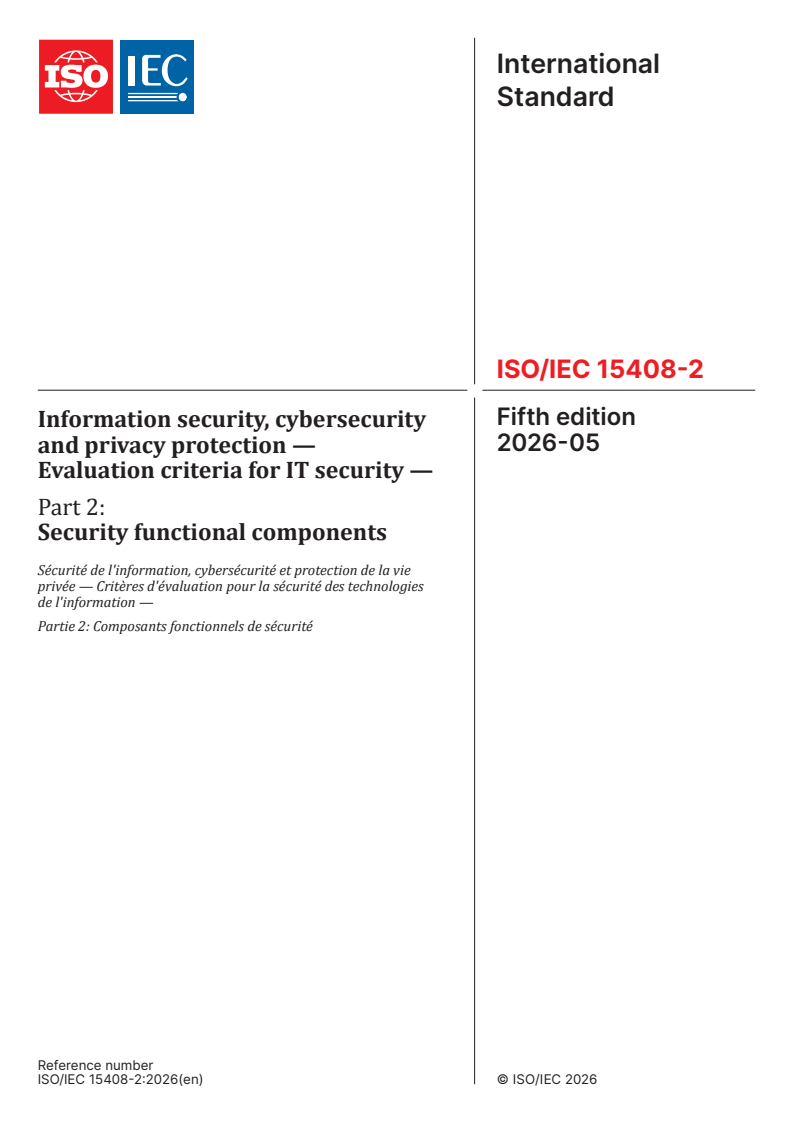
International
Standard
ISO/IEC 15408-2
Fifth edition
Information security, cybersecurity
2026-05
and privacy protection —
Evaluation criteria for IT security —
Part 2:
Security functional components
Sécurité de l'information, cybersécurité et protection de la vie
privée — Critères d'évaluation pour la sécurité des technologies
de l'information —
Partie 2: Composants fonctionnels de sécurité
Reference number
© ISO/IEC 2026
All rights reserved. Unless otherwise specified, or required in the context of its implementation, no part of this publication may
be reproduced or utilized otherwise in any form or by any means, electronic or mechanical, including photocopying, or posting on
the internet or an intranet, without prior written permission. Permission can be requested from either ISO at the address below
or ISO’s member body in the country of the requester.
ISO copyright office
CP 401 • Ch. de Blandonnet 8
CH-1214 Vernier, Geneva
Phone: +41 22 749 01 11
Email: copyright@iso.org
Website: www.iso.org
Published in Switzerland
© ISO/IEC 2026 – All rights reserved
ii
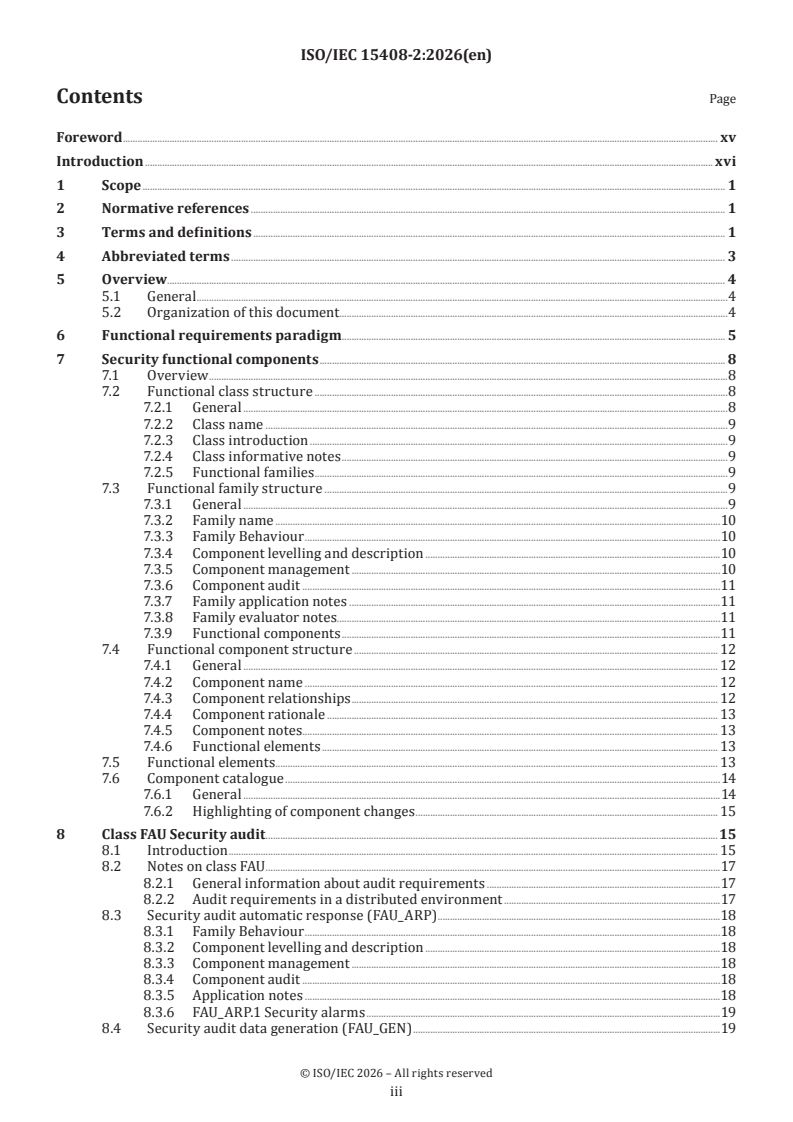
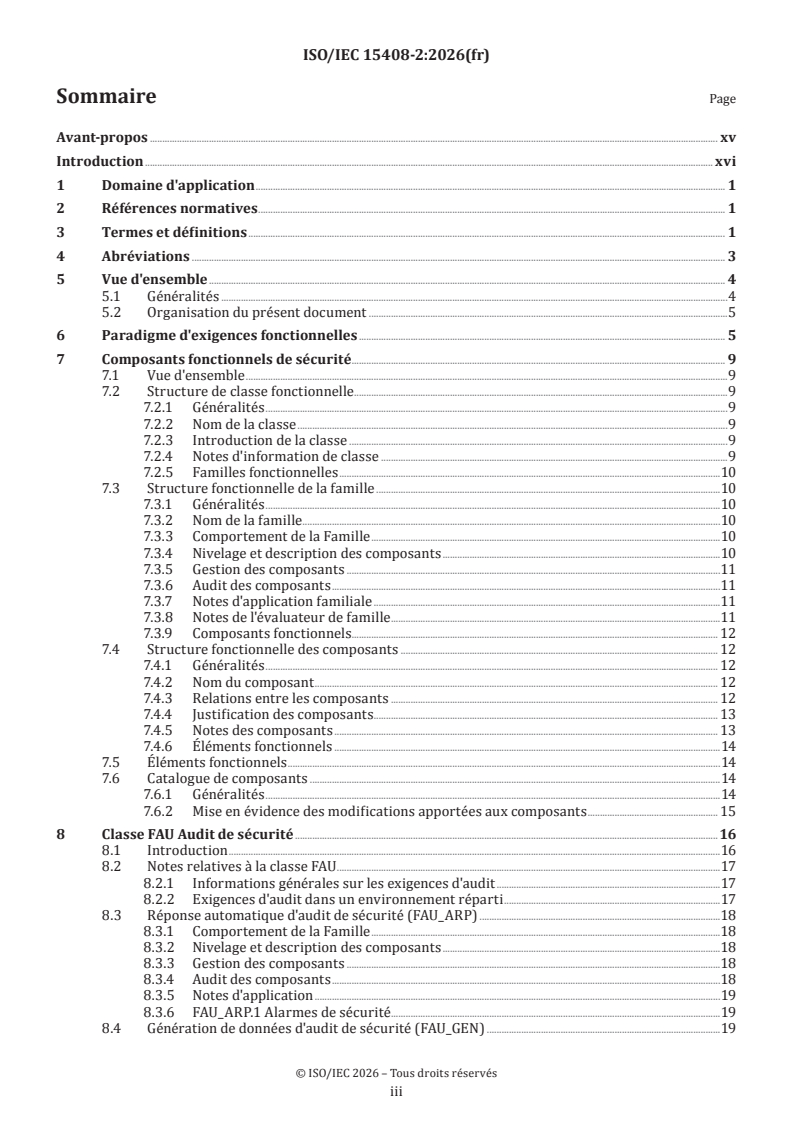
Contents Page
Foreword . xv
Introduction . xvi
1 Scope . 1
2 Normative references . 1
3 Terms and definitions . 1
4 Abbreviated terms . 3
5 Overview . 4
5.1 General .4
5.2 Organization of this document . .4
6 Functional requirements paradigm . . 5
7 Security functional components . 8
7.1 Overview .8
7.2 Functional class structure .8
7.2.1 General .8
7.2.2 Class name .9
7.2.3 Class introduction .9
7.2.4 Class informative notes .9
7.2.5 Functional families .9
7.3 Functional family structure .9
7.3.1 General .9
7.3.2 Family name .10
7.3.3 Family Behaviour .10
7.3.4 Component levelling and description .10
7.3.5 Component management .10
7.3.6 Component audit .11
7.3.7 Family application notes .11
7.3.8 Family evaluator notes.11
7.3.9 Functional components .11
7.4 Functional component structure . 12
7.4.1 General . 12
7.4.2 Component name . 12
7.4.3 Component relationships . 12
7.4.4 Component rationale . 13
7.4.5 Component notes . . 13
7.4.6 Functional elements . 13
7.5 Functional elements. 13
7.6 Component catalogue .14
7.6.1 General .14
7.6.2 Highlighting of component changes . 15
8 Class FAU Security audit .15
8.1 Introduction . 15
8.2 Notes on class FAU .17
8.2.1 General information about audit requirements .17
8.2.2 Audit requirements in a distributed environment .17
8.3 Security audit automatic response (FAU_ARP) .18
8.3.1 Family Behaviour .18
8.3.2 Component levelling and description .18
8.3.3 Component management .18
8.3.4 Component audit .18
8.3.5 Application notes .18
8.3.6 FAU_ARP.1 Security alarms .19
8.4 Security audit data generation (FAU_GEN) .19
© ISO/IEC 2026 – All rights reserved
iii
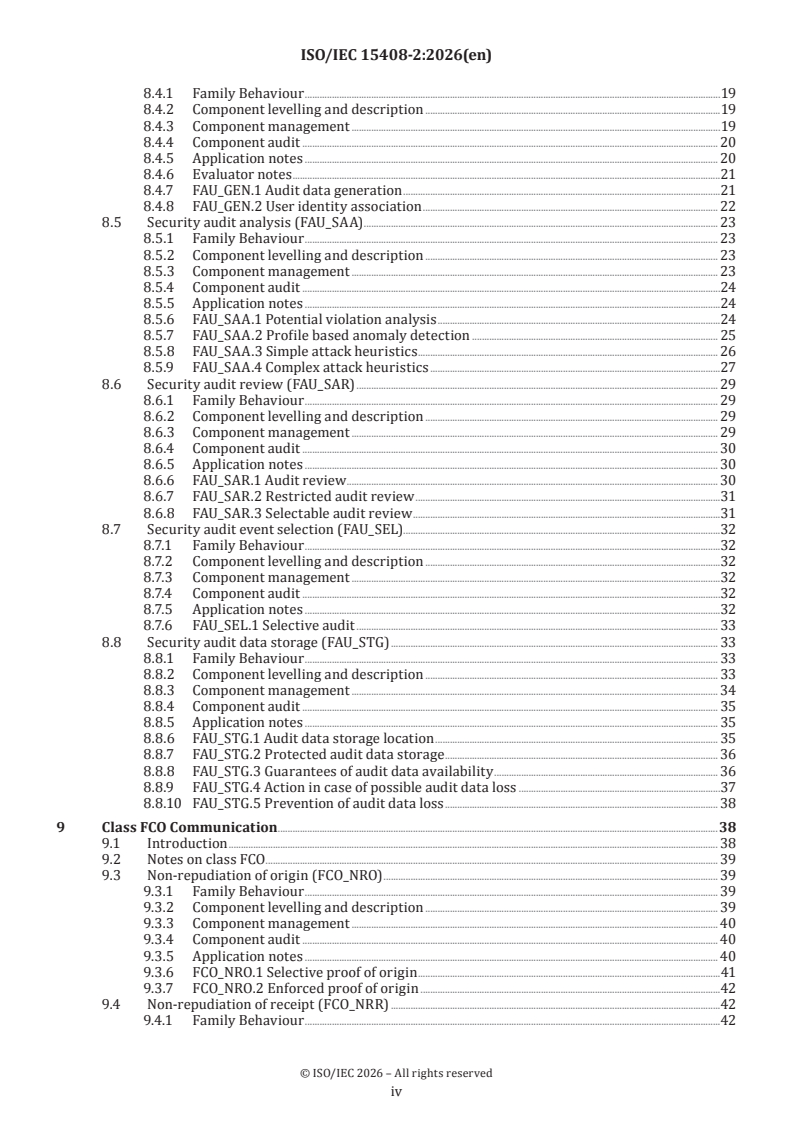
8.4.1 Family Behaviour .19
8.4.2 Component levelling and description .19
8.4.3 Component management .19
8.4.4 Component audit . 20
8.4.5 Application notes . 20
8.4.6 Evaluator notes .21
8.4.7 FAU_GEN.1 Audit data generation .21
8.4.8 FAU_GEN.2 User identity association . 22
8.5 Security audit analysis (FAU_SAA) . 23
8.5.1 Family Behaviour . 23
8.5.2 Component levelling and description . 23
8.5.3 Component management . 23
8.5.4 Component audit .24
8.5.5 Application notes .24
8.5.6 FAU_SAA.1 Potential violation analysis .24
8.5.7 FAU_SAA.2 Profile based anomaly detection . 25
8.5.8 FAU_SAA.3 Simple attack heuristics . 26
8.5.9 FAU_SAA.4 Complex attack heuristics .27
8.6 Security audit review (FAU_SAR) . 29
8.6.1 Family Behaviour . 29
8.6.2 Component levelling and description . 29
8.6.3 Component management . 29
8.6.4 Component audit . 30
8.6.5 Application notes . 30
8.6.6 FAU_SAR.1 Audit review . 30
8.6.7 FAU_SAR.2 Restricted audit review .31
8.6.8 FAU_SAR.3 Selectable audit review .31
8.7 Security audit event selection (FAU_SEL) .32
8.7.1 Family Behaviour .32
8.7.2 Component levelling and description .32
8.7.3 Component management .32
8.7.4 Component audit .32
8.7.5 Application notes .32
8.7.6 FAU_SEL.1 Selective audit . 33
8.8 Security audit data storage (FAU_STG) . 33
8.8.1 Family Behaviour . 33
8.8.2 Component levelling and description . 33
8.8.3 Component management . 34
8.8.4 Component audit . 35
8.8.5 Application notes . 35
8.8.6 FAU_STG.1 Audit data storage location . 35
8.8.7 FAU_STG.2 Protected audit data storage . 36
8.8.8 FAU_STG.3 Guarantees of audit data availability . 36
8.8.9 FAU_STG.4 Action in case of possible audit data loss .37
8.8.10 FAU_STG.5 Prevention of audit data loss . 38
9 Class FCO Communication .38
9.1 Introduction . 38
9.2 Notes on class FCO . . 39
9.3 Non-repudiation of origin (FCO_NRO) . 39
9.3.1 Family Behaviour . 39
9.3.2 Component levelling and description . 39
9.3.3 Component management . 40
9.3.4 Component audit . 40
9.3.5 Application notes . 40
9.3.6 FCO_NRO.1 Selective proof of origin .41
9.3.7 FCO_NRO.2 Enforced proof of origin .42
9.4 Non-repudiation of receipt (FCO_NRR) .42
9.4.1 Family Behaviour .42
© ISO/IEC 2026 – All rights reserved
iv
9.4.2 Component levelling and description .43
9.4.3 Component management .43
9.4.4 Component audit .43
9.4.5 Application notes .43
9.4.6 FCO_NRR.1 Selective proof of receipt . 44
9.4.7 FCO_NRR.2 Enforced proof of receipt .45
10 Class FCS Cryptographic support .46
10.1 Introduction . 46
10.2 Notes on class FCS . 48
10.3 Cryptographic key management (FCS_CKM) . 50
10.3.1 Family Behaviour . 50
10.3.2 Component levelling and description . 50
10.3.3 Component management .51
10.3.4 Component audit .51
10.3.5 Application notes .51
10.3.6 Evaluator notes .52
10.3.7 FCS_CKM.1 Cryptographic key generation .52
10.3.8 FCS_CKM.2 Cryptographic key distribution . 53
10.3.9 FCS_CKM.3 Cryptographic key access . 53
10.3.10 FCS_CKM.5 Cryptographic key derivation . 54
10.3.11 FCS_CKM.6 Timing and event of cryptographic key destruction . 55
10.4 Cryptographic operation (FCS_COP) . 56
10.4.1 Family Behaviour . 56
10.4.2 Component levelling and description . 56
10.4.3 Component management . 56
10.4.4 Component audit . 56
10.4.5 Application notes . 56
10.4.6 FCS_COP.1 Cryptographic operation .57
10.5 Random bit generation (FCS_RBG) . 58
10.5.1 Family Behaviour . 58
10.5.2 Component levelling and description . 58
10.5.3 Component management .59
10.5.4 Component audit .59
10.5.5 Application notes .59
10.5.6 FCS_RBG.1 Random bit generation (RBG) .59
10.5.7 FCS_RBG.2 Random bit generation (external seeding) .61
10.5.8 FCS_RBG.3 Random bit generation (internal seeding - single source) .61
10.5.9 FCS_RBG.4 Random bit generation (internal seeding - multiple sources) .62
10.5.10 FCS_RBG.5 Random bit generation (combining entropy sources) .62
10.5.11 FCS_RBG.6 Random bit generation service . 63
10.6 Generation of random numbers (FCS_RNG) . 63
10.6.1 Family Behaviour . 63
10.6.2 Component levelling and description . 64
10.6.3 Component management . 64
10.6.4 Component audit . 64
10.6.5 Application notes . 64
10.6.6 FCS_RNG.1 Random number generation . 64
11 Class FDP User data protection .66
11.1 Introduction . 66
11.2 Notes on class FDP . 69
11.3 Access control policy (FDP_ACC) .71
11.3.1 Family Behaviour .71
11.3.2 Component levelling and description . 72
11.3.3 Component management . 72
11.3.4 Component audit . 72
11.3.5 Application notes . 72
11.3.6 FDP_ACC.1 Subset access control . 73
11.3.7 FDP_ACC.2 Complete access control . 73
© ISO/IEC 2026 – All rights reserved
v
11.4 Access control functions (FDP_ACF) .74
11.4.1 Family Behaviour .74
11.4.2 Component levelling and description .74
11.4.3 Component management .74
11.4.4 Component audit . 75
11.4.5 Application notes . 75
11.4.6 FDP_ACF.1 Security attribute-based access control . 75
11.5 Data authentication (FDP_DAU) . 77
11.5.1 Family Behaviour . 77
11.5.2 Component levelling and description . 77
11.5.3 Component management . 77
11.5.4 Component audit . 77
11.5.5 Application notes . 78
11.5.6 FDP_DAU.1 Basic Data Authentication . 78
11.5.7 FDP_DAU.2 Data Authentication with Identity of Guarantor . 78
11.6 Export from the TOE (FDP_ETC) . 79
11.6.1 Family Behaviour . 79
11.6.2 Component levelling and description . 79
11.6.3 Component management . 80
11.6.4 Component audit . 80
11.6.5 Application notes . 80
11.6.6 FDP_ETC.1 Export of user data without security attributes . 80
11.6.7 FDP_ETC.2 Export of user data with security attributes . 81
11.7 Information flow control policy (FDP_IFC) . 82
11.7.1 Family Behaviour . 82
11.7.2 Component levelling and description . 82
11.7.3 Component management . 82
11.7.4 Component audit . 82
11.7.5 Application notes . 82
11.7.6 FDP_IFC.1 Subset information flow control. 83
11.7.7 FDP_IFC.2 Complete information flow control . 84
11.8 Information flow control functions (FDP_IFF) . 85
11.8.1 Family Behaviour . 85
11.8.2 Component levelling and description . 85
11.8.3 Component management . 86
11.8.4 Component audit . 86
11.8.5 Application notes . 86
11.8.6 FDP_IFF.1 Simple security attributes . 87
11.8.7 FDP_IFF.2 Hierarchical security attributes . 88
11.8.8 FDP_IFF.3 Limited illicit information flows. 90
11.8.9 FDP_IFF.4 Partial elimination of illicit information flows .91
11.8.10 FDP_IFF.5 No illicit information flows .91
11.8.11 FDP_IFF.6 Illicit information flow monitoring . 92
11.9 Information retention control (FDP_IRC) . 92
11.9.1 Family Behaviour . 92
11.9.2 Component levelling and description . 93
11.9.3 Component management . 93
11.9.4 Component audit . 93
11.9.5 Application notes . 93
11.9.6 FDP_IRC.1 Information retention control . 94
11.10 Import from outside of the TOE (FDP_ITC) . 94
11.10.1 Family Behaviour . 94
11.10.2 Component levelling and description . 94
11.10.3 Component management . 95
11.10.4 Component audit . 95
11.10.5 Application notes . 95
11.10.6 FDP_ITC.1 Import of user data without security attributes . 96
11.10.7 FDP_ITC.2 Import of user data with security attributes . 97
11.11 Internal TOE transfer (FDP_ITT) . 98
© ISO/IEC 2026 – All rights reserved
vi
11.11.1 Family Behaviour . 98
11.11.2 Component levelling and description . 98
11.11.3 Component management . 98
11.11.4 Component audit . 99
11.11.5 Application notes . 99
11.11.6 FDP_ITT.1 Basic internal transfer protection . 99
11.11.7 FDP_ITT.2 Transmission separation by attribute . 100
11.11.8 FDP_ITT.3 Integrity monitoring . 101
11.11.9 FDP_ITT.4 Attribute-based integrity monitoring . 101
11.12 Resid
...
Norme
internationale
ISO/IEC 15408-2
Cinquième édition
Sécurité de l'information,
2026-05
cybersécurité et protection de la
vie privée — Critères d'évaluation
pour la sécurité des technologies de
l'information —
Partie 2:
Composants fonctionnels de
sécurité
Information security, cybersecurity and privacy protection —
Evaluation criteria for IT security —
Part 2: Security functional components
Numéro de référence
DOCUMENT PROTÉGÉ PAR COPYRIGHT
© ISO/IEC 2026
Tous droits réservés. Sauf prescription différente ou nécessité dans le contexte de sa mise en œuvre, aucune partie de cette
publication ne peut être reproduite ni utilisée sous quelque forme que ce soit et par aucun procédé, électronique ou mécanique,
y compris la photocopie, ou la diffusion sur l’internet ou sur un intranet, sans autorisation écrite préalable. Une autorisation peut
être demandée à l’ISO à l’adresse ci-après ou au comité membre de l’ISO dans le pays du demandeur.
ISO copyright office
Case postale 401 • Ch. de Blandonnet 8
CH-1214 Vernier, Genève
Tél.: +41 22 749 01 11
E-mail: copyright@iso.org
Web: www.iso.org
Publié en Suisse
© ISO/IEC 2026 – Tous droits réservés
ii
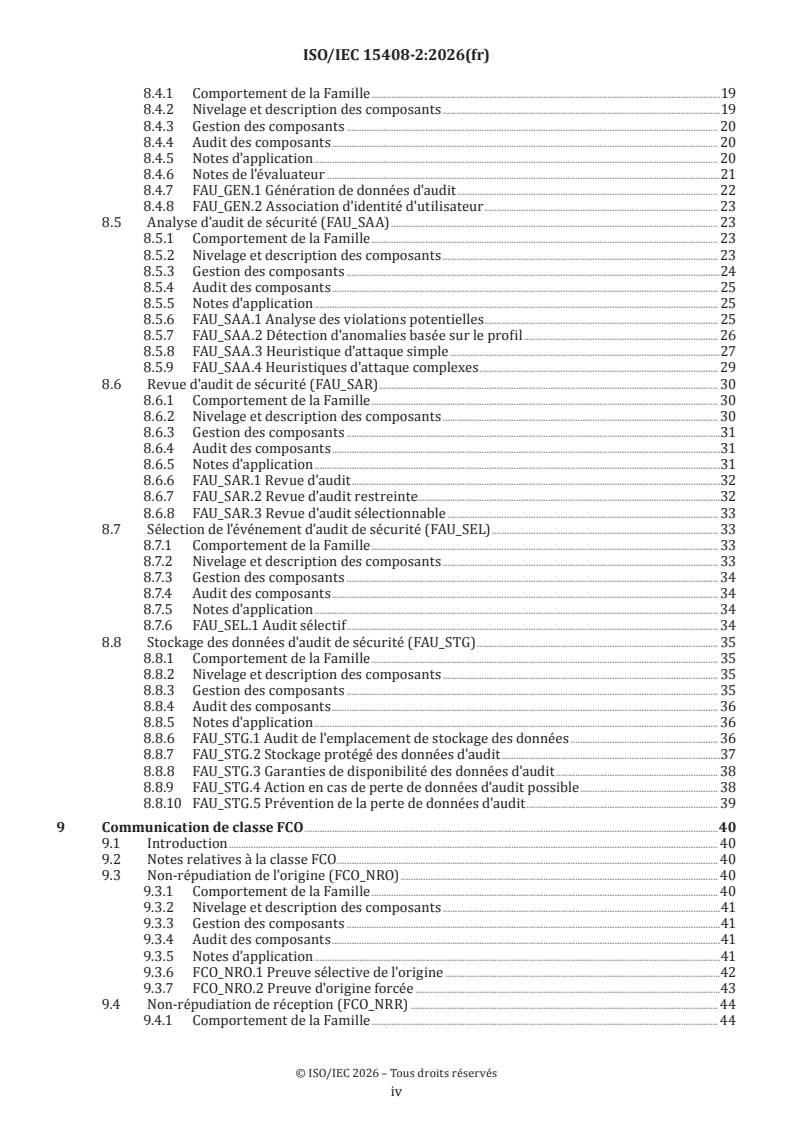
Sommaire Page
Avant-propos . xv
Introduction . xvi
1 Domaine d'application . 1
2 Références normatives . 1
3 Termes et définitions . 1
4 Abréviations . 3
5 Vue d'ensemble . 4
5.1 Généralités .4
5.2 Organisation du présent document .5
6 Paradigme d'exigences fonctionnelles . 5
7 Composants fonctionnels de sécurité . 9
7.1 Vue d'ensemble .9
7.2 Structure de classe fonctionnelle . .9
7.2.1 Généralités .9
7.2.2 Nom de la classe .9
7.2.3 Introduction de la classe .9
7.2.4 Notes d'information de classe .9
7.2.5 Familles fonctionnelles .10
7.3 Structure fonctionnelle de la famille .10
7.3.1 Généralités .10
7.3.2 Nom de la famille . .10
7.3.3 Comportement de la Famille .10
7.3.4 Nivelage et description des composants .10
7.3.5 Gestion des composants .11
7.3.6 Audit des composants .11
7.3.7 Notes d'application familiale .11
7.3.8 Notes de l'évaluateur de famille .11
7.3.9 Composants fonctionnels. 12
7.4 Structure fonctionnelle des composants . 12
7.4.1 Généralités . 12
7.4.2 Nom du composant . 12
7.4.3 Relations entre les composants . 12
7.4.4 Justification des composants . . 13
7.4.5 Notes des composants . 13
7.4.6 Éléments fonctionnels .14
7.5 Éléments fonctionnels .14
7.6 Catalogue de composants .14
7.6.1 Généralités .14
7.6.2 Mise en évidence des modifications apportées aux composants . 15
8 Classe FAU Audit de sécurité .16
8.1 Introduction .16
8.2 Notes relatives à la classe FAU .17
8.2.1 Informations générales sur les exigences d'audit .17
8.2.2 Exigences d'audit dans un environnement réparti .17
8.3 Réponse automatique d'audit de sécurité (FAU_ARP) .18
8.3.1 Comportement de la Famille .18
8.3.2 Nivelage et description des composants .18
8.3.3 Gestion des composants .18
8.3.4 Audit des composants .18
8.3.5 Notes d'application .19
8.3.6 FAU_ARP.1 Alarmes de sécurité . .19
8.4 Génération de données d'audit de sécurité (FAU_GEN) .19
© ISO/IEC 2026 – Tous droits réservés
iii
8.4.1 Comportement de la Famille .19
8.4.2 Nivelage et description des composants .19
8.4.3 Gestion des composants . 20
8.4.4 Audit des composants . 20
8.4.5 Notes d'application . 20
8.4.6 Notes de l'évaluateur .21
8.4.7 FAU_GEN.1 Génération de données d'audit . 22
8.4.8 FAU_GEN.2 Association d'identité d'utilisateur . 23
8.5 Analyse d'audit de sécurité (FAU_SAA) . 23
8.5.1 Comportement de la Famille . 23
8.5.2 Nivelage et description des composants . 23
8.5.3 Gestion des composants .24
8.5.4 Audit des composants . 25
8.5.5 Notes d'application . 25
8.5.6 FAU_SAA.1 Analyse des violations potentielles . 25
8.5.7 FAU_SAA.2 Détection d'anomalies basée sur le profil . 26
8.5.8 FAU_SAA.3 Heuristique d'attaque simple .27
8.5.9 FAU_SAA.4 Heuristiques d'attaque complexes . 29
8.6 Revue d'audit de sécurité (FAU_SAR) . 30
8.6.1 Comportement de la Famille . 30
8.6.2 Nivelage et description des composants . 30
8.6.3 Gestion des composants .31
8.6.4 Audit des composants .31
8.6.5 Notes d'application .31
8.6.6 FAU_SAR.1 Revue d'audit .32
8.6.7 FAU_SAR.2 Revue d'audit restreinte . .32
8.6.8 FAU_SAR.3 Revue d'audit sélectionnable . 33
8.7 Sélection de l'événement d'audit de sécurité (FAU_SEL) . 33
8.7.1 Comportement de la Famille . 33
8.7.2 Nivelage et description des composants . 33
8.7.3 Gestion des composants . 34
8.7.4 Audit des composants . 34
8.7.5 Notes d'application . 34
8.7.6 FAU_SEL.1 Audit sélectif . 34
8.8 Stockage des données d'audit de sécurité (FAU_STG) . 35
8.8.1 Comportement de la Famille . 35
8.8.2 Nivelage et description des composants . 35
8.8.3 Gestion des composants . 35
8.8.4 Audit des composants . 36
8.8.5 Notes d'application . 36
8.8.6 FAU_STG.1 Audit de l'emplacement de stockage des données . 36
8.8.7 FAU_STG.2 Stockage protégé des données d'audit .37
8.8.8 FAU_STG.3 Garanties de disponibilité des données d'audit . 38
8.8.9 FAU_STG.4 Action en cas de perte de données d'audit possible . 38
8.8.10 FAU_STG.5 Prévention de la perte de données d'audit . 39
9 Communication de classe FCO .40
9.1 Introduction . 40
9.2 Notes relatives à la classe FCO . . 40
9.3 Non-répudiation de l'origine (FCO_NRO) . 40
9.3.1 Comportement de la Famille . 40
9.3.2 Nivelage et description des composants .41
9.3.3 Gestion des composants .41
9.3.4 Audit des composants .41
9.3.5 Notes d'application .41
9.3.6 FCO_NRO.1 Preuve sélective de l'origine .42
9.3.7 FCO_NRO.2 Preuve d'origine forcée .43
9.4 Non-répudiation de réception (FCO_NRR) . 44
9.4.1 Comportement de la Famille . 44
© ISO/IEC 2026 – Tous droits réservés
iv
9.4.2 Nivelage et description des composants . 44
9.4.3 Gestion des composants . 44
9.4.4 Audit des composants . 44
9.4.5 Notes d'application .45
9.4.6 FCO_NRR.1 Preuve sélective de réception . 46
9.4.7 FCO_NRR.2 Preuve de réception forcée .47
10 Classe FCS Support cryptographique . 47
10.1 Introduction .47
10.2 Notes relatives à la classe FCS . 49
10.3 Gestion des clés cryptographiques (FCS_CKM) .51
10.3.1 Comportement de la Famille .51
10.3.2 Nivelage et description des composants .51
10.3.3 Gestion des composants .52
10.3.4 Audit des composants .52
10.3.5 Notes d'application .52
10.3.6 Notes de l'évaluateur . 53
10.3.7 FCS_CKM.1 Génération de clés cryptographiques . 53
10.3.8 FCS_CKM.2 Distribution de clés cryptographiques . 54
10.3.9 FCS_CKM.3 Accès aux clés cryptographiques . 54
10.3.10 FCS_CKM.5 Dérivement de clés cryptographiques . 55
10.3.11 FCS_CKM.6 Moment et événement de la destruction des clés cryptographiques . 56
10.4 Opération cryptographique (FCS_COP) .57
10.4.1 Comportement de la Famille .57
10.4.2 Nivelage et description des composants .57
10.4.3 Gestion des composants .57
10.4.4 Audit des composants .57
10.4.5 Notes d'application .57
10.4.6 FCS_COP.1 Opération cryptographique . 58
10.5 Génération aléatoire de bits (FCS_RBG) .59
10.5.1 Comportement de la Famille .59
10.5.2 Nivelage et description des composants .59
10.5.3 Gestion des composants . 60
10.5.4 Audit des composants . 60
10.5.5 Notes d'application .61
10.5.6 FCS_RBG.1 Génération aléatoire de bits (RBG) .61
10.5.7 FCS_RBG.2 Génération aléatoire de bits (semencement externe) .62
10.5.8 FCS_RBG.3 Génération aléatoire de bits (semence interne - source unique) . 63
10.5.9 FCS_RBG.4 Génération aléatoire de bits (semence interne - sources multiples) . 64
10.5.10 FCS_RBG.5 Génération aléatoire de bits (combinant sources d'entropie) . 64
10.5.11 FCS_RBG.6 Service aléatoire de génération de bits . 65
10.6 Génération de nombres aléatoires (FCS_RNG) . 65
10.6.1 Comportement de la Famille . 65
10.6.2 Nivelage et description des composants . 65
10.6.3 Gestion des composants . 66
10.6.4 Audit des composants . 66
10.6.5 Notes d'application . 66
10.6.6 FCS_RNG.1 Génération aléatoire de nombres . 66
11 Classe FDP Protection des données de l'utilisateur .68
11.1 Introduction . 68
11.2 Notes relatives à la classe FDP. 72
11.3 Politique de contrôle d'accès (FDP_ACC) .74
11.3.1 Comportement de la Famille .74
11.3.2 Nivelage et description des composants .74
11.3.3 Gestion des composants .74
11.3.4 Audit des composants .74
11.3.5 Notes d'application . 75
11.3.6 FDP_ACC.1 Sous-ensemble de contrôle d'accès . 75
11.3.7 FDP_ACC.2 Contrôle d'accès complet .76
© ISO/IEC 2026 – Tous droits réservés
v
11.4 Fonctions de contrôle d'accès (FDP_ACF) .76
11.4.1 Comportement de la Famille .76
11.4.2 Nivelage et description des composants . 77
11.4.3 Gestion des composants . 77
11.4.4 Audit des composants . 77
11.4.5 Notes d'application . 77
11.4.6 FDP_ACF.1 Contrôle d'accès basé sur les attributs de sécurité . 78
11.5 Authentification des données (FDP_DAU) . 79
11.5.1 Comportement de la Famille . 79
11.5.2 Nivelage et description des composants . 79
11.5.3 Gestion des composants . 80
11.5.4 Audit des composants . 80
11.5.5 Notes d'application . 80
11.5.6 FDP_DAU.1 Authentification de base des données . 80
11.5.7 FDP_DAU.2 Authentification des données avec l'identité du garant . 81
11.6 Export de la TOE (FDP_ETC) . 82
11.6.1 Comportement de la Famille . 82
11.6.2 Nivelage et description des composants . 82
11.6.3 Gestion des composants . 82
11.6.4 Audit des composants . 82
11.6.5 Notes d'application . 82
11.6.6 FDP_ETC.1 Export de données utilisateur sans attributs de sécurité . 83
11.6.7 FDP_ETC.2 Export de données utilisateur avec attributs de sécurité . 83
11.7 Politique de contrôle du flux d'informations (FDP_IFC) . 84
11.7.1 Comportement de la Famille . 84
11.7.2 Nivelage et description des composants . 85
11.7.3 Gestion des composants . 85
11.7.4 Audit des composants . 85
11.7.5 Notes d'application . 85
11.7.6 FDP_IFC.1 Contrôle du flux d'informations du sous-ensemble . 86
11.7.7 FDP_IFC.2 Contrôle complet du flux d'informations . 87
11.8 Fonctions de contrôle du flux d'information (FDP_IFF) . 87
11.8.1 Comportement de la Famille . 87
11.8.2 Nivelage et description des composants . 88
11.8.3 Gestion des composants . 88
11.8.4 Audit des composants . 89
11.8.5 Notes d'application . 89
11.8.6 FDP_IFF.1 Attributs de sécurité simples . 90
11.8.7 FDP_IFF.2 Attributs de sécurité hiérarchiques .91
11.8.8 FDP_IFF.3 Flux limités d'informations illicites . 93
11.8.9 FDP_IFF.4 Élimination partielle des flux d'informations illicites . 94
11.8.10 FDP_IFF.5 Aucun flux d'informations illicites . 95
11.8.11 FDP_IFF.6 Surveillance du flux d'informations illicites . 95
11.9 Contrôle de la conservation de l'information (FDP_IRC) . 96
11.9.1 Comportement de la Famille . 96
11.9.2 Nivelage et description des composants . 96
11.9.3 Gestion des composants . 97
11.9.4 Audit des composants . 97
11.9.5 Notes d'application . 97
11.9.6 FDP_IRC.1 Contrôle de la conservation de l'information . 97
11.10 Importation depuis l'extérieur de la TOE (FDP_ITC) . 98
11.10.1 Comportement de la Famille . 98
11.10.2 Nivelage et description des composants . 98
11.10.3 Gestion des composants . 99
11.10.4 Audit des composants . 99
11.10.5 Notes d'application . 99
11.10.6 FDP_ITC.1 Importation de données utilisateur sans attributs de sécurité . 100
11.10.7 FDP_ITC.2 Importation de données utilisateur avec attributs de sécurité . 101
11.11 Transfert interne de la TOE (FDP_ITT) . 102
© ISO/IEC 2026 – Tous droits réservés
vi
11.11.1 Comportement de la Famille . 102
11.11.2 Nivelage et description des composants . 102
11.11.3 Gestion des composants . 103
11.11.4 Audit des composants . 103
11.11.5 Notes d'application . 103
11.11.6 FDP_ITT.1 Protection de transfert interne de base . 104
11.11.7 FDP_ITT.2 Séparation de transmission par attribut . 104
11.11.8 FDP_ITT.3 Surveillance de l'intégrité . 105
11.11.9 FDP_ITT.4 Surveillance de l'intégrité basée sur les attributs . 106
11.12 Protection des informations résiduelles (FDP_RIP) . 107
11.12.1 Comportement de la Famille . 107
11.12.2 Nivelage et description des composants . 107
11.12.3 Gestion des composants . 107
11.12.4 Audit des composants . 107
11.12.5 Notes d'application . 108
11.12.6 FDP_RIP.1 Sous-ensemble de protection des informations résiduelles . 109
11.12.7 FDP_RIP.2 Protection complète des informations résiduelles . 109
11.13 Rollback (FDP_ROL) .110
11.13.1 Comportement de la Famille .110
11.13.2 Nivelage et description des composants .
...