

ISO 5663:1984
(Main)Water quality — Determination of Kjeldahl nitrogen — Method after mineralization with selenium
General Information
- Abstract
Specifies a procedure for the determination of trivalent negative nitrogen. Organic nitrogen in the form of azide, azine, azo, hydrazone, nitrite, nitro, nitroso, oxime or semicarbazone is not determined quantitatively. The procedure is applicable to the analysis of raw, potable and waste waters.
- Status
- Published
- Publication Date
- 30-Apr-1984
- Technical Committee
- ISO/TC 147/SC 2 - Physical, chemical and biochemical methods
- Drafting Committee
- ISO/TC 147/SC 2 - Physical, chemical and biochemical methods
- Current Stage
- 9092 - International Standard to be revised
- Start Date
- 14-Mar-2025
- Completion Date
- 29-Aug-2026
Buy Documents
ISO 5663:1984 - Water quality — Determination of Kjeldahl nitrogen — Method after mineralization with selenium Released:5/1/1984
ISO 5663:1984 - Qualité de l'eau — Dosage de l'azote Kjeldahl — Méthode apres minéralisation au sélénium Released:5/1/1984
ISO 5663:1984 - Qualité de l'eau — Dosage de l'azote Kjeldahl — Méthode apres minéralisation au sélénium Released:5/1/1984
Overview
ISO 5663:1984 is an international standard developed by the International Organization for Standardization (ISO) that specifies a procedure for the determination of Kjeldahl nitrogen in water. This method is particularly important for laboratories analyzing water quality, as it enables the quantification of trivalent negative nitrogen after mineralization with selenium. The standard applies to various water types, including raw, potable, and waste waters, supporting environmental monitoring and regulatory compliance in the field of water analysis.
The significance of the Kjeldahl method lies in its ability to assess the presence of organic and ammoniacal nitrogen forms, which are key indicators of water pollution and overall quality. This standard does not quantitatively determine certain organic nitrogen forms such as azide, azine, azo, hydrazone, nitrite, nitro, nitroso, oxime, or semicarbazone.
Key Topics
- Kjeldahl Nitrogen Determination: The method focuses on measuring organic and ammoniacal nitrogen, providing essential data for water quality assessment.
- Selenium Mineralization: Selenium is used as a catalyst in place of mercury, reflecting growing health and environmental considerations.
- Applicability: Suitable for raw, drinking, and waste water samples, supporting a wide range of water quality monitoring requirements.
- Limitations: The method is specific to certain nitrogen compounds, excluding quantitative measurement of several organically bound nitrogen forms.
- Interference and Sensitivity: The presence of nitrate, nitrite, and some organic compounds may affect accuracy, potentially producing high or low results.
- Detection Range: Enables detection of Kjeldahl nitrogen concentrations up to 1,000 mg/L, with a limit of detection around 1 mg/L under specified conditions.
- Laboratory Precautions: Details on handling toxic reagents and proper disposal, especially regarding selenium, are included for safe laboratory practice.
Applications
ISO 5663:1984 is widely utilized in:
- Environmental Water Testing: Regulatory bodies, environmental agencies, and research institutions use this standard method to monitor nitrogen levels in natural waters, ensuring ecosystem health.
- Drinking Water Quality Control: Municipal water treatment plants analyze potable water to comply with safety standards and manage nitrogen-based pollutants.
- Wastewater Analysis: Wastewater treatment facilities rely on this method to track nitrogen removal efficiency and comply with environmental discharge regulations.
- Industrial Water Management: Industries that produce or treat water utilize the Kjeldahl determination to monitor effluents for sustainable environmental practices.
- Laboratory Standardization: Analytical chemistry laboratories apply ISO 5663 procedures for consistent, internationally recognized results.
The standard’s robust approach supports accurate evaluation of nitrogen pollution, assists in compliance with environmental legislation, and contributes to public and ecological health protection.
Related Standards
Several ISO standards complement ISO 5663:1984, providing comprehensive guidance for water analysis:
- ISO 7150-1:1984 - Water quality - Determination of ammonium - Part 1: Manual spectrometric method.
- ISO/TC 147 - A suite of standards related to water quality testing, covering various chemical, physical, and biological methods.
- Other Kjeldahl Methods - National standards or methods for nitrogen determination in different sample types.
Organizations involved in water quality monitoring may reference multiple standards to ensure accurate and legally defensible analytical results.
Keywords: water quality, Kjeldahl nitrogen, selenium mineralization, ISO 5663:1984, water pollution, nitrogen analysis, laboratory methods, wastewater, potable water, raw water, nitrogen detection, environmental standards, chemical analysis.
Relations
- Effective Date
- 25-Aug-2026
- Effective Date
- 25-Aug-2026
- Consolidated By
ISO 20645:2004 - Textile fabrics — Determination of antibacterial activity — Agar diffusion plate test - Effective Date
- 06-Jun-2022
Buy Documents
ISO 5663:1984 - Water quality — Determination of Kjeldahl nitrogen — Method after mineralization with selenium Released:5/1/1984
ISO 5663:1984 - Qualité de l'eau — Dosage de l'azote Kjeldahl — Méthode apres minéralisation au sélénium Released:5/1/1984
ISO 5663:1984 - Qualité de l'eau — Dosage de l'azote Kjeldahl — Méthode apres minéralisation au sélénium Released:5/1/1984
Get Certified
Connect with accredited certification bodies for this standard

CIS Institut d.o.o.
Personal Protective Equipment (PPE) certification body. Notified Body NB-2890 for EU Regulation 2016/425 PPE.

Kiwa BDA Testing
Building and construction product certification.
Kmetijski inštitut Slovenije
Agricultural Institute of Slovenia. Soil testing, plant health, agricultural product analysis.
Sponsored listings
Frequently Asked Questions
ISO 5663:1984 is a standard published by the International Organization for Standardization (ISO). Its full title is "Water quality — Determination of Kjeldahl nitrogen — Method after mineralization with selenium". This standard covers: Specifies a procedure for the determination of trivalent negative nitrogen. Organic nitrogen in the form of azide, azine, azo, hydrazone, nitrite, nitro, nitroso, oxime or semicarbazone is not determined quantitatively. The procedure is applicable to the analysis of raw, potable and waste waters.
Specifies a procedure for the determination of trivalent negative nitrogen. Organic nitrogen in the form of azide, azine, azo, hydrazone, nitrite, nitro, nitroso, oxime or semicarbazone is not determined quantitatively. The procedure is applicable to the analysis of raw, potable and waste waters.
ISO 5663:1984 is classified under the following ICS (International Classification for Standards) categories: 13.060.50 - Examination of water for chemical substances. The ICS classification helps identify the subject area and facilitates finding related standards.
ISO 5663:1984 has the following relationships with other standards: It is inter standard links to EN ISO 14855-1:2012, EN ISO 14855-2:2009, ISO 20645:2004. Understanding these relationships helps ensure you are using the most current and applicable version of the standard.
ISO 5663:1984 is available in PDF format for immediate download after purchase. The document can be added to your cart and obtained through the secure checkout process. Digital delivery ensures instant access to the complete standard document.
Standards Content (Sample)
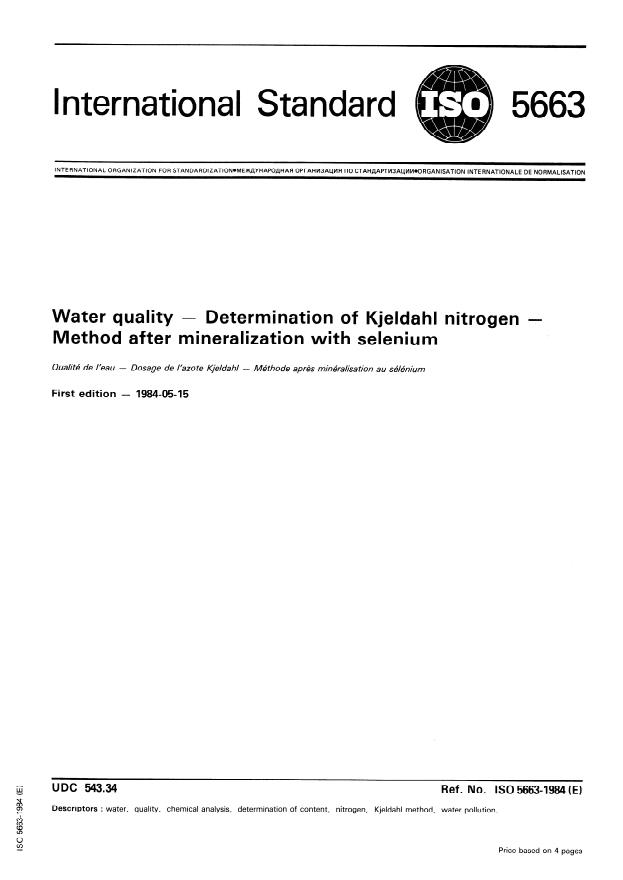
International Standard
INTERNATIONAL ORGANIZATION FOR STANDARDIZATlON.MEIK,QYHAPOfiHAFI OPrAHM3A~MR IlO CTAH~APTM3Al@lM.ORGANlSATlON INTERNATIONALE DE NORMALISATION
Water quality -
Determination of Kjeldahl nitrogen -
Method after mineralization with selenium
Qua/it& de l’eau - Dosage de l’azote Kjeldahl - Mb thode aprks min&alisa tion au s&nium
First edition - 1984~05-m
UDC 543.34 Ref. No. IS0 5663-1984 (E)
determination of content, nitrogen, Kjeldahl method, water pollution.
Descriptors : water, quality, chemical analysis,
Price based on 4 pages
Foreword
IS0 (the International Organization for Standardization) is a worldwide federation of
national standards bodies (IS0 member bodies). The work of developing International
Standards is carried out through IS0 technical committees. Every member body
interested in a subject for which a technical committee has been authorized has the
right to be represented on that committee. International organizations, governmental
and non-governmental, in liaison with ISO, also take part in the work.
Draft International Standards adopted by the technical committees are circulated to
the member bodies for approval before their acceptance as International Standards by
the IS0 Council.
International Standard IS0 5663 was developed by Technical Committee ISO/TC 147,
Water quality, and was circulated to the member bodies in December 1982.
It has been approved by the member bodies of the following countries:
Australia Norway
Germany, F. R.
Austria Hungary Poland
Belgium
India Romania
Brazil Iran South Africa, Rep. of
Canada
Iraq Spain
China Sweden
Italy
Czechoslovakia Korea, Dem. P. Rep. of Switzerland
Denmark Thailand
Mexico
Egypt, Arab Rep. of Netherlands USSR
France New Zealand
The member bodies of the following countries expressed disapproval of the document
on technical grounds :
Japan
United Ki ngdom
0 International Organization for Standardization, 1984
Printed in Switzerland
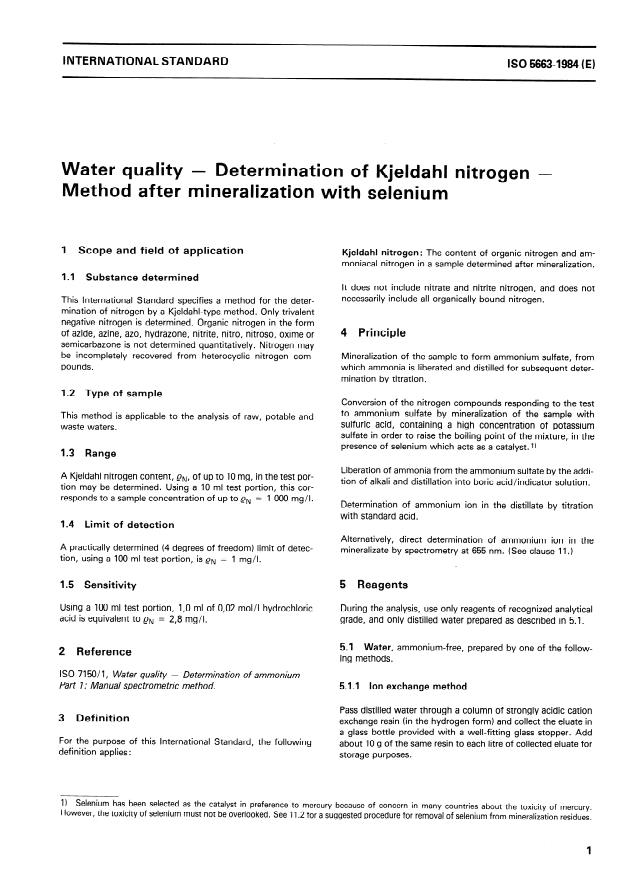
INTERNATIONAL STANDARD IS0 5663-1984 (E)
Water quality - Determination of Kjeldahl nitrogen -
Method after mineralization with selenium
1 Scope and field of application Kjeldahl nitrogen: The content of organic nitrogen and am-
moniacal nitrogen in a sample determined after mineralization.
1 .I Substance determined
It does not include nitrate and nitrite nitrogen, and does not
necessarily include all organically bound nitrogen.
This International Standard specifies a method for the deter-
mination of nitrogen by a Kjeldahl-type method. Only trivalent
negative nitrogen is determined. Organic nitrogen in the form
4 Principle
of azide, azine, azo, hydrazone, nitrite, nitro, nitroso, oxime or
semicarbazone is not determined quantitatively. Nitrogen may
Mineralization of the sample to form ammonium sulfate, from
be incompletely recovered from heterocyclic nitrogen com-
which ammonia is liberated and distilled for subsequent deter-
pounds.
mination by titration.
1.2 Type of sample
Conversion of the nitrogen compounds responding to the test
to ammonium sulfate by mineralization of the sample with
This method is applicable to the analysis of raw, potable and
sulfuric acid, containing a high concentration of potassium
waste waters.
sulfate in order to raise the boiling point of the mixture, in the
presence of selenium which acts as a catalyst. 1)
1.3 Range
Liberation of ammonia from the ammonium sulfate by the addi-
A Kjeldahl nitrogen content, @N, of up to IO mg, in the test por-
tion of alkali and distillation into boric acid/indicator solution.
tion may be determined. Using a IO ml test portion, this cor-
responds to a sample concentration of up to @N = I 000 mg/l.
Determination of ammonium ion in the distillate by titration
with standard acid.
1.4 Limit of detection
Alternatively, direct determination of ammonium ion in the
A practically determined (4 degrees of freedom) limit of detec-
mineralizate by spectrometry at 655 nm. (See clause I I .)
tion, using a 100 ml test portion, is ,oN = 1 mg/l.
5 Reagents
1.5 Sensitivity
During the analysis, use only reagents of recognized analytical
Using a 100 ml test portion, I,0 ml of 0,02 mol/l hydrochloric
grade, and only distilled water prepared as described in 5.1.
acid is equivalent to @N = 2,8 mg/l.
5.1 Water, ammonium-free, prepared by one of the follow-
2 Reference
ing methods.
IS0 71501 I, Water quality - Determination of ammonium -
5.1.1 Ion exchange method
Part 7: Manual spectrometric method.
Pass distilled water through a column of strongly acidic cation
3 Definition
exchange resin (in the hydrogen form) and collect the eluate in
a glass bottle provided with a well-fitting glass stopper. Add
For the purpose of this International Standard, the following
about IO g of the same resin to each litre of collected eluate for
definition applies :
storage purposes.
1) Selenium has been selected as the catalyst in preference to mercury because of concern in many countries about the toxicity of mercury.
However, the toxicity of selenium must not be overlooked. See 11.2 for a suggested procedure for removal of selenium from mineralization residues.
IS0 5663-1984 (El
5.1.2 Distillation method 5.8 Catalyst mixture.
- This mixture is toxic. Inhalation of any dust
WARNING
Add 0,lO +_ 0,Ol ml of sulfuric acid (5.3) to 1 000 +_ 10 ml of
resulting from its preparation or use shall be avoided. All
distilled water and redistil in all glass apparatus. Discard the
residues containing selenium shall be collected for
first 50 ml of distillate, and then collect the distillate in a g!ass
selenium recovery (11.2) or controlled disposal.
bottle provided with a well-fitting glass stopper. Add about
IO g of strongly acidic cation exchange resin (in the hydrogen
Thoroughly mix 1 000 + 20 g of potassium sulfate and
form) to each litre of collected distillate.
10,O + 0,2 g of selenium pellets.
5.2 Hydrochloric acid, Q = 1,18 g/ml.
5.9 Anti-bumping granules.
5.3 Sulfuric acid, Q = 1,84 g/ml.
6 Apparatus
WARNING - This reagent causes severe burns.
Ordinary laboratory apparatus and :
The highest purity sulfuric acid shall always be used. Pay par-
6.1 Kjeldahl mineralization flasks, specially designed, of
ticular attention to the manufacturer’s specification with
sufficient capacity to accommodate the test portion volume to
respect to its nitrogen content.
be used in the analysis, and in any event not exceeding 500 ml.
5.4 Sodium hydroxide, approximately 500 g/l solution. They should preferably be suitable for direct attachment to the
distillation apparatus (6.2).
WARNING - This reagent causes severe burns.
6.2 Distillation apparatus,
incorporating an anti-splash
Dissolve 500 + 20 g of sodium hydroxide in about 800 ml of
distillation head and a vertical condenser whose outlet can be
water. Cool to room temperature and dilute to 1 litre with water
submerged in the absorbent solution.
in a measuring cylinder.
5.5 Hydrochloric acid, standard volumetric solution,
c( HCI) = 0,lO mol/l.
NOTE ON PRELIMINARY CLEANING OF THE DISTILLATION
This solution shall be prepared by dilution of hydrochloric acid
APPARATUS
(5.2) followed by standardization by normal analytical pro-
cedures. Alternatively, a commercial solution of guaranteed
out th e following procedure whenever
Carry the apparatus has
concentration may be used.
been out of use for more than a few days.
Add about 350 ml of water (5.1) to the distillation flask. Add a
5.6 Hydrochloric acid, standard volumetric solution,
few anti-bumping granules (5.9), assemble the apparatus, and
c(HCI) = 0,02 mol/l.
distil at least 100 ml. Discard the distillate and the residue in the
distillation flask.
This solution shall be prepared by dilution of hydrochloric acid
(5.2 or 5.5) followed by standardization by normal analytical
procedures. Alternatively, a commercial solution of guaranteed
7 Sampling and samples
concentration may be used.
Laboratory samples shall be collected in polyethylene or glass
bottles. They should be analysed as quickly as possible, or else
5.7 Boric acid/indicator, solution.
stored at between 2 and 5 OC until analysed. Acidification with
sulfuric acid (5.3) to < pH 2 may also be used as an aid to
preservation, provided that possible contamination of the
5.7.1 D
...
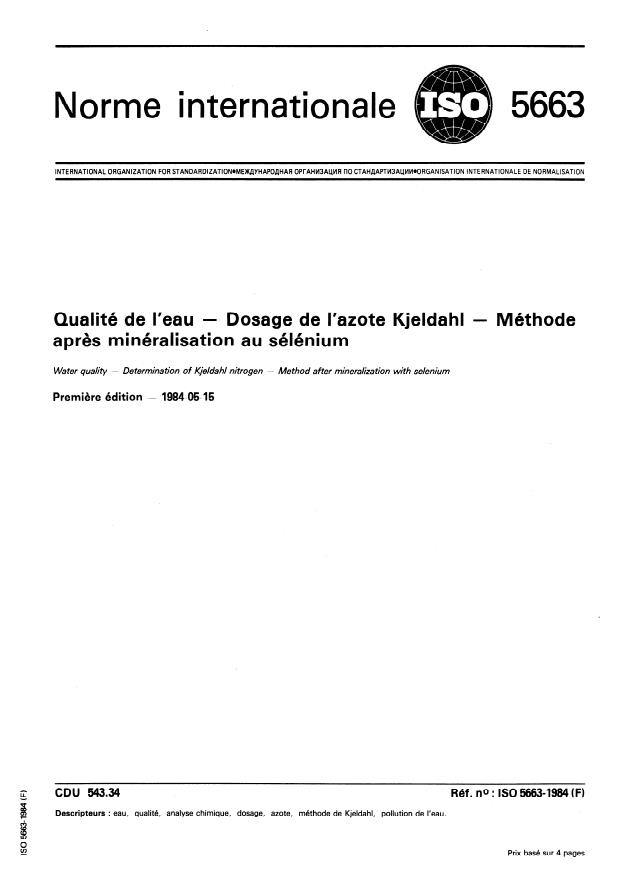
Norme internationale
INTERNATIONAL ORGANIZATION FOR STANDARDIZATION.ME)I(~YHAPOJJHAR OPrAHM3A~Mfl fl0 CTAH~APTbl3A~MM.ORGANISATlON INTERNATIONALE DE NORMALISATION
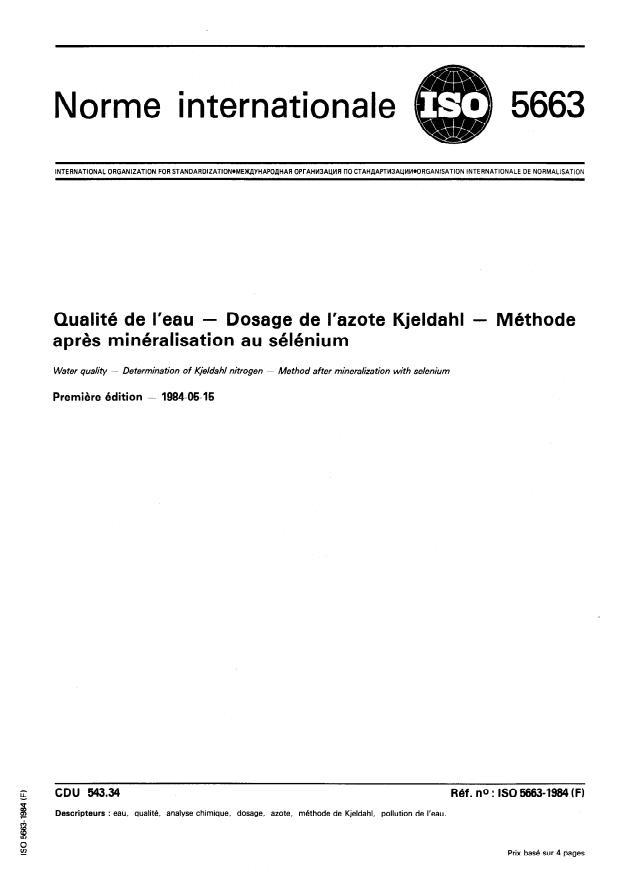
Qualité de l’eau - Dosage de l’azote Kjeldahl - Méthode
après minéralisation au sélénium
Water qua@ - Determination of Kjeldahl nitrogen - Method after mineraliza tion with selenium
Première édition - 1984-05-15
CDU 543.34 Réf. no : ISO 5663-1984 (FI
Gz
Y
Descripteurs : eau, qualité, analyse chimique, dosage, azote, méthode de Kjeldahl, pollution de l’eau.
I
P
v)
Prix basé sur 4 pages
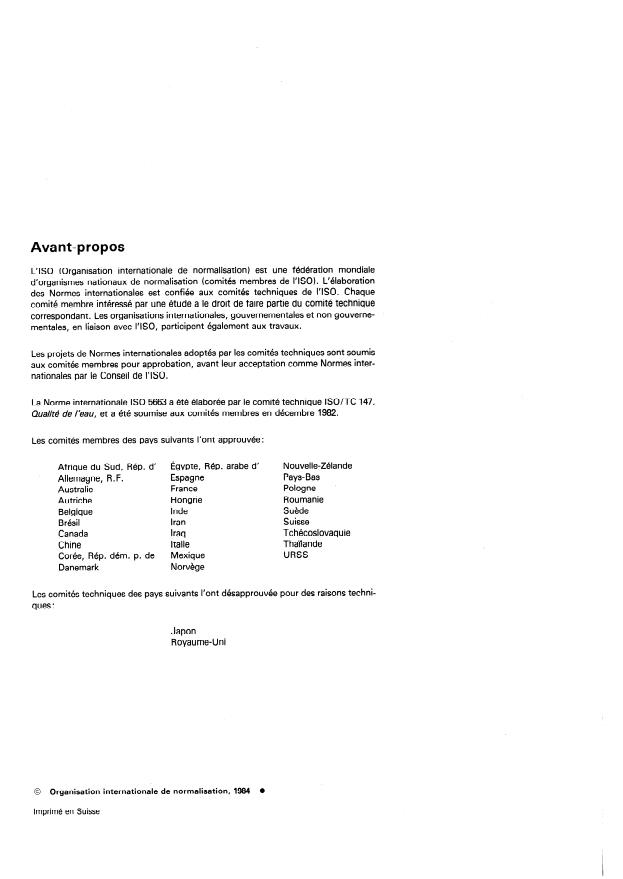
Avant-propos
L’ISO (Organisation internationale de normalisation) est une fédération mondiale
d’organismes nationaux de normalisation (comités membres de I’ISO). L’élaboration
des Normes internationales est confiée aux comités techniques de I’ISO. Chaque
comité membre intéressé par une étude a le droit de faire partie du comité technique
correspondant. Les organisations internationales, gouvernementales et non gouverne-
mentales, en liaison avec I’ISO, participent également aux travaux.
Les projets de Normes internationales adoptés par les comités techniques sont soumis
aux comités membres pour approbation, avant leur acceptation comme Normes inter-
nationales par le Conseil de I’ISO.
La Norme internationale ISO 5663 a été élaborée par le comité technique ISO/TC 147,
Qualité de l’eau, et a été soumise aux comités membres en décembre 1982.
Les comités membres des pays suivants l’ont approuvée:
Égypte, Rép. arabe d’
Afrique du Sud, Rép. d’ Nouvelle-Zélande
Allemagne, R.F. Espagne Pays-Bas
Australie France Pologne
Hongrie
Autriche Roumanie
Belgique Inde Suède
Brésil Iran Suisse
Canada Iraq Tchécoslovaquie
Chine Italie Thaïlande
Corée, Rép. dém. p. de Mexique URSS
Danemark Norvège
Les comités techniques des suivants l’ont désapprouvée pour
pays
ques :
Japon
Royaume-Uni
0 Organisation internationale de normalisation, 1984
Imprimé en Suisse
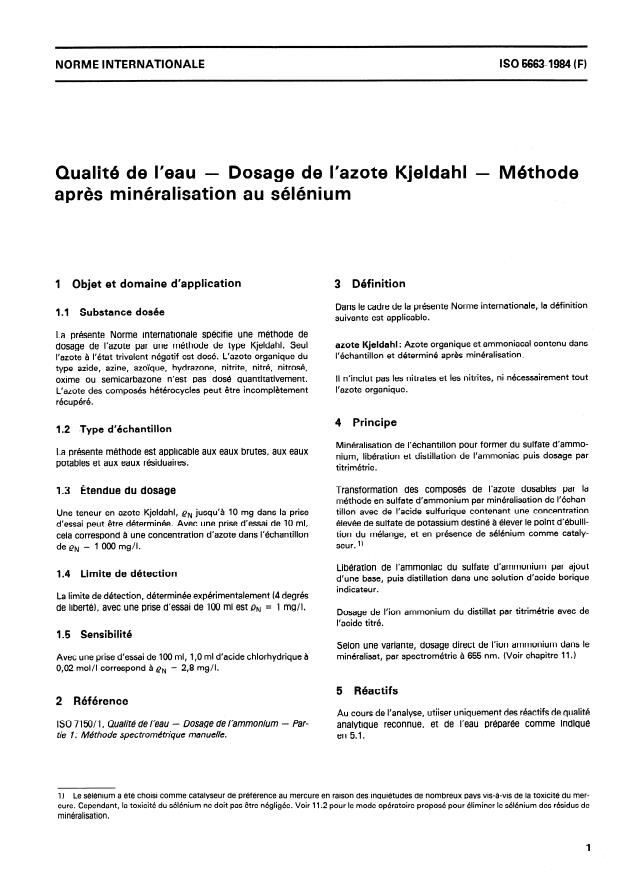
NORME INTERNATIONALE ISO 5663-1984 (FI
Qualité de l’eau - Dosage de l’azote Kjeldahl - Méthode
après minéralisation au sélénium
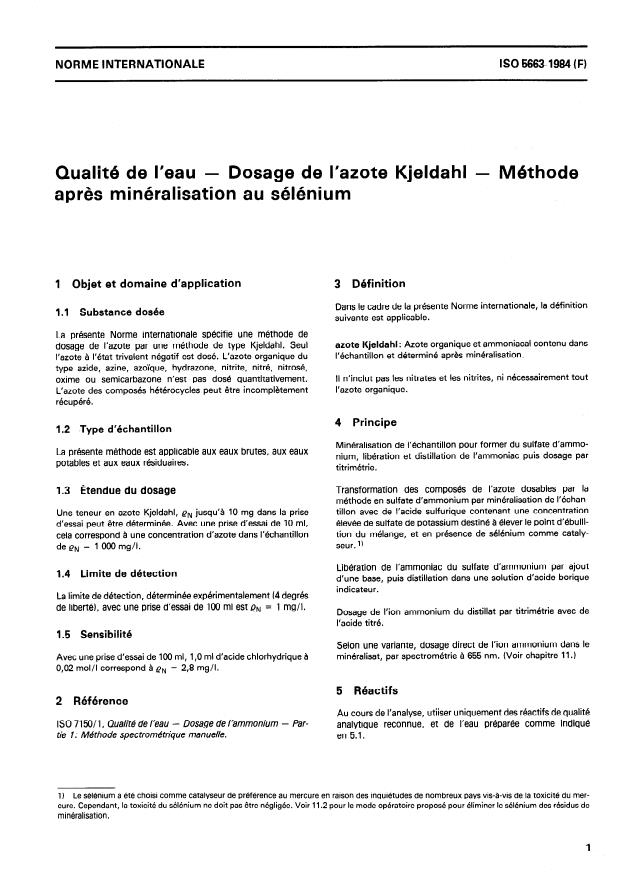
1 Objet et domaine d’application
3 Définition
Dans le cadre de la présente Norme internationale, la définition
1.1 Substance dosée
suivante est applicable.
La présente Norme internationale spécifie une méthode de
azote Kjeldahl: Azote organique et ammoniacal contenu dans
dosage de l’azote par une méthode de type Kjeldahl. Seul
l’échantillon et déterminé après minéralisation.
l’azote à l’état trivalent négatif est dosé. L’azote organique du
type azide, azine, azoïque, hydrazone, nitrite, nitré, nitrosé,
II n’inclut pas les nitrates et les nitrites, ni nécessairement tout
oxime ou semicarbazone n’est pas dosé quantitativement.
l’azote organique.
L’azote des composés hétérocycles peut être incomplétement
récupéré.
4 Principe
1.2 -Type d’échantillon
Minéralisation de l’échantillon pour former du sulfate d’ammo-
La présente méthode est applicable aux eaux brutes, aux eaux
nium, libération et distillation de l’ammoniac puis dosage par
potables et aux eaux résiduaires.
titrimétrie.
Transformation des composés de l’azote dosables par la
1.3 Étendue du dosage
méthode en sulfate d’ammonium par minéralisation de I’échan-
tillon avec de l’acide sulfurique contenant une concentration
Une teneur en azote Kjeldahl, @N jusqu’à 10 mg dans la prise
élevée de sulfate de potassium destiné à élever le point d’ébulli-
d’essai peut être déterminée. Avec une prise d’essai de 10 ml,
cela correspond à une concentration d’azote dans l’échantillon tion du mélange, et en présence de sélénium comme cataly-
= 1 000 mg/I. seur. 1)
de i?N
Libération de l’ammoniac du sulfate d’ammonium par ajout
1.4 Limite de détection
d’une base, puis distillation dans une solution d’acide borique
indicateur.
La limite de détection, déterminée expérimentalement (4 degrés
de liberté), avec une prise d’essai de 100 ml est @N = 1 mg/I.
Dosage de l’ion ammonium du distillat par titrimétrie avec de
l’acide titré.
1.5 Sensibilité
Selon une variante, dosage direct de l’ion ammonium dans le
Avec une prise d’essai de 100 ml, 1,O ml d’acide chlorhydrique à minéralisat, par spectrométrie à 655 nm. (Voir chapitre 11.)
0,OZ mol/1 correspond à @N = 2,8 mg/l.
5 Réactifs
2 Référence
Au cours de l’analyse, utiiser uniquement des réactifs de qualité
ISO 715Ol1, Qualité de l’eau - Dosage de l’ammonium - Par-
analytique reconnue, et de l’eau préparée comme indiqué
tie 1: Mkthode spectrométrique manuelle.
en 5.1.
1) Le sélénium a été choisi comme catalyseur de préférence au mercure en raison des inquiétudes de nombreux pays vis-à-vis de la toxicité du mer-
cure. Cependant, la toxicité du sélénium ne doit pas être négligée. Voir 11.2 pour le mode opératoire proposé pour éliminer le sélénium des résidus de
minéralisation.
ISO 5663-1984 (FI
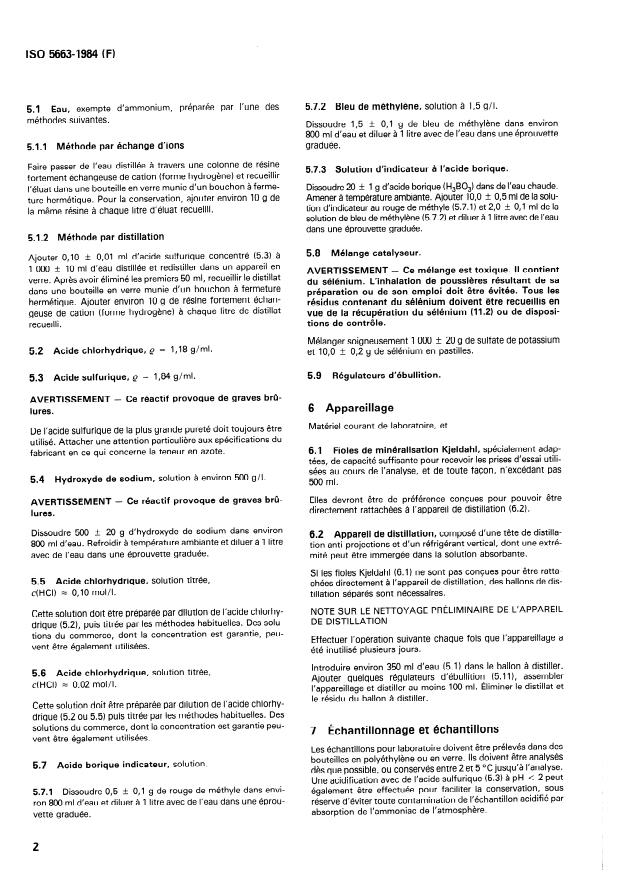
d’ammonium, préparée par l’une des 5.7.2 Bleu de méthylène, solution à 1,5 g/l.
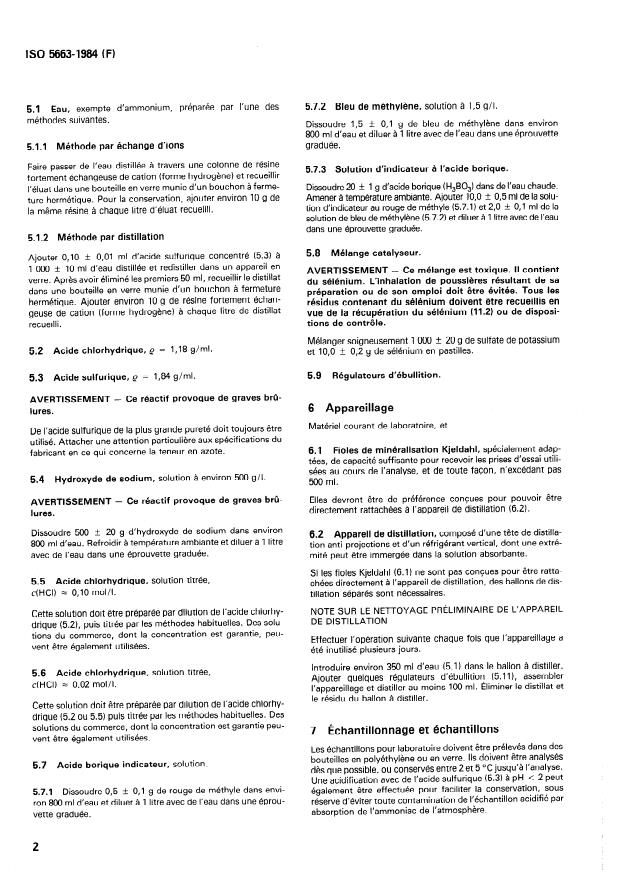
5.1 Eau, exempte
méthodes suivantes.
Dissoudre 1,5 + 0,l g de bleu de méthylène dans environ
800 ml d’eau et diluer à 1 litre avec de l’eau dans une éprouvette
5.1.1 Méthode par échange d’ions graduée.
Faire passer de l’eau distillée à travers une colonne de résine
5.7.3 Solution d’indicateur à l’acide borique.
fortement échangeuse de cation (forme hydrogène) et recueillir
I’éluat dans une bouteille en verre munie d’un bouchon à ferme- Dissoudre 20 Ifr 1 g d’acide borique (H,BO,) dans de l’eau chaude.
Amener à température ambiante. Ajouter 10,O + 0,5 ml de la solu-
ture hermétique. Pour la conservation, ajouter environ 10 g de
tion d’indicateur au rouge de méthyle (5.7.1) et 2,0 + 0,l ml de la
la même résine à chaque litre d’éluat recueilli.
solution de bleu de méthylène (5.7.2) et diluer à 1 litre avec de l’eau
dans une éprouvette graduée.
5.1.2 Méthode par distillation
5.8 Mélange catalyseur.
Ajouter 0,lO + 0,Ol ml d’acide sulfurique concentré (5.3) à
1 000 + 10 ml d’eau distillée et redistiller dans un appareil en
AVERTISSEMENT - Ce mélange est toxique. II contient
verre. Après avoir éliminé les premiers 50 ml, recueillir le distillat
du sélénium. L’inhalation de poussières résultant de sa
dans une bouteille en verre munie d’un bouchon à fermeture
préparation ou de son emploi doit être évitée. Tous les
hermétique. Ajouter environ 10 g de résine fortement échan-
résidus contenant du sélénium doivent être recueillis en
geuse de cation (forme hydrogène) à chaque litre de distillat
vue de la récupération du sélénium (11.2) ou de disposi-
recuerlli.
tions de contrôle.
Mélanger soigneusement 1 000 + 20 g de sulfate de potassium
5.2 Acide chlorhydrique, Q = 1,18 g/ml.
et 10,O + 0,2 g de sélénium en pastilles.
5.3 Acide sulfurique, Q = 1,84 g/ml. 5.9 Régulateurs d’ébullition.
Ce réactif provoque de graves brû-
AVERTISSEMENT -
6 Appareillage
lures.
Matériel courant de laboratoire, et
De l’acide sulfurique de la plus grande pureté doit toujours être
utilisé. Attacher une attention particulière aux spécifications du
6.1 Fioles de minéralisation Kjeldahl, spécialement adap-
fabricant en ce qui concerne la teneur en azote.
tées, de capacité suffisante pour recevoir les prises d’essai utili-
sées au cours de l’analyse, et de toute facon, n’excédant pas
5.4 Hydroxyde de sodium, solution à environ 500 g/l.
500 ml.
Ce réactif provoque de graves brû- El les devront être de préférence concues pour pouvo ir être
AVERTISSEMENT -
di rectement rattachées à l’appareil de distillation (6.2).
lures.
Dissoudre 500 Z!Z 20 g d’hydroxyde de sodium dans environ
6.2
Appareil de distillation, composé d’une tête de distilla-
800 ml d’eau. Refroidir à température ambiante et diluer à 1 litre
tion anti-projections et d’un réfrigérant vertical, dont une extré-
avec de l’eau dans une éprouvette graduée.
mité peut être immergée dans la solution absorbante.
Si les fioles Kjeldahl (6.1) ne sont pas concues pour être ratta-
5.5 Acide chlorhydrique, solution titrée,
chées directement à l’appareil de distillation, des ballons de dis-
c(HCI) = 0,lO mol/l.
tillation séparés sont nécessaires.
NOTE SUR LE NETTOYAGE PRELIMINAIRE DE L’APPAREIL
Cette solution doit être préparée par dilution de l’acide chlorhy-
DE DISTILLATION
drique (5.2), puis titrée par les méthodes habituelles. Des solu-
tions du commerce, dont la concentration est garantie, peu-
Effectuer l’opération suivante chaque fois que l’appareillage a
vent être également utilisées.
été inutilisé plusieurs jours.
Introduire environ 350 ml d’eau (5.1) dans le ballon à distiller.
5.6 Acide chlorhydrique, solution titrée,
Ajouter quelques régulateurs d’ébullition (5.111, assembler
c(HCI) = 0,02 mol/l.
l’appareillage et distiller au moins 100 ml. Éliminer le distillat et
le résidu du ballon à distiller.
Cette solution doit être préparée par dilution de l’aci
...
Norme internationale
INTERNATIONAL ORGANIZATION FOR STANDARDIZATION.ME)I(~YHAPOJJHAR OPrAHM3A~Mfl fl0 CTAH~APTbl3A~MM.ORGANISATlON INTERNATIONALE DE NORMALISATION
Qualité de l’eau - Dosage de l’azote Kjeldahl - Méthode
après minéralisation au sélénium
Water qua@ - Determination of Kjeldahl nitrogen - Method after mineraliza tion with selenium
Première édition - 1984-05-15
CDU 543.34 Réf. no : ISO 5663-1984 (FI
Gz
Y
Descripteurs : eau, qualité, analyse chimique, dosage, azote, méthode de Kjeldahl, pollution de l’eau.
I
P
v)
Prix basé sur 4 pages
Avant-propos
L’ISO (Organisation internationale de normalisation) est une fédération mondiale
d’organismes nationaux de normalisation (comités membres de I’ISO). L’élaboration
des Normes internationales est confiée aux comités techniques de I’ISO. Chaque
comité membre intéressé par une étude a le droit de faire partie du comité technique
correspondant. Les organisations internationales, gouvernementales et non gouverne-
mentales, en liaison avec I’ISO, participent également aux travaux.
Les projets de Normes internationales adoptés par les comités techniques sont soumis
aux comités membres pour approbation, avant leur acceptation comme Normes inter-
nationales par le Conseil de I’ISO.
La Norme internationale ISO 5663 a été élaborée par le comité technique ISO/TC 147,
Qualité de l’eau, et a été soumise aux comités membres en décembre 1982.
Les comités membres des pays suivants l’ont approuvée:
Égypte, Rép. arabe d’
Afrique du Sud, Rép. d’ Nouvelle-Zélande
Allemagne, R.F. Espagne Pays-Bas
Australie France Pologne
Hongrie
Autriche Roumanie
Belgique Inde Suède
Brésil Iran Suisse
Canada Iraq Tchécoslovaquie
Chine Italie Thaïlande
Corée, Rép. dém. p. de Mexique URSS
Danemark Norvège
Les comités techniques des suivants l’ont désapprouvée pour
pays
ques :
Japon
Royaume-Uni
0 Organisation internationale de normalisation, 1984
Imprimé en Suisse
NORME INTERNATIONALE ISO 5663-1984 (FI
Qualité de l’eau - Dosage de l’azote Kjeldahl - Méthode
après minéralisation au sélénium
1 Objet et domaine d’application
3 Définition
Dans le cadre de la présente Norme internationale, la définition
1.1 Substance dosée
suivante est applicable.
La présente Norme internationale spécifie une méthode de
azote Kjeldahl: Azote organique et ammoniacal contenu dans
dosage de l’azote par une méthode de type Kjeldahl. Seul
l’échantillon et déterminé après minéralisation.
l’azote à l’état trivalent négatif est dosé. L’azote organique du
type azide, azine, azoïque, hydrazone, nitrite, nitré, nitrosé,
II n’inclut pas les nitrates et les nitrites, ni nécessairement tout
oxime ou semicarbazone n’est pas dosé quantitativement.
l’azote organique.
L’azote des composés hétérocycles peut être incomplétement
récupéré.
4 Principe
1.2 -Type d’échantillon
Minéralisation de l’échantillon pour former du sulfate d’ammo-
La présente méthode est applicable aux eaux brutes, aux eaux
nium, libération et distillation de l’ammoniac puis dosage par
potables et aux eaux résiduaires.
titrimétrie.
Transformation des composés de l’azote dosables par la
1.3 Étendue du dosage
méthode en sulfate d’ammonium par minéralisation de I’échan-
tillon avec de l’acide sulfurique contenant une concentration
Une teneur en azote Kjeldahl, @N jusqu’à 10 mg dans la prise
élevée de sulfate de potassium destiné à élever le point d’ébulli-
d’essai peut être déterminée. Avec une prise d’essai de 10 ml,
cela correspond à une concentration d’azote dans l’échantillon tion du mélange, et en présence de sélénium comme cataly-
= 1 000 mg/I. seur. 1)
de i?N
Libération de l’ammoniac du sulfate d’ammonium par ajout
1.4 Limite de détection
d’une base, puis distillation dans une solution d’acide borique
indicateur.
La limite de détection, déterminée expérimentalement (4 degrés
de liberté), avec une prise d’essai de 100 ml est @N = 1 mg/I.
Dosage de l’ion ammonium du distillat par titrimétrie avec de
l’acide titré.
1.5 Sensibilité
Selon une variante, dosage direct de l’ion ammonium dans le
Avec une prise d’essai de 100 ml, 1,O ml d’acide chlorhydrique à minéralisat, par spectrométrie à 655 nm. (Voir chapitre 11.)
0,OZ mol/1 correspond à @N = 2,8 mg/l.
5 Réactifs
2 Référence
Au cours de l’analyse, utiiser uniquement des réactifs de qualité
ISO 715Ol1, Qualité de l’eau - Dosage de l’ammonium - Par-
analytique reconnue, et de l’eau préparée comme indiqué
tie 1: Mkthode spectrométrique manuelle.
en 5.1.
1) Le sélénium a été choisi comme catalyseur de préférence au mercure en raison des inquiétudes de nombreux pays vis-à-vis de la toxicité du mer-
cure. Cependant, la toxicité du sélénium ne doit pas être négligée. Voir 11.2 pour le mode opératoire proposé pour éliminer le sélénium des résidus de
minéralisation.
ISO 5663-1984 (FI
d’ammonium, préparée par l’une des 5.7.2 Bleu de méthylène, solution à 1,5 g/l.
5.1 Eau, exempte
méthodes suivantes.
Dissoudre 1,5 + 0,l g de bleu de méthylène dans environ
800 ml d’eau et diluer à 1 litre avec de l’eau dans une éprouvette
5.1.1 Méthode par échange d’ions graduée.
Faire passer de l’eau distillée à travers une colonne de résine
5.7.3 Solution d’indicateur à l’acide borique.
fortement échangeuse de cation (forme hydrogène) et recueillir
I’éluat dans une bouteille en verre munie d’un bouchon à ferme- Dissoudre 20 Ifr 1 g d’acide borique (H,BO,) dans de l’eau chaude.
Amener à température ambiante. Ajouter 10,O + 0,5 ml de la solu-
ture hermétique. Pour la conservation, ajouter environ 10 g de
tion d’indicateur au rouge de méthyle (5.7.1) et 2,0 + 0,l ml de la
la même résine à chaque litre d’éluat recueilli.
solution de bleu de méthylène (5.7.2) et diluer à 1 litre avec de l’eau
dans une éprouvette graduée.
5.1.2 Méthode par distillation
5.8 Mélange catalyseur.
Ajouter 0,lO + 0,Ol ml d’acide sulfurique concentré (5.3) à
1 000 + 10 ml d’eau distillée et redistiller dans un appareil en
AVERTISSEMENT - Ce mélange est toxique. II contient
verre. Après avoir éliminé les premiers 50 ml, recueillir le distillat
du sélénium. L’inhalation de poussières résultant de sa
dans une bouteille en verre munie d’un bouchon à fermeture
préparation ou de son emploi doit être évitée. Tous les
hermétique. Ajouter environ 10 g de résine fortement échan-
résidus contenant du sélénium doivent être recueillis en
geuse de cation (forme hydrogène) à chaque litre de distillat
vue de la récupération du sélénium (11.2) ou de disposi-
recuerlli.
tions de contrôle.
Mélanger soigneusement 1 000 + 20 g de sulfate de potassium
5.2 Acide chlorhydrique, Q = 1,18 g/ml.
et 10,O + 0,2 g de sélénium en pastilles.
5.3 Acide sulfurique, Q = 1,84 g/ml. 5.9 Régulateurs d’ébullition.
Ce réactif provoque de graves brû-
AVERTISSEMENT -
6 Appareillage
lures.
Matériel courant de laboratoire, et
De l’acide sulfurique de la plus grande pureté doit toujours être
utilisé. Attacher une attention particulière aux spécifications du
6.1 Fioles de minéralisation Kjeldahl, spécialement adap-
fabricant en ce qui concerne la teneur en azote.
tées, de capacité suffisante pour recevoir les prises d’essai utili-
sées au cours de l’analyse, et de toute facon, n’excédant pas
5.4 Hydroxyde de sodium, solution à environ 500 g/l.
500 ml.
Ce réactif provoque de graves brû- El les devront être de préférence concues pour pouvo ir être
AVERTISSEMENT -
di rectement rattachées à l’appareil de distillation (6.2).
lures.
Dissoudre 500 Z!Z 20 g d’hydroxyde de sodium dans environ
6.2
Appareil de distillation, composé d’une tête de distilla-
800 ml d’eau. Refroidir à température ambiante et diluer à 1 litre
tion anti-projections et d’un réfrigérant vertical, dont une extré-
avec de l’eau dans une éprouvette graduée.
mité peut être immergée dans la solution absorbante.
Si les fioles Kjeldahl (6.1) ne sont pas concues pour être ratta-
5.5 Acide chlorhydrique, solution titrée,
chées directement à l’appareil de distillation, des ballons de dis-
c(HCI) = 0,lO mol/l.
tillation séparés sont nécessaires.
NOTE SUR LE NETTOYAGE PRELIMINAIRE DE L’APPAREIL
Cette solution doit être préparée par dilution de l’acide chlorhy-
DE DISTILLATION
drique (5.2), puis titrée par les méthodes habituelles. Des solu-
tions du commerce, dont la concentration est garantie, peu-
Effectuer l’opération suivante chaque fois que l’appareillage a
vent être également utilisées.
été inutilisé plusieurs jours.
Introduire environ 350 ml d’eau (5.1) dans le ballon à distiller.
5.6 Acide chlorhydrique, solution titrée,
Ajouter quelques régulateurs d’ébullition (5.111, assembler
c(HCI) = 0,02 mol/l.
l’appareillage et distiller au moins 100 ml. Éliminer le distillat et
le résidu du ballon à distiller.
Cette solution doit être préparée par dilution de l’aci
...