

ISO 8957:1996
(Main)Information and documentation — Hebrew alphabet coded character sets for bibliographic information interchange
General Information
- Abstract
Specifies two coded Hebrew character sets. Set 1 contains 78 characters including 74 basic characters needed in Hebrew texts. Set 2 contains 51 additional characters used in combination with basic characters in some older Hebrew texts. The sets may be used in a 7-bit or an 8-bit environment in accordance with ISO/IEC 2022.
- Status
- Published
- Publication Date
- 25-Dec-1996
- Technical Committee
- ISO/IEC JTC 1/SC 2 - Coded character sets
- Drafting Committee
- ISO/IEC JTC 1/SC 2 - Coded character sets
- Current Stage
- 9093 - International Standard confirmed
- Start Date
- 27-Aug-2020
- Completion Date
- 29-Aug-2026
Overview
ISO 8957:1996 - "Information and documentation - Hebrew alphabet coded character sets for bibliographic information interchange" defines standardized coded character sets for exchanging bibliographic citations and related metadata in Hebrew script. The standard specifies two complementary sets for international interchange, usable in either a 7-bit or 8-bit environment in accordance with ISO/IEC 2022. It targets Old and Modern Hebrew and other languages written in Hebrew script (for example Yiddish, Ladino/Judezmo, Judeo-Arabic and related Judaeo-languages).
Key topics and technical requirements
- Two coded sets
- Set 1: 78 positions including 74 basic alphabetic characters, three Yiddish ligatures and one Judeo-Spanish point.
- Set 2: 51 additional characters (vowel points, accents, cantillation and special marks) used mainly in older or regional texts.
- Character types covered
- Alphabetic characters (ordinary and final forms)
- Vowels, diacritic-like marks, accents and cantillation marks
- Punctuation, numerals and special spacing characters
- Combining (non‑spacing) marks
- Many vowels and accents are non‑spacing combining marks. They are encoded before the base character they modify.
- Multiple combining marks for one letter are encoded in the visual order (left-to-right / top-to-bottom).
- The BACKSPACE character must not be used to encode non‑spacing marks.
- Interchange rules
- Sets may be implemented in 7‑bit or 8‑bit environments following ISO/IEC 2022 and are identified by escape sequences (registration/assignment handled via the appropriate registration authority).
- Unassigned code positions must not be used for bibliographic interchange.
- Rendering and naming
- Graphic renderings in the standard serve unique identification; character names were aligned as far as possible with ISO/IEC 10646-I conventions.
Applications and who uses it
- Library and bibliographic systems exchanging Hebrew citations and catalog records
- Metadata workflows, library automation vendors, and digital archives handling Hebrew-script content
- Publishers, data conversion services and international cataloging agencies needing reliable interchange of Hebrew, Yiddish and Judeo-language texts
- Software developers implementing character encoding support, transliteration bridges or legacy-data migration to Unicode
Related standards
- ISO/IEC 2022 - Character code structure and extension techniques (identification by escape sequences)
- ISO/IEC 646 - 7‑bit coded character set for information interchange
- ISO/IEC 10646‑1 - Universal Multiple-Octet Coded Character Set (relevant for name mapping)
- ISO 259 - Transliteration of Hebrew characters into Latin characters
Keywords: ISO 8957, Hebrew alphabet coded character sets, bibliographic information interchange, Hebrew script encoding, ISO/IEC 2022, Hebrew vowels and accents, library metadata.
Get Certified
Connect with accredited certification bodies for this standard

BSI Group
BSI (British Standards Institution) is the business standards company that helps organizations make excellence a habit.

NYCE
Mexican standards and certification body.
Sponsored listings
Frequently Asked Questions
ISO 8957:1996 is a standard published by the International Organization for Standardization (ISO). Its full title is "Information and documentation — Hebrew alphabet coded character sets for bibliographic information interchange". This standard covers: Specifies two coded Hebrew character sets. Set 1 contains 78 characters including 74 basic characters needed in Hebrew texts. Set 2 contains 51 additional characters used in combination with basic characters in some older Hebrew texts. The sets may be used in a 7-bit or an 8-bit environment in accordance with ISO/IEC 2022.
Specifies two coded Hebrew character sets. Set 1 contains 78 characters including 74 basic characters needed in Hebrew texts. Set 2 contains 51 additional characters used in combination with basic characters in some older Hebrew texts. The sets may be used in a 7-bit or an 8-bit environment in accordance with ISO/IEC 2022.
ISO 8957:1996 is classified under the following ICS (International Classification for Standards) categories: 35.040 - Information coding; 35.040.10 - Coding of character sets. The ICS classification helps identify the subject area and facilitates finding related standards.
ISO 8957:1996 is available in PDF format for immediate download after purchase. The document can be added to your cart and obtained through the secure checkout process. Digital delivery ensures instant access to the complete standard document.
Standards Content (Sample)
INTERNATIONAL IS0
STANDARD 8957
First edit ion
1996-12-15
Information and documentation - Hebrew
alphabet coded character sets for
bibliographic information interchange
Information et documentation - Jeux de caracMes cod& de /‘alphabet
hbbreu pour les khanges d ‘informa tions bibliographiques
Reference number
IS0 8957:1996(E)
IS0 8957:1996(E)
Foreword
IS0 (the International Organization for Standardization) is a worldwide
federation of national standards bodies (IS0 member bodies). The work of
preparing International Standards is normally carried out through IS0
technical committees. Each member body interested in a subject for
which a technical committee has been established has the right to be
represented on that committee. International organizations, governmental
and non-governmental, in liaison with ISO, also take part in the work. IS0
collaborates closely with the International Electrotechnical Commission
(IEC) on all matters of electrotechnical standardization.
Draft International Standards adopted by the technical committees are
circulated to the member bodies for voting. Publication as an International
Standard requires approval by at least 75 % of the member bodies casting
a vote.
International Standard IS0 8957 was prepared by Technical Committee
4,
ISO/TC 46, Information and documentation, Subcommittee SC
Computer applications in information and documentation.
Annex A of this International Standard is for information only.
0 IS0 1996
All rights reserved. Unless otherwise specified, no part of this publication may be
reproduced or utilized in any form or by any means, electronic or mechanical, including
photocopying and microfilm, without permission in writing from the publisher.
International Organization for Standardization
Case Postale 56 l W-1 211 Geneve 20 l Switzerland
Printed in Switzerland
ii
INTERNATIONAL STANDARD o Iso IS0 8957:1996(E)
- Hebrew alphabet coded
Information and documentation
character sets for bibliographic information interchange
1 Scope
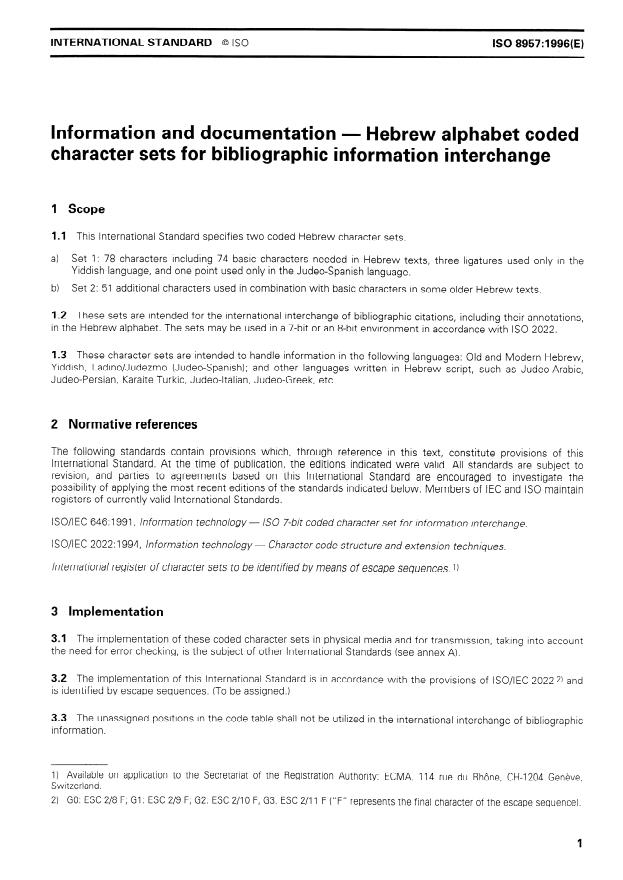
1.1 This International Standard specifies two coded Hebrew character sets
a) Set 1: 78 characters including 74 basic characters needed in Hebrew texts three ligatures used only in the
Yiddish language, and one point used only in the Judeo-Spanish language.
b) Set 2: 51 additional characters used in combination with basic characters in some older Hebrew texts.
1.2 These sets are intended for the international interchange of bibliographic citations, including their annotations,
in the Hebrew alphabet. The sets may be used in a 7-bit or an 8-bit environment in accordance with IS0 2022.
1.3 These character sets are intended to handle information in the following languages: Old and Modern Hebrew,
Yiddish, Ladino/Judezmo (Judeo-Spanish); and other languages written in Hebrew script, such as Judeo-Arabic,
Judeo-Persian, Karaite Turkic, Judeo-Italian, Judeo-Greek, etc.
2 Normative references
The following standards contain provisions which, th ough reference in this text, constitute provisions of this
International Standard. At the time of publication, the editions indicated were valid. All standards are subject to
nternational Standard are encouraged to investigate the
revision, and parties to agreements based on this I
possibility of applying the most recent editions of the st; jndards indicated below. Members of IEC and IS0 maintain
registers of currently valid International Standards.
lSO/l EC 646: 1991, Information technology - IS0 7-bit coded character set for information interchange.
lSO/I EC 2022: 1994, Information technology - Character code structure and extension techniques.
International register of character sets to be identified by means of escape sequences. 1)
3 Implementation
3.1 The implementation of these coded character sets in physical media and for transmission, taking into account
the need for error checking, is the subject of other International Standards (see annex A).
3.2 The implementation of this International Standard is in accordance with the provisions of lSO/lEC 20222) and
is identified by escape sequences. (To be assigned.)
3.3 The unassigned positions in the code table shall not be utilized in the international interchange of bibliographic
information.
1) Available on application to the Secretariat of the Registration Authority: ECMA, 114 rue du Rhbne, CH-I 204 Genhe,
Switzerland.
2) GO: ESC 2/8 F; Gl : ESC 2/9 F; G2: ESC 2/l 0 F; 63: ESC 2/l 1 F (“F” represents the final character of the escape sequence).
IS0 8957:1996(E)
4 Code tables
Code table for the basic Hebrew alphabet
4.1
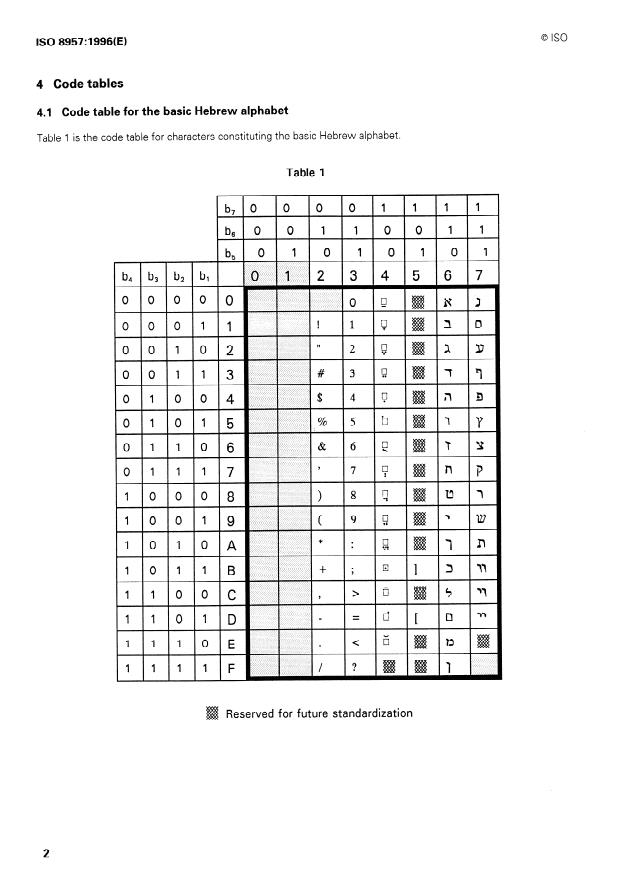
Table 1 is the code table for characters constituting the basic Hebrew alphabet.
Table 1
Reserved for future standardization
0 IS0 IS0 8957:1996(E)
4.2 Code table for additional Hebrew characters
Table 2 is the code table for additional Hebrew script characters.
Table 2
Reserved for future standardization
IS0 8957: 1996(E)
5 Legend
5.1 Basic Hebrew alphabet
Table 3 gives the code, graphic and name of each character constituting the basic Hebrew alphabet. Comments on
usage are also provided when needed.
Table 3 - Set 1: Basic Hebrew alphabet
Comments
Code Graphic Name
SPACE
! EXCLAMATION MARK
HEBREW PUNCTUATION GERSHAYIM
NUMBER SlGN
23 #
DOLLAR SIGN
24 $
% PERCENT SIGN
& AMPERSAND
HEBREW PUNCTUATION GERESH
OPENING PARENTHESIS
CLOSING PARENTHESIS
ASTERISK
2A
+ PLUS SIGN
HEBREW COMMA
2c
HEBREW PUNCTUATION MAQAF
2D
PERIOD
2E
SLASH
2F I
0 DIGIT ZERO
1 DIGIT ONE
2 DIGIT TWO
DIGIT THREE
4 DIGIT FOUR
5 DIGIT FIVE
DIGIT SIX
7 DIGIT SEVEN
8 DIGIT EIGHT
9 DIGIT NINE
HEBREW PUNCTUATION SOF PASUQ
3A
3B SEMICOLON
OPENING ANGLE BRACKET
3c
-
EQUALS SIGN
3D
CLOSING ANGLE BRACKET
3E
3F ? QUESTION MARK
IS0 8957:1996(E)
Table 3 (continued)
Code Graphic Name Comments
rJ
HEBREW POINT PATAH
HEBREW POINT QAMATS
HEBREW POINT SEGOL
HEBREW POINT TSERE
HEBREW POINT HIRIQ
HEBRW POINT SIN DOT
HEBREW POINT QUBUTS
HEBREW POINT SHEVA
HEBREW POINT HATAF PATAH
HEBREW POINT HATAF QAMATS
4A HEBREW POINT HATAF SEGOL
HEBREW POINT DAGESH OR MAPlQ
4B
HEBREW POINT RAFE
4c
..-?
i
i.
HEBREW POINT SHIN DOT
E
4E HEBREW POINT VARIKA
4F (This position shall not be used)
(These positions shall not be used)
50-5A
OPENING SQUARE BRACKET
5B
(This position shall not be used)
5c
50 CLOSING SQUARE BRACKET
5E-5F (These positions shall not be used)
HEBREW LETTER ALEF
HEBREW LETTER BET
HEBREW LETTER GIMEL
HEBREW LETTER DALET
HEBREW LETTER HE
HEBREW LETTER VAV
HEBREW LETTER ZAYIN
HEBREW LETTER HET
HEBREW LETTER TET
HEBREW LETTER YOD
Final form
HEBREW LETTER FINAL KAF
6A
Ordinary form
HEBREW LETTER KAF
6B
HEBREW LETTER LAMED
6C
Final form
HEBREW LETTER FINAL MEM
6D
Ordinary form
HEBREW LETTER MEM
6E
Final form
HEBREW LETTER FINAL NUN
6F
@ IS0
IS0 8957:1996(E)
Table 3 (concluded)
Comments
Code Graphic Name
70 HEBREW LETTER NUN Ordinary form
71 HEBREW LETTER SAMEKH
HEBREW LETTER AYIN
73 HEBREW LETTER FINAL PE Final form
74 HEBREW LETTER PE Ordinary form
75 HEBREW LETTER FINAL TSADI Final form
76 HEBREW LETTER TSADI Ordinary form
HEBREW LETTER QOF
78 HEBREW LETTER RESH
79 HEBRW LETTER SHIN Undifferentiated form
7A HEBREW LETTER TAV
7B HEBREW LETTER YIDDISH DOUBLE VAV
7c HEBREW LETTER YIDDISH VAV YOD
70 HEBREW LETTER YIDDISH DOUBLE YOD
7E (This position shall not be used)
5.2 Special vowel points, accents and marks
Table 4 gives the code, graphic and name of each character in the set of additional Hebrew script characters. This
set includes many special points and accent (or cantillation) marks used in texts from several geographic areas.
When a special character is applicable to a specific geographic area, the area is identified in the comments section
by a single upper-case letter according to the following list:
(P) = Palestinian;
(B) = Babylonian;
(T) = Tiberian.
(S) = Samarian;
Table 4 - Set 2: Additional Hebrew characters
Graphic Name Comments
Code
Placed betwe
...