

ISO 7720:2012
(Main)Prevailing torque type all-metal hexagon nuts, style 2 — Property class 9
General Information
- Abstract
ISO 7720:2012 specifies the characteristics of prevailing torque type all-metal hexagon nuts, of style 2, with threads from M5 up to and including M36, in product grade A for threads up to and including M16, and product grade B for threads over M16, and with property class 9.
- Status
- Withdrawn
- Publication Date
- 31-May-2012
- Technical Committee
- ISO/TC 2/SC 12 - Fasteners with metric internal thread
- Drafting Committee
- ISO/TC 2/SC 12 - Fasteners with metric internal thread
- Current Stage
- 9599 - Withdrawal of International Standard
- Start Date
- 10-Jun-2025
- Completion Date
- 29-Aug-2026
Buy Documents


ISO 7720:2012 - Prevailing torque type all-metal hexagon nuts, style 2 -- Property class 9

ISO 7720:2012 - Prevailing torque type all-metal hexagon nuts, style 2 — Property class 9/1/2012
Overview
ISO 7720:2012 defines the specifications for prevailing torque type all-metal hexagon nuts, style 2, property class 9. This international standard covers hexagon nuts with metric threads ranging from M5 up to and including M36. Nuts for threads up to M16 are classified under product grade A, while those with threads over M16 fall under product grade B. These nuts feature a prevailing torque mechanism ensuring secure fastening without the need for additional locking elements.
Developed under the auspices of ISO Technical Committee ISO/TC 2 (Fasteners), this third edition updates previous versions to reflect current mechanical performance and manufacturing tolerances. The standard is essential for manufacturers, engineers, and quality inspectors involved with assembling machinery or structural components requiring high-strength fastening solutions.
Key Topics
Material & Property Class
The nuts are made from steel and classified as property class 9, indicating high mechanical strength appropriate for demanding applications.Thread Sizes and Grades
Thread sizes covered range from M5 to M36:- Product grade A for M5–M16
- Product grade B for M20–M36
Dimensions and Tolerances
Dimensional characteristics align mostly with ISO 4033, except for specific nut height dimensions. Thread profiles and tolerances comply with ISO 261, ISO 724, and ISO 965-2 to ensure compatibility and interchangeability.Mechanical and Performance Properties
Performance meets the requirements detailed in ISO 898-2 and ISO 2320, addressing strength, prevailing torque, and locking capabilities.Surface Finishes and Coatings
Surface coating specifications include electroplating (ISO 4042) and zinc flake coatings (ISO 10683). Additional finishes must be agreed upon between suppliers and purchasers.Inspection and Quality Control
Acceptance inspection follows ISO 3269, with surface integrity according to ISO 6157-2 ensuring minimization of defects affecting performance.
Applications
ISO 7720:2012 hexagon nuts are widely used in mechanical assemblies requiring secure, vibration-resistant fastening. Typical applications include:
- Automotive and aerospace industries where high-strength fasteners maintain joint integrity under dynamic loads.
- Machinery and heavy equipment manufacturing requiring durable, reliable nuts to withstand stress and environmental conditions.
- Construction frameworks where safety-critical connections depend on prevailing torque nuts to prevent loosening.
- Electrical and electronic assemblies that mandate consistent mechanical performance of fasteners.
By selecting nuts compliant with ISO 7720, designers and engineers can ensure standardized quality and fit, enhancing the overall reliability and safety of their products.
Related Standards
ISO 7720:2012 interacts closely with several other ISO standards critical for the full specification and application of hexagon nuts:
- ISO 4033 – Defines dimensions for hexagon nuts, style 2.
- ISO 7042 – Covers nuts of property classes 5, 8, 10, and 12.
- ISO 898-2 – Mechanical properties of carbon and alloy steel nuts with specified property classes.
- ISO 2320 – Mechanical and performance properties of prevailing torque type steel hexagon nuts.
- ISO 4759-1 – Tolerances for fasteners in product grades A and B.
- ISO 8992 – General requirements for bolts, screws, studs, and nuts.
- ISO 4042 and ISO 10683 – Standards governing electroplated and non-electrolytically applied zinc coatings respectively.
- ISO 3269 – Defines acceptance inspection procedures.
- ISO 6157-2 – Specifies limits for surface discontinuities to ensure fastener integrity.
Adhering to ISO 7720:2012 alongside these related standards guarantees a comprehensive approach to selecting and using prevailing torque type all-metal hexagon nuts, resulting in enhanced assembly safety and performance.
Keywords: ISO 7720:2012, all-metal hexagon nuts, prevailing torque nuts, property class 9, metric threads M5-M36, product grade A, product grade B, ISO fastener standards, high-strength nuts, mechanical fastening, vibration-resistant nuts, steel fasteners.
Relations
- Revised
ISO 7720:2025 - Fasteners — Prevailing torque hexagon nuts — High nuts (all metal) with slot(s) - Effective Date
- 06-Jun-2022
- Effective Date
- 19-Jan-2012
Buy Documents
ISO 7720:2012 - Prevailing torque type all-metal hexagon nuts, style 2 -- Property class 9
ISO 7720:2012 - Prevailing torque type all-metal hexagon nuts, style 2 — Property class 9/1/2012
Frequently Asked Questions
ISO 7720:2012 is a standard published by the International Organization for Standardization (ISO). Its full title is "Prevailing torque type all-metal hexagon nuts, style 2 — Property class 9". This standard covers: ISO 7720:2012 specifies the characteristics of prevailing torque type all-metal hexagon nuts, of style 2, with threads from M5 up to and including M36, in product grade A for threads up to and including M16, and product grade B for threads over M16, and with property class 9.
ISO 7720:2012 specifies the characteristics of prevailing torque type all-metal hexagon nuts, of style 2, with threads from M5 up to and including M36, in product grade A for threads up to and including M16, and product grade B for threads over M16, and with property class 9.
ISO 7720:2012 is classified under the following ICS (International Classification for Standards) categories: 21.060.20 - Nuts. The ICS classification helps identify the subject area and facilitates finding related standards.
ISO 7720:2012 has the following relationships with other standards: It is inter standard links to ISO 7720:2025, ISO 7720:1997. Understanding these relationships helps ensure you are using the most current and applicable version of the standard.
ISO 7720:2012 is available in PDF format for immediate download after purchase. The document can be added to your cart and obtained through the secure checkout process. Digital delivery ensures instant access to the complete standard document.
Standards Content (Sample)
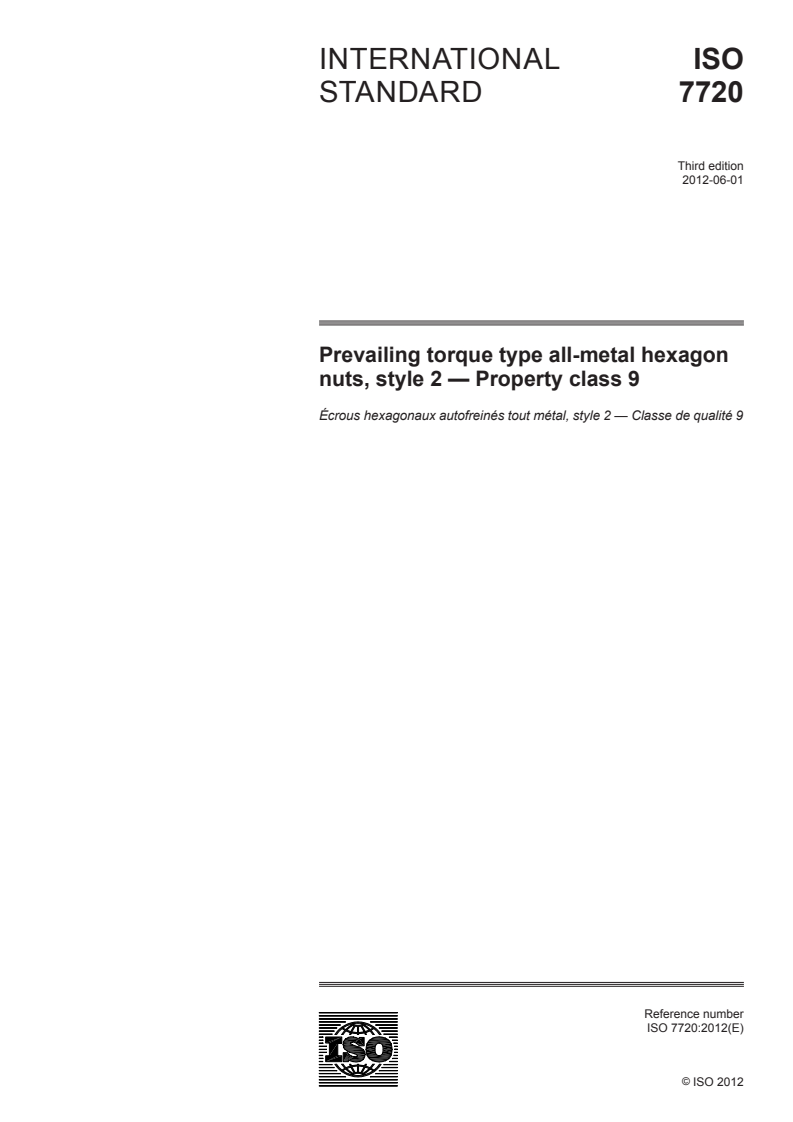
INTERNATIONAL ISO
STANDARD 7720
Third edition
2012-06-01
Prevailing torque type all-metal hexagon
nuts, style 2 — Property class 9
Écrous hexagonaux autofreinés tout métal, style 2 — Classe de qualité 9
Reference number
©
ISO 2012
All rights reserved. Unless otherwise specified, no part of this publication may be reproduced or utilized in any form or by any means,
electronic or mechanical, including photocopying and microfilm, without permission in writing from either ISO at the address below or ISO’s
member body in the country of the requester.
ISO copyright office
Case postale 56 • CH-1211 Geneva 20
Tel. + 41 22 749 01 11
Fax + 41 22 749 09 47
E-mail copyright@iso.org
Web www.iso.org
Published in Switzerland
ii © ISO 2012 – All rights reserved
Foreword
ISO (the International Organization for Standardization) is a worldwide federation of national standards bodies
(ISO member bodies). The work of preparing International Standards is normally carried out through ISO
technical committees. Each member body interested in a subject for which a technical committee has been
established has the right to be represented on that committee. International organizations, governmental and
non-governmental, in liaison with ISO, also take part in the work. ISO collaborates closely with the International
Electrotechnical Commission (IEC) on all matters of electrotechnical standardization.
International Standards are drafted in accordance with the rules given in the ISO/IEC Directives, Part 2.
The main task of technical committees is to prepare International Standards. Draft International Standards
adopted by the technical committees are circulated to the member bodies for voting. Publication as an
International Standard requires approval by at least 75 % of the member bodies casting a vote.
Attention is drawn to the possibility that some of the elements of this document may be the subject of patent
rights. ISO shall not be held responsible for identifying any or all such patent rights.
ISO 7720 was prepared by Technical Committee ISO/TC 2, Fasteners, Subcommittee SC 12, Fasteners with
metric internal thread.
This third edition cancels and replaces the second edition (ISO 7720:1997), which has been technically revised.
INTERNATIONAL STANDARD ISO 7720:2012(E)
Prevailing torque type all-metal hexagon nuts, style 2 —
Property class 9
1 Scope
This International Standard specifies the characteristics of prevailing torque type all-metal hexagon nuts, of
style 2, with threads from M5 up to and including M36, in product grade A for threads up to and including M16,
and product grade B for threads over M16, and with property class 9.
NOTE 1 The dimensions of the nuts, with the exception of the dimensions m and h , correspond to those given in
w max
ISO 4033.
NOTE 2 Nuts of property classes 5, 8, 10 and 12 are dealt with in ISO 7042.
If other specifications are required, they can be selected from existing International Standards, for example
ISO 261, ISO 724, ISO 898-2, ISO 965-2, ISO 2320 and ISO 4759-1.
2 Normative references
The following referenced documents are indispensable for the application of this document. For dated
references, only the edition cited applies. For undated references, the latest edition of the referenced document
(including any amendments) applies.
ISO 225, Fasteners — Bolts, screws, studs and nuts — Symbols and descriptions of dimensions
ISO 261, ISO general purpose metric screw threads — General plan
ISO 724, ISO general-purpose metric screw threads — Basic dim
...
INTERNATIONAL ISO
STANDARD 7720
Third edition
2012-06-01
Prevailing torque type all-metal hexagon
nuts, style 2 — Property class 9
Écrous hexagonaux autofreinés tout métal, style 2 — Classe de qualité 9
Reference number
©
ISO 2012
All rights reserved. Unless otherwise specified, no part of this publication may be reproduced or utilized in any form or by any means,
electronic or mechanical, including photocopying and microfilm, without permission in writing from either ISO at the address below or ISO’s
member body in the country of the requester.
ISO copyright office
Case postale 56 • CH-1211 Geneva 20
Tel. + 41 22 749 01 11
Fax + 41 22 749 09 47
E-mail copyright@iso.org
Web www.iso.org
Published in Switzerland
ii © ISO 2012 – All rights reserved
Foreword
ISO (the International Organization for Standardization) is a worldwide federation of national standards bodies
(ISO member bodies). The work of preparing International Standards is normally carried out through ISO
technical committees. Each member body interested in a subject for which a technical committee has been
established has the right to be represented on that committee. International organizations, governmental and
non-governmental, in liaison with ISO, also take part in the work. ISO collaborates closely with the International
Electrotechnical Commission (IEC) on all matters of electrotechnical standardization.
International Standards are drafted in accordance with the rules given in the ISO/IEC Directives, Part 2.
The main task of technical committees is to prepare International Standards. Draft International Standards
adopted by the technical committees are circulated to the member bodies for voting. Publication as an
International Standard requires approval by at least 75 % of the member bodies casting a vote.
Attention is drawn to the possibility that some of the elements of this document may be the subject of patent
rights. ISO shall not be held responsible for identifying any or all such patent rights.
ISO 7720 was prepared by Technical Committee ISO/TC 2, Fasteners, Subcommittee SC 12, Fasteners with
metric internal thread.
This third edition cancels and replaces the second edition (ISO 7720:1997), which has been technically revised.
INTERNATIONAL STANDARD ISO 7720:2012(E)
Prevailing torque type all-metal hexagon nuts, style 2 —
Property class 9
1 Scope
This International Standard specifies the characteristics of prevailing torque type all-metal hexagon nuts, of
style 2, with threads from M5 up to and including M36, in product grade A for threads up to and including M16,
and product grade B for threads over M16, and with property class 9.
NOTE 1 The dimensions of the nuts, with the exception of the dimensions m and h , correspond to those given in
w max
ISO 4033.
NOTE 2 Nuts of property classes 5, 8, 10 and 12 are dealt with in ISO 7042.
If other specifications are required, they can be selected from existing International Standards, for example
ISO 261, ISO 724, ISO 898-2, ISO 965-2, ISO 2320 and ISO 4759-1.
2 Normative references
The following referenced documents are indispensable for the application of this document. For dated
references, only the edition cited applies. For undated references, the latest edition of the referenced document
(including any amendments) applies.
ISO 225, Fasteners — Bolts, screws, studs and nuts — Symbols and descriptions of dimensions
ISO 261, ISO general purpose metric screw threads — General plan
ISO 724, ISO general-purpose metric screw threads — Basic dim
...