


ISO 23195:2021
(Main)Security objectives of information systems of third-party payment services
Security objectives of information systems of third-party payment services
This document defines a common terminology to be used in the context of third-party payment (TPP). Next, it establishes two logical structural models in which the assets to be protected are clarified. Finally, it specifies security objectives based on the analysis of the logical structural models and the interaction of the assets affected by threats, organizational security policies and assumptions. These security objectives are set out in order to counter the threats resulting from the intermediary nature of TPPSPs offering payment services compared with simpler payment models where the payer and the payee directly interact with their respective account servicing payment service provider (ASPSP). This document assumes that TPP-centric payments rely on the use of TPPSP credentials and the corresponding certified processes for issuance, distribution and renewal purposes. However, security objectives for such processes are out of the scope of this document. NOTE This document is based on the methodology specified in the ISO/IEC 15408 series. Therefore, the security matters that do not belong to the TOE are dealt with as assumptions, such as the security required by an information system that provides TPP services and the security of communication channels between the entities participating in a TPP business.
Titre manque
General Information
Standards Content (Sample)
INTERNATIONAL ISO
STANDARD 23195
First edition
2021-06
Security objectives of information
systems of third-party payment
services
Reference number
©
ISO 2021
© ISO 2021
All rights reserved. Unless otherwise specified, or required in the context of its implementation, no part of this publication may
be reproduced or utilized otherwise in any form or by any means, electronic or mechanical, including photocopying, or posting
on the internet or an intranet, without prior written permission. Permission can be requested from either ISO at the address
below or ISO’s member body in the country of the requester.
ISO copyright office
CP 401 • Ch. de Blandonnet 8
CH-1214 Vernier, Geneva
Phone: +41 22 749 01 11
Email: copyright@iso.org
Website: www.iso.org
Published in Switzerland
ii © ISO 2021 – All rights reserved
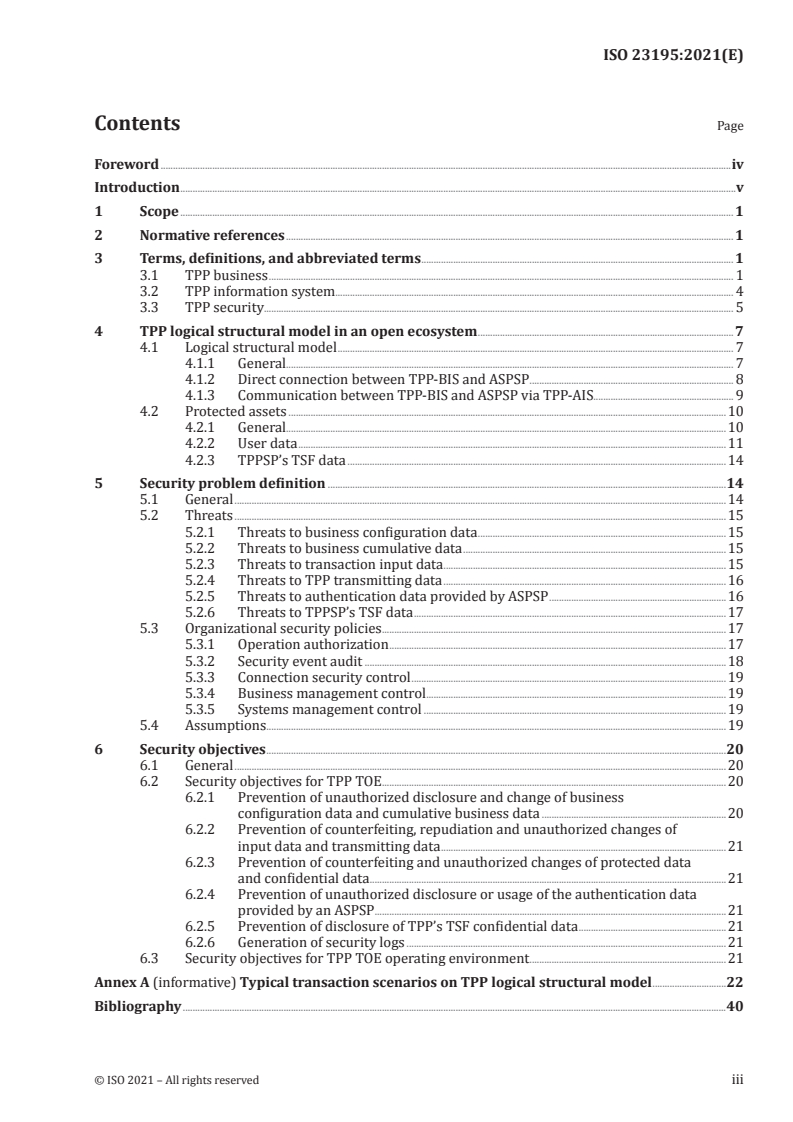
Contents Page
Foreword .iv
Introduction .v
1 Scope . 1
2 Normative references . 1
3 Terms, definitions, and abbreviated terms . 1
3.1 TPP business . 1
3.2 TPP information system. 4
3.3 TPP security. 5
4 TPP logical structural model in an open ecosystem . 7
4.1 Logical structural model . 7
4.1.1 General. 7
4.1.2 Direct connection between TPP-BIS and ASPSP . 8
4.1.3 Communication between TPP-BIS and ASPSP via TPP-AIS. 9
4.2 Protected assets .10
4.2.1 General.10
4.2.2 User data .11
4.2.3 TPPSP’s TSF data .14
5 Security problem definition .14
5.1 General .14
5.2 Threats .15
5.2.1 Threats to business configuration data .15
5.2.2 Threats to business cumulative data .15
5.2.3 Threats to transaction input data .15
5.2.4 Threats to TPP transmitting data .16
5.2.5 Threats to authentication data provided by ASPSP .16
5.2.6 Threats to TPPSP’s TSF data .17
5.3 Organizational security policies .17
5.3.1 Operation authorization .17
5.3.2 Security event audit .18
5.3.3 Connection security control .19
5.3.4 Business management control .19
5.3.5 Systems management control .19
5.4 Assumptions .19
6 Security objectives .20
6.1 General .20
6.2 Security objectives for TPP TOE .20
6.2.1 Prevention of unauthorized disclosure and change of business
configuration data and cumulative business data .20
6.2.2 Prevention of counterfeiting, repudiation and unauthorized changes of
input data and transmitting data .21
6.2.3 Prevention of counterfeiting and unauthorized changes of protected data
and confidential data . . .21
6.2.4 Prevention of unauthorized disclosure or usage of the authentication data
provided by an ASPSP . .21
6.2.5 Prevention of disclosure of TPP’s TSF confidential data .21
6.2.6 Generation of security logs .21
6.3 Security objectives for TPP TOE operating environment . .21
Annex A (informative) Typical transaction scenarios on TPP logical structural model .22
Bibliography .40
Foreword
ISO (the International Organization for Standardization) is a worldwide federation of national standards
bodies (ISO member bodies). The work of preparing International Standards is normally carried out
through ISO technical committees. Each member body interested in a subject for which a technical
committee has been established has the right to be represented on that committee. International
organizations, governmental and non-governmental, in liaison with ISO, also take part in the work.
ISO collaborates closely with the International Electrotechnical Commission (IEC) on all matters of
electrotechnical standardization.
The procedures used to develop this document and those intended for its further maintenance are
described in the ISO/IEC Directives, Part 1. In particular, the different approval criteria needed for the
different types of ISO documents should be noted. This document was drafted in accordance with the
editorial rules of the ISO/IEC Directives, Part 2 (see www .iso .org/ directives).
Attention is drawn to the possibility that some of the elements of this document may be the subject of
patent rights. ISO shall not be held responsible for identifying any or all such patent rights. Details of
any patent rights identified during the development of the document will be in the Introduction and/or
on the ISO list of patent declarations received (see www .iso .org/ patents).
Any trade name used in this document is information given for the convenience of users and does not
constitute an endorsement.
For an explanation of the voluntary nature of standards, the meaning of ISO specific terms and
expressions related to conformity assessment, as well as information about ISO's adherence to the
World Trade Organization (WTO) principles in the Technical Barriers to Trade (TBT), see www .iso .org/
iso/ foreword .html.
This document was prepared by Technical Committee ISO/TC 68, Financial services, Subcommittee SC 2,
Financial Services, security.
Any feedback or questions on this document should be directed to the user’s national standards body. A
complete listing of these bodies can be found at www .iso .org/ members .html.
iv © ISO 2021 – All rights reserved
Introduction
The global third-party payment (TPP) service is booming and has a profound impact on payment
methods. The third-party payment service providers (TPPSPs) act as an intermediary entity between
the payment service user (PSU) and the account servicing payment service provider (ASPSP), usually a
financial institution. TPPSPs provide payment and other financial services (referred to in this document
as TPP services). From the security point of view, the intermediary nature of TPPSPs raises the specific
threat of customer impersonation in payment processing. Payment service providers increasingly seek
to mitigate the risks of payment fraud in order to protect PSUs and enhance their own business.
Following the CC methodology (see the ISO/IEC 15408 series), this document: i) establishes two logical
structural models centred around the TPP services, ii) identifies assets to be protected within this open
ecosystem and iii) specifies the security objectives of TPPSP information systems to counter threats
faced by the TPP. It aims to assist stakeholders, such as TPPSPs and developers of their information
systems, to mitigate specific threats arising from the intermediary role of TPPSPs in the processing of
financial transactions, with a focus on payments.
The logical structural models, assets, threats and security objectives in this document are based on
real-world practices and are described in a way that is independent of the specific payment instrument
used for the TPP payment.
In particular, security objectives focus on the mitigation of identified threats against the integrity,
non-repudiation and confidentiality of TPP payment data. Consequently, the TPPSP needs to define
the security mechanisms to ensure the protection of sensitive payment data when offering a new TPP
service. Conformity with the security objectives set out in this document can help stakeholders gain
trust when establishing a business relationship with TPPSPs.
With regards to the scope of this document, it makes full sense to refer to “complementary” or
“additional” security objectives compared with other payment circuits where a direct communication
link is established between an ASPSP and a PSU. It is worth noting that the integration of the TPPSP
has an impact on the security of those entities connected with the TPPSP. However, this document only
focuses on the security aspects for TPPSPs.
Financial regulatory authorities have either taken or considered a range of legal initiatives related to
TPPs in their respective jurisdictions. Therefore, it is the responsibility of the user of this document to
analyse and decide whether the payment processing procedures in this document comply with regional
financial regulations related to TPP services.
INTERNATIONAL STANDARD ISO 23195:2021(E)
Security objectives of information systems of third-party
payment services
1 Scope
This document defines a common terminology to be used in the context of third-party payment (TPP).
Next, it establishes two logical structural models in which the assets to be protected are clarified.
Finally, it specifies security objectives based on the analysis of the logical structural models and the
interaction of the assets affected by threats, organizational security policies and assumptions. These
security objectives are set out in order to counter the threats resulting from the intermediary nature
of TPPSPs offering payment services compared with simpler payment models where the payer and the
payee directly interact with their respective account servicing payment service provider (ASPSP).
This document assumes that TPP-centric payments rely on the use of TPPSP credentials and the
corresponding certified processes for issuance, distribution and renewal purposes. However, security
objectives for such processes are out of the scope of this document.
NOTE This document is based on the methodology specified in the ISO/IEC 15408 series. Therefore, the
security matters that do not belong to the TOE are dealt with as assumptions, such as the security required by an
information system that provides TPP services and the security of communication channels between the entities
participating in a TPP business.
2 Normative references
There are no normative references in this document.
3 Terms, definitions, and abbreviated terms
For the purposes of this document, the following terms, definitions, and abbreviated terms apply.
ISO and IEC maintain terminological databases for use in standardization at the following addresses:
— ISO Online browsing platform: available at https:// www .iso .org/ obp
— IEC Electropedia: available at http:// www .electropedia .org/
3.1 TPP business
3.1.1
payment transaction
act of placing, transferring or withdrawing funds, irrespective of any underlying obligations between
the payer (3.1.9) and the payee (3.1.8)
[SOURCE: ISO 12812-1:2017, 3.40]
3.1.2
payment account
account held in the name of a payment service user (3.1.7) which is used for the execution of a payment
transaction (3.1.1)
Note 1 to entry: The original definition in ISO 21741 is “account held in the name of one or more payment service
users which is used for the execution of payment transactions”. However, only cases in which one account is held
by one payment service user are considered in this document.
[SOURCE: ISO/TR 21941:2017, 3.1.7, modified — Note 1 to entry has been added.]
3.1.3
third-party payment
TPP
payment transaction (3.1.1) involving at least one intermediary TPPSP (3.1.5)
3.1.4
intermediary
commercial party who provides services to customers, suppliers or authorities within the supply chain
Note 1 to entry: The customer is the payment service user (3.1.7), who may be a payer (3.1.9) or a payee (3.1.8),
such as a merchant.
[SOURCE: ISO/TS 24533:2012, 2.31, modified — Note 1 to entry has been revised.]
3.1.5
third-party payment service provider
TPPSP
payment service provider offering TPP (3.1.3) services where they are not the ASPSP (3.1.6) itself
Note 1 to entry: Comparison with the term “third-party payment service provider” defined in ISO/TR 21941:2017,
3.1.11:
a) the abbreviated form of “third-party payment service provider” has been clarified as “TPPSP” instead of
“TPP” because “TPP” is a business mode which has been defined in this document;
b) the abbreviated form ASPSP is utilized instead of “account servicing payment service provider”;
c) the term “payment initiation service” has been changed to “TPP” since the “TPP” contains “the payment
initiation services”;
d) “account information service on accounts” has been removed because it is not linked to TPP closely.
[SOURCE: ISO/TR 21941:2017, 3.1.11, modified — Note 1 to entry has been added.]
3.1.6
account servicing payment service provider
ASPSP
payment service provider providing and maintaining a payment account (3.1.2) for a payment service
user (3.1.7)
Note 1 to entry: In ISO/TR 21941:2017, an ASPSP is defined as “providing and maintaining a payment account
for a payer” only. In the context of this document, an ASPSP can be a bank or other institution which opens and
maintains a payment account for the payment service user.
[SOURCE: ISO/TR 21941:2017, 3.1.3, modified — Note 1 to entry has been added.]
3.1.7
payment service user
PSU
natural or legal person making use of a payment service in the capacity of payer (3.1.9), payee (3.1.8) or
both
Note 1 to entry: Generally, a payment service user is an end user of a TPP information system.
Note 2 to entry: Generally, the payee is a merchant or a person who receives the money without offering goods or
services directly. In this document they are called merchant and payee, respectively, if necessary.
Note 3 to entry: In situations where the payment service user is a natural person, this payment service user is
deemed a PII principal (3.1.10).
[SOURCE: ISO/TR 21941:2017, 3.1.2, modified — Note 1 to entry, Note 2 to entry and Note 3 to entry
have been added.]
2 © ISO 2021 – All rights reserved
3.1.8
payee
person or legal entity who is the intended recipient of funds which have been the subject of a payment
transaction (3.1.1)
[SOURCE: ISO 12812-1:2017, 3.38]
3.1.9
payer
person or legal entity who authorizes a payment transaction (3.1.1)
[SOURCE: ISO 12812-1:2017, 3.39]
3.1.10
personally identifiable information
PII
information that i) can be used to identify the PII principal (3.1.11) to whom such information relates or
ii) is or is possibly directly or indirectly linked to a PII principal
Note 1 to entry: To determine whether a PII principal is identifiable, account should be taken of all the means
which can reasonably be used by the privacy stakeholder holding the data, or by any other party, to identify that
natural person.
[SOURCE: ISO/IEC 29100:2011, 2.9, modified]
3.1.11
PII principal
natural person to whom the PII (3.1.10) relates
Note 1 to entry: Depending on the jurisdiction and the particular data protection and privacy legislation, the
synonym “data subject” can also be used instead of the term “PII principal”.
[SOURCE: ISO/IEC 29100:2011, 2.11, modified — The full designation of “PII”, i.e. “personally identifiable
information”, has been removed from the definition.]
3.1.12
credential
data provided to the payment service user (3.1.7) for identification (3.1.16) and/or authentication (3.1.17)
purposes
Note 1 to entry: The phrase “data provided to the payment service user” is used instead of “data provided to the
customer” so that the definition is clearer in the context of this document.
Note 2 to entry: The expression of “identification and/or authentication” replaces “identification/authentication”
in the definition to improve clarity.
[SOURCE: ISO 12812-1:2017, 3.10, modified — Note 1 to entry and Note 2 to entry have been added.]
3.1.13
credential carrier
personal device held by payment service user (3.1.7) to store and transmit credential(s) (3.1.12)
Note 1 to entry: Under supporting of the state of the art of technologies, a credential can be stored in more than
one credential carrier while a credential carrier can store more than one credential.
Note 2 to entry: A credential carrier may be a standalone device or a part of a payment instrument (3.1.19).
EXAMPLE A TPPSP issues a payer a USB key storing a digital certificate. In this case, the USB key is the
TPPSP credential carrier.
3.1.14
ASPSP credential
credential (3.1.12) which is provided by ASPSP (3.1.6) and used by the payment service user (3.1.7)
3.1.15
TPPSP credential
credential (3.1.12) which is provided by TPPSP (3.1.5) and used by the payment service user (3.1.7)
3.1.16
identification
process of recognizing the attributes that identify an entity
Note 1 to entry: In TPP business, an entity generally is a payment service user (3.1.7).
[SOURCE: ISO 22300:2021, 3.1.117, modified — Note 1 to entry has been added]
3.1.17
authentication
process of corroborating an entity or attributes with a specified or understood level of assurance
[SOURCE: ISO 22300:2021, 3.2.8, modified — Notes 1 and 2 to entry have been removed]
3.1.18
strong customer authentication
authentication (3.1.17) based on the use of two or more elements categorized as knowledge (something
only the user knows), possession (something only the user owns) and inherence (something the user is)
that are independent, in that the breach of one does not compromise the reliability of the others, and is
designed in such a way as to protect the confidentiality of the authentication data
[SOURCE: ISO/TR 21941:2017, 3.1.5, modified]
3.1.19
payment instrument
personalized device(s) and/or set of procedures agreed between the payment service user (3.1.7) and
the payment service provider and used in order to initiate a payment order
Note 1 to entry: In the context of TPP, the payment service provider is a TPPSP.
[SOURCE: ISO/TR 21941:2017, 3.1.9, modified — Note 1 to entry has been added.]
3.2 TPP information system
3.2.1
information system
set of applications, services, information technology assets or other information-handling components
[SOURCE: ISO/IEC 27000:2018, 3.35]
3.2.2
TPP business information system
TPP-BIS
information system (3.2.1) that enables business functions of TPPSP (3.1.5) and deals with payment
transactions (3.1.1) based on TPPSP credentials (3.1.15)
3.2.3
ASPSP gatekeeper
function implemented by the ASPSP (3.1.6) that ensures that admittance is limited to TPPSP (3.1.5) who
comply with the relevant regulatory and technical requirement
3.2.4
TPPSP gatekeeper
function implemented by TPPSP (3.1.5) that performs access control services to the TPP-BIS (3.2.2)
Note 1 to entry: The TPPSP gatekeeper can protect the TPP platform by preventing and mitigating the attack
against the TPP-BIS and set up the trusted channel (3.3.9) while the message is transferred via the transaction
channel.
4 © ISO 2021 – All rights reserved
3.2.5
TPP agent information system
TPP-AIS
information system (3.2.1), that receives requests of payment transaction (3.1.1) from multilateral TPPSP
(3.1.5) and forwards them to multilateral ASPSP (3.1.6), then receives responses from the ASPSP and
forwards them to the relevant TPPSP
Note 1 to entry: When the TPP-AIS is constructed as the common financial infrastructure, the TPP-AIS may
directly connect with CASS (3.2.6) and deliver the clearing information based on their payment transaction log.
Note 2 to entry: Regarding TPP as a whole, TPP-AIS can be deemed an internal component. However, TPP-AISs
do not belong to any TPPSP or ASPSP generally. The operation of the TPP-AIS is independent of the information
systems owned by TPPSP and/or ASPSP.
3.2.6
clearing and settlement system
CASS
system responsible for inter-bank funds clearing and funds transfer
Note 1 to entry: CASS may provide instant funds clearing; it may also provide batch clearing, in which the funds
clearing may be completed in a conventional period.
3.2.7
trust centre
entity implementing a trusted mechanism
Note 1 to entry: Trust centres can facilitate the establishment of both trusted channels and trusted paths.
However, they are not a prerequisite for establishing both trusted channels and trusted paths.
3.2.8
TPP payment terminal
terminal equipment which is utilized in order to interact with a TPPSP’s credential carrier (3.1.13) to
retrieve TPPSP credentials (3.1.15) and to perform payment transactions (3.1.1)
Note 1 to entry: The TPP payment terminal may be implemented in different devices operated by the payment
service user (3.1.7), the merchant or both.
3.3 TPP security
3.3.1
sensitive payment data
data, including both TSF data (3.3.10) and user data (3.3.11), which can be used to carry out fraud
Note 1 to entry: For the activities of TPPSP (3.1.5), the name of the account owner and the account number do not
constitute sensitive payment data.
Note 2 to entry: The ASPSP credential (3.1.14) and TPPSP credential (3.1.15) are two kinds of TSF data.
Note 3 to entry: Both the definition and Note 1 to entry have been rewritten based on ISO/TR 21941:2017, 3.1.10,
so as to fit the context of ISO/IEC 15408-1:2009. In fact, protected entities are consistent.
[SOURCE: ISO/TR 21941:2017, 3.1.10, modified — Note 2 to entry and Note 3 to entry have been added.]
3.3.2
security objective
statement of an intent to counter identified threats and/or satisfy identified organization security
policies, assumptions or both
[SOURCE: ISO/IEC 15408-1:2009, 3.1.60, modified]
3.3.3
asset
entity that the owner of the TOE (3.3.4) presumably places value upon
[SOURCE: ISO/IEC 15408-1:2009, 3.1.2, modified]
3.3.4
target of evaluation
TOE
set of software, firmware, hardware or a combination of all three, possibly accompanied by guidance
[SOURCE: ISO/IEC 15408-1:2009, 3.1.70, modified]
3.3.5
security problem
statement which in a formal manner defines the nature and scope of the security that the TOE is
intended to address
Note 1 to entry: This statement consists of a combination of:
— threats to be countered by the TOE;
— the OSPs enforced by the TOE;
— the assumptions that are upheld for the TOE and its operational environment.
[SOURCE: ISO/IEC 15408-1:2009, 3.1.61]
3.3.6
TOE security functionality
TSF
combined functionality of all hardware, software and firmware of a TOE (3.3.4) that must be relied
upon for the correct enforcement of the SFRs (3.3.7)
[SOURCE: ISO/IEC 15408-1:2009, 3.1.74]
3.3.7
security functional requirement
SFR
requirement defining the rule by which the TOE (3.3.4) governs access to and use of its resources, and
thus information and services controlled by the TOE
3.3.8
trusted channel
means by which a TSF (3.3.6) and another trusted IT product can communicate with necessary
confidence
[SOURCE: ISO/IEC 15408-1:2009, 3.1.78]
3.3.9
covert channel
enforced, illicit signalling channel that allows a user to surreptitiously contravene the multi-level
separation policy and unobservability requirements of the TOE (3.3.4)
[SOURCE: ISO/IEC 15408-1:2009, 3.5.1]
3.3.10
trusted path
means by which a user and a TSF (3.3.6) can communicate with the necessary confidence
[SOURCE: ISO/IEC 15408-1:2009, 3.1.80]
6 © ISO 2021 – All rights reserved
3.3.11
TSF data
data for the operation of the TOE (3.3.4) upon which the enforcement of the SFR (3.3.7) relies
[SOURCE: ISO/IEC 15408-1:2009, 3.1.81]
3.3.12
user data
data for the user that does not affect the operation of the TSF (3.3.6)
[SOURCE: ISO/IEC 15408-1:2009, 3.1.83]
3.3.13
protection profile
PP
implementation-independent statement of security needs for a TOE (3.3.4) type
[SOURCE: ISO/IEC 15408-1:2009, 3.1.52, modified — the abbreviated term has been added.]
3.3.14
security target
ST
implementation-dependent statement of security needs for a specific identified TOE (3.3.4)
[SOURCE: ISO/IEC 15408-1:2009, 3.1.63]
4 TPP logical structural model in an open ecosystem
4.1 Logical structural model
4.1.1 General
The reason for depicting the logical structural models in this clause is in order to identify the protected
assets (according to the methodology defined in ISO/IEC 15408). However, the models included in
this clause do not constitute a comprehensive landscape, i.e. characteristics that are not connected to
information security are not included. Therefore, it is probably not sufficient to use these models to
analyse other aspects, such as financial risks and business risks in the TPP context.
According to the methodology given in ISO/IEC 15408, the following steps should be taken when setting
up TPP logical structural model:
a) identify assets to be protected;
b) identify any threats against the assets, organizational security policies affecting the assets and
assumptions that may underpin those organizational security policies;
c) decide which security objectives apply (based on the comprehensive analysis of threats,
organization security policies, and assumptions);
d) specify the security requirements that achieve these security objectives and are mainly chosen
from ISO/IEC 15408-2 and ISO/IEC 15408-3;
e) design and implement the IT system based on those security requirements.
In order to perform this analysis, all components in a model are generally divided into two groups,
namely those within the target of evaluation (TOE) and those outside the TOE. Only the assets within
the TOE need to be considered for protection. Particularly, the communications between the TOE and
its operational environment are protected by the implementation of security mechanisms according to
the applicable organizational security policies.
EXAMPLE 1 The networks in both Figure 1 and Figure 2 are within the TOE. In fact, the network can be either
a private network, such as a leased line, or an open network, such as the internet. No matter the type of network
used, there is a requirement to transmit messages securely via the networks.
EXAMPLE 2 It is assumed that communications between all ASPSPs and the CASS are secure. This assumption
is fundamental for achieving the security objectives by the TPPSP. However, the implementation of such secure
communications is out of the scope of this document.
The components inside the double-line rectangle in Figure 1 constitute the TOE of a TPP information
system as described in this document. Components outside the double-line rectangle are deemed as
external entities.
There are five types of communication channels represented in Figure 1, each one represented by a
different graphical link according to Table 1.
Table 1 — Graphical representation of the communication channels in the logical structural
model
Link type Meaning
A solid single link with arrow represents a communication channel through a
network. The TPP should implement specific IT security mechanisms, for example
VPN, to ensure security properties such as confidentiality, availability and integrity
of information transmitted using a public network.
A broken single link with an arrow represents a communication channel estab-
lished by the payment service user with an internal logical component of the TOE,
using a man-machine interface.
A solid double link with an arrow represents a trusted channel through which mes-
sages are protected in confidentiality, availability and integrity.
A broken double link with an arrow represents an optional trusted channel, i.e.
the channel may not be present because of some non-technical reason; however, if
present the channel shall be a trusted channel.
A double link with circles either end represents an internal trusted channel be-
tween two logical components in the TOE. In practice, the two components may be
implemented as a single physical entity.
Components such as ASPSP gatekeepers are not represented explicitly in Figures 1 and 2, since it is
assumed that any communication involving ASPSP’s accounting systems is secure. Therefore, the
description of how an ASPSP gatekeeper achieves its security objectives is out of the scope of this
document.
NOTE To better understand the analytical methodology used in this document and the different aspects,
please refer to ISO/IEC 15408-1. For additional information related to information security, please refer to
ISO/IEC 27000:2018, 4.2.3.
4.1.2 Direct connection between TPP-BIS and ASPSP
The logical mode for the direct connection between the TPP-BIS and the ASPSP is illustrated in Figure 1.
8 © ISO 2021 – All rights reserved
Key
1 communication channel through a network
2 communication channel involving man-machine interface
3 trusted channel
4 optional trusted channel
5 internal trusted channel
NOTE The graphical interpretation of the links connecting the different components is described in Table 1.
Figure 1 — TPP logical structural model without the TPP-AIS
In this mode, a TPP-BIS connects to every payment service user's ASPSP (including both payer’s and
payee’s ASPSP) directly, to complete a payment transaction. The clearing and settlement between the
two ASPSPs involved in the payment transaction is executed via a CASS.
Annex A describes in detail the information flows for common scenarios found in commercial TPP
payment services.
4.1.3 Communication between TPP-BIS and ASPSP via TPP-AIS
The logical mode for the communication between TPP-BISs and ASPSPs via a TPP-AIS is illustrated in
Figure 2.
Key
1 communication channel through a network
2 communication channel involving man-machine interface
3 trusted channel
4 optional trusted channel
5 internal trusted channel
NOTE The graphical interpretation of the links connecting the different components is described in Table 1.
Figure 2 — TPP logical structural model with the TPP-AIS
In this mode, all the TPP-BISs and all the ASPSPs are connected to the TPP-AIS. Every transaction is
transmitted to the TPP-AIS, then the TPP-AIS transmits the message to the corresponding ASPSP.
Based on the transaction log in which clearing and settlement information is recorded, information is
generated by the TPP-AIS and sent to the CASS to perform the settlement between each ASPSP.
Annex A describes in detail the information flows for common scenarios found in commercial TPP
payment services.
4.2 Protected assets
4.2.1 General
The analysis in this document is based on the logic that if assets (such as configuration and transactional
data) are effectively protected during input, storage, processing and transmission, the risks of TPP
payment fraud can be mitigated.
10 © ISO 2021 – All rights reserved
The description of the security vulnerabilities and the security objectives hereafter are intended to
protect those assets previously mentioned because their degradation and/or damages in quality can
result in an unacceptable level of risk of fraud.
4.2.2 User data
4.2.2.1 General
User data include specific data required by the TPP service which is entered by or generated under
the control of either human users or external IT entities. Abuse or breach of user data can cause some
commercial business risks, such as loss of reputation for the TPPSP. However, they generally cannot
influence the operation of the security functional components, i.e. they cannot cause financial systemic
risks.
NOTE The term “user data” is taken from ISO/IEC 15408. According to the methodology outlined in
ISO/IEC 15408, all data can be divided into two types, namely “user data” and “TSF data”. See 3.3.10 and 3.3.11.
4.2.2.2 TPP business configuration data
The configuration data specifies the rules for TPP transactions, as set out by a TPP scheme. Those rules
are laid down by both TPPSP and ASPSP, along with TPP-AIS (if the mode is chosen). Configuration data
may be present in:
a) the TPPSP credential carriers;
b) the ASPSP credential carriers if the ASPSP credential needs to be used in the TPP transaction;
c) the TPP payment terminals;
d) the TPPSP gatekeepers;
e) the TPP-BIS;
f) the ASPSP gatekeepers;
g) the ASPSP accounting system;
h) the TPP-AIS (if this mode is chosen).
NOTE Rules for TPP transactions are enforced by both the implementation of application-level software in
the different logical components as per Figure 1 and the associated business configuration data depicted here.
EXAMPLE In a TPP business, the maximum daily transfer balance limit is a type of business configuration
data.
4.2.2.3 TPP business cumulative data
Cumulative data in the TPP business are the data that are accumulated during the TPP business
operation. Typically, cumulative data are divided into several types as follows:
a) Customer information: this kind of data comprises the payment service user's PII.
EXAMPLE 1 The name of the payer or payee, the certificate type and number and the phone number
are all TPP-related customer’s PII.
b) Accounting information: this kind of data comprises account numbers issued by ASPSP and account
numbers issued by TPPSP.
EXAMPLE 2 Payment accounts are issued by an ASPSP and are enrolled in the TPP-BIS.
EXAMPLE 3 The TPP-BIS and TPP-AIS records, including the details of all the payment processing
information for a particular payment service user.
c) Credential information: this kind of data comprises an identifier of accounts issued by TPPSP,
authenticating modes and values, and so on. If one payment service user owns more than one
account in TPP-BIS and each account can be identified independently, the number of identifiers
can be equal to the number of accounts. Otherwise, one payment service user can only have one
identifier. If an identifier can be authenticated by one mode, there is only one authenticating value.
Otherwise, there are several authenticating values for an identifier.
d) Customized service information: if customized services can be provided to payment service users,
this kind of data has the potential to comprise parameters for specific services, such as the layout
of the app interface, the default account when more than one account has been owned in a TPPSP,
and so on.
The cumulative data of the TPP business does not include authenticating data issued by the ASPSP to
the payment service user.
4.2.2.4 TPP transaction input data
TPP transaction input data include data entered manually by a human using a man-machine interface
during a TPP transaction. The human may have a distinct role in a payment transaction, such as:
a) the payer;
b) the cashier of a merchant;
c) the payee other than the cashier of a merchant.
The type of transaction can determine how many roles may be input, the data and the order of input.
EXAMPLE 1 When a payer buys some goods in a supermarket, the following payment procedure is possible:
— The cashier counts up the whole price of the goods.
— The payer opens a TPP app issued by a TPPSP which is authenticated by using their fingerprint.
— The payer then chooses parameters such as the payment account to be used and shows the relevant QR code
to the cashier.
— The cashier scans the QR code with a scanner.
— The payer confirms the amount they need to be charged by inputting the payment password to complete the
transaction.
In this transaction, the payer's fingerprint, the QR code required by the cashier and final payment password
entered by the payer are all input data.
EXAMPLE 2 When a payer wants to repay an owed sum of money to a payee via TPP, the following repaying
procedure is possible:
— The payer opens an app issued by a TPPSP on their mobile phone and log in using a credential consisting of a
username and password.
— The payer inputs:
— the identity of the payee, which has been linked to one of the payee’s accounts in the TPPSP;
— the payment account that they want to repay;
— the amount to be repaid;
— the desired time for funds to be transferred, and so on.
— After the payer completes the transaction, there are two situations for the payee based on the product
requirements of TPPSP:
— the amount of money credits the payee's account directly; or
12 © ISO 2021 – All rights reserved
— the amount of money credits the payee's account if the payee confirms to accept it.
In this transaction, messages input by both the payer the payee are all input data.
EXAMPLE 3 When a payee wants to collect money for splitting a bill, the following collection procedure is
possible:
— The payee opens a TPP app issued by a TPPSP on their mobile phone and logs in using a credential consisting
of a username and biometric (face recognition).
— The payee inputs:
— the identities of the payers, which have been related to the payers’ relevant accounts in the TPPSP;
— the payment account in which they wish to collect the money;
— the amount they wish to collect;
— a deadline by which they wish to collect;
— the reason for splitting the bill, and so on.
Each payer receiving the payment invitation performs the action independently.
If a payer confirms payment of the requested amount, they input the account to be paid and confirm payment.
If a payer refuses to pay, they can either respond to the payee with a message or not respond to the invitation
before the request times out.
In this transaction, messages input by both the payee and the payer are all input data.
4.2.2.5 TPP transmitting data
TPP transmitting data include all messages to be exchanged between two components of the TPP
models, and are divided into two groups, as follows:
a) TPP transmitting data in the first group are transmitted within the TOE so that the security
objectives can be influenced, such as:
1) data exchanged between a TPP credential carrier and a TPP payment terminal;
2) data exchanged between a TPP payment terminal and a TPP gatekeeper;
3) data exchanged between a TPP gatekeeper and a merchant sales system;
4) data exchanged between each TPP-BIS and the TPP-AIS;
5) data exchanged between a TPP credential carrier and the trust centre;
6) data exchanged between a TPP payment terminal and the trust centre;
7) data exchanged between a TPP gatekeeper and the trust centre.
b) TPP transmitting dat
...
Questions, Comments and Discussion
Ask us and Technical Secretary will try to provide an answer. You can facilitate discussion about the standard in here.
Loading comments...