

ISO 21239:2026
(Main)Thermal insulation products for buildings — Reflective insulating products — Specification
General Information
- Abstract
This document specifies the requirements for factory-made thermal insulating products containing one or more reflective or low-emissivity surface components, and designed to be used in conjunction with an incorporated air space, for the thermal insulation of buildings. This document specifies products manufactured in the form of rolls, boards and sheets, and also covers products that are used in prefabricated thermal insulation systems and composite panels. Such prefabricated systems and composite panels are not within the scope of this document. The products specified in this document are not intended for use in load-bearing applications. This document does not specify the required level of a given property to be achieved by a product to demonstrate fitness for purpose in an application. The levels of performance required for a given application are to be found in project specifications.
- Status
- Published
- Publication Date
- 26-Jan-2026
- Technical Committee
- ISO/TC 163/SC 3 - Thermal insulation products, components and systems
- Drafting Committee
- ISO/TC 163/SC 3 - Thermal insulation products, components and systems
- Current Stage
- 6060 - International Standard published
- Start Date
- 27-Jan-2026
- Due Date
- 12-Sep-2026
- Completion Date
- 27-Jan-2026


Overview
ISO 21239:2026 specifies the requirements for factory-made reflective insulating products designed for building thermal insulation applications. These products incorporate one or more reflective or low-emissivity surfaces and are intended to be used with an air space to enhance insulation performance. The standard covers products in the form of rolls, boards, and sheets, as well as those used in prefabricated insulation systems and composite panels (though such systems themselves are not within the scope). The products addressed are not intended for load-bearing applications. ISO 21239 provides requirements for product characteristics, testing methods, durability, and conformity assessment, ensuring reliability and consistency in insulation performance worldwide.
Key Topics
Reflective and Low-Emissivity Surfaces
ISO 21239 sets criteria for thermal insulation materials that derive their performance from one or more reflective or low-emissivity surfaces. These surfaces are designed to minimize radiant heat transfer when combined with air spaces.Product Forms and Types
The standard applies to factory-made insulation in rolls, boards, and sheets, establishing classification based on physical characteristics and structure, including material thickness and surface configuration.Testing and Durability
It details methods for testing thermal resistance, emissivity, dimensional stability, combustibility, water vapor transmission, moisture content, and mildew resistance. Durability requirements address emissivity and insulation performance over time, as well as the integrity of reflective layers under various conditions.Conformity Assessment
ISO 21239 requires initial type testing (ITT), factory production control (FPC), and clear marking and labelling to demonstrate conformity and performance, supporting quality assurance in manufacturing and supply.Performance Declaration
The standard outlines the proper declaration of product characteristics such as thermal resistance (R-value), emissivity, thickness tolerances, water absorption, and vapor transmission resistance.
Applications
Building Envelope Insulation
Reflective insulation products according to ISO 21239 are used within building envelopes to enhance thermal efficiency. They are suitable for walls, roofs, floors, and ceilings where radiant heat transfer needs to be minimized.Prefabricated Panels and Systems
While prefabricated insulation systems and composite panels themselves are outside the direct scope, the reflective insulating products they contain are covered, facilitating integration into modular and composite construction elements.Retrofit and New Construction
These products are applicable in both new building projects and retrofitting of existing structures, offering improved energy performance and compliance with modern building regulations.Sustainable Building
By reducing heat loss or gain, reflective insulation products contribute to sustainable building practices, lower energy consumption, and enhance indoor comfort.
Related Standards
- ISO 22097:2023 – Related standard for determination of the thermal performance of reflective insulation products.
- ISO 12576-1 – Guidance on factory-made insulating materials and products for conformity control systems.
- ISO 29465, ISO 29466, ISO 29467, and ISO 29472 – Measurement methods for length, width, thickness, squareness, and dimensional stability.
- ISO 9229 – Thermal insulation vocabulary.
- ISO 1182, ISO 1716, ISO 9772, ISO 11925-2 – Reaction to fire tests and combustibility.
- ISO 12570, ISO 12572, ISO 16535, ISO 16536 – Testing of moisture content, water vapour transmission, and water absorption.
- ISO 846 and ISO 4590 – Tests for mildew resistance and closed cell content.
These referenced standards provide validated methodologies and consistent terminology, supporting comprehensive testing and international comparability in the evaluation of building insulation products.
Keywords: ISO 21239:2026, reflective insulation, thermal insulation products, low-emissivity surfaces, building insulation, factory-made insulation, air space insulation, insulation specification, thermal resistance, sustainability, conformity assessment, international standards.
Get Certified
Connect with accredited certification bodies for this standard

DIBt (Deutsches Institut für Bautechnik)
German Institute for Building Technology.
DIN CERTCO
DIN Group product certification.

Aboma Certification B.V.
Specialized in construction, metal, and transport sectors.
Sponsored listings
Frequently Asked Questions
ISO 21239:2026 is a standard published by the International Organization for Standardization (ISO). Its full title is "Thermal insulation products for buildings — Reflective insulating products — Specification". This standard covers: This document specifies the requirements for factory-made thermal insulating products containing one or more reflective or low-emissivity surface components, and designed to be used in conjunction with an incorporated air space, for the thermal insulation of buildings. This document specifies products manufactured in the form of rolls, boards and sheets, and also covers products that are used in prefabricated thermal insulation systems and composite panels. Such prefabricated systems and composite panels are not within the scope of this document. The products specified in this document are not intended for use in load-bearing applications. This document does not specify the required level of a given property to be achieved by a product to demonstrate fitness for purpose in an application. The levels of performance required for a given application are to be found in project specifications.
This document specifies the requirements for factory-made thermal insulating products containing one or more reflective or low-emissivity surface components, and designed to be used in conjunction with an incorporated air space, for the thermal insulation of buildings. This document specifies products manufactured in the form of rolls, boards and sheets, and also covers products that are used in prefabricated thermal insulation systems and composite panels. Such prefabricated systems and composite panels are not within the scope of this document. The products specified in this document are not intended for use in load-bearing applications. This document does not specify the required level of a given property to be achieved by a product to demonstrate fitness for purpose in an application. The levels of performance required for a given application are to be found in project specifications.
ISO 21239:2026 is classified under the following ICS (International Classification for Standards) categories: 91.100.60 - Thermal and sound insulating materials. The ICS classification helps identify the subject area and facilitates finding related standards.
ISO 21239:2026 is available in PDF format for immediate download after purchase. The document can be added to your cart and obtained through the secure checkout process. Digital delivery ensures instant access to the complete standard document.
Standards Content (Sample)
International
Standard
ISO 21239
First edition
Thermal insulation products for
2026-01
buildings — Reflective insulating
products — Specification
Produits d'isolation thermique pour les bâtiments — Produits
isolants réfléchissants — Spécification
Reference number
© ISO 2026
All rights reserved. Unless otherwise specified, or required in the context of its implementation, no part of this publication may
be reproduced or utilized otherwise in any form or by any means, electronic or mechanical, including photocopying, or posting on
the internet or an intranet, without prior written permission. Permission can be requested from either ISO at the address below
or ISO’s member body in the country of the requester.
ISO copyright office
CP 401 • Ch. de Blandonnet 8
CH-1214 Vernier, Geneva
Phone: +41 22 749 01 11
Email: copyright@iso.org
Website: www.iso.org
Published in Switzerland
ii
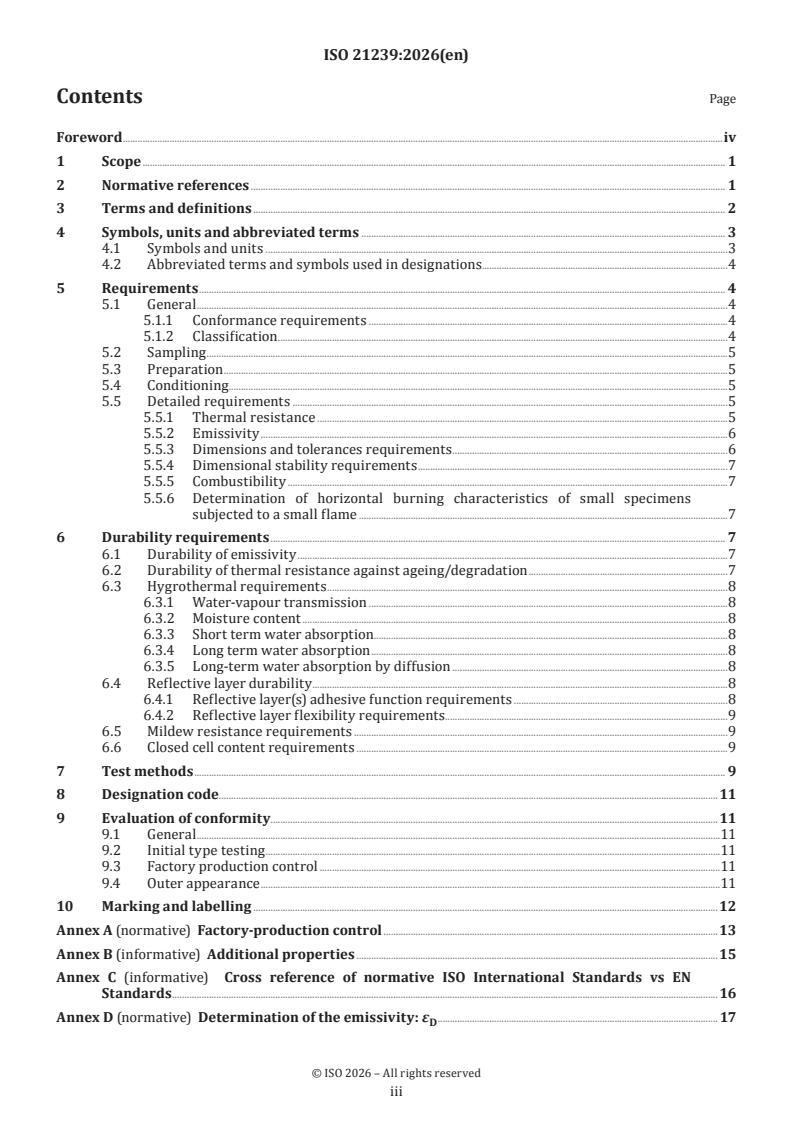
Contents Page
Foreword .iv
1 Scope . 1
2 Normative references . 1
3 Terms and definitions . 2
4 Symbols, units and abbreviated terms . 3
4.1 Symbols and units .3
4.2 Abbreviated terms and symbols used in designations.4
5 Requirements . 4
5.1 General .4
5.1.1 Conformance requirements .4
5.1.2 Classification . .4
5.2 Sampling .5
5.3 Preparation .5
5.4 Conditioning.5
5.5 Detailed requirements .5
5.5.1 Thermal resistance .5
5.5.2 Emissivity .6
5.5.3 Dimensions and tolerances requirements .6
5.5.4 Dimensional stability requirements .7
5.5.5 Combustibility .7
5.5.6 Determination of horizontal burning characteristics of small specimens
subjected to a small flame .7
6 Durability requirements . 7
6.1 Durability of emissivity .7
6.2 Durability of thermal resistance against ageing/degradation .7
6.3 Hygrothermal requirements .8
6.3.1 Water-vapour transmission .8
6.3.2 Moisture content .8
6.3.3 Short term water absorption.8
6.3.4 Long term water absorption .8
6.3.5 Long-term water absorption by diffusion .8
6.4 Reflective layer durability .8
6.4.1 Reflective layer(s) adhesive function requirements .8
6.4.2 Reflective layer flexibility requirements.9
6.5 Mildew resistance requirements .9
6.6 Closed cell content requirements .9
7 Test methods . 9
8 Designation code . .11
9 Evaluation of conformity . .11
9.1 General .11
9.2 Initial type testing .11
9.3 Factory production control .11
9.4 Outer appearance .11
10 Marking and labelling .12
Annex A (normative) Factory-production control .13
Annex B (informative) Additional properties .15
Annex C (informative) Cross reference of normative ISO International Standards vs EN
Standards . 16
Annex D (normative) Determination of the emissivity: ε . 17
D
iii
Foreword
ISO (the International Organization for Standardization) is a worldwide federation of national standards
bodies (ISO member bodies). The work of preparing International Standards is normally carried out through
ISO technical committees. Each member body interested in a subject for which a technical committee
has been established has the right to be represented on that committee. International organizations,
governmental and non-governmental, in liaison with ISO, also take part in the work. ISO collaborates closely
with the International Electrotechnical Commission (IEC) on all matters of electrotechnical standardization.
The procedures used to develop this document and those intended for its further maintenance are described
in the ISO/IEC Directives, Part 1. In particular, the different approval criteria needed for the different types
of ISO document should be noted. This document was drafted in accordance with the editorial rules of the
ISO/IEC Directives, Part 2 (see www.iso.org/directives).
ISO draws attention to the possibility that the implementation of this document may involve the use of (a)
patent(s). ISO takes no position concerning the evidence, validity or applicability of any claimed patent
rights in respect thereof. As of the date of publication of this document, ISO had not received notice of (a)
patent(s) which may be required to implement this document. However, implementers are cautioned that
this may not represent the latest information, which may be obtained from the patent database available at
www.iso.org/patents. ISO shall not be held responsible for identifying any or all such patent rights.
Any trade name used in this document is information given for the convenience of users and does not
constitute an endorsement.
For an explanation of the voluntary nature of standards, the meaning of ISO specific terms and expressions
related to conformity assessment, as well as information about ISO's adherence to the World Trade
Organization (WTO) principles in the Technical Barriers to Trade (TBT), see www.iso.org/iso/foreword.html.
This document was prepared by Technical Committee ISO/TC 163, Thermal performance and energy use in
the built environment, Subcommittee SC 3, Thermal insulation products, components and systems.
Any feedback or questions on this document should be directed to the user’s national standards body. A
complete listing of these bodies can be found at www.iso.org/members.html.
iv
International Standard ISO 21239:2026(en)
Thermal insulation products for buildings — Reflective
insulating products — Specification
1 Scope
This document specifies the requirements for factory-made thermal insulating products containing one
or more reflective or low-emissivity surface components, and designed to be used in conjunction with an
incorporated air space, for the thermal insulation of buildings.
This document specifies products manufactured in the form of rolls, boards and sheets, and also covers
products that are used in prefabricated thermal insulation systems and composite panels. Such prefabricated
systems and composite panels are not within the scope of this document. The products specified in this
document are not intended for use in load-bearing applications.
This document does not specify the required level of a given property to be achieved by a product to
demonstrate fitness for purpose in an application. The levels of performance required for a given application
are to be found in project specifications.
2 Normative references
The following documents are referred to in the text in such a way that some or all of their content constitutes
requirements of this document. For dated references, only the edition cited applies. For undated references,
the latest edition of the referenced document (including any amendments) applies.
ISO 846, Plastics — Evaluation of the action of microorganisms
ISO 1182, Reaction to fire tests for products — Non-combustibility test
ISO 1716, Reaction to fire tests for products — Determination of the gross heat of combustion (calorific value)
ISO 4590, Rigid cellular plastics — Determination of the volume percentage of open cells and of closed cells
ISO 4624, Paints and varnishes — Pull-off test for adhesion
ISO 6946, Building components and building elements — Thermal resistance and thermal transmittance —
Calculation methods
ISO 8990, Thermal insulation — Determination of steady-state thermal transmission properties — Calibrated
and guarded hot box
ISO 9229, Thermal insulation — Vocabulary
ISO 9772, Cellular plastics — Determination of horizontal burning characteristics of small specimens subjected
to a small flame
ISO 10456, Building materials and products — Hygrothermal properties — Tabulated design values and
procedures for determining declared and design thermal values
ISO 11925-2, Reaction to fire tests — Ignitability of products subjected to direct impingement of flame — Part 2:
Single-flame source test
ISO 12570, Hygrothermal performance of building materials and products — Determination of moisture content
by drying at elevated temperature
ISO 12572, Hygrothermal performance of building materials and products — Determination of water vapour
transmission properties — Cup method
ISO 12576-1, Thermal insulation — Insulating materials and products for buildings — Conformity control
systems — Part 1: Factory-made products
ISO 16535, Thermal insulating products for building applications — Determination of long-term water
absorption by immersion
ISO 16536, Thermal insulating products for building applications — Determination of long-term water
absorption by diffusion
ISO 16544, Thermal insulating products for building applications — Conditioning to moisture equilibrium under
specified temperature and humidity conditions
ISO 16269-6:2014, Statistical interpretation of data — Part 6: Determination of statistical tolerance intervals
ISO 29465, Thermal insulating products for building applications — Determination of length and width
ISO 29466, Thermal insulating products for building applications — Determination of thickness
ISO 29467, Thermal insulating products for building applications — Determination of squareness
ISO 29472, Thermal insulating products for building applications — Determination of dimensional stability
under specified temperature and humidity conditions
ISO 29767, Thermal insulating products for building applications — Determination of short-term water
absorption by partial immersion
ISO 22097:2023, Thermal insulation for buildings — Reflective insulation products — Determination of thermal
performance
3 Terms and definitions
For the purposes of this document, the terms and definitions given in ISO 9229 and the following apply.
ISO and IEC maintain terminology databases for use in standardization at the following addresses:
— ISO Online browsing platform: available at https:// www .iso .org/ obp
— IEC Electropedia: available at https:// www .electropedia .org/
3.1
class
classification of a product by a property bounded by an upper and lower limit and used to differentiate from
other products which fulfil the same function
3.2
emissivity
ratio of the energy radiated from a material's surface to that radiated from a perfect emitter, known as
a blackbody, at the same temperature and wavelength and under the same viewing conditions
3.3
radiation
emission or transmission of energy in the form of waves or particles through space or through a material
medium
3.4
reflection
phenomenon by which progressive waves or particles propagate in a new direction in the same medium
after changing directions as a result of collision with another medium
3.5
reflective insulation
thermal insulation product that derives a portion of its claimed thermal performance and properties from
the presence of one or more reflective or low emissivity surfaces incorporated with associated airspace(s)
4 Symbols, units and abbreviated terms
4.1 Symbols and units
b width mm
D inside diameter mm
i
D outside diameter mm
o
d thickness mm
d thickness mm
D
d nominal thickness of the product mm
N
d thickness of the test specimen mm
s
∆ε relative change in width %
b
∆ε relative change in thickness %
d
∆ε relative change in length %
l
ε emissivity —
ε declared emissivity —
D
ε declared emissivity representing at least 90 % of the production —
90/90
determined with a confidence level of 90 %
l length mm
λ thermal conductivity W/(m⋅K)
λ thermal conductivity W/(m⋅K)
D
μ water vapour diffusion resistance factor —
N number of test results —
S deviation from squareness on length and width mm/m
b
S deviation from squareness on thickness mm
d
σ compressive stress at 10 % deformation kPa
σ compressive strength kPa
m
v tensile strength perpendicular to faces mm
W long term water absorption by partial immersion kg/m2
lp
Wp short-term water absorption kg/m
4.2 Abbreviated terms and symbols used in designations
CS(10\Y) level for compressive stress or compressive strength
DS(TH) value for dimensional stability under specified temperature and relative humidity conditions
FPC factory production control
ITT initial type test
MU value for water vapour diffusion resistance factor
R declared thermal resistance, m2 K/W
D
RI reflective insulation
RtF reaction to fire
RH relative humidity
R 90 % fractile with a confidence level of 90 % for the thermal resistance, m2 K/W
90/90
T class for thickness tolerances
WS level for short term water absorption
CD(V) level for water absorption by diffusion
WL(T) declared level for long term water absorption by total immersion
WL(P) declared level for long term water absorption by partial immersion
Z declared value for water vapour resistance
5 Requirements
5.1 General
5.1.1 Conformance requirements
Reflective insulating products for application as thermal insulation products for buildings shall conform
with the requirements of this specification
Those additional durability aspects, not applicable to all materials, are set out in Clause 6.
A summary of test methods, test specimens and specific conditions is set out in Table 4 of Clause 7.
5.1.2 Classification
This document is applicable to products which include air spaces and reflective surfaces within the body
of the products, or can possess inner or outer reflective coatings or reflective facings materials. Four
product types are used in the classification of ISO 22097 products. These classifications define the thermal
transmission test methods required to determine and verify classification. The four product types are:
— Product Type 1, includes materials with parallel faces or which can be compressed into parallel faces
without compromising the nominal thickness for testing of thermal resistance when using guarded hot
plate or heat flow meter equipment.
— Product Type 2, has the properties as for Type 1 but can contain indentations of less than 5 mm in width
or depth. Indentations can be grooves, folds, creases or contoured shapes as for containing air bubbles.
— Product Type 3, has external surfaces which are not parallel and can vary considerably in thickness.
— Product Type 4, is a thin film or sheet of less than 2,0 mm thickness.
5.2 Sampling
Test specimens shall be taken from the same product sample of total area not less than 1 m and sufficient
to cover the necessary test methods. The shorter side of the sample shall not be less than 300 mm or full
size of the product. When testing is carried out in accordance with ISO 8990, larger test specimens shall be
required.
Table 4 shows the required test specimen dimensions and the minimum number of test specimens required
to give one test result.
5.3 Preparation
All test specimens shall be cut appropriately for their respective tests at least 50 mm from each edge or
corner of the sample.
If additional layers are to be added to a single-layer product, the test conditions for multi-layered reflective
insulation products shall be applied and a note of such action is made.
5.4 Conditioning
5.4.1 All test specimens used in testing shall have been manufactured not less than 72 h earlier and shall
be conditioned at a temperature range of (23 ± 2) °C with an RH range of (50 ± 10) %, for at least 24 h
immediately prior to testing.
5.4.2 Products with layers of closed cell insulating foam shall be aged for 180 days and conditioned at
a temperature range of (23 ± 2) °C with an RH range of (50 ± 10) %, for at least 24 h immediately prior to
testing.
5.5 Detailed requirements
5.5.1 Thermal resistance
Thermal resistance shall be determined in accordance with ISO 22097.
The thermal resistance shall be declared by the manufacturer according to the following:
— the reference mean temperature shall be 10 °C for temperate climate conditions and 23 °C for tropical
conditions;
— the measured values shall be expressed to three significant decimal places;
— the declared thermal resistance, R , shall be given as a limit value representing at least 90 % of the
D
production, determined with a confidence level of 90 %;
— the declared thermal resistance, R , shall be based upon the nominal thickness (d ), or the measured
D N
thickness (d ) whichever is the lesser thickness;
L
— the statistical value of thermal resistance, R , shall be rounded downwards to the nearest 0,05 m ⋅K/W,
90/90
and declared as R in levels with steps of 0,05 m ⋅K/W;
D
— R & U (design values) shall be determined in accordance with either ISO 10456 or ISO 6946, or both, for
air spaces.
5.5.2 Emissivity
The emissivity of the reflective surface or surfaces shall be determined in accordance with the test method
set out in Annex D to this document.
Measured values shall be declared by the manufacturer as follows:
— the measured value shall be expressed to two significant figures;
— the declared value of emissivity ε shall be given as a limit value representing at least 90 % of the
production, determined with a confidence level of 90 %;
— the statistical value of emissivity ε shall be declared for each external face of the product if the two
90/90
faces differ (including the presence of printing on any face), otherwise the declared value may be the
mean value for the two faces provided they do not differ by more than 0,01;
— the statistical value of emissivity shall be rounded upwards to the nearest 0,01. Values less than 0,05
shall be declared as 0,05.
5.5.3 Dimensions and tolerances requirements
5.5.3.1 Specimen preparation
5.5.3.1.1 General
For test specimens of reflective insulation products in sheet form, test specimens longer than 500 mm shall
be cut from a roll and at points greater than 20 mm from each edge or ends of the roll. Specimens shall be
conditioned immediately prior to the test for 24 h at 23 °C and 90 % RH or aged for 180 days under the same
conditions if the composition incudes any layers of closed cell polymeric foam materials.
5.5.3.1.2 Linear dimensions requirements (length and width)
The length, l and width, b, for flat products shall be determined in accordance with ISO 29465 and ISO 29466.
Thickness shall be measured with a device having a maximum permissible measurement error of 0,1 mm or
better. In the case of partially packed products, measurement shall be made with the packed portion.
Thickness tolerances shall be in accordance with Table 1. No test result shall deviate from the declared
values by more than the tolerances given in Table 1.
Table 1 — Levels and class
...