


ISO/IEC 19785-1:2015
(Main)Information technology — Common Biometric Exchange Formats Framework — Part 1: Data element specification
Information technology — Common Biometric Exchange Formats Framework — Part 1: Data element specification
ISO/IEC 19785-1:2015 defines structures and data elements for biometric information records (BIRs). ISO/IEC 19785-1:2015 defines the concept of a domain of use to establish the applicability of a standard or specification that complies with CBEFF requirements. ISO/IEC 19785-1:2015 defines the concept of a CBEFF patron format, which is a published BIR format specification that complies with CBEFF requirements, specified by a CBEFF patron. ISO/IEC 19785-1:2015 defines the abstract values (and associated semantics) of a set of CBEFF data elements to be used in the definition of CBEFF patron formats. ISO/IEC 19785-1:2015 specifies the use of CBEFF data elements by a CBEFF patron to define the content and encoding of a standard biometric header (SBH) to be included in a biometric information record (i.e. the definition of a CBEFF patron format). ISO/IEC 19785-1:2015 provides the means for identification of the formats of the BDBs in a BIR but the standardization and interoperability of BDB formats are not in the scope of this part of ISO/IEC 19785. It also provides a means (the security block) for BIRs to carry information about the encryption of a BDB in the BIR and about integrity mechanisms applied to the BIR as a whole; the structure and content of security blocks are not in the scope of this part of ISO/IEC 19785. Further, the specification of encryption mechanisms for BDBs and of integrity mechanisms for BIRs is not in the scope of this part of ISO/IEC 19785. ISO/IEC 19785-1:2015 specifies transformations from one CBEFF patron format to a different CBEFF patron format. The encoding of the abstract values of CBEFF data elements to be used in the specification of CBEFF patron formats is not in the scope of this part of ISO/IEC 19785. ISO/IEC 19785-3 specifies several patron format specifications for which ISO/IEC JTC 1 SC 37 is the CBEFF patron. ISO/IEC 19785-4 specifies several security block format specifications for which ISO/IEC JTC 1 SC 37 is the CBEFF patron. Protection of the privacy of individuals from inappropriate dissemination and use of biometric data is not in the scope of this part of ISO/IEC 19785 but may be subject to national regulation.
Technologies de l'information — Cadre de formats d'échange biométriques communs — Partie 1: Spécifications de données d'élément
General Information
- Status
- Withdrawn
- Publication Date
- 19-Aug-2015
- Withdrawal Date
- 19-Aug-2015
- Technical Committee
- ISO/IEC JTC 1/SC 37 - Biometrics
- Drafting Committee
- ISO/IEC JTC 1/SC 37 - Biometrics
- Current Stage
- 9599 - Withdrawal of International Standard
- Start Date
- 14-Sep-2020
- Completion Date
- 12-Feb-2026
Relations
- Effective Date
- 23-Apr-2020
- Effective Date
- 01-Mar-2014
- Effective Date
- 01-Mar-2014

Get Certified
Connect with accredited certification bodies for this standard

BSI Group
BSI (British Standards Institution) is the business standards company that helps organizations make excellence a habit.

NYCE
Mexican standards and certification body.
Sponsored listings
Frequently Asked Questions
ISO/IEC 19785-1:2015 is a standard published by the International Organization for Standardization (ISO). Its full title is "Information technology — Common Biometric Exchange Formats Framework — Part 1: Data element specification". This standard covers: ISO/IEC 19785-1:2015 defines structures and data elements for biometric information records (BIRs). ISO/IEC 19785-1:2015 defines the concept of a domain of use to establish the applicability of a standard or specification that complies with CBEFF requirements. ISO/IEC 19785-1:2015 defines the concept of a CBEFF patron format, which is a published BIR format specification that complies with CBEFF requirements, specified by a CBEFF patron. ISO/IEC 19785-1:2015 defines the abstract values (and associated semantics) of a set of CBEFF data elements to be used in the definition of CBEFF patron formats. ISO/IEC 19785-1:2015 specifies the use of CBEFF data elements by a CBEFF patron to define the content and encoding of a standard biometric header (SBH) to be included in a biometric information record (i.e. the definition of a CBEFF patron format). ISO/IEC 19785-1:2015 provides the means for identification of the formats of the BDBs in a BIR but the standardization and interoperability of BDB formats are not in the scope of this part of ISO/IEC 19785. It also provides a means (the security block) for BIRs to carry information about the encryption of a BDB in the BIR and about integrity mechanisms applied to the BIR as a whole; the structure and content of security blocks are not in the scope of this part of ISO/IEC 19785. Further, the specification of encryption mechanisms for BDBs and of integrity mechanisms for BIRs is not in the scope of this part of ISO/IEC 19785. ISO/IEC 19785-1:2015 specifies transformations from one CBEFF patron format to a different CBEFF patron format. The encoding of the abstract values of CBEFF data elements to be used in the specification of CBEFF patron formats is not in the scope of this part of ISO/IEC 19785. ISO/IEC 19785-3 specifies several patron format specifications for which ISO/IEC JTC 1 SC 37 is the CBEFF patron. ISO/IEC 19785-4 specifies several security block format specifications for which ISO/IEC JTC 1 SC 37 is the CBEFF patron. Protection of the privacy of individuals from inappropriate dissemination and use of biometric data is not in the scope of this part of ISO/IEC 19785 but may be subject to national regulation.
ISO/IEC 19785-1:2015 defines structures and data elements for biometric information records (BIRs). ISO/IEC 19785-1:2015 defines the concept of a domain of use to establish the applicability of a standard or specification that complies with CBEFF requirements. ISO/IEC 19785-1:2015 defines the concept of a CBEFF patron format, which is a published BIR format specification that complies with CBEFF requirements, specified by a CBEFF patron. ISO/IEC 19785-1:2015 defines the abstract values (and associated semantics) of a set of CBEFF data elements to be used in the definition of CBEFF patron formats. ISO/IEC 19785-1:2015 specifies the use of CBEFF data elements by a CBEFF patron to define the content and encoding of a standard biometric header (SBH) to be included in a biometric information record (i.e. the definition of a CBEFF patron format). ISO/IEC 19785-1:2015 provides the means for identification of the formats of the BDBs in a BIR but the standardization and interoperability of BDB formats are not in the scope of this part of ISO/IEC 19785. It also provides a means (the security block) for BIRs to carry information about the encryption of a BDB in the BIR and about integrity mechanisms applied to the BIR as a whole; the structure and content of security blocks are not in the scope of this part of ISO/IEC 19785. Further, the specification of encryption mechanisms for BDBs and of integrity mechanisms for BIRs is not in the scope of this part of ISO/IEC 19785. ISO/IEC 19785-1:2015 specifies transformations from one CBEFF patron format to a different CBEFF patron format. The encoding of the abstract values of CBEFF data elements to be used in the specification of CBEFF patron formats is not in the scope of this part of ISO/IEC 19785. ISO/IEC 19785-3 specifies several patron format specifications for which ISO/IEC JTC 1 SC 37 is the CBEFF patron. ISO/IEC 19785-4 specifies several security block format specifications for which ISO/IEC JTC 1 SC 37 is the CBEFF patron. Protection of the privacy of individuals from inappropriate dissemination and use of biometric data is not in the scope of this part of ISO/IEC 19785 but may be subject to national regulation.
ISO/IEC 19785-1:2015 is classified under the following ICS (International Classification for Standards) categories: 35.040 - Information coding; 35.240.15 - Identification cards. Chip cards. Biometrics. The ICS classification helps identify the subject area and facilitates finding related standards.
ISO/IEC 19785-1:2015 has the following relationships with other standards: It is inter standard links to ISO/IEC 19785-1:2020, ISO/IEC 19785-1:2006, ISO/IEC 19785-1:2006/Amd 1:2010. Understanding these relationships helps ensure you are using the most current and applicable version of the standard.
ISO/IEC 19785-1:2015 is available in PDF format for immediate download after purchase. The document can be added to your cart and obtained through the secure checkout process. Digital delivery ensures instant access to the complete standard document.
Standards Content (Sample)
INTERNATIONAL ISO/IEC
STANDARD 19785-1
Second edition
2015-08-01
Information technology — Common
Biometric Exchange Formats
Framework —
Part 1:
Data element specification
Technologies de l’information — Cadre de formats d’échange
biométriques communs —
Partie 1: Spécifications de données d’élément
Reference number
©
ISO/IEC 2015
© ISO/IEC 2015, Published in Switzerland
All rights reserved. Unless otherwise specified, no part of this publication may be reproduced or utilized otherwise in any form
or by any means, electronic or mechanical, including photocopying, or posting on the internet or an intranet, without prior
written permission. Permission can be requested from either ISO at the address below or ISO’s member body in the country of
the requester.
ISO copyright office
Ch. de Blandonnet 8 • CP 401
CH-1214 Vernier, Geneva, Switzerland
Tel. +41 22 749 01 11
Fax +41 22 749 09 47
copyright@iso.org
www.iso.org
ii © ISO/IEC 2015 – All rights reserved
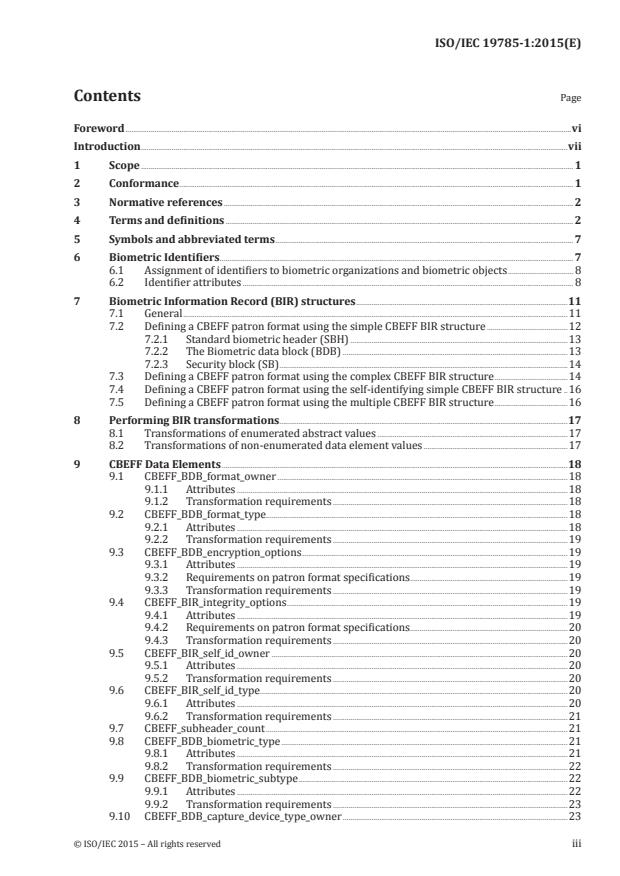
Contents Page
Foreword .vi
Introduction .vii
1 Scope . 1
2 Conformance . 1
3 Normative references . 2
4 Terms and definitions . 2
5 Symbols and abbreviated terms . 7
6 Biometric Identifiers . 7
6.1 Assignment of identifiers to biometric organizations and biometric objects . 8
6.2 Identifier attributes . 8
7 Biometric Information Record (BIR) structures .11
7.1 General .11
7.2 Defining a CBEFF patron format using the simple CBEFF BIR structure .12
7.2.1 Standard biometric header (SBH) .13
7.2.2 The Biometric data block (BDB) .13
7.2.3 Security block (SB) .14
7.3 Defining a CBEFF patron format using the complex CBEFF BIR structure .14
7.4 Defining a CBEFF patron format using the self-identifying simple CBEFF BIR structure .16
7.5 Defining a CBEFF patron format using the multiple CBEFF BIR structure .16
8 Performing BIR transformations.17
8.1 Transformations of enumerated abstract values .17
8.2 Transformations of non-enumerated data element values .17
9 CBEFF Data Elements .18
9.1 CBEFF_BDB_format_owner .18
9.1.1 Attributes .18
9.1.2 Transformation requirements .18
9.2 CBEFF_BDB_format_type.18
9.2.1 Attributes .18
9.2.2 Transformation requirements .19
9.3 CBEFF_BDB_encryption_options .19
9.3.1 Attributes .19
9.3.2 Requirements on patron format specifications.19
9.3.3 Transformation requirements .19
9.4 CBEFF_BIR_integrity_options .19
9.4.1 Attributes .19
9.4.2 Requirements on patron format specifications.20
9.4.3 Transformation requirements .20
9.5 CBEFF_BIR_self_id_owner .20
9.5.1 Attributes .20
9.5.2 Transformation requirements .20
9.6 CBEFF_BIR_self_id_type .20
9.6.1 Attributes .20
9.6.2 Transformation requirements .21
9.7 CBEFF_subheader_count .21
9.8 CBEFF_BDB_biometric_type .21
9.8.1 Attributes .21
9.8.2 Transformation requirements .22
9.9 CBEFF_BDB_biometric_subtype .22
9.9.1 Attributes .22
9.9.2 Transformation requirements .23
9.10 CBEFF_BDB_capture_device_type_owner .23
© ISO/IEC 2015 – All rights reserved iii
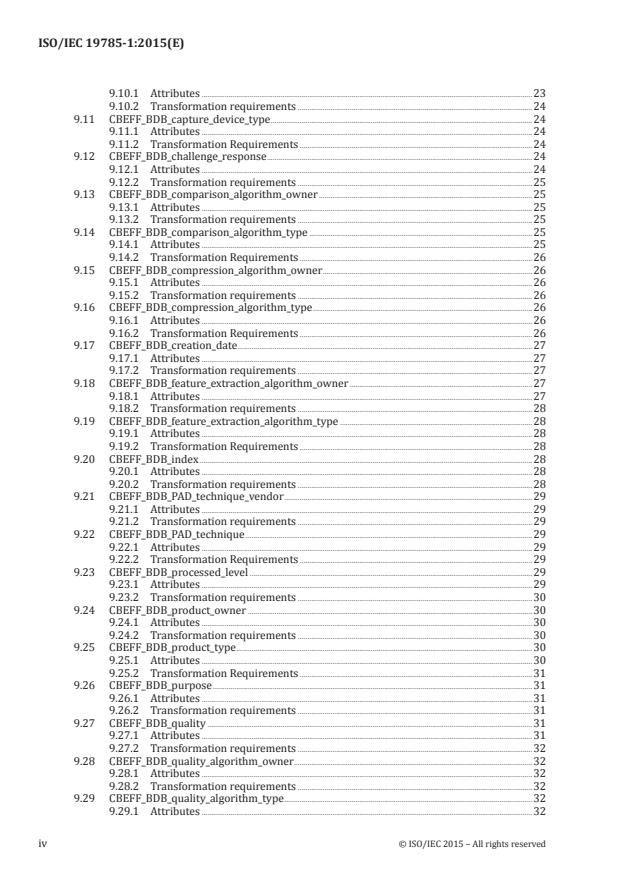
9.10.1 Attributes .23
9.10.2 Transformation requirements .24
9.11 CBEFF_BDB_capture_device_type .24
9.11.1 Attributes .24
9.11.2 Transformation Requirements .24
9.12 CBEFF_BDB_challenge_response .24
9.12.1 Attributes .24
9.12.2 Transformation requirements .25
9.13 CBEFF_BDB_comparison_algorithm_owner .25
9.13.1 Attributes .25
9.13.2 Transformation requirements .25
9.14 CBEFF_BDB_comparison_algorithm_type .25
9.14.1 Attributes .25
9.14.2 Transformation Requirements .26
9.15 CBEFF_BDB_compression_algorithm_owner .26
9.15.1 Attributes .26
9.15.2 Transformation requirements .26
9.16 CBEFF_BDB_compression_algorithm_type .26
9.16.1 Attributes .26
9.16.2 Transformation Requirements .26
9.17 CBEFF_BDB_creation_date .27
9.17.1 Attributes .27
9.17.2 Transformation requirements .27
9.18 CBEFF_BDB_feature_extraction_algorithm_owner .27
9.18.1 Attributes .27
9.18.2 Transformation requirements .28
9.19 CBEFF_BDB_feature_extraction_algorithm_type .28
9.19.1 Attributes .28
9.19.2 Transformation Requirements .28
9.20 CBEFF_BDB_index .28
9.20.1 Attributes .28
9.20.2 Transformation requirements .28
9.21 CBEFF_BDB_PAD_technique_vendor .29
9.21.1 Attributes .29
9.21.2 Transformation requirements .29
9.22 CBEFF_BDB_PAD_technique .29
9.22.1 Attributes .29
9.22.2 Transformation Requirements .29
9.23 CBEFF_BDB_processed_level .29
9.23.1 Attributes .29
9.23.2 Transformation requirements .30
9.24 CBEFF_BDB_product_owner .30
9.24.1 Attributes .30
9.24.2 Transformation requirements .30
9.25 CBEFF_BDB_product_type .30
9.25.1 Attributes .30
9.25.2 Transformation Requirements .31
9.26 CBEFF_BDB_purpose .31
9.26.1 Attributes .31
9.26.2 Transformation requirements .31
9.27 CBEFF_BDB_quality .31
9.27.1 Attributes .31
9.27.2 Transformation requirements .32
9.28 CBEFF_BDB_quality_algorithm_owner .32
9.28.1 Attributes .32
9.28.2 Transformation requirements .32
9.29 CBEFF_BDB_quality_algorithm_type .32
9.29.1 Attributes .32
iv © ISO/IEC 2015 – All rights reserved
9.29.2 Transformation Requirements .33
9.30 CBEFF_BDB_validity_period .33
9.30.1 Attributes .33
9.30.2 Transformation requirements .33
9.31 CBEFF_BIR_creation_date .33
9.31.1 Attributes .33
9.31.2 Transformation requirements .34
9.32 CBEFF_BIR_creator .34
9.32.1 Attributes .34
9.32.2 Transformation requirements .34
9.33 CBEFF_BIR_index .34
9.33.1 Attributes .34
9.33.2 Transformation requirements .34
9.34 CBEFF_BIR_patron_format_owner .35
9.34.1 Attributes .35
9.34.2 Transformation requirements .35
9.35 CBEFF_BIR_patron_format_type .35
9.35.1 Attributes .35
9.35.2 Transformation requirements .35
9.36 CBEFF_BIR_payload .36
9.36.1 Attributes .36
9.36.2 Transformation requirements .36
9.37 CBEFF_BIR_pointer .36
9.37.1 Attributes .36
9.37.2 Transformation requirements .36
9.38 CBEFF_BIR_validity_period .36
9.38.1 Attributes .36
9.38.2 Transformation requirements .37
9.39 CBEFF_patron_header_version .37
9.39.1 Attributes .37
9.39.2 Transformation requirements .37
9.40 CBEFF_SB_format_owner .37
9.40.1 Attributes .37
9.40.2 Transformation requirements .38
9.41 CBEFF_SB_format_type .38
9.41.1 Attributes .38
9.41.2 Transformation requirements .38
9.42 CBEFF_ version .38
9.42.1 Attributes .38
9.42.2 Transformation requirements .38
Annex A (normative) Format and content of a patron format conformance statement .39
Annex B (informative) Conventions for CBEFF names .41
Annex C (informative) Registration Authority .42
Bibliography .43
© ISO/IEC 2015 – All rights reserved v
Foreword
ISO (the International Organization for Standardization) and IEC (the International Electrotechnical
Commission) form the specialized system for worldwide standardization. National bodies that are
members of ISO or IEC participate in the development of International Standards through technical
committees established by the respective organization to deal with particular fields of technical
activity. ISO and IEC technical committees collaborate in fields of mutual interest. Other international
organizations, governmental and non-governmental, in liaison with ISO and IEC, also take part in the
work. In the field of information technology, ISO and IEC have established a joint technical committee,
ISO/IEC JTC 1.
The procedures used to develop this document and those intended for its further maintenance are
described in the ISO/IEC Directives, Part 1. In particular the different approval criteria needed for
the different types of document should be noted. This document was drafted in accordance with the
editorial rules of the ISO/IEC Directives, Part 2 (see www.iso.org/directives).
Attention is drawn to the possibility that some of the elements of this document may be the subject
of patent rights. ISO and IEC shall not be held responsible for identifying any or all such patent
rights. Details of any patent rights identified during the development of the document will be in the
Introduction and/or on the ISO list of patent declarations received (see www.iso.org/patents).
Any trade name used in this document is information given for the convenience of users and does not
constitute an endorsement.
For an explanation on the meaning of ISO specific terms and expressions related to conformity
assessment, as well as information about ISO’s adherence to the WTO principles in the Technical
Barriers to Trade (TBT) see the following URL: Foreword - Supplementary information
The committee responsible for this document is ISO/IEC JTC 1, Information technology, SC 37, Biometrics.
This second edition cancels and replaces the first edition (ISO/IEC 19785-1:2006), which has been
technically revised.
ISO/IEC 19785 consists of the following parts, under the general title Information technology — Common
Biometric Exchange Formats Framework:
— Part 1: Data element specification
— Part 3: Patron format specifications
— Part 4: Security block format specifications
This is the second ISO/IEC standard on CBEFF. Previous versions were published by the National
Institute of Standards and Technology (an agency of the government of the United States of America) and
the Biometric Consortium Working Group. Since the last official non-ISO/IEC release was designated
Version 1.1, the first version of this ISO/IEC 19785-1 International Standard was designated Version 2.0,
and this version is designated Version 3.0. This is to distinguish the versions of CBEFF products in the
marketplace. Version 3.0 is fully backward compatible with Version 2.0.
vi © ISO/IEC 2015 – All rights reserved
Introduction
The Common Biometric Exchange Formats Framework (CBEFF) promotes interoperability of biometric-
based applications and systems by specifying standard structures for biometric information records
(BIRs) and a set of abstract data elements and values that can be used to create the header part of a
CBEFF-compliant BIR.
A biometric information record (BIR) is an encoding in accordance with a CBEFF patron format (see
below). It is a unit of biometric data for storage in a database or for interchange between systems or
parts of systems. A BIR always has at least two parts: a) a standard biometric header (SBH); b) at least
one biometric data block (BDB). It may also have a third part called the security block (SB). CBEFF
places no requirements on the content and encoding of a BDB except that its length is to be an integral
number of octets; the several parts of ISO/IEC 19794 specify standardized BDB formats for a number of
biometric types.
The primary purpose of CBEFF is to define abstract data elements (data elements with a set of defined
abstract values, with their semantics) that are expected to be of general utility as parts of the SBH in
biometric information records. This part of ISO/IEC 19785 defines these data elements.
A CBEFF patron format is defined for a particular domain of use. A CBEFF patron format is a full bit-
level specification of encodings that can carry some or all of the abstract values of the CBEFF data
elements defined in this part of ISO/IEC 19785 (possibly with additional abstract values determined
by the CBEFF patron), together with one or more biometric data blocks (BDBs) containing biometric
data. It is intended that there be a limited number of CBEFF patron formats in any given domain of use.
However, new technologies may evolve that need new encoding rules (or support of more or different
CBEFF data elements) and hence may require new CBEFF patron formats for a given domain of use.
CBEFF also has a requirement that a Biometric Registration Authority exists to assign unique identifiers
to biometric organizations, to biometric data block (BDB) formats, to security block (SB) formats, and
to CBEFF patron format specifications (see below), to publish them where appropriate, and to ensure
that no conflicts occur between identifiers.
CBEFF introduces the concept of assigning a unique identifier to a biometric organization. A CBEFF
biometric organization is any organization, public or private, that requests and receives a biometric
organization identifier from the Biometric Registration Authority.
CBEFF also introduces the concept of a CBEFF patron. A CBEFF patron is an organization (registered
as a biometric organization) that specifies or intends to specify one or more CBEFF patron formats in
an open and public manner. Only public standards organizations such as a standards body, working
group, or industry consortium can register as CBEFF patrons (other CBEFF biometric organizations
are not CBEFF patrons). A CBEFF patron obtains a biometric organization identifier from the Biometric
Registration Authority but has privileges beyond those of ordinary CBEFF biometric organizations:
it can define, register, and publish one or more CBEFF patron formats. The biometric organization
identifier of a CBEFF patron can (but need not) be encoded in BIRs conforming to the patron formats
defined by that CBEFF patron.
CBEFF also defines the concept of a CBEFF biometric data block (BDB) format owner. A CBEFF BDB
format owner is an organization (registered as a CBEFF biometric organization) that specifies one or
more BDB format specifications. A BDB format owner obtains a CBEFF biometric organization identifier
from the Biometric Registration Authority. A BDB format owner can be a public standards organization
(that would, coincidentally, also qualify as a CBEFF patron) or any organization that has a need to define
its own vendor-specific BDB formats, whether they are to be published or not.
A CBEFF BDB format owner defines one or more BDB formats and assigns a BDB format identifier
that unambiguously identifies that BDB format within those defined by the BDB format owner. A BDB
format identifier (and the corresponding format) may, but need not, be registered with the Biometric
Registration Authority.
© ISO/IEC 2015 – All rights reserved vii
CBEFF also defines the concepts of CBEFF biometric product owner as well as owners or vendors for
the following specific product types: a) capture device; b) feature extraction algorithm; c) comparison
algorithm; d) quality algorithm; e) compression algorithm; f) presentation attack detection (PAD)
technique. A CBEFF biometric product owner is an organization (registered as a CBEFF biometric
organization) that assigns a biometric product identifier to a biometric product. A biometric product
owner can be a public standards organization such as a standards body, working group, or industry
consortium (such an organization would, coincidentally, also qualify as a CBEFF patron), or any
organization, such as a vendor or integrator, that has a need to assign biometric product identifiers
to biometric products. A given organization can be the owner of one or more entities in one or more
of these categories (also including BDB formats and SB formats as additional categories) with no
restrictions on the number of entities owned by the organization or on which categories those entities
may belong to.
A CBEFF biometric product owner assigns biometric product identifiers to one or more biometric
products. The identified products can be hardware or software products or a combination of hardware
and software. Examples of biometric products are biometric service providers (BSPs as defined by
ISO/IEC 19784-1) and biometric transforming applications, as well as the specific product types
mentioned in the previous paragraph. A biometric product identifier unambiguously identifies a
biometric product within those that have been assigned an identifier by the biometric product owner. A
biometric product identifier may, but need not, be registered with the Biometric Registration Authority.
A CBEFF capture device type owner, feature extraction algorithm owner, comparison algorithm owner,
quality algorithm owner, compression algorithm owner, or PAD technique vendor assigns capture
device type identifiers (or feature extraction algorithm identifiers, etc.) to one or more capture device
types (or feature extraction algorithms, etc.), respectively. A capture device type identifier (or feature
extraction algorithm identifier, etc.) unambiguously identifies a capture device type (or feature
extraction algorithm, etc.) within those that have been assigned an identifier by the owner/vendor. A
capture device type identifier (or feature extraction algorithm identifier, etc.) may, but need not, be
registered with the Biometric Registration Authority.
CBEFF also defines the concept of a CBEFF security block (SB) format owner. A CBEFF security block
format owner is an organization (registered as a CBEFF biometric organization) that assigns a security
block format identifier to a security block format. A CBEFF security block format owner can be a public
standards organization such as a standards body, working group, or industry consortium (such an
organization would, coincidentally, also qualify as a CBEFF patron) or any organization, such as a vendor
or integrator, that has a need to assign security block format identifiers to security block formats. A
security block format owner can also, but need not, be a BDB format owner and vice versa.
A CBEFF security block format owner assigns security block format identifiers to one or more security
block formats. A security block format identifier unambiguously identifies a security block format within
those that have been assigned an identifier by the biometric security block format owner. A security
block format identifier may, but need not, be registered with the Biometric Registration Authority.
This part of ISO/IEC 19785 specifies a simple CBEFF BIR structure (the format of which can only
be inferred from the domain of use in which such a BIR is encountered) and a complex CBEFF BIR
structure (the format of which can also only be inferred from the domain of use in which such a BIR is
encountered) and gives the requirements for the specification of a CBEFF patron format based on either
of these abstract data structures.
This part of ISO/IEC 19785 also specifies a self-identifying simple CBEFF BIR structure that includes
mandatory data elements that identify the format of the structure.
This part of ISO/IEC 19785 also specifies a multiple CBEFF BIR structure upon which patrons can
specify BIR formats that support one or more sub-BIRs. BIR formats conforming to this structure may
or may not be self-identifying.
This part of ISO/IEC 19785 also specifies transformations of BIRs from one CBEFF patron format into a
different CBEFF patron format.
viii © ISO/IEC 2015 – All rights reserved
Clause 2 specifies the conformance requirements for CBEFF patrons that define CBEFF patron formats.
It also specifies the conformance requirements for biometric transforming applications and for
implementations claiming conformance to a specific patron format.
Clause 9 specifies the CBEFF-defined abstract data elements and the transformation requirements for
each data element. CBEFF permits CBEFF patrons to specify additional abstract data elements.
Annex A is normative. It defines a patron format conformance statement that patrons are to complete
and publish as part of their patron format specifications as assurance that the format fully complies
with CBEFF requirements.
Annex B is informative. It explains the naming conventions used for data elements and abstract values
specified in this part of ISO/IEC 19785 and in ISO/IEC 19785-3.
Annex C is informative. It identifies the CBEFF Registration Authority.
© ISO/IEC 2015 – All rights reserved ix
INTERNATIONAL STANDARD ISO/IEC 19785-1:2015(E)
Information technology — Common Biometric Exchange
Formats Framework —
Part 1:
Data element specification
1 Scope
This part of ISO/IEC 19785 defines structures and data elements for biometric information records (BIRs).
This part of ISO/IEC 19785 defines the concept of a domain of use to establish the applicability of a
standard or specification that complies with CBEFF requirements.
This part of ISO/IEC 19785 defines the concept of a CBEFF patron format, which is a published BIR
format specification that complies with CBEFF requirements, specified by a CBEFF patron.
This part of ISO/IEC 19785 defines the abstract values (and associated semantics) of a set of CBEFF data
elements to be used in the definition of CBEFF patron formats.
This part of ISO/IEC 19785 specifies the use of CBEFF data elements by a CBEFF patron to define the
content and encoding of a standard biometric header (SBH) to be included in a biometric information
record (i.e. the definition of a CBEFF patron format).
This part of ISO/IEC 19785 provides the means for identification of the formats of the BDBs in a
BIR but the standardization and interoperability of BDB formats are not in the scope of this part of
ISO/IEC 19785. It also provides a means (the security block) for BIRs to carry information about the
encryption of a BDB in the BIR and about integrity mechanisms applied to the BIR as a whole; the
structure and content of security blocks are not in the scope of this part of ISO/IEC 19785. Further, the
specification of encryption mechanisms for BDBs and of integrity mechanisms for BIRs is not in the
scope of this part of ISO/IEC 19785.
This part of ISO/IEC 19785 specifies transformations from one CBEFF patron format to a different
CBEFF patron format.
The encoding of the abstract values of CBEFF data elements to be used in the specification of CBEFF
patron formats is not in the scope of this part of ISO/IEC 19785.
ISO/IEC 19785-3 specifies several patron format specifications for which ISO/IEC JTC 1 SC 37 is the
CBEFF patron.
ISO/IEC 19785-4 specifies several security block format specifications for which ISO/IEC JTC 1 SC 37 is
the CBEFF patron.
Protection of the privacy of individuals from inappropriate dissemination and use of biometric data is
not in the scope of this part of ISO/IEC 19785 but may be subject to national regulation.
2 Conformance
2.1 A conforming CBEFF patron
a) shall define CBEFF patron formats in accordance with the requirements of 7.2 (CBEFF simple
BIR structure) or in accordance with the requirements of 7.3 (CBEFF complex BIR structure) or
in accordance with the requirements of 7.4 (self-identifying simple CBEFF BIR structure) or in
accordance with the requirements of 7.5 (multiple CBEFF BIR structure),
© ISO/IEC 2015 – All rights reserved 1
b) shall include in the specification of a patron format
...
Questions, Comments and Discussion
Ask us and Technical Secretary will try to provide an answer. You can facilitate discussion about the standard in here.
Loading comments...