

ISO 18819:2026
(Main)Ships and marine technology — High-manganese austenitic steel — Specification for plates, sheets and coils below 6,0 mm for cryogenic temperature
General Information
- Abstract
This document specifies the delivery conditions for high-manganese austenitic steel in the form of hot rolled or cold rolled plates, sheets, and coils for low temperature purposes. This document covers all product types with a thickness below 6,0 mm. Refer to ISO 23430 for specifications on high manganese-austenitic steel thin strips.
- Status
- Published
- Publication Date
- 01-Mar-2026
- Technical Committee
- ISO/TC 8/SC 4 - Outfitting and deck machinery
- Drafting Committee
- ISO/TC 8/SC 4 - Outfitting and deck machinery
- Current Stage
- 6060 - International Standard published
- Start Date
- 02-Mar-2026
- Due Date
- 15-Dec-2025
- Completion Date
- 02-Mar-2026
Overview
ISO 18819:2026, titled Ships and marine technology - High-manganese austenitic steel - Specification for plates, sheets and coils below 6,0 mm for cryogenic temperature, is an international standard developed by ISO. This document specifies the conditions for the delivery of high-manganese austenitic steel products-including hot rolled and cold rolled plates, sheets, and coils under 6.0 mm thickness-intended for use at low and cryogenic temperatures. ISO 18819:2026 supports material manufacturers, ship owners, shipyards, and shipping companies in producing, purchasing, and utilizing high-manganese austenitic steel in line with global best practices for safety and performance under cryogenic conditions.
Key Topics
- Product Scope: Applies to plates, sheets, and coils manufactured from high-manganese austenitic steel, each with thicknesses below 6.0 mm. It does not cover thin strips, which are specified in ISO 23430.
- Material Properties: Defines minimum mechanical properties, including yield strength, tensile strength, elongation, and Charpy impact energy suited for service temperatures down to -196 °C.
- Manufacturing Requirements: Outlines allowed steelmaking practices, cooling rates to prevent carbide precipitation, and chemical composition limits to ensure retention of austenite and reliable cryogenic performance.
- Inspection and Testing: Stipulates protocols for mechanical testing (tensile and impact tests), retesting procedures, surface and internal quality, dimensional inspections, and marking.
- Documentation & Traceability: Mandatory documentation per ISO 10474 ensures complete traceability of each batch, including chemical and mechanical test results and identification numbers.
Applications
ISO 18819:2026 is fundamental for sectors requiring reliable performance at cryogenic temperatures:
- Shipbuilding: Essential for constructing cargo tanks, fuel tanks, and piping systems in LNG carriers, LPG carriers, and ships carrying low-temperature fuels.
- Marine Technology: Ensures safety and durability of steel components used in cryogenic applications such as handling and storage of liquefied gases.
- Cryogenic Storage: Supports adoption of high-manganese steel in on-board systems, where retention of mechanical properties at low temperatures is critical.
- Liquefied Hydrogen Applications: Upon agreement between the purchaser and manufacturer, the specification may also apply to steel products used in liquefied hydrogen piping systems.
The standard is designed to align with the requirements of international maritime codes (including the IGC and IGF codes), which enhances global safety and regulatory compliance for vessels in the transport of liquefied gases and low-flashpoint fuels.
Related Standards
To ensure comprehensive compliance, ISO 18819:2026 references several related international standards:
- ISO 23430: Specification for high-manganese austenitic steel thin strips used for LNG tanks on ships.
- ISO 148-1: Test method for Charpy pendulum impact test.
- ISO 6892-1: Method of tensile testing at room temperature.
- ISO 2566-1: Conversion of elongation values for carbon and low-alloy steels.
- ISO 10474: Requirements for inspection documents for steel and steel products.
- ISO 16160 & ISO 16162: Tolerances for hot-rolled and cold-rolled steel sheet products.
- EN 10048, EN 10140: European standards for tolerances on dimensions and shapes of narrow steel strips.
- ASTM A370, ASTM E8: Alternative testing standards for mechanical properties of steel products.
- IGC and IGF Codes: International Maritime Organization codes related to ship safety for liquefied gases and low-flashpoint fuels.
By following ISO 18819:2026, industry stakeholders can assure high standards in material selection, testing, and traceability for high-manganese austenitic steel products used in challenging cryogenic and marine environments.
Get Certified
Connect with accredited certification bodies for this standard

DNV
DNV is an independent assurance and risk management provider.

Lloyd's Register
Lloyd's Register is a global professional services organisation specialising in engineering and technology.

FSC International
Forest Stewardship Council certification.
Sponsored listings
Frequently Asked Questions
ISO 18819:2026 is a standard published by the International Organization for Standardization (ISO). Its full title is "Ships and marine technology — High-manganese austenitic steel — Specification for plates, sheets and coils below 6,0 mm for cryogenic temperature". This standard covers: This document specifies the delivery conditions for high-manganese austenitic steel in the form of hot rolled or cold rolled plates, sheets, and coils for low temperature purposes. This document covers all product types with a thickness below 6,0 mm. Refer to ISO 23430 for specifications on high manganese-austenitic steel thin strips.
This document specifies the delivery conditions for high-manganese austenitic steel in the form of hot rolled or cold rolled plates, sheets, and coils for low temperature purposes. This document covers all product types with a thickness below 6,0 mm. Refer to ISO 23430 for specifications on high manganese-austenitic steel thin strips.
ISO 18819:2026 is classified under the following ICS (International Classification for Standards) categories: 47.020.05 - Materials and components for shipbuilding. The ICS classification helps identify the subject area and facilitates finding related standards.
ISO 18819:2026 is available in PDF format for immediate download after purchase. The document can be added to your cart and obtained through the secure checkout process. Digital delivery ensures instant access to the complete standard document.
Standards Content (Sample)
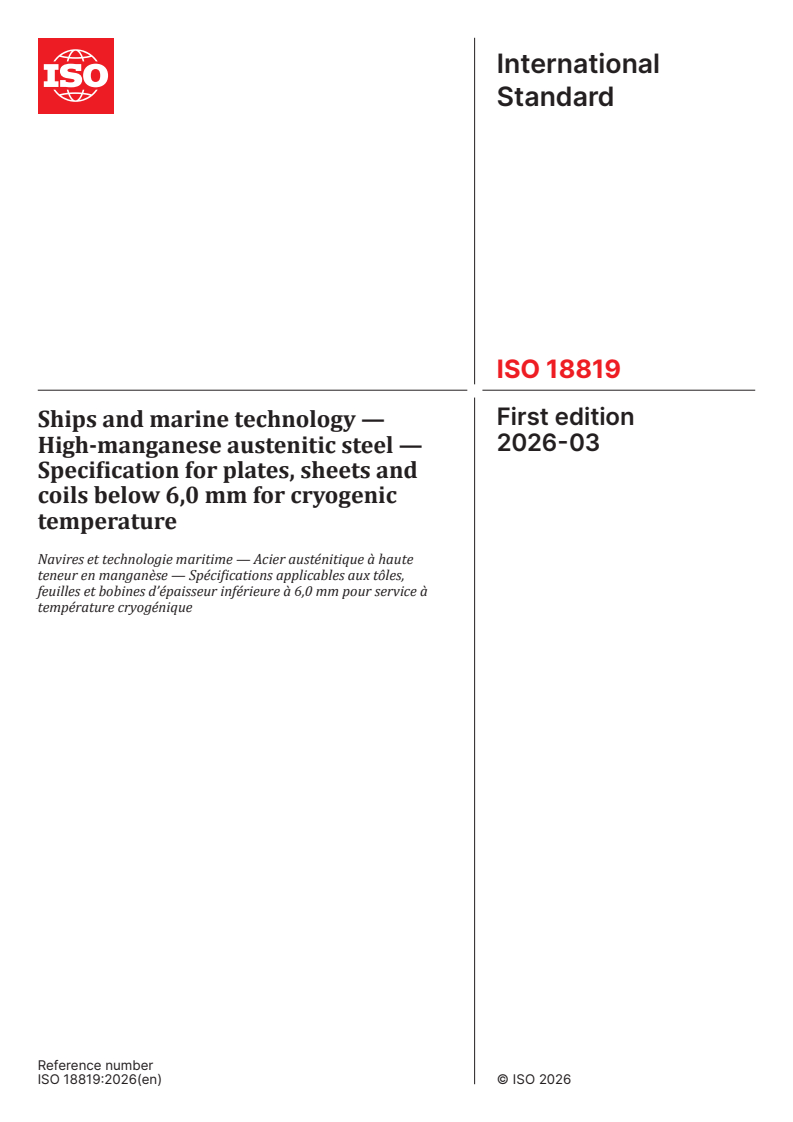
International
Standard
ISO 18819
First edition
Ships and marine technology —
2026-03
High-manganese austenitic steel —
Specification for plates, sheets and
coils below 6,0 mm for cryogenic
temperature
Navires et technologie maritime — Acier austénitique à haute
teneur en manganèse — Spécifications applicables aux tôles,
feuilles et bobines d’épaisseur inférieure à 6,0 mm pour service à
température cryogénique
Reference number
© ISO 2026
All rights reserved. Unless otherwise specified, or required in the context of its implementation, no part of this publication may
be reproduced or utilized otherwise in any form or by any means, electronic or mechanical, including photocopying, or posting on
the internet or an intranet, without prior written permission. Permission can be requested from either ISO at the address below
or ISO’s member body in the country of the requester.
ISO copyright office
CP 401 • Ch. de Blandonnet 8
CH-1214 Vernier, Geneva
Phone: +41 22 749 01 11
Email: copyright@iso.org
Website: www.iso.org
Published in Switzerland
ii
Contents Page
Foreword .iv
Introduction .v
1 Scope . 1
2 Normative references . 1
3 Terms and definitions . 1
4 Manufacture . 2
4.1 Steel-making practice .2
4.2 Rolled product .2
4.3 Chemical composition .2
4.4 Mechanical properties .3
4.4.1 General .3
4.4.2 Tensile strength .3
4.4.3 Impact test .3
4.5 Retesting .4
4.5.1 General .4
4.5.2 Tensile test .4
4.5.3 Impact test .4
4.6 Supplementary processes (optional) .4
5 Inspection . 5
5.1 Surface quality and internal soundness .5
5.2 Weld repair .5
5.3 Dimensional inspection .5
6 Marking . . 5
7 Documentation . 6
Bibliography . 7
iii
Foreword
ISO (the International Organization for Standardization) is a worldwide federation of national standards
bodies (ISO member bodies). The work of preparing International Standards is normally carried out through
ISO technical committees. Each member body interested in a subject for which a technical committee
has been established has the right to be represented on that committee. International organizations,
governmental and non-governmental, in liaison with ISO, also take part in the work. ISO collaborates closely
with the International Electrotechnical Commission (IEC) on all matters of electrotechnical standardization.
The procedures used to develop this document and those intended for its further maintenance are described
in the ISO/IEC Directives, Part 1. In particular, the different approval criteria needed for the different types
of ISO document should be noted. This document was drafted in accordance with the editorial rules of the
ISO/IEC Directives, Part 2 (see www.iso.org/directives).
ISO draws attention to the possibility that the implementation of this document may involve the use of (a)
patent(s). ISO takes no position concerning the evidence, validity or applicability of any claimed patent
rights in respect thereof. As of the date of publication of this document, ISO had not received notice of (a)
patent(s) which may be required to implement this document. However, implementers are cautioned that
this may not represent the latest information, which may be obtained from the patent database available at
www.iso.org/patents. ISO shall not be held responsible for identifying any or all such patent rights.
Any trade name used in this document is information given for the convenience of users and does not
constitute an endorsement.
For an explanation of the voluntary nature of standards, the meaning of ISO specific terms and expressions
related to conformity assessment, as well as information about ISO's adherence to the World Trade
Organization (WTO) principles in the Technical Barriers to Trade (TBT), see www.iso.org/iso/foreword.html.
This document was prepared by Technical Committee TC 8, Ships and marine technology, Subcommittee SC
4, Outfitting and deck machinery.
Any feedback or questions on this document should be directed to the user’s national standards body. A
complete listing of these bodies can be found at www.iso.org/members.html.
iv
Introduction
The newly developed, high-manganese austenitic steel is expected to possess mechanical properties
including Charpy impact energy values comparable to those materials for cryogenic service listed in both
[1] [2]
the IGC Code and IGF Code. Consequently, high-manganese steel is intended to satisfy the strength
requirements of the structure of cargo tanks, fuel tanks and piping systems.
In addition, upon agreement with a purchaser, this document can be applied to piping systems for liquefied
hydrogen.
This document provides a standard specification of high-manganese austenitic steel plate, sheet, strip and
coil for material manufacturers, ship owners, ship yards and shipping companies with regard to producing,
purchasing and using such materials.
v
International Standard ISO 18819:2026(en)
Ships and marine technology — High-manganese austenitic
steel — Specification for plates, sheets and coils below 6,0
mm for cryogenic temperature
1 Scope
This document specifies the delivery conditions for high-manganese austenitic steel in the form of hot rolled
or cold rolled plates, sheets, and coils for low temperature purposes.
This document covers all product types with a thickness below 6,0 mm. Refer to ISO 23430 for specifications
on high manganese-austenitic steel thin strips.
2 Normative references
The following documents are referred to in the text in such a way that some or all of their content constitutes
requirements of this document. For dated references, only the edition cited applies. For undated references,
the latest edition of the referenced document (including any amendments) applies.
ISO 148-1, Metallic materials — Charpy pendulum impact test — Part 1: Test method
ISO 2566-1, Steel — Conversion of elongation values — Part 1: Carbon and low-allo
...