

ISO 17941:2015
(Main)Ships and marine technology — Hydraulic hinged watertight fireproof doors
General Information
- Abstract
ISO 17941:2015 specifies classification and designation, requirements, test method, marking, packaging, transport, and storage of hydraulic watertight hinged fireproof doors (hereinafter referred to as "watertight doors"). ISO 17941:2015 is applicable to the design, manufacture, and acceptance of hydraulic watertight hinged fireproof doors with water pressure not more than 1,0 MPa used for ships, other floating structures and ocean engineering.
- Status
- Published
- Publication Date
- 04-Mar-2015
- Technical Committee
- ISO/TC 8/SC 8 - Ship design
- Drafting Committee
- ISO/TC 8/SC 8 - Ship design
- Current Stage
- 9060 - Close of review
- Completion Date
- 04-Mar-2031
Buy Documents
ISO 17941:2015 - Ships and marine technology -- Hydraulic hinged watertight fireproof doors
ISO 17941:2015 - Ships and marine technology — Hydraulic hinged watertight fireproof doors/5/2015
Overview
ISO 17941:2015 - Ships and marine technology - Hydraulic hinged watertight fireproof doors - defines requirements for the design, manufacture and acceptance of hydraulic hinged watertight fireproof doors used on ships, floating structures and ocean engineering. The standard covers classification and designation, materials, test methods, marking, packaging, transport and storage for watertight doors with working water pressure up to 1.0 MPa. Annexes include schematic diagrams for manual, hydraulic and electro‑hydraulic and electrical systems.
Key topics and technical requirements
- Scope and designation
- Applicable for door types R (right‑hand) and L (left‑hand) and fire‑protection ratings A‑60, A‑30, A‑15, A‑0.
- Standard designation format example: “Hydraulic hinged watertight fireproof door ISO 17941–A60R1800×750 – 0,5”.
- Dimensions and clear opening
- Nominal sizes referenced to ISO 3796 clear openings; alternate sizes may be agreed between purchaser and manufacturer.
- Materials and construction
- Minimum mechanical properties are specified (e.g., door panel yield strength 355 N/mm2; tensile 490–620 N/mm2). Insulation and structural materials must be non‑combustible meeting the IMO FTP Code (Annex 1, Part 1).
- Sealing and tightness
- Sealing contact verified by powder contact test; hydrostatic test at the working pressure (offshore test = working pressure + 5 m water head) with no leakage.
- Hydraulic and electrical systems
- Hydraulic components (pumps, cylinders, accumulators, piping, valves) comply with Administration or Classification Society rules; Annex A/B contain schematic diagrams.
- Hydraulic system must withstand 1.5× working pressure without leakage.
- Control and performance
- Control panel functions: “Close all doors”, “Local”, “Close individually”.
- “Close all doors” must close all open doors within 60 s; powered closing times and manual backup (hand pump) are specified (manual closing ≤ 90 s; accumulator to operate 3 cycles at cut‑in pressure).
- Fabrication and finish
- Weld quality to AWS D1.1/D1M; surface preparation at least ISO 8501‑1 Sa2½; anti‑corrosion coating and proper packaging, transport and storage requirements included.
Applications and users
ISO 17941:2015 is intended for:
- Shipyards and naval architects specifying watertight, fire‑resistant doors
- Door manufacturers and OEMs producing hydraulic hinged watertight doors
- Classification societies, flag administrations and surveyors performing acceptance tests
- Offshore and marine engineers for floating platform access control and compartmentation Practical applications include machinery spaces, accommodation boundaries, and watertight bulkhead penetrations where combined watertight integrity and fire resistance are required.
Related standards
- ISO 3796 - clear openings for external single‑leaf doors
- ISO 8501‑1 - surface preparation (Sa2½)
- IEC 61162‑1 - maritime digital interfaces (referenced for electrical systems)
- AWS D1.1/D1M - structural welding code (weld quality)
- IMO FTP Code (2010) - fire‑resistant materials and components
Keywords: ISO 17941:2015, hydraulic hinged watertight fireproof doors, watertight doors, ships, marine technology, hydrostatic test, fire resistance, hydraulic system, door control.
Buy Documents
ISO 17941:2015 - Ships and marine technology -- Hydraulic hinged watertight fireproof doors
ISO 17941:2015 - Ships and marine technology — Hydraulic hinged watertight fireproof doors/5/2015
Get Certified
Connect with accredited certification bodies for this standard

DNV
DNV is an independent assurance and risk management provider.

Lloyd's Register
Lloyd's Register is a global professional services organisation specialising in engineering and technology.

FSC International
Forest Stewardship Council certification.
Sponsored listings
Frequently Asked Questions
ISO 17941:2015 is a standard published by the International Organization for Standardization (ISO). Its full title is "Ships and marine technology — Hydraulic hinged watertight fireproof doors". This standard covers: ISO 17941:2015 specifies classification and designation, requirements, test method, marking, packaging, transport, and storage of hydraulic watertight hinged fireproof doors (hereinafter referred to as "watertight doors"). ISO 17941:2015 is applicable to the design, manufacture, and acceptance of hydraulic watertight hinged fireproof doors with water pressure not more than 1,0 MPa used for ships, other floating structures and ocean engineering.
ISO 17941:2015 specifies classification and designation, requirements, test method, marking, packaging, transport, and storage of hydraulic watertight hinged fireproof doors (hereinafter referred to as "watertight doors"). ISO 17941:2015 is applicable to the design, manufacture, and acceptance of hydraulic watertight hinged fireproof doors with water pressure not more than 1,0 MPa used for ships, other floating structures and ocean engineering.
ISO 17941:2015 is classified under the following ICS (International Classification for Standards) categories: 47.020.05 - Materials and components for shipbuilding; 47.020.10 - Hulls and their structure elements. The ICS classification helps identify the subject area and facilitates finding related standards.
ISO 17941:2015 is available in PDF format for immediate download after purchase. The document can be added to your cart and obtained through the secure checkout process. Digital delivery ensures instant access to the complete standard document.
Standards Content (Sample)
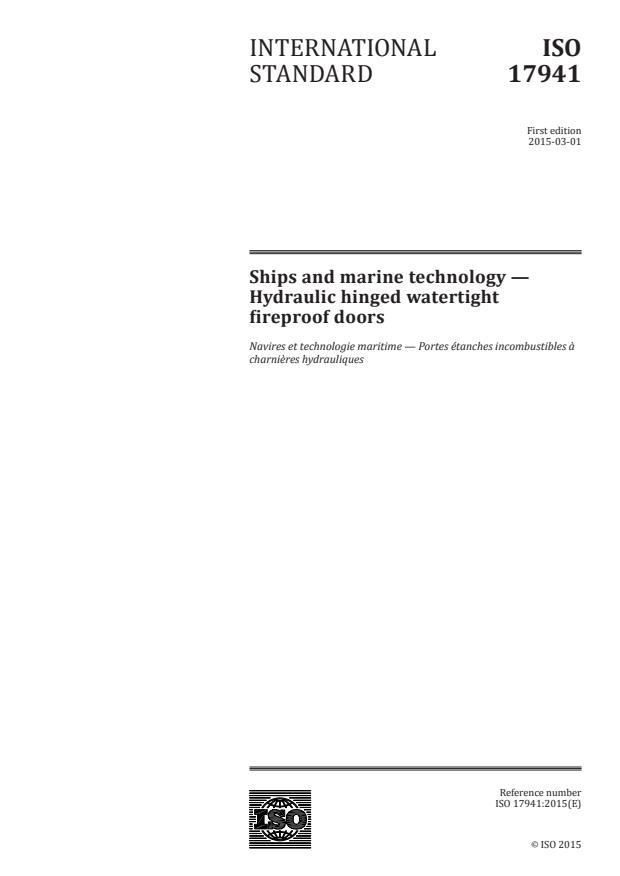
INTERNATIONAL ISO
STANDARD 17941
First edition
2015-03-01
Ships and marine technology —
Hydraulic hinged watertight
fireproof doors
Navires et technologie maritime — Portes étanches incombustibles à
charnières hydrauliques
Reference number
©
ISO 2015
© ISO 2015
All rights reserved. Unless otherwise specified, no part of this publication may be reproduced or utilized otherwise in any form
or by any means, electronic or mechanical, including photocopying, or posting on the internet or an intranet, without prior
written permission. Permission can be requested from either ISO at the address below or ISO’s member body in the country of
the requester.
ISO copyright office
Case postale 56 • CH-1211 Geneva 20
Tel. + 41 22 749 01 11
Fax + 41 22 749 09 47
E-mail copyright@iso.org
Web www.iso.org
Published in Switzerland
ii © ISO 2015 – All rights reserved
Contents Page
Foreword .iv
Introduction .v
1 Scope . 1
2 Normative references . 1
3 Classification and designation . 1
3.1 Types. 1
3.2 Structure and main dimensions . 2
3.3 Manual hydraulic and electric-hydraulic system schematic diagram . 4
3.4 Electrical system diagram . 5
3.5 Designation . 5
4 Requirement and inspection . 5
4.1 Material . 5
4.2 Appearance . 5
4.3 Welds . 6
4.4 Heat Treatment . 6
4.5 Anti-corrosion. 6
4.6 Tightness . 6
4.6.1 Degrees of contact . 6
4.6.2 Water pressure . 6
4.7 System. 6
4.8 Control . 6
4.9 Flexibility . 7
4.10 Alarm . 7
4.11 Status indication . 7
4.12 Inclination test . 7
4.13 Fire resistance . 8
5 Marking, packaging, transport, and storage . 9
5.1 Marking . 9
5.2 Packaging . 9
5.3 Transportation and storage . 9
Annex A (informative) Watertight door’s hydraulic system schematic diagram .10
Annex B (informative) Watertight door’s electrical system schematic diagram .11
Foreword
ISO (the International Organization for Standardization) is a worldwide federation of national standards
bodies (ISO member bodies). The work of preparing International Standards is normally carried out
through ISO technical committees. Each member body interested in a subject for which a technical
committee has been established has the right to be represented on that committee. International
organizations, governmental and non-governmental, in liaison with ISO, also take part in the work.
ISO collaborates closely with the International Electrotechnical Commission (IEC) on all matters of
electrotechnical standardization.
The procedures used to develop this document and those intended for its further maintenance are
described in the ISO/IEC Directives, Part 1. In particular the different approval criteria needed for the
different types of ISO documents should be noted. This document was drafted in accordance with the
editorial rules of the ISO/IEC Directives, Part 2 (see www.iso.org/directives).
Attention is drawn to the possibility that some of the elements of this document may be the subject of
patent rights. ISO shall not be held responsible for identifying any or all such patent rights. Details of any
patent rights identified during the development of the document will be in the Introduction and/or on
the ISO list of patent declarations received (see www.iso.org/patents).
Any trade name used in this document is information given for the convenience of users and does not
constitute an endorsement.
For an explanation on the meaning of ISO specific terms and expressions related to conformity
assessment, as well as information about ISO’s adherence to the WTO principles in the Technical Barriers
to Trade (TBT), see the following URL: Foreword — Supplementary information.
The committee responsible for this document is ISO/TC 8, Ships and marine technology, Subcommittee
SC 8, Ship design.
iv © ISO 2015 – All rights reserved
Introduction
Fire-proof doors shall comply with the requirements of IMO FTP-code. The standard provides reference
for design, manufacturing and inspection of hydraulic watertight hinged fireproof doors, so it is not
imperative for shipyards to implement the standard.
INTERNATIONAL STANDARD ISO 17941:2015(E)
Ships and marine technology — Hydraulic hinged
watertight fireproof doors
1 Scope
This International Standard specifies classification and designation, requirements, test method,
marking, packaging, transport, and storage of hydraulic watertight hinged fireproof doors (hereinafter
referred to as “watertight doors”).
This International Standard is applicable to the design, manufacture, and acceptance of hydraulic
watertight hinged fireproof doors with water pressure not more than 1,0 MPa used for ships, other
floating structures and ocean engineering.
2 Normative references
The following documents, in whole or in part, are normatively referenced in this document and are
indispensable for its application. For dated references, only the edition cited applies. For undated
references, the latest edition of the referenced document (including any amendments) applies.
ISO 3796, Ships and marine technology — Clear openings for external single-leaf doors
ISO 8501-1, Preparation of steel substrates before application of paints and related products — Visual
assessment of surface cleanliness — Part 1: Rust grades and preparation grades of uncoated steel substrates
and of steel substrates after overall removal of previous coatings
IEC 61162-1:2010, Maritime navigation and radio communication equipment and systems — Digital
interfaces — Part 1: Single talker and multiple listeners
AWS D1.1/D1M:2008, Structural Welding Code — Steel
IMO Resolution MSC.302 (87), Adoption of performance standards for Bridge Alert Management
3 Classification and designation
3.1 Types
3.1.1 Depending on the opening direction, watertight doors shall be classified into two types (see Figure 1):
— Type R-Right-hand watertight door (the hinge stays right when the door opens towards the observer);
— Type L-Left-hand watertight door (the hinge stays left when the door opens towards the observer).
R
L
1 1
Key
1 hinge
L left-hand door
R right-hand door
Figure 1 — Opening directions
3.1.2 According to the fire-protection rating, watertight doors shall be classified into four levels: A-60,
A-30, A-15, and A-0.
3.2 Structure and main dimensions
3.2.1 The structure and main dimensions of watertight doors shall be in accordance with Table 1
and Figure 2. The nominal size, L × B, of watertight doors is denoted by reference to the clear opening
according to ISO 3796. Watertight doors of other dimensions can be provided upon agreement between
manufacturer and purchaser.
Table 1 — Main dimensions for watertight door
Dimensions in millimetres
Nominal size Opening in the bulkhead plate Door frames
L × B L B L B
1 1 2 2
1 200 × 600 1 340 740 1 480 880
1 400 × 600 1 540 740 1 680 880
1 400 × 750 1 540 890 1 680 1 030
1 400 × 900 1 540 1 040 1 680 1 180
1 600 × 600 1 740 740 1 880 880
1 600 × 750 1 740 890 1 880 1 030
1 600 × 900 1 740 1 040 1 880 1 180
1 800 × 750 1 940 890 2 080 1 030
1 800 × 900 1 940 1 040 2 080 1 180
The tolerance is as follows:
— Nominal size: mm;
−2
+2
— Opening in the bulkhead
...
INTERNATIONAL ISO
STANDARD 17941
First edition
2015-03-01
Ships and marine technology —
Hydraulic hinged watertight
fireproof doors
Navires et technologie maritime — Portes étanches incombustibles à
charnières hydrauliques
Reference number
©
ISO 2015
© ISO 2015
All rights reserved. Unless otherwise specified, no part of this publication may be reproduced or utilized otherwise in any form
or by any means, electronic or mechanical, including photocopying, or posting on the internet or an intranet, without prior
written permission. Permission can be requested from either ISO at the address below or ISO’s member body in the country of
the requester.
ISO copyright office
Case postale 56 • CH-1211 Geneva 20
Tel. + 41 22 749 01 11
Fax + 41 22 749 09 47
E-mail copyright@iso.org
Web www.iso.org
Published in Switzerland
ii © ISO 2015 – All rights reserved
Contents Page
Foreword .iv
Introduction .v
1 Scope . 1
2 Normative references . 1
3 Classification and designation . 1
3.1 Types. 1
3.2 Structure and main dimensions . 2
3.3 Manual hydraulic and electric-hydraulic system schematic diagram . 4
3.4 Electrical system diagram . 5
3.5 Designation . 5
4 Requirement and inspection . 5
4.1 Material . 5
4.2 Appearance . 5
4.3 Welds . 6
4.4 Heat Treatment . 6
4.5 Anti-corrosion. 6
4.6 Tightness . 6
4.6.1 Degrees of contact . 6
4.6.2 Water pressure . 6
4.7 System. 6
4.8 Control . 6
4.9 Flexibility . 7
4.10 Alarm . 7
4.11 Status indication . 7
4.12 Inclination test . 7
4.13 Fire resistance . 8
5 Marking, packaging, transport, and storage . 9
5.1 Marking . 9
5.2 Packaging . 9
5.3 Transportation and storage . 9
Annex A (informative) Watertight door’s hydraulic system schematic diagram .10
Annex B (informative) Watertight door’s electrical system schematic diagram .11
Foreword
ISO (the International Organization for Standardization) is a worldwide federation of national standards
bodies (ISO member bodies). The work of preparing International Standards is normally carried out
through ISO technical committees. Each member body interested in a subject for which a technical
committee has been established has the right to be represented on that committee. International
organizations, governmental and non-governmental, in liaison with ISO, also take part in the work.
ISO collaborates closely with the International Electrotechnical Commission (IEC) on all matters of
electrotechnical standardization.
The procedures used to develop this document and those intended for its further maintenance are
described in the ISO/IEC Directives, Part 1. In particular the different approval criteria needed for the
different types of ISO documents should be noted. This document was drafted in accordance with the
editorial rules of the ISO/IEC Directives, Part 2 (see www.iso.org/directives).
Attention is drawn to the possibility that some of the elements of this document may be the subject of
patent rights. ISO shall not be held responsible for identifying any or all such patent rights. Details of any
patent rights identified during the development of the document will be in the Introduction and/or on
the ISO list of patent declarations received (see www.iso.org/patents).
Any trade name used in this document is information given for the convenience of users and does not
constitute an endorsement.
For an explanation on the meaning of ISO specific terms and expressions related to conformity
assessment, as well as information about ISO’s adherence to the WTO principles in the Technical Barriers
to Trade (TBT), see the following URL: Foreword — Supplementary information.
The committee responsible for this document is ISO/TC 8, Ships and marine technology, Subcommittee
SC 8, Ship design.
iv © ISO 2015 – All rights reserved
Introduction
Fire-proof doors shall comply with the requirements of IMO FTP-code. The standard provides reference
for design, manufacturing and inspection of hydraulic watertight hinged fireproof doors, so it is not
imperative for shipyards to implement the standard.
INTERNATIONAL STANDARD ISO 17941:2015(E)
Ships and marine technology — Hydraulic hinged
watertight fireproof doors
1 Scope
This International Standard specifies classification and designation, requirements, test method,
marking, packaging, transport, and storage of hydraulic watertight hinged fireproof doors (hereinafter
referred to as “watertight doors”).
This International Standard is applicable to the design, manufacture, and acceptance of hydraulic
watertight hinged fireproof doors with water pressure not more than 1,0 MPa used for ships, other
floating structures and ocean engineering.
2 Normative references
The following documents, in whole or in part, are normatively referenced in this document and are
indispensable for its application. For dated references, only the edition cited applies. For undated
references, the latest edition of the referenced document (including any amendments) applies.
ISO 3796, Ships and marine technology — Clear openings for external single-leaf doors
ISO 8501-1, Preparation of steel substrates before application of paints and related products — Visual
assessment of surface cleanliness — Part 1: Rust grades and preparation grades of uncoated steel substrates
and of steel substrates after overall removal of previous coatings
IEC 61162-1:2010, Maritime navigation and radio communication equipment and systems — Digital
interfaces — Part 1: Single talker and multiple listeners
AWS D1.1/D1M:2008, Structural Welding Code — Steel
IMO Resolution MSC.302 (87), Adoption of performance standards for Bridge Alert Management
3 Classification and designation
3.1 Types
3.1.1 Depending on the opening direction, watertight doors shall be classified into two types (see Figure 1):
— Type R-Right-hand watertight door (the hinge stays right when the door opens towards the observer);
— Type L-Left-hand watertight door (the hinge stays left when the door opens towards the observer).
R
L
1 1
Key
1 hinge
L left-hand door
R right-hand door
Figure 1 — Opening directions
3.1.2 According to the fire-protection rating, watertight doors shall be classified into four levels: A-60,
A-30, A-15, and A-0.
3.2 Structure and main dimensions
3.2.1 The structure and main dimensions of watertight doors shall be in accordance with Table 1
and Figure 2. The nominal size, L × B, of watertight doors is denoted by reference to the clear opening
according to ISO 3796. Watertight doors of other dimensions can be provided upon agreement between
manufacturer and purchaser.
Table 1 — Main dimensions for watertight door
Dimensions in millimetres
Nominal size Opening in the bulkhead plate Door frames
L × B L B L B
1 1 2 2
1 200 × 600 1 340 740 1 480 880
1 400 × 600 1 540 740 1 680 880
1 400 × 750 1 540 890 1 680 1 030
1 400 × 900 1 540 1 040 1 680 1 180
1 600 × 600 1 740 740 1 880 880
1 600 × 750 1 740 890 1 880 1 030
1 600 × 900 1 740 1 040 1 880 1 180
1 800 × 750 1 940 890 2 080 1 030
1 800 × 900 1 940 1 040 2 080 1 180
The tolerance is as follows:
— Nominal size: mm;
−2
+2
— Opening in the bulkhead
...