

ISO/IEC 9075-1:2023/Cor 1:2026
(Corrigendum)Information technology — Database languages SQL — Part 1: Framework (SQL/Framework) — Technical Corrigendum 1
- Status
- Published
- Publication Date
- 02-Aug-2026
- Technical Committee
- ISO/IEC JTC 1/SC 32 - Data management and interchange
- Drafting Committee
- ISO/IEC JTC 1/SC 32/WG 3 - Database language
- Current Stage
- 6060 - International Standard published
- Start Date
- 03-Aug-2026
- Completion Date
- 03-Aug-2026
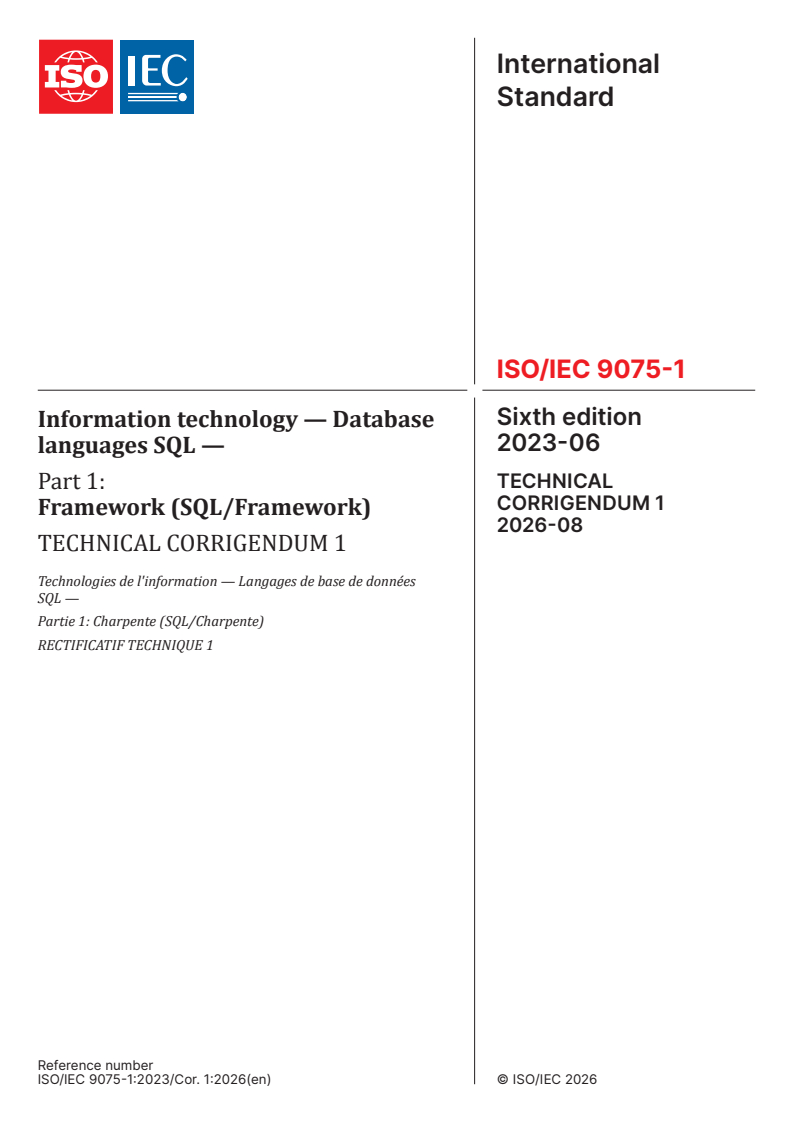

ISO/IEC 9075-1:2023/Cor 1:2026 is ISO/IEC Technical Corrigendum 1 to ISO/IEC 9075-1:2023, the Framework part of the SQL series. It corrects the wording used in the SQL Framework conventions, especially the meaning of the ellipsis in BNF and the rule for raising a condition in exceptions. It is aimed at people who implement, specify, or check SQL behavior across the ISO/IEC 9075 series.
What does ISO/IEC 9075-1:2023/Cor 1:2026 specify?
ISO/IEC 9075-1:2023/Cor 1:2026 is a corrigendum, so it amends existing SQL Framework text rather than introducing a new part of SQL. The corrections apply to clause 6, which covers notation and conventions used in other parts of the ISO/IEC 9075 series.
The document is organized around two amended places:
- 6.2, Notation provided in the ISO/IEC 9075 series
- 6.3, Conventions, including 6.3.3 Use of terms and 6.3.3.7 Exceptions
In practice, this means the corrigendum is there to make the shared SQL notation and exception wording precise for the rest of the series.
What are the key requirements of ISO/IEC 9075-1:2023/Cor 1:2026?
The corrigendum makes two targeted corrections in clause 6, and both matter because they affect how readers interpret the SQL series.
Ellipsis in BNF
In Table 2, the ellipsis symbol is clarified so that it means repetition of the element it applies to. When the ellipsis follows a closing brace, it applies to the whole grouped portion inside the matching braces; when it follows another element, it applies only to that element.
For readers, this removes ambiguity in SQL syntax notation. It tells implementers and standards readers whether repetition belongs to one token or to a grouped sequence, which affects how syntax is parsed and implemented.
The same table also states how ordered lists are to be read in Syntax Rules, Access Rules, General Rules, and Conformance Rules. A reference to the n-th element in such a list assumes the order in which the elements are given unless another order is stated.
That matters when a rule refers to a numbered item in a list. It prevents different interpretations of the same rule text in implementations or conformance checks.
Exceptions and raising a condition
In 6.3.3.7, the corrigendum adds a paragraph stating that the method of raising a condition is implementation-defined (IW168).
In practice, this means SQL implementations may choose their own mechanism for raising the condition, while the standard makes that choice part of the implementation behavior. Users and testers therefore need to look to the implementation for the exact mechanism, rather than expecting one fixed method from the standard text.
What terms does ISO/IEC 9075-1:2023/Cor 1:2026 define?
- BNF - Backus-Naur Form, the notation used here to describe SQL syntax.
- Ellipsis - The
...symbol, used to show repetition in a syntax form. - Syntax Rules - Rules that describe valid SQL syntax and that read list items in sequence unless stated otherwise.
- Access Rules - Rules governing permitted access, interpreted with the same list-order convention.
- General Rules - General normative rules used across the ISO/IEC 9075 series.
- Conformance Rules - Rules that state what is required for conformance.
- implementation-defined - A term meaning the implementation chooses the method; here it applies to raising a condition.
- IW168 - The identifier attached to the implementation-defined note in 6.3.3.7.
Who uses ISO/IEC 9075-1:2023/Cor 1:2026?
ISO/IEC 9075-1:2023/Cor 1:2026 is used by SQL language implementers, database engine developers, and standards writers who need the framework conventions of the SQL series to be unambiguous. It is also relevant to quality teams and conformity assessors who check whether an SQL product follows the wording and conventions used across ISO/IEC 9075.
In practice, it helps when reading or applying syntax rules, defining parser behavior, documenting implementation-defined behavior, or checking conformance claims against the shared SQL framework text.
What changed in ISO/IEC 9075-1:2023/Cor 1:2026 from the previous edition?
ISO/IEC 9075-1:2023/Cor 1:2026 is Technical Corrigendum 1 to ISO/IEC 9075-1:2023.
The corrigendum states these changes:
- It replaces the Table 2 explanation of ellipsis to remove ambiguity in BNF notation.
- It inserts a paragraph in 6.3.3.7 saying that the method of raising a condition is implementation-defined (IW168).
What does the ISO/IEC 9075-1:2023/Cor 1:2026 document contain?
This corrigendum contains the amended text for clause 6 of SQL Framework, with the corrected wording for notation and for exceptions. It includes the updated Table 2 entry for BNF symbols and the added paragraph in 6.3.3.7.
The document also gives the rationale for each correction, which shows why the wording was changed. That makes it useful for implementers and reviewers who need to trace the exact behavior described by the framework text.
Relations
- Effective Date
- 07-Jan-2026
Get Certified
Connect with accredited certification bodies for this standard

BSI Group
BSI (British Standards Institution) is the business standards company that helps organizations make excellence a habit.

NYCE
Mexican standards and certification body.
Sponsored listings
Frequently Asked Questions
ISO/IEC 9075-1:2023/Cor 1:2026 is a standard published by the International Organization for Standardization (ISO). Its full title is "Information technology — Database languages SQL — Part 1: Framework (SQL/Framework) — Technical Corrigendum 1". This standard covers: Information technology — Database languages SQL — Part 1: Framework (SQL/Framework) — Technical Corrigendum 1
Information technology — Database languages SQL — Part 1: Framework (SQL/Framework) — Technical Corrigendum 1
ISO/IEC 9075-1:2023/Cor 1:2026 is classified under the following ICS (International Classification for Standards) categories: 35.060 - Languages used in information technology. The ICS classification helps identify the subject area and facilitates finding related standards.
ISO/IEC 9075-1:2023/Cor 1:2026 has the following relationships with other standards: It is inter standard links to ISO/IEC 9075-1:2023. Understanding these relationships helps ensure you are using the most current and applicable version of the standard.
ISO/IEC 9075-1:2023/Cor 1:2026 is available in PDF format for immediate download after purchase. The document can be added to your cart and obtained through the secure checkout process. Digital delivery ensures instant access to the complete standard document.
Standards Content (Sample)
International
Standard
ISO/IEC 9075-1
Sixth edition
Information technology — Database
2023-06
languages SQL —
TECHNICAL
Part 1:
CORRIGENDUM 1
Framework (SQL/Framework)
2026-08
TECHNICAL CORRIGENDUM 1
Technologies de l'information — Langages de base de données
SQL —
Partie 1: Charpente (SQL/Charpente)
RECTIFICATIF TECHNIQUE 1
Reference number
ISO/IEC 9075-1:2023/Cor. 1:2026(en) © ISO/IEC 2026
ISO/IEC 9075-1:2023/Cor. 1:2026(en)
© ISO/IEC 2026
All rights reserved. Unless otherwise specified, or required in the context of its implementation, no part of this publication may
be reproduced or utilized otherwise in any form or by any means, electronic or mechanical, including photocopying, or posting on
the internet or an intranet, without prior written permission. Permission can be requested from either ISO at the address below
or ISO’s member body in the country of the requester.
ISO copyright office
CP 401 • Ch. de Blandonnet 8
CH-1214 Vernier, Geneva
Phone: +41 22 749 01 11
Email: copyright@iso.org
Website: www.iso.org
Published in Switzerland
© ISO/IEC 2026 – All rights reserved
ii
ISO/IEC 9075-1:2023/Cor.1:2026(en)
Technical Corrigendum 1 to ISO/IEC 9075-1:2023 was prepared by Joint Technical Committee ISO/IE
...