


ISO/IEC 23008-3:2015
(Main)Information technology — High efficiency coding and media delivery in heterogeneous environments — Part 3: 3D audio
Information technology — High efficiency coding and media delivery in heterogeneous environments — Part 3: 3D audio
ISO/IEC 23008-3:2015 specifies technology which supports the efficient transmission of 3D audio signals and flexible rendering for the playback of 3D audio in a wide variety of listening scenarios. These include 3D home theater setups, 22.2 loudspeaker systems, automotive entertainment systems and playback over headphones connected to a tablet or smartphone.
Technologies de l'information — Codage à haute efficacité et livraison des medias dans des environnements hétérogènes — Partie 3: Audio 3D
General Information
- Status
- Withdrawn
- Publication Date
- 15-Oct-2015
- Withdrawal Date
- 15-Oct-2015
- Current Stage
- 9599 - Withdrawal of International Standard
- Start Date
- 28-Feb-2019
- Completion Date
- 12-Feb-2026
Relations
- Effective Date
- 14-Oct-2020
- Effective Date
- 09-May-2020
- Effective Date
- 25-Apr-2020
- Effective Date
- 23-Apr-2020
- Effective Date
- 02-Sep-2017

Get Certified
Connect with accredited certification bodies for this standard

BSI Group
BSI (British Standards Institution) is the business standards company that helps organizations make excellence a habit.

NYCE
Mexican standards and certification body.
Sponsored listings
Frequently Asked Questions
ISO/IEC 23008-3:2015 is a standard published by the International Organization for Standardization (ISO). Its full title is "Information technology — High efficiency coding and media delivery in heterogeneous environments — Part 3: 3D audio". This standard covers: ISO/IEC 23008-3:2015 specifies technology which supports the efficient transmission of 3D audio signals and flexible rendering for the playback of 3D audio in a wide variety of listening scenarios. These include 3D home theater setups, 22.2 loudspeaker systems, automotive entertainment systems and playback over headphones connected to a tablet or smartphone.
ISO/IEC 23008-3:2015 specifies technology which supports the efficient transmission of 3D audio signals and flexible rendering for the playback of 3D audio in a wide variety of listening scenarios. These include 3D home theater setups, 22.2 loudspeaker systems, automotive entertainment systems and playback over headphones connected to a tablet or smartphone.
ISO/IEC 23008-3:2015 is classified under the following ICS (International Classification for Standards) categories: 35.040 - Information coding; 35.040.40 - Coding of audio, video, multimedia and hypermedia information. The ICS classification helps identify the subject area and facilitates finding related standards.
ISO/IEC 23008-3:2015 has the following relationships with other standards: It is inter standard links to ISO/IEC 23008-3:2015/Amd 3:2017, ISO/IEC 23008-3:2015/Amd 1:2016, ISO/IEC 23008-3:2015/Amd 4:2016, ISO/IEC 23008-3:2015/Amd 2:2016, ISO/IEC 23008-3:2019. Understanding these relationships helps ensure you are using the most current and applicable version of the standard.
ISO/IEC 23008-3:2015 is available in PDF format for immediate download after purchase. The document can be added to your cart and obtained through the secure checkout process. Digital delivery ensures instant access to the complete standard document.
Standards Content (Sample)
INTERNATIONAL ISO/IEC
STANDARD 23008-3
First edition
2015-10-15
Corrected version
2016-03-01
Information technology — High
efficiency coding and media delivery
in heterogeneous environments —
Part 3:
3D audio
Technologies de l’information — Codage à haute efficacité et livraison
des medias dans des environnements hétérogènes —
Partie 3: Audio 3D
Reference number
©
ISO/IEC 2015
© ISO/IEC 2015, Published in Switzerland
All rights reserved. Unless otherwise specified, no part of this publication may be reproduced or utilized otherwise in any form
or by any means, electronic or mechanical, including photocopying, or posting on the internet or an intranet, without prior
written permission. Permission can be requested from either ISO at the address below or ISO’s member body in the country of
the requester.
ISO copyright office
Ch. de Blandonnet 8 • CP 401
CH-1214 Vernier, Geneva, Switzerland
Tel. +41 22 749 01 11
Fax +41 22 749 09 47
copyright@iso.org
www.iso.org
ii © ISO/IEC 2015 – All rights reserved
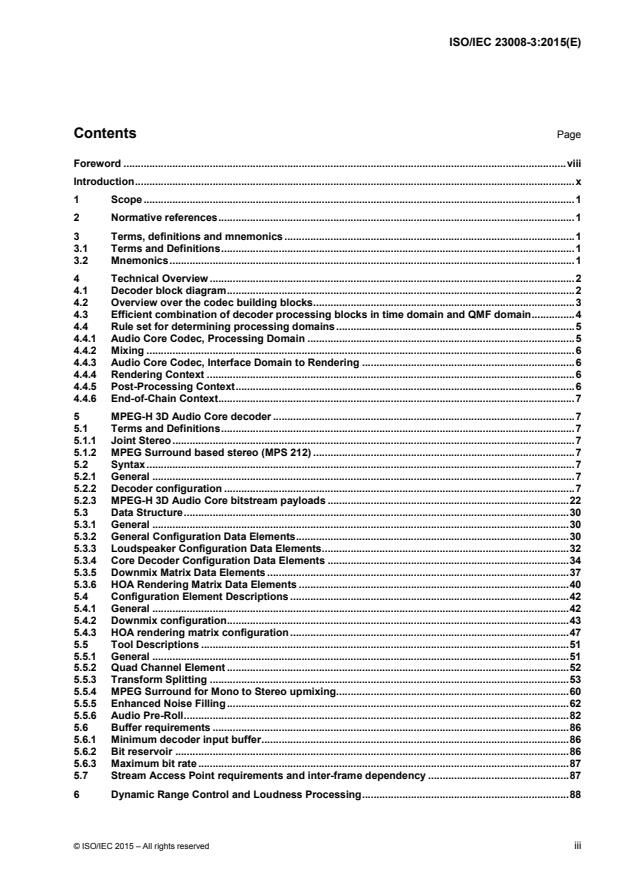
Contents Page
Foreword . viii
Introduction . x
1 Scope . 1
2 Normative references . 1
3 Terms, definitions and mnemonics . 1
3.1 Terms and Definitions . 1
3.2 Mnemonics . 1
4 Technical Overview . 2
4.1 Decoder block diagram . 2
4.2 Overview over the codec building blocks . 3
4.3 Efficient combination of decoder processing blocks in time domain and QMF domain . 4
4.4 Rule set for determining processing domains . 5
4.4.1 Audio Core Codec, Processing Domain . 5
4.4.2 Mixing . 6
4.4.3 Audio Core Codec, Interface Domain to Rendering . 6
4.4.4 Rendering Context . 6
4.4.5 Post-Processing Context . 6
4.4.6 End-of-Chain Context . 7
5 MPEG-H 3D Audio Core decoder . 7
5.1 Terms and Definitions . 7
5.1.1 Joint Stereo . 7
5.1.2 MPEG Surround based stereo (MPS 212) . 7
5.2 Syntax . 7
5.2.1 General . 7
5.2.2 Decoder configuration . 7
5.2.3 MPEG-H 3D Audio Core bitstream payloads . 22
5.3 Data Structure . 30
5.3.1 General . 30
5.3.2 General Configuration Data Elements . 30
5.3.3 Loudspeaker Configuration Data Elements . 32
5.3.4 Core Decoder Configuration Data Elements . 34
5.3.5 Downmix Matrix Data Elements . 37
5.3.6 HOA Rendering Matrix Data Elements . 40
5.4 Configuration Element Descriptions . 42
5.4.1 General . 42
5.4.2 Downmix configuration . 43
5.4.3 HOA rendering matrix configuration . 47
5.5 Tool Descriptions . 51
5.5.1 General . 51
5.5.2 Quad Channel Element . 52
5.5.3 Transform Splitting . 53
5.5.4 MPEG Surround for Mono to Stereo upmixing. 60
5.5.5 Enhanced Noise Filling . 62
5.5.6 Audio Pre-Roll . 82
5.6 Buffer requirements . 86
5.6.1 Minimum decoder input buffer . 86
5.6.2 Bit reservoir . 86
5.6.3 Maximum bit rate . 87
5.7 Stream Access Point requirements and inter-frame dependency . 87
6 Dynamic Range Control and Loudness Processing . 88
© ISO/IEC 2015 – All rights reserved iii
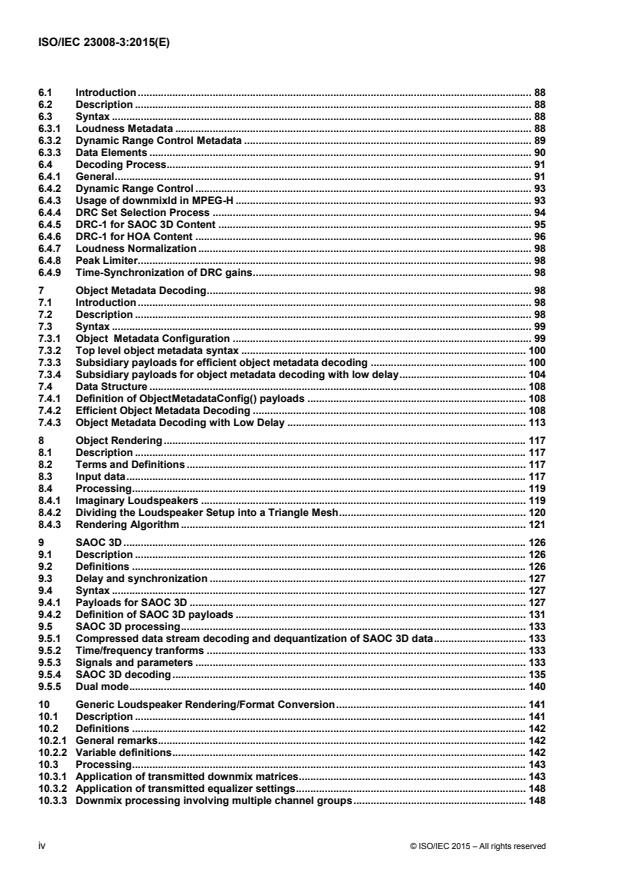
6.1 Introduction . 88
6.2 Description . 88
6.3 Syntax . 88
6.3.1 Loudness Metadata . 88
6.3.2 Dynamic Range Control Metadata . 89
6.3.3 Data Elements . 90
6.4 Decoding Process. 91
6.4.1 General . 91
6.4.2 Dynamic Range Control . 93
6.4.3 Usage of downmixId in MPEG-H . 93
6.4.4 DRC Set Selection Process . 94
6.4.5 DRC-1 for SAOC 3D Content . 95
6.4.6 DRC-1 for HOA Content . 96
6.4.7 Loudness Normalization . 98
6.4.8 Peak Limiter . 98
6.4.9 Time-Synchronization of DRC gains . 98
7 Object Metadata Decoding . 98
7.1 Introduction . 98
7.2 Description . 98
7.3 Syntax . 99
7.3.1 Object Metadata Configuration . 99
7.3.2 Top level object metadata syntax . 100
7.3.3 Subsidiary payloads for efficient object metadata decoding . 100
7.3.4 Subsidiary payloads for object metadata decoding with low delay . 104
7.4 Data Structure . 108
7.4.1 Definition of ObjectMetadataConfig() payloads . 108
7.4.2 Efficient Object Metadata Decoding . 108
7.4.3 Object Metadata Decoding with Low Delay . 113
8 Object Rendering . 117
8.1 Description . 117
8.2 Terms and Definitions . 117
8.3 Input data . 117
8.4 Processing . 119
8.4.1 Imaginary Loudspeakers . 119
8.4.2 Dividing the Loudspeaker Setup into a Triangle Mesh . 120
8.4.3 Rendering Algorithm . 121
9 SAOC 3D . 126
9.1 Description . 126
9.2 Definitions . 126
9.3 Delay and synchronization . 127
9.4 Syntax . 127
9.4.1 Payloads for SAOC 3D . 127
9.4.2 Definition of SAOC 3D payloads . 131
9.5 SAOC 3D processing . 133
9.5.1 Compressed data stream decoding and dequantization of SAOC 3D data . 133
9.5.2 Time/frequency tranforms . 133
9.5.3 Signals and parameters . 133
9.5.4 SAOC 3D decoding . 135
9.5.5 Dual mode . 140
10 Generic Loudspeaker Rendering/Format Conversion . 141
10.1 Description . 141
10.2 Definitions . 142
10.2.1 General remarks. 142
10.2.2 Variable definitions . 142
10.3 Processing . 143
10.3.1 Application of transmitted downmix matrices . 143
10.3.2 Application of transmitted equalizer settings . 148
10.3.3 Downmix processing involving multiple channel groups . 148
iv © ISO/IEC 2015 – All rights reserved
10.3.4 Initialization of the format converter . 149
10.3.5 Audio signal processing . 165
11 Immersive Loudspeaker Rendering / Format Conversion . 171
11.1 Description . 171
11.2 Syntax . 172
11.3 Definitions . 173
11.3.1 General remarks . 173
11.3.2 Variable definitions . 173
12 Higher Order Ambisonics (HOA) . 221
12.1 Technical Overview . 221
12.1.1 Block Diagram . 221
12.1.2 Overview of the decoder tools . 222
12.2 Syntax . 223
12.2.1 Configuration of HOA elements . 223
12.2.2 Payloads of HOA elements . 224
12.3 Data Structure . 229
12.3.1 Definitions of HOA Config . 229
12.3.2 Definitions of HOA payload . 231
12.4 HOA Tool Description . 234
12.4.1 HOA Frame Converter . 234
12.4.2 Spatial HOA decoding . 243
12.4.3 HOA Renderer . 255
13 Binaural Renderer . 263
13.1 Introduction . 263
13.2 Frequency-Domain Binaural Renderer . 264
13.2.1 Introduction . 264
13.2.2 Definitions . 266
13.2.3 Parameterization of Binaural Room Impulse Responses . 270
13.2.4 Frequency-Domain Binaural Processing . 282
13.3 Time-Domain Binaural Renderer . 289
13.3.1 Introduction . 289
13.3.2 Definitions . 290
13.3.3 Parameterization of Binaural Room Impulse Responses . 291
13.3.4 Time-Domain Binaural Processing . 296
14 MPEG-H 3D audio stream (MHAS) . 297
14.1 Overview . 297
14.2 Syntax . 297
14.2.1 Main MHAS syntax elements . 297
14.2.2 Subsidiary MHAS syntax elements . 299
14.3 Semantics . 299
14.3.1 mpeghAudioStreamPacket() . 299
14.3.2 MHASPacketPayload() . 300
14.4 Description of MHASPacketTypes . 300
14.4.1 PACTYP_FILLDATA . 300
14.4.2 PACTYP_MPEGH3DACFG . 300
14.4.3 PACTYP_MPEGH3DAFRAME . 301
14.4.4 PACTYP_SYNC . 301
14.4.5 PACTYP_SYNCGAP . 301
14.4.6 PACTYP_MARKER . 301
14.4.7 PACTYP_CRC16 and PACTYP_CRC32 . 302
14.4.8 PACTYP_DESCRIPTOR . 302
14.4.9 PACTYP_USERINTERACTION . 302
14.4.10 PACTYP_LOUDNESS_DRC . 302
14.4.11 PACTYP_BUFFERINFO . 303
14.5 Application Examples . 303
14.5.1 Light-weighted broadcast . 303
14.5.2 MPEG-2 Transport Stream . 303
14.6 Multi-Stream Delivery and Interface . 304
© ISO/IEC 2015 – All rights reserved v
15 Metadata Audio Elements (MAE) . 306
15.1 Introduction . 306
15.2 Syntax . 307
15.3 Semantics . 311
15.4 Definition of mae_metaDataElementIDs . 319
16 Loudspeaker Distance Compensation . 319
17 Interfaces to the MPEG-H 3D audio decoder . 320
17.1 General . 320
17.2 Interface for local setup information . 321
17.2.1 General . 321
17.2.2 WIRE output . 321
17.2.3 Syntax for local setup information. 321
17.2.4 Semantics for local setup information . 321
17.3 Interface for local loudspeaker setup and rendering . 322
17.3.1 General . 322
17.3.2 Syntax for local loudspeaker signaling . 322
17.3.3 Semantics for local loudspeaker signaling . 323
17.4 Interface for binaural room impulse responses (BRIRs) . 324
17.4.1 Introduction . 324
17.4.2 Syntax of Binaural Renderer Interface . 324
17.4.3 Semantics . 327
17.5 Interface for local screen size information . 332
17.5.1 General . 332
17.5.2 Syntax . 332
17.5.3 Semantics . 332
17.6 Interface for signaling of local zoom area . 333
17.6.1 General . 333
17.6.2 Syntax . 333
17.6.3 Semantics . 334
17.7 Interface for user interaction . 334
17.7.1 Introduction . 334
17.7.2 Definition of User Interaction Categories . 334
17.7.3 Definition of an Interface for User Interaction . 335
17.7.4 Syntax of interaction interface . 335
17.7.5 Semantics of interaction interface . 336
17.8 Interface for loudness normalization and dynamic range control (DRC) . 338
18 Application and processing of local setup information and interaction data . 338
18.1 Element Metadata Preprocessing . 338
18.2 Interactivity Limitations and Restrictions . 341
18.2.1 General Information . 341
18.2.2 WIRE Interactivity . 341
18.2.3 Position Interactivity . 342
18.2.4 Screen-Related Element Remapping and Object Remapping for Zooming . 342
18.2.5 Closest Speaker Playback . 342
18.3 Screen-Related Element Remapping . 342
18.4 Object Remapping for Zooming . 344
18.5 Determination of the Closest Speaker . 345
Annex A (normative) Tables for arithmetic decoding of IGF information . 347
A.1 cf_se01[27] . 347
A.2 cf_se10[27] . 347
A.3 cf_se02[ 7][27] . 347
A.4 short cf_se20[ 7][27] . 347
A.5 short cf_se11[ 7][ 7][27] . 348
A.6 cf_off_se01 . 349
A.7 cf_off_se10 . 349
A.8 cf_off_se02[ 7] . 349
A.9 short cf_off_se20[ 7] . 350
A.10 cf_off_se11[ 7][ 7] . 350
vi © ISO/IEC 2015 – All rights reserved
Annex B (normative) SAOC 3D Decorrelator pre-mixing matrices . 351
B.1 Premixing matrix for output configurations with small number of output channels . 351
B.2 Premixing matrix for 22.2 output configuration . 351
B.3 Algorithm for generating pre-mixing matrices . 352
B.3.1 Input to the algorithm and representations . 352
B.3.2 Algorithm steps . 352
Annex C (informative) Encoder Tools . 356
C.1 General Overview . 356
C.1.1 Encoder block diagram . 356
C.1.2 Overview of the encoder and decoder building blocks . 356
C.2 Core Encoder Tools . 357
C.2.1 Quad Channel Element . 357
C.2.2 Transform Splitting . 358
C.2.3 Calculation of Residual Signal for MPEG Surround with Hybrid Residual Coding . 359
C.2.4 Enhanced Noise Filling . 359
C.3 Object Metadata Encoding . 360
C.3.1 Pre-Processing of the Object Metadata . 360
C.3.2 Efficient Object Metadata Encoding . 361
C.3.3 Object Metadata Encoding with Low Delay . 361
C.3.4 Spatially skipping objects . 361
C.4 SAOC 3D Encoder . 361
C.4.1 Overview . 361
C.4.2 Calculation of the SAOC 3D parameters . 361
C.4.3 Time/frequency transform . 362
C.4.4 Framing. 362
C.4.5 Parameter quantization and coding . 362
Annex D (informative) Peak limiter for unguided clipping prevention . 384
Annex E (normative) Compact Template Downmix Matrices . 385
Annex F (normative) HOA Tables . 386
F.6 32 Uniformly Distributed Positions in Spherical Coordinates . 390
F.12 Table of 256x8 weighting values, WeightValCdbk . 404
Annex G (informative) Low Complexity HOA Rendering . 421
G.1 Tool Description . 421
G.2 Predominant Sound Rendering . 421
G.3 Ambient Sound Rendering . 422
G.4 Output Signal Composition . 422
Annex H (informative) Information on delay and complexity of Time-Domain binauralization . 423
H.1 Complexity and latency . 423
H.1.1 Algorithm description . 423
H.1.2 Complexity . 423
H.1.3 Latency . 424
H.2 Experimental results . 425
H.3 Alternative low-delay implementations . 426
Bibliography . 428
© ISO/IEC 2015 – All rights reserved vii
Foreword
ISO (the International Organization for Standardization) and IEC (the International Electrotechnical
Commission) form the specialized system for worldwide standardization. National bodies that are members of
ISO or IEC participate in the development of International Standards through technical committees
established by the respective organization to deal with particular fields of technical activity. ISO and IEC
technical committees collaborate in fields of mutual interest. Other international organizations, governmental
and non-governmental, in liaison with ISO and IEC, also take part in the work. In the field of information
technology, ISO and IEC have established a joint technical committee, ISO/IEC JTC 1.
The procedures used to develop this document and those intended for its further maintenance are described
in the ISO/IEC Directives, Part 1. In particular the different approval criteria needed for the different types of
document should be noted. This document was drafted in accordance with the editorial rules of the ISO/IEC
Directives, Part 2 (see www.iso.org/directives).
Attention is drawn to the possibility that some of the elements of this document may be the subject of patent
rights. ISO and IEC shall not be held responsible for identifying any or all such patent rights.
Details of any patent rights identified during the development of the document will be in the Introduction and/or
on the ISO list of patent declarations received (see www.iso.org/patents).
Any trade name used in this document is information given for the convenience of users and does not
constitute an endorsement.
For an explanation on the meaning of ISO specific terms and expressions related to conformity assessment,
as well as information about ISO’s adherence to the WTO principles in the Technical Barriers to Trade (TBT)
see the following URL: Foreword - Supplementary information
The committee responsible for this document is ISO/IEC JTC 1, Information technology, Subcommittee SC 29,
Coding of audio, picture, multimedia and hypermedia information.
ISO/IEC 23008 consists of the following parts, under the general title Information technology — High efficiency
coding and media delivery in heterogeneous environments:
Part 1: MPEG media transport (MMT)
Part 2: High efficiency video coding
Part 3: 3D audio
Part 4: MMT Reference and Conformance Software
Part 5: Reference software for high efficiency video coding
Part 8: HEVC conformance testing
Part 10: MPEG media transport forward error correction (FEC) codes
Part 11: MPEG media transport composition information
Part 12: Image file format
Part 13: MMT Implementation Guidelines
viii © ISO/IEC 2015 – All rights reserved
This corrected version of ISO 23008-3:2015 incorporates the following corrections: unreadable equations
have been improved.
© ISO/IEC 2015 – All rights reserved ix
Introduction
3D sound systems are able to realize a significantly enhanced sound experience relative to current
widespread 5.1 channel audio programs and playback systems. These systems demand high quality audio
coding and error-free transmission in order to keep the timbre, sound localization and sound envelopment of
the original audio program. Presentation over headphones with
...
Questions, Comments and Discussion
Ask us and Technical Secretary will try to provide an answer. You can facilitate discussion about the standard in here.
Loading comments...