

ISO 5432:2022
(Main)Leather — Wet blue sheep skins — Specification
General Information
- Abstract
This document specifies requirements, sampling methods and testing methods for wet blue leather produced from sheep skins tanned without wool and with the use of basic chromium sulfate as the primary tanning agent.
- Status
- Published
- Publication Date
- 17-Nov-2022
- Technical Committee
- ISO/TC 120/SC 2 - Tanned leather
- Drafting Committee
- ISO/TC 120/SC 2 - Tanned leather
- Current Stage
- 6060 - International Standard published
- Start Date
- 18-Nov-2022
- Due Date
- 09-Aug-2022
- Completion Date
- 18-Nov-2022


Overview
ISO 5432:2022 is an international standard specifying the requirements, sampling methods, and testing procedures for wet blue leather produced from sheep skins. This leather is tanned primarily using basic chromium sulfate without wool and is widely used in the leather industry for its quality and durability. The standard ensures consistency, safety, and quality across producers and suppliers by defining strict chemical, physical, and presentation criteria.
Key Topics
Raw Material
Wet blue sheep skins must be processed from cured or fresh sheep skins and free from wool.Tanning Process
Uses basic chromium sulfate as the primary tanning agent, with complete chromium penetration in the leather and a tanning pH of 3.0 or above.Chemical Requirements
- Volatile matter to exceed 50% of dry leather mass
- Matter soluble in dichloromethane less than 4%
- pH of water extract at least 3.2
- Chromic oxide content no less than 3.0% of dry mass to ensure durability and proper tanning
Fungicidal Additives
Use of effective fungicides to inhibit mould growth and pigmentation during storage and transportation, maintaining leather quality for up to 4 months.Physical Quality
Leather should have a tight grain, be free from creases, drum folds, and stains caused by iron or chromium salts, with at least 95% of skins free from such defects.Shrinkage Temperature
A minimum shrinkage temperature of 95 °C, ensuring thermal stability of the wet blue sheep skins.Sampling and Testing
Defined procedures for routine and dispute sampling, along with methods for assessing color uniformity, chromium sulfate penetration, shrinkage temperature, pH, volatile matter, fungicide effectiveness, and chemical residuals.Packaging and Marking
Packaging must preserve the original wet condition of the skins, and labeling must include material type, manufacturer details, tanning date, quantity, and purchaser-specific information.
Applications
ISO 5432:2022 serves multiple practical uses in the leather manufacturing and supply chain:
- Quality Control: Provides measurable criteria for raw material inspection and quality assurance in tanneries producing wet blue sheep leather.
- Supplier Agreements: Defines clear terms for product acceptance between purchasers and suppliers, including agreed tolerances on chemical content and physical defects.
- Storage and Transportation: Guidelines on fungicide use help preserve leather during transit and storage, preventing quality degradation by mould.
- Testing Laboratories: Standardizes chemical and physical test methods, enabling consistent laboratory assessments across the global leather industry.
- Regulatory Compliance: Supports adherence to international trade and chemical safety regulations by defining permissible chemical levels and testing protocols.
Manufacturers and suppliers across the leather production chain, from raw skin processing to finished goods, rely on ISO 5432:2022 to ensure product reliability and international market acceptance.
Related Standards
ISO 5432:2022 references and complements several other standards critical to leather processing and testing:
- ISO 2418 – Sampling location for chemical, physical, mechanical, and fastness tests on leather
- ISO 3380 – Determination of shrinkage temperature of leather
- ISO 4044 & ISO 4045 – Preparation of chemical test samples and determination of pH
- ISO 4048 – Determination of matter soluble in dichloromethane and free fatty acid content
- ISO 4684 – Determination of volatile matter in leather
- ISO 5398-1 – Quantification of chromic oxide content by titration
- ASTM D4576 – Test methods for mold growth resistance of wet blue leather
Adhering to this suite of standards ensures comprehensive quality control, safety, and performance evaluation for wet blue sheep skins, promoting global consistency in leather production and trade.
Keywords: ISO 5432:2022, wet blue sheep skins, leather specification, chromium tanning, fungicidal additives, shrinkage temperature, chemical testing, leather quality, sampling methods, leather industry standards, chromic oxide content, leather packaging, leather testing methods.
Relations
- Effective Date
- 17-Jul-2021
Get Certified
Connect with accredited certification bodies for this standard

Control Union Certifications
Global certification for agriculture and sustainability.

Hohenstein Institut
Textile testing and certification.

Bureau Veritas Bangladesh
Bureau Veritas certification services in Bangladesh.
Sponsored listings
Frequently Asked Questions
ISO 5432:2022 is a standard published by the International Organization for Standardization (ISO). Its full title is "Leather — Wet blue sheep skins — Specification". This standard covers: This document specifies requirements, sampling methods and testing methods for wet blue leather produced from sheep skins tanned without wool and with the use of basic chromium sulfate as the primary tanning agent.
This document specifies requirements, sampling methods and testing methods for wet blue leather produced from sheep skins tanned without wool and with the use of basic chromium sulfate as the primary tanning agent.
ISO 5432:2022 is classified under the following ICS (International Classification for Standards) categories: 59.140.30 - Leather and furs. The ICS classification helps identify the subject area and facilitates finding related standards.
ISO 5432:2022 has the following relationships with other standards: It is inter standard links to ISO 5432:2013. Understanding these relationships helps ensure you are using the most current and applicable version of the standard.
ISO 5432:2022 is available in PDF format for immediate download after purchase. The document can be added to your cart and obtained through the secure checkout process. Digital delivery ensures instant access to the complete standard document.
Standards Content (Sample)
INTERNATIONAL ISO
STANDARD 5432
Third edition
2022-11
Leather — Wet blue sheep skins —
Specification
Cuir — Peaux d'ovins à l'état «bleu humide» — Spécifications
Reference number
© ISO 2022
All rights reserved. Unless otherwise specified, or required in the context of its implementation, no part of this publication may
be reproduced or utilized otherwise in any form or by any means, electronic or mechanical, including photocopying, or posting on
the internet or an intranet, without prior written permission. Permission can be requested from either ISO at the address below
or ISO’s member body in the country of the requester.
ISO copyright office
CP 401 • Ch. de Blandonnet 8
CH-1214 Vernier, Geneva
Phone: +41 22 749 01 11
Email: copyright@iso.org
Website: www.iso.org
Published in Switzerland
ii
Contents Page
Foreword .iv
1 Scope . 1
2 Normative references . 1
3 Terms and definitions . 1
4 Requirements . 2
4.1 Raw material . 2
4.2 Tanning . 2
4.3 Fungicidal additives . 2
4.4 Presentation . 2
4.5 Shrinkage temperature . 2
4.6 Chemical requirements . . 2
5 Sampling . 3
5.1 Sampling for routine testing . 3
5.2 Sampling in cases of dispute . 3
5.3 Preparation of samples . 3
6 Method of testing . 3
6.1 Visual tests . 3
6.2 Shrinkage temperature . 3
6.3 Volatile matter . 4
6.4 pH of the water extract . 4
6.5 Effectiveness of the fungicide . 4
6.6 Determination of matter soluble in dichloromethane . 4
7 Packaging and Marking . 4
7.1 Packaging . 4
7.2 Marking . 4
Bibliography . 5
iii
Foreword
ISO (the International Organization for Standardization) is a worldwide federation of national standards
bodies (ISO member bodies). The work of preparing International Standards is normally carried out
through ISO technical committees. Each member body interested in a subject for which a technical
committee has been established has the right to be represented on that committee. International
organizations, governmental and non-governmental, in liaison with ISO, also take part in the work.
ISO collaborates closely with the International Electrotechnical Commission (IEC) on all matters of
electrotechnical standardization.
The procedures used to develop this document and those intended for its further maintenance are
described in the ISO/IEC Directives, Part 1. In particular, the different approval criteria needed for the
different types of ISO documents should be noted. This document was drafted in accordance with the
editorial rules of the ISO/IEC Directives, Part 2 (see www.iso.org/directives).
Attention is drawn to the possibility that some of the elements of this document may be the subject of
patent rights. ISO shall not be held responsible for identifying any or all such patent rights. Details of
any patent rights identified during the development of the document will be in the Introduction and/or
on the ISO list of patent declarations received (see www.iso.org/patents).
Any trade name used in this document is information given for the convenience of users and does not
constitute an endorsement.
For an explanation of the voluntary nature of standards, the meaning of ISO specific terms and
expressions related to conformity assessment, as well as information about ISO's adherence to
the World Trade Organization (WTO) principles in the Technical Barriers to Trade (TBT), see
www.iso.org/iso/foreword.html.
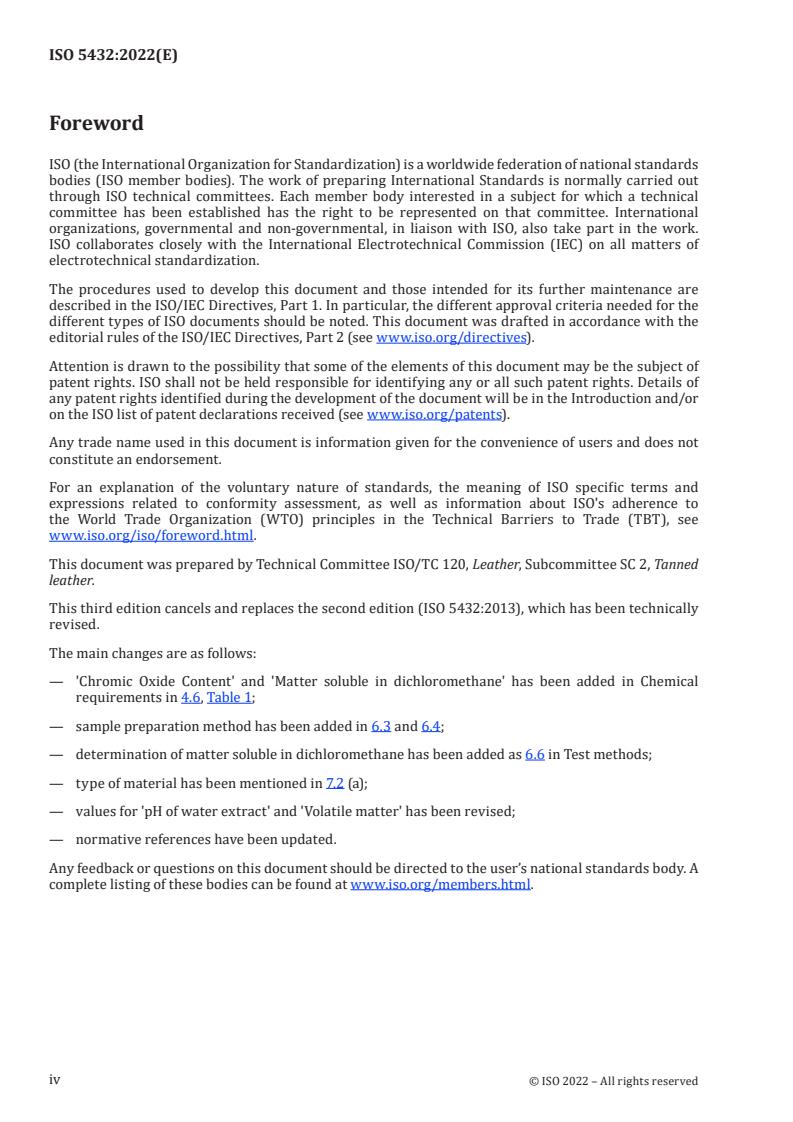
This document was
...