

ISO 22067-2:2026
(Main)Graphic technology — Requirements for communication of environmental aspects of printed products — Part 2: Print finishing
- Abstract
This document specifies requirements for environmental communication on print finishing, including surface decoration, binding and packaging processes in post press. This document is applicable for most print finishing processes but excludes those specific to textile printing and ceramic printing due to their unique processing requirements.
- Status
- Published
- Publication Date
- 18-May-2026
- Technical Committee
- ISO/TC 130 - Graphic technology
- Drafting Committee
- ISO/TC 130/WG 11 - Environmental impact of graphic technology
- Current Stage
- 6060 - International Standard published
- Start Date
- 19-May-2026
- Due Date
- 18-Apr-2027
- Completion Date
- 19-May-2026


ISO 22067-2:2026 is an International Standard from ISO for communicating environmental aspects of printed products at the print finishing stage. It specifies what material suppliers and print finishing service providers need to collect, report, and document for surface decoration, binding, and packaging processes in post press.
It is written for the print finishing supply chain, including organizations that prepare environmental statements, share substance information, or make public environmental claims.
What does ISO 22067-2:2026 specify?
ISO 22067-2:2026 specifies requirements for environmental communication on print finishing, including surface decoration, binding, and packaging processes in post press. It applies to most print finishing processes, while excluding processes specific to textile printing and ceramic printing because of their unique processing requirements.
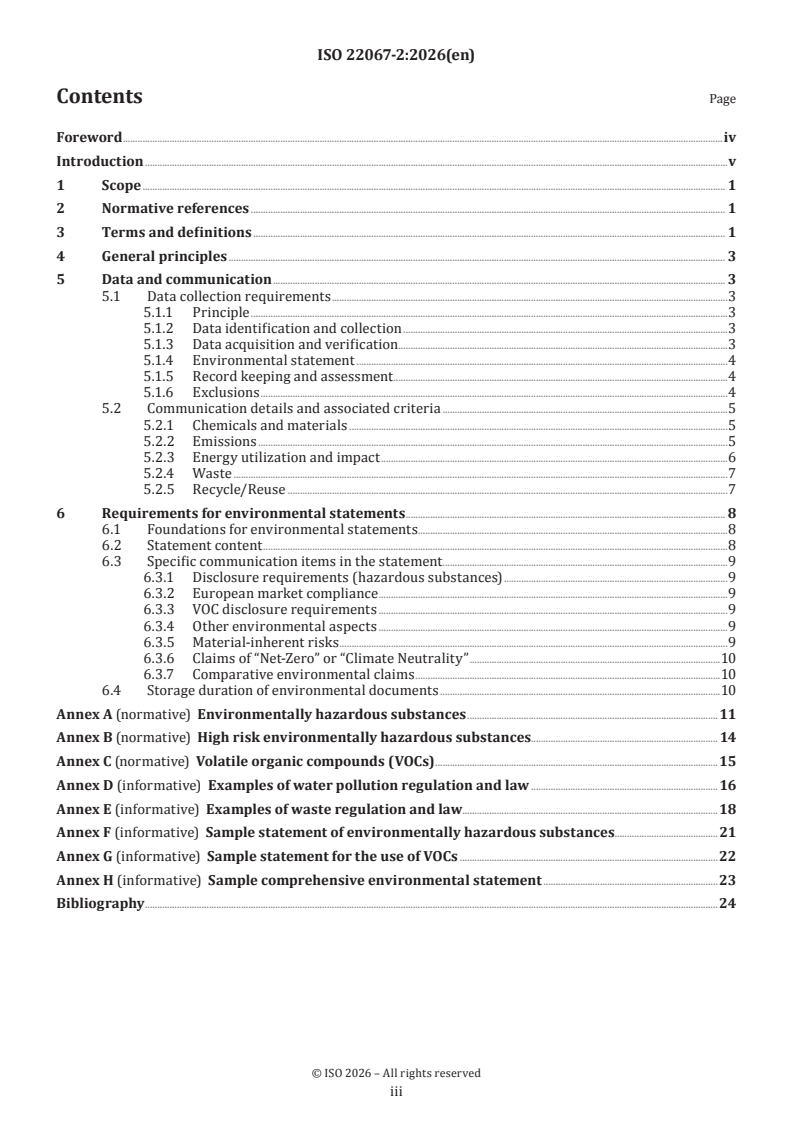
The document is organized into:
- Clause 1 Scope
- Clause 2 Normative references
- Clause 3 Terms and definitions
- Clause 4 General principles
- Clause 5 Data and communication
- Clause 6 Requirements for environmental statements
- Annexes A to H
| Annex | What it covers |
|---|---|
| Annex A | Environmentally hazardous substances |
| Annex B | High risk environmentally hazardous substances |
| Annex C | Volatile organic compounds (VOCs) |
| Annex D | Examples of water pollution regulation and law |
| Annex E | Examples of waste regulation and law |
| Annex F | Sample statement of environmentally hazardous substances |
| Annex G | Sample statement for the use of VOCs |
| Annex H | Sample comprehensive environmental statement |
What are the key requirements of ISO 22067-2:2026?
ISO 22067-2:2026 focuses on collecting reliable environmental data from print finishing, then turning that data into clear statements that can be shared along the supply chain. The practical goal is traceable communication about materials, emissions, energy, waste, and recovery options.
Data collection and supply chain reporting
Clause 5.1 requires collection and evaluation of environmental information on materials, consumables, emissions, energy consumption, waste, and recovery opportunities related to print finishing production and finished products. In practice, suppliers need a documented data trail for the materials and processes they use, not just a general environmental summary.
Clause 5.1.2 requires identification of the materials used in print finishing, including printed sheets, chemicals, adhesives, varnishes, foils, films, and other consumables. That matters because the statement has to reflect the actual finishing system, including recyclability-related issues.
Clause 5.1.3 requires supply chain organizations to obtain environmental compliance data from suppliers, share it with the contracting organization, and audit it for accuracy. Uncertainties such as data gaps or estimation methods need to be documented, so the recipient can judge how strong the evidence is.
Clause 5.1.4 requires material suppliers and print finishing service providers to provide an environmental statement based on the collected and verified data. It also separates responsibilities: material suppliers report hazardous substances and VOCs, while finishing service providers report emissions, energy use, carbon footprint, reuse/recycling suitability, and waste disposal plans.
Clause 5.1.5 requires records and supporting documentation to be kept. That is important for later audits, customer questions, and trend tracking over time.
Substances, emissions, and recovery-related disclosures
Clause 5.2.1 requires environmentally hazardous substances to be identified and stated, including quantities used and disposal information. Annex A and Annex B define which substances and thresholds trigger communication, and the document says the use of those substances should be avoided where possible.
Clause 5.2.2 covers emissions. Air emissions must be communicated where materials contain environmentally hazardous substances or VOCs, and VOC content has to be measured using ISO 11890-1 or ISO 11890-2. Water discharges and noise emissions also need to be communicated when relevant, with noise measured according to ISO 11204.
Clause 5.2.3 covers energy utilization and impact. Energy consumption shall be reported, renewable energy use needs objective evidence, energy recovery potential should be evaluated, and carbon footprint for the print finishing stage shall be reported using ISO 16759 or ISO 14067. This gives buyers and specifiers a way to compare process impacts instead of relying on generic environmental claims.
Clause 5.2.5 requires evaluation of reuse, recyclability, energy recovery, and biodegradability/composting performance by reference to ISO 18603, ISO 18604, ISO 18605, and ISO 18606. For practice, this means the statement should say whether the finished product is designed to be reused or recovered, and what limits that recovery.
Environmental statements and claims
Clause 6.2 says an environmental statement may use any format, but it shall include the environmental aspects and impacts, recommended use limits, confirmation that relevant items were checked, confirmation of compliance with local legislation, and details of uncertainties, allocations, remakes, and excess waste. It also calls for the product name, provider identity, evaluation date and location, and third-party assurance or self-declaration.
Clause 6.2 also requires that ambiguous or unspecified claims not be used. For external communication, the statement has to reference the applicable ISO standard(s) and follow the communication principles of ISO 14063, including transparency, appropriateness, credibility, clarity, and regionality.
Clause 6.3 adds specific communication items for hazardous substances, European market compliance, VOC disclosure, energy and emissions topics, material-inherent risks, and claims such as “Net-Zero” or “Climate Neutrality”. Comparative claims also have to identify the comparison method and the products compared, and they must be based on verifiable data with a life cycle perspective.
What terms does ISO 22067-2:2026 define?
ISO 22067-2:2026 defines the core terms used in environmental communication for print finishing.
- Print finishing - post-press actions performed on printed materials after ink application and before delivery to the buyer or intended user.
- Environmental statement - a collection of sector- and application-specific environmental performance data communicated between stakeholders.
- Environmental aspect - an element of a product or its production process that can interact with the environment during its life cycle.
- Environmental impact - a change to the environment resulting wholly or partly from an environmental aspect.
- Environmentally hazardous substance - a material that can pose a risk to ecosystems, humans, flora, fauna, and other forms of life.
- Volatile organic compound (VOC) - an organic compound that is liquid at room temperature and has a boiling point below 250 °C at standard atmospheric pressure.
- Carbon footprint - the net amount of greenhouse gas emissions and removals, expressed as CO2 equivalents.
- Security printing - processes that transform raw materials into protected documents, ID documents, or security foils.
Who uses ISO 22067-2:2026?
ISO 22067-2:2026 is used by material suppliers, converters, print finishing service providers, and other supply chain organizations that need to communicate environmental information about finished printed products. It is relevant to bookbinding, packaging production, and surface decoration operations in post press.
It also matters to quality managers, sustainability teams, environmental managers, buyers, and auditors who need substance disclosures, emissions data, energy information, or product recovery information. In practice, they use it to prepare statements, check supplier data, support customer requests, and document claims.
Security printing supply chains are treated separately in the document because of the sensitivity of their materials and processes.
Which standards are used with ISO 22067-2:2026?
| Standard | What it contributes |
|---|---|
| ISO 22067-1 | Base requirements for communicating environmental aspects of printed products in general printing |
| ISO 11204 | Method for determining noise emission sound pressure levels |
| ISO 11890-1 | Gravimetric method for VOC determination |
| ISO 11890-2 | Gas-chromatographic method for VOC determination |
| ISO 14024 | Principles and procedures for Type I environmental labelling and verification of public claims |
| ISO 14025 | Principles and procedures for Type III environmental declarations and verification |
| ISO 14063 | Guidelines and examples for environmental communication |
| ISO 14067 | Requirements and guidance for carbon footprint of products |
| ISO 16759 | Quantification and communication for calculating the carbon footprint of print media products |
| ISO 18603 | Reuse of packaging |
| ISO 18604 | Material recycling of packaging |
| ISO 18605:2013 | Energy recovery of packaging |
| ISO 18606 | Organic recycling of packaging |
| ISO 14040, ISO 14044 | Life Cycle Assessment principles used when broader impacts are assessed |
| ISO 50001 | Energy management principles used for energy data collection and monitoring |
| ISO/IEC 13273-2 | Terminology for renewable energy |
What does the ISO 22067-2:2026 document contain?
ISO 22067-2:2026 contains a structured set of rules, thresholds, and examples for environmental communication at the print finishing stage. The introduction includes an overview table of print finishing inputs, processes, and outputs, plus a figure showing the data collection process for an environmental statement.
The normative annexes provide threshold-based lists for environmentally hazardous substances, high risk substances, and VOCs. These annexes are the core technical reference points for deciding what must be disclosed.
The informative annexes give examples of water and waste regulation, plus sample statement formats for hazardous substances, VOCs, and a comprehensive environmental statement. That makes the document usable not only for technical assessment, but also for preparing supplier declarations and customer-facing environmental statements.
Frequently Asked Questions
ISO 22067-2:2026 is a standard published by the International Organization for Standardization (ISO). Its full title is "Graphic technology — Requirements for communication of environmental aspects of printed products — Part 2: Print finishing". This standard covers: This document specifies requirements for environmental communication on print finishing, including surface decoration, binding and packaging processes in post press. This document is applicable for most print finishing processes but excludes those specific to textile printing and ceramic printing due to their unique processing requirements.
This document specifies requirements for environmental communication on print finishing, including surface decoration, binding and packaging processes in post press. This document is applicable for most print finishing processes but excludes those specific to textile printing and ceramic printing due to their unique processing requirements.
ISO 22067-2:2026 is classified under the following ICS (International Classification for Standards) categories: 37.100.01 - Graphic technology in general. The ICS classification helps identify the subject area and facilitates finding related standards.
ISO 22067-2:2026 is available in PDF format for immediate download after purchase. The document can be added to your cart and obtained through the secure checkout process. Digital delivery ensures instant access to the complete standard document.
Standards Content (Sample)
International
Standard
ISO 22067-2
First edition
Graphic technology —
2026-05
Requirements for communication
of environmental aspects of printed
products —
Part 2:
Print finishing
Technologie graphique — Exigences pour la communication des
aspects environnementaux des produits imprimés —
Partie 2: Finissage des impressions
Reference number
© ISO 2026
All rights reserved. Unless otherwise specified, or required in the context of its implementation, no part of this publication may
be reproduced or utilized otherwise in any form or by any means, electronic or mechanical, including photocopying, or posting on
the internet or an intranet, without prior written permission. Permission can be requested from either ISO at the address below
or ISO’s member body in the country of the requester.
ISO copyright office
CP 401 • Ch. de Blandonnet 8
CH-1214 Vernier, Geneva
Phone: +41 22 749 01 11
Email: copyright@iso.org
Website: www.iso.org
Published in Switzerland
ii
Contents Page
Foreword .iv
Introduction .v
1 Scope . 1
2 Normative references . 1
3 Terms and definitions . 1
4 General principles . 3
5 Data and communication . 3
5.1 Data collection requirements .3
5.1.1 Principle .3
5.1.2 Data identification and collection .3
5.1.3 Data acquisition and verification . .3
5.1.4 Environmental statement .4
5.1.5 Record keeping and assessment .4
5.1.6 Exclusions .4
5.2 Communication details and associated criteria .5
5.2.1 Chemicals and materials .5
5.2.2 Emissions .5
5.2.3 Energy utilization and impact .6
5.2.4 Waste .7
5.2.5 Recycle/Reuse .7
6 Requirements for environmental statements . 8
6.1 Foundations for environmental statements.8
6.2 Statement content .8
6.3 Specific communication items in the statement .9
6.3.1 Disclosure requirements (hazardous substances) .9
6.3.2 European market compliance .9
6.3.3 VOC disclosure requirements .9
6.3.4 Other environmental aspects .9
6.3.5 Material-inherent risks . .9
6.3.6 Claims of “Net-Zero” or “Climate Neutrality” .10
6.3.7 Comparative environmental claims .10
6.4 Storage duration of environmental documents .10
Annex A (normative) Environmentally hazardous substances .11
Annex B (normative) High risk environmentally hazardous substances. 14
Annex C (normative) Volatile organic compounds (VOCs) .15
Annex D (informative) Examples of water pollution regulation and law .16
Annex E (informative) Examples of waste regulation and law.18
Annex F (informative) Sample statement of environmentally hazardous substances.21
Annex G (informative) Sample statement for the use of VOCs .22
Annex H (informative) Sample comprehensive environmental statement .23
Bibliography .24
iii
Foreword
ISO (the International Organization for Standardization) is a worldwide federation of national standards
bodies (ISO member bodies). The work of preparing International Standards is normally carried out through
ISO technical committees. Each member body interested in a subject for which a technical committee
has been established has the right to be represented on that committee. International organizations,
governmental and non-governmental, in liaison with ISO, also take part in the work. ISO collaborates closely
with the International Electrotechnical Commission (IEC) on all matters of electrotechnical standardization.
The procedures used to develop this document and those intended for its further maintenance are described
in the ISO/IEC Directives, Part 1. In particular, the different approval criteria needed for the different types
of ISO documents should be noted. This document was drafted in accordance with the editorial rules of the
ISO/IEC Directives, Part 2 (see www.iso.org/directives).
ISO draws attention to the possibility that the implementation of this document may involve the use of (a)
patent(s). ISO takes no position concerning the evidence, validity or applicability of any claimed patent
rights in respect thereof. As of the date of publication of this document, ISO had not received notice of (a)
patent(s) which may be required to implement this document. However, implementers are cautioned that
this may not represent the latest information, which may be obtained from the patent database available at
www.iso.org/patents. ISO shall not be held responsible for identifying any or all such patent rights.
Any trade name used in this document is information given for the convenience of users and does not
constitute an endorsement.
For an explanation of the voluntary nature of standards, the meaning of ISO specific terms and expressions
related to conformity assessment, as well as information about ISO's adherence to the World Trade
Organization (WTO) principles in the Technical Barriers to Trade (TBT), see www.iso.org/iso/foreword.html.
This document was prepared by Technical Committee ISO/TC 130, Graphic technology.
A list of all parts in the ISO 22067 series can be found on the ISO website.
Any feedback or questions on this document should be directed to the user’s national standards body. A
complete listing of these bodies can be found at www.iso.org/members.html.
iv
Introduction
In this highly competitive era, every business needs promotional materials to attract customers and
strengthen its market presence. An impeccable design can make promotional printed materials more
attractive and eye-catching, but print finishing is also required to create compelling products.
Print finishing comprises value-added processes that are carried out after ink has been applied to the
substrate. While some of these processes can occur prior to the print leaving the press (inline), a significant
number are executed offline. The key objective of these finishing processes is to enhance the overall quality,
appearance, durability and functionality of the printed product, thereby meeting the specific needs of the
customer or end user.
Print finishing involves a diverse array of raw materials and final products depending on the specific
requirements of customers or end users. Table 1 provides an overview of print finishing and final products.
Table 1 — Overview of print finishing and final products
Substances input for print finishing Type of process Outputs of print finishing
— printed materials Book binding — books
— cutting and trimming
— adhesives — magazines
— folding
— varnishes and coatings — journals
— collating and gathering
— stitching materials — newspapers
— gluing or saddle-stitching or
— plastic films — catalogues
sewing
— foils — brochures
— trimming
— wire — calendars
— cover making
— others — business cards
— others
— others
Packaging production — labels
— cutting or die cutting
— tags
— creasing
— boxes
— folding
— bags
— gluing
— mail bundling
— pressing
— others
— others
Surface decoration process Effects of surface decoration are
presented on books, covers and book
— embossing and debossing
bindings as well as packaging prod-
ucts
— foil stamping
— coating
— film lamination
— others
Sustainability is the core concern of the printing industry. To enhance the industry’s environmental
sustainability, effective communication of environmental aspects of products and processes is essential.
The ISO 22067 series specifies requirements and criteria for communicating environmental aspects within
the print production supply chain. This document is the second part of the ISO 22067 series, specifically
v
addressing print finishing production. The data collection requirements outlined herein begin with printed
materials that have not yet been configured as a finished print product.
In practice, to comprehensively communicate the environmental aspects associated with production of
finished print products, such as books or folding boxes, data collection during the printing stage will follow
the requirements of ISO 22067-1. Subsequently, data collection during the print finishing stage will follow
with ISO 22067-2, enabling the development of a comprehensive environmental statement. Figure 1 outlines
the data collection process for this environmental statement.
Figure 1 — Data collection process for an environmental statement
vi
International Standard ISO 22067-2:2026(en)
Graphic technology — Requirements for communication of
environmental aspects of printed products —
Part 2:
Print finishing
1 Scope
This document specifies requirements for environmental communication on print finishing, including
surface decoration, binding and packaging processes in post press. This document is applicable for most
print finishing processes but excludes those specific to textile printing and ceramic printing due to their
unique processing requirements.
2 Normative references
The following documents are referred to in the text in such a way that some or all of their content constitutes
requirements of this document. For dated references, only the edition cited applies. For undated references,
the latest edition of the referenced document (including any amendments) applies.
ISO 11204, Acoustics — Noise emitted by machinery and equipment — Determination of emission sound
pressure levels at a work station and at other specified positions applying accurate environmental corrections
ISO 11890-1, Paints and varnishes — Determination of volatile organic compounds (VOC) and/or semi volatile
organic compounds (SVOC) content — Part 1: Gravimetric method for VOC determination
ISO 11890-2, Paints and varnishes — Determination of volatile organic compounds(VOC) and/or semi volatile
organic compounds (SVOC) content — Part 2: Gas-chromatographic method
ISO 14024, Environmental labels and declarations — Type I environmental labelling — Principles and procedures
ISO 14025, Environmental labels and declarations — Type III environmental declarations —Principles and
procedures
ISO 14063:2020, Environmental management — Environmental communication — Guidelines and examples
ISO 14067, Greenhouse gases — Carbon footprint of products — Requirements and guidelines for quantification
ISO 16759, Graphic technology — Quantification and communication for calculating the carbon footprint of
print media products
ISO 18603, Packaging and the environment — Reuse
ISO 18604, Packaging and the environment — Material recycling
ISO 18605:2013, Packaging and the environment — Energy recovery
ISO 18606, Packaging and the environment — Organic recycling
3 Terms and definitions
For the purposes of this document, the following terms and definitions apply.
ISO and IEC maintain terminology databases for use in standardization at the following addresses:
— ISO Online browsing platform: available at https:// www .iso .org/ obp
— IEC Electropedia: available at https:// www .electropedia .org/
3.1
print finishing
post-press actions performed on or to printed materials, after the ink has been applied but before the final
product is delivered to its buyer, customer, user, or intended location for use and application
3.2
environmental statement
collection of sector and application specific environmental performance data communicated between
stakeholders
[SOURCE: ISO 22067-1:2022, 3.2]
3.3
environmental aspect
element of a product or its production process that, during its life-cycle, can interact with the environment
[SOURCE: ISO 22067-1:2022, 3.4]
3.4
environmental impact
any change to the environment, wholly or partially resulting from a product environmental aspect (3.3)
[SOURCE: ISO 22067-1:2022, 3.5]
3.5
environmentally hazardous substance
material that can pose a risk to ecosystems, humans, flora, fauna and other forms of life
[SOURCE: ISO 22067-1:2022, 3.6]
3.6
volatile organic compound
VOC
organic compound which is liquid at room temperature (20 °C) and which has a boiling point below 250 °C at
standard atmospheric pressure
[SOURCE: ISO 22067-1:2022, 3.12]
3.7
GHS hazard statement
standard references for chemical substances and mixture classifications
[SOURCE: ISO 22067-1:2022, 3.15]
3.8
carbon footprint
net amount of greenhouse gas emissions removals, expressed as CO equivalents
[SOURCE: ISO 22067-1:2022, 3.17]
3.10
security printing
set of processes which transform raw materials into documents or products of value or entitlement, ID
documents or security foils physically protected by security features
[SOURCE: ISO 14298:2021, 3.25]
4 General principles
Based on the requirements and criteria outlined in ISO 22067-1 for communicating environmental
aspects of printing production, this document specifies the requirements and criteria for communicating
environmental aspects of print finishing production after printing.
Environmental statements prepared in accordance with this document, aimed at promoting such
communication, shall pertain to all known aspects of the relevant print finishing processes and be grounded
in comprehensive and reliable data.
However, it is important to acknowledge that supply chains involved in security printing are exempt from
this requirement. This exemption arises from the fact that the imperative of safeguarding information
on materials and processes used in security printing can, at times, outweigh the specific benefits of
environmental communication, given the paramount importance of safety and security (see also 5.1.6).
Although the sensitive nature of information in security printing limits external communication on
environmental aspects, internal environmental management practices — including data collection and
continuous improvement initiatives (e.g. adhering to ISO 14001 principles) — should not only remain
necessary but also be actively promoted.
Environmental communication should be clear and transparent. When data provided is accumulated over a
production period, the communication should explicitly indicate that these are "typical values".
NOTE Country or regional laws, regulations and international trade agreements can apply where it is necessary
to provide additional related statements.
5 Data and communication
5.1 Data collection requirements
5.1.1 Principle
All necessary environmental information shall be collected and evaluated, including data on materials,
consumables, emissions, energy consumption, waste generated, and recovery opportunities related to
print finishing production and finished products. This evaluation shall also consider process-specific
environmental aspects and their corresponding impacts, distinguishing between those occurring before
and after print finishing.
In principle, product suppliers at every stage of the supply chain are information providers. The information
providers are responsible for collecting the necessary information and providing it to the supply chain.
Organizations are encouraged to apply Life Cycle Assessment (LCA) principles as outlined in ISO 14040 and
ISO 14044 to assess broader environmental impacts (e.g., water footprint, resource depletion, ecotoxicity)
where relevant to the print finishing process.
5.1.2 Data identification and collection
Clear identification shall be established for the materials used in the print finishing processes, including
printed sheets, chemicals, adhesives, varnishes, foils, films, and other finishing consumables. Special
attention shall be given to the recyclability of certain materials. Additionally, the energy consumption,
emissions and other discharges, and waste generated during these processes shall be identified and
documented, in order to provide comprehensive and accurate data for environmental statements.
5.1.3 Data acquisition and verification
Supply chain organizations shall obtain environmental compliance data from suppliers, either in total
or on an allocation basis (e.g. by product or process). Supplier data shall be shared with the contracting
organization and audited for accuracy, with uncertainties (e.g. data gaps, estimation methods) documented
and explained.
Data for public claims (e.g. environmental labels, reports) shall undergo independent verification in
accordance with ISO 14024 or ISO 14025.
5.1.4 Environmental statement
Material suppliers and print finishing service providers shall provide a detailed environmental statement
based on the data collection methods specified in 5.1.2 and the data acquisition and verification requirements
outlined in 5.1.3 or any other means which fulfil the needs of information transfer in the supply chain.
Suppliers of the materials used in the print finishing processes shall:
— indicate whether their supplied materials contain environmentally hazardous substances and volatile
organic compounds (VOCs), specifying the types and concentrations used.
— provide specific information on materials with potential and direct environmental impacts, along with
corresponding treatment or management recommendations.
Print finishing service providers shall clearly indicate the following aspects:
— exhaust gas and wastewater emissions;
— noise emissions;
— energy consumption and carbon footprint;
— suitability for reuse or recycling of materials and finished products;
— waste disposal plans.
Such statements shall also incorporate requirements for any additional processes necessary to ensure that
the final printed product is suitable for its intended application.
Detailed requirements for the preparation of environmental statements are outlined in Clause 6.
5.1.5 Record keeping and assessment
Records and all related documentation that quantifies and documents environmental aspects and impacts,
chemicals and materials shall be kept. Management should utilize assessment data collected during the
production phase to measure and monitor the environmental aspects and impacts of a given type of finished
print product over time.
NOTE ISO 9001 and ISO 14001 contain information and best practices for systematic record keeping and
document management.
5.1.6 Exclusions
The following criteria and parameters apply to all participants in the print finishing supply chain, except
for suppliers that provide materials and processing services specifically for the print finishing processing of
security printing. In such cases, the suppliers shall clearly indicate that, due to the fact that these materials
and processes are designed exclusively for the finishing processing of security printing, information related
to the environmental aspects of these materials and processes cannot be provided.
NOTE The above-mentioned information can be provided if needed by request from local, national or international
governing authorities.
5.2 Communication details and associated criteria
5.2.1 Chemicals and materials
The use of environmentally hazardous substances in finished print products impacts all phases of the
product's lifecycle. These substances shall be identified and stated, along with the quantities used and
disposal information.
The compilation of lists of environmentally hazardous substances shall adhere to the specifications outlined
in Annex A and Annex B.
If any substances used in the print finishing process contain levels exceeding those specified in Annex A
(see Tables A.1 and A.2) and Annex B (see Table B.1), they shall be listed in the statement described in
Clause 6. The use of environmentally hazardous substances listed in Annex A and high-risk environmentally
hazardous substances listed in Annex B should be avoided.
The calculation of the quantity of environmentally hazardous substances shall identify the methods used to
calculate their concentration in the materials, processes, or printed matter. The provider of the information
shall be responsible for ensuring that the information provided is accurate and complete. Theoretically,
the concentration of all chemicals used in a finished print product could be determined through chemical
analysis. However, given the impracticability of testing all substances, this document only requires
identification and measurement of materials with potentially hazardous levels. Users shall be aware of any
regional laws or regulations related to the estimation of environmentally hazardous substances. Where no
such laws or regulations exist, the concentration of environmentally hazardous substances contained in the
finished print product shall be determined by the calculation performed by the supplier of the product based
on the information from suppliers.
When materials used in finished print products contain environmentally hazardous substances as specified
in Annex A and Annex B, information regarding potential problems and appropriate preventive measures
shall be communicated to all individuals involved in their handling. This is particularly crucial when there
is a possibility that they contain any of the heavy metals listed in Table B.1. In such cases, these individuals
should be familiar with the preventive measures described in ISO 18605:2013, Annex C.
NOTE Environmental information on paper substrates is provided in accordance with the requirements and
guidelines of standards bodies and industry groups. Conformance to the requirements of this clause is deemed
satisfied when those requirements are harmonized with the UN Globally Harmonized System of Classification and
Labelling of Chemicals (GHS) document.
5.2.2 Emissions
5.2.2.1 Emissions to air
Information related to environmentally hazardous materials that can be emitted to air shall be
communicated. Local regulations can require further communication.
When materials used in the print finishing process contain volatile organic compounds, their use shall be
reported as outlined in Clause 6. VOC content thresholds shall be as specified in Annex C, and are determined
based on industry best practices and regulatory considerations.
VOC thresholds vary by region. Suppliers shall be aware of local regulations, which can be stricter. If local
requirements differ from those specified in this document, suppliers shall adhere to the more stringent
threshold.
The supplier or print finishing service provider shall determine the amount of VOC content in production and
the amount released as accurately as possible. VOC content shall be determined and measured by methods
outlined in ISO 11890-1 or ISO 11890-2.
If direct measurement of VOC emissions is impractical or cost-prohibitive, suppliers may utilize conservative
estimation methods to assess potential emissions. These methods should be based on sound scientific
principles and consider factors such as the type and quantity of VOCs used, the efficiency of capture and
control systems, and the duration of process operations. The use of such estimation methods should be
clearly documented, and the resulting emission estimates should be reviewed periodically to reflect
improvements in measurement technologies or changes in process conditions.
NOTE Direct measurement is preferred, conservative estimation methods are a valuable tool for suppliers to
manage and report VOC emissions responsibly, especially in situations where direct measurement is not feasible.
In some cases, especially for small print finishing organizations, it can be difficult to measure the amount of
VOC released into the atmosphere. In such cases, the organization may use calculations provided by the post-
press machine manufacturer and material manufacturer, provided that the methodology and results have
been independently verified by a third party and the print finishing production is carried out in accordance
with the post-press machine manufacturer's recommendation.
Users of this document should consider both emissions to the workspace and to the open air.
5.2.2.2 Emissions to water
Information related to environmentally hazardous materials that can be discharged into water shall be
communicated. Annex D lists examples of substances that are highly relevant as potentially damaging to the
environment. Any unavoidable discharges and accidental discharges shall be reported. Users shall be aware
of regional laws or regulations regarding communications.
5.2.2.3 Noise emission
The emission sound pressure levels of machinery or equipment at workstations or other specified positions
for print finishing production shall be determined in accordance with ISO 11204. If these levels exceed the
hazardous sound limits stipulated by regional laws or local regulations, relevant noise control measures
shall be communicated.
5.2.3 Energy utilization and impact
5.2.3.1 Energy consumption
The energy consumption during the print finishing processing shall be reported, and the calculation shall
be based on international or regional formulas, while adhering to the principles of the ISO 50001 energy
management system. These methods include, but are not limited to, calculating electricity consumption
based on the product of equipment power and operating time, or estimating the energy consumption per
unit of product through the product of energy consumption coefficient and processing volume. During the
calculation process, full consideration shall be given to the characteristics of print finishing processing
production and the main sources of energy consumption, such as electricity and gas. In strict accordance
with the requirements of ISO 50001 for energy data collection, monitoring, and measurement, precise
measurements of various types of energy consumption will be conducted to ensure the accuracy and
reliability of energy consumption calculations.
5.2.3.2 Use of renewable energy
During print finishing processes, the service provider shall provide objective evidence if renewable energy
(as defined in ISO/IEC 13273-2) is used. Such evidence is required to ensure the proper and traceable use of
renewable energy in the print finishing process and may encompass test reports, procurement records, ir
energy-related data.
NOTE See ISO/IEC 13273-2 for further clarification on renewable energy.
5.2.3.3 Energy recovery
Suppliers of finished print products shall evaluate and report the potential for energy recovery for individual
products during both recycling and production processes. The calculation methods for determining the
amounts of thermal energy (specifically, calorific gain and theoretical minimum net calorific value) shall
be in accordance with ISO 18605:2013, Annex A. The necessary thermal data for various materials used in
finished print products are provided in ISO 18605:2013, Annex B. Suppliers are required to calculate both
the calorific gain and the theoretical minimum net calorific value, and to evaluate the feasibility of energy
recovery based on the procedures outlined in ISO 18605:2013, Annex B.
5.2.3.4 Carbon footprint calculation
The carbon footprint resulting from the print finishing production stage shall be reported. In calculating
this carbon footprint, the process shall be in accordance with the requirements of ISO 16759 or ISO 14067,
including the following steps:
a) Identify carbon emission sources and carbon emission factors
According to the process and production requirements of the print finishing stage, determine the sources of
carbon emissions and gather relevant activity data, then collect the appropriate carbon emission factors for
this stage.
b) Conduct carbon emission accounting
Using the collected carbon emission data, account for the carbon emissions from raw material production,
energy consumption, production processes, waste disposal, and energy recovery involved in the print
finishing processing stage, and output the total carbon emissions.
c) Propose carbon emission reduction measures
Based on the analysis results, propose emission reduction measures and recommendations.
In addition to carbon footprint, organizations are encouraged to assess other environmental impact
categories (e.g. water footprint, ecotoxicity) using Life Cycle Assessment (LCA) principles as outlined in
ISO 14040 and ISO 14044.
5.2.4 Waste
Waste is generated at most stages of print finishing production and in the production of components and raw
materials. Examples of local waste regulations are provided in Annex E. If potentially harmful substances
are contained in components, such information shall be communicated within the supply chain and the
waste disposal chain.
5.2.5 Recycle/Reuse
The selection of materials and processing procedures for finished print products have a significant impact on
their recovery. To ensure the environmental friendliness of products, manufacturers should fully consider
the recyclability and reusability of materials during the design phase, and adopt environmentally friendly
technologies in the production process to reduce waste and promote effective resource circulation.
For the assessment of the reusability and recyclability of finished print products, the following ISO standards
shall be applied:
a) Reusability evaluation
Assess whether the design, materials, and structure of the finished print product support reuse, and
verify its performance stability after multiple uses in accordance with ISO 18603.
b) Recyclability analysis
Analyse the material composition's recyclability, technical feasibility, and environmental impact of the
recycling process as specified in ISO 18604.
c) Energy recovery potential assessment
Evaluate the energy recovery potential from product waste based on ISO 18605.
d) Biodegradability and composting performance evaluation
Assess the biodegradability and composting process performance of the finished print product as
defined in ISO 18606.
NOTE These documents are intended for packaging but are good references for general finished print products.
Information on product reusability and recyclability should be communicated within the print finishing
supply chain.
6 Requirements for environmental statements
6.1 Foundations for environmental statements
After conducting data collection and validation as stipulated in Clause 5, the environmental aspects
associated with the print finishing production of a finished print product are identified and quantified.
Based on these outcomes, the next steps involve preparing detailed environmental statements that address
various aspects of the production process.
6.2 Statement content
An environmental statement may use an arbitrary format, but it shall include the following:
a) details of environmental aspects and impacts;
b) recommended uses and limitations on use;
c) confirmation that the material or process has been checked against all relevant items and that nothing
is missed in the description of substances with environmental impact;
d) confirmation of compliance with local legislation and regulations;
e) any other mitigating factors or circumstances influencing the evaluation; and
f) details of any uncertainties and allocations, as well as remakes leading to excess and unanticipated
waste.
Additionally, the following information should be included:
g) the name of the reference product;
h) the name of the information provider’s company (with address, phone number, or e-mail address added);
i) the date and location of the evaluation, statement, and the period of study; and
j) assurance provided by a third party (internal or external organization), certification program, or self-
declaration.
Ambiguous or unspecified claims shall not be used in the environmental statement. All claims shall
be substantiated with relevant measurement data, and the statement shall be in accordance with the
requirements of ISO 14024, ISO 14021 or ISO 14025 to ensure reliability. For external communication,
environmental statements shall explicitly reference the applicable ISO standard(s) and adhere to the
principles of ISO 14063, which are transparency, appropriateness, credibility, clarity and regionality.
NOTE Terms like “eco-friendly” are prohibited under EU Regulation 66/2010 unless verified by data according to
ISO 14021.
External environmental statements shall include a publicly accessible mechanism (e.g. QR code, URL) linking
to detailed substantiation data.
6.3 Specific communication items in the statement
6.3.1 Disclosure requirements (hazardous substances)
Stakeholders shall communicate, through Safety Data Sheets (SDS) or required documents, the following
information for substances listed in Table A.1 at all product lifecycle stages:
— substances used and their quantities;
— GHS hazard statements.
Where not legally required, stakeholders are encouraged to voluntarily disclose additional environmentally
significant information, including:
— unregulated high-risk substances (e.g., those in Table B.1 with persistent/bio-accumulative properties).
— quantitative data or risk scenarios for Table A.1 substances (e.g., concentrations exceeding recycling
safety thresholds).
6.3.2 European market compliance
Products entering the European market shall notify hazardous chemicals and mixtures classified under
the European Union’s Classification, Labelling and Packaging (CLP) Amendment (see Table A.2). Suppliers
of materials used shall prepare a document describing the substances. An example of the environmental
statement is provided in Annex F.
6.3.3 VOC disclosure requirements
When volatile organic compounds (VOCs, listed in Annex C) are used above the threshold content,
stakeholders shall provide the following details in a statement (see example in Annex G):
— name of the VOC (solvent);
— content and GHS hazard statement(s);
— information necessary for safe handling.
6.3.4 Other environmental aspects
The following environmental aspects shall be described in a statement (see example in Annex H):
— energy consumption, use of renewable energy and energy recovery;
— emissions, wastes, recyclability and reusability.
6.3.5 Material-inherent risks
Print finishing service providers and suppliers of print finishing materials shall communicate risks inherent
to the material that may:
a) degrade recycling processes (e.g. chemical reactions during pulping, thermal instability during
incineration); or
b) negatively impact the quality of recycled materials (e.g. contaminants, reduced mechanical properties).
NOTE Material-inherent risks are defined as risks arising from the material's chemical composition, additives, or
degradation byproducts, independent of interactions with other materials in the final product.
If solutions to technical issues are anticipated to be developed in the near future, these shall be described in
the statement along with an estimated timeline.
6.3.6 Claims of “Net-Zero” or “Climate Neutrality”
Such claims shall be substantiated by:
a) transparent reporting of product lifecycle emissions in accordance with ISO 14067;
b) a clear emission reduction plan;
c) verified offsetting methods;
d) regular updates on progress.
6.3.7 Comparative environmental claims
Comparative claims (e.g., “more sustainable”) shall:
a) specify the method and products compared;
b) be based on verifiable data;
c) adopt a life cycle perspective.
6.4 Storage duration of environmental documents
These documents shall be stored for the longest of the following periods:
— the lifetime of a finished print product,
— the time between when a print finishing component is created and becomes a new product,
— the time for when a component used for print finishing is changed to a new product or other product,
— until such time as the print finishing process used to produce the product is replaced or upgraded,
— the timeframe for when the prints are replaced with other prints, and
— the timeframe by which the finished print product is likely to be discontinued.
Annex A
(normative)
Environmentally hazardous substances
Substances that are classified with the hazard classes listed in Table A.1 are considered environmentally
hazardous. If any substance with a value exceeding the specified limit in Table A.1 is contained in the print
finishing component (i.e. adhesives, plastic films, varnishes, solvents, substrates, etc.), it shall be listed in
the statement specified in Clause 6 (an example is shown in Annex F). Details of concentrations shall be
provided, along with the GHS hazard statement(s) and other information required to mitigate environmental
risk, such as handling precautions. When these chemicals are used, safe handling precautions should be
communicated. This is done to ensure the safe handling of materials throughout supply and distribution
chains.
NOTE 1 Where test data are available for the complete mixture, GHS classification is based on these data. Where
this is not done, the mixture is assessed based on its component parts.
NOTE 2 These values will be reviewed from time to time to ensure they are aligned with best industry practice.
Information on chemical risks is available on the web site of the European Chemicals Agency (ECHA, https:// echa
.europa .eu/ information -on -chemicals).
Table A.1 — GHS classifications of environmentally hazardous chemical substances and mixtures to
[16]
be communicated
GHS Code Hazard statement (GHS hazard statement) Hazard class Report if above
Toxic substances
H300 Fatal if swallowed Acute toxicity, oral 1,0 wt%
H301 Toxic if swallowed Acute toxicity, oral 1,0 wt%
H304 May be fatal if swallowed and enters airways As
...