


ISO 9466:2025
(Main)Railway applications — Coating of passenger rail vehicles
Railway applications — Coating of passenger rail vehicles
This document establishes the performance requirements and acceptance criteria for coating material used for passenger rolling stock, locomotives and components. This document also provides guidance on the coating application processes, product selection, surface preparation, coating application, verification and inspection methods, repairs, refurbishment (refresh, etc.), and tests to measure the minimum performance for the final product. This document applies to all types of coating materials (liquid, powder, etc.) used on — railway vehicle bodies, and — on-board equipment and constituent parts.
Applications ferroviaires — Peinturage des véhicules ferroviaires destinés au transport de passagers
Le présent document établit les exigences de performance et les critères d’acceptation relatifs au matériau de revêtement utilisé pour le matériel roulant destiné au transport de passagers, les locomotives et les composants. Le présent document fournit également des recommandations concernant les procédés d’application du revêtement, la sélection des produits, la préparation des surfaces, les méthodes d’application, de vérification et d’inspection, les réparations, la rénovation (rafraîchissement, etc.) et les essais visant à mesurer la performance minimale pour le produit final. Le présent document s’applique à tous les types de matériaux de revêtement (liquides, poudres, etc.) utilisés sur: — les caisses des véhicules ferroviaires, et — les équipements embarqués et leurs parties constitutives.
General Information
- Status
- Published
- Publication Date
- 28-Jan-2025
- Technical Committee
- ISO/TC 269/SC 2 - Rolling stock
- Drafting Committee
- ISO/TC 269/SC 2 - Rolling stock
- Current Stage
- 6060 - International Standard published
- Start Date
- 29-Jan-2025
- Due Date
- 15-Oct-2024
- Completion Date
- 29-Jan-2025
Relations
- Consolidates
EN ISO 9466:2025 - Railway Applications - Coating of passenger rail vehicle (ISO 9466:2025) - Effective Date
- 12-Feb-2026
- Effective Date
- 02-Sep-2023
Overview - ISO 9466:2025 (Coating of passenger rail vehicles)
ISO 9466:2025 defines performance requirements and acceptance criteria for coatings used on passenger rolling stock, locomotives and constituent parts. The standard provides comprehensive guidance on coating material selection (liquid, powder, etc.), surface preparation, coating application processes, verification and inspection methods, and procedures for repairs and refurbishment. It applies to coatings on railway vehicle bodies and on‑board equipment, helping manufacturers, maintainers and suppliers ensure durable, safe and attractive finishes for passenger rail vehicles.
Key technical topics and requirements
- Coating system definitions and locations - classification of decorative, protective and functional coatings by location and exposure.
- Product characteristics and qualification - requirements for chemical and physico‑chemical properties, application properties, film thickness, hardness and decorative attributes.
- Performance and ageing tests - minimum tests and acceptance criteria for corrosion resistance, humidity, weathering, adhesion, abrasion, gloss and colour stability.
- Surface preparation and pretreatment - cleaning, degreasing, abrasive or blast profile requirements and substrate support specifications.
- Coating application and process control - ambient conditions, drying, inter‑operation times, powder vs liquid application methods, and process qualification testing.
- Inspection, verification and traceability - first article inspection, in‑house testing during serial production, cross‑cut and pull‑off tests, and documentation requirements for supplier process information.
- Repair, maintenance and refurbishment - accepted repair methods, refresh cycles and criteria for re‑coating, plus guidance on graffiti removal (informative annex).
Practical applications - who uses ISO 9466:2025
- Rolling stock manufacturers specifying railway coatings and paint systems for new vehicles.
- Coating suppliers qualifying products (powder and liquid) and demonstrating compliance.
- Maintenance workshops and refurbishment centers using standardized inspection and repair criteria.
- Procurement teams and spec writers creating contracts with measurable acceptance criteria.
- Quality managers and inspectors conducting first article inspections and serial production testing.
Related standards (examples referenced)
ISO 9466:2025 references many established test and inspection standards commonly used in paint and varnish evaluation, including:
- ISO 2808 (film thickness), ISO 4624 (pull‑off adhesion), ISO 2409 (cross‑cut test)
- ISO 6270 (humidity/condensation), ISO 2813 (gloss), ISO 8501 (surface cleanliness) These linked standards form the test methods and measurement protocols for verifying coating performance.
ISO 9466:2025 is essential for anyone specifying, applying or maintaining coatings on passenger rail vehicles, offering a single, harmonized framework for durable finishes, corrosion protection and consistent aesthetic quality. Keywords: ISO 9466:2025, coating of passenger rail vehicles, railway coatings, coating application, surface preparation, corrosion protection, paint systems.


ISO 9466:2025 - Railway applications — Coating of passenger rail vehicles Released:29. 01. 2025


ISO 9466:2025 - Applications ferroviaires — Peinturage des véhicules ferroviaires destinés au transport de passagers Released:29. 01. 2025
Get Certified
Connect with accredited certification bodies for this standard

Bureau Veritas Railway Certification
Railway and transportation certification.

Deutsch Quality Systems (India) Pvt. Ltd. (DQS India)
Subsidiary of DQS Holding GmbH, founding member of IQNet. CDSCO Notified Body.

Excellence Ireland Quality Association (EIQA)
Irish quality certification organization.
Sponsored listings
Frequently Asked Questions
ISO 9466:2025 is a standard published by the International Organization for Standardization (ISO). Its full title is "Railway applications — Coating of passenger rail vehicles". This standard covers: This document establishes the performance requirements and acceptance criteria for coating material used for passenger rolling stock, locomotives and components. This document also provides guidance on the coating application processes, product selection, surface preparation, coating application, verification and inspection methods, repairs, refurbishment (refresh, etc.), and tests to measure the minimum performance for the final product. This document applies to all types of coating materials (liquid, powder, etc.) used on — railway vehicle bodies, and — on-board equipment and constituent parts.
This document establishes the performance requirements and acceptance criteria for coating material used for passenger rolling stock, locomotives and components. This document also provides guidance on the coating application processes, product selection, surface preparation, coating application, verification and inspection methods, repairs, refurbishment (refresh, etc.), and tests to measure the minimum performance for the final product. This document applies to all types of coating materials (liquid, powder, etc.) used on — railway vehicle bodies, and — on-board equipment and constituent parts.
ISO 9466:2025 is classified under the following ICS (International Classification for Standards) categories: 45.060.01 - Railway rolling stock in general. The ICS classification helps identify the subject area and facilitates finding related standards.
ISO 9466:2025 has the following relationships with other standards: It is inter standard links to EN ISO 9466:2025, ISO/ASTM 52926-5:2023. Understanding these relationships helps ensure you are using the most current and applicable version of the standard.
ISO 9466:2025 is available in PDF format for immediate download after purchase. The document can be added to your cart and obtained through the secure checkout process. Digital delivery ensures instant access to the complete standard document.
Standards Content (Sample)
International
Standard
ISO 9466
First edition
Railway applications — Coating of
2025-01
passenger rail vehicles
Applications ferroviaires — Peinturage des véhicules ferroviaires
destinés au transport de passagers
Reference number
© ISO 2025
All rights reserved. Unless otherwise specified, or required in the context of its implementation, no part of this publication may
be reproduced or utilized otherwise in any form or by any means, electronic or mechanical, including photocopying, or posting on
the internet or an intranet, without prior written permission. Permission can be requested from either ISO at the address below
or ISO’s member body in the country of the requester.
ISO copyright office
CP 401 • Ch. de Blandonnet 8
CH-1214 Vernier, Geneva
Phone: +41 22 749 01 11
Email: copyright@iso.org
Website: www.iso.org
Published in Switzerland
ii
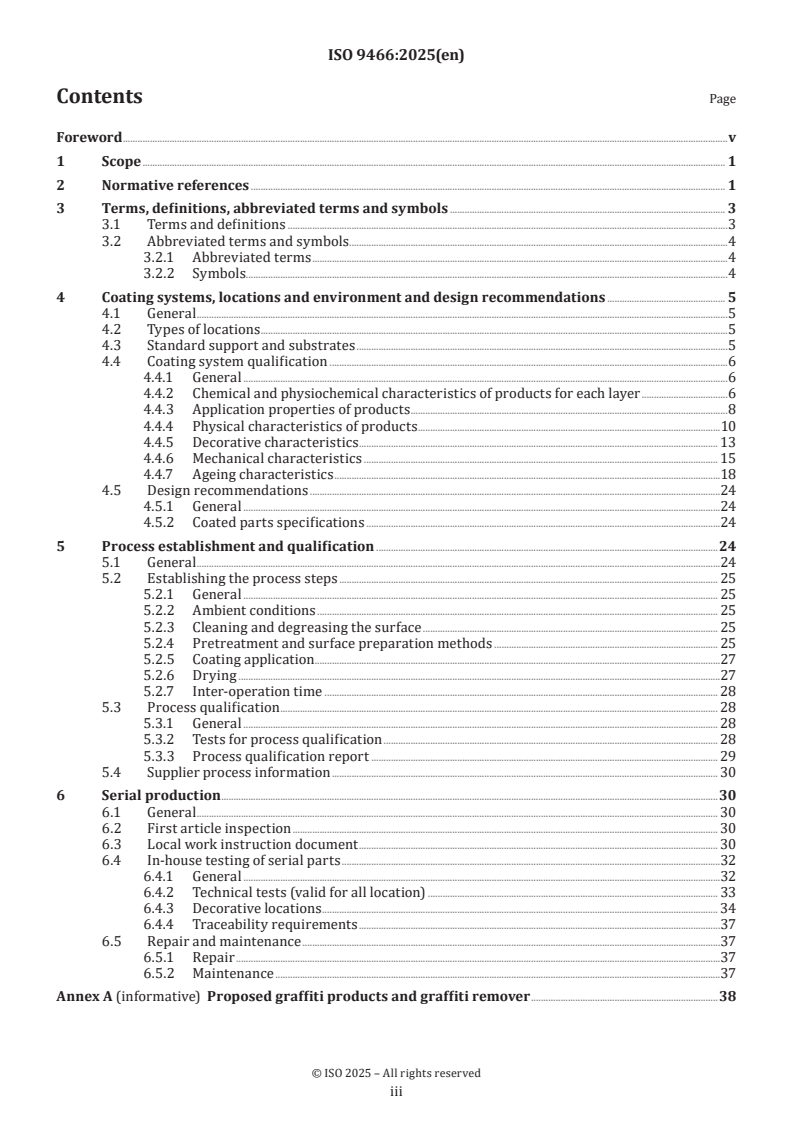
Contents Page
Foreword .v
1 Scope . 1
2 Normative references . 1
3 Terms, definitions, abbreviated terms and symbols . 3
3.1 Terms and definitions .3
3.2 Abbreviated terms and symbols.4
3.2.1 Abbreviated terms .4
3.2.2 Symbols.4
4 Coating systems, locations and environment and design recommendations . 5
4.1 General .5
4.2 Types of locations .5
4.3 Standard support and substrates .5
4.4 Coating system qualification .6
4.4.1 General .6
4.4.2 Chemical and physiochemical characteristics of products for each layer .6
4.4.3 Application properties of products .8
4.4.4 Physical characteristics of products .10
4.4.5 Decorative characteristics . 13
4.4.6 Mechanical characteristics . 15
4.4.7 Ageing characteristics .18
4.5 Design recommendations .24
4.5.1 General .24
4.5.2 Coated parts specifications .24
5 Process establishment and qualification .24
5.1 General .24
5.2 Establishing the process steps . 25
5.2.1 General . 25
5.2.2 Ambient conditions . 25
5.2.3 Cleaning and degreasing the surface . 25
5.2.4 Pretreatment and surface preparation methods . 25
5.2.5 Coating application .27
5.2.6 Drying .27
5.2.7 Inter-operation time . 28
5.3 Process qualification . 28
5.3.1 General . 28
5.3.2 Tests for process qualification . 28
5.3.3 Process qualification report . 29
5.4 Supplier process information . 30
6 Serial production .30
6.1 General . 30
6.2 First article inspection . 30
6.3 Local work instruction document . 30
6.4 In-house testing of serial parts .32
6.4.1 General .32
6.4.2 Technical tests (valid for all location) . 33
6.4.3 Decorative locations . 34
6.4.4 Traceability requirements .37
6.5 Repair and maintenance .37
6.5.1 Repair .37
6.5.2 Maintenance .37
Annex A (informative) Proposed graffiti products and graffiti remover .38
iii
Annex B (informative) Duration level related to the refurbishment time for corrosion, humidity
and weathering tests .39
Bibliography .40
iv
Foreword
ISO (the International Organization for Standardization) is a worldwide federation of national standards
bodies (ISO member bodies). The work of preparing International Standards is normally carried out through
ISO technical committees. Each member body interested in a subject for which a technical committee
has been established has the right to be represented on that committee. International organizations,
governmental and non-governmental, in liaison with ISO, also take part in the work. ISO collaborates closely
with the International Electrotechnical Commission (IEC) on all matters of electrotechnical standardization.
The procedures used to develop this document and those intended for its further maintenance are described
in the ISO/IEC Directives, Part 1. In particular, the different approval criteria needed for the different types
of ISO document should be noted. This document was drafted in accordance with the editorial rules of the
ISO/IEC Directives, Part 2 (see www.iso.org/directives).
ISO draws attention to the possibility that the implementation of this document may involve the use of (a)
patent(s). ISO takes no position concerning the evidence, validity or applicability of any claimed patent
rights in respect thereof. As of the date of publication of this document, ISO had not received notice of (a)
patent(s) which may be required to implement this document. However, implementers are cautioned that
this may not represent the latest information, which may be obtained from the patent database available at
www.iso.org/patents. ISO shall not be held responsible for identifying any or all such patent rights.
Any trade name used in this document is information given for the convenience of users and does not
constitute an endorsement.
For an explanation of the voluntary nature of standards, the meaning of ISO specific terms and expressions
related to conformity assessment, as well as information about ISO's adherence to the World Trade
Organization (WTO) principles in the Technical Barriers to Trade (TBT), see www.iso.org/iso/foreword.html.
This document was prepared by Technical Committee ISO/TC 269, Railway applications, Subcommittee SC 2,
Rolling stock, in collaboration with the European Committee for Standardization (CEN) Technical Committee
CEN/TC 256, Railway applications, in accordance with the Agreement on technical cooperation between ISO
and CEN (Vienna Agreement).
Any feedback or questions on this document should be directed to the user’s national standards body. A
complete listing of these bodies can be found at www.iso.org/members.html.
v
International Standard ISO 9466:2025(en)
Railway applications — Coating of passenger rail vehicles
1 Scope
This document establishes the performance requirements and acceptance criteria for coating material used
for passenger rolling stock, locomotives and components.
This document also provides guidance on the coating application processes, product selection, surface
preparation, coating application, verification and inspection methods, repairs, refurbishment (refresh, etc.),
and tests to measure the minimum performance for the final product.
This document applies to all types of coating materials (liquid, powder, etc.) used on
— railway vehicle bodies, and
— on-board equipment and constituent parts.
2 Normative references
The following documents are referred to in the text in such a way that some or all of their content constitutes
requirements of this document. For dated references, only the edition cited applies. For undated references,
the latest edition of the referenced document (including any amendments) applies.
ISO 1518-1, Paints and varnishes — Determination of scratch resistance — Part 1: Constant-loading method
ISO 1519, Paints and varnishes — Bend test (cylindrical mandrel)
ISO 2409:2020, Paints and varnishes — Cross-cut test
ISO 2808, Paints and varnishes — Determination of film thickness
ISO 2811-1, Paints and varnishes — Determination of density — Part 1: Pycnometer method
ISO 2812-3, Paints and varnishes — Determination of resistance to liquids — Part 3: Method using an
absorbent medium
ISO 2813, Paints and varnishes — Determination of gloss value at 20°, 60° and 85°
ISO 3233-3, Paints and varnishes — Determination of the percentage volume of non-volatile matter — Part 3:
Determination by calculation from the non-volatile-matter content determined in accordance with ISO 3251, the
density of the coating material and the density of the solvent in the coating material
ISO 3251:2019, Paints, varnishes and plastics — Determination of non-volatile-matter content
ISO 3668, Paints and varnishes — Visual comparison of colour of paints
ISO 4545-1:2023, Metallic materials — Knoop hardness test — Part 1: Test method
ISO 4618:2023, Paints and varnishes — Vocabulary
ISO 4624:2023, Paints and varnishes — Pull-off test for adhesion
ISO 4628-2:2016, Paints and varnishes — Evaluation of degradation of coatings — Designation of quantity and
size of defects, and of intensity of uniform changes in appearance — Part 2: Assessment of degree of blistering
ISO 4628-3:2024, Paints and varnishes — Evaluation of quantity and size of defects, and of intensity of uniform
changes in appearance — Part 3: Assessment of degree of rusting
ISO 4628-4:2016, Paints and varnishes — Evaluation of degradation of coatings — Designation of quantity and
size of defects, and of intensity of uniform changes in appearance — Part 4: Assessment of degree of cracking
ISO 4628-5:2022, Paints and varnishes — Evaluation of quantity and size of defects, and of intensity of uniform
changes in appearance — Part 5: Assessment of degree of flaking
ISO 4628-8, Paints and varnishes — Evaluation of degradation of coatings — Designation of quantity and size of
defects, and of intensity of uniform changes in appearance — Part 8: Assessment of degree of delamination and
corrosion around a scribe or other artificial defect
ISO 6270-2, Paints and varnishes — Determination of resistance to humidity — Part 2: Condensation (in-cabinet
exposure with heated water reservoir)
ISO 6272-1, Paints and varnishes — Rapid-deformation (impact resistance) tests — Part 1: Falling-weight test,
large-area indenter
ISO 6344-2:2021, Coated abrasives — Determination and designation of grain size distribution — Part 2:
Macrogrit sizes P12 to P220
ISO 6344-3, Coated abrasives — Determination and designation of grain size distribution — Part 3: Microgrit
sizes P240 to P5000
ISO 6504-3:2019, Paints and varnishes — Determination of hiding power — Part 3: Determination of hiding
power of paints for masonry, concrete and interior use
ISO 6507-1:2023, Metallic materials — Vickers hardness test — Part 1: Test method
ISO 7784-1, Paints and varnishes — Determination of resistance to abrasion — Part 1: Method with abrasive-
paper covered wheels and rotating test specimen
ISO 8130-1, Coating powders — Part 1: Determination of particle size distribution by sieving
ISO 8130-13, Coating powders — Part 13: Particle size analysis by laser diffraction
ISO 8130-8:2021, Coating powders — Part 8: Assessment of the storage stability of thermosetting powders
ISO 8501-1:2007, Preparation of steel substrates before application of paints and related products — Visual
assessment of surface cleanliness — Part 1: Rust grades and preparation grades of uncoated steel substrates and
of steel substrates after overall removal of previous coatings
ISO 8502-3, Preparation of steel substrates before application of paints and related products — Tests for the
assessment of surface cleanliness — Part 3: Assessment of dust on steel surfaces prepared for painting (pressure-
sensitive tape method)
ISO 8503-1, Preparation of steel substrates before application of paints and related products — Surface
roughness characteristics of blast-cleaned steel substrates — Part 1: Specifications and definitions for ISO
surface profile comparators for the assessment of abrasive blast-cleaned surfaces
ISO 9227, Corrosion tests in artificial atmospheres — Salt spray tests
ISO 9514, Paints and varnishes — Determination of the pot life of multicomponent coating systems —
Preparation and conditioning of samples and guidelines for testing
ISO 11890-1, Paints and varnishes — Determination of volatile organic compounds (VOC) and/or semi volatile
organic compounds (SVOC) content — Part 1: Gravimetric method for VOC determination
ISO 11890-2, Paints and varnishes — Determination of volatile organic compounds(VOC) and/or semi volatile
organic compounds (SVOC) content — Part 2: Gas-chromatographic method
ISO 16276-2, Corrosion protection of steel structures by protective paint systems — Assessment of, and
acceptance criteria for, the adhesion/cohesion (fracture strength) of a coating — Part 2: Cross-cut testing and
X-cut testing
ISO 16474-2:2013/Amd 1:2022, Paints and varnishes — Methods of exposure to laboratory light sources — Part
2: Xenon-arc lamps — Amendment 1: Classification of daylight filters
ISO 16862:2003, Paints and varnishes — Evaluation of sag resistance
ISO 17872, Paints and varnishes — Guidelines for the introduction of scribe marks through coatings on metallic
panels for corrosion testing
ISO 18768-1, Organic coatings on aluminium and its alloys — Methods for specifying decorative and protective
organic coatings on aluminium — Part 1: Powder coatings
ISO 19840, Paints and varnishes — Corrosion protection of steel structures by protective paint systems —
Measurement of, and acceptance criteria for, the thickness of dry films on rough surfaces
ISO 20567-1:2017, Paints and varnishes — Determination of stone-chip resistance of coatings — Part 1: Multi-
impact testing
ISO 22163:2023, Railway applications — Railway quality management system — ISO 9001:2015 and specific
requirements for application in the railway sector
ISO/CIE 11664-1, Colorimetry — Part 1: CIE standard colorimetric observers
ISO/CIE 11664-2, Colorimetry — Part 2: CIE standard illuminants
ISO/CIE 11664-3, Colorimetry — Part 3: CIE tristimulus values
ISO/CIE 11664-4, Colorimetry — Part 4: CIE 1976 L*a*b* colour space
ISO/CIE 11664-5, Colorimetry — Part 5: CIE 1976 L*u*v* colour space and u', v' uniform chromaticity scale diagram
ISO/CIE 11664-6, Colorimetry — Part 6: CIEDE2000 colour-difference formula
3 Terms, definitions, abbreviated terms and symbols
For the purposes of this document, the terms and definitions given in ISO 4618 and the following apply.
ISO and IEC maintain terminology databases for use in standardization at the following addresses:
— ISO Online browsing platform: available at https:// www .iso .org/ obp
— IEC Electropedia: available at https:// www .electropedia .org/
3.1 Terms and definitions
3.1.1
coater
paint applicator
operator which applies the coating material (3.1.2)
3.1.2
coating material
product, in liquid, paste or powder form, that, when applied to a substrate, forms a layer possessing
protective, decorative and/or other specific properties
[SOURCE: ISO 4618:2023, 3.48]
3.1.3
technical data sheet
document released by the coating material (3.1.2) supplier which details all the technical parameters needed
to prepare and apply the coating material
3.1.4
coating system
layer combined of all coats of the same or multiple coating materials
[SOURCE: ISO 4618:2023, 3.51]
3.1.5
qualification
process that proves that a set of technical requirements are fulfilled
3.1.6
refurbishment time
expected duration of use not linked to warranty time
3.1.7
work sample
representative part (same material, same pretreatment) which is produced under qualified production
conditions
3.1.8
standard atmosphere
atmosphere for conditioning or testing according to ISO 554:1976, 2.2 (ordinary tolerances) with 23 °C ±
2 °C and 50 % ± 5 % of relative humidity
3.2 Abbreviated terms and symbols
3.2.1 Abbreviated terms
AASS acetic acid salt spray
AHT alternating humidity and air temperature
CH constant humidity
FRP fibre reinforced plastic
GU gloss unit
NSS neutral salt spray
SCI specular component included
VOC volatile organic compound
3.2.2 Symbols
a thickness µm
C* colourimetric variance according to the chroma axis
R arithmetic mean height of the roughness according to ISO 21920-2
a
R roughness based on themaximum height according to ISO 21920-2
z
Ri degree of rusting according to ISO 4628-3
g specific gravity
spe
Sa surface preparation by blast-cleaning according to ISO 8501-1 (the optional number following
Sa refers to ISO 8501-1:2007, Table 1)
St surface preparation by hand and power tool cleaning according to ISO 8501-1 (the optional
number following St refers to ISO 8501-1:2007, Table 2)
4 Coating systems, locations and environment and design recommendations
4.1 General
The coating system shall be qualified based on its location within the vehicle.
4.2 Types of locations
The locations are defined in Table 1.
Table 1 — Types of location
Decorative location Non-decorative location
Type of location
(visible to passengers and crew) (non-visible)
Examples include:
Ceiling
Side ceiling
Carbody side walls and ceiling
Interior (walls and ceilings)
Side walls
Parts behind ceilings and side walls
and equipment
(C-rail, hooks, etc.)
Grab-handles
Cab desk
Luggage racks
Seating (pedestal)
Carbody floor
Mounting of seats
Interior needing higher
Toilet walls
resistance to corrosion (floor Mounting of support bars
Mounting parts
and elements mounted on the
Bottom of side of walls
Interior of equipment boxes on the roof
floor)
Vestibule
Examples include: Examples include:
Carbody side Carbody roof (tube)
Exterior doors Carbody ends
Fairings/roof fin Equipment boxes
Carbody roof (rounded) Fairings (for HVAC unit, pantograph,
Exterior (direct UV exposure)
insulator head, etc.)
Carbody ends (if decorative)
Handrail (for inspection of the roof)
Cab front/front end
Drain pipe/gutter
Equipment (outside window frames,
door gutters, etc.) Fresh air duct
Devices (cameras, speakers, etc.) Intercar barrier bracket
Carbody underframe
Equipment mounted on the underframe
Coupler
Exterior (indirect or no UV
No
exposure)
Buffer
Bogie frame and bogie components
Axles, wheelsets
4.3 Standard support and substrates
Table 2 lists the supports and substrates that shall be used for the tests described in Table 3, Table 4, Table 5,
Table 6, Table 7 and Table 8.
For the chemical pretreatments described in Table 2, the name of each product used for pretreatment
(degreasing, etching, passivation, pickling) should be included in the qualification report.
Table 2 — Standard support and substrates
Type Standard support Support for elasticity tests
Substrate S2 defined in this document as:
Material: cold rolled steel (steel grade: DC01/SPCC-SD)
Thickness: 2 mm
Substrate S1 defined in this
Size:
document as:
— depends on the test machine;
Material: steel
— for corrosion tests min. 150 mm × 200 mm.
Steel Thickness: 0,7 mm to 1 mm
Pretreatment:
Size: depends on test machine
— powder: zinc phosphate pretreatment or abrasive blast cleaning
Pretreatment: zinc phosphated
(surface quality: Sa 2½; roughness R value between 25 and
z
or bare surface or both
40 µm) or both;
— liquid: abrasive blast cleaning (surface quality: Sa 2½; roughness
fine G in accordance with ISO 8503-1).
Substrate A2 defined in this document as:
Material: aluminium grade: AlMg3 (Al5754), AlMg2.5 (A5052),
AlSi1MgMn (A6082) or AlMg1SiCu (A6061/Al6061T6)
Thickness: 2 mm min.
Size:
— depends on the test machine;
— for corrosion tests: min. 100 mm × 150 mm.
Aluminium Not required
Pretreatment:
— powder: chemical treatment in accordance with ISO 18768-1 or
abrasive blast cleaning (surface quality: Sa 2½; roughness R
z
value between 25 µm and 40 µm) or both;
— liquid: abrasive blast cleaning (the degree of cleanliness shall
have a flat, uniform and clean blasting pattern); roughness R
z
value between 25 µm and 40 µm.
In the case of abrasive blast cleaning and if the surface is not protected from contamination and oxidation,
the coating should be applied immediately after.
The results are not valid for other substrates (e.g. FRP or plastic). A process qualification (see 5.3) is necessary
in any case on the substrate of the project and needs to be performed with the original pretreatment.
4.4 Coating system qualification
4.4.1 General
The coating system shall be qualified in accordance with Table 3, Table 4, Table 5, Table 6, Table 7 and Table 8.
All tests should be performed with the nominal thickness mentioned in Table 4. If single tests are carried out
with a different nominal layer thickness, this shall be explicitly indicated in the test report.
4.4.2 Chemical and physiochemical characteristics of products for each layer
Table 3 — Chemical and physiochemical characteristics of products for each layer
Type of coating
Characteristic Method Results required
material
Temperature in °C is given in accordance with the safety data
sheet.
Powder and
Flash point References [1] and [2] are given as examples
liquid coats
If a standard or regulation has been followed, please record its
details in the report.
Solid content by mass ready Solid content in % is given in accordance with the technical data
ISO 3251:2019, Table A.1, 60 min, 105 °C Liquid coat only
to use sheet and in the technical report.
ISO 3233-3: Calculating the non-volatile matter
Theoretical yield for liquid
content in accordance with ISO 3251, the densi- Theoretical yield in m /kg/µm is given in accordance with the
coating material (theoretical Liquid coat only
ty of the coating material and the density of the technical data sheet and in the technical report.
spreading rate) (m /kg/µm)
solvent in the coating material.
Theoretical yield for powder
Powder coat
coating material (theoretical Theoretical yield in m /kg/µm is noted in the technical report.
only
ga*
2 spe
spreading rate) (m /kg/µm)
ISO 8130-1
Particle size in % is given in accordance with the technical data Powder coat
Particle size distribution
sheet and in the technical report. only
ISO 8130-13
VOC in g/l is given in accordance with the technical data sheet
Quantity of VOCs (g/l) ISO 11890-1 or ISO 11890-2, or both Liquid coat only
and in the technical report.
4.4.3 Application properties of products
Table 4 — Application properties of products
Locations (Table 1)
Characteristic Method Coating material drying Results required and type of coating
material
All locations
Nominal dry film ISO 2808 or ISO 19840, or Data given in accordance with
Thickness in µm is given in accordance with the technical data sheet.
thickness both the technical data sheet
Powder and liquid coats
All locations
Nominal wet
ISO 2808 Not applicable Thickness in µm is given in accordance with the technical data sheet.
thickness
Liquid coat only
Thickness in µm is given in the technical report. All locations
Sagging or run off ISO 16862:2003, method
Not applicable
limit “sag index applicator”
Min. 1,5 times the nominal wet thickness. Liquid coat only
Similar results of values checked before and after artificial storage:
— topcoat and clear coat: gloss in accordance with ISO 2813;
After artificial storage, cure
All locations
Storage stability
ISO 8130-8:2021, 8.2.1 b) completely in accordance
— primer: NSS (steel) or AASS (aluminium) in accordance with
(powder coat)
Powder coat only
with technical data sheet.
ISO 9227, 240 h;
— topcoat and primer: impact test in accordance with ISO 6272-1.
After artificial storage of the
Similar results of values checked before and after artificial storage:
Recommended artificial
liquid coating material and
— colour checked by human eyes;
storage at 30 °C to 40 °C
All locations
Storage stability panels conditioning, condition
depending on technical
— topcoat and clear coat: gloss in accordance with ISO 2813;
(liquid coat) for 14 d in a standard atmos-
Liquid coat only
data sheet and for 28 days’
— primer: NSS (steel) or AASS (aluminium) in accordance with
phere or for 21 d for water
duration
ISO 9227, 240 h.
borne coating materials
All locations
Theoretical pot life ISO 9514 Not applicable Time in h is given in accordance with the technical data sheet.
Only liquid coat
All locations
Method of According to coating
Not applicable Methods listed in the technical data sheet
application process material supplier
Powder and liquid coats
Data is given in accordance with the technical data sheet and in the
EXAMPLE 1 ISO 2431
technical report: specify the name of the standards and the parame-
(flow time in seconds). All locations
Viscosity or flow
ters.
Not applicable
time
EXAMPLE 2 ISO 2555 Only liquid coat
EXAMPLE 1 ISO 2431: flow time of 30 s through cup 6 at 23 °C.
(viscosity).
EXAMPLE 2 ISO 2555: 3 000 mPa·s at 21 °C.
All locations
Density in g/cm is given in accordance with the technical data sheet
Density ISO 2811-1 Not applicable
for each component and in the technical report.
Powder and liquid coats
Information (yes or no) is given in accordance with the technical data
All locations
Re-usability of According to coating
Not applicable sheet: possibility and conditions, if relevant, given by the coating mate-
powder over spray material supplier
Powder coat only
rial supplier.
4.4.4 Physical characteristics of products
All tests in Table 5 should be performed with the nominal thickness mentioned in Table 4 with a minimum
of deviation. If single tests are carried out with a different nominal layer thickness, this shall be explicitly
indicated in the report.
All tests in Table 5 shall be performed after a minimum of two weeks drying in a standard atmosphere for
liquid coating material and in accordance with the technical data sheet for powder coating material.
Table 5 — Physical characteristics
Locations
Type of support
Characteristic Method Results required (Table 1) and type
(Table 2)
of coating material
Check the hiding power in accordance with ISO 6504-3:2019, Method B
Liquid coating
with black or white cards.
Hiding power in % is calculated by nominal
material: black
All decorative
Three colours shall be checked, depending on the chroma level: thickness:
or white cards
locations
— level 1: C* ≤ 7; — good hiding power ≥98 %;
Hiding power
Powder coating
Liquid and powder
— level 2: 7 < C* ≤ 30; — 95 % ≤ limited hiding power < 98 %; material: black
coats
or white metal
— level 3: C* > 30. — weak hiding power <95 %.
panels
Powder: with black or white metal panels instead
The recommended stages from ISO 9117-5 are:
Drying time Time in h for each stage is given in accord-
— stage 1 (dust-free): ISO 9117-3 and ISO 9117-5; All locations
(liquid coating ance with the technical data sheet for each A2
— stage 3 (touch dry): ISO 9117-5; Liquid only
material) component and in the technical report.
— stage 6 (through dry): ISO 9117-5.
Time in min and object temperature in °C is
After curing, perform all mechanical and chemical resistance tests in
given in accordance with the technical data
Curing conditions
accordance with this document. All locations
sheet and in the technical report:
(powder coating A2
All tests in the reference with powder coat shall be performed using the Powder only
material) — min. temperature with time, and
minimum temperature and time from the technical data sheet.
— max. temperature with time.
Perform sanding with grit P120 at different times until clogging on the
All location
Drying time Time of drying in h by which clogging is no
paper is no longer noticed.
A2
before sanding longer visible after sanding.
Liquid only
After sanding, the aspect should have a homogeneous mat surface.
Apparatus: drying coating material at defined standard conditions:
a) ambient drying in a standard atmosphere
b) forced curing at 50 °C object temperature
Time in h for dry to tape is given by the
c) powder coat curing in accordance with technical data sheet
supplier: drying time and condition of
Type of tape: adhesion power on greased-free steel panel between 2 N/cm
tested layer.
and 4 N/cm
Time in h is without any residues of coating
Apply the tape and smooth the surface with a plastic applicator (i.e. squee- All locations
Dry-to-tape material on the tape after removing. A2
gee).
Liquid only
After drying the final layer (in accordance
Duration of the tape contact time: 60 min in standard atmosphere
with technical data sheet): no marks of
Remove tape in accordance with ISO 2409:2020, Annex A:
tape after application of the final coating
— peeling angle: 60° in accordance with ISO 2409;
layer.
— peeling speed: between 0,5 s and 1 s.
Apply the final coating layer.
Observe the aspect of the final coating layer after curing.
Table 5 (continued)
Locations
Type of support
Characteristic Method Results required (Table 1) and type
(Table 2)
of coating material
Recoatability with following layer: defining the time during which it is not
necessary to grind before applying the following coating material layer.
nd
Liquid: conditioning of the 2 layer for 7 d in a standard atmosphere
Time in h is linked to the drying conditions
All locations
nd
and type of 2 layer with:
Powder: standard curing
Recoatability with
A2
Liquid and powder
following layer — blistering: 0(S0);
Test: 72 h condensed water test in accordance with ISO 6270-2:
coats
— adhesion: cross-cut value ≤1.
— immediately after the test: check blistering in accordance with
ISO 4628-2;
— 24 h after the test: check adhesion in accordance with ISO 2409.
Test method: establishing the time during which it is not necessary to
grind before applying the same layer again.
— recoatability with itself to the nominal film thickness of the technical
data sheet by spraying;
— drying time of the first coat: 1,5 h at 50 °C object temperature;
— possible stages for qualification depending on the coating system:
Maximum time
— stage 1: 16 h storage in a standard atmosphere, without sanding,
between coating
— stage 2: 72 h storage in a standard atmosphere without sanding;
operation –
All locations
— curing;
Recoatability with Achieved stage with cross-cut value ≤1 A2
Liquid only
— 30 min flash-off time in a standard atmosphere;
itself after storage
in a standard
— 7 d at 50 °C object temperature in circulating air oven – subsequently
atmosphere
cool down to standard atmosphere;
— 72 h condensed water test in accordance with ISO 6270-2;
— after reconditioning for 24 h in a standard atmosphere, perform cross-
cut test
in accordance with ISO 2409 (type of tape for removing loose coating
material: adhesion power on degreased steel panel between 6 N and
10 N for a tape width of 25 mm).
4.4.5 Decorative characteristics
All tests in Table 6 should be performed with the nominal thickness mentioned in Table 4. If single tests are
carried out with a different nominal layer thickness, this shall be explicitly indicated in the test report.
All tests in Table 6 shall be performed after a minimum of two weeks drying in a standard atmosphere for
liquid coating material and in accordance with the technical data sheet for powder coating material.
Table 6 — Decorative characteristics
Locations and Type of
Characteristic Methods Results required type of coating support
material (Table 2)
There shall be 5 measurement points per surface of 20 cm × 30 cm (~ A4
ISO 2813 only for topcoat and clearcoat without paper size).
Liquid and
texture.
The average shall be documented, only one point out of tolerance is allowed.
powder coats
Textured coating material shall be checked visually
GU and angle are given in accordance with the technical data sheet and in
Gloss Mandatory for
with the naked eye, or, if possible, using gloss meas-
the technical report allowed tolerance, for example:
(measurement all decorative
urement without texture. A2
— <10 GU (+3 GU) at 60° or at 85°;
of gloss for the locations
Metallic coating material can only be compared using
master sample)
— between 10 GU and 29 GU ± 5 GU at 60°;
Optional for
the same system. The gloss level will be different
non-decorative
— between 30 GU and 64 GU ± 7 GU at 60°;
to the visual assessment because of measurement
locations
— between 65 GU and 89 GU ± 8 GU at 60°;
errors.
— >90 GU (−10 GU) at 60° or >80 GU (−5 GU) at 20°.
Plain colours: ISO/CIE 11664-6
Kind of light: D65 Plain colours – tolerance between primal sample and standard:
Measurement angle: 8° — dE2000 (SCI) ≤ 1 according to ISO/CIE 11664-6 of the primal sample Liquid and
and standard for colour matching; powder coats
Colour
Calculation method: dE2000 (SCI)
measurement or A2
— note single values L*a*b* according to ISO/CIE 11664-4 of the primal Mandatory for
Non-uniform colours (e.g. metallic colours or pearl
evaluation
sample and standard for colour matching. all decorative
effect): can be checked only visually by human eye in
locations
accordance with ISO 13076. Metallic colours value is in accordance with ISO 3668 ≤1 (very slight, i.e. just
perceptible changes).
Visual inspection shall be performed under two
different angles.
4.4.6 Mechanical characteristics
All tests in Table 7 should be performed with the nominal thickness mentioned in Table 4. If singles tests are
carried out with a different nominal layer thickness, this shall be explicitly indicated in the test report.
All tests in Table 7 shall be performed after a minimum of two weeks drying in a standard atmosphere for
liquid coating material and in accordance with the technical data sheet for powder coating material.
Table 7 — Mechanical characteristics
Type of
Locations and type of
Characteristic Methods Results required support
coating material
(Table 2)
In accordance with ISO 2409:
— adhesion with adhesive tape
— dry film thickness up to 250 µm in accordance with ISO 2409;
— dry film thickness higher than 250 µm in accordance with
ISO 16276-2.
Liquid and powder
Cross-cut and — type of tape: adhesion power on degreased steel panel between S2 and A2 if
Cross-cut value ≤1
Mandatory for all loca-
X-cut testing 6 N and 10 N for a tape width of 25 mm applicable
tions
— knives: only single blades with template, multi-knife tools shall
not be used.
Remove the tape in accordance with ISO 2409:2020, Annex A:
— peeling angle: 60° in accordance with ISO 2409;
— peeling speed: between 0,5 s and 1 s.
ISO 4624
Liquid and powder coats
S1, S2 and
System with and without putty:
Breaking strength is in MPa and the nature of
Pull off test A2 if appli-
Mandatory for all loca-
fracture is in accordance with ISO 4624.
— breaking strength in accordance with ISO 4624;
cable
tions
— nature of fracture in accordance with ISO 4624.
Liquid and powder coat-
ISO 1519
ing material
For liquid coating material, mandrel size depending on zone:
Mandatory for all loca-
— decorative without putty: 20 mm mandrel;
tions
— non-decorative: 10 mm mandrel. No exfoliation, no cracking down to substrate
Bend test S1
The mandrel depends on
(bare metal) allowed
For powder coating material, mandrel size depending on zone and
the location (decorative
number of layers:
or non-decorative) and
— decorative and 2-layer systems: 12 mm mandrel;
the type
...
Norme
internationale
ISO 9466
Première édition
Applications ferroviaires —
2025-01
Peinturage des véhicules
ferroviaires destinés au transport
de passagers
Railway applications — Coating of passenger rail vehicles
Numéro de référence
DOCUMENT PROTÉGÉ PAR COPYRIGHT
© ISO 2025
Tous droits réservés. Sauf prescription différente ou nécessité dans le contexte de sa mise en œuvre, aucune partie de cette
publication ne peut être reproduite ni utilisée sous quelque forme que ce soit et par aucun procédé, électronique ou mécanique,
y compris la photocopie, ou la diffusion sur l’internet ou sur un intranet, sans autorisation écrite préalable. Une autorisation peut
être demandée à l’ISO à l’adresse ci-après ou au comité membre de l’ISO dans le pays du demandeur.
ISO copyright office
Case postale 401 • Ch. de Blandonnet 8
CH-1214 Vernier, Genève
Tél.: +41 22 749 01 11
E-mail: copyright@iso.org
Web: www.iso.org
Publié en Suisse
ii
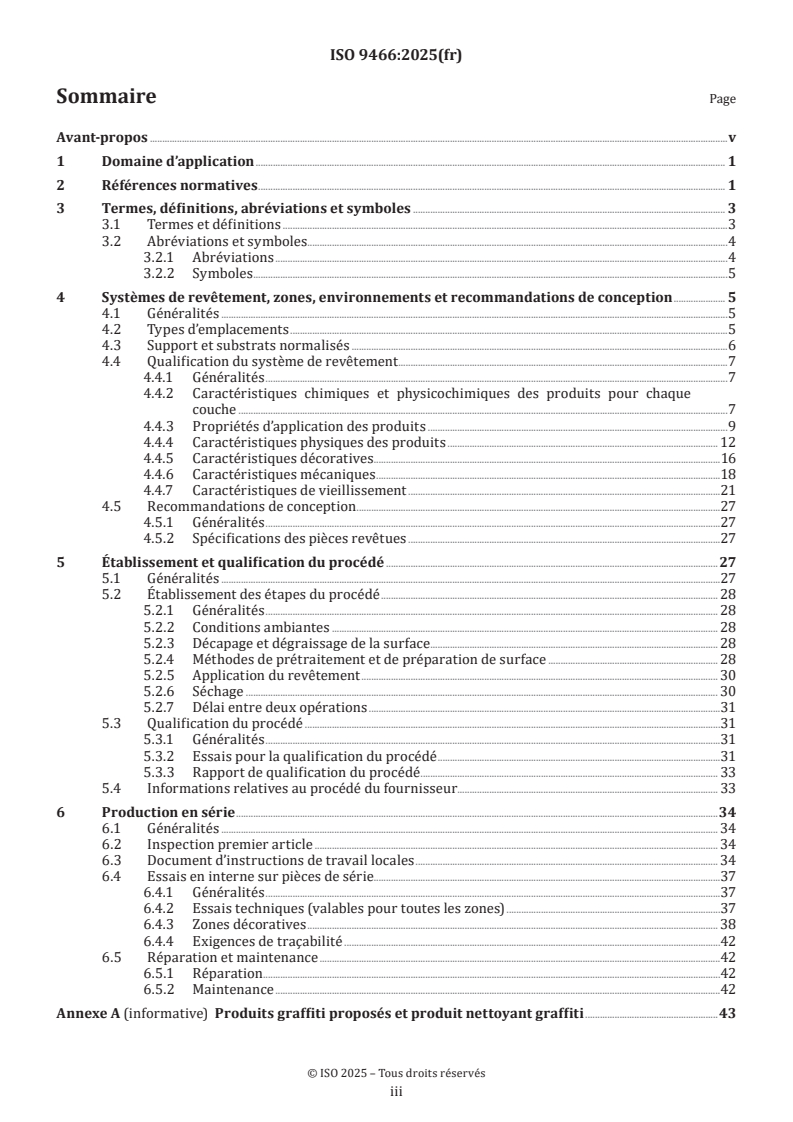
Sommaire Page
Avant-propos .v
1 Domaine d’application . 1
2 Références normatives . 1
3 Termes, définitions, abréviations et symboles . 3
3.1 Termes et définitions .3
3.2 Abréviations et symboles . .4
3.2.1 Abréviations .4
3.2.2 Symboles .5
4 Systèmes de revêtement, zones, environnements et recommandations de conception . 5
4.1 Généralités .5
4.2 Types d’emplacements .5
4.3 Support et substrats normalisés .6
4.4 Qualification du système de revêtement .7
4.4.1 Généralités .7
4.4.2 Caractéristiques chimiques et physicochimiques des produits pour chaque
couche .7
4.4.3 Propriétés d’application des produits .9
4.4.4 Caractéristiques physiques des produits . 12
4.4.5 Caractéristiques décoratives .16
4.4.6 Caractéristiques mécaniques .18
4.4.7 Caractéristiques de vieillissement .21
4.5 Recommandations de conception .27
4.5.1 Généralités .27
4.5.2 Spécifications des pièces revêtues .27
5 Établissement et qualification du procédé .27
5.1 Généralités .27
5.2 Établissement des étapes du procédé . 28
5.2.1 Généralités . 28
5.2.2 Conditions ambiantes . 28
5.2.3 Décapage et dégraissage de la surface . . 28
5.2.4 Méthodes de prétraitement et de préparation de surface . 28
5.2.5 Application du revêtement . 30
5.2.6 Séchage . 30
5.2.7 Délai entre deux opérations .31
5.3 Qualification du procédé .31
5.3.1 Généralités .31
5.3.2 Essais pour la qualification du procédé .31
5.3.3 Rapport de qualification du procédé . 33
5.4 Informations relatives au procédé du fournisseur . . 33
6 Production en série .34
6.1 Généralités . 34
6.2 Inspection premier article . 34
6.3 Document d’instructions de travail locales . 34
6.4 Essais en interne sur pièces de série.37
6.4.1 Généralités .37
6.4.2 Essais techniques (valables pour toutes les zones) .37
6.4.3 Zones décoratives . 38
6.4.4 Exigences de traçabilité .42
6.5 Réparation et maintenance .42
6.5.1 Réparation . .42
6.5.2 Maintenance .42
Annexe A (informative) Produits graffiti proposés et produit nettoyant graffiti .43
iii
Annexe B (informative) Niveaux de durée associés au temps de rénovation pour les essais de
corrosion, d’humidité et d’intempéries .44
Bibliographie .46
iv
Avant-propos
L’ISO (Organisation internationale de normalisation) est une fédération mondiale d’organismes nationaux
de normalisation (comités membres de l’ISO). L’élaboration des Normes internationales est en général
confiée aux comités techniques de l’ISO. Chaque comité membre intéressé par une étude a le droit de faire
partie du comité technique créé à cet effet. Les organisations internationales, gouvernementales et non
gouvernementales, en liaison avec l’ISO participent également aux travaux. L’ISO collabore étroitement avec
la Commission électrotechnique internationale (IEC) en ce qui concerne la normalisation électrotechnique.
Les procédures utilisées pour élaborer le présent document et celles destinées à sa mise à jour sont
décrites dans les Directives ISO/IEC, Partie 1. Il convient, en particulier, de prendre note des différents
critères d’approbation requis pour les différents types de documents ISO. Le présent document a
été rédigé conformément aux règles de rédaction données dans les Directives ISO/IEC, Partie 2 (voir
www.iso.org/directives).
L’ISO attire l’attention sur le fait que la mise en application du présent document peut entraîner l’utilisation
d’un ou de plusieurs brevets. L’ISO ne prend pas position quant à la preuve, à la validité et à l’applicabilité de
tout droit de brevet revendiqué à cet égard. À la date de publication du présent document, l’ISO n’avait pas
reçu notification qu’un ou plusieurs brevets pouvaient être nécessaires à sa mise en application. Toutefois,
il y a lieu d’avertir les responsables de la mise en application du présent document que des informations
plus récentes sont susceptibles de figurer dans la base de données de brevets, disponible à l’adresse
www.iso.org/patents. L’ISO ne saurait être tenue pour responsable de ne pas avoir identifié de tels droits de
propriété et averti de leur existence.
Les appellations commerciales éventuellement mentionnées dans le présent document sont données pour
information, par souci de commodité, à l’intention des utilisateurs et ne sauraient constituer un engagement.
Pour une explication de la nature volontaire des normes, la signification des termes et expressions
spécifiques de l’ISO liés à l’évaluation de la conformité, ou pour toute information au sujet de l’adhésion de
l’ISO aux principes de l’Organisation mondiale du commerce (OMC) concernant les obstacles techniques au
commerce (OTC), voir le lien suivant: www.iso.org/iso/foreword.html.
Le présent document a été élaboré par le Comité Technique ISO/TC 269, Applications ferroviaires, sous comité
SC 2, Matériel roulant, en collaboration avec le Comité Technique CEN/TC 256, Applications ferroviaires, du
Comité européen de normalisation (CEN), conformément à l’Accord de coopération technique entre l’ISO et
le CEN (l’Accord de Vienne).
Il convient que l’utilisateur adresse tout retour d’information ou toute question concernant le présent
document à l’organisme national de normalisation de son pays. Une liste exhaustive desdits organismes se
trouve à l’adresse www.iso.org/members.html.
v
Norme internationale ISO 9466:2025(fr)
Applications ferroviaires — Peinturage des véhicules
ferroviaires destinés au transport de passagers
1 Domaine d’application
Le présent document établit les exigences de performance et les critères d’acceptation relatifs au matériau
de revêtement utilisé pour le matériel roulant destiné au transport de passagers, les locomotives et les
composants.
Le présent document fournit également des recommandations concernant les procédés d’application du
revêtement, la sélection des produits, la préparation des surfaces, les méthodes d’application, de vérification
et d’inspection, les réparations, la rénovation (rafraîchissement, etc.) et les essais visant à mesurer la
performance minimale pour le produit final.
Le présent document s’applique à tous les types de matériaux de revêtement (liquides, poudres, etc.) utilisés sur:
— les caisses des véhicules ferroviaires, et
— les équipements embarqués et leurs parties constitutives.
2 Références normatives
Les documents suivants sont cités dans le texte de sorte qu’ils constituent, pour tout ou partie de leur
contenu, des exigences du présent document. Pour les références datées, seule l’édition citée s’applique. Pour
les références non datées, la dernière édition du document de référence s’applique (y compris les éventuels
amendements).
ISO 1518-1, Peintures et vernis — Détermination de la résistance à la rayure — Partie 1: Méthode à charge
constante
ISO 1519, Peintures et vernis — Essai de pliage sur mandrin cylindrique
ISO 2409:2020, Peintures et vernis — Essai de quadrillage
ISO 2808, Peintures et vernis — Détermination de l'épaisseur du feuil
ISO 2811-1, Peintures et vernis — Détermination de la masse volumique — Partie 1: Méthode pycnométrique
ISO 2812-3, Peintures et vernis — Détermination de la résistance aux liquides — Partie 3: Méthode utilisant un
milieu absorbant
ISO 2813, Peintures et vernis — Détermination de l'indice de brillance à 20°, 60° et 85°
ISO 3233-3, Peintures et vernis — Détermination du pourcentage en volume de matière non volatile — Partie 3:
Détermination par calcul à partir de la teneur en matière non volatile déterminée conformément à l'ISO 3251, de
la masse volumique du produit de peinture et de la masse volumique du solvant du produit de peinture
ISO 3251:2019, Peintures, vernis et plastiques — Détermination de la matière non volatile
ISO 3668, Peintures et vernis — Comparaison visuelle de la couleur des peintures
ISO 4545-1:2023, Matériaux métalliques — Essai de dureté Knoop — Partie 1: Méthode d'essai
ISO 4618:2023, Peintures et vernis — Vocabulaire
ISO 4624:2023, Peintures et vernis — Essai de traction
ISO 4628-2:2016, Peintures et vernis — Évaluation de la dégradation des revêtements — Désignation de
la quantité et de la dimension des défauts, et de l'intensité des changements uniformes d'aspect — Partie 2:
Évaluation du degré de cloquage
ISO 4628-3:2024, Peintures et vernis — Évaluation de la quantité et de la dimension des défauts, et de l’intensité
des changements uniformes d’aspect — Partie 3: Évaluation du degré d’enrouillement
ISO 4628-4:2016, Peintures et vernis — Évaluation de la dégradation des revêtements — Désignation de
la quantité et de la dimension des défauts, et de l'intensité des changements uniformes d'aspect — Partie 4:
Évaluation du degré de craquelage
ISO 4628-5:2022, Peintures et vernis — Évaluation de la quantité et de la dimension des défauts, et de l’intensité
des changements uniformes d’aspect — Partie 5: Évaluation du degré d’écaillage
ISO 4628-8, Peintures et vernis — Évaluation de la dégradation des revêtements — Désignation de la quantité
et de la dimension des défauts, et de l'intensité des changements uniformes d'aspect — Partie 8: Évaluation du
degré de décollement et de corrosion autour d'une rayure ou d'un autre défaut artificiel
ISO 6270-2, Peintures et vernis — Détermination de la résistance à l’humidité — Partie 2: Condensation
(exposition en enceinte avec réservoir à eau chauffée)
ISO 6272-1, Peintures et vernis — Essais de déformation rapide (résistance au choc) — Partie 1: Essai de chute
d'une masse avec pénétrateur de surface importante
ISO 6344-2:2021, Abrasifs appliqués — Détermination et désignation de la distribution granulométrique —
Partie 2: Macrograins P12 à P220
ISO 6344-3, Abrasifs appliqués — Détermination et désignation de la distribution granulométrique — Partie 3:
Micrograins P240 à P5000
ISO 6504-3:2019, Peintures et vernis — Détermination du pouvoir masquant — Partie 3: Détermination du
pouvoir masquant pour des peintures bâtiments, béton et utilisation en intérieur
ISO 6507-1:2023, Matériaux métalliques — Essai de dureté Vickers — Partie 1: Méthode d'essai
ISO 7784-1, Peintures et vernis — Détermination de la résistance à l'abrasion — Partie 1: Méthode utilisant des
roues revêtues de papier abrasif et une éprouvette rotative
ISO 8130-1, Poudres pour revêtement — Partie 1: Détermination de la distribution granulométrique par
tamisage
ISO 8130-13, Poudres pour revêtement — Partie 13: Analyse granulométrique par diffraction laser
ISO 8130-8:2021, Poudres pour revêtement — Partie 8: Estimation de la stabilité au stockage des poudres
thermodurcissables
ISO 8501-1:2007, Préparation des subjectiles d'acier avant application de peintures et de produits assimilés —
Évaluation visuelle de la propreté d'un subjectile — Partie 1: Degrés de rouille et degrés de préparation des
subjectiles d'acier non recouverts et des subjectiles d'acier après décapage sur toute la surface des revêtements
précédents
ISO 8502-3, Préparation des subjectiles d'acier avant application de peintures et de produits assimilés — Essais
pour apprécier la propreté d'une surface — Partie 3: Évaluation de la poussière sur les surfaces d'acier préparées
pour la mise en peinture (méthode du ruban adhésif sensible à la pression)
ISO 8503-1, Préparation des subjectiles d'acier avant application de peintures et de produits assimilés —
Caractéristiques de rugosité des subjectiles d'acier décapés — Partie 1: Spécifications et définitions des
comparateurs viso-tactiles ISO pour caractériser les surfaces décapées par projection d'abrasif
ISO 9227, Essais de corrosion en atmosphères artificielles — Essais aux brouillards salins
ISO 9514, Peintures et vernis — Détermination du délai maximal d'utilisation après mélange des systèmes de
revêtement multicomposants — Préparation et conditionnement des échantillons et lignes directrices pour les essais
ISO 11890-1, Peintures et vernis — Détermination de la teneur en composés organiques volatils (COV) et/ou
composés organiques semi-volatils (COSV) — Partie 1: Méthode gravimétrique pour la détermination des COV
ISO 11890-2, Peintures et vernis — Détermination de la teneur en composés organiques volatils (COV) et/ou
composés organiques semi-volatils (COSV) — Partie 2: Méthode par chromatographie en phase gazeuse
ISO 16276-2, Anticorrosion des structures en acier par systèmes de peintures — Évaluation et critères
d’acceptation de l’adhésion/cohésion (résistance à la rupture) d’un revêtement — Partie 2: Essai de quadrillage
et essai à la croix de Saint-André
ISO 16474-2:2013/Amd 1:2022, Peintures et vernis — Méthodes d’exposition à des sources lumineuses de
laboratoire — Partie 2: Lampes à arc au xénon — Amendement 1: Classification des filtres de la lumière du jour
ISO 16862:2003, Peintures et vernis — Évaluation de la résistance à la formation de festons
ISO 17872, Peintures et vernis — Lignes directrices pour la production de rayures au travers du revêtement de
panneaux métalliques en vue des essais de corrosion
ISO 18768-1, Couches organiques sur l’aluminium et ses alliages — Méthodes de spécification des revêtements
décoratifs et protecteurs sur aluminium — Partie 1: Revêtements par poudre
ISO 19840, Peintures et vernis — Anticorrosion des structures en acier par systèmes de peinture — Mesure et
critères d'acceptation de l'épaisseur d'un feuil sec sur des surfaces rugueuses
ISO 20567-1:2017, Peintures et vernis — Détermination de la résistance des revêtements aux impacts de cailloux
— Partie 1: Essais de chocs multiples
ISO 22163:2023, Applications ferroviaires — Système de management de la qualité ferroviaire — Exigences de
l'ISO 9001:2015 et exigences particulières concernant les applications dans le secteur ferroviaire
ISO/CIE 11664-1, Colorimétrie — Partie 1: Observateurs CIE de référence pour la colorimétrie
ISO/CIE 11664-2, Colorimétrie — Partie 2: Illuminants CIE normalisés
ISO/CIE 11664-3, Colorimétrie — Partie 3: Composantes trichromatiques CIE
ISO/CIE 11664-4, Colorimétrie — Partie 4: Espace chromatique L*a*b* CIE 1976
ISO/CIE 11664-5, Colorimétrie — Partie 5: Espace chromatique L*u*v* et diagramme de chromaticité uniforme
u’, v’ CIE 1976
ISO/CIE 11664-6, Colorimétrie — Partie 6: Formule de la différence de couleur CIEDE2000
3 Termes, définitions, abréviations et symboles
Pour les besoins du présent document, les termes et définitions de l’ISO 4618 ainsi que les suivants
s’appliquent.
L’ISO et l’IEC tiennent à jour des bases de données terminologiques destinées à être utilisées en normalisation,
consultables aux adresses suivantes:
— ISO Online browsing platform: disponible à l’adresse https:// www .iso .org/ obp
— IEC Electropedia: disponible à l’adresse https:// www .electropedia .org/
3.1 Termes et définitions
3.1.1
applicateur
applicateur de la peinture
entreprise qui réalise l’application du matériau de revêtement (3.1.2)
3.1.2
matériau de revêtement
produit sous forme d’un liquide, d’une pâte ou d’une poudre qui, une fois appliqué à un substrat, forme une
couche qui possède des propriétés protectrices, décoratives et/ou autres propriétés spécifiques
[SOURCE: ISO 4618:2023, 3.48]
3.1.3
fiche technique
document publié par le fournisseur du matériau de revêtement (3.1.2) qui détaille l’ensemble des paramètres
techniques à remplir lors de la préparation et de l’application du matériau de revêtement
3.1.4
système de revêtement
dépôt combiné de toutes les couches d’un même produit de peinture ou de plusieurs produits de peinture
[SOURCE: ISO 4618:2023, 3.51]
3.1.5
qualification
procédé qui démontre qu’un ensemble d’exigences techniques est rempli
3.1.6
temps de rénovation
durée d’utilisation prévue non liée à la période de garantie
3.1.7
échantillon de travail
pièce représentative (même matériau et même prétraitement) qui a été fabriquée dans les conditions de
production qualifiées
3.1.8
atmosphère normalisée
atmosphère pour conditionnement ou essai conformément à l’ISO 554:1976, 2.2 (tolérances ordinaires) avec
23 °C ± 2 °C et 50 % ± 5 % d’humidité relative
3.2 Abréviations et symboles
3.2.1 Abréviations
AASS embruns salés d’acide acétique (acetic acid salt spray)
AHT alternance de l’humidité et de la température d’air (alternating humidity and air temperature)
CH humidité constante (constant humidity)
FRP plastique renforcé de fibres (fibre reinforced plastic)
GU unité de brillance (gloss unit)
NSS brouillard salin neutre (neutral salt spray)
SCI composante spéculaire incluse (specular component included)
VOC composé organique volatile (volatile organic compound)
3.2.2 Symboles
a épaisseur µm
C* différence colorimétrique selon l’axe chromatique
R hauteur moyenne arithmétique de la rugosité conformément à l’ISO 21920-2
a
R rugosité basée sur la hauteur maximale selon l’ISO 21920-2
z
Ri degré d’enrouillement selon l’ISO 4628-3
g gravité spécifique
spe
Sa préparation des surfaces par décapage par projection selon l’ISO 8501-1 (le nombre facultatif
après Sa se réfère à l’ISO 8501-1:2007, Tableau 1)
St préparation des surfaces à la main et par outil électrique selon l’ISO 8501-1 (le nombre facultatif
après St se réfère à l’ISO 8501-1:2007, Tableau 2)
4 Systèmes de revêtement, zones, environnements et recommandations de
conception
4.1 Généralités
Le système de revêtement doit être qualifié selon la zone dans laquelle il est appliqué dans le véhicule.
4.2 Types d’emplacements
Les emplacements considérés sont définis dans le Tableau 1.
Tableau 1 — Types d’emplacements
Type Zone décorative Zone non décorative
d’emplacements (visible aux voyageurs et au personnel) (non visible)
Quelques exemples:
Plafond
Plafond latéral
Parois latérales et plafond de la caisse
Intérieur (parois et
plafonds) et équipe- Parois latérales
Pièces situées derrière les plafonds et les
ments
parois latérales (profilés en C, crochets, etc.)
Mains courantes
Pupitre de conduite
Porte-bagages
Siège (pied)
Intérieur nécessitant
Plancher de la caisse
Éléments de fixation des sièges
une haute résistance à
Murs des toilettes
la corrosion (plancher Éléments de fixation des barres d’appui
Pièces de fixation
et éléments fixés au
Partie basse des parois latérales
Intérieur des coffres d’équipement en toiture
plancher)
Vestibule
Quelques exemples:
Quelques exemples:
Côtés de la caisse
Toit de la caisse (tube)
Portes extérieures
Extrémités de la caisse
Carénages/ailerons de toit
Coffres d’équipement
Extérieur (exposition Toit de la caisse (profilé arrondi)
Carénages (CVC, pantographe, archet, etc.)
directe aux rayons UV)
Extrémités de la caisse (si décoratives)
Main courante (pour l’examen du toit)
Partie avant de la cabine/extrémité avant
Tuyau d’évacuation/gouttière
Équipements (cadres extérieurs des fenêtres,
Conduite d’air neuf
gouttières de portes, etc.)
Soufflet intercirculation
Dispositifs (caméras, haut-parleurs, etc.)
Châssis de la caisse
Équipements fixés au châssis
Extérieur (exposition
Coupleur d’attelage
indirecte ou aucune
Non
exposition aux rayons
Tampon
UV)
Châssis et éléments de bogies
Essieux, essieux montés
4.3 Support et substrats normalisés
Le Tableau 2 répertorie les supports et substrats qui doivent être utilisés dans le cadre des essais décrits
dans le Tableau 3, le Tableau 4, le Tableau 5, le Tableau 6, le Tableau 7 et le Tableau 8.
Pour les prétraitements chimiques décrits dans le Tableau 2, il convient de consigner le nom de chaque
produit utilisé pour le prétraitement (dégraissage, attaque, passivation, décapage) dans le rapport de
qualification.
Tableau 2 — Support et substrats normalisés
Support pour les essais
Type Support normalisé
d’élasticité
Substrat S2 défini dans ce document comme:
Matériau: acier laminé à froid (nuance d’acier: DC01/SPCC-SD)
Épaisseur: 2 mm
Substrat S1 défini dans ce
Dimensions:
document comme:
— en fonction de la machine d’essai;
Matériau: acier
Épaisseur: 0,7 mm à 1 mm
— pour les essais de corrosion: 150 mm × 200 mm au minimum
Acier
Dimensions: en fonction de la
Prétraitement:
machine d’essai
— poudre: prétraitement au phosphate de zinc ou décapage par
Prétraitement: au phosphate
projection d’abrasif (qualité de surface: Sa 2½ et rugosité R
de zinc ou surface nue ou les
z
comprise entre 25 μm et 40 μm) ou les deux;
deux
— liquide: décapage par projection d’abrasif (qualité de surface: Sa 2½
et rugosité de classe fine G conformément à l’ISO 8503-1).
Substrat A2 défini dans ce document comme:
Matériau: nuance d’aluminium: AlMg3 (Al5754), AlMg2.5 (A5052),
AlSi1MgMn (A6082) ou AlMg1SiCu (A6061/Al6061T6)
Épaisseur: 2 mm au minimum
Dimensions:
— en fonction de la machine d’essai;
— pour les essais de corrosion: 100 mm × 150 mm au minimum
Aluminium Non requis
Prétraitement:
— poudre: traitement chimique conformément à l’ISO 18768-1, ou
décapage par projection d’abrasif (qualité de surface: Sa 2½ et
rugosité R comprise entre 25 μm et 40 μm) ou les deux;
z
— liquide: décapage par projection d’abrasif (le degré de propreté doit
correspondre à un motif de grenaillage plan, uniforme et propre);
rugosité R comprise entre 25 μm et 40 μm).
z
En cas de décapage par projection d’abrasif et si la surface n’est pas protégée de la contamination et de
l’oxydation, il convient d’appliquer le revêtement immédiatement après.
Les résultats ne sont pas valables pour les autres types de substrats (par exemple, PRF ou plastiques). Dans
tous les cas, une qualification du procédé (voir 5.3) doit être effectuée sur le substrat du projet, avec le
prétraitement d’origine.
4.4 Qualification du système de revêtement
4.4.1 Généralités
Le système de revêtement doit être qualifié conformément aux Tableau 3, Tableau 4, Tableau 5, Tableau 6,
Tableau 7 et Tableau 8.
Il convient d’effectuer l’ensemble des essais avec l’épaisseur nominale indiquée dans le Tableau 4. Si certains
essais sont effectués avec une épaisseur de couche nominale différente, cela doit être indiqué clairement
dans le rapport d’essai.
4.4.2 Caractéristiques chimiques et physicochimiques des produits pour chaque couche
Tableau 3 — Caractéristiques chimiques et physicochimiques des produits pour chaque couche
Type de
Caractéristique Méthode Résultats exigés matériau
de revêtement
La température en °C est indiquée conformément à la fiche
de données de sécurité.
Revêtements
Point d’éclair Les Références [1] et [2] sont données à titre d’exemple
poudre et liquide
Si une norme ou un règlement a été suivi(e), veuillez noter
ses détails dans le rapport.
Teneur en matière solide La teneur en matière solide en % est indiquée conformé-
Peinture liquide
par rapport au poids prêt à ISO 3251:2019, Tableau A.1, 60 min, 105 °C ment à la fiche technique et consignée dans le rapport
uniquement
l’emploi technique.
ISO 3233-3: Calcul de la teneur en matière non volatile
Pouvoir couvrant théorique Le pouvoir couvrant théorique en m /kg/µm est indiqué
déterminée conformément à l’ISO 3251, de la masse Peinture liquide
pour un matériau de revête- conformément à la fiche technique et consigné dans le
volumique du produit de revêtement et de la masse uniquement
ment liquide (m /kg/µm) rapport technique.
volumique du solvant du produit de revêtement
Pouvoir couvrant théorique
1000 2
Le pouvoir couvrant théorique en m /kg/µm est consigné Peinture poudre
pour un matériau de revête-
dans le rapport technique. uniquement
ga*
spe
ment poudre (m /kg/µm)
La distribution granulométrique en % est indiquée confor-
ISO 8130-1
Distribution Peinture poudre
mément à la fiche technique et consignée dans le rapport
granulométrique uniquement
ISO 8130-13
technique.
La teneur en COV, en g/l, est indiquée conformément à la Peinture liquide
Teneur en COV (g/l) ISO 11890-1 ou ISO 11890-2, ou les deux
fiche technique et consignée dans le rapport technique. uniquement
4.4.3 Propriétés d’application des produits
Tableau 4 — Propriétés d’application des produits
Emplacements
Séchage du matériau de
Caractéristique Méthode Résultats exigés (Tableau 1) et type de
revêtement
matériau de revêtement
Toutes les zones
Épaisseur nominale ISO 2808 ou ISO 19840, ou Données indiquées conformé-
L'épaisseur, en μm, est indiquée conformément à la fiche technique.
Revêtements poudre et
du feuil sec les deux ment à la fiche technique
liquide
Toutes les zones
Épaisseur nominale
ISO 2808 Non applicable L'épaisseur, en μm, est indiquée conformément à la fiche technique.
Peinture liquide
du feuil humide
uniquement
Toutes les zones
Méthode ISO 16862:2003
L'épaisseur en μm est consignée dans le rapport technique.
Coulures utilisant un «testeur de Non applicable
Peinture liquide
Au minimum 1,5 × épaisseur nominale du feuil humide
résistance à la coulure»
uniquement
Résultats similaires des valeurs vérifiées avant et après stockage en
conditions artificielles:
— brillant direct et vernis: brillance conformément à l’ISO 2813;
Après stockage en conditions
Toutes les zones
Stabilité au
artificielles, cuire complète
— primaire: essai au brouillard salin neutre (NSS) pour l’acier/essai
stockage (peinture ISO 8130-8:2021, 8.2.1 b)
Peinture poudre
conformément à la fiche
au brouillard salin acétique (AASS) pour l’aluminium conformément à
poudre)
uniquement
technique.
l’ISO 9227, 240 h;
— brillant direct et primaire: essai de chocs conformément à
l’ISO 6272-1.
Après stockage en conditions
Résultats similaires des valeurs vérifiées avant et après stockage en
artificielles du matériau de
conditions artificielles:
Stockage en conditions revêtement liquide et condi-
— évaluation de la couleur à l’œil nu; Toutes les zones
Stabilité au stoc- artificielles recommandé tionnement des panneaux,
kage (peinture de 30°C à 40 °C conformé- conditionner pendant 14 jours
— brillant direct et vernis: brillance conformément à l’ISO 2813; Peinture liquide
liquide) ment à la fiche technique à l’atmosphère normalisée
uniquement
— primaire: essai au brouillard salin neutre (NSS) pour l’acier/essai
et pendant 28 jours ou pendant 21 jours pour les
au brouillard salin acétique (AASS) pour l’aluminium conformément à
matériaux de revêtement
l’ISO 9227, 240 h.
aqueux.
Toutes les zones
Durée de vie en pot
ISO 9514 Non applicable La durée, en heures, est indiquée conformément à la fiche technique.
Peinture liquide
théorique
uniquement
Toutes les zones
Conformément aux ins-
Méthode du pro-
tructions du fournisseur Non applicable Méthodes indiquées dans la fiche technique
Revêtements poudre et
cédé d’application
du matériau de revêtement
liquide
Tableau 4 (suite)
Emplacements
Séchage du matériau de
Caractéristique Méthode Résultats exigés (Tableau 1) et type de
revêtement
matériau de revêtement
Les données sont indiquées conformément à la fiche technique et
EXEMPLE 1 ISO 2431
consignées dans le rapport technique: spécifier l’intitulé des normes et
(temps d’écoulement en Toutes les zones
les paramètres pertinents.
Viscosité ou temps
secondes).
Non applicable
Peinture liquide
d’écoulement EXAMPLE 1 ISO 2431: temps d’écoulement de 30 secondes à travers la
EXEMPLE 2 ISO 2555 uniquement
coupe n° 6 à 23 °C.
(viscosité).
EXAMPLE 2 ISO 2555: 3 000 mPa·s à 21 °C.
Toutes les zones
La masse volumique, en g/cm , est indiquée conformément à la fiche
Masse volumique ISO 2811-1 Non applicable technique pour chaque composant et consignée dans le rapport tech-
Revêtements poudre et
nique.
liquide
Réutilisabilité de la Conformément aux ins- Les informations (Oui ou Non) sont indiquées conformément à la fiche Toutes les zones
poudre après tructions du fournisseur Non applicable technique: possibilités et conditions, le cas échéant, indiquées par le Peinture poudre
pulvérisation du matériau de revêtement fournisseur du matériau de revêtement. uniquement
4.4.4 Caractéristiques physiques des produits
Il convient d’effectuer l’ensemble des essais du Tableau 5 avec l’épaisseur nominale indiquée dans le
Tableau 4, avec le minimum d’écart possible. Si certains essais sont effectués avec une épaisseur de couche
nominale différente, cela doit être indiqué clairement dans le rapport.
Tous les essais du Tableau 5 doivent être effectués après au moins deux semaines de séchage à température
normalisée pour les matériaux de revêtement liquides et conformément à la fiche technique des matériaux
de revêtement poudre.
Tableau 5 — Caractéristiques physiques
Emplacements
Type de
(Tableau 1) et type
Caractéristique Méthode Résultats exigés support
de matériau de
(Tableau 2)
revêtement
Matériau de
revêtement
liquide: cartes
Vérifier le pouvoir masquant conformément à l’ISO 6504-3:2019,
à contraste
Méthode B avec des cartes à contraste de noir et blanc
de noir ou de
Le pouvoir masquant (en %) est calculé en
3 couleurs doivent être vérifiées, en fonction du niveau de chroma:
Toutes les zones blanc
fonction de l’épaisseur nominale:
— niveau 1: C* ≤ 7; décoratives
Matériau de
— pouvoir masquant élevé ≥ 98 %;
Pouvoir masquant
— niveau 2: 7 < C* ≤ 30; Peintures poudre et revêtement
— 95 % ≤ pouvoir masquant limité < 98 %;
liquide poudre:
— niveau 3: C* > 30.
— pouvoir masquant faible < 95 %.
panneaux
Peinture poudre: utiliser des panneaux métalliques à contraste de noir
métalliques
ou de blanc à la place
à contraste
de noir ou de
blanc
Stades de séchage recommandés dans l’ISO 9117-5:
Le temps de chaque stade, en heures, est
Temps de séchage
— stade 1 (sec sans poussière): ISO 9117-3 et ISO 9117-5; Toutes les zones
indiqué conformément à la fiche technique
(matériau de revê- A2
de chaque composant et consigné dans le
— stade 3 (sec au toucher): ISO 9117-5; Liquide uniquement
tement liquide)
rapport technique.
— stade 6 (sec à cœur): ISO 9117-5.
Le temps en minutes et températures de
l’objet, en °C, sont indiqués conformément à
Après la cuisson, effectuer tous les essais de résistance mécanique et
la fiche technique et consignés dans le rap-
Conditions de
chimique conformément au présent document.
port technique:
Toutes les zones
cuisson (matériau
A2
Tous les essais relatifs aux pentures poudres doivent être effectués à
de revêtement — température minimale avec les durées
Poudre uniquement
la température minimale et pendant la durée indiquées dans la fiche
poudre) associées, et
technique.
— température maximale avec les durées
associées.
Effectuer un ponçage avec du grain 120 à plusieurs reprises jusqu’à ce
Le temps de séchage est en heures jusqu’à ce
Toutes les zones
Temps de séchage
que le colmatage du papier ne soit plus visible.
que le colmatage ne soit plus visible après le A2
avant ponçage
Liquide uniquement
ponçage.
Après le ponçage, il convient que la surface ait un aspect mat homogène.
Tableau 5 (suite)
Emplacements
Type de
(Tableau 1) et type
Caractéristique Méthode Résultats exigés support
de matériau de
(Tableau 2)
revêtement
Appareillage: séchage du matériau de revêtement dans les conditions
normalisées définies:
a) séchage à température ambiante à l’atmosphère normalisée
b) cuisson forcée avec une température de l’objet de 50 °C
Délai en heures pour poser le ruban de mas-
c) cuisson de la peinture poudre conformément à la fiche technique
quage, indiqué par le fournisseur: temps de
Type de ruban de masquage: pouvoir adhérent sur un panneau d’acier
séchage et état de la couche en essai
dégraissé entre 2 N/cm et 4 N/cm
Temps (en heures) sans observation de rési-
Appliquer le ruban de masquage et lisser la surface à l’aide d’un applica-
«Délai pour poser
Toutes les zones
dus de matériau de revêtement sur le ruban
teur en plastique (une raclette, par exemple)
le ruban de mas- A2
après son retrait
Liquide uniquement
quage»
Temps d’application du ruban de masquage: 60 min à l’atmosphère
Après séchage de la couche finale (conformé-
normalisée
ment à la fiche technique): aucune trace de
Arracher le ruban de masquage conformément à l’ISO 2409:2020,
ruban de masquage après application de la
Annexe A:
couche finale
— angle d’arrachage: 60° conformément à l’ISO 2409;
— vitesse d’arrachage: entre 0,5 s et 1 s.
Appliquer la couche de revêtement finale.
Observer l’aspect de la couche de revêtement finale après cuisson.
Recouvrabilité avec la couche suivante: définir le temps pendant lequel
il n’est pas nécessaire de poncer la surface avant d’appliquer la couche
de matériau de revêtement suivante.
Le temps, en heures, est en fonction des
e
Liquide: conditionnement de la 2 couche pendant 7 j à l’atmosphère
e
conditions de séchage et du type de la 2
normalisée
Toutes les zones
couche, avec:
Recouvrabilité avec
Poudre: cuisson normalisée
A2
Peintures poudre et
la couche suivante — degré de cloquage: 0(S0)<
Essai: essai en atmosphère de condensation d’eau pendant 72 h confor- liquide
— adhésion: résultat de l’essai de quadril-
mément à l’ISO 6270-2:
lage ≤ 1.
— immédiatement après l’essai: contrôle du cloquage conformément à
l’ISO 4628-2;
— 24 h après l’essai: contrôle de l’adhésion conformément à l’ISO 2409.
Tableau 5 (suite)
Emplacements
Type de
(Tableau 1) et type
Caractéristique Méthode Résultats exigés support
de matériau de
(Tableau 2)
revêtement
Méthode d’essai: Définir le temps pendant lequel il n’est pas nécessaire
de poncer la surface avant d’appliquer la même couche.
— recouvrabilité avec la même couche en fonction de l’épaisseur nomi-
nale du feuil indiquée dans la fiche technique, méthode par pulvérisa-
tion;
— temps de séchage: de la première couche: 1,5 h avec une tempéra-
ture de l’objet de 50 °C;
— étapes de qualification possibles selon le système de revêtement
utilisé:
Délai d’application
— étape 1: stockage pendant 16 h à l’atmosphère normalisée, sans
maximal entre
ponçage;
deux couches de
— étape 2: stockage pendant 72 h à l’atmosphère normalisée, sans
Toutes les zones
revêtement - Re- Étape atteinte avec un résultat de l’essai de
...
Questions, Comments and Discussion
Ask us and Technical Secretary will try to provide an answer. You can facilitate discussion about the standard in here.
Loading comments...