


ISO 6360-1:1985
(Main)Dental rotary instruments — Number coding system — Part 1: General characteristics
Dental rotary instruments — Number coding system — Part 1: General characteristics
Specification of a number coding system for all dental rotary instruments and for several accessories used with the instruments. This standard contains the terms in English, French, Russian and German and illustrates the basic form of the instruments.
Instruments rotatifs dentaires — Système de codification numérique — Partie 1: Caractéristiques générales
General Information
- Status
- Withdrawn
- Publication Date
- 24-Jul-1985
- Withdrawal Date
- 24-Jul-1985
- Technical Committee
- ISO/TC 106/SC 4 - Dental instruments
- Drafting Committee
- ISO/TC 106/SC 4 - Dental instruments
- Current Stage
- 9599 - Withdrawal of International Standard
- Start Date
- 16-Mar-2004
- Completion Date
- 12-Feb-2026
Relations
- Effective Date
- 06-Jun-2022
- Effective Date
- 15-Apr-2008
- Effective Date
- 15-Apr-2008
Get Certified
Connect with accredited certification bodies for this standard

BSI Group
BSI (British Standards Institution) is the business standards company that helps organizations make excellence a habit.

TÜV Rheinland
TÜV Rheinland is a leading international provider of technical services.

TÜV SÜD
TÜV SÜD is a trusted partner of choice for safety, security and sustainability solutions.
Sponsored listings
Frequently Asked Questions
ISO 6360-1:1985 is a standard published by the International Organization for Standardization (ISO). Its full title is "Dental rotary instruments — Number coding system — Part 1: General characteristics". This standard covers: Specification of a number coding system for all dental rotary instruments and for several accessories used with the instruments. This standard contains the terms in English, French, Russian and German and illustrates the basic form of the instruments.
Specification of a number coding system for all dental rotary instruments and for several accessories used with the instruments. This standard contains the terms in English, French, Russian and German and illustrates the basic form of the instruments.
ISO 6360-1:1985 is classified under the following ICS (International Classification for Standards) categories: 11.060.20 - Dental equipment. The ICS classification helps identify the subject area and facilitates finding related standards.
ISO 6360-1:1985 has the following relationships with other standards: It is inter standard links to ISO 6360-1:1985/Add 1:1988, ISO 6360-1:2004; is excused to ISO 6360-1:1985/Add 1:1988. Understanding these relationships helps ensure you are using the most current and applicable version of the standard.
ISO 6360-1:1985 is available in PDF format for immediate download after purchase. The document can be added to your cart and obtained through the secure checkout process. Digital delivery ensures instant access to the complete standard document.
Standards Content (Sample)
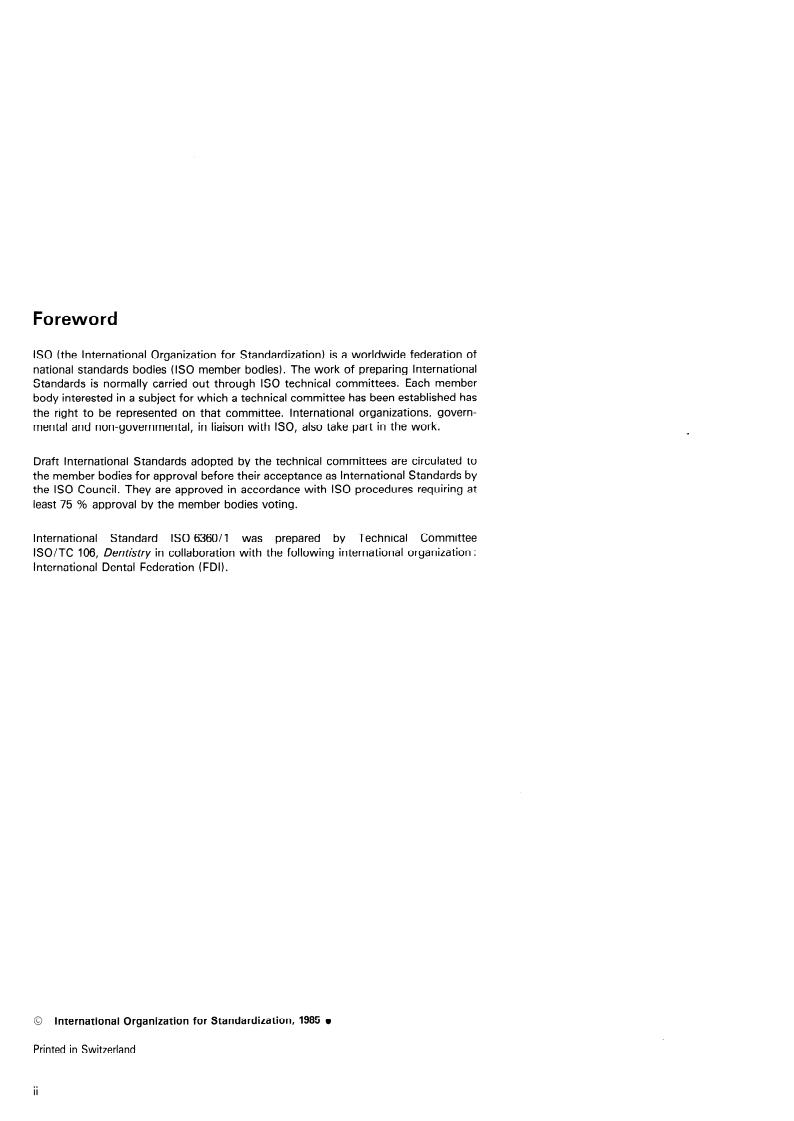
6360 / 1
International Standard
Norme internationale
INTERNATIONAL ORGANIZATION FOR STANDARDIZATION.ME)I(fiYHAPOflHAfl OPfAHM3ALWlR l-l0 CTAH~APTM3A~MM~ORGANISATlON INTERNATIONALE DE NORMALISATION
Dental rotary instruments - Number coding System -
.
Part 1 : General characteristics
First edition - 1985-08-01
Instruments rotatifs dentaires - Systeme de codification
numerique -
Partie 1 3 Caracteristiques generales
Premiere Edition - 1985-08-01
G1
\
LLI
UDWCDU 616.314 : 615.472 Ref. No./Ref. no ISO 6360/1-1985 (E/F)
dental rotary-cutting instruments, codification, numeric Codes. / Descripteurs : art dentaire,
Descriptors : dentistry, dental instruments,
instrument dentaire, instrument de coupe rotatif dentaire, codification, code numerique.
Price based on 20 pages/ Prix bas6 sur 20 pages
-
Foreword
ISO (the International Organization for Standardization) is a worldwide federation of
national Standards bodies (ISO member bodies). The work of preparing International
Standards is normally carried out through ISO technical committees. Esch member
body interested in a subject for which a technical committee has been established has
the right to be represented on that committee. International organizations, govern-
mental and non-governmental, in liaison with ISO, also take part in the work.
Draft International Standards adopted by the technical committees are circulated to
the member bodies for approval before their acceptance as International Standards by
the ISO Council. They are approved in accordance with ISO procedures requiring at
least 75 % approval by the member bodies voting.
International Standard ISO 6360/1 was prepared by Technical Committee
ISO/TC 106, Dent/Stry in collaboration with the following international organization :
International Dental Federation (FDI).
0 International Organkation for Standardkation, 1985 l
Printed in Switzerland
ii
Avant-propos
L’ISO (Organisation internationale de normalisation) est une federation mondiale
d’organismes nationaux de normalisation (comites membres de I’ISO). L’elaboration
des Normes internationales est confiee aux comites techniques de I’ISO. Chaque
comite membre interesse par une etude a Ie droit de faire Partie du comite technique
cr& a cet effet. Les organisations internationales, gouvernementales et non gouverne-
mentales, en liaison avec I’ISO, participent egalement aux travaux.
l
Les projets de Normes internationales adoptes par les comites techniques sont soumis
aux comites membres pour approbation, avant leur acceptation comme Normes inter-
nationales par Ie Conseil de I’ISO. Les Normes internationales sont approuvees confor-
mement aux procedures de I’ISO qui requierent I’approbation de 75 % au moins des
comites membres votants.
La Norme internationale ISO 6360/1 a etc elaboree par Ie comite technique
ISO/TC 106, Produits et matkiel pour /‘art dentaire en collaboration avec I’organisa-
tion internationale suivante : Federation dentaire internationale (FDI).
Organisation internationale de normalisation, 1985 l
Imprimk en Suisse
This page intentionally left blank
INTERNATIONAL STANDARD
ISO 6360/1-1985 (E/F)
NORME INTERNATIONALE
Dental rotary instruments - Number coding System -
Part 1 : General characteristics
Instruments rotatifs dentaires - Systeme de codification
numerique -
Partie 1 : Caracteristiques gen6rales
0 Introduction
0 Introduction
Une vaste gamme d’instruments rotatifs dentaires (y compris
A wide variety of dental rotary instruments (including root
les instruments pour canaux radiculaires) est fabriquee dans
canal instruments) is manufactured throughout the world for
use by the dental Profession. tous les pays du monde pour usage par Ia Profession dentaire.
This International Standard was prepared by ISO/TC 106 Den- La presente Norme internationale a etc elaboree par I’ISO/
tistry in response to a need by the dental trade and industry and TC 106, Produits et matkiel pour /‘art dentaire pour repondre
au besoin de I’industrie, du commerce et des praticiens dentai-
the dental Profession for a universal System of classification
and designation for these instruments. It establishes a com- res de disposer d’un Systeme Universe1 de classification et de
designation de ces instruments. Elle etablit un Systeme complet
prehensive System suitable for all dental rotary instruments by
de codification en quinze chiffres de tous les instruments rota-
the use of a fifteen digit number Code.
tifs dentaires. Ce Systeme ne sera benefique que s’il est large-
ment adopte. En consequence, les fabricants d’instruments
The benefits of this System will only be derived if the System is
rotatifs dentaires sont invites a faire reference a I’ISO 6360 dans
widely adopted; manufacturers of dental rotary instruments are
therefore requested to refer to ISO 6360 in their catalogues. leurs catalogues.
L’ISO 6360 camporte deux Parties:
ISO 6360 consists of two Parts:
Partie 7 : Caractbistiques g&&ales
Part 7 : General characteristics
Part 2 : Shape and specific characteristics Partie 2 : Forme et caractkistiques spkifiques.
NOTE - La presente Norme internationale donne les termes en lan-
NOTE - This International Standard gives terms in English, French,
gues anglaise, francaise, russe et allemande. Les termes en langue alle-
Russian and German. The German language terms have been included
mande ont etc inclus a Ia demande de I’ISO/TC 106 et relevent de Ia
at the request of ISO/TC 106 and are published under the responsi-
responsabilite du comite membre pour Ia Republique federale d’Alle-
bility of the member body for Germany, F. R. (DIN). However only the
magne (DIN). Toutefois, seuls les termes dans les langues officielles de
terms in the official ISO languages (English, French and Russian) are to
I’ISO (anglais, francais et russe) doivent etre consideres comme termes
be considered as ISO terms.
ISO.
1 Objet et domaine d’application
1 Scope and field of application
La presente Norme internationale specifie un Systeme de codifi-
This International Standard specifies a number coding System
for all dental rotary instruments and for several accessories (for cation numerique pour tous les instruments rotatifs dentaires et
example screws) used with the instruments. pour plusieurs accessoires (par exemple les vis) utilises avec ces
instruments.
This patt of ISO 6366 specifies the number code for the general
characteristics of all dental rotary instruments. La presente Partie de I’ISO 6360 specifie Ia codification numeri-
que pour les caracteristiques generales de tous les instruments
rotatifs dentaires.
ISO 6360/1-1985 (E/F)
2 References Refehences
ISO 1797, Dental rotary instruments - Fitting dimensions. 1) I S 0 1797, Instruments ro ta tifs den taires - Dimensions d’ajus-
temen t. 1)
ISO 2157, Dental rotary instruments - Nominal sizes and
designa tion. I SO 2157, Instruments ro ta tifs den taires - Dimensions nomi-
nales et designa tion des Parties actives.
ISO 3630, Dental root canal instruments.
ISO 3630, Instruments pour canaux radiculaires utilises en art
den taire. 1)
ISO 6360, Dental rotary instruments - Number coding sys-
tem - Part 2 : Shape and specific characteristics. 2)
ISO 6360, Instruments rotatifs dentaires - Systeme de codifi-
cation numerique - Partie 2 : Forme et caracteristiques speci-
fiques. 2)
Codification numkique
3 Number code 3
The number code consists of fifteen digits which specify the La codification numerique est constituee de quinze chiffres
specifiant Ie materiau, les formes et les dimensions de Ia Partie
material, the shape and dimensions of the working part of the
instrument and the type of shank and the coating or binding. active de I’instrument et du type de queue, ainsi que Ie revete-
ment ou Ie liant. Le code numerique complet ne decrit qu’un
The complete number code describes only one type of instru-
seul instrument et, pour une identification precise, I’ensemble
ment and for precise numerical identification the full fifteen
digit Code, as indicated in the key to figure 1, shall be used. des quinze chiffres, tel qu’indique dans Ie Principe de Ia
figure 1, doit etre utilise.
lt is anticipated that the use of the fifteen digit number will
become more important with the increasing use of data pro- II faut s’attendre a ce que I’utilisation des quinze chiffres
cessing. However if it is desired initially to introduce only part devienne plus importante, eu egard a I’usage Croissant du trai-
tement informatique des donnees. Toutefois, si initialement on
of the System, the code may be abbreviated by using only nine
digits. In that case the digits detailed below shall at least be souhaite n’introduire qu’une Partie du Systeme, on peut reduire
given : Ie code et n’utiliser que neuf chiffres. Dans ce cas, il convient
de donner au moins les neuf chiffres detailles ci-apres:
-
three digits for the shape;
-
trois chiffres pour Ia forme;
-
three digits for the characterization;
-
trois chiffres pour Ia realisation;
-
three digits for the nominal size of the working part.
-
trois chiffres pour Ia dimension nominale de Ia Partie
NOTE - Six examples using the number code for different types of active.
instruments are given in the annex.
NOTE - Six exemples d’utilisation de Ia codification numerique pour
differents types d’instruments sont donnes en annexe.
Figure 1 - Key to numbered components
Figure 1 - Principe de Ia codification numhique
At present at the Stage of draft. (Revision of ISO 17974976.) Actuellement au stade de projet. Revision
1) de I’ISO 1797- 1976.)
2) At present at the Stage of draft. Actuellement au stade de projet.
ISO 6360/1-1985 (E/F)
KeY
Principe
000. 00 0. 000.000. 000.
Material of working part and coating or binding
(first three digits; see clause 4)
Materiau constitutif de Ia Partie active
et du revetement ou du liant
(trois Premiers chiffres; voir chapitre 4)
Type of shank and handle
(fourth and fifth digits; see clause 5)
Type de queue
(quatrieme et einquieme chiffres; voir chapitre 5)
Overall length
(sixth digit; see clause 6)
Longueur totale
(sixieme Chiffre; voir chapitre 6)
Shape and characterization
(seventh to twelfth digit; see ISO 6360/2)
Forme et realisation
(septieme au dauzieme Chiffre; voir ISO 6360/2)
.
Nominal size of working part or head
(thirteenth to fifteenth digit; see ISO 2157
for burs, Cutters and abrasives, and ISO 3630
for root canal instruments)
Dimension nominale de Ia Partie active ou de Ia tete
(treizieme au quinzieme Chiffre; voir ISO 2157
pour fraises, instruments de coupe et instruments abrasifs
et ISO 3630 pour instruments pour canaux radiculaires)
NOTE - A Ia place des Points entre les groupes de trois chiffres, un
NOTE - Instead of dots between the three digit group numbers, a
clearly visible space may be used. espacement clairement visible peut etre utilise.
4 Material of working part and coating 4 Materiau de Ia Partie active
or binding et du revetement ou du liant
These characteristics are designated by three digits, which ap- Ces caracteristiques sont designees par trois chiffres, soit Ie
pear as the first, second and third digits in the fifteen digit Premier, Ie second et Ie troisieme des quinze chiffres du code
number Code. numerique.
The first two of these three digits indicate the material of the Les deux Premiers de ces trois chiffres s’appliquent au materiau
de Ia Partie active de I’instrument, tel que donne dans Ie
working part of the instrument as given in table 1.
tableau 1.
The third digit, for steel and tungsten carbide instruments,
Le troisieme Chiffre qui s’applique aux instruments en acier et
indicates the coating (plating) of the working Part, and, for
grinding instruments, it indicates the material used to bind the au carbure de tungstene, indique Ie revetement (placage) de Ia
abrasive. For soft materials and brushes no further information Partie active et, pour les instruments abrasifs, Ie materiau liant
is needed and, therefore, the third digit is a Zero. The number utilise. Pour les materiaux tendres et les brosses, aucune autre
coding for the coating or binding is given in tables 2 and 3. information n’est necessaire et, par consequent, Ie troisieme
Chiffre est un Zero. La codification numerique du revetement ou
The illustrations given in table 1 are given as examples only. du liant est donnee dans les tableaux 2 et 3.
They are not intended to give any further information on the in-
struments themselves. Les illustrations du tableau 1 ne sont donnees qu’a titre
d’exemple. Elles ne sont pas destinees a donner des informa-
tions quelconques sur les instruments eux-memes.
ISO 6360/1-1985 (E/F)
Table 1 - Material of working part
Tableau 1 - Mathiau constitutif de Ia Partie active
Number coding
Numero de code
Material Illustration of example
Ist and 2nd
Materiau Illustration de I’exemple
3rd digit
digits
ler et 2e chiffres 3e Chiffre
E : Felt
F : Feutre
R:
o=
D: Filz
E : Rubber
F : Caoutchouc
R:
D: Gummi
E : Plastic
F : Plastique
R:
D: Kunststoff
0 for instruments
E : Leather
without coating
(sec table 2)
F : Cuir
0 pour instruments
R:
sans revetement
D: Leder
(voir tableau 2)
E : Flannel
F : Flanelle
R :
D: Flanell
E : Muslin
F :
Mousseline
R:
D: Nessel
CE
E : Felt cloth
F : Feutre
R:
D: Filztuch
ISO 6360/1-1985 (E/F)
Table 1 t continued)
Tableau 1 (suite)
Number coding
Numero de code
Material Illustration of example
1st and 2nd
Illustration de I’exemple
Materiau
3rd digit
digits
10’ et 2e chiffres 3e Chiffre
E : Yarn
F : Fit
R:
D: Garn
ck
E : Goat hair
F :
Poil de chevre
R:
D: Ziegenhaar
, t; .
E : Natura1 bristles .*:. :- .
*.‘.“.
* .: Y.?,.
::.-.f
:::w*:
F : Brossettes en crin naturel
2-y
“.‘-L * IO
l .-
. . .
:y+
R: ;m’
. .‘. . : *L
‘.‘.-. ;.
‘F.
D: Borsten, natur .&
0 for instruments
, -.; .
-- .
E : Synthetic bristles ::. . without coating
*.,**: .:**
. .&
,,&j
(sec table 2)
:::w:;
F : Brossettes synthetiques
p-. .
p*E
.:.
0 pour instruments
:.-.
-0.
R:
;‘: -:.’
2-1., . * c
sans revetement
*::. ;.y
-::*
Borsten, synthetisch B-
D:
(voir tableau 2)
E : Quill
F: -
R:
D: Federkiel
.
.::*
E : Brass .f
;s
.;-
F : Laiton
:=:
. 20
._
2-.
R:
Ts
l ::.+
.*:”
B+
D: Messing
E : German silver
F : Argent alli6
R:
D: Neusilber
ISO 6360/1-1985 (E/F)
Table 1 ( confinued)
Tableau 1 (suite)
Number coding
Numero de code
Illustration of example
Material
Ist and 2nd
Illustration de I’exemple
Materiau
3rd digit
digits
ler et 2e chiffres 3e Chiffre
E : Free cutting steel
F : Acier de decolletage
rapide
R:
D: Automatenstahl
E : Cold work tool steel
F : Acier a outils pour travail
a froid
R:
D: Werkzeugstahl
Spring steel
E :
F : Acier a ressort
R:
D: Federstahl
E : Stainless steel
See table 2
F : Acier inoxydable
Voir tableau 2
R:
D: Nichtrostender Sta hl
E : Stainless spring steel
F : Acier a ressort inoxydable
R:
D:
Nichtrostender Federstahl
E : Highspeed steel
F :
Acier rapide
R:
D: Hochleistungs-
Werkzeugstahl
E : Tungsten carbide
F : Carbure de tungstene
R:
D: Hartmetall
ISO 6360/1-1985 (E/F)
Table 1 ( continued)
Tableau 1 (suite)
Number coding
Numero de code
Illustration of example
Material
Ist and 2nd
Materiau Illustration de I’exemple
3rd digit
digits
ler et 2e chiffres 3e Chiffre
E : Cuttlefish
F : Os de seiche
R:
D: Tintenfischknochen
@
E : Quartz
F : Quartz
R:
D: Quarz
E : Normal grit corundum
F : Corindon grain normal
R:
D: Normalkorund
E : High grade corundum,
pink
See table 3
F : Corindon grain fin, rose
Voir tableau 3
R:
D: Edelkorund, rosa
E : High grade corundum,
white
F : Corindon grain fin, blanc 63
R:
D: Edelkorund, weiß
E : Tungsten carbide grit
F : Grain en carbure de
tungstene
R:
D: Hartmetall-Korn
E : Silicon carbide
F : Carbure de silice
R:
D: Silicum Carbide
ISO 6360/1-1985 (E/F)
Table 1 ( conchded)
Tableau 1 U7n)
Number coding
Numero de code
Illustration of example
Material
1st and 2nd
Materiau Illustration de I’exemple
3rd digit
digits
ler et 2e chiffres 3e Chiffre
E : Ruby
F : Rubis
R :
D: Rubin
E : Sapphire
F : Saphir
R:
D: Saphir
E : Cubic boron nitride
See table 3
F : Nitrure de bore cubique
Voir tableau 3
R:
D: Kubisches Bornitrit
E : Electro corundum, red
F : Corindon artificiel, rouge
R:
D: Edelkorund, dunkelrot
E : Diamond
F :
Diamant
R:
D: Diamant
ISO 6360/1-1985 (E/F)
Table 3 - Bindings on grinding instruments
Table 2 - Coatings on steel and tungsten carbide
instruments
Liant pour instruments abrasifs
Tableau 3 -
Tableau 2 - Revetements pour instruments en acier
et au carbure de tungsthe
...
Questions, Comments and Discussion
Ask us and Technical Secretary will try to provide an answer. You can facilitate discussion about the standard in here.
Loading comments...