

ISO/TR 20659-1:2024
(Main)Rheological test methods — Fundamentals and interlaboratory comparisons — Part 1: Determination of the yield point
General Information
- Abstract
This document gives information on an interlaboratory comparison for the determination of the yield point, using rheological test methods. The yield point is the shear stress τ below which a material does not flow. This document provides examples of fields of applications, in which important material properties are characterized with the aid of the yield point. These fields of application include: — effectiveness of rheological additives; — shelf life (e.g. with regard to sedimentation, separation and flocculation); — stability of the structure at rest; — behaviour when starting to pump; — use in scraper systems; — wet-film thickness; — levelling and sagging behaviour (e.g. without brushmarks or sag formation); — orientation of effect pigments.
- Status
- Published
- Publication Date
- 06-Mar-2024
- Technical Committee
- ISO/TC 35/SC 9 - General test methods for paints and varnishes
- Drafting Committee
- ISO/TC 35/SC 9 - General test methods for paints and varnishes
- Current Stage
- 6060 - International Standard published
- Start Date
- 07-Mar-2024
- Completion Date
- 07-Mar-2024


Overview
ISO/TR 20659-1:2024 is a Technical Report from ISO that documents the fundamentals and interlaboratory comparisons for the determination of the yield point using rheological test methods. The yield point is defined as the shear stress τ below which a material does not flow. This report summarizes measurement approaches, evaluation methods and the outcomes of a comparative testing programme using rheometers and standardised ramp profiles.
Key technical topics and requirements
- Scope and purpose
- Information on an interlaboratory comparison for yield-point determination and practical guidance on reproducible testing.
- Test modalities
- Shear rate-controlled rotational tests (γ̇ ramps).
- Shear stress-controlled rotational tests (τ ramps).
- Other approaches covered include constant shear-rate tests, creep tests and oscillatory amplitude sweeps.
- Yield-point evaluation methods
- Flow curve regression models: Bingham, Casson, Herschel–Bulkley models (axis intercept methods).
- Axis intercept on linear τ vs γ̇ plots and plateau identification on log–log plots.
- Reference-value method (e.g., τ at a pre-defined shear rate such as γ̇ = 0.01 s‑1).
- Regression lines in lg γ / lg τ diagrams and intersection-point or deviation methods to detect yield or a yield transition zone.
- Viscosity-maximum method (η max) for rotational tests - sensitive to ramp duration and transient effects.
- Metrological considerations
- Importance of specifying temperature, pressure and thermal/mechanical history.
- Influence of rheometer resolution, lowest rotational speeds, measuring-point duration and ramp duration on results.
- Discussion of rheometer calibration and measurement uncertainty.
- Samples and special cases
- Waterborne basecoats (low yield points), dispersions (higher yield points), very-low-yield (< 1 Pa) cases and materials showing stepwise structure disintegration (yield zones).
Practical applications and who uses this standard
ISO/TR 20659-1:2024 is directly relevant to:
- Formulation scientists and rheologists in paints, coatings and varnish industries.
- QC and R&D laboratories performing rheological characterization.
- Process engineers concerned with pumpability, scraper systems and application behavior.
- Manufacturers evaluating rheological additives, shelf life (sedimentation, separation, flocculation), wet-film thickness, levelling/sag resistance and effect-pigment orientation.
- National metrology institutes and interlaboratory study organizers.
Use keywords: ISO/TR 20659-1:2024, yield point, rheological test methods, interlaboratory comparison, rheometer calibration, Bingham, Casson, Herschel–Bulkley, measurement uncertainty.
Related standards
- ISO 3219-1 (Rheology - vocabulary and symbols for rotational and oscillatory rheometry) is cited as a normative reference and should be used in conjunction with this report.
Frequently Asked Questions
ISO/TR 20659-1:2024 is a technical report published by the International Organization for Standardization (ISO). Its full title is "Rheological test methods — Fundamentals and interlaboratory comparisons — Part 1: Determination of the yield point". This standard covers: This document gives information on an interlaboratory comparison for the determination of the yield point, using rheological test methods. The yield point is the shear stress τ below which a material does not flow. This document provides examples of fields of applications, in which important material properties are characterized with the aid of the yield point. These fields of application include: — effectiveness of rheological additives; — shelf life (e.g. with regard to sedimentation, separation and flocculation); — stability of the structure at rest; — behaviour when starting to pump; — use in scraper systems; — wet-film thickness; — levelling and sagging behaviour (e.g. without brushmarks or sag formation); — orientation of effect pigments.
This document gives information on an interlaboratory comparison for the determination of the yield point, using rheological test methods. The yield point is the shear stress τ below which a material does not flow. This document provides examples of fields of applications, in which important material properties are characterized with the aid of the yield point. These fields of application include: — effectiveness of rheological additives; — shelf life (e.g. with regard to sedimentation, separation and flocculation); — stability of the structure at rest; — behaviour when starting to pump; — use in scraper systems; — wet-film thickness; — levelling and sagging behaviour (e.g. without brushmarks or sag formation); — orientation of effect pigments.
ISO/TR 20659-1:2024 is classified under the following ICS (International Classification for Standards) categories: 87.040 - Paints and varnishes. The ICS classification helps identify the subject area and facilitates finding related standards.
ISO/TR 20659-1:2024 is available in PDF format for immediate download after purchase. The document can be added to your cart and obtained through the secure checkout process. Digital delivery ensures instant access to the complete standard document.
Standards Content (Sample)
Technical
Report
ISO/TR 20659-1
First edition
Rheological test methods —
2024-03
Fundamentals and interlaboratory
comparisons —
Part 1:
Determination of the yield point
Méthodes d'essai rhéologiques — Principes fondamentaux et
comparaisons interlaboratoires —
Partie 1: Détermination du seuil d'écoulement
Reference number
© ISO 2024
All rights reserved. Unless otherwise specified, or required in the context of its implementation, no part of this publication may
be reproduced or utilized otherwise in any form or by any means, electronic or mechanical, including photocopying, or posting on
the internet or an intranet, without prior written permission. Permission can be requested from either ISO at the address below
or ISO’s member body in the country of the requester.
ISO copyright office
CP 401 • Ch. de Blandonnet 8
CH-1214 Vernier, Geneva
Phone: +41 22 749 01 11
Email: copyright@iso.org
Website: www.iso.org
Published in Switzerland
ii
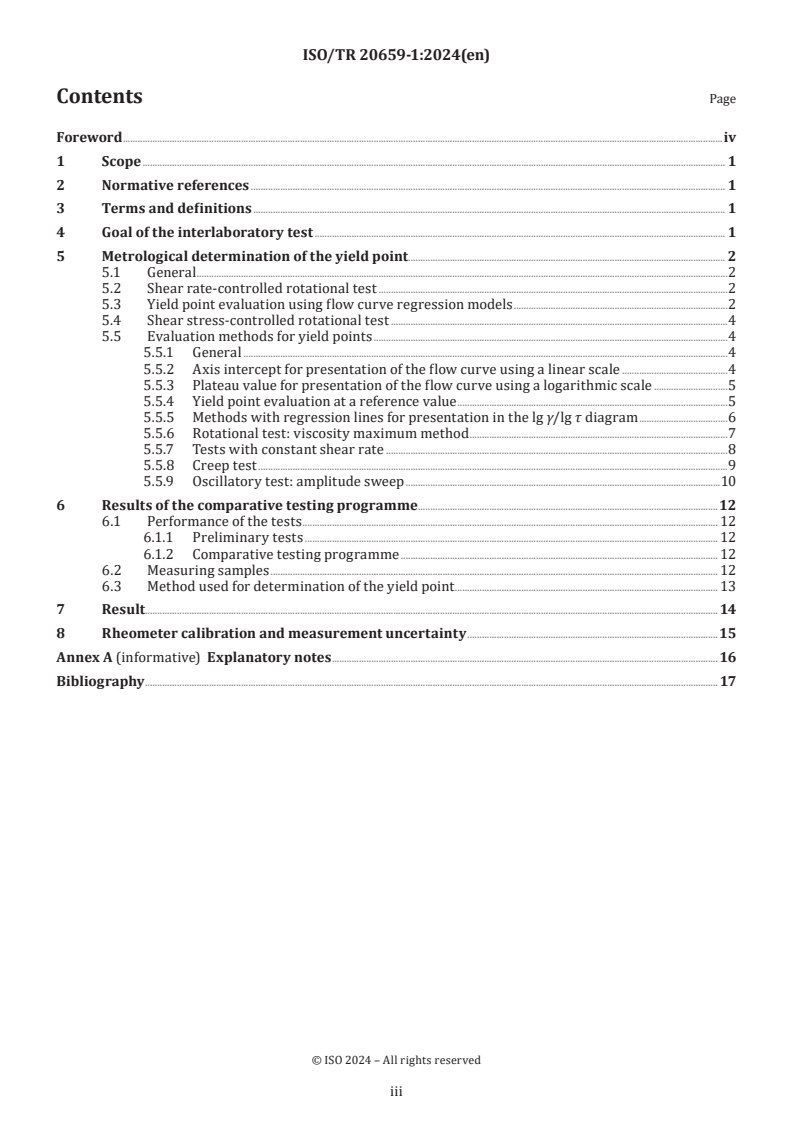
Contents Page
Foreword .iv
1 Scope . 1
2 Normative references . 1
3 Terms and definitions . 1
4 Goal of the interlaboratory test . 1
5 Metrological determination of the yield point . 2
5.1 General .2
5.2 Shear rate-controlled rotational test .2
5.3 Yield point evaluation using flow curve regression models .2
5.4 Shear stress-controlled rotational test .4
5.5 E valuation methods for yield points .4
5.5.1 General .4
5.5.2 Axis intercept for presentation of the flow curve using a linear scale .4
5.5.3 Plateau value for presentation of the flow curve using a logarithmic scale .5
5.5.4 Yield point evaluation at a reference value .5
5.5.5 Methods with regression lines for presentation in the lg γ/lg τ diagram .6
5.5.6 Rotational test: viscosity maximum method .7
5.5.7 Tests with constant shear rate .8
5.5.8 Creep test .9
5.5.9 Oscillatory test: amplitude sweep .10
6 Results of the comparative testing programme .12
6.1 Performance of the tests . 12
6.1.1 Preliminary tests . 12
6.1.2 Comparative testing programme . 12
6.2 Measuring samples . 12
6.3 Method used for determination of the yield point . 13
7 Result. 14
8 Rheometer calibration and measurement uncertainty .15
Annex A (informative) Explanatory notes .16
Bibliography . 17
iii
Foreword
ISO (the International Organization for Standardization) is a worldwide federation of national standards
bodies (ISO member bodies). The work of preparing International Standards is normally carried out through
ISO technical committees. Each member body interested in a subject for which a technical committee
has been established has the right to be represented on that committee. International organizations,
governmental and non-governmental, in liaison with ISO, also take part in the work. ISO collaborates closely
with the International Electrotechnical Commission (IEC) on all matters of electrotechnical standardization.
The procedures used to develop this document and those intended for its further maintenance are described
in the ISO/IEC Directives, Part 1. In particular, the different approval criteria needed for the different types
of ISO document should be noted. This document was drafted in accordance with the editorial rules of the
ISO/IEC Directives, Part 2 (see www.iso.org/directives).
ISO draws attention to the possibility that the implementation of this document may involve the use of (a)
patent(s). ISO takes no position concerning the evidence, validity or applicability of any claimed patent
rights in respect thereof. As of the date of publication of this document, ISO had not received notice of (a)
patent(s) which may be required to implement this document. However, implementers are cautioned that
this may not represent the latest information, which may be obtained from the patent database available at
www.iso.org/patents. ISO shall not be held responsible for identifying any or all such patent rights.
Any trade name used in this document is information given for the convenience of users and does not
constitute an endorsement.
For an explanation of the voluntary nature of standards, the meaning of ISO specific terms and expressions
related to conformity assessment, as well as information about ISO's adherence to the World Trade
Organization (WTO) principles in the Technical Barriers to Trade (TBT), see www.iso.org/iso/foreword.html.
This document was prepared by Technical Committee ISO/TC 35, Paints and varnishes, Subcommittee SC 9,
General test methods for paints and varnishes.
A list of all parts in the ISO 20659 series can be found on the ISO website.
Any feedback or questions on this document should be directed to the user’s national standards body. A
complete listing of these bodies can be found at www.iso.org/members.html.
iv
Technical Report ISO/TR 20659-1:2024(en)
Rheological test methods — Fundamentals and
interlaboratory comparisons —
Part 1:
Determination of the yield point
1 Scope
This document gives information on an interlaboratory comparison for the determination of the yield point,
using rheological test methods. The yield point is the shear stress τ below which a material does not flow.
This document provides examples of fields of applications, in which important material properties are
characterized with the aid of the yield point. These fields of application include:
— effectiveness of rheological additives;
— shelf life (e.g. with regard to sedimentation, separation and flocculation);
— stability of the structure at rest;
— behaviour when starting to pump;
— use in scraper systems;
— wet-film thickness;
— levelling and sagging behaviour (e.g. without brushmarks or sag formation);
— orientation of effect pigments.
2 Normative references
The following documents are referred to in the text in such a way that some or all of their content constitutes
requirements of this document. For dated references, only the edition cited applies. For undated references,
the latest edition of the referenced document (including any amendments) applies.
ISO 3219-1, Rheology — Part 1: Vocabulary and symbols for rotational and oscillatory rheometry
3 Terms and definitions
For the purposes of this document, the terms and definitions given in ISO 3219-1.
ISO and IEC maintain terminology databases for use in standardization at the following addresses:
— ISO Online browsing platform: available at https:// www .iso .org/ obp
— IEC Electropedia: available at https:// www .electropedia .org/
4 Goal of the interlaboratory test
In the interlaboratory test, different possibilities for determining the yield point using the preferred methods
were considered.
The samples used in the comparative testing programme consisted of different waterborne basecoats
with lower yield points and dispersions with distinctly higher yield points. The samples also included the
following limited cases:
— very low yield points (<1 Pa), at which the range of elastic deformation is so low that the material can also
be approximately considered as a liquid at the state of rest;
— materials of which the internal structure is disintegrated only stepwise so that a transition range is
occurring and a yield zone rather than a punctual yield point is determined.
Furthermore, a non-Newtonian reference sample from the the National Metrology Institute of Germany
(PTB) was also included in the comparative testing programme.
Some background information on the original interlaboratory test is given in Annex A.
5 Metrological determination of the yield point
5.1 General
Clause 5 briefly describes all the methods in use at the time of publication. In principle, the yield point
depends on the temperature, the pressure and the thermal and mechanical history of the material. A detailed
specification of the measuring profile is therefore a precondition for reproducible measurements.
5.2 Shear rate-controlled rotational test
The shear rate γ is specified in the form of a ramp, as shown in Figure 1.
Key
shear rate
γ
t time
Figure 1 — Shear rate/time function as a ramp
5.3 Yield point evaluation using flow curve regression models
With a linear representation of the flow curve (usually the shear stress τ as a function of the shear rate γ ),
the yield point is determined as the axis intercept on the τ axis (Figure 2).
Key
τ shear stress
τ Bingham yield point
B
K consistency index according to Bingham
B
shear rate
γ
1 chosen shear rate range
Figure 2 — Flow curve regression according to Bingham
This yield point value depends not only on the specified ramp period, but also on the chosen shear rate range
and the chosen regression model. In industrial laboratories, the models according to Bingham, Casson or
Herschel/Bulkley are widely used.
The model function according to Bingham is given in Formula (1):
ττ=+ K ⋅γ (1)
BB
where
τ is the shear stress;
τ is the calculated Bingham yield point;
B
K is the consistency index according to Bingham;
B
γ
is the shear rate.
The model function according to Casson is given in Formula (2):
ττ=+ ()K ⋅γ (2)
C C
where
τ is the shear stress;
τ is the calculated Casson yield point;
C
K is the consistency index according to Casson;
C
γ
is the shear rate.
The model function according to Herschel/Bulkley is given in Formula (3):
p
ττ=+K ⋅γ (3)
HB HB
where
τ is the shear stress;
τ is the calculated yield point according to Herschel/Bulkley;
HB
K is the consistency index according to Herschel/Bulkley;
HB
γ
is the shear rate;
p is an exponent; if p < 1, the flow behaviour is shear thinning (structural viscosity, pseudoplastic),
and if p > 1, the flow behaviour is shear thickening (dilatant).
5.4 Shear stress-controlled rotational test
The shear stress, τ, is specified in the form of a ramp, as shown in Figure 3.
Key
τ shear stress
t time
Figure 3 — Specified profile: shear stress/time function as a ramp
5.5 E valuation methods for yield points
5.5.1 General
Besides the specified ramp period, the yield point value above all depends on the resolution of the rheometer
−1
for the lowest rotational speed. At shear rates of γ< 1 s , time-dependent (transient) effects are expected if
the measuring point duration is too short.
5.5.2 Axis intercept for presentation of the flow curve using a linear scale
This is the “classic method” of the yield point determination. In the case of the upward ramp, the yield
point τ is determined as the last τ value at which the rheometer does not yet detect movement of the
y
−1
measuring system, i.e. at which γ =0s is still measured. By contrast, in the case of the downward ramp,
the yield point is determined as the first τ value at which the rheometer no longer detects movement, i.e. at
−1
which γ =0s is measured (see Figure 4).
Key
τ shear stress
τ yield point
y
γ shear rate
Figure 4 — Flow curve in a linear scale with the yield point as an axis intercept on the τ axis
5.5.3 Plateau value for presentation of the flow curve using a logarithmic scale
If the flow curve approaches a plateau value in the range of low shear rates, this τ value is taken as the yield
point τ , as shown in Figure 5.
y
Key
τ shear stress
τ yield point
y
shear rate
γ
Figure 5 — Flow curve in a double-logarithmic scale with the yield point as a plateau value of the
shear stress in the range of low shear rates
5.5.4 Yield point evaluation at a reference value
The flow curve specification can take the form of a γ ramp or a τ ramp. The yield value is determined as
−1
shown in Figure 6 as the τ value at a shear rate previously defined by the user, e.g. γ =00,s1 .
Key
τ shear stress
τ yield point
y
shear rate
γ
−−1
Figure 6 — Flow curve, determination of the yield point τ as the τ value with γγ =0,01s
y
5.5.5 Methods with regression lines for presentation in the lg γ/lg τ diagram
If a yield point is present, then a straight line becomes visible in the range of low shear load because then the
shear stress τ and the shear strain γ are proportional at low values. The measured sample then demonstrates
reversible linear-elastic deformation behaviour in accordance with Hooke‘s law on elasticity. At higher
loads the structure-at-rest disintegrates and the deformation then becomes disproportionately high, i.e. the
material now demonstrates irreversible viscoelastic or viscous flow behaviour. The yield point is exceeded
if the measuring points no longer lie on a straight line. If it is also possible to apply a second line through the
measuring points in the flow range, i.e. when the deformation is high, the intersection point between the
lines is evaluated as the yield point (see Figure 7).
Key
γ shear strain
τ shear stress
τ yield point
y
Figure 7 — Determination of the yield point using the method of the intersection point between two
regression lines
If it is not easily possible to apply a second line, the regression line is only fitted in the lower range, i.e. in the
linear-elastic range. The yield point is then the τ value at which the measuring curve deviates upwards from
this line into the flow range (see Figure 8). If the internal structure of a material is disintegrated stepwise
only so that no sharp edge but a transition range becomes visible, it is preferred to talk of a “yield transition
zone” instead of a “yield point”. In this case, the evaluation method shown in Figure 8 is preferred.
Key
γ shear strain
τ shear stress
τ yield point
y
Figure 8 — Determination of the yield point τ using a regression line in the linear-elastic
y
deformation range
5.5.6 Rotational test: viscosity maximum method
For rotational tests, the specification can take the form of a γ ramp or τ ramp. The yield point is determined
at the maximum value η of the shear viscosity function η τ or η γ .
() ()
max
Due to time-dependent (transient) rheological effects, this yield point value depends strongly on the
measuring point duration. The reason for this is inhomogeneous deformation behaviour and flow behaviour
of the measured sample in the shear gap at very low shear rates during the transition from the
...