

ISO 8934-1:2026
(Main)Biotechnology — Cell viability analytical methods — Part 1: General requirements and considerations
- Abstract
This document specifies the general requirements for cell viability analytical methods and for reporting cell viability. This document gives general guidelines for selecting and establishing fit for purpose cell viability analytical methods. This document specifies requirements for establishing standard operating procedures for cell viability analytical methods. This document also gives guidelines for managing sources of variability for cell viability measurements during pre-analytical, analytical, and post-analytical phases. This document is applicable to cells in suspension, cells adhered to a substrate, and cells in complex matrices. This document is primarily applicable to cell viability measurements of nucleated mammalian cells. NOTE 1 Several sector/application-specific international and national standards for cell viability currently exist. NOTE 2 When applicable, the user can consult existing standards when operating within their scope.
- Status
- Published
- Publication Date
- 20-May-2026
- Technical Committee
- ISO/TC 276 - Biotechnology
- Drafting Committee
- ISO/TC 276 - Biotechnology
- Current Stage
- 6060 - International Standard published
- Start Date
- 21-May-2026
- Due Date
- 25-Apr-2026
- Completion Date
- 21-May-2026

ISO 8934-1:2026 is an ISO standard from biotechnology that sets general requirements and considerations for cell viability analytical methods. It tells users how to select a fit-for-purpose method, establish standard operating procedures (SOPs), manage variability, qualify and validate the method, and report cell viability for cells in suspension, cells adhered to a substrate, and cells in complex matrices, mainly for nucleated mammalian cells. It is written for laboratories and organizations that need consistent cell viability measurements for research, manufacturing, and release decisions.
What does ISO 8934-1:2026 specify?
ISO 8934-1:2026 specifies the general requirements for cell viability analytical methods and for reporting cell viability. It also gives guidance for choosing a method that fits the intended use, and for controlling variability across the pre-analytical, analytical, and post-analytical phases.
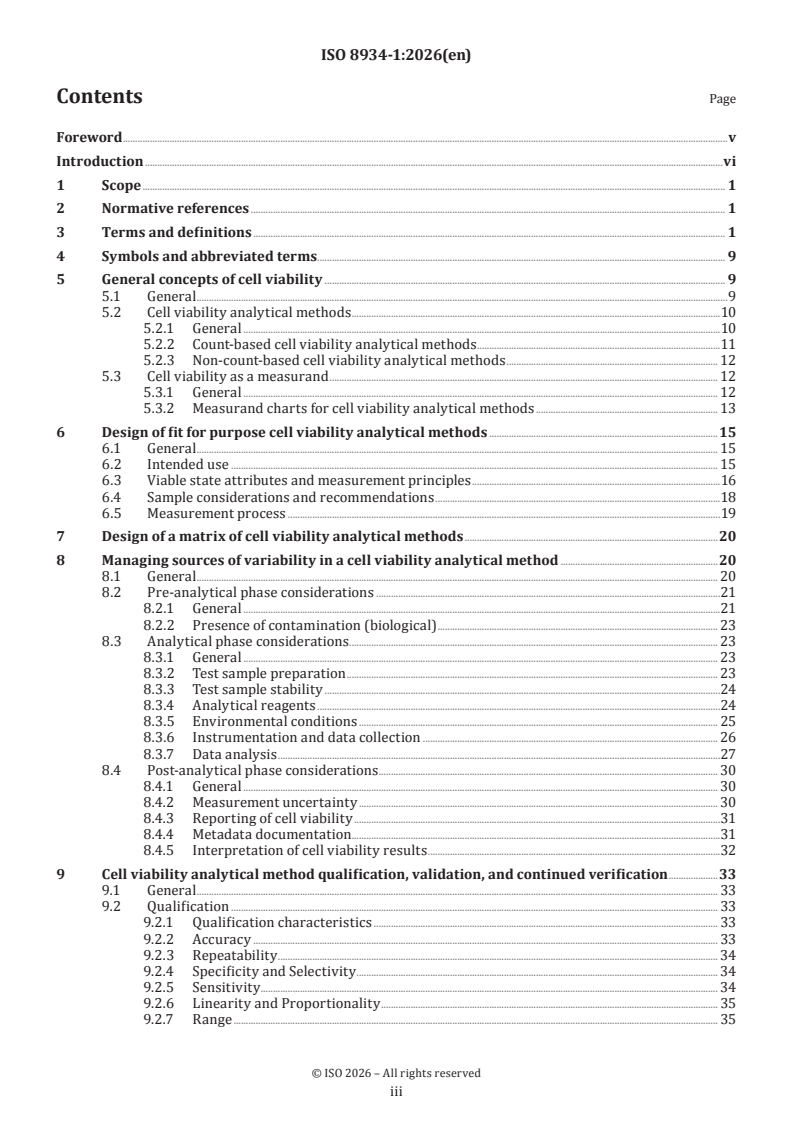
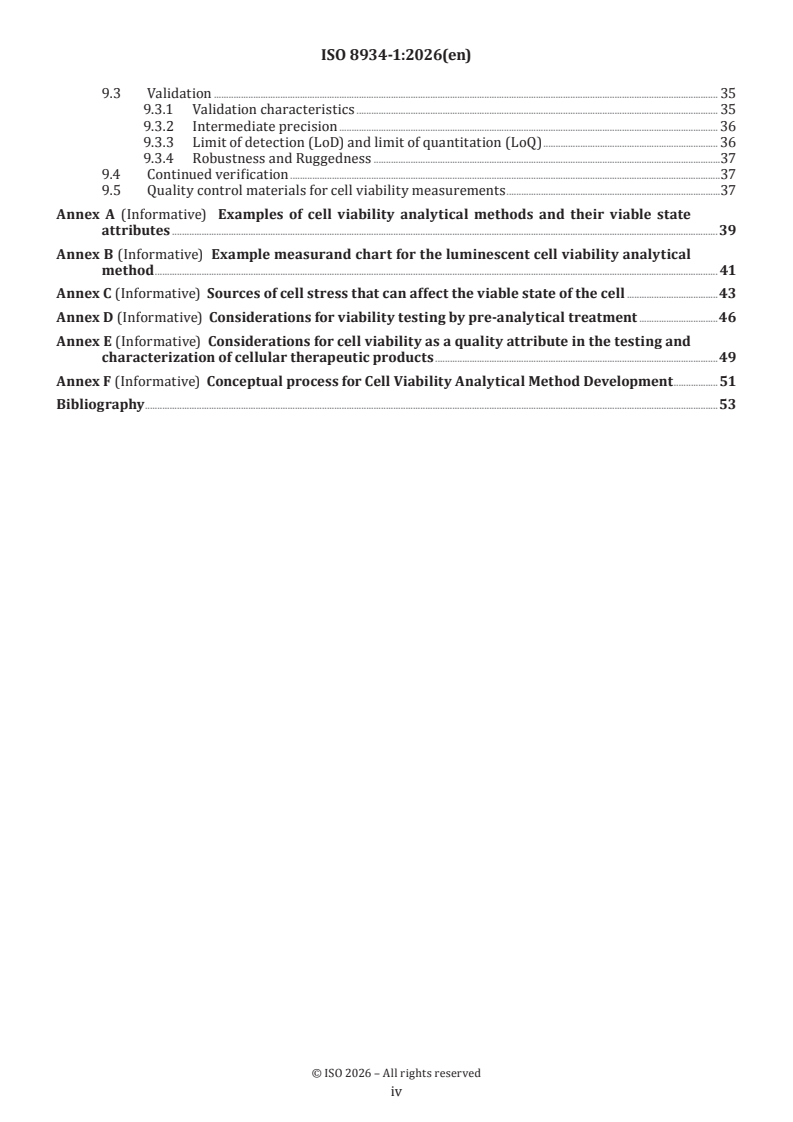
The document is organized into clauses 1 to 9, followed by informative annexes A to F. The main flow is: scope, terms, concepts of cell viability, design of fit-for-purpose methods, design of a matrix of methods, variability management, and qualification, validation, and continued verification.
| Annex | What it covers |
|---|---|
| Annex A | Examples of cell viability analytical methods and the viable state attributes they evaluate |
| Annex B | Example measurand chart for the luminescent cell viability analytical method |
| Annex C | Sources of cell stress that can affect the viable state of the cell |
| Annex D | Considerations for viability testing by pre-analytical treatment |
| Annex E | Cell viability as a quality attribute in testing and characterization of cellular therapeutic products |
| Annex F | Conceptual process for Cell Viability Analytical Method Development |
What are the key requirements of ISO 8934-1:2026?
ISO 8934-1:2026 is built around a fit-for-purpose approach. In practice, that means the user must define the intended use first, then choose the viable state attribute, measurement principle, sample handling, and measurement process that suit that use.
Document the intended use and design around it
Clause 6.2 says the intended use of a cell viability measurement shall be documented. Examples include release testing, storage and transport stability testing, starting material characterization, cell expansion monitoring, bioprocess monitoring, cytotoxicity testing, analytical method normalization, and cell passaging.
That matters because performance needs change with the use case. A method for early upstream samples may need different sensitivity, automation, sample volume, or ability to separate nucleated cells from debris than a method used for purified material or final release.
Select the viable state attribute and measurement principle
Clause 6.3 requires the selected viable state attribute(s) and the measurement principle to be documented. The standard treats viability as based on one or more attributes linked to the viable state, such as membrane integrity, metabolic activity, molecular markers of injury, proliferative capacity, adhesion, motility, morphology, or mechanical response.
In practice, this means the user must be clear about what the method is really measuring. Two methods can both be called “viability” methods but produce different results if one tracks membrane integrity and another tracks metabolic activity.
Define the sample conditions that can affect the result
Clause 6.4 and Clause 8 stress that sample properties can strongly affect cell viability measurements. The document highlights cell concentration, cell type, medium, matrix, debris, aggregation, heterogeneity, donor variability, storage conditions, contamination, and the timing of the measurement after a traumatic event such as cryopreservation or electroporation.
This matters because the same method can behave differently on fresh cells, thawed cells, primary tissue-derived cells, bioreactor samples, cell lines, or cells in engineered matrices. The method should be chosen and, if needed, adjusted so that the sample still represents the process or product being assessed.
Use a measurement process that matches the analytical need
Clause 6.5 says the instrument and data collection approach should be fit for the intended use, with attention to specificity, sensitivity, range, linearity or proportionality, repeatability, reproducibility, and accuracy. It also lists practical factors such as cost, maintenance, calibration, throughput, automation, reference materials, traceability, time per assay, and data handling.
For users, this is a selection framework. A method is not just chosen for technical performance; it must also work operationally in the lab or manufacturing setting where it will be used.
Manage variability across all phases and document the controls
Clause 8 breaks the measurement process into pre-analytical, analytical, and post-analytical phases, and says sources of variability should be evaluated, documented, and managed. It also expects strategies for monitoring and verification, plus replication, randomization, and, where appropriate, blinding.
That means the user should control what happens before measurement, during sample preparation and data collection, and after the result is generated. The standard also points to documenting uncertainty, metadata, and interpretation so results can be defended and compared.
Use method matrices when one method is not enough
Clause 7 allows a matrix of complementary cell viability analytical methods when a single method does not give an adequate view of the sample. The methods should be run on comparable samples so the data can be combined or interpreted together.
This is important when viability has more than one relevant dimension. Results from different methods may not be linearly correlated, so they may be cumulative rather than confirmatory.
Plan qualification, validation, and continued verification
Clause 9 requires a qualification or validation plan based on intended use, followed by continued verification during routine use. The clause covers accuracy, repeatability, specificity, selectivity, sensitivity, linearity, proportionality, range, intermediate precision, limit of detection (LoD), limit of quantitation (LoQ), robustness, and ruggedness.
For the reader, this is the quality control backbone of the method. It tells you what needs to be shown before routine use and what must keep being checked afterward, especially if new sample types or unknown characteristics are introduced.
Use quality control materials appropriately
Clause 9.5 discusses quality control materials (QCMs) and in-house reference materials. They should represent nominally viable, nominally non-viable, or other relevant viable states, and they can be created by processes such as thermal, chemical, mechanical, light, or nutrient stress.
This matters because a control material should challenge the method in a realistic way. The standard also warns that beads or cell-like particles may help with some instrument checks but are not always representative of real cells.
What terms does ISO 8934-1:2026 define?
- Cell viability analytical method - an investigative procedure for measuring or assessing viable cells, non-viable cells, other viable-state-related categories, or their ratio.
- Viable state - the condition of cells related to one or more attributes of being alive.
- Viable state attribute - a physical, biochemical, or biological property that indicates the viable state of the cell(s).
- Intended use - the use for which the product, process, or service is intended according to supplied specifications or instructions.
- Fit for purpose - aligned with prearranged requirements for the intended use.
- Standard operating procedure (SOP) - a written procedure for repetitive use, aimed at obtaining a desired outcome.
- Quality control material (QCM) - a reference material used for quality control of a measurement.
Who uses ISO 8934-1:2026?
ISO 8934-1:2026 is intended for biotechnology users who measure cell viability in research, development, manufacturing, and quality control. The introduction names basic research, drug discovery, toxicity testing, manufacturing control, and release testing for cell banks, biological products, and cellular therapeutic products.
In practice, the standard is useful to method developers, analytical scientists, quality managers, validation teams, production and bioprocess engineers, and buyers or technical evaluators who need to choose a viability method for a specific workflow. It is especially relevant where cell quality, dose, potency, or process control depends on how viability is measured and reported.
Which standards are used with ISO 8934-1:2026?
ISO 8934-1:2026 cites several related standards and guidance documents that support its terminology and method design.
- ISO 8934-2 - referenced for experimental designs for cell count-based cell viability analytical methods and for additional QCM preparation information.
- ISO 23033:2021 - provides the broader framework for analytical methods for cellular therapeutic products and is used in Annex E for terminology and quality-attribute context.
- ISO 20391-1:2018 - provides general guidance on cell counting and is a source for several counting-related terms used in the document.
- ISO 20391-2:2018 - provides experimental design and statistical analysis guidance for quantifying counting method performance.
- ISO Guide 80 - used as the basis for preparing QCMs in Clause 9.5.
What does the ISO 8934-1:2026 document contain?
ISO 8934-1:2026 contains a structured explanation of cell viability as a measurand, including count-based and non-count-based approaches, and the relationship between viability, viable cells, and the viable state. It includes a practical framework for selecting a method based on intended use, sample properties, and measurement process constraints.
The document also contains detailed guidance on managing variability across pre-analytical, analytical, and post-analytical phases, plus qualification, validation, and continued verification of the method. Annex A lists example methods such as dye exclusion, metabolic assays, imaging-based approaches, and electrical or signal-based approaches; Annex B gives an example measurand chart; Annex C and Annex D focus on stress and pre-analytical treatment; Annex E relates the standard to cellular therapeutic products; and Annex F shows the conceptual development process.
Frequently Asked Questions
ISO 8934-1:2026 is a standard published by the International Organization for Standardization (ISO). Its full title is "Biotechnology — Cell viability analytical methods — Part 1: General requirements and considerations". This standard covers: This document specifies the general requirements for cell viability analytical methods and for reporting cell viability. This document gives general guidelines for selecting and establishing fit for purpose cell viability analytical methods. This document specifies requirements for establishing standard operating procedures for cell viability analytical methods. This document also gives guidelines for managing sources of variability for cell viability measurements during pre-analytical, analytical, and post-analytical phases. This document is applicable to cells in suspension, cells adhered to a substrate, and cells in complex matrices. This document is primarily applicable to cell viability measurements of nucleated mammalian cells. NOTE 1 Several sector/application-specific international and national standards for cell viability currently exist. NOTE 2 When applicable, the user can consult existing standards when operating within their scope.
This document specifies the general requirements for cell viability analytical methods and for reporting cell viability. This document gives general guidelines for selecting and establishing fit for purpose cell viability analytical methods. This document specifies requirements for establishing standard operating procedures for cell viability analytical methods. This document also gives guidelines for managing sources of variability for cell viability measurements during pre-analytical, analytical, and post-analytical phases. This document is applicable to cells in suspension, cells adhered to a substrate, and cells in complex matrices. This document is primarily applicable to cell viability measurements of nucleated mammalian cells. NOTE 1 Several sector/application-specific international and national standards for cell viability currently exist. NOTE 2 When applicable, the user can consult existing standards when operating within their scope.
ISO 8934-1:2026 is classified under the following ICS (International Classification for Standards) categories: 07.080 - Biology. Botany. Zoology. The ICS classification helps identify the subject area and facilitates finding related standards.
ISO 8934-1:2026 is available in PDF format for immediate download after purchase. The document can be added to your cart and obtained through the secure checkout process. Digital delivery ensures instant access to the complete standard document.
Standards Content (Sample)
International
Standard
ISO 8934-1
First edition
Biotechnology — Cell viability
2026-05
analytical methods —
Part 1:
General requirements and
considerations
Biotechnologie — Méthodes d'analyse de la viabilité cellulaire —
Partie 1: Exigences générales et considérations
Reference number
© ISO 2026
All rights reserved. Unless otherwise specified, or required in the context of its implementation, no part of this publication may
be reproduced or utilized otherwise in any form or by any means, electronic or mechanical, including photocopying, or posting on
the internet or an intranet, without prior written permission. Permission can be requested from either ISO at the address below
or ISO’s member body in the country of the requester.
ISO copyright office
CP 401 • Ch. de Blandonnet 8
CH-1214 Vernier, Geneva
Phone: +41 22 749 01 11
Email: copyright@iso.org
Website: www.iso.org
Published in Switzerland
ii
Contents Page
Foreword .v
Introduction .vi
1 Scope . 1
2 Normative references . 1
3 Terms and definitions . 1
4 Symbols and abbreviated terms. 9
5 General concepts of cell viability . 9
5.1 General .9
5.2 Cell viability analytical methods .10
5.2.1 General .10
5.2.2 Count-based cell viability analytical methods .11
5.2.3 Non-count-based cell viability analytical methods . 12
5.3 Cell viability as a measurand . 12
5.3.1 General . 12
5.3.2 Measurand charts for cell viability analytical methods . 13
6 Design of fit for purpose cell viability analytical methods .15
6.1 General . 15
6.2 Intended use . 15
6.3 Viable state attributes and measurement principles .16
6.4 Sample considerations and recommendations .18
6.5 Measurement process .19
7 Design of a matrix of cell viability analytical methods .20
8 Managing sources of variability in a cell viability analytical method .20
8.1 General . 20
8.2 Pre-analytical phase considerations .21
8.2.1 General .21
8.2.2 Presence of contamination (biological) . 23
8.3 Analytical phase considerations . . 23
8.3.1 General . 23
8.3.2 Test sample preparation . 23
8.3.3 Test sample stability .24
8.3.4 Analytical reagents .24
8.3.5 Environmental conditions . 25
8.3.6 Instrumentation and data collection . 26
8.3.7 Data analysis .27
8.4 Post-analytical phase considerations . 30
8.4.1 General . 30
8.4.2 Measurement uncertainty . 30
8.4.3 Reporting of cell viability .31
8.4.4 Metadata documentation .31
8.4.5 Interpretation of cell viability results .32
9 Cell viability analytical method qualification, validation, and continued verification .33
9.1 General . 33
9.2 Qualification . 33
9.2.1 Qualification characteristics . 33
9.2.2 Accuracy . 33
9.2.3 Repeatability . 34
9.2.4 Specificity and Selectivity . 34
9.2.5 Sensitivity . 34
9.2.6 Linearity and Proportionality . 35
9.2.7 Range . 35
iii
9.3 Validation . 35
9.3.1 Validation characteristics . 35
9.3.2 Intermediate precision . 36
9.3.3 Limit of detection (LoD) and limit of quantitation (LoQ) . 36
9.3.4 Robustness and Ruggedness .37
9.4 Continued verification .37
9.5 Quality control materials for cell viability measurements .37
Annex A (Informative) Examples of cell viability analytical methods and their viable state
attributes .39
Annex B (Informative) Example measurand chart for the luminescent cell viability analytical
method . 41
Annex C (Informative) Sources of cell stress that can affect the viable state of the cell .43
Annex D (Informative) Considerations for viability testing by pre-analytical treatment .46
Annex E (Informative) Considerations for cell viability as a quality attribute in the testing and
characterization of cellular therapeutic products .49
Annex F (Informative) Conceptual process for Cell Viability Analytical Method Development .51
Bibliography .53
iv
Foreword
ISO (the International Organization for Standardization) is a worldwide federation of national standards
bodies (ISO member bodies). The work of preparing International Standards is normally carried out through
ISO technical committees. Each member body interested in a subject for which a technical committee
has been established has the right to be represented on that committee. International organizations,
governmental and non-governmental, in liaison with ISO, also take part in the work. ISO collaborates closely
with the International Electrotechnical Commission (IEC) on all matters of electrotechnical standardization.
The procedures used to develop this document and those intended for its further maintenance are described
in the ISO/IEC Directives, Part 1. In particular, the different approval criteria needed for the different types
of ISO document should be noted. This document was drafted in accordance with the editorial rules of the
ISO/IEC Directives, Part 2 (see www.iso.org/directives).
ISO draws attention to the possibility that the implementation of this document may involve the use of (a)
patent(s). ISO takes no position concerning the evidence, validity or applicability of any claimed patent
rights in respect thereof. As of the date of publication of this document, ISO had not received notice of (a)
patent(s) which may be required to implement this document. However, implementers are cautioned that
this may not represent the latest information, which may be obtained from the patent database available at
www.iso.org/patents. ISO shall not be held responsible for identifying any or all such patent rights.
Any trade name used in this document is information given for the convenience of users and does not
constitute an endorsement.
For an explanation of the voluntary nature of standards, the meaning of ISO specific terms and expressions
related to conformity assessment, as well as information about ISO's adherence to the World Trade
Organization (WTO) principles in the Technical Barriers to Trade (TBT), see www.iso.org/iso/foreword.html.
This document was prepared by Technical Committee ISO/TC 276, Biotechnology, Subcommittee SC 1,
Analytical methods.
A list of all parts in the ISO 8934 series can be found on the ISO website.
Any feedback or questions on this document should be directed to the user’s national standards body. A
complete listing of these bodies can be found at www.iso.org/members.html.
v
Introduction
Evaluation of cell viability is a fundamental measurement in biotechnology. Cell viability measurements
are widely and routinely used in basic research, drug discovery, toxicity testing, manufacturing control
and release testing for cell banks, biological products, and cellular therapeutic products. Cell viability can
be important in ensuring the safety and efficacy of cellular therapeutic products, in determining cell dose
and product potency in cellular therapeutic products, and in the manufacturing and control of cell-based
products and products derived from cells.
A quantity value for cell viability can be determined through a broad range of analytical methods evaluating
different attributes related to the viable state of the cell(s). Several biological properties, or attributes,
serve as the targets for identifying the viable state of the cell(s), and can be used to determine the viability
status of cells. Examples include observations of the cell’s membrane integrity, metabolic activity, nuclear
morphology, and a cell’s ability to replicate. Cell viability can also refer to different quantities related to
viable and non-viable cells including percent cell viability, viable cell concentration, and signals related to
the viable state. There is also a wide range of instrumentation used in the measurement of cell viability,
including image based, flow cytometry based, spectrophotometric, and electrical signal-based approaches.
Given the wide range of analytical methods associated with cell viability, it is often challenging to compare
cell viability results from different analytical methods without additional knowledge regarding the viable
state attribute investigated or the analytical method that was conducted. In addition, different applications
require the use of different cell viability analytical methods that are compatible with or relevant to the
intended use. Although cell viability standards exist, these standards are either test method specific, test
article specific, sector specific or region specific. Existing standards do not address the general need of
establishing common terminology for cell viability, considerations for fit for purpose cell viability analytical
method development and the reporting of cell viability measurement results.
This document establishes a common approach for defining fit for purpose cell viability analytical methods
to facilitate common understanding between users of the standard. This document provides general
concepts and terminology for cell viability measurements, provides considerations for measurement control
strategies and validation strategies, and considerations for establishing cell viability analytical method
standard operating procedures. This document also includes the establishment of a common framework for
reporting cell viability measurements.
This document is intended for a broad and worldwide industry where the quality and viability of cells are
critical for research and product development.
This part of the ISO 8934 series is focused primarily on mammalian cells.
vi
International Standard ISO 8934-1:2026(en)
Biotechnology — Cell viability analytical methods —
Part 1:
General requirements and considerations
1 Scope
This document specifies the general requirements for cell viability analytical methods and for reporting cell
viability. This document gives general guidelines for selecting and establishing fit for purpose cell viability
analytical methods. This document specifies requirements for establishing standard operating procedures
for cell viability analytical methods. This document also gives guidelines for managing sources of variability
for cell viability measurements during pre-analytical, analytical, and post-analytical phases.
This document is applicable to cells in suspension, cells adhered to a substrate, and cells in complex matrices.
This document is primarily applicable to cell viability measurements of nucleated mammalian cells.
NOTE 1 Several sector/application-specific international and national standards for cell viability currently exist.
NOTE 2 When applicable, the user can consult existing standards when operating within their scope.
2 Normative references
There are no normative references in this document.
3 Terms and definitions
For the purposes of this document, the following terms and definitions apply.
ISO and IEC maintain terminology databases for use in standardization at the following addresses:
— ISO Online browsing platform: available at https:// www .iso .org/ obp
— IEC Electropedia: available at https:// www .electropedia .org/
3.1
analytical method
investigative procedure for qualitatively or quantitatively measuring or assessing the presence, amount, or
functional activity of a target entity (the analyte)
[SOURCE: ISO 23033:2021, 3.3]
3.2
analytical method matrix
set of two or more complementary analytical methods (3.1) to measure different aspects of a quality attribute
(3.32)
[SOURCE: ISO 23033:2021, 3.7]
3.3
attribute
physical, chemical, biological, or microbiological property or characteristic
[SOURCE: ISO 20391-1:2018, 3.5]
3.4
attribute component
quantity used to derive a quality attribute (3.32)
[SOURCE: ISO 23033:2021, 3.9]
3.5
biological property
biological phenomenon that is evaluated to assess the quality attribute (3.32)
[SOURCE: ISO 23033:2021, 3.11]
3.6
bioprocessing monitoring mode
spatio-temporal position of a measurement device (i.e. sensor) or measurement process in relation to a
bioreactor or vessel
3.7
calibration
operation that, under specified conditions in a first step, establishes a relation between the quantity (3.34)
values with measurement uncertainties provided by measurement standards and corresponding indications
with associated measurement uncertainties and, in a second step, uses this information to establish a
relation for obtaining a measurement result from an indication
[SOURCE: ISO/IEC Guide 99:2007, 2.39, modified — Notes to entry deleted.]
3.8
cell concentration
cell count (3.9) per volume
Note 1 to entry: Typically used for cells in suspension.
[SOURCE: ISO 20391-1:2018, 3.6]
3.9
cell count
discrete number of cells
Note 1 to entry: Cell count is typically expressed as cell concentration (3.8) or area density.
[SOURCE: ISO 20391-1:2018, 3.7]
3.10
cell death
state of irreversible degeneration of vital cellular functions culminating in the loss of cellular integrity
Note 1 to entry: Definition based on Reference [5].
3.11
cell viability analytical method
investigative procedure for measuring or assessing the presence, amount, or functional activity of viable
cells (3.53), non-viable cells, other category related to viable state (3.55), or ratio thereof
3.12
examinand
nominal property (3.27) intended to be examined
Note 1 to entry: Definition based on Reference [7].
3.13
examination
process of experimentally obtaining one or more values that can reasonably be attributed to a nominal
property (3.27) together with any other available relevant information
Note 1 to entry: Definition based on Reference [7].
3.14
fit for purpose
in line with prearranged requirements for an intended use (3.17)
[SOURCE: ISO 20387:2018, 3.24, modified — Note to entry deleted.]
3.15
in-house reference material
non-certified material or substance, produced by one laboratory, one or more of whose property values are
sufficiently homogeneous and well established to be used for the intended use (3.17)
Note 1 to entry: The use of in-house reference materials can include, but is not limited to, validation (3.51), calibration
(3.7), monitoring of comparability, and potency and process evaluations.
[SOURCE: ISO 23033:2021, 3.24]
3.16
installation qualification
IQ
establishing by objective evidence that all key aspects of the process equipment and ancillary system
installation adhere to the manufacturer’s approved specification (3.45) and that the recommendations of the
supplier of the equipment are suitably considered
[SOURCE: ISO 23033:2021, 3.25]
3.17
intended use
use for which a product, process, or service is intended according to the specifications (3.45), instructions or
information or multiple of them provided by the manufacturer or user
[SOURCE: ISO 23033:2021, 3.26]
3.18
intermediate measurand
measurand (3.22) that is obtained as a part of the analytical method (3.1) where the quantity value (3.36) is
utilized by the user of the analytical method (3.1) but not reported as a quantity value (3.36) for the reported
measurand
3.19
intermediate precision
measurement precision under a set of intermediate precision (3.31) conditions
Note 1 to entry: The intermediate precision condition refers to the condition of measurement, out of a set of conditions
that includes the same measurement procedure, same location, and replicate measurements on the same or similar
objects over an extended period of time but can include other conditions involving changes (e.g. analyst or instrument).
[SOURCE: ISO/IEC Guide 99:2007, 2.23, modified — “measurement” was deleted from the term, note 1 to
entry has been added.]
3.20
limit of detection
lowest amount of analyte in a sample (3.43) which can be detected but not necessarily quantitated as an
exact value
[SOURCE: ISO 23033:2021, 3.29]
3.21
limit of quantitation
lowest amount of analyte in a sample (3.43) which can be quantitatively determined with suitable precision
(3.31) and accuracy
Note 1 to entry: The limit of quantitation is a parameter of quantitative analytical methods (3.1) for low levels of
compounds in sample (3.43) matrices and is used particularly for the determination of impurities (3.23) or degradation
products or both.
[SOURCE: ISO 23033:2021, 3.30]
3.22
measurand
quantity (3.34) intended to be measured
[SOURCE: ISO/IEC Guide 99:2007, 2.3, modified — Notes to entry and examples deleted.]
3.23
measurement principle
phenomenon serving as a basis of a measurement
Note 1 to entry: The phenomenon can be of a physical, chemical, or biological in nature.
[SOURCE: ISO/IEC Guide 99:2007, 2.4, modified — Notes to entry and examples have been deleted.]
3.24
measurement target
intended object of measurement
Note 1 to entry: A measurement target can denote a feature or complex features of cells that is informative of cellular
status or quality. The term is additional to the term analyte or measurand (3.22) in situations where the use of those
terms is not appropriate or possible.
Note 2 to entry: A measurement target can include both a measurand (3.22) and examinand (3.12).
[SOURCE: ISO 23033:2021, 3.21, modified – Notes to entry added]
3.25
membrane integrity
ability of a cell membrane to generate or maintain gradients of the concentration of specific target molecules
in solution
Note 1 to entry: Membrane integrity indicates metabolic activity of the cell but is not related to proliferation potential.
Note 2 to entry: The result of a membrane integrity test depends on the selected molecule.
3.26
metadata
data that define and describe other data
[SOURCE: ISO/IEC 11179-1:2023, 3.2.26]
3.27
nominal property
property of a phenomenon, body, or substance, where the property has no magnitude
Note 1 to entry: The nominal property is one for which only comparability by equivalence applies.
[SOURCE: ISO/IEC Guide 99:2007, 1.30, modified — Notes to entry and examples deleted.]
3.28
operational qualification
OQ
establishing by objective evidence process control limits and action levels which result in an analytical
method (3.1) that meets all predetermined requirements
[SOURCE: ISO 23033:2021, 3.33]
3.29
performance criteria
required functionality and behaviour of the test method (3.49)
[SOURCE: ISO 23033:2021, 3.34]
3.30
performance qualification
PQ
establishing by objective evidence that the analytical method (3.1), under anticipated conditions, consistently
meets all predetermined requirements
[SOURCE: ISO 23033:2021, 3.35]
3.31
precision
closeness of agreement between indications or measured quantity (3.34) values obtained by replicate
measurements on the same or similar objects under specified conditions
Note 1 to entry: Precision is usually expressed numerically by measures of imprecision, such as standard deviation,
variance, or coefficient of variation under the specified conditions of measurement.
Note 2 to entry: The 'specified conditions' can be, for example, repeatability (3.38) conditions of measurement,
intermediate precision (3.19) conditions of measurement, or reproducibility (3.40) conditions of measurement.
Note 3 to entry: Measured quantity value (3.36) refers to the quantity (3.34) value representing a measurement result.
[SOURCE: ISO/IEC Guide 99:2007, 2.15, modified — Term “measurement precision” was deleted and Notes 3
and 4 to entry were deleted.]
3.32
quality attribute
physical, chemical, biological, or microbiological property or characteristic that is an indicator of the quality
[SOURCE: ISO 23033:2021, 3.38]
3.33
quality control material
QCM
reference material (3.37) used for quality control of a measurement
[SOURCE: ISO Guide 30: 2015, 2.1.22]
3.34
quantity
property of a phenomenon, body, or substance, where the property has a magnitude that can be expressed
as a number and a reference
[SOURCE: ISO/IEC Guide 99:2007, 1.1, modified — Notes to entry and example were deleted.]
3.35
quantity formula
mathematical relation among quantities (3.34) in a given system of quantities, independent of measurement
units
[SOURCE: ISO/IEC Guide 99:2007, 1.22, modified — notes and examples were deleted and term changed to
"quantity formula".]
3.36
quantity value
value of a quantity
number and reference together expressing magnitude of a quantity (3.34)
[SOURCE: ISO/IEC Guide 99:2007, 1.19, modified — Notes to entry and examples were deleted.]
3.37
reference material
material, sufficiently homogeneous and stable with reference to specified properties, which has been
established to be fit for its intended use (3.17) in measurement or in examination (3.13) of nominal properties
(3.27)
[SOURCE: ISO/IEC Guide 99:2007, 5.13, modified — Notes to entry and examples deleted.]
3.38
repeatability
precision (3.31) of measurement under a set of repeatability conditions of measurement
Note 1 to entry: Repeatability conditions of a measurement refers to condition of measurement, out of a set of
conditions that includes the same measurement procedure, same operators, same measuring system, same operating
conditions and same location, and replicate measurements on the same or similar objects over a short period of time
(see ISO 23033:2021, 3.41).
[SOURCE: ISO/IEC Guide 99:2007, 2.21, modified — Term “measurement repeatability” was deleted and Note
1 to entry was added.]
3.39
representative sample
sample (3.43) that accurately represents or reflects the attributes (3.3) of the system
Note 1 to entry: Generally intended to provide information on the system, often to serve as a basis for decision on the
system or its production.
[SOURCE: ISO 23033:2021, 3.42]
3.40
reproducibility
precision (3.31) of measurement under reproducibility conditions of measurement
Note 1 to entry: Reproducibility conditions of measurement refer to the condition of measurement, out of a set of
conditions that includes different locations, operators, measuring systems, and replicate measurements on the same
or similar objects.
[SOURCE: ISO/IEC Guide 99:2007, 2.25, modified — Note to entry replaced and term “measurement
reproducibility” modified.]
3.41
robustness
measure of a test method (3.49) capacity to remain unaffected by small, but deliberate variations in method
parameters and provides an indication of its reliability during normal usage
[SOURCE: ISO 23033:2021, 3.44]
3.42
ruggedness
degree of reproducibility (3.40) of test results obtained by the analysis of the same samples (3.43) under a
variety of normal test conditions
Note 1 to entry: Normal test conditions can include for example: different laboratories, different analysts, different
instruments, different reagent lots, different analysis days, different elapsed times, different temperatures etc.
[SOURCE: ISO 23033:2021, 3.45]
3.43
sample
one or more parts taken from a system
[SOURCE: ISO 23033:2021, 3.46]
3.44
sensitivity
quotient of the change in an indication of a measuring system and the corresponding change in a value of a
quantity (3.34) being measured
[SOURCE: ISO/IEC Guide 99:2007, 4.12, modified — Notes to entry deleted and term “sensitivity of a
measuring system” revised.]
3.45
specification
document stating needs or expectations that are stated, generally implied or obligatory
3.46
specificity
characteristic of a test method (3.49) that expresses qualitatively and quantitatively its ability to detect or
determine an individual analyte without interferences from accompanying species
[SOURCE: ISO 23033:2021, 3.48, modified – Note to entry deleted.]
3.47
stability
characteristic of a material, when stored under specified conditions, to maintain a value(s) for stated
property(ies) within specified limits for a specified period of time
[SOURCE: ISO/TS 20399-1:2022, 3.17]
3.48
standard operating procedure
SOP
written procedure prescribed for repetitive use as a practice, in accordance with agreed-upon specifications
(3.45) aimed at obtaining a desired outcome
[SOURCE: ISO 21899:2020, 3.22]
3.49
test method
technical procedure used with a specified analytical method (3.1)
[SOURCE: ISO 23033:2021, 3.52]
3.50
test sample
small aliquot of the sample (3.43) that is prepared for measurement in the method of interest
Note 1 to entry: Generally, test samples are representative of the sample (3.43) they are prepared from and are
sometimes referred to as “representative test sample(s)”.
[SOURCE: ISO 20391-2:2019, 3.1.35]
3.51
validation
confirmation, through the provision of objective evidence, that the requirements for a specific intended use
(3.17) or application have been fulfilled
[SOURCE: ISO 9000:2015, 3.8.13, modified — Notes to entry deleted.]
3.52
verification
confirmation, through the provision of objective evidence, that specified requirements have been fulfilled
[SOURCE: ISO 9000:2015, 3.8.12, modified — Notes to entry deleted.]
3.53
viability
quantity or quantities (3.34) associated with the viable state (3.55)of cells within a cell sample (3.43) , that
is based on the measurement of a pre-selected viable state attribute(s) (3.56) that is (are) relevant to the
intended use (3.17)
Note 1 to entry: The viable state (3.55) of cells can change over time and can be heterogeneous within a cell population.
Thus, viability typically only represents the viable state (3.55) of a cell or of cells within a cell population at the time of
measurement.
3.54
viable cells
cells within a sample (3.43) that have an attribute (3.3) or attributes (3.3) of being alive (e.g. metabolically
active, capable of reproduction, possessed of intact cell membrane, or with the capacity to resume these
functions) defined based on the intended use (3.17)
Note 1 to entry: Non-viable cells can be considered those cells within a sample (3.43) that do not exhibit an attribute
(3.3) or attributes (3.3) of being alive based on the intended use (3.17).
[SOURCE: ISO 20391-1:2018, 3.29, modified — Note 1 to entry added.]
3.55
viable state
condition of a cell(s) related to an attribute(s) (3.3) of being alive
Note 1 to entry: The viable state can be described by a spectrum of attributes (3.3) related to vital cellular function and
cell death (3.10). Attributes (3.3) related to the viable state can include membrane integrity (3.25), metabolic activity,
molecular markers of cell injury, proliferative capacity, cell adhesion, cell motility, mechanical integrity of the cell,
reactivity to stimuli, cell or organelle morphology.
Note 2 to entry: Viable state can be applied to a single cell or a population of cells.
3.56
viable state attribute
physical, biochemical, or biological property (3.5) or characteristic that is an indicator of the viable state
(3.55) of the cell(s)
Note 1 to entry: In some applications, viable state attribute is referred to as the biological property (3.5) of the cell
viability analytical method (3.11).
4 Symbols and abbreviated terms
Abbreviated term or Description
symbol
AO Acridine orange
ATP Adenosine Triphosphate
CAR-T Chimeric antigen receptor T Cells
CQA Critical quality attribute
CRM Certified reference material
DAPI 4',6-Diamidino-2-phenylindole
DMSO Dimethyl sulfoxide
LDH Lactate dehydrogenase
LoD Limit of detection
LoQ Limit of quantitation
MTS 3-(4,5-dimethylthiazol-2-yl)-5-(3-carboxymethoxyphenyl)-2-(4-sulfophenyl)-2H-tetrazolium
N Viable cell count
N Total cell count
t
N Non-viable cell count
PBMC Peripheral blood mononuclear cell
PI Propidium iodide
PMT Photomultiplier tube
QCM Quality control material
RFU Relative fluorescence units
RM Reference material
SD Standard deviation
SOP Standard operating procedure
TUNEL Terminal deoxynucleotidyl transferase dUTP nick end labeling
V Viability, in %
5 General concepts of cell viability
5.1 General
Cell viability is a quantity associated with the viable state of cells and is based on the measurement of pre-
selected viable state attributes that are selected based on the intended use.
NOTE 1 Cell viability is sometimes discussed in the context of cell vitality. Cell vitality can be considered a subset
of cell viability where typically, vitality is a quantity(s) associated with viable cell state attributes that are not directly
indicative of cell necrosis.
NOTE 2 Cell viability is sometimes discussed in the context of cell health where cell viability is referred to as a
measure of cell health. Here the terminology of “cell health” is not used in order to avoid confusion with the pre-
analytical condition of the cells (e.g. the condition of the organism at the time the cells were isolated, for example cells
isolated from a “healthy” donor versus a “diseased donor). Cells from a diseased or “un-healthy” condition can still be
viable and non-viable.
Cell viability can be important in determining cell dose and product potency in cellular therapeutic products,
and in the control of manufacturing processes of cell-based products and products derived from cells.
Cell viability is also a common quantity measured in cell-based assays.
EXAMPLE An intended use of cell viability analytical methods can be to evaluate the cytotoxic effects of materials
(cytotoxicity can also be cell-mediated) in a cytotoxicity assay. The cytotoxicity assay measurement process includes
exposure of cells to potentially cytotoxic materials followed by testing of the cell sample with cell viability analytical
methods. There is often a temporal component to the cytotoxicity assay, where the cell viability measurements can
be taken at several time points after exposure to the potentially toxic material. Cell viability can be an intermediate
measurand in a cytotoxicity assay or the measurand itself.
5.2 Cell viability analytical methods
5.2.1 General
In a cell viability analytical method, one or more viable state attributes are evaluated to determine the viable
state of the cells and quantify the presence, amount or functional activity of viable cells, non-viable cells, or
other category related to viable state, or combination thereof.
In a cell viability analytical method, the definition of viable, non-viable, or other relevant category related to
viable state, should be based on the intended use.
NOTE Intended use in this context refers to understanding what attributes of viable state are critical for specific
applications (e.g. regulatory compliance, bioprocess monitoring).
Cell viability analytical methods that measure different viable state attributes, can result in different values
for measured cell viability with respect to both units of measure and biological implications. Selection of
the viable state attribute for a cell viability analytical method can impact the comparability of cell viability
results.
EXAMPLE 1 Membrane permeability, metabolic activity, and proliferation characteristics of cells can change at
different rates as the viable state changes and so evaluation of these different viable state attributes can result in
different conclusions regarding the viable state at any given time.
Different measurement principles can be used to evaluate a viable state attribute. Cell viability analytical
methods evaluating similar viable state attributes but utilizing different measurement principles can result
in different measured cell viabilities.
EXAMPLE 2 Cell viability analytical methods that indicate membrane integrity such as trypan blue and AO/PI can
derive different values for cell viability due to the size/shape of the indicator molecules, as well as the selectivity of the
indicators for nucleated versus non-nucleated cells.
Annex A provides examples of cell viability analytical methods.
Cell viability analytical methods can be based on cell counting methods (specifically differential cell
counting) or be based on non-count-based methods. When cell viability is based on cell counting methods,
it will have units of cells per volume or area, or be a unitless ratio of cell concentration values. When cell
viability is based on non-count-based methods it can have units based on the analytical target (e.g. lactate
dehydrogenase (LDH) concentration (g/L)) or be a unitless ratio of analyte concentrations.
Both count- and non-count-based methods can evaluate the same viable cell state attributes. This can
sometimes result in different cell viability quantity values even when the same attribute for viable cell state
is evaluated.
EXAMPLE 3 Both count-based and non-count-based cell viability analytical methods exist for evaluating the viable
cell state attribute of membrane permeability; however, the count-based method uses a membrane integrity dye to
enumerate membrane permeable and impermeable cells to evaluate cell viability (e.g. Trypan blue assay). The non-
count method evaluates the release of an analyte into the suspension media when cells lose membrane integrity
(e.g. LDH release assay). The amount of analyte released into the suspension media is correlated to the cumulative
number of cells that lost membrane integrity in the sample. Although both types of cell viability analytical methods
evaluate membrane integrity, the count-based method only accounts for cells that can be identified as viable and non-
viable entities, while the non-count-based method is an accumulation of information across cells that can be no longer
identifiable as individual entities (lysed cells). Therefore, cell viability quantity values resulting from these analytical
methods can differ.
5.2.2 Count-based cell viability analytical methods
Cell viability can be evaluated using differential cell counting analytical methods where viable, non-viable,
or other category of cells related to viable state, are selectively counted eithe
...