


ISO/IEC 23090-2:2021
(Main)Information technology — Coded representation of immersive media — Part 2: Omnidirectional media format
Information technology — Coded representation of immersive media — Part 2: Omnidirectional media format
This document specifies the omnidirectional media format for coding, storage, delivery and rendering of omnidirectional media, including video, images, audio and timed text. Omnidirectional image or video can contain graphics elements generated by computer graphics but encoded as image or video. Multiple viewpoints, each corresponding to an omnidirectional camera, are supported. The document also specifies storage and delivery of overlay images or video intended to be rendered over the omnidirectional background image or video.
Technologies de l'information — Représentation codée de média immersifs — Partie 2: Format de média omnidirectionnel
General Information
- Status
- Withdrawn
- Publication Date
- 06-Jul-2021
- Current Stage
- 9599 - Withdrawal of International Standard
- Start Date
- 09-Jun-2023
- Completion Date
- 12-Feb-2026
Relations
- Effective Date
- 06-Jun-2022
- Effective Date
- 23-Apr-2020
ISO/IEC 23090-2:2021 - Information technology — Coded representation of immersive media — Part 2: Omnidirectional media format Released:7/7/2021



ISO/IEC 23090-2:2021 - Information technology -- Coded representation of immersive media
Get Certified
Connect with accredited certification bodies for this standard

BSI Group
BSI (British Standards Institution) is the business standards company that helps organizations make excellence a habit.

NYCE
Mexican standards and certification body.
Sponsored listings
Frequently Asked Questions
ISO/IEC 23090-2:2021 is a standard published by the International Organization for Standardization (ISO). Its full title is "Information technology — Coded representation of immersive media — Part 2: Omnidirectional media format". This standard covers: This document specifies the omnidirectional media format for coding, storage, delivery and rendering of omnidirectional media, including video, images, audio and timed text. Omnidirectional image or video can contain graphics elements generated by computer graphics but encoded as image or video. Multiple viewpoints, each corresponding to an omnidirectional camera, are supported. The document also specifies storage and delivery of overlay images or video intended to be rendered over the omnidirectional background image or video.
This document specifies the omnidirectional media format for coding, storage, delivery and rendering of omnidirectional media, including video, images, audio and timed text. Omnidirectional image or video can contain graphics elements generated by computer graphics but encoded as image or video. Multiple viewpoints, each corresponding to an omnidirectional camera, are supported. The document also specifies storage and delivery of overlay images or video intended to be rendered over the omnidirectional background image or video.
ISO/IEC 23090-2:2021 is classified under the following ICS (International Classification for Standards) categories: 35.040.40 - Coding of audio, video, multimedia and hypermedia information. The ICS classification helps identify the subject area and facilitates finding related standards.
ISO/IEC 23090-2:2021 has the following relationships with other standards: It is inter standard links to ISO/IEC 23090-2:2023, ISO/IEC 23090-2:2019. Understanding these relationships helps ensure you are using the most current and applicable version of the standard.
ISO/IEC 23090-2:2021 is available in PDF format for immediate download after purchase. The document can be added to your cart and obtained through the secure checkout process. Digital delivery ensures instant access to the complete standard document.
Standards Content (Sample)
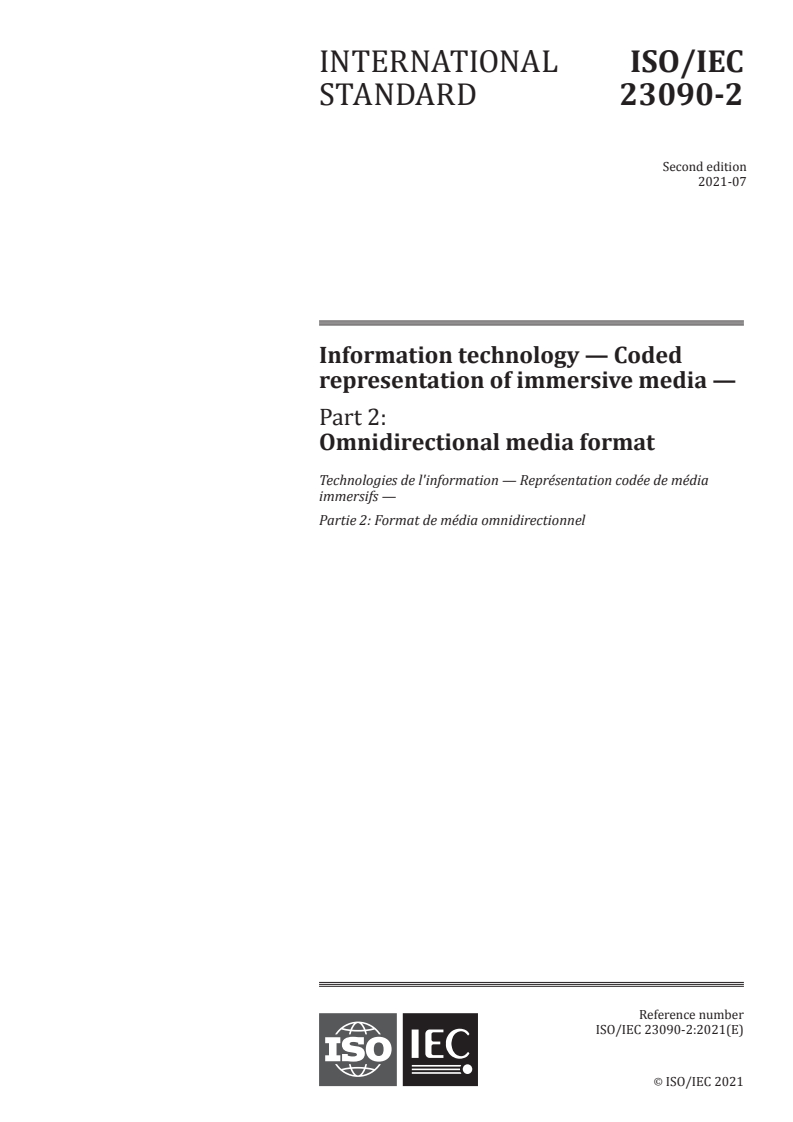
INTERNATIONAL ISO/IEC
STANDARD 23090-2
Second edition
2021-07
Information technology — Coded
representation of immersive media —
Part 2:
Omnidirectional media format
Technologies de l'information — Représentation codée de média
immersifs —
Partie 2: Format de média omnidirectionnel
Reference number
©
ISO/IEC 2021
© ISO/IEC 2021
All rights reserved. Unless otherwise specified, or required in the context of its implementation, no part of this publication may
be reproduced or utilized otherwise in any form or by any means, electronic or mechanical, including photocopying, or posting
on the internet or an intranet, without prior written permission. Permission can be requested from either ISO at the address
below or ISO’s member body in the country of the requester.
ISO copyright office
CP 401 • Ch. de Blandonnet 8
CH-1214 Vernier, Geneva
Phone: +41 22 749 01 11
Email: copyright@iso.org
Website: www.iso.org
Published in Switzerland
ii © ISO/IEC 2021 – All rights reserved
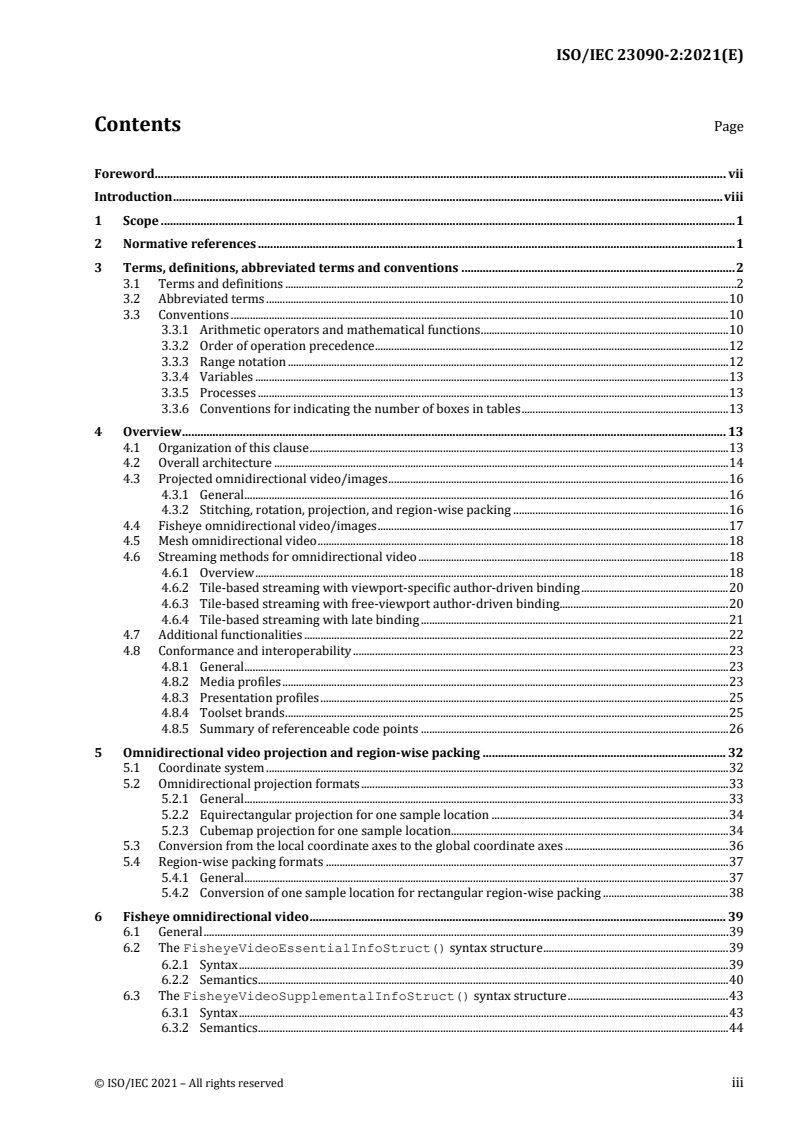
Contents Page
Foreword. vii
Introduction . viii
1 Scope . 1
2 Normative references . 1
3 Terms, definitions, abbreviated terms and conventions . 2
3.1 Terms and definitions .2
3.2 Abbreviated terms . 10
3.3 Conventions . 10
3.3.1 Arithmetic operators and mathematical functions . 10
3.3.2 Order of operation precedence . 12
3.3.3 Range notation . 12
3.3.4 Variables . 13
3.3.5 Processes . 13
3.3.6 Conventions for indicating the number of boxes in tables . 13
4 Overview . 13
4.1 Organization of this clause . 13
4.2 Overall architecture . 14
4.3 Projected omnidirectional video/images . 16
4.3.1 General . 16
4.3.2 Stitching, rotation, projection, and region-wise packing . 16
4.4 Fisheye omnidirectional video/images . 17
4.5 Mesh omnidirectional video . 18
4.6 Streaming methods for omnidirectional video . 18
4.6.1 Overview . 18
4.6.2 Tile-based streaming with viewport-specific author-driven binding . 20
4.6.3 Tile-based streaming with free-viewport author-driven binding. 20
4.6.4 Tile-based streaming with late binding . 21
4.7 Additional functionalities . 22
4.8 Conformance and interoperability . 23
4.8.1 General . 23
4.8.2 Media profiles . 23
4.8.3 Presentation profiles . 25
4.8.4 Toolset brands . 25
4.8.5 Summary of referenceable code points . 26
5 Omnidirectional video projection and region-wise packing . 32
5.1 Coordinate system . 32
5.2 Omnidirectional projection formats . 33
5.2.1 General . 33
5.2.2 Equirectangular projection for one sample location . 34
5.2.3 Cubemap projection for one sample location. 34
5.3 Conversion from the local coordinate axes to the global coordinate axes . 36
5.4 Region-wise packing formats . 37
5.4.1 General . 37
5.4.2 Conversion of one sample location for rectangular region-wise packing . 38
6 Fisheye omnidirectional video . 39
6.1 General . 39
6.2 The FisheyeVideoEssentialInfoStruct() syntax structure . 39
6.2.1 Syntax . 39
6.2.2 Semantics . 40
6.3 The FisheyeVideoSupplementalInfoStruct() syntax structure . 43
6.3.1 Syntax . 43
6.3.2 Semantics . 44
© ISO/IEC 2021 – All rights reserved iii
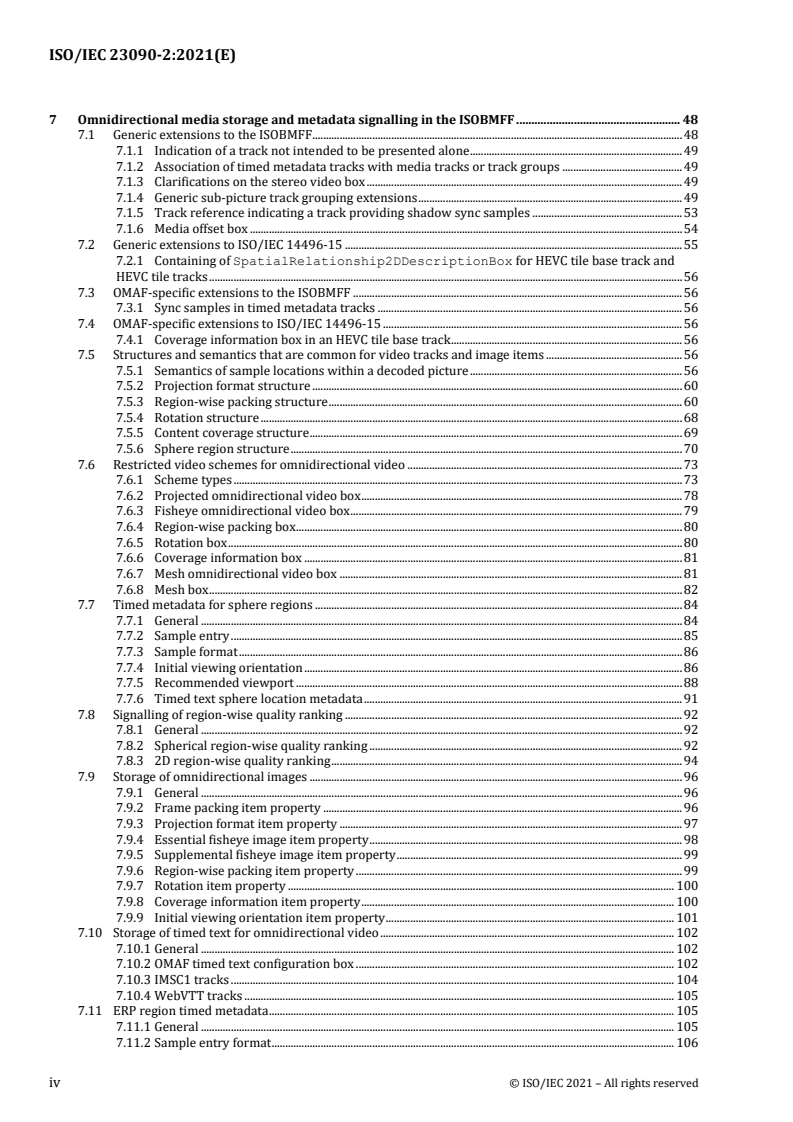
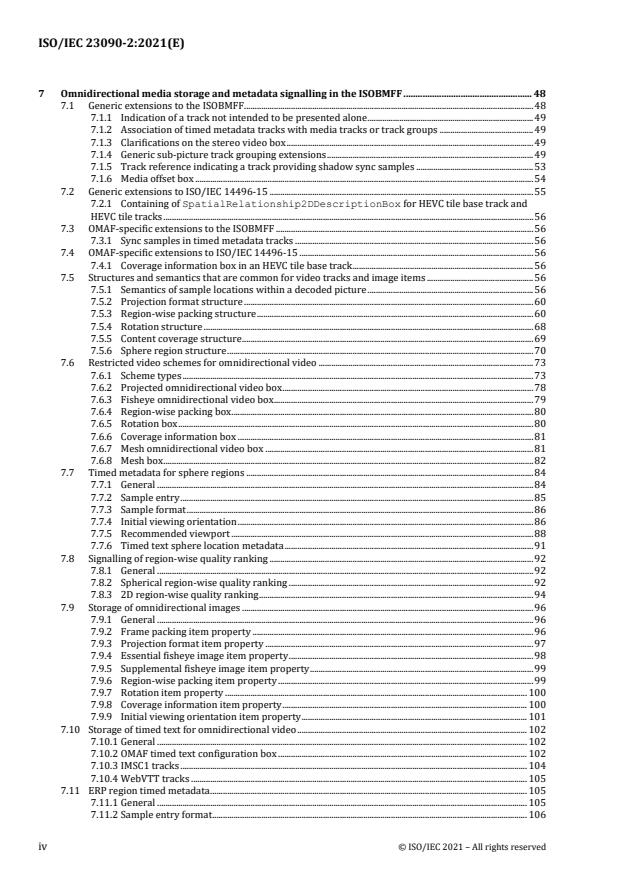
7 Omnidirectional media storage and metadata signalling in the ISOBMFF . 48
7.1 Generic extensions to the ISOBMFF . 48
7.1.1 Indication of a track not intended to be presented alone . 49
7.1.2 Association of timed metadata tracks with media tracks or track groups . 49
7.1.3 Clarifications on the stereo video box . 49
7.1.4 Generic sub-picture track grouping extensions . 49
7.1.5 Track reference indicating a track providing shadow sync samples . 53
7.1.6 Media offset box . 54
7.2 Generic extensions to ISO/IEC 14496-15 . 55
7.2.1 Containing of SpatialRelationship2DDescriptionBox for HEVC tile base track and
HEVC tile tracks . 56
7.3 OMAF-specific extensions to the ISOBMFF . 56
7.3.1 Sync samples in timed metadata tracks . 56
7.4 OMAF-specific extensions to ISO/IEC 14496-15 . 56
7.4.1 Coverage information box in an HEVC tile base track . 56
7.5 Structures and semantics that are common for video tracks and image items . 56
7.5.1 Semantics of sample locations within a decoded picture . 56
7.5.2 Projection format structure . 60
7.5.3 Region-wise packing structure . 60
7.5.4 Rotation structure . 68
7.5.5 Content coverage structure . 69
7.5.6 Sphere region structure . 70
7.6 Restricted video schemes for omnidirectional video . 73
7.6.1 Scheme types . 73
7.6.2 Projected omnidirectional video box . 78
7.6.3 Fisheye omnidirectional video box . 79
7.6.4 Region-wise packing box . 80
7.6.5 Rotation box . 80
7.6.6 Coverage information box . 81
7.6.7 Mesh omnidirectional video box . 81
7.6.8 Mesh box . 82
7.7 Timed metadata for sphere regions . 84
7.7.1 General . 84
7.7.2 Sample entry . 85
7.7.3 Sample format . 86
7.7.4 Initial viewing orientation . 86
7.7.5 Recommended viewport . 88
7.7.6 Timed text sphere location metadata . 91
7.8 Signalling of region-wise quality ranking . 92
7.8.1 General . 92
7.8.2 Spherical region-wise quality ranking . 92
7.8.3 2D region-wise quality ranking . 94
7.9 Storage of omnidirectional images . 96
7.9.1 General . 96
7.9.2 Frame packing item property . 96
7.9.3 Projection format item property . 97
7.9.4 Essential fisheye image item property . 98
7.9.5 Supplemental fisheye image item property . 99
7.9.6 Region-wise packing item property . 99
7.9.7 Rotation item property . 100
7.9.8 Coverage information item property . 100
7.9.9 Initial viewing orientation item property . 101
7.10 Storage of timed text for omnidirectional video . 102
7.10.1 General . 102
7.10.2 OMAF timed text configuration box . 102
7.10.3 IMSC1 tracks . 104
7.10.4 WebVTT tracks . 105
7.11 ERP region timed metadata . 105
7.11.1 General . 105
7.11.2 Sample entry format . 106
iv © ISO/IEC 2021 – All rights reserved
7.11.3 Semantics . 106
7.11.4 Sample format . 107
7.11.5 Generating ERP region metadata . 108
7.12 Storage and signalling of viewpoints for omnidirectional video and images . 108
7.12.1 Viewpoint information structures . 108
7.12.2 Viewpoint entity grouping . 117
7.12.3 Timed metadata for viewpoints . 119
7.13 Storage of omnidirectional video in sub-picture tracks. 123
7.13.1 General . 123
7.13.2 Projected omnidirectional video . 124
7.13.3 Indication of composition pictures being packed pictures or projected pictures . 125
7.13.4 Fisheye omnidirectional video . 125
7.14 Storage and signalling of overlays for omnidirectional video and images . 125
7.14.1 General . 125
7.14.2 Overlay structure . 128
7.14.3 Overlay control structures . 129
7.14.4 Overlay configuration box . 139
7.14.5 Overlay item property . 140
7.14.6 Overlay timed metadata track . 140
7.14.7 Entity groups . 142
7.14.8 Overlay alpha auxiliary image . 144
7.15 Signalling of viewing space information . 145
7.15.1 General . 145
7.15.2 Viewing space structure. 145
7.15.3 Viewing space box . 148
7.15.4 Viewing space item property . 148
7.15.5 Time varying immersive viewing space signalling . 148
7.16 Mapping of rectangular regions to the 3D mesh . 149
7.16.1 General . 149
7.16.2 Tile mesh sample grouping . 149
7.16.3 Rectangular region structure. 151
7.16.4 Projection of a sample location onto the 3D mesh . 152
8 Omnidirectional media encapsulation and signalling in DASH . 153
8.1 Architecture of DASH delivery in OMAF . 153
8.2 Usage of DASH in OMAF . 155
8.2.1 General . 155
8.2.2 Signalling of stereoscopic frame packing . 155
8.2.3 Carriage of timed metadata . 155
8.2.4 Associating Adaptation Sets or Representations with each other . 156
8.3 DASH MPD descriptors for omnidirectional media in the namespace
"urn:mpeg:mpegI:omaf:2017" . 157
8.3.1 XML namespace and schema . 157
8.3.2 Signalling of projection type information . 157
8.3.3 Signalling of region-wise packing type . 158
8.3.4 Signalling of content coverage . 159
8.3.5 Signalling of spherical region-wise quality ranking . 162
8.3.6 Signalling of 2D region-wise quality ranking . 168
8.3.7 Signalling of fisheye omnidirectional video . 173
8.4 Carriage of images . 173
8.4.1 General . 173
8.4.2 Format and constraints for Segments. 174
8.5 DASH MPD descriptors for omnidirectional media in the namespace
"urn:mpeg:mpegI:omaf:2020" . 174
8.5.1 XML namespace and schema . 174
8.5.2 Signalling of association . 174
8.5.3 Signalling of viewpoints . 176
8.5.4 Signalling of sub-picture composition identifier and its attributes. 183
8.5.5 Signalling of overlays . 184
8.5.6 Entity to group descriptor . 186
© ISO/IEC 2021 – All rights reserved v
8.6 Segment formats . 188
8.6.1 Initialization Segment for OMAF base track . 188
8.6.2 Tile Index Segment . 192
8.6.3 Tile Data Segment . 193
9 Omnidirectional media encapsulation and signalling in MMT . 194
9.1 Architecture of MMT delivery in OMAF . 194
9.2 OMAF signalling in MPEG composition information . 195
9.3 VR application-specific MMT signalling . 195
9.3.1 General . 195
9.3.2 MMT signalling . 196
10 Media profiles . 212
10.1 Video profiles . 212
10.2 Audio profiles . 243
10.3 Image profiles . 252
10.4 Timed text profiles . 257
11 Presentation profiles . 258
11.1 OMAF viewport-independent baseline presentation profile . 258
11.1.1 General . 258
11.1.2 ISO Base Media File Format constraints . 259
11.2 OMAF viewport-dependent baseline presentation profile . 259
11.2.1 General . 259
11.2.2 ISO Base Media File Format constraints . 259
12 OMAF toolset brands . 260
12.1 Overlay toolset brand . 260
12.1.1 Overview. 260
12.1.2 ISO Base Media File Format constraints . 260
12.1.3 OMAF player operation . 260
12.2 Viewpoint toolset brand . 260
12.2.1 Overview. 260
12.2.2 ISO Base Media File Format constraints . 260
12.2.3 OMAF player operation . 260
12.3 Non-linear storyline toolset brand. 260
12.3.1 Overview. 260
12.3.2 ISO Base Media File Format constraints . 261
12.3.3 OMAF player operation . 261
Annex A (normative) OMAF DASH schema . 262
Annex B (normative) DASH integration of media profiles . 266
Annex C (normative) CMAF integration of media profiles . 279
Annex D (informative) Viewport-dependent omnidirectional video processing . 282
Annex E (informative) DASH MPD examples . 316
Annex F (informative) MMT signalling examples . 320
Annex G (normative) Expected behaviour of OMAF player . 322
Bibliography . 332
vi © ISO/IEC 2021 – All rights reserved
Foreword
ISO (the International Organization for Standardization) and IEC (the International Electrotechnical Commission)
form the specialized system for worldwide standardization. National bodies that are members of ISO or IEC
participate in the development of International Standards through technical committees established by the
respective organization to deal with particular fields of technical activity. ISO and IEC technical committees
collaborate in fields of mutual interest. Other international organizations, governmental and non-governmental, in
liaison with ISO and IEC, also take part in the work.
The procedures used to develop this document and those intended for its further maintenance are described in the
ISO/IEC Directives, Part 1. In particular, the different approval criteria needed for the different types of document
should be noted. This document was drafted in accordance with the editorial rules of the ISO/IEC Directives, Part 2
(see www.iso.org/directives or www.iec.ch/members_experts/refdocs).
Attention is drawn to the possibility that some of the elements of this document may be the subject of patent rights.
ISO and IEC shall not be held responsible for identifying any or all such patent rights. Details of any patent rights
identified during the development of the document will be in the Introduction and/or on the ISO list of patent
declarations received (see www.iso.org/patents ) or the IEC list of patent declarations received (see patents.iec.ch).
Any trade name used in this document is information given for the convenience of users and does not constitute an
endorsement.
For an explanation of the voluntary nature of standards, the meaning of ISO specific terms and expressions related
to conformity assessment, as well as information about ISO's adherence to the World Trade Organization (WTO)
principles in the Technical Barriers to Trade (TBT) see www.iso.org/iso/foreword.html. In the IEC, see
www.iec.ch/understanding-standards.
This document was prepared by Joint Technical Committee ISO/IEC JTC 1, Information technology, Subcommittee
SC 29, Coding of audio, picture, multimedia and hypermedia information.
This second edition cancels and replaces the first edition (ISO/IEC 23090-2:2019), which has been technically
revised.
The main changes compared to the previous edition are as follows:
— Multiple viewpoints have been added. Viewpoints can be used for example to provide several user-switchable
camera positions to view the content or to express a storyline where the user is given the choice to select which
storyline path is followed.
— Sphere-relative and viewport-relative video and image overlays have been added.
— Mesh omnidirectional video where the video is projected on an indicated set of mesh elements has been added.
— Two tiling OMAF video profiles for viewport-dependent streaming have been added.
A list of all parts in the ISO/IEC 23090 series can be found on the ISO and IEC websites.
Any feedback or questions on this document should be directed to the user’s national standards body. A complete
listing of these bodies can be found at www.iso.org/members.html and www.iec.ch/national-committees.
© ISO/IEC 2021 – All rights reserved vii
Introduction
When omnidirectional media content is consumed with a head-mounted display and headphones, only the parts of
the media that correspond to the user's viewing orientation are rendered, as if the user were in the spot where and
when the media was captured. One of the forms of omnidirectional media applications is omnidirectional video, also
known as 360° video. Omnidirectional video is typically captured by multiple cameras that cover the entire sphere
or at least a large part of the sphere. Compared to traditional media application formats, the end-to-end technology
for omnidirectional video (from capture to playback) is more easily fragmented due to various capturing and video
projection technologies. From the capture side, there exist many different types of cameras capable of capturing
360° video, and on the playback side there are many different devices that are able to playback 360° video with
different processing capabilities. To avoid fragmentation of omnidirectional media content and devices, a
standardized format for omnidirectional media applications is specified in this document.
This document defines a media format that enables omnidirectional media applications, focusing on 360° video,
images, and audio, as well as associated timed text. What is specified in this document includes (but is not limited
to):
a coordinate system that consists of a unit sphere and three coordinate axes, namely the X (back-to-front) axis,
the Y (lateral, side-to-side) axis, and the Z (vertical, up) axis;
projection and rectangular region-wise packing methods that may be used for conversion of a spherical video
sequence or image into a two-dimensional rectangular video sequence or image, respectively;
storage of omnidirectional media and the associated metadata using the ISO Base Media File Format (ISOBMFF)
as specified in ISO/IEC 14496-12;
storage of video or image overlays and the associated metadata using ISOBMFF;
encapsulation, signalling, and streaming of omnidirectional media and overlays in a media streaming system,
e.g. dynamic adaptive streaming over HTTP (DASH) as specified in ISO/IEC 23009-1 or MPEG media transport
(MMT) as specified in ISO/IEC 23008-1;
media profiles and presentation profiles that provide conformance points for media codecs as well as media
coding and encapsulation configurations that may be used for compression, streaming, and playback of the
omnidirectional media content;
toolset brands that provide conformance points for functionalities beyond plain 360° video, images and audio.
This document is organized as follows:
a) Clause 1 specifies the scope of this document.
b) Clause 2 contains the normative references.
c) Clause 3 specifies the terms, definitions, abbreviated terms, arithmetic operations, mathematical functions and
other conventions used in this document.
d) Clause 4 contains an overview of this document.
e) Clause 5 specifies a coordinate system used in this document and the equations for the equirectangular and
cubemap omnidirectional projection formats, the conversion from the
...
INTERNATIONAL ISO/IEC
STANDARD 23090-2
Second edition
2021-07
Information technology — Coded
representation of immersive media —
Part 2:
Omnidirectional media format
Technologies de l'information — Représentation codée de média
immersifs —
Partie 2: Format de média omnidirectionnel
Reference number
©
ISO/IEC 2021
© ISO/IEC 2021
All rights reserved. Unless otherwise specified, or required in the context of its implementation, no part of this publication may
be reproduced or utilized otherwise in any form or by any means, electronic or mechanical, including photocopying, or posting
on the internet or an intranet, without prior written permission. Permission can be requested from either ISO at the address
below or ISO’s member body in the country of the requester.
ISO copyright office
CP 401 • Ch. de Blandonnet 8
CH-1214 Vernier, Geneva
Phone: +41 22 749 01 11
Email: copyright@iso.org
Website: www.iso.org
Published in Switzerland
ii © ISO/IEC 2021 – All rights reserved
Contents Page
Foreword. vii
Introduction . viii
1 Scope . 1
2 Normative references . 1
3 Terms, definitions, abbreviated terms and conventions . 2
3.1 Terms and definitions .2
3.2 Abbreviated terms . 10
3.3 Conventions . 10
3.3.1 Arithmetic operators and mathematical functions . 10
3.3.2 Order of operation precedence . 12
3.3.3 Range notation . 12
3.3.4 Variables . 13
3.3.5 Processes . 13
3.3.6 Conventions for indicating the number of boxes in tables . 13
4 Overview . 13
4.1 Organization of this clause . 13
4.2 Overall architecture . 14
4.3 Projected omnidirectional video/images . 16
4.3.1 General . 16
4.3.2 Stitching, rotation, projection, and region-wise packing . 16
4.4 Fisheye omnidirectional video/images . 17
4.5 Mesh omnidirectional video . 18
4.6 Streaming methods for omnidirectional video . 18
4.6.1 Overview . 18
4.6.2 Tile-based streaming with viewport-specific author-driven binding . 20
4.6.3 Tile-based streaming with free-viewport author-driven binding. 20
4.6.4 Tile-based streaming with late binding . 21
4.7 Additional functionalities . 22
4.8 Conformance and interoperability . 23
4.8.1 General . 23
4.8.2 Media profiles . 23
4.8.3 Presentation profiles . 25
4.8.4 Toolset brands . 25
4.8.5 Summary of referenceable code points . 26
5 Omnidirectional video projection and region-wise packing . 32
5.1 Coordinate system . 32
5.2 Omnidirectional projection formats . 33
5.2.1 General . 33
5.2.2 Equirectangular projection for one sample location . 34
5.2.3 Cubemap projection for one sample location. 34
5.3 Conversion from the local coordinate axes to the global coordinate axes . 36
5.4 Region-wise packing formats . 37
5.4.1 General . 37
5.4.2 Conversion of one sample location for rectangular region-wise packing . 38
6 Fisheye omnidirectional video . 39
6.1 General . 39
6.2 The FisheyeVideoEssentialInfoStruct() syntax structure . 39
6.2.1 Syntax . 39
6.2.2 Semantics . 40
6.3 The FisheyeVideoSupplementalInfoStruct() syntax structure . 43
6.3.1 Syntax . 43
6.3.2 Semantics . 44
© ISO/IEC 2021 – All rights reserved iii
7 Omnidirectional media storage and metadata signalling in the ISOBMFF . 48
7.1 Generic extensions to the ISOBMFF . 48
7.1.1 Indication of a track not intended to be presented alone . 49
7.1.2 Association of timed metadata tracks with media tracks or track groups . 49
7.1.3 Clarifications on the stereo video box . 49
7.1.4 Generic sub-picture track grouping extensions . 49
7.1.5 Track reference indicating a track providing shadow sync samples . 53
7.1.6 Media offset box . 54
7.2 Generic extensions to ISO/IEC 14496-15 . 55
7.2.1 Containing of SpatialRelationship2DDescriptionBox for HEVC tile base track and
HEVC tile tracks . 56
7.3 OMAF-specific extensions to the ISOBMFF . 56
7.3.1 Sync samples in timed metadata tracks . 56
7.4 OMAF-specific extensions to ISO/IEC 14496-15 . 56
7.4.1 Coverage information box in an HEVC tile base track . 56
7.5 Structures and semantics that are common for video tracks and image items . 56
7.5.1 Semantics of sample locations within a decoded picture . 56
7.5.2 Projection format structure . 60
7.5.3 Region-wise packing structure . 60
7.5.4 Rotation structure . 68
7.5.5 Content coverage structure . 69
7.5.6 Sphere region structure . 70
7.6 Restricted video schemes for omnidirectional video . 73
7.6.1 Scheme types . 73
7.6.2 Projected omnidirectional video box . 78
7.6.3 Fisheye omnidirectional video box . 79
7.6.4 Region-wise packing box . 80
7.6.5 Rotation box . 80
7.6.6 Coverage information box . 81
7.6.7 Mesh omnidirectional video box . 81
7.6.8 Mesh box . 82
7.7 Timed metadata for sphere regions . 84
7.7.1 General . 84
7.7.2 Sample entry . 85
7.7.3 Sample format . 86
7.7.4 Initial viewing orientation . 86
7.7.5 Recommended viewport . 88
7.7.6 Timed text sphere location metadata . 91
7.8 Signalling of region-wise quality ranking . 92
7.8.1 General . 92
7.8.2 Spherical region-wise quality ranking . 92
7.8.3 2D region-wise quality ranking . 94
7.9 Storage of omnidirectional images . 96
7.9.1 General . 96
7.9.2 Frame packing item property . 96
7.9.3 Projection format item property . 97
7.9.4 Essential fisheye image item property . 98
7.9.5 Supplemental fisheye image item property . 99
7.9.6 Region-wise packing item property . 99
7.9.7 Rotation item property . 100
7.9.8 Coverage information item property . 100
7.9.9 Initial viewing orientation item property . 101
7.10 Storage of timed text for omnidirectional video . 102
7.10.1 General . 102
7.10.2 OMAF timed text configuration box . 102
7.10.3 IMSC1 tracks . 104
7.10.4 WebVTT tracks . 105
7.11 ERP region timed metadata . 105
7.11.1 General . 105
7.11.2 Sample entry format . 106
iv © ISO/IEC 2021 – All rights reserved
7.11.3 Semantics . 106
7.11.4 Sample format . 107
7.11.5 Generating ERP region metadata . 108
7.12 Storage and signalling of viewpoints for omnidirectional video and images . 108
7.12.1 Viewpoint information structures . 108
7.12.2 Viewpoint entity grouping . 117
7.12.3 Timed metadata for viewpoints . 119
7.13 Storage of omnidirectional video in sub-picture tracks. 123
7.13.1 General . 123
7.13.2 Projected omnidirectional video . 124
7.13.3 Indication of composition pictures being packed pictures or projected pictures . 125
7.13.4 Fisheye omnidirectional video . 125
7.14 Storage and signalling of overlays for omnidirectional video and images . 125
7.14.1 General . 125
7.14.2 Overlay structure . 128
7.14.3 Overlay control structures . 129
7.14.4 Overlay configuration box . 139
7.14.5 Overlay item property . 140
7.14.6 Overlay timed metadata track . 140
7.14.7 Entity groups . 142
7.14.8 Overlay alpha auxiliary image . 144
7.15 Signalling of viewing space information . 145
7.15.1 General . 145
7.15.2 Viewing space structure. 145
7.15.3 Viewing space box . 148
7.15.4 Viewing space item property . 148
7.15.5 Time varying immersive viewing space signalling . 148
7.16 Mapping of rectangular regions to the 3D mesh . 149
7.16.1 General . 149
7.16.2 Tile mesh sample grouping . 149
7.16.3 Rectangular region structure. 151
7.16.4 Projection of a sample location onto the 3D mesh . 152
8 Omnidirectional media encapsulation and signalling in DASH . 153
8.1 Architecture of DASH delivery in OMAF . 153
8.2 Usage of DASH in OMAF . 155
8.2.1 General . 155
8.2.2 Signalling of stereoscopic frame packing . 155
8.2.3 Carriage of timed metadata . 155
8.2.4 Associating Adaptation Sets or Representations with each other . 156
8.3 DASH MPD descriptors for omnidirectional media in the namespace
"urn:mpeg:mpegI:omaf:2017" . 157
8.3.1 XML namespace and schema . 157
8.3.2 Signalling of projection type information . 157
8.3.3 Signalling of region-wise packing type . 158
8.3.4 Signalling of content coverage . 159
8.3.5 Signalling of spherical region-wise quality ranking . 162
8.3.6 Signalling of 2D region-wise quality ranking . 168
8.3.7 Signalling of fisheye omnidirectional video . 173
8.4 Carriage of images . 173
8.4.1 General . 173
8.4.2 Format and constraints for Segments. 174
8.5 DASH MPD descriptors for omnidirectional media in the namespace
"urn:mpeg:mpegI:omaf:2020" . 174
8.5.1 XML namespace and schema . 174
8.5.2 Signalling of association . 174
8.5.3 Signalling of viewpoints . 176
8.5.4 Signalling of sub-picture composition identifier and its attributes. 183
8.5.5 Signalling of overlays . 184
8.5.6 Entity to group descriptor . 186
© ISO/IEC 2021 – All rights reserved v
8.6 Segment formats . 188
8.6.1 Initialization Segment for OMAF base track . 188
8.6.2 Tile Index Segment . 192
8.6.3 Tile Data Segment . 193
9 Omnidirectional media encapsulation and signalling in MMT . 194
9.1 Architecture of MMT delivery in OMAF . 194
9.2 OMAF signalling in MPEG composition information . 195
9.3 VR application-specific MMT signalling . 195
9.3.1 General . 195
9.3.2 MMT signalling . 196
10 Media profiles . 212
10.1 Video profiles . 212
10.2 Audio profiles . 243
10.3 Image profiles . 252
10.4 Timed text profiles . 257
11 Presentation profiles . 258
11.1 OMAF viewport-independent baseline presentation profile . 258
11.1.1 General . 258
11.1.2 ISO Base Media File Format constraints . 259
11.2 OMAF viewport-dependent baseline presentation profile . 259
11.2.1 General . 259
11.2.2 ISO Base Media File Format constraints . 259
12 OMAF toolset brands . 260
12.1 Overlay toolset brand . 260
12.1.1 Overview. 260
12.1.2 ISO Base Media File Format constraints . 260
12.1.3 OMAF player operation . 260
12.2 Viewpoint toolset brand . 260
12.2.1 Overview. 260
12.2.2 ISO Base Media File Format constraints . 260
12.2.3 OMAF player operation . 260
12.3 Non-linear storyline toolset brand. 260
12.3.1 Overview. 260
12.3.2 ISO Base Media File Format constraints . 261
12.3.3 OMAF player operation . 261
Annex A (normative) OMAF DASH schema . 262
Annex B (normative) DASH integration of media profiles . 266
Annex C (normative) CMAF integration of media profiles . 279
Annex D (informative) Viewport-dependent omnidirectional video processing . 282
Annex E (informative) DASH MPD examples . 316
Annex F (informative) MMT signalling examples . 320
Annex G (normative) Expected behaviour of OMAF player . 322
Bibliography . 332
vi © ISO/IEC 2021 – All rights reserved
Foreword
ISO (the International Organization for Standardization) and IEC (the International Electrotechnical Commission)
form the specialized system for worldwide standardization. National bodies that are members of ISO or IEC
participate in the development of International Standards through technical committees established by the
respective organization to deal with particular fields of technical activity. ISO and IEC technical committees
collaborate in fields of mutual interest. Other international organizations, governmental and non-governmental, in
liaison with ISO and IEC, also take part in the work.
The procedures used to develop this document and those intended for its further maintenance are described in the
ISO/IEC Directives, Part 1. In particular, the different approval criteria needed for the different types of document
should be noted. This document was drafted in accordance with the editorial rules of the ISO/IEC Directives, Part 2
(see www.iso.org/directives or www.iec.ch/members_experts/refdocs).
Attention is drawn to the possibility that some of the elements of this document may be the subject of patent rights.
ISO and IEC shall not be held responsible for identifying any or all such patent rights. Details of any patent rights
identified during the development of the document will be in the Introduction and/or on the ISO list of patent
declarations received (see www.iso.org/patents ) or the IEC list of patent declarations received (see patents.iec.ch).
Any trade name used in this document is information given for the convenience of users and does not constitute an
endorsement.
For an explanation of the voluntary nature of standards, the meaning of ISO specific terms and expressions related
to conformity assessment, as well as information about ISO's adherence to the World Trade Organization (WTO)
principles in the Technical Barriers to Trade (TBT) see www.iso.org/iso/foreword.html. In the IEC, see
www.iec.ch/understanding-standards.
This document was prepared by Joint Technical Committee ISO/IEC JTC 1, Information technology, Subcommittee
SC 29, Coding of audio, picture, multimedia and hypermedia information.
This second edition cancels and replaces the first edition (ISO/IEC 23090-2:2019), which has been technically
revised.
The main changes compared to the previous edition are as follows:
— Multiple viewpoints have been added. Viewpoints can be used for example to provide several user-switchable
camera positions to view the content or to express a storyline where the user is given the choice to select which
storyline path is followed.
— Sphere-relative and viewport-relative video and image overlays have been added.
— Mesh omnidirectional video where the video is projected on an indicated set of mesh elements has been added.
— Two tiling OMAF video profiles for viewport-dependent streaming have been added.
A list of all parts in the ISO/IEC 23090 series can be found on the ISO and IEC websites.
Any feedback or questions on this document should be directed to the user’s national standards body. A complete
listing of these bodies can be found at www.iso.org/members.html and www.iec.ch/national-committees.
© ISO/IEC 2021 – All rights reserved vii
Introduction
When omnidirectional media content is consumed with a head-mounted display and headphones, only the parts of
the media that correspond to the user's viewing orientation are rendered, as if the user were in the spot where and
when the media was captured. One of the forms of omnidirectional media applications is omnidirectional video, also
known as 360° video. Omnidirectional video is typically captured by multiple cameras that cover the entire sphere
or at least a large part of the sphere. Compared to traditional media application formats, the end-to-end technology
for omnidirectional video (from capture to playback) is more easily fragmented due to various capturing and video
projection technologies. From the capture side, there exist many different types of cameras capable of capturing
360° video, and on the playback side there are many different devices that are able to playback 360° video with
different processing capabilities. To avoid fragmentation of omnidirectional media content and devices, a
standardized format for omnidirectional media applications is specified in this document.
This document defines a media format that enables omnidirectional media applications, focusing on 360° video,
images, and audio, as well as associated timed text. What is specified in this document includes (but is not limited
to):
a coordinate system that consists of a unit sphere and three coordinate axes, namely the X (back-to-front) axis,
the Y (lateral, side-to-side) axis, and the Z (vertical, up) axis;
projection and rectangular region-wise packing methods that may be used for conversion of a spherical video
sequence or image into a two-dimensional rectangular video sequence or image, respectively;
storage of omnidirectional media and the associated metadata using the ISO Base Media File Format (ISOBMFF)
as specified in ISO/IEC 14496-12;
storage of video or image overlays and the associated metadata using ISOBMFF;
encapsulation, signalling, and streaming of omnidirectional media and overlays in a media streaming system,
e.g. dynamic adaptive streaming over HTTP (DASH) as specified in ISO/IEC 23009-1 or MPEG media transport
(MMT) as specified in ISO/IEC 23008-1;
media profiles and presentation profiles that provide conformance points for media codecs as well as media
coding and encapsulation configurations that may be used for compression, streaming, and playback of the
omnidirectional media content;
toolset brands that provide conformance points for functionalities beyond plain 360° video, images and audio.
This document is organized as follows:
a) Clause 1 specifies the scope of this document.
b) Clause 2 contains the normative references.
c) Clause 3 specifies the terms, definitions, abbreviated terms, arithmetic operations, mathematical functions and
other conventions used in this document.
d) Clause 4 contains an overview of this document.
e) Clause 5 specifies a coordinate system used in this document and the equations for the equirectangular and
cubemap omnidirectional projection formats, the conversion from the
...
Questions, Comments and Discussion
Ask us and Technical Secretary will try to provide an answer. You can facilitate discussion about the standard in here.
Loading comments...