

ISO 10898:2016
(Main)Spot drills
General Information
- Abstract
ISO 10998:2016 specifies the dimensions and technical specifications of spot drills of high-speed steel and hardmetal with a point angle of 90° or 120°.
- Status
- Published
- Publication Date
- 13-Sep-2016
- Current Stage
- 9093 - International Standard confirmed
- Start Date
- 23-Mar-2023
- Completion Date
- 29-Aug-2026
Buy Documents
ISO 10898:2016 - Spot drills/14/2016
ISO 10898:2016 - Forets à pointer/14/2016
Overview
ISO 10898:2016 is an international standard published by the International Organization for Standardization (ISO) that specifies the dimensions and technical requirements for spot drills. This standard covers spot drills made from high-speed steel and hardmetal materials featuring point angles of 90° or 120°. Spot drills are precision tools used primarily for creating accurate starter holes in metalworking before further drilling operations, ensuring proper drill guidance and reducing deflection.
The 2016 edition of ISO 10898 updates the original 1992 version with minor revisions, including the addition of an informative annex relating the designations in this standard to ISO 13399 cutting tool data representation.
Key Topics
- Materials Covered: High-speed steel and hardmetal spot drills
- Point Angles: 90° and 120°, standardizing the cutting geometry for optimal drilling performance
- Dimensional Specifications: Detailed sizes for diameters from 4 mm to 20 mm, with precise length measurements as shown in the standard’s tables
- Conception Requirements: Spot drills must be manufactured without lands and back taper to maintain precision
- Tolerance and Runout:
- Permissible division deviation on flutes specified per diameter category
- Maximum allowable runout of the fluted part relative to the shank defined
- Designation Format: Clear naming convention that includes "Spot drill," the ISO number, the point angle, and diameter (e.g., Spot drill ISO 10898 - 90° - 10)
- Compatibility with ISO 13399: Annex A provides mapping of standard properties to ISO 13399 symbols, facilitating data exchange and tool management
Applications
ISO 10898:2016 spot drills are essential tools in various industrial machining processes, particularly in metal fabrication and manufacturing sectors where precision drilling is critical. Typical applications include:
- Pilot Hole Creation: Providing accurate starting points for twist drills to ensure proper hole placement and prevent drill wander
- CNC Machining: Enhancing hole accuracy in automated machining centers by using standardized drill geometry and dimensioning
- Tooling and Fixture Design: Enabling engineers and toolmakers to select and specify spot drills conforming to international dimensions and quality tolerances
- Quality Control: Allowing manufacturers and inspectors to verify spot drill conformity using defined tolerances and measurements from ISO 10898
Related Standards
- ISO 286-2: Defines tolerance classes and limit deviations for linear sizes, referenced in the dimensional specifications for spot drills within ISO 10898
- ISO 13399: Cutting tool data representation and exchange standard, closely linked with ISO 10898 for consistent designation and data management of cutting tools
- Other ISO Tooling Standards: ISO 10898 is part of a broader suite of ISO standards covering cutting tools with defined edges, reinforcing uniformity across tooling components
- ISO/IEC Directives: Governs the development and maintenance process of ISO standards, ensuring quality and procedural compliance
Keywords: ISO 10898, spot drills, drill standard, high-speed steel drills, hardmetal drills, point angle 90°, point angle 120°, drilling tools, machining standards, ISO drilling tools, drill dimensions, technical specifications, ISO 13399 compatibility, cutting tools, metalworking drills, drill tolerances.
Relations
- Revises
ISO 10898:1992 - Spot drills - Effective Date
- 12-Feb-2014
Buy Documents
ISO 10898:2016 - Spot drills/14/2016
ISO 10898:2016 - Forets à pointer/14/2016
Get Certified
Connect with accredited certification bodies for this standard

DVS-ZERT GmbH
German welding certification society.
CARES (UK Certification Authority for Reinforcing Steels)
UK certification for reinforcing steels and construction.
EWF/IIW (European/International Welding Federation)
International welding personnel certification.
Sponsored listings
Frequently Asked Questions
ISO 10898:2016 is a standard published by the International Organization for Standardization (ISO). Its full title is "Spot drills". This standard covers: ISO 10998:2016 specifies the dimensions and technical specifications of spot drills of high-speed steel and hardmetal with a point angle of 90° or 120°.
ISO 10998:2016 specifies the dimensions and technical specifications of spot drills of high-speed steel and hardmetal with a point angle of 90° or 120°.
ISO 10898:2016 is classified under the following ICS (International Classification for Standards) categories: 25.100.30 - Drills, countersinks, reamers. The ICS classification helps identify the subject area and facilitates finding related standards.
ISO 10898:2016 has the following relationships with other standards: It is inter standard links to ISO 10898:1992. Understanding these relationships helps ensure you are using the most current and applicable version of the standard.
ISO 10898:2016 is available in PDF format for immediate download after purchase. The document can be added to your cart and obtained through the secure checkout process. Digital delivery ensures instant access to the complete standard document.
Standards Content (Sample)
INTERNATIONAL ISO
STANDARD 10898
Second edition
2016-09-15
Spot drills
Forets à pointer
Reference number
©
ISO 2016
© ISO 2016, Published in Switzerland
All rights reserved. Unless otherwise specified, no part of this publication may be reproduced or utilized otherwise in any form
or by any means, electronic or mechanical, including photocopying, or posting on the internet or an intranet, without prior
written permission. Permission can be requested from either ISO at the address below or ISO’s member body in the country of
the requester.
ISO copyright office
Ch. de Blandonnet 8 • CP 401
CH-1214 Vernier, Geneva, Switzerland
Tel. +41 22 749 01 11
Fax +41 22 749 09 47
copyright@iso.org
www.iso.org
ii © ISO 2016 – All rights reserved
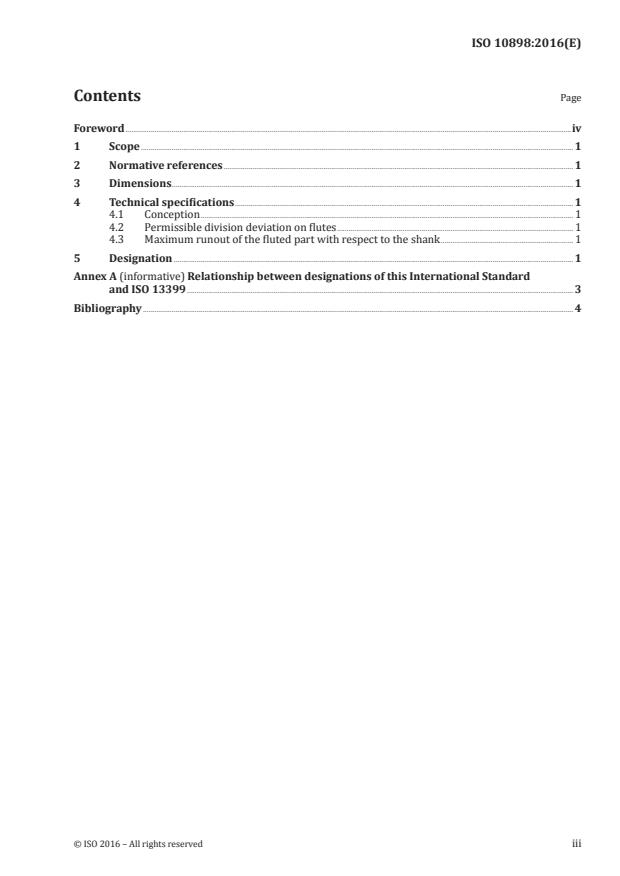
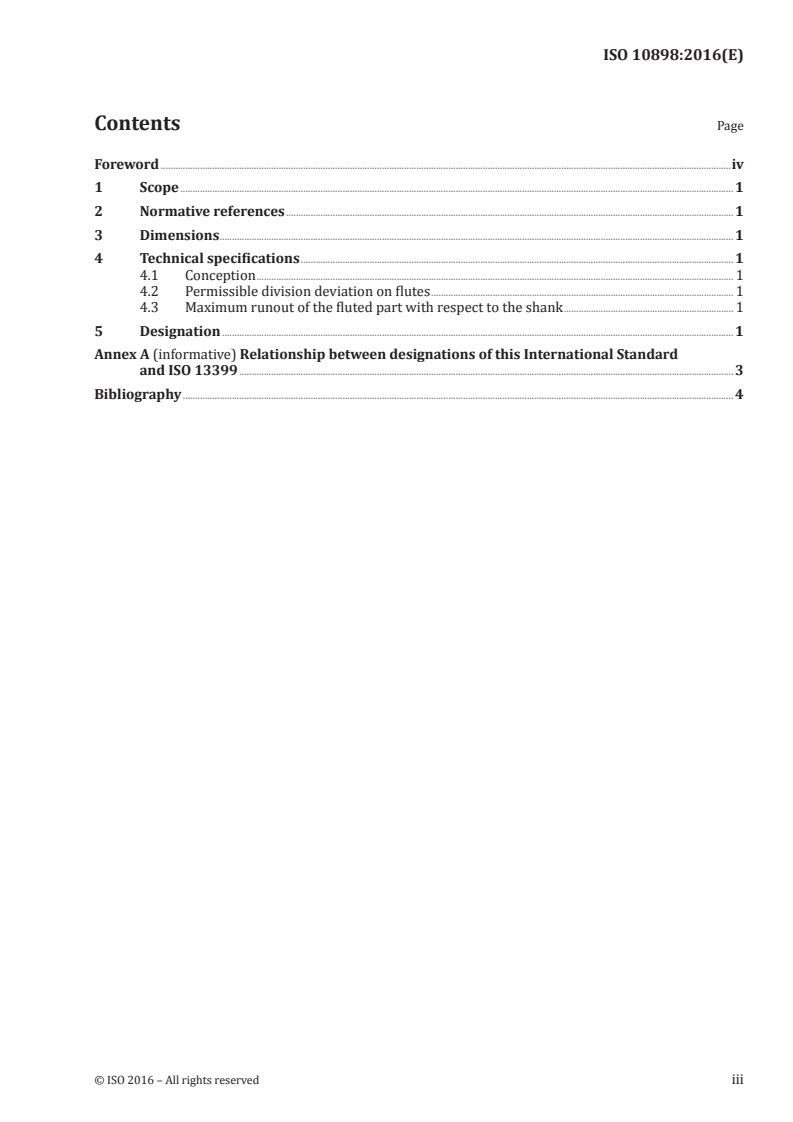
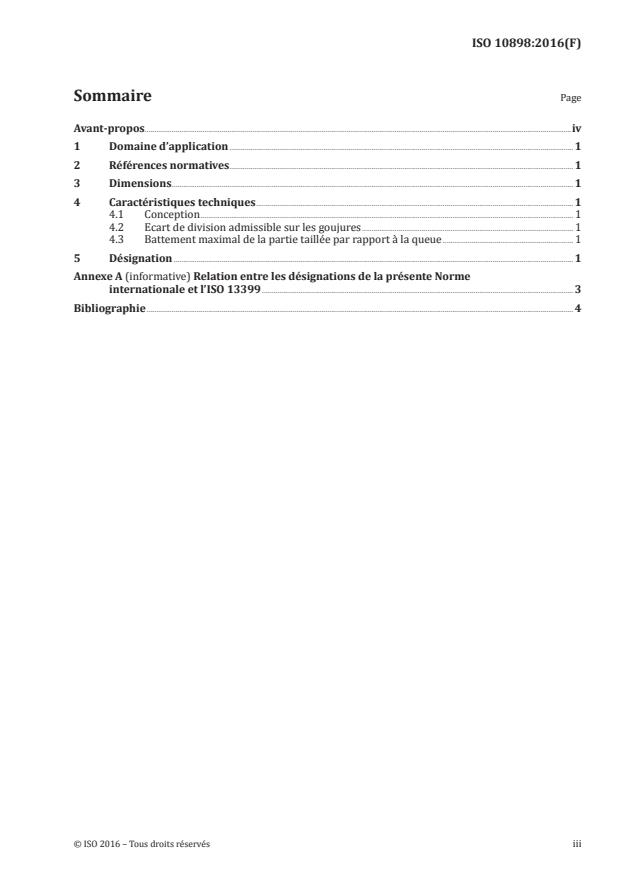
Contents Page
Foreword .iv
1 Scope . 1
2 Normative references . 1
3 Dimensions . 1
4 Technical specifications . 1
4.1 Conception . 1
4.2 Permissible division deviation on flutes . 1
4.3 Maximum runout of the fluted part with respect to the shank . 1
5 Designation . 1
Annex A (informative) Relationship between designations of this International Standard
and ISO 13399 . 3
Bibliography . 4
Foreword
ISO (the International Organization for Standardization) is a worldwide federation of national standards
bodies (ISO member bodies). The work of preparing International Standards is normally carried out
through ISO technical committees. Each member body interested in a subject for which a technical
committee has been established has the right to be represented on that committee. International
organizations, governmental and non-governmental, in liaison with ISO, also take part in the work.
ISO collaborates closely with the International Electrotechnical Commission (IEC) on all matters of
electrotechnical standardization.
The procedures used to develop this document and those intended for its further maintenance are
described in the ISO/IEC Directives, Part 1. In particular the different approval criteria needed for the
different types of ISO documents should be noted. This document was drafted in accordance with the
editorial rules of the ISO/IEC Directives, Part 2 (see www.iso.org/directives)
...
INTERNATIONAL ISO
STANDARD 10898
Second edition
2016-09-15
Spot drills
Forets à pointer
Reference number
©
ISO 2016
© ISO 2016, Published in Switzerland
All rights reserved. Unless otherwise specified, no part of this publication may be reproduced or utilized otherwise in any form
or by any means, electronic or mechanical, including photocopying, or posting on the internet or an intranet, without prior
written permission. Permission can be requested from either ISO at the address below or ISO’s member body in the country of
the requester.
ISO copyright office
Ch. de Blandonnet 8 • CP 401
CH-1214 Vernier, Geneva, Switzerland
Tel. +41 22 749 01 11
Fax +41 22 749 09 47
copyright@iso.org
www.iso.org
ii © ISO 2016 – All rights reserved
Contents Page
Foreword .iv
1 Scope . 1
2 Normative references . 1
3 Dimensions . 1
4 Technical specifications . 1
4.1 Conception . 1
4.2 Permissible division deviation on flutes . 1
4.3 Maximum runout of the fluted part with respect to the shank . 1
5 Designation . 1
Annex A (informative) Relationship between designations of this International Standard
and ISO 13399 . 3
Bibliography . 4
Foreword
ISO (the International Organization for Standardization) is a worldwide federation of national standards
bodies (ISO member bodies). The work of preparing International Standards is normally carried out
through ISO technical committees. Each member body interested in a subject for which a technical
committee has been established has the right to be represented on that committee. International
organizations, governmental and non-governmental, in liaison with ISO, also take part in the work.
ISO collaborates closely with the International Electrotechnical Commission (IEC) on all matters of
electrotechnical standardization.
The procedures used to develop this document and those intended for its further maintenance are
described in the ISO/IEC Directives, Part 1. In particular the different approval criteria needed for the
different types of ISO documents should be noted. This document was drafted in accordance with the
editorial rules of the ISO/IEC Directives, Part 2 (see www.iso.org/directives)
...
NORME ISO
INTERNATIONALE 10898
Deuxième édition
2016-09-15
Forets à pointer
Spot drills
Numéro de référence
©
ISO 2016
DOCUMENT PROTÉGÉ PAR COPYRIGHT
© ISO 2016, Publié en Suisse
Droits de reproduction réservés. Sauf indication contraire, aucune partie de cette publication ne peut être reproduite ni utilisée
sous quelque forme que ce soit et par aucun procédé, électronique ou mécanique, y compris la photocopie, l’affichage sur
l’internet ou sur un Intranet, sans autorisation écrite préalable. Les demandes d’autorisation peuvent être adressées à l’ISO à
l’adresse ci-après ou au comité membre de l’ISO dans le pays du demandeur.
ISO copyright office
Ch. de Blandonnet 8 • CP 401
CH-1214 Vernier, Geneva, Switzerland
Tel. +41 22 749 01 11
Fax +41 22 749 09 47
copyright@iso.org
www.iso.org
ii © ISO 2016 – Tous droits réservés
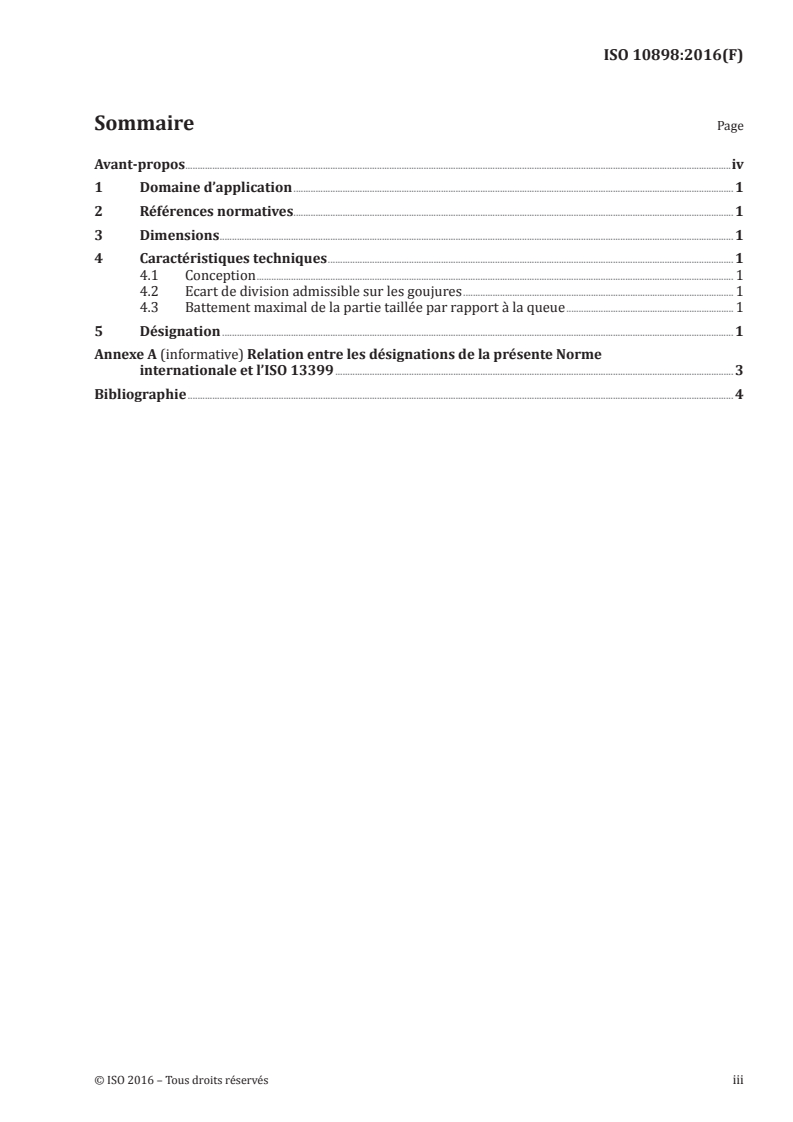
Sommaire Page
Avant-propos .iv
1 Domaine d’application . 1
2 Références normatives . 1
3 Dimensions . 1
4 Caractéristiques techniques . 1
4.1 Conception . 1
4.2 Ecart de division admissible sur les goujures . 1
4.3 Battement maximal de la partie taillée par rapport à la queue . 1
5 Désignation . 1
Annexe A (informative) Relation entre les désignations de la présente Norme
internationale et l’ISO 13399 . 3
Bibliographie . 4
Avant-propos
L’ISO (Organisation internationale de normalisation) est une fédération mondiale d’organismes
nationaux de normalisation (comités membres de l’ISO). L’élaboration des Normes internationales est
en général confiée aux comités techniques de l’ISO. Chaque comité membre intéressé par une étude
a le droit de faire partie du comité technique créé à cet effet. Les organisations internationales,
gouvernementales et non gouvernementales, en liaison avec l’ISO participent également aux travaux.
L’ISO collabore étroitement avec la Commission électrotechnique internationale (IEC) en ce qui
concerne la normalisation électrotechnique.
Les procédures utilisées pour élaborer le présent document et celles destinées à sa mise à jour sont
décrites dans les Directives ISO/IEC, Partie 1. Il convient, en particulier de prendre note des différents
critères d’approbation requis pour les différents types de documents ISO. Le présent document a été
rédigé conformément aux règles de rédaction données dans les Directives ISO/IEC, Partie 2 (voir www.
iso.org/directives).
L’attention est appelée sur le fait que certains des éléments du présent document peuvent faire l’objet de
droits de propriété intellectuelle ou de droits analogues. L’ISO ne saurait être tenue pour responsable
de ne pas avoir identifié de tels droits de propriété et averti de
...
NORME ISO
INTERNATIONALE 10898
Deuxième édition
2016-09-15
Forets à pointer
Spot drills
Numéro de référence
©
ISO 2016
DOCUMENT PROTÉGÉ PAR COPYRIGHT
© ISO 2016, Publié en Suisse
Droits de reproduction réservés. Sauf indication contraire, aucune partie de cette publication ne peut être reproduite ni utilisée
sous quelque forme que ce soit et par aucun procédé, électronique ou mécanique, y compris la photocopie, l’affichage sur
l’internet ou sur un Intranet, sans autorisation écrite préalable. Les demandes d’autorisation peuvent être adressées à l’ISO à
l’adresse ci-après ou au comité membre de l’ISO dans le pays du demandeur.
ISO copyright office
Ch. de Blandonnet 8 • CP 401
CH-1214 Vernier, Geneva, Switzerland
Tel. +41 22 749 01 11
Fax +41 22 749 09 47
copyright@iso.org
www.iso.org
ii © ISO 2016 – Tous droits réservés
Sommaire Page
Avant-propos .iv
1 Domaine d’application . 1
2 Références normatives . 1
3 Dimensions . 1
4 Caractéristiques techniques . 1
4.1 Conception . 1
4.2 Ecart de division admissible sur les goujures . 1
4.3 Battement maximal de la partie taillée par rapport à la queue . 1
5 Désignation . 1
Annexe A (informative) Relation entre les désignations de la présente Norme
internationale et l’ISO 13399 . 3
Bibliographie . 4
Avant-propos
L’ISO (Organisation internationale de normalisation) est une fédération mondiale d’organismes
nationaux de normalisation (comités membres de l’ISO). L’élaboration des Normes internationales est
en général confiée aux comités techniques de l’ISO. Chaque comité membre intéressé par une étude
a le droit de faire partie du comité technique créé à cet effet. Les organisations internationales,
gouvernementales et non gouvernementales, en liaison avec l’ISO participent également aux travaux.
L’ISO collabore étroitement avec la Commission électrotechnique internationale (IEC) en ce qui
concerne la normalisation électrotechnique.
Les procédures utilisées pour élaborer le présent document et celles destinées à sa mise à jour sont
décrites dans les Directives ISO/IEC, Partie 1. Il convient, en particulier de prendre note des différents
critères d’approbation requis pour les différents types de documents ISO. Le présent document a été
rédigé conformément aux règles de rédaction données dans les Directives ISO/IEC, Partie 2 (voir www.
iso.org/directives).
L’attention est appelée sur le fait que certains des éléments du présent document peuvent faire l’objet de
droits de propriété intellectuelle ou de droits analogues. L’ISO ne saurait être tenue pour responsable
de ne pas avoir identifié de tels droits de propriété et averti de
...