

ISO 7925:2026
(Main)Dried oregano (Origanum vulgare L.) — Whole or ground leaves — Specification
- Abstract
This document specifies requirements for processed or semi-processed dried leaves of Origanum vulgare L. (including subspecies), in the whole or ground (powdered) form. This document does not apply to the requirements of Origanum majorana L., for which a separate document exists, see ISO 10620:1995. Recommendations relating to storage and transport conditions are given in Annex A.
- Status
- Published
- Publication Date
- 20-Oct-2026
- Technical Committee
- ISO/TC 34/SC 7 - Spices, culinary herbs and condiments
- Drafting Committee
- ISO/TC 34/SC 7 - Spices, culinary herbs and condiments
- Current Stage
- 6060 - International Standard published
- Start Date
- 21-Oct-2026
- Completion Date
- 21-Oct-2026
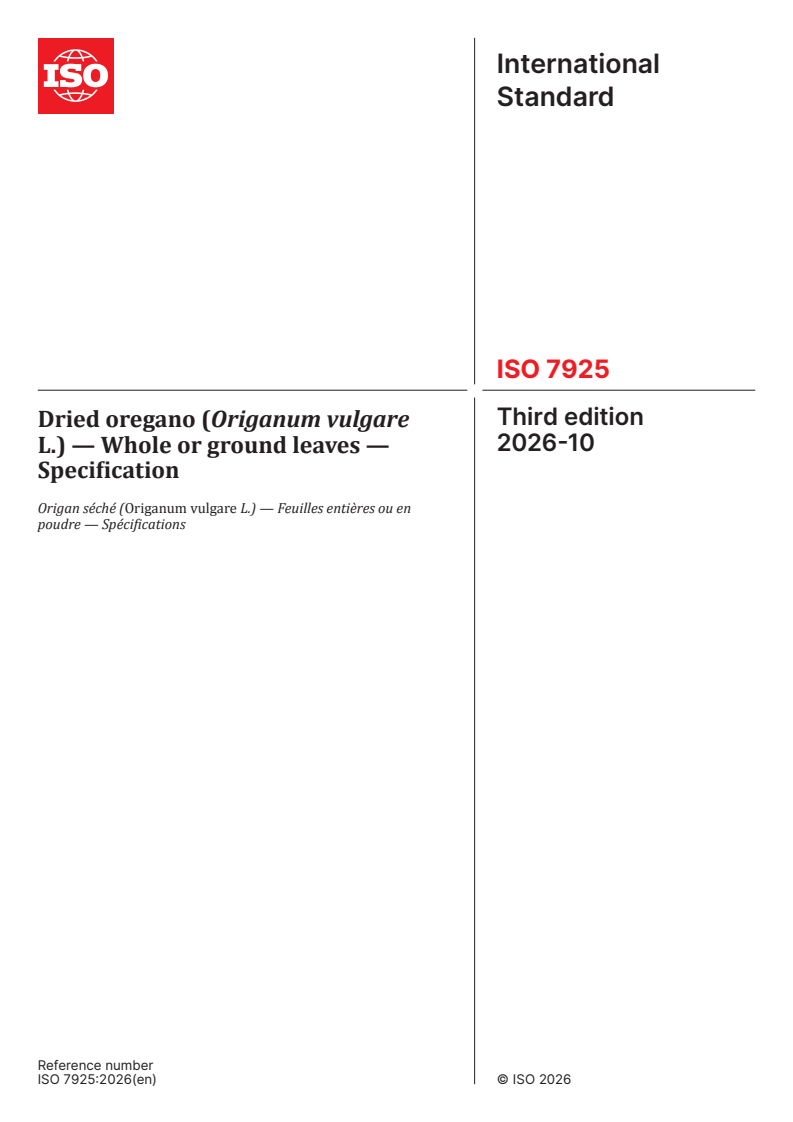
ISO 7925:2026 is an International Organization for Standardization (ISO) specification for dried oregano from Origanum vulgare L., including subspecies, in whole or ground form. It defines what the product must be for trade, testing, and quality control, and it is aimed at producers, packers, buyers, and laboratories handling dried oregano.
What does ISO 7925:2026 specify?
ISO 7925:2026 specifies requirements for processed or semi-processed dried leaves of Origanum vulgare L. in whole or ground (powdered) form. It also points users to Annex A for storage and transport recommendations.
The document is organized into scope, normative references, terms and definitions, requirements, sampling, test methods, and packing and marking. Annex A gives handling guidance after packing, which matters in practice because oregano can lose volatile matter and pick up moisture or contamination if it is poorly stored or transported.
What are the key requirements of ISO 7925:2026?
ISO 7925:2026 sets sensory, cleanliness, chemical, physical, sampling, and marking requirements for dried oregano. In practice, these are the checks a supplier or buyer uses to decide whether a lot is acceptable.
Sensory quality and cleanliness
- Clause 4.1 requires oregano to have a strong aromatic odour and a characteristic warm, pungent, bitter flavour, while being free from mustiness and other foreign flavours. This matters because smell and taste are immediate indicators of product quality and freshness.
- Clause 4.2 requires the product to be free from live insects and mould growth, and practically free from dead insects, fragments, and rodent contamination. If dispute testing is needed for ground oregano, ISO 1208 is used. This is the basic hygiene check for commercial lots.
- Clause 4.3 limits extraneous matter. The limit is tighter for processed oregano than for semi-processed oregano, and broken stalks and other plant parts are also limited. This matters because buyers need to know how much plant waste is still present after cleaning.
- Clause 4.4 requires the product to be free from foreign matter when tested by ISO 927. That helps prevent non-plant contamination from entering food supply chains.
Chemical and physical quality
- Clause 4.5 and Table 1 set maximum moisture content, ash limits, acid-insoluble ash limits, and minimum volatile oil content for whole or cut leaves and for ground oregano. These figures are the main laboratory acceptance criteria and show whether the herb is dry enough, clean enough, and rich enough in essential aromatic constituents.
- Clause 4.6 requires ground oregano to pass completely through a 500 µm sieve. This is the particle-size check that confirms the powder is sufficiently fine and uniform for trade or further processing.
Sampling, test methods, packing, and marking
- Clause 5 requires sampling in accordance with ISO 948, so test results are based on a recognized sampling method rather than an arbitrary grab sample.
- Clause 6 requires conformity testing using the methods referenced in the requirements, and it requires preparation of the ground sample for analysis according to ISO 2825.
- Clause 7 requires clean, sound, dry containers that protect the product from contamination, moisture gain or loss, and loss of volatile matter. Marking must identify the product, producer or packer, batch, net mass, country of origin, any treatment, and the reference to ISO 7925. This is what buyers use for traceability and product identification.
What terms does ISO 7925:2026 define?
ISO 7925:2026 defines four terms that are central to grading and compliance.
- Processed oregano - dried leaves that have been cleaned, prepared, or graded by the producing country before export, and that must still meet the document’s requirements.
- Semi-processed oregano - dried leaves that have had partial cleaning before export, but without preparation or grading by the producing country.
- Foreign matter - material visible to the naked eye or up to 10x magnification that is not part of the oregano plant, such as stones, straw, insects, or excreta.
- Extraneous matter - plant waste belonging to the oregano plant, plus sand, earth, and dust, but not flowering tops.
Who uses ISO 7925:2026?
ISO 7925:2026 is used by oregano producers, exporters, importers, packers, and buyers who need a common product specification. It is also used by quality control laboratories for sampling and test work, and by inspectors checking cleanliness, identity, moisture, ash, volatile oil content, packaging, and labelling in the spices and culinary herbs trade.
What changed in ISO 7925:2026 from the previous edition?
ISO 7925:2026 is the third edition and cancels and replaces ISO 7925:1999. The stated technical changes are a clearer exclusion of Origanum majorana L., revised definitions of processed and semi-processed oregano, an added definition for foreign and extraneous matter, and an updated description of dried oregano.
Which standards are used with ISO 7925:2026?
ISO 7925:2026 relies on several ISO methods for test work and sample preparation.
- ISO 927 - determines extraneous matter and foreign matter content.
- ISO 928 - determines total ash.
- ISO 930 - determines acid-insoluble ash.
- ISO 939 - determines moisture content.
- ISO 948 - gives the sampling method.
- ISO 1208 - is used for dispute testing of contamination in ground oregano.
- ISO 2825 - covers preparation of a ground sample for analysis.
- ISO 6571 - determines volatile oil content by hydrodistillation.
- ISO 10620:1995 - is the separate specification for Origanum majorana L., which is excluded from this document.
What does the ISO 7925:2026 document contain?
ISO 7925:2026 contains the specification clause, testable quality requirements, a sampling clause, a test methods clause, and packing and marking rules. Table 1 collects the chemical requirements and the associated test methods in one place, which is the part most users will consult for laboratory acceptance. The introduction includes a figure of oregano and a short product description, while Annex A gives practical recommendations for storage and transport conditions.
Relations
- Effective Date
- 19-Oct-2024
Get Certified
Connect with accredited certification bodies for this standard

BSI Group
BSI (British Standards Institution) is the business standards company that helps organizations make excellence a habit.

Bureau Veritas
Bureau Veritas is a world leader in laboratory testing, inspection and certification services.

DNV
DNV is an independent assurance and risk management provider.
Sponsored listings
Frequently Asked Questions
ISO 7925:2026 is a standard published by the International Organization for Standardization (ISO). Its full title is "Dried oregano (Origanum vulgare L.) — Whole or ground leaves — Specification". This standard covers: This document specifies requirements for processed or semi-processed dried leaves of Origanum vulgare L. (including subspecies), in the whole or ground (powdered) form. This document does not apply to the requirements of Origanum majorana L., for which a separate document exists, see ISO 10620:1995. Recommendations relating to storage and transport conditions are given in Annex A.
This document specifies requirements for processed or semi-processed dried leaves of Origanum vulgare L. (including subspecies), in the whole or ground (powdered) form. This document does not apply to the requirements of Origanum majorana L., for which a separate document exists, see ISO 10620:1995. Recommendations relating to storage and transport conditions are given in Annex A.
ISO 7925:2026 is classified under the following ICS (International Classification for Standards) categories: 67.220.10 - Spices and condiments. The ICS classification helps identify the subject area and facilitates finding related standards.
ISO 7925:2026 has the following relationships with other standards: It is inter standard links to ISO 7925:1999. Understanding these relationships helps ensure you are using the most current and applicable version of the standard.
ISO 7925:2026 is available in PDF format for immediate download after purchase. The document can be added to your cart and obtained through the secure checkout process. Digital delivery ensures instant access to the complete standard document.
Standards Content (Sample)
International
Standard
ISO 7925
Third edition
Dried oregano (Origanum vulgare
2026-10
L.) — Whole or ground leaves —
Specification
Origan séché (Origanum vulgare L.) — Feuilles entières ou en
poudre — Spécifications
Reference number
© ISO 2026
All rights reserved.
This ISO publication is protected by copyright and is owned by ISO and/or its licensors.
The content of this ISO publication is provided under licence, not sold. Use is subject to the applicable licence terms issued by ISO,
an ISO member body, or an authorized third-party distributor.
Except as required for implementation or expressly permitted by a separate licence, no part of this ISO publication may be
reproduced, distributed, modified, used, or made available in any form or by any means – electronic or mechanical, including
photocopying, scanning, recording, or posting on internal or external digital platforms.
Any use beyond the scope of the granted rights is prohibited and may result in legal action.
ISO copyright office
CP 401 • CH-1214 Vernier, Geneva
Phone: +41 22 749 01 11
Email: copyright@iso.org
Website: www.iso.org
Published in Switzerland
ii
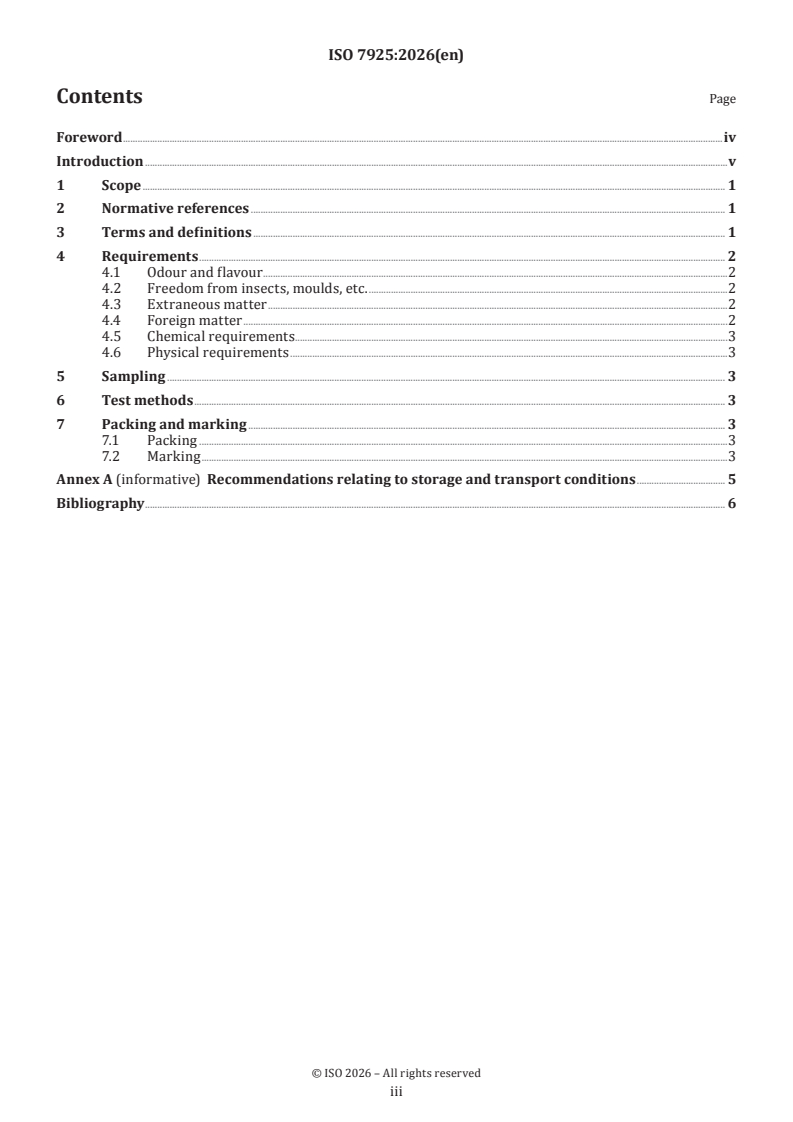
Contents Page
Foreword .iv
Introduction .v
1 Scope . 1
2 Normative references . 1
3 Terms and definitions . 1
4 Requirements . 2
4.1 Odour and flavour .2
4.2 Freedom from insects, moulds, etc. .2
4.3 Extraneous matter .2
4.4 Foreign matter .2
4.5 Chemical requirements . .3
4.6 Physical requirements .3
5 Sampling . 3
6 Test methods . 3
7 Packing and marking . 3
7.1 Packing .3
7.2 Marking .3
Annex A (informative) Recommendations relating to storage and transport conditions . 5
Bibliography . 6
iii
Foreword
ISO (the International Organization for Standardization) is a worldwide federation of national standards
bodies (ISO member bodies). The work of preparing International Standards is normally carried out through
ISO technical committees. Each member body interested in a subject for which a technical committee
has been established has the right to be represented on that committee. International organizations,
governmental and non-governmental, in liaison with ISO, also take part in the work. ISO collaborates closely
with the International Electrotechnical Commission (IEC) on all matters of electrotechnical standardization.
The procedures used to develop this document and those intended for its further maintenance are described
in the ISO/IEC Directives, Part 1. In particular, the different approval criteria needed for the different types
of ISO document should be noted. This document was drafted in accordance with the editorial rules of the
ISO/IEC Directives, Part 2 (see www.iso.org/directives).
ISO draws attention to the possibility that the implementation of this document may involve the use of (a)
patent(s). ISO takes no position concerning the evidence, validity or applicability of any claimed patent
rights in respect thereof. As of the date of publication of this document, ISO had not received notice of (a)
patent(s) which may be required to implement this document. However, implementers are cautioned that
this may not represent the latest information, which may be obtained from the patent database available at
www.iso.org/patents. ISO shall not be held responsible for identifying any or all such patent rights.
Any trade name used in this document is information given for the convenience of users and does not
constitute an endorsement.
For an explanation of the voluntary nature of standards, the meaning of ISO specific terms and expressions
related to conformity assessment, as well as information about ISO's adherence to the World Trade
Organization (WTO) principles in the Technical Barriers to Trade (TBT), see www.iso.org/iso/foreword.html.
This document was prepared by Technical Committee ISO/TC 34, Food products, Subcommittee SC 7, Spices,
culinary herbs and condiments.
This third edition cancels and replaces the second edition (ISO 7925:1999), which has been technically
revised.
The main changes are as follows:
— the scope has been updated to clarify the exclusion of Origanum majorana L.;
— the definitions of the terms “processed” and “semi-processed” oregano have been revised;
— a definition for foreign and extraneous matter has been included;
— the description of dried oregano has been updated.
Any feedback or questions on this document should be directed to the user’s national standards body. A
complete listing of these bodies can be found at www.iso.org/members.html.
iv
Introd
...