


ISO/IEC/IEEE 29119-3:2013
(Main)Software and systems engineering — Software testing — Part 3: Test documentation
Software and systems engineering — Software testing — Part 3: Test documentation
The purpose of the ISO/IEC/IEEE 29119 series of software testing standards is to define an internationally-agreed set of standards for software testing that can be used by any organization when performing any form of software testing. ISO/IEC/IEEE 29119-3:2013 includes templates and examples of test documentation. The templates are arranged within clauses reflecting the overall test process description structure in ISO/IEC/IEEE 29119-2, i.e. by the test process in which they are being produced. Annex A contains outlines of the contents of each document. Annex B contains mappings of ISO/IEC/IEEE 29119-2. Annex C contains an overview of the examples. Annexes D to S contain examples of the application of the templates. Annex T provides mappings to existing standards. The Bibliography for ISO/IEC/IEEE 29119-3:2013 is at the end of the document. ISO/IEC/IEEE 29119-3:2013 supports dynamic testing, functional and non-functional testing, manual and automated testing, and scripted and unscripted testing. The documentation templates defined in ISO/IEC/IEEE 29119-3:2013 can be used in conjunction with any software development lifecycle model.
Ingénierie du logiciel et des systèmes — Essais du logiciel — Partie 3: Documentation des essais
General Information
- Status
- Withdrawn
- Publication Date
- 28-Aug-2013
- Withdrawal Date
- 28-Aug-2013
- Technical Committee
- ISO/IEC JTC 1/SC 7 - Software and systems engineering
- Drafting Committee
- ISO/IEC JTC 1/SC 7/WG 26 - Software testing
- Current Stage
- 9599 - Withdrawal of International Standard
- Start Date
- 28-Oct-2021
- Completion Date
- 14-Feb-2026
Relations
- Effective Date
- 23-Apr-2020
Get Certified
Connect with accredited certification bodies for this standard

BSI Group
BSI (British Standards Institution) is the business standards company that helps organizations make excellence a habit.

BSCIC Certifications Pvt. Ltd.
Established 2006, accredited by NABCB, JAS-ANZ, EIAC, IAS. CDSCO Notified Body.

Intertek India Pvt. Ltd.
Delivers Assurance, Testing, Inspection & Certification since 1993 with 26 labs and 32 offices.
Sponsored listings
Frequently Asked Questions
ISO/IEC/IEEE 29119-3:2013 is a standard published by the International Organization for Standardization (ISO). Its full title is "Software and systems engineering — Software testing — Part 3: Test documentation". This standard covers: The purpose of the ISO/IEC/IEEE 29119 series of software testing standards is to define an internationally-agreed set of standards for software testing that can be used by any organization when performing any form of software testing. ISO/IEC/IEEE 29119-3:2013 includes templates and examples of test documentation. The templates are arranged within clauses reflecting the overall test process description structure in ISO/IEC/IEEE 29119-2, i.e. by the test process in which they are being produced. Annex A contains outlines of the contents of each document. Annex B contains mappings of ISO/IEC/IEEE 29119-2. Annex C contains an overview of the examples. Annexes D to S contain examples of the application of the templates. Annex T provides mappings to existing standards. The Bibliography for ISO/IEC/IEEE 29119-3:2013 is at the end of the document. ISO/IEC/IEEE 29119-3:2013 supports dynamic testing, functional and non-functional testing, manual and automated testing, and scripted and unscripted testing. The documentation templates defined in ISO/IEC/IEEE 29119-3:2013 can be used in conjunction with any software development lifecycle model.
The purpose of the ISO/IEC/IEEE 29119 series of software testing standards is to define an internationally-agreed set of standards for software testing that can be used by any organization when performing any form of software testing. ISO/IEC/IEEE 29119-3:2013 includes templates and examples of test documentation. The templates are arranged within clauses reflecting the overall test process description structure in ISO/IEC/IEEE 29119-2, i.e. by the test process in which they are being produced. Annex A contains outlines of the contents of each document. Annex B contains mappings of ISO/IEC/IEEE 29119-2. Annex C contains an overview of the examples. Annexes D to S contain examples of the application of the templates. Annex T provides mappings to existing standards. The Bibliography for ISO/IEC/IEEE 29119-3:2013 is at the end of the document. ISO/IEC/IEEE 29119-3:2013 supports dynamic testing, functional and non-functional testing, manual and automated testing, and scripted and unscripted testing. The documentation templates defined in ISO/IEC/IEEE 29119-3:2013 can be used in conjunction with any software development lifecycle model.
ISO/IEC/IEEE 29119-3:2013 is classified under the following ICS (International Classification for Standards) categories: 35.080 - Software. The ICS classification helps identify the subject area and facilitates finding related standards.
ISO/IEC/IEEE 29119-3:2013 has the following relationships with other standards: It is inter standard links to ISO/IEC/IEEE 29119-3:2021. Understanding these relationships helps ensure you are using the most current and applicable version of the standard.
ISO/IEC/IEEE 29119-3:2013 is available in PDF format for immediate download after purchase. The document can be added to your cart and obtained through the secure checkout process. Digital delivery ensures instant access to the complete standard document.
Standards Content (Sample)
INTERNATIONAL ISO/IEC/
STANDARD IEEE
29119-3
First edition
2013-09-01
Software and systems engineering —
Software testing —
Part 3:
Test documentation
Ingénierie du logiciel et des systèmes — Essais du logiciel —
Partie 3: Documentation des essais
Reference number
©
ISO/IEC 2013
©
IEEE 2013
© ISO/IEC 2013
© IEEE 2013
All rights reserved. Unless otherwise specified, no part of this publication may be reproduced or utilized in any form or by any means,
electronic or mechanical, including photocopying and microfilm, without permission in writing from ISO, IEC or IEEE at the respective
address below.
ISO copyright office IEC Central Office Institute of Electrical and Electronics Engineers, Inc.
Case postale 56 3, rue de Varembé 3 Park Avenue, New York
CH-1211 Geneva 20 CH-1211 Geneva 20 NY 10016-5997, USA
Tel. + 41 22 749 01 11 Switzerland E-mail stds.ipr@ieee.org
Fax + 41 22 749 09 47 E-mail inmail@iec.ch Web www.ieee.org
E-mail copyright@iso.org Web www.iec.ch
Web www.iso.org
Published in Switzerland
© ISO/IEC 2013 – All rights reserved
ii © IEEE 2013 – All rights reserved
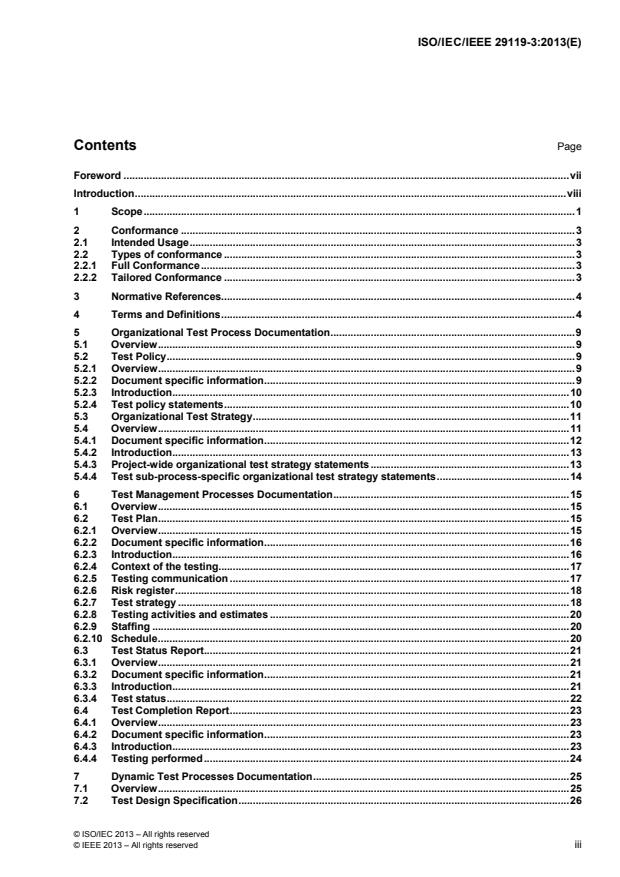
Contents Page
Foreword . vii
Introduction . viii
1 Scope . 1
2 Conformance . 3
2.1 Intended Usage . 3
2.2 Types of conformance . 3
2.2.1 Full Conformance . 3
2.2.2 Tailored Conformance . 3
3 Normative References. 4
4 Terms and Definitions . 4
5 Organizational Test Process Documentation . 9
5.1 Overview . 9
5.2 Test Policy . 9
5.2.1 Overview . 9
5.2.2 Document specific information . 9
5.2.3 Introduction . 10
5.2.4 Test policy statements . 10
5.3 Organizational Test Strategy . 11
5.4 Overview . 11
5.4.1 Document specific information . 12
5.4.2 Introduction . 13
5.4.3 Project-wide organizational test strategy statements . 13
5.4.4 Test sub-process-specific organizational test strategy statements . 14
6 Test Management Processes Documentation . 15
6.1 Overview . 15
6.2 Test Plan . 15
6.2.1 Overview . 15
6.2.2 Document specific information . 16
6.2.3 Introduction . 16
6.2.4 Context of the testing . 17
6.2.5 Testing communication . 17
6.2.6 Risk register . 18
6.2.7 Test strategy . 18
6.2.8 Testing activities and estimates . 20
6.2.9 Staffing . 20
6.2.10 Schedule . 20
6.3 Test Status Report . 21
6.3.1 Overview . 21
6.3.2 Document specific information . 21
6.3.3 Introduction . 21
6.3.4 Test status . 22
6.4 Test Completion Report . 23
6.4.1 Overview . 23
6.4.2 Document specific information . 23
6.4.3 Introduction . 23
6.4.4 Testing performed . 24
7 Dynamic Test Processes Documentation . 25
7.1 Overview . 25
7.2 Test Design Specification . 26
© ISO/IEC 2013 – All rights reserved
© IEEE 2013 – All rights reserved iii
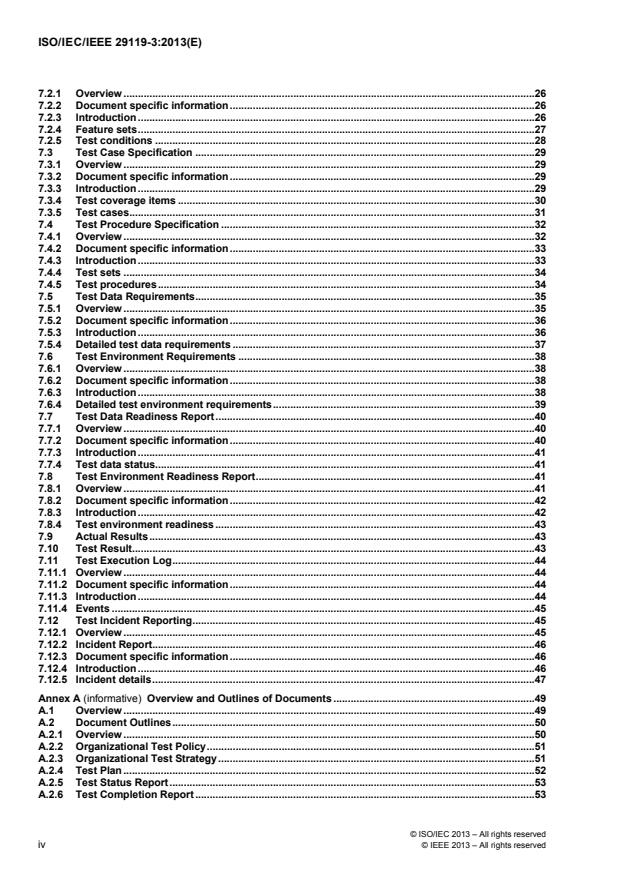
7.2.1 Overview .26
7.2.2 Document specific information .26
7.2.3 Introduction .26
7.2.4 Feature sets .27
7.2.5 Test conditions .28
7.3 Test Case Specification .29
7.3.1 Overview .29
7.3.2 Document specific information .29
7.3.3 Introduction .29
7.3.4 Test coverage items .30
7.3.5 Test cases .31
7.4 Test Procedure Specification .32
7.4.1 Overview .32
7.4.2 Document specific information .33
7.4.3 Introduction .33
7.4.4 Test sets .34
7.4.5 Test procedures .34
7.5 Test Data Requirements .35
7.5.1 Overview .35
7.5.2 Document specific information .36
7.5.3 Introduction .36
7.5.4 Detailed test data requirements .37
7.6 Test Environment Requirements .38
7.6.1 Overview .38
7.6.2 Document specific information .38
7.6.3 Introduction .38
7.6.4 Detailed test environment requirements .39
7.7 Test Data Readiness Report .40
7.7.1 Overview .40
7.7.2 Document specific information .40
7.7.3 Introduction .41
7.7.4 Test data status .41
7.8 Test Environment Readiness Report .41
7.8.1 Overview .41
7.8.2 Document specific information .42
7.8.3 Introduction .42
7.8.4 Test environment readiness .43
7.9 Actual Results .43
7.10 Test Result .43
7.11 Test Execution Log .44
7.11.1 Overview .44
7.11.2 Document specific information .44
7.11.3 Introduction .44
7.11.4 Events .45
7.12 Test Incident Reporting .45
7.12.1 Overview .45
7.12.2 Incident Report .46
7.12.3 Document specific information .46
7.12.4 Introduction .46
7.12.5 Incident details .47
Annex A (informative) Overview and Outlines of Documents .49
A.1 Overview .49
A.2 Document Outlines .50
A.2.1 Overview .50
A.2.2 Organizational Test Policy .51
A.2.3 Organizational Test Strategy .51
A.2.4 Test Plan .52
A.2.5 Test Status Report .53
A.2.6 Test Completion Report .53
© ISO/IEC 2013 – All rights reserved
iv © IEEE 2013 – All rights reserved
A.2.7 Test Design Specification . 54
A.2.8 Test Case Specification . 54
A.2.9 Test Procedure Specification . 55
A.2.10 Test Data Requirements . 55
A.2.11 Test Environment Requirements . 56
A.2.12 Test Data Readiness Report . 56
A.2.13 Test Environment Readiness Report . 56
A.2.14 Test Execution Log . 56
A.2.15 Incident Report . 56
Annex B (informative) ISO/IEC/IEEE 29119-2 Normative Requirements Mapped to
ISO/IEC/IEEE 29119-3 Information Items. 58
B.1 Mapping . 58
B.1.1 Organizational Test Policy . 58
B.1.2 Organizational Test Strategy . 58
B.1.3 Test Plan . 59
B.1.4 Test Status Report . 59
B.1.5 Test Completion Report . 60
B.1.6 Test Design Specification . 60
B.1.7 Test Case Specification . 60
B.1.8 Test Procedure Specification . 60
B.1.9 Test Data Requirements . 61
B.1.10 Test Environment Requirements . 61
B.1.11 Test Data Readiness Report . 61
B.1.12 Test Environment Readiness Report . 61
B.1.13 Test Execution Log . 61
B.1.14 Incident Report . 61
Annex C (informative) Overview of Examples. 63
C.1 Overview . 63
Annex D (informative) Test Policy . 65
D.1 Example 1 – Agile Corporation . 65
D.2 Example 2 – Traditional Ltd . 65
Annex E (informative) Organizational Test Strategy . 67
E.1 Example 1 – Agile Corporation . 67
E.2 Example 2 – Traditional Ltd . 68
Annex F (informative) Test Plan . 72
F.1 Example 1 – Agile Corporation . 72
F.2 Example 2 – Traditional Ltd . 73
F.2.1 Project Test Plan . 74
F.2.2 System Test Plan . 80
Annex G (informative) Test Status Report . 85
G.1 Example 1 – Agile Corporation . 85
G.2 Example 2 – Traditional Ltd . 85
Annex H (informative) Test Completion Report . 88
H.1 Example 1 – Agile Corporation . 88
H.2 Example 2 – Traditional Ltd . 89
Annex I (informative) Test Design Specification . 91
I.1 Example 1 – Agile Corporation . 91
H.2 Example 2 – Traditional Ltd . 91
Annex J (informative) Test Case Specification . 99
J.1 Example 1 – Agile Corporation . 99
J.2 Example 2 – Traditional Ltd . 99
Annex K (informative) Test Procedure Specification . 104
K.1.1 Example 1.1 – Agile Corporation . 104
K.1.2 Example 1.2 – Agile Corporation . 104
K.2 Example 2 – Traditional Ltd . 105
© ISO/IEC 2013 – All rights reserved
© IEEE 2013 – All rights reserved v
Annex L (informative) Test Data Requirements . 107
L.1 Example 1 – Agile Corporation . 107
L.2 Example 2 – Traditional Ltd . 107
Annex M (informative) Test Environment Requirements . 109
M.1 Example 1 – Agile Corporation . 109
M.2 Example – Traditional Ltd . 109
Annex N (informative) Test Data Readiness Report . 111
N.1 Example 1 – Agile Corporation . 111
N.2 Example 2 – Traditional Ltd . 111
Annex O (informative) Test Environment Readiness Report . 112
O.1 Example 1 – Agile Corporation . 112
O.2 Example 2 – Traditional Ltd . 112
Annex P (informative) Actual Results . 113
P.1 Example 1 – Agile Corporation . 113
P.2 Example 2 – Traditional . 114
Annex Q (informative) Test Result . 115
Q.1 Example 1 – Agile Corporation . 115
Q.2 Example 2 – Traditional Ltd . 116
Annex R (informative) Test Execution Log . 117
R.1 Example 1 – Agile Corporation . 117
R.2 Example 2 – Traditional Ltd . 117
Annex S (informative) Incident Report . 118
S.1 Example 1 – Agile Corporation . 118
S.2 Example 2 – Traditional Ltd . 119
Annex T (informative) Mappings to Existing Standards . 120
T.1 Mapping to IEEE 829:2008 . 120
T.2 Mapping to ISO/IEC FDIS 15289: 2011 . 125
T.3 Mapping to BS 7925-2:1998 . 126
T.4 Mapping to ISO/IEC 25051:2006 . 126
Bibliography . 127
© ISO/IEC 2013 – All rights reserved
vi © IEEE 2013 – All rights reserved
Foreword
ISO (the International Organization for Standardization) and IEC (the International Electrotechnical
Commission) form the specialized system for worldwide standardization. National bodies that are members of
ISO or IEC participate in the development of International Standards through technical committees established
by the respective organization to deal with particular fields of technical activity. ISO and IEC technical
committees collaborate in fields of mutual interest. Other international organizations, governmental and non-
governmental, in liaison with ISO and IEC, also take part in the work. In the field of information technology, ISO
and IEC have established a joint technical committee, ISO/IEC JTC 1.
IEEE Standards documents are developed within the IEEE Societies and the Standards Coordinating
Committees of the IEEE Standards Association (IEEE-SA) Standards Board. The IEEE develops its standards
through a consensus development process, approved by the American National Standards Institute, which
brings together volunteers representing varied viewpoints and interests to achieve the final product. Volunteers
are not necessarily members of the Institute and serve without compensation. While the IEEE administers the
process and establishes rules to promote fairness in the consensus development process, the IEEE does not
independently evaluate, test, or verify the accuracy of any of the information contained in its standards.
International Standards are drafted in accordance with the rules given in the ISO/IEC Directives, Part 2.
The main task of ISO/IEC JTC 1 is to prepare International Standards. Draft International Standards adopted
by the joint technical committee are circulated to national bodies for voting. Publication as an International
Standard requires approval by at least 75 % of the national bodies casting a vote.
Attention is called to the possibility that implementation of this standard may require the use of subject matter
covered by patent rights. By publication of this standard, no position is taken with respect to the existence or
validity of any patent rights in connection therewith. ISO/IEEE is not responsible for identifying essential
patents or patent claims for which a license may be required, for conducting inquiries into the legal validity or
scope of patents or patent claims or determining whether any licensing terms or conditions provided in
connection with submission of a Letter of Assurance or a Patent Statement and Licensing Declaration Form, if
any, or in any licensing agreements are reasonable or non-discriminatory. Users of this standard are expressly
advised that determination of the validity of any patent rights, and the risk of infringement of such rights, is
entirely their own responsibility. Further information may be obtained from ISO or the IEEE Standards
Association.
ISO/IEC/IEEE 29119-3 was prepared by Joint Technical Committee ISO/IEC JTC 1, Information technology,
Subcommittee SC 7, Software and systems engineering, in cooperation with the Software & Systems
Engineering Standards Committee of the IEEE Computer Society, under the Partner Standards Development
Organization cooperation agreement between ISO and IEEE.
ISO/IEC 29119 consists of the following standards, under the general title Software and systems
engineering — Software testing:
Part 1: Concepts and definitions
Part 2: Test processes
Part 3: Test documentation
Part 4: Test techniques
© ISO/IEC 2013 – All rights reserved
© IEEE 2013 – All rights reserved vii
Introduction
The purpose of the ISO/IEC/IEEE 29119 series of software testing standards is to define an internationally-
agreed set of standards for software testing that can be used by any organization when performing any form
of software testing.
This part of ISO/IEC/IEEE 29119, Test Documentation, includes templates and examples of test
documentation that are produced during the test process. The templates are arranged within clauses
reflecting the overall test process description structure in ISO/IEC/IEEE 29119-2 Test Processes, i.e. by the
test process in which they are being produced. Annex A contains outlines of the contents of each document.
Annex B contains a list of all the information items identified in Clauses 5, 6 and 7 of this part of
ISO/IEC/IEEE 29119 with the corresponding level of conformance (shall/should/may) from
ISO/IEC/IEEE 29119-2 Test Processes. Annex C contains an overview of the examples. Annexes D to S
contain examples of the application of the templates. Annex T provides mappings to existing standards. The
Bibliography for this part of ISO/IEC/IEEE 29119 is at the end of the document.
The concepts and vocabulary relating to the software testing documentation are defined in
ISO/IEC/IEEE 29119-1 Concepts and Definitions.
The actual test process model is defined in ISO/IEC/IEEE 29119-2 Test Processes. It comprises test process
descriptions that define the software testing processes at the organizational level, test management level and
dynamic test level. Supporting informative diagrams describing the processes are also provided.
Software test design techniques that can be used during test design are defined in ISO/IEC/IEEE 29119-4
Test Techniques.
This series of international standards aims to provide stakeholders with the ability to manage and perform
software testing in any organization.
© ISO/IEC 2013 – All rights reserved
viii © IEEE 2013 – All rights reserved
INTERNATIONAL STANDARD ISO/IEC/IEEE 29119-3:2013(E)
Software and systems engineering — Software testing —
Part 3:
Test documentation
1 Scope
This part of ISO/IEC/IEEE 29119 specifies software test documentation templates that can be used by any
organization, project or smaller testing activity. It describes the test documentation that is an output of the
processes specified in ISO/IEC/IEEE 29119-2 Test Processes. An overview of the documents is provided in
Figure 1 below. A slightly larger version of this figure is provided in Annex A.
© ISO/IEC 2013 – All rights reserved
© IEEE 2013 – All rights reserved 1
… …
… …
Organizational Test Documentation
Test Policy
5.2
Found in clause
Organizational Organizational
…
Test Strategy Test Strategy
5.3
Test Management Documentation
Test Plan
Test Plan Test Plan
…
…
(Project)
(Project) (Project)
6.2
Test Plan Test Plan Test Plan
…
(Sub-process) (Sub-process) (Sub-process)
…
6.2
Dynamic Test Documentation
(See details
Test Specification
7.2 - 7.4
next page.)
Test Environment Test Data
Requirement Requirement
7.6 7.5
Test Environment Test Data
Readiness Report Readiness Report
7.8 7.7
Perform
Dynamic Test
Test Execution
Incident
Report Documentation
7.9 – 7.11
7.12
Test Status
Report
6.3
Test Completion Report
(Sub-process)
6.4
Test Management
Test Completion Report
Documentation,
(Project)
cont.
6.4
Figure 1 — The hierarchy of test documentation
This part of ISO/IEC/IEEE 29119 is applicable to testing in all software development lifecycle models.
© ISO/IEC 2013 – All rights reserved
2 © IEEE 2013 – All rights reserved
…
…
This part of ISO/IEC/IEEE 29119 is intended for, but not limited to, testers, test managers, developers, and
project managers, particularly those responsible for governing, managing, and implementing software testing.
The documents described in this part of ISO/IEC/IEEE 29119 may be issued in several versions over time.
However, the handling of multiple versions of documents is out of scope of this part of ISO/IEC/IEEE 29119,
because this is a configuration management issue.
2 Conformance
2.1 Intended usage
The requirements in this part of ISO/IEC/IEEE 29119 are contained in Clauses 5, 6 and 7. This part of
ISO/IEC/IEEE 29119 provides requirements for a number of test documents suitable for use during the
complete software lifecycle. It is recognized that particular projects or organizations may not need to use all of
the documents defined by this part of ISO/IEC/IEEE 29119. Therefore, implementation of this part of
ISO/IEC/IEEE 29119 typically involves selecting a set of documents suitable for the organization or project.
There are two ways that an organization can claim to conform to the provisions of this part of
ISO/IEC/IEEE 29119; full or tailored conformance. Conformance may be claimed for organizations, projects,
multi-supplier projects and services, as identified in the claim of conformance.
The information items identified in Clauses 5, 6, and 7 of this part of ISO/IEC/IEEE 29119 correspond to the
outputs of the ISO/IEC/IEEE 29119-2 Test Processes. Annex B is normative and provides an overview of the
normative requirements for the clauses in ISO/IEC/IEEE 29119-2 where the creation of the information items
defined in Clauses 5, 6, and 7 of this part of ISO/IEC/IEEE 29119 is described.
In this part of ISO/IEC/IEEE 29119, for simplicity of reference, each document is described as if it were
published as a separate hardcopy document. Document titles and contents provided in this part of
ISO/IEC/IEEE 29119 may be modified (added to, combined or re-titled) and use of the nomenclature of the
specific records in Clauses 5, 6 and 7 is not required to claim conformance. Documents shall be considered
as conforming if they are unpublished but available in electronic form, divided into separate documents or
volumes, or combined with other documents into one document.
2.2 Types of conformance
The following types of conformance shall be asserted. The selected type shall be identified in the claim of
conformance documentation.
2.2.1 Full Conformance
The minimum set of required information items is all of those information items specified in Clauses 5, 6 and 7
of this part of ISO/IEC/IEEE 29119.
NOTE Full conformance could be claimed for selected documents even if full conformance with the entire standard is
not claimed.
2.2.2 Tailored Conformance
The content of the test documents defined in Clauses 5, 6 and 7 of this part of ISO/IEC/IEEE 29119 may be
tailored based on the tailored conformance to ISO/IEC/IEEE 29119-2 Test Processes and/or based on the
specific needs of an organization or project. Where tailoring occurs, justification shall be provided whenever
an information item defined in Clauses 5, 6 and 7 of this part of ISO/IEC/IEEE 29119 is not prepared. All
tailoring decisions shall be recorded with their rationale, including the consideration of any applicable risks.
Tailoring decisions shall be agreed by the relevant stakeholders.
Tailored conformance can be achieved by:
a) The minimum set of required test documentation is determined by the tailoring of the processes and
activities in accordance with Clause 2 of ISO/IEC/IEEE 29119-2 Test Processes; and/or
© ISO/IEC 2013 – All rights reserved
© IEEE 2013 – All rights reserved 3
b) The minimum set of required test documentation is determined according to specific organization and/or
project needs; and/or
c) The minimum set of required information items within documents is determined according to specific
organization and/or project needs.
NOTE 1 In projects, particularly those following an agile approach, tailoring can be applied to all Part 3 documents to
allow them to be condensed or presented in an alternate format (e.g. verbal or slide presentation).
NOTE 2 Different document names could be used, but when this is done and conformity needs to be demonstrated, a
mapping is often produced between this part of ISO/IEC/IEEE 29119 and local usage to aid conformity assessment.
3 Normative references
The following documents, in whole or in part, are normatively referenced in this document and are
indispensable for its application. For dated references, only the edition cited applies. For undated references,
the latest edition of the referenced document (including any amendments) applies.
ISO/IEC/IEEE 15289:2011, Systems and software engineering — Content of life-cycle information products
(documentation)
ISO/IEC/IEEE 29119-1, Software and systems engineering — Software testing — Part 1: Concepts and
definitions
ISO/IEC/IEEE 29119-2, Software and systems engineering — Software testing — Part 2: Test processes
Other standards useful for the implementation and interpretation of this standard are listed in the Bibliography.
4 Terms and definitions
For the purposes of this document, the terms and definitions given in ISO/IEC/IEEE 24765 and the following
apply.
NOTE Use of the terminology in this part of ISO/IEC/IEEE 29119 is for ease of reference and is not mandatory for
conformance with this part of ISO/IEC/IEEE 29119. The following terms and definitions are provided to assist with the
understanding and readability of this part of ISO/IEC/IEEE 29119. Only terms critical to the understanding of this part of
ISO/IEC/IEEE 29119 are included. This clause is not intended to provide a complete list of testing terms. The Systems
and Software Engineering vocabulary ISO/IEC/IEEE 24765 can be referenced for terms not defined in this clause. All
terms defined in this clause are also intentionally included in ISO/IEC/IEEE 29119-1, as that international standard
includes all terms that are used in ISO/IEC/IEEE 29119-1, 2, 3 and 4.
4.1
actual results
set of b
...
Questions, Comments and Discussion
Ask us and Technical Secretary will try to provide an answer. You can facilitate discussion about the standard in here.
Loading comments...