

ISO 17831-2:2025
(Main)Solid biofuels — Determination of mechanical durability of pellets and briquettes — Part 2: Briquettes
General Information
- Abstract
This document specifies a method for determination of the mechanical durability of briquettes. The mechanical durability is a measure of the resistance of compressed fuels towards shocks and/or abrasion as a consequence of handling and transportation.
- Status
- Published
- Publication Date
- 29-Apr-2025
- Technical Committee
- ISO/TC 238 - Solid biofuels
- Drafting Committee
- ISO/TC 238 - Solid biofuels
- Current Stage
- 6060 - International Standard published
- Start Date
- 30-Apr-2025
- Due Date
- 15-Aug-2026
- Completion Date
- 30-Apr-2025
Buy Documents
ISO 17831-2:2025 - Solid biofuels — Determination of mechanical durability of pellets and briquettes — Part 2: Briquettes Released:30. 04. 2025
ISO 17831-2:2025 - Biocombustibles solides — Détermination de la résistance mécanique des granulés et des briquettes — Partie 2: Briquettes Released:30. 04. 2025
Overview
ISO 17831-2:2025 is an international standard developed by ISO that specifies a reliable method for determining the mechanical durability of solid biofuel briquettes. Mechanical durability is a key indicator of the briquettes' resistance to shock and abrasion resulting from handling, transportation, and storage. This durability test ensures that briquettes maintain structural integrity, minimizing fines generation and material losses during logistical operations.
This standard is part two of the ISO 17831 series, dedicated specifically to briquettes, distinguishing them from pellets based on larger dimensions (typically above 25 mm diameter). The document builds on previous editions with updated procedures, equipment specifications, and references aligned with other key biofuel standards.
Key Topics
Scope and Purpose: The standard defines a test method to quantify the mechanical durability of compressed biomass briquettes. Durability reflects briquette quality related to their resistance to breakage under mechanical stresses during transport and handling.
Test Principle: Samples of briquettes are rotated inside a cylindrical steel drum (durabilimeter), where they collide and rub against each other and drum walls. After a specified number of rotations at a controlled speed (21 rpm for 5 minutes), the sample is sieved to separate broken particles. The mechanical durability is calculated as the mass percentage of intact briquettes remaining.
Equipment Specifications:
- Durabilimeter drum: Cylindrical steel drum with 600 mm diameter and length, featuring an internal deflector.
- Sieve (Sieve circle): Circular sieve with 5.6 mm diameter round holes for manual sieving, complying with ISO 3310-2.
- Balance: Precision balance with at least 0.1 g accuracy and 2 kg capacity to weigh samples precisely.
- Additional accessories include a dust-tight cover for the drum and sample preparation tools.
Sample Preparation:
- Samples must be representative and meet size and weight requirements based on briquette type (A, B, or C).
- Moisture content must be measured as it influences mechanical durability, following ISO 18134 methods.
- Samples are conditioned to ambient temperature and stored airtight before testing.
Test Procedure:
- Select and weigh test samples as per classification.
- Rotate samples inside the durabilimeter at 21±0.1 rpm for 5 minutes.
- Sieve the contents manually to remove fines and broken particles.
- Calculate the mechanical durability based on the weight ratio of remaining briquettes.
Reporting:
- The test report must include moisture content, sample description, appearance of briquettes before and after testing, test parameters, and calculated durability results.
Applications
ISO 17831-2:2025 is essential for producers, suppliers, and users of solid biofuel briquettes aiming to:
Ensure Quality Control: Implementing this standardized durability test enables manufacturers to assess and improve briquette quality, reducing fines production and waste.
Optimize Handling and Transportation: Durable briquettes withstand mechanical stresses during transport, minimizing losses and contamination, thus maintaining energy density and combustion efficiency.
Support Compliance and Certification: This standard aligns with broader biomass fuel quality standards like ISO 17225, helping stakeholders comply with national and international regulations and market requirements.
Research and Development: Provides a benchmark method to evaluate the effects of raw materials, binders, and production techniques on briquette mechanical performance.
Related Standards
ISO 17831-2:2025 works in conjunction with a series of standards dedicated to solid biofuels and testing methods:
- ISO 17831-1 - Determination of mechanical durability of pellets (Part 1: Pellets)
- ISO 17225-1 - Solid biofuels - Fuel specifications and classes (General requirements)
- ISO 3310-2 - Test sieves - Technical requirements (Perforated metal sheets)
- ISO 5370 - Determination of fines content in pellets
- ISO 18134-1 & ISO 18134-2 - Moisture content determination methods
- ISO 14780 - Sample preparation for solid biofuels
- ISO 18135, ISO 21945 - Sampling procedures for solid biofuels
These complementary standards ensure a comprehensive framework for assessing biomass fuel quality and consistency.
Keywords: ISO 17831-2, mechanical durability, biofuel briquettes, solid biofuels, briquette testing, durability test method, bioenergy quality standards, mechanical resistance, briquette quality control, biomass fuel handling
Relations
- Effective Date
- 12-Feb-2026
- Effective Date
- 19-Aug-2023
Buy Documents
ISO 17831-2:2025 - Solid biofuels — Determination of mechanical durability of pellets and briquettes — Part 2: Briquettes Released:30. 04. 2025
ISO 17831-2:2025 - Biocombustibles solides — Détermination de la résistance mécanique des granulés et des briquettes — Partie 2: Briquettes Released:30. 04. 2025
Get Certified
Connect with accredited certification bodies for this standard

DNV
DNV is an independent assurance and risk management provider.

Lloyd's Register
Lloyd's Register is a global professional services organisation specialising in engineering and technology.
DNV Energy Systems
Energy and renewable energy certification.
Sponsored listings
Frequently Asked Questions
ISO 17831-2:2025 is a standard published by the International Organization for Standardization (ISO). Its full title is "Solid biofuels — Determination of mechanical durability of pellets and briquettes — Part 2: Briquettes". This standard covers: This document specifies a method for determination of the mechanical durability of briquettes. The mechanical durability is a measure of the resistance of compressed fuels towards shocks and/or abrasion as a consequence of handling and transportation.
This document specifies a method for determination of the mechanical durability of briquettes. The mechanical durability is a measure of the resistance of compressed fuels towards shocks and/or abrasion as a consequence of handling and transportation.
ISO 17831-2:2025 is classified under the following ICS (International Classification for Standards) categories: 27.190 - Biological sources and alternative sources of energy; 75.160.40 - Biofuels. The ICS classification helps identify the subject area and facilitates finding related standards.
ISO 17831-2:2025 has the following relationships with other standards: It is inter standard links to EN ISO 17831-2:2025, ISO 17831-2:2015. Understanding these relationships helps ensure you are using the most current and applicable version of the standard.
ISO 17831-2:2025 is available in PDF format for immediate download after purchase. The document can be added to your cart and obtained through the secure checkout process. Digital delivery ensures instant access to the complete standard document.
Standards Content (Sample)
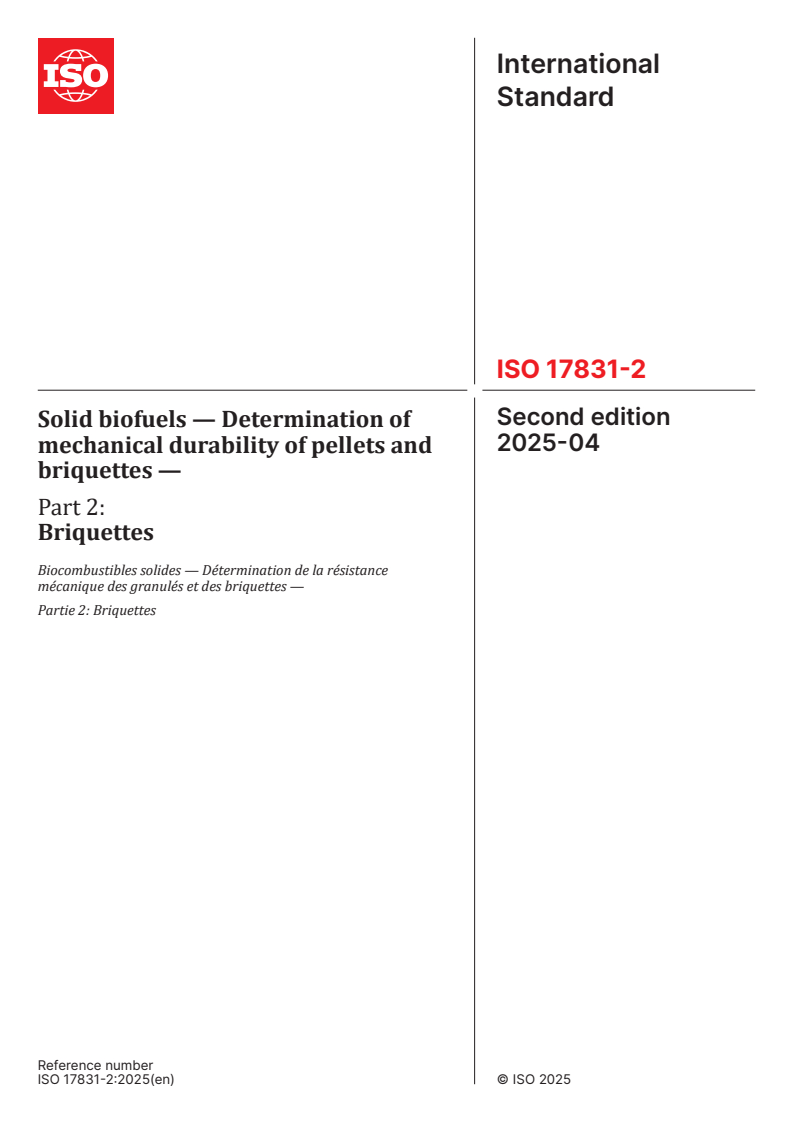
International
Standard
ISO 17831-2
Second edition
Solid biofuels — Determination of
2025-04
mechanical durability of pellets and
briquettes —
Part 2:
Briquettes
Biocombustibles solides — Détermination de la résistance
mécanique des granulés et des briquettes —
Partie 2: Briquettes
Reference number
© ISO 2025
All rights reserved. Unless otherwise specified, or required in the context of its implementation, no part of this publication may
be reproduced or utilized otherwise in any form or by any means, electronic or mechanical, including photocopying, or posting on
the internet or an intranet, without prior written permission. Permission can be requested from either ISO at the address below
or ISO’s member body in the country of the requester.
ISO copyright office
CP 401 • Ch. de Blandonnet 8
CH-1214 Vernier, Geneva
Phone: +41 22 749 01 11
Email: copyright@iso.org
Website: www.iso.org
Published in Switzerland
ii
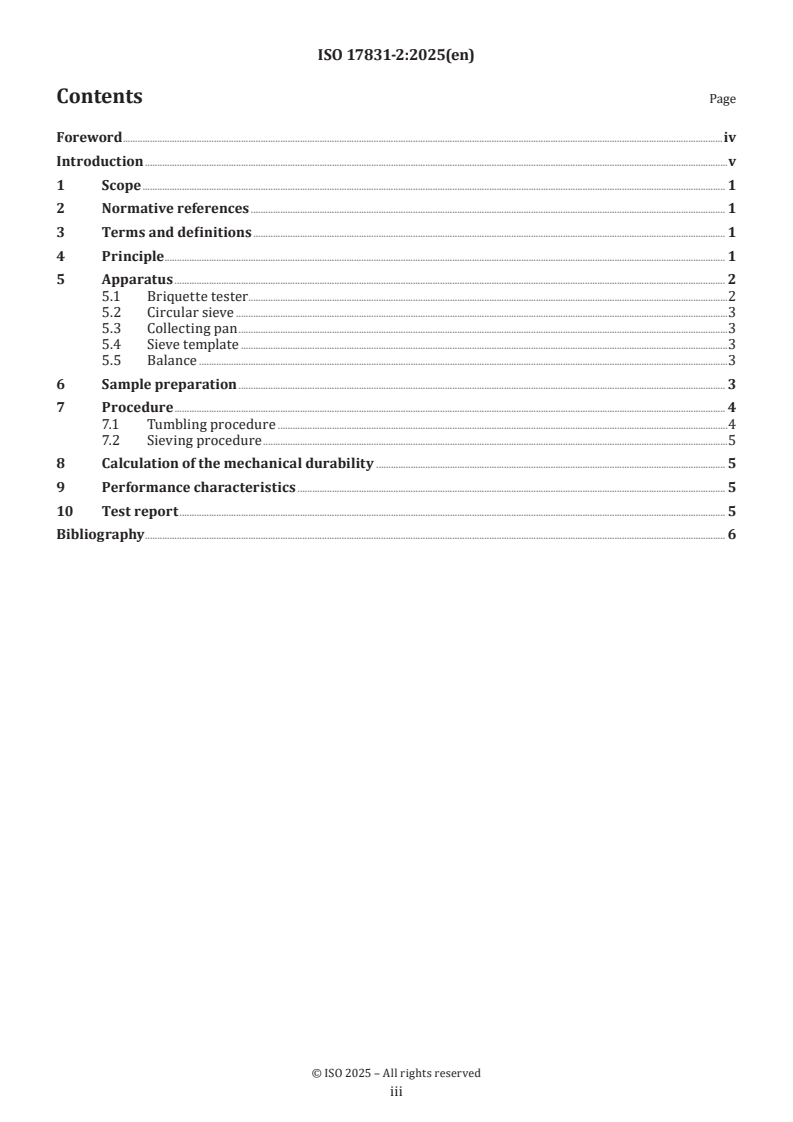
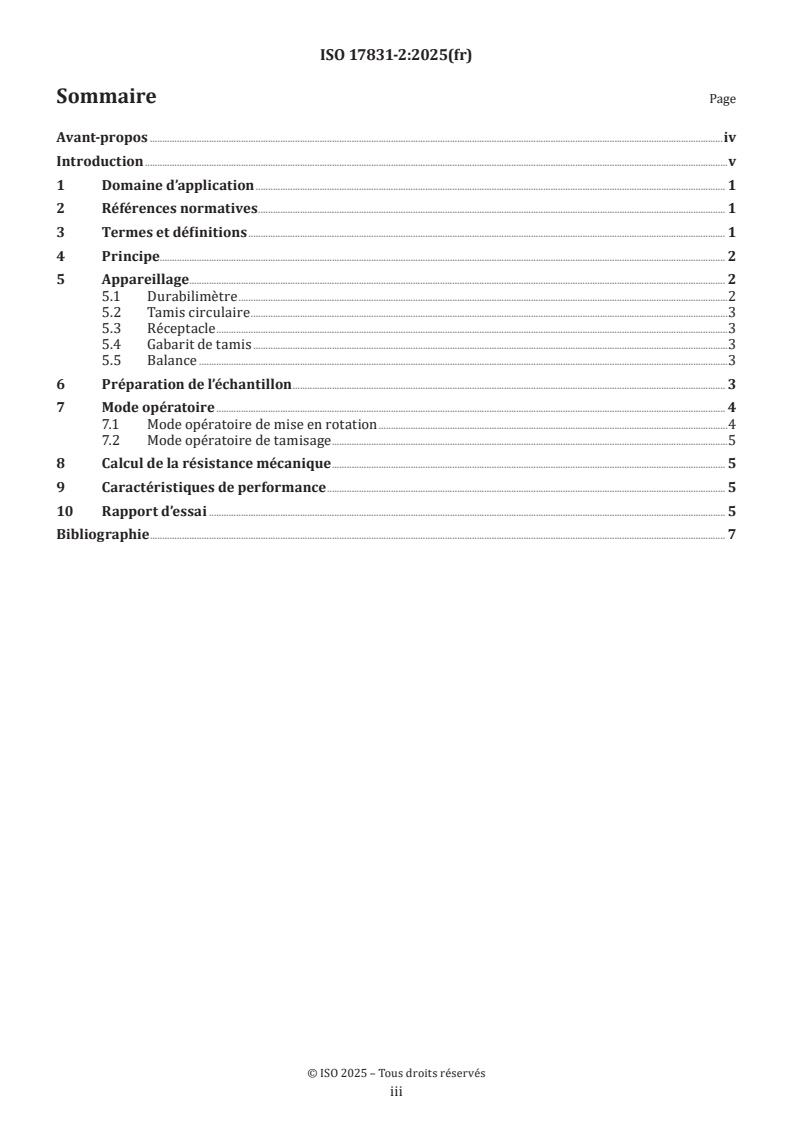
Contents Page
Foreword .iv
Introduction .v
1 Scope . 1
2 Normative references . 1
3 Terms and definitions . 1
4 Principle . 1
5 Apparatus . 2
5.1 Briquette tester . .2
5.2 Circular sieve .3
5.3 Collecting pan .3
5.4 Sieve template .3
5.5 Balance .3
6 Sample preparation . 3
7 Procedure . 4
7.1 Tumbling procedure .4
7.2 Sieving procedure .5
8 Calculation of the mechanical durability . 5
9 Performance characteristics . 5
10 Test report . 5
Bibliography . 6
iii
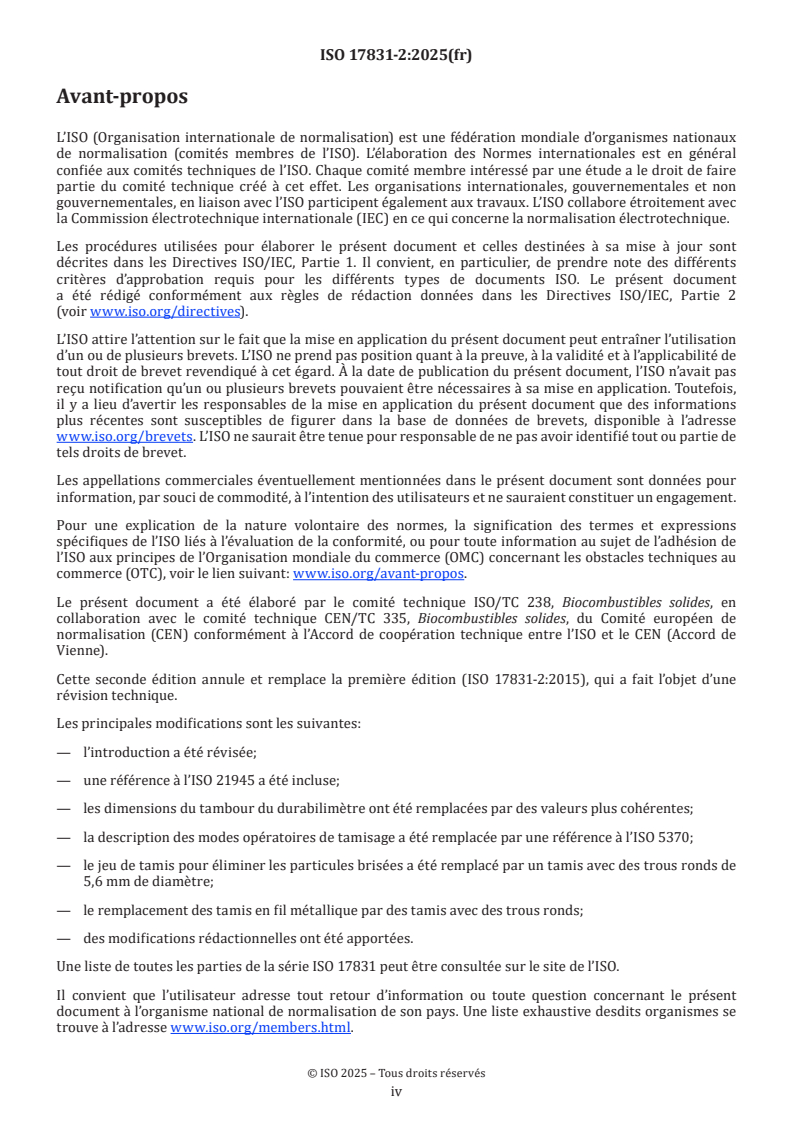
Foreword
ISO (the International Organization for Standardization) is a worldwide federation of national standards
bodies (ISO member bodies). The work of preparing International Standards is normally carried out through
ISO technical committees. Each member body interested in a subject for which a technical committee
has been established has the right to be represented on that committee. International organizations,
governmental and non-governmental, in liaison with ISO, also take part in the work. ISO collaborates closely
with the International Electrotechnical Commission (IEC) on all matters of electrotechnical standardization.
The procedures used to develop this document and those intended for its further maintenance are described
in the ISO/IEC Directives, Part 1. In particular, the different approval criteria needed for the different types
of ISO document should be noted. This document was drafted in accordance with the editorial rules of the
ISO/IEC Directives, Part 2 (see www.iso.org/directives).
ISO draws attention to the possibility that the implementation of this document may involve the use of (a)
patent(s). ISO takes no position concerning the evidence, validity or applicability of any claimed patent
rights in respect thereof. As of the date of publication of this document, ISO had not received notice of (a)
patent(s) which may be required to implement this document. However, implementers are cautioned that
this may not represent the latest information, which may be obtained from the patent database available at
www.iso.org/patents. ISO shall not be held responsible for identifying any or all such patent rights.
Any trade name used in this document is information given for the convenience of users and does not
constitute an endorsement.
For an explanation of the voluntary nature of standards, the meaning of ISO specific terms and expressions
related to conformity assessment, as well as information about ISO's adherence to the World Trade
Organization (WTO) principles in the Technical Barriers to Trade (TBT), see www.iso.org/iso/foreword.html.
This document was prepared by Technical Committee ISO/TC 238, Solid biofuels and pyrogenic biocarbon, in
collaboration with the European Committee for Standardization (CEN) Technical Committee CEN/TC 335,
Solid biofuels and pyrogenic biocarbon, in accordance with the Agreement on technical cooperation between
ISO and CEN (Vienna Agreement).
This second edition cancels and replaces the first edition (ISO 17831-2:2015), which has been technically
revised.
The main changes are as follows:
— introduction has been revised;
— a reference to ISO 21945 has been included;
— dimensions of the drum of the briquette tester have been revised to more consistent values;
— description of sieving procedures has been substituted by a reference to ISO 5370;
— the set of sieves for removing the broken particles has been substituted by a size with 5,6 mm diameter
round holes;
— changing the sieves from metal wire sieves to sieves with round holes;
— editorial changes.
A list of all parts in the ISO 17831 series can be found on the ISO website.
Any feedback or questions on this document should be directed to the user’s national standards body. A
complete listing of these bodies can be found at www.iso.org/members.html.
iv
Introduction
Compressed solid biomass fuel is usually assigned either as pellets or briquettes, of which pellets usually
have a diameter less or equal to 25 mm while for briquettes the diameter is higher (see ISO 17225-1). The
mechanical durability is an important parameter to estimate the tendency to create new fines by abrasion of
pellets or briquettes, respectively, during handling.
To account for the different particle dimensions, it is necessary to specify different test apparatuses for
determination of the mechanical durability of pellets and briquettes.
v
International Standard ISO 17831-2:2025(en)
Solid biofuels — Determination of mechanical durability of
pellets and briquettes —
Part 2:
Briquettes
1 Scope
This document specifies a method for determination of the mechanical durability of briquettes. The
mechanical durability is a measure of the resistance of compressed fuels towards shocks and/or abrasion as
a consequence of handling and transportation.
2 Normative references
The following documents are referred to
...
Norme
internationale
ISO 17831-2
Deuxième édition
Biocombustibles solides —
2025-04
Détermination de la résistance
mécanique des granulés et des
briquettes —
Partie 2:
Briquettes
Solid biofuels — Determination of mechanical durability of
pellets and briquettes —
Part 2: Briquettes
Numéro de référence
DOCUMENT PROTÉGÉ PAR COPYRIGHT
© ISO 2025
Tous droits réservés. Sauf prescription différente ou nécessité dans le contexte de sa mise en œuvre, aucune partie de cette
publication ne peut être reproduite ni utilisée sous quelque forme que ce soit et par aucun procédé, électronique ou mécanique,
y compris la photocopie, ou la diffusion sur l’internet ou sur un intranet, sans autorisation écrite préalable. Une autorisation peut
être demandée à l’ISO à l’adresse ci-après ou au comité membre de l’ISO dans le pays du demandeur.
ISO copyright office
Case postale 401 • Ch. de Blandonnet 8
CH-1214 Vernier, Genève
Tél.: +41 22 749 01 11
E-mail: copyright@iso.org
Web: www.iso.org
Publié en Suisse
ii
Sommaire Page
Avant-propos .iv
Introduction .v
1 Domaine d’application . 1
2 Références normatives . 1
3 Termes et définitions . 1
4 Principe. 2
5 Appareillage . 2
5.1 Durabilimètre .2
5.2 Tamis circulaire .3
5.3 Réceptacle .3
5.4 Gabarit de tamis .3
5.5 Balance .3
6 Préparation de l’échantillon . 3
7 Mode opératoire . 4
7.1 Mode opératoire de mise en rotation .4
7.2 Mode opératoire de tamisage .5
8 Calcul de la résistance mécanique . 5
9 Caractéristiques de performance . 5
10 Rapport d’essai . 5
Bibliographie . 7
iii
Avant-propos
L’ISO (Organisation internationale de normalisation) est une fédération mondiale d’organismes nationaux
de normalisation (comités membres de l’ISO). L’élaboration des Normes internationales est en général
confiée aux comités techniques de l’ISO. Chaque comité membre intéressé par une étude a le droit de faire
partie du comité technique créé à cet effet. Les organisations internationales, gouvernementales et non
gouvernementales, en liaison avec l’ISO participent également aux travaux. L’ISO collabore étroitement avec
la Commission électrotechnique internationale (IEC) en ce qui concerne la normalisation électrotechnique.
Les procédures utilisées pour élaborer le présent document et celles destinées à sa mise à jour sont
décrites dans les Directives ISO/IEC, Partie 1. Il convient, en particulier, de prendre note des différents
critères d’approbation requis pour les différents types de documents ISO. Le présent document
a été rédigé conformément aux règles de rédaction données dans les Directives ISO/IEC, Partie 2
(voir www.iso.org/directives).
L’ISO attire l’attention sur le fait que la mise en application du présent document peut entraîner l’utilisation
d’un ou de plusieurs brevets. L’ISO ne prend pas position quant à la preuve, à la validité et à l’applicabilité de
tout droit de brevet revendiqué à cet égard. À la date de publication du présent document, l’ISO n’avait pas
reçu notification qu’un ou plusieurs brevets pouvaient être nécessaires à sa mise en application. Toutefois,
il y a lieu d’avertir les responsables de la mise en application du présent document que des informations
plus récentes sont susceptibles de figurer dans la base de données de brevets, disponible à l’adresse
www.iso.org/brevets. L’ISO ne saurait être tenue pour responsable de ne pas avoir identifié tout ou partie de
tels droits de brevet.
Les appellations commerciales éventuellement mentionnées dans le présent document sont données pour
information, par souci de commodité, à l’intention des utilisateurs et ne sauraient constituer un engagement.
Pour une explication de la nature volontaire des normes, la signification des termes et expressions
spécifiques de l’ISO liés à l’évaluation de la conformité, ou pour toute information au sujet de l’adhésion de
l’ISO aux principes de l’Organisation mondiale du commerce (OMC) concernant les obstacles techniques au
commerce (OTC), voir le lien suivant: www.iso.org/avant-propos.
Le présent document a été élaboré par le comité technique ISO/TC 238, Biocombustibles solides, en
collaboration avec le comité technique CEN/TC 335, Biocombustibles solides, du Comité européen de
normalisation (CEN) conformément à l’Accord de coopération technique entre l’ISO et le CEN (Accord de
Vienne).
Cette seconde édition annule et remplace la première édition (ISO 17831-2:2015), qui a fait l’objet d’une
révision technique.
Les principales modifications sont les suivantes:
— l’introduction a été révisée;
— une référence à l’ISO 21945 a été incluse;
— les dimensions du tambour du durabilimètre ont été remplacées par des valeurs plus cohérentes;
— la description des modes opératoires de tamisage a été remplacée par une référence à l’ISO 5370;
— le jeu de tamis pour éliminer les particules brisées a été remplacé par un tamis avec des trous ronds de
5,6 mm de diamètre;
— le remplacement des tamis en fil métallique par des tamis avec des trous ronds;
— des modifications rédactionnelles ont été apportées.
Une liste de toutes les parties de la série ISO 17831 peut être consultée sur le site de l’ISO.
Il convient que l’utilisateur adresse tout retour d’information ou toute question concernant le présent
document à l’organisme national de normalisation de son pays. Une liste exhaustive desdits organismes se
trouve à l’adresse www.iso.org/members.html.
iv
Introduction
Les combustibles biomasses solides comprimés sont généralement classés comme étant des granulés ou des
briquettes en fonction de leur diamètre (inférieur ou égal à 25 mm pour les granulés et supérieur pour les
briquettes) (voir l’ISO 17225-1). La résistance mécanique constitue un paramètre important pour estimer la
propension à créer de nouvelles fines en raison du frottement des granulés ou des briquettes pendant leur
manipulation.
Pour prendre en compte les différentes dimensions des particules, il est nécessaire de spécifier différents
appareillages d’essai pour la détermination de la résistance mécanique des granulés et des briquettes.
v
Norme internationale ISO 17831-2:2025(fr)
Biocombustibles solides — Détermination de la résistance
mécanique des granulés et des briquettes —
Partie 2:
Briquettes
1 Domaine d’application
Le présent document spécifie une méthode de détermination de la résistance mécanique des briquettes. La
résistance mécanique est la mesure de la résistance aux chocs et/ou à l’abrasion subis par les combustibles
comprimés, à la suite de processus de manipulation et de transport.
2 Références normatives
Les documents suivants sont cités dans le texte de sorte qu’ils constituent, pour tout ou partie de leur
contenu, des exigences du présent document. Pour les références datées, seule l’édition citée s’applique. Pour
les références non datées, la dernière édition du document de référence s’applique (y compris les éventuels
amendements).
ISO 3310-2, Tamis de contrôle — Exigences techniques et vérifications — Partie 2: Tamis de contrôle en tôles
métalliques perforées
ISO 5370, Biocombustibles solides — Détermination de la teneur en fines des granulés
ISO 14780, Biocombustibles solides
...