


SIST EN 1916:2003/AC:2008
(Corrigendum)Concrete pipes and fittings, unreinforced, steel fibre and reinforced
Concrete pipes and fittings, unreinforced, steel fibre and reinforced
TC Correction of Figure I.1 (this third Corrigendum to EN 1916:2002 contains the text of AC1, AC2 and AC3)
Rohre und Formstücke aus Beton, Stahlfaserbeton und Stahlbeton
Ergänze im ersten Satz "für Anwendung in Leitungen" nach " ... und Stahlbeton, ":
"Diese Europäische Norm legt die in Tabelle 1 angegeben Leistungsanforderungen fest und beschreibt Prüfverfahren für vorgefertigte Rohre und Formstücke aus Beton, Stahlfaserbeton und Stahlbeton für Anwendung in Leitungen mit flexiblen Verbindungen (mit im Bauteil eingebauten oder getrennt mitgelieferten Dichtungen) und Nennweiten nicht über DN 1 750 für Bauteile mit kreisrundem inneren Querschnitt oder WN/HN 1200/1800 für Bauteile mit eiförmigem inneren Querschnitt. Bauteile nach dieser Norm werden im Wesentlichen für den Transport von Abwasser, Regenwasser und Oberflächenwasser als Freispiegelleitungen oder gelegentlich unter geringem Überdruck und in der Regel erdverlegt angewendet."
Tuyaux et pièces complémentaires en béton non armé, béton fibré acier et béton armé
[Not translated]
General Information
- Status
- Published
- Publication Date
- 04-Jun-2008
- Technical Committee
- IOVO - Water supply and waste water engineering
- Current Stage
- 6060 - National Implementation/Publication (Adopted Project)
- Start Date
- 23-May-2008
- Due Date
- 28-Jul-2008
- Completion Date
- 05-Jun-2008
- Directive
- 89/106/EEC - Construction products
Relations
- Replaces
SIST EN 1916:2003/AC:2007 - Concrete pipes and fittings, unreinforced, steel fibre and reinforced - Effective Date
- 22-Dec-2008
- Effective Date
- 01-Jul-2008

Frequently Asked Questions
SIST EN 1916:2003/AC:2008 is a corrigendum published by the Slovenian Institute for Standardization (SIST). Its full title is "Concrete pipes and fittings, unreinforced, steel fibre and reinforced". This standard covers: TC Correction of Figure I.1 (this third Corrigendum to EN 1916:2002 contains the text of AC1, AC2 and AC3)
TC Correction of Figure I.1 (this third Corrigendum to EN 1916:2002 contains the text of AC1, AC2 and AC3)
SIST EN 1916:2003/AC:2008 is classified under the following ICS (International Classification for Standards) categories: 23.040.50 - Pipes and fittings of other materials; 93.030 - External sewage systems. The ICS classification helps identify the subject area and facilitates finding related standards.
SIST EN 1916:2003/AC:2008 has the following relationships with other standards: It is inter standard links to SIST EN 1916:2003/AC:2007, SIST EN 1916:2003. Understanding these relationships helps ensure you are using the most current and applicable version of the standard.
SIST EN 1916:2003/AC:2008 is associated with the following European legislation: EU Directives/Regulations: 305/2011, 89/106/EEC, 93/38/EEC; Standardization Mandates: M/118, M/131. When a standard is cited in the Official Journal of the European Union, products manufactured in conformity with it benefit from a presumption of conformity with the essential requirements of the corresponding EU directive or regulation.
SIST EN 1916:2003/AC:2008 is available in PDF format for immediate download after purchase. The document can be added to your cart and obtained through the secure checkout process. Digital delivery ensures instant access to the complete standard document.
Standards Content (Sample)
2003-01.Slovenski inštitut za standardizacijo. Razmnoževanje celote ali delov tega standarda ni dovoljeno.Concrete pipes and fittings, unreinforced, steel fibre and reinforced[Not translated]Tuyaux et pièces complémentaires en béton non armé, béton fibré acier et béton arméRohre und Formstücke aus Beton, Stahlfaserbeton und Stahlbeton93.030Zunanji sistemi za odpadno vodoExternal sewage systems23.040.50Cevi in fitingi iz drugih materialovPipes and fittings of other materialsICS:SIST EN 1916:2003/AC:2008en,fr,deTa slovenski standard je istoveten z:EN 1916:2002/AC:200801-julij-2008SIST EN 1916:2003/AC:2008SLOVENSKI
STANDARD
EUROPEAN STANDARDNORME EUROPÉENNEEUROPÄISCHE NORMEN 1916:2002/ACApril 2008Avril 2008April 2008ICS 23.040.50; 93.030English versionVersion FrançaiseDeutsche FassungConcrete pipes and fittings, unreinforced, steel fibre and reinforcedTuyaux et pièces complémentaires enbéton non armé, béton fibré acier et bétonarméRohre und Formstücke aus Beton,Stahlfaserbeton und StahlbetonThis corrigendum becomes effective on 23 April 2008 for incorporation in the three official languageversions of the EN.Ce corrigendum prendra effet le 23 avril 2008 pour incorporation dans les trois versions linguistiquesofficielles de la EN.Die Berichtigung tritt am 23.April 2008 zur Einarbeitung in die drei offiziellen Sprachfassungen der ENin Kraft.EUROPEAN COMMITTEE FOR STANDARDIZATIONCOMITÉ EUROPÉEN DE NORMALISATIONEUROPÄISCHES KOMITEE FÜR NORMUNGManagement Centre: rue de Stassart, 36
B-1050 Brussels© 2008 CENAll rights of exploitation in any form and by any means reserved worldwide for CEN national Members.Tous droits d'exploitation sous quelque forme et de quelque manière que ce soit réservés dans le monde entier auxmembres nationaux du CEN.Alle Rechte der Verwertung, gleich in welcher Form und in welchem Verfahren, sind weltweit den nationalen Mitgliedernvon CEN vorbehalten.Ref. No.:EN 1916:2002/AC:2008 D/E/F
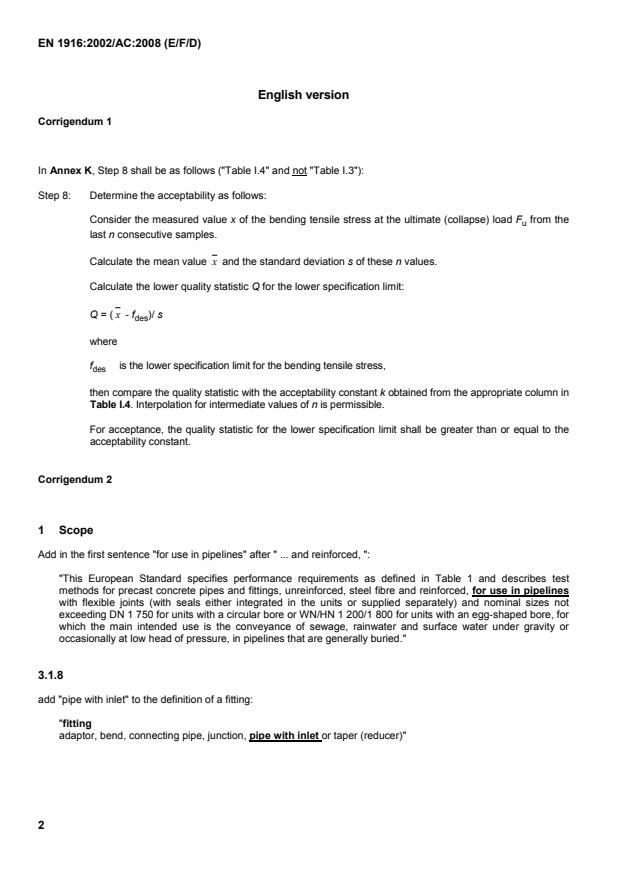
Corrigendum 1
In Annex K, Step 8 shall be as follows ("Table I.4" and not "Table I.3"): Step 8: Determine the acceptability as follows:
Consider the measured value x of the bending tensile stress at the ultimate (collapse) load Fu from the last n consecutive samples.
Calculate the mean value x and the standard deviation s of these n values.
Calculate the lower quality statistic Q for the lower specification limit:
Q = (x - fdes)/ s
where
fdes is the lower specification limit for the bending tensile stress,
then compare the quality statistic with the acceptability constant k obtained from the appropriate column in Table I.4. Interpolation for intermediate values of n is permissible.
For acceptance, the quality statistic for the lower specification limit shall be greater than or equal to the acceptability constant.
Corrigendum 2
1 Scope
Add in the first sentence "for use in pipelines" after " . and reinforced, ":
"This European Standard specifies performance requirements as defined in Table 1 and describes test methods for precast concrete pipes and fittings, unreinforced, steel fibre and reinforced, for use in pipelines with flexible joints (with seals either integrated in the units or supplied separately) and nominal sizes not exceeding DN 1 750 for units with a circular bore or WN/HN 1 200/1 800 for units with an egg-shaped bore, for which the main intended use is the conveyance of sewage, rainwater and surface water under gravity or occasionally at low head of pressure, in pipelines that are generally buried."
3.1.8
add "pipe with inlet" to the definition of a fitting:
"fitting adaptor, bend, connecting pipe, junction, pipe with inlet or taper (reducer)"
Add the words "that have been" after "pipes" in the first sentence:
"Reinforced concrete pipes that have been tested only to proof (crack) load in accordance with 6.4 and meeting the requirements of 5.2.3 conform to this European Standard."
6.8 Concrete strength in jacking pipes
Correct the conversion factor for drilled 50 mm ± 1 mm diameter cores from 0,9 into 1,07:
"The drilled cores shall have a height equal to their diameter ± 10 mm:
when 100 mm ± 1 mm diameter cores are used, the result shall be applied without any conversion factor;
when 50 mm ± 1 mm diameter cores are used, a conversion factor of 1,07 shall be applied to the results."
A.2.5.2.1 Preliminaries
Correct the formula for δmax:
"The specific force/deformation diagram shall then be used to determine the change in the maximum deformation ∆δmax caused by a unit force Fd, then the maximum deformation δmax calculated from the following equation:
δmax = δ2 + ∆δmax"
A.2.5.2.2 Evaluation of effective tightened width (Method 1)
Insert the words "used in A.2.5.2.1" after "test piece" in the first sentence:
The test piece used in A.2.5.2.1 shall be placed in the apparatus at an ambient temperature of 20 °C ± 3 °C, compressed to a deformation equal to δmin and the relevant tightening force F and effective tightened width bt measured and recorded.
A.2.6.2 Mean pressure (Method 1)
Correct de definition of f:
"f is the mean pressure, in megapascals (newtons per square millimetre);"
A.3.3.1 Method 1 Correct in the title of Figure A.2 the reference to table A.3:
Figure A.2 — Basic assumptions for the example in Table A.3
Replace figures C.2a and C.2b by the following:
Figure C.2 a) Figure C.2 b)
(not for pipes DN ≤ 1 200) Figure C.2 c)
Figure C.2 — Typical arrangements for the crushing test on circular pipes
Annex E: E.4 Procedure (hydrostatic test - routine and initial type tests)
Add reference to Method 4 in first sentence:
"Where the durability of joints is demonstrated by either Method 1, Method 3 or Method 4 in 4.3.4.2, a single unit shall be clamped securely in the apparatus, its ends closed and then filled with water, taking care to ensure that all the air is removed. The internal hydrostatic pressure shall then be raised gradually to 50 kPa (0,5 bar or approximately 5 metre water column), measured from the centre-line of the unit, and maintained for a period of 15 minutes, during which time the unit shall be evaluated for conformity to 4.3.7, before reducing the internal pressure to zero."
Annex E: E.5.2 Watertightness during angular deflection
Clarify the procedure for preventing the joint gap from closing by deleting the word "mean" in the 3rd sentence:
"The units shall be deflected to an angular deflection of 12 500/DN (or 12 500/WN, as appropriate to the shape of the bore) in millimetres per metre or 50 millimetres per metre, whichever is the smaller, taking care to ensure that no structural damage is caused. In the case of egg-shaped units the deflection shall be in the vertical plane. During this operation the joint gap shall be prevented from closing at any point by, for example, interposing at the appropriate place a packing with a thickness equal to the [ ] value of the clearance stated in the factory documents.
Take into account that the pipe submitted to the watertightness test is not necessary completely filled with water: Add after the formula for Rs and the definition of Ww:
"Where the pipe is completely filled with water the value of Rs shall be calculated according to the following formula:
Rs = (Fs - Ww / 2) × l1 /( l1 - as) ≥ 0, in kilonewtons
where
Ww is the weight of one unit filled with water, in kilonewtons
Where the full length of the pipe bore is not filled with water the formula shall be adjusted accordingly."
Annex F: F.4.1 Determination of mass of immersed sample m1
Clarify the procedure of immerging the sample, by inserting the word "minimum" to the 2nd sentence:
"The sample shall be brought to a temperature of 20 °C ± 3 °C, then immersed in tap water at the same temperature until a constant mass has been reached. This shall be achieved in stages by successively immersing the sample at intervals of one hour to approximately 1/3 of the height, approximately 2/3 of the height and the total height, with a minimum final water level of 20 mm above the top surface of the sample."
Annex H: Table H.1:
Correct sampling procedures for concrete cover according to clauses 5.2.2 and 5.3.3: - by replacing the frequency 1 N for the initial type test by 1 S; - by adding the word "using" before "covermeter" for the initial type test; - by replacing the reference to 5.2.3 by the word "collapse" for the routine inspection.
Table H.1 — Sampling procedures Clause Test when specified Initial type test Routine inspection 5.2.2 and 5.3.3 Concrete cover 1 S using every pipe that has been type-tested to 5.2.3, or using covermeter for other units every pipe that has been tested to collapse and, using covermeter, 2 N/day
Clarify sampling procedure for initial type test of joint assembly by adding " or, at the manufacturer's discretion, one such pair of units with the most unfavourable tolerances."
Clarify sampling procedure for joint assembly tests under routine inspection by adding "joint assembly of a" before ". pair of units.":
Table H.2 — Sampling procedures for joint assembly tests Tests
1) Angular deflection and
2) shear load,
or
3) angular deflection and shear load combined. Initial type test Routine inspection (where Method 1, 3 or 4 has been used in 4.3.4.2 to demonstrate the durability of joints) Two pairs of units from the same group: - having the same seal profile section; - having the same joint profile that is effective when jointing, or, at the manufacturer's discretion, one such pair of units with the most unfavourable tolerances. One joint assembly of a pair of units from the same group per 1 000 produced but not less than one test per year: - having the same seal profile section; - having the same joint profile that is effective when jointing; or, at the manufacturer's discretion, if the initial type test has been successfully carried out with the most unfavourable tolerances, it is permissible to verify only joint and joint seal profile dimensions at a frequency as stated in the factory documents, but not less than: - one unit per 25 produced for each nominal size and type; - one unit per day for each nominal size and type.
Correct symbol for the standard deviation in the last lozenge of the right branch of the flow chart (δ → σ).
Figure I.1 — Flow chart for inspection of ultimate (collapse) load
on the basis of individual assessments (excluding inspection of unreinforced pipes using the Annex K option and basic inspection of reinforced pipes)
Annex I: I.4: Figure I.1
Replace Figure I.1 with the following, where in the first line of the last lozenge in the right branch of the flow chart in the equitation for the mean value xn, the minus (-) was replaced by plus (+).
Figure I.1 — Flow chart for inspection of ultimate (collapse) load
on the basis of individual assessments (excluding inspection of unreinforced pipes using the Annex K option and basic inspection of reinforced pipes)
Corrigendum 2
1 Domaine d'application
Ajoutez dans la première frase "pour utilisation dans des conduites" après " . et béton armé, ":
"La présente norme européenne spécifie les exigences performancielles définies au Tableau 1 et décrit les méthodes d'essai relatives aux tuyaux et pièces complémentaires préfabriqués en béton non armé, béton fibré acier et béton armé, pour utilisations en canalisations à assemblages souples (avec garnitures d'étanchéité intégrées à l'élément ou fournies séparément), dont la dimension nominale ne dépasse pas DN 1750 dans le cas des éléments de section intérieure circulaire ou WN/HN 1200/1800 dans le cas des éléments de section ovoïde, et destinés principalement à véhiculer, dans des canalisations généralement enterrées, des eaux usées, des eaux pluviales et des eaux de surface par écoulement gravitaire ou, occasionnellement, sous faible pression."
3.1.8
Ajoutez "tuyau avec orifice d'entrée" à la définition d'une pièce complémentaire:
"pièce complémentaire
adaptateur, coude, tuyau de raccordement, tuyau avec branchement, tuyau avec orifice d'entrée ou élément de réduction"
6.8 Résistance du béton des tuyaux de fonçage
Changez le coefficient de conversion pour les carottes d'un diamètre de 50 mm ± 1 mm d de 0,9 à 1,07:
"La hauteur des carottes doit être égale à leur diamètre ± 10 mm :
lorsqu'on utilise des carottes d'un diamètre de 100 mm ± 1 mm, le résultat doit être exploité sans coefficient de conversion ;
lorsqu'on utilise des carottes d'un diamètre de 50 mm ± 1 mm, on doit appliquer un coefficient de conversion égal à 1,07."
7.2.2 Essais de type initiaux
Remplacez les mots "au démarrage d'une nouvelle fabrication" par "au démarrage de la fabrication d'un nouveau type":
"Les essais de type initiaux doivent être effectués pour démontrer la conformité des éléments à la présente Norme européenne : Les essais effectués antérieurement selon les prescriptions de la présente norme (même produit ou groupe spécifié de produits, mêmes caractéristiques, même méthode d’échantillonnage et essai identique ou plus exigeants) peuvent être pris en compte. Des essais de type initiaux doivent aussi être effectués :
au démarrage de la fabrication d'un nouveau type"
Corrigez la formule pour δmax:
Le diagramme effort/déformation spécifique doit alors être utilisé pour déterminer la variation de la déformation maximale ∆δmax engendrée par un effort unitaire Fd et on calcule ensuite la déformation maximale δmax à l'aide de l'équation suivante :
δmax = δ2 + ∆δmax"
Annexe A: A.2.5.2.2 Evaluation de la largeur comprimée effective (Méthode 1)
Insérez les mots "utilisée sous A.2.5.2.1" après "éprouvette" dans la première frase:
L'éprouvette utilisée sous A.2.5.2.1 doit être placée dans l'appareillage à une température ambiante de 20 °C ± 3 °C et comprimée pour atteindre une déformation égale à
δmin; on note l'effort de serrage F et la largeur comprimée effective bt mesurés.
Annexe A: A.2.6.2 Pression moyenne (méthode 1)
Corrigez la définition de f:
f est la pression moyenne, en mégapascal (newton par millimètre carré);
Remplacez la Figure A.1 par la suivante:
Légende X Déformation Y Force par unité de longueur de garniture
Figure A.1 — Diagramme effort/déformation spécifique admis pour les exemples et pris en compte pour la détermination de ∆∆∆∆δδδδmin (méthode 1) ou ∆∆∆∆δδδδmax (méthode 2)
Annexe A: A.3.2 Méthode 2
Corrigez les formules pour K, δ1 et δ2:
()2sps2sos2sp2so2j2ûdûdûdûdûhK++++= ()()m2sp2so2jspsom1210022h/ûdûdûhddh/××++−+−= ()()m2sp2so2jspsom2210022h/ûdûdûhddh/××++++−=
A.3.3.1 Méthode 1 Insérer l'intitulé de la Figure A.2:
Figure A.2 — Hyptohèses de base admises pour l'exemple du tableau A.3
Remplacez p par π dans les formules de la surface comprimée Ac:
()42i2ec/ddA×−= dans le cas des assemblages à manchette []42i2'e2'i2ec/ddddA×−+−= dans le cas des assemblages à mi-épaisseur
Annexe B: B.4.2 Calculs
Ajoutez "=" après "π/4" dans l'exemple de calcul de la surface comprimée Ac:
Ac = (de2 - di2) × π/4 = (1,7352 - 1,5002) × π/4 = 0,597 m2;
Remplacez figures C.1 et C.2 et C.3 par les figures suivantes et ajoutez les intitulés "Figure C.2.a", "Figure C.2.b", "Figure C.2.c", Figure "C.3.a" et Figure C.3.b":
Figure C.1 — Appuis in
...
Questions, Comments and Discussion
Ask us and Technical Secretary will try to provide an answer. You can facilitate discussion about the standard in here.
Loading comments...