

SIST EN ISO 13647:2026
(Main)Water quality - Enumeration of culturable microorganisms - Colony count by spread plate inoculation on R2A medium (ISO 13647:2026)
- Abstract
This document specifies a method for the enumeration of culturable microorganisms in water by counting colonies on a low-nutrient agar culture medium by spread plate inoculation after incubation at 22 °C for 7 d.
This document is applicable to:
water from the treatment process of public drinking water supplies (e.g. process water in the waterworks);
chlorinated and non-chlorinated tap water in distribution systems and containers;
bottled water;
well water intended for human consumption.
For detailed information on the performance characteristics, see Annex B.
This document can be applied to other water matrices if the appropriate validation of performance of this method has been undertaken by the laboratory prior to use.
- Status
- Published
- Public Enquiry End Date
- 02-Jun-2025
- Publication Date
- 27-Aug-2026
- Technical Committee
- KAV - Water quality
- Current Stage
- 6060 - National Implementation/Publication (Adopted Project)
- Start Date
- 27-Aug-2026
- Due Date
- 01-Nov-2026
- Completion Date
- 28-Aug-2026

SIST EN ISO 13647:2026 is the Slovenian adoption of EN ISO 13647:2026 and ISO 13647:2026. It specifies a laboratory method for enumerating culturable microorganisms in water by spread plate inoculation on R2A medium after incubation at 22 °C for 7 d. In practice, it is used to monitor drinking water quality, check treatment performance, and follow changes in distribution systems and bottled water.
What does SIST EN ISO 13647:2026 specify?
SIST EN ISO 13647:2026 specifies a colony count method for culturable microorganisms in water using a low-nutrient agar medium, spread plate inoculation, and incubation at 22 °C. The scope covers water from drinking water treatment works, chlorinated and non-chlorinated tap water, bottled water, and well water intended for human consumption.
The method can also be used for other water matrices when the laboratory has validated the performance for that case before use. Annex B gives the performance characteristics, so users can judge whether the method fits their water type and decision needs.
| Annex | What it covers |
|---|---|
| Annex A | Composition, preparation and performance testing of the culture medium |
| Annex B | Performance characteristics |
| Annex C | Additional information about colony counting methods for heterotrophic plate counting |
| Annex D | Determination of acceptable time between sampling and analysis |
The document is organized into clauses for scope, normative references, terms and definitions, principle, medium and diluents, equipment, sampling, procedure, result expression, test report, and quality assurance.
What are the key requirements of SIST EN ISO 13647:2026?
SIST EN ISO 13647:2026 is built around a simple workflow: prepare the sample, inoculate R2A plates by the spread plate technique, incubate them, count visible colonies, and report the result as cfu/ml. The details matter because colony recovery depends strongly on the medium, the inoculum volume, the storage time before analysis, and how the plates are read.
Principle and counting
Clause 4 states that a test portion or dilution is spread on the surface of the specified medium in Petri dishes, then incubated at (22 ± 2) °C for (164 ± 4) h. Visible colonies are counted as culturable microorganisms, and the result is calculated as colony forming units per millilitre.
The document notes that the spread plate technique keeps colonies on the agar surface, which helps separate them from particles and bubbles. It also notes that the low-nutrient medium slows fast growers and makes slower growers easier to see, which matters when the water has low microbial numbers.
Medium, diluents and equipment
Clause 5 requires good laboratory practice and use of the medium and diluents specified in ISO 8199 and ISO 11133. Annex A gives the composition, preparation and performance testing of R2A medium, and commercially available medium may be used if it conforms and the manufacturer’s instructions are followed.
Clause 6 lists the equipment that supports reliable results: sterilization by steam, a controlled incubator, a pH meter, magnifying equipment for colony counting, and refrigerated storage for samples. The document also allows disposable equipment where suitable, and it notes that higher magnification can reduce counting variability.
Sampling, transport and incubation
Clause 7 requires sampling and transport in line with ISO 19458 and ISO 5667-5. Samples are stored and transported at 5 °C, and the document allows analysis up to 24 h after sampling while still recommending the shortest practical delay.
Clause 8 gives the handling steps in more detail. The sample is prepared and diluted as in ISO 8199, the plates are dried before use, and 0.1 ml of sample or dilution is spread on a 90 mm Petri dish. The clause also says that other dish diameters can be used if their performance has been demonstrated.
Reading the plates
Clause 8.3 requires incubation at (22 ± 2) °C and counting without delay after incubation. If immediate examination is not possible, the plates are stored and handled as directed in ISO 8199. The clause also allows an early reading after about 72 h to observe growth speed, followed by the full incubation period for the final count.
Results, reporting and quality assurance
Clause 9 requires results to be expressed as cfu/ml in accordance with ISO 8199, and it gives a detection limit of 10 cfu/ml when 0.1 ml is used. When dilutions are used, the result is calculated as a weighted mean, and measurement uncertainty is linked to ISO 29201.
Clause 10 sets out the test report contents, including sample identification, the test method, the reported result, deviations, unusual occurrences that could affect the result, and the test date. Clause 11 requires a laboratory quality control system, including suitable equipment, culture medium, diluents, techniques, control strains and blanks.
What terms does SIST EN ISO 13647:2026 define?
- culturable microorganism - aerobic bacteria, yeast or mould capable of forming colonies on a culture medium.
- colony forming unit (cfu) - the count unit used for the colonies recovered from the sample and reported per millilitre.
- Reasoner’s 2 Agar (R2A) - the low-nutrient agar medium used in this method for colony enumeration.
- spread plate technique - the inoculation method where a measured sample volume is spread over the agar surface.
- productivity ratio (P_R) - the performance measure used in Annex A when testing the medium for recovery.
- WDCM - World Data Centre for Microorganisms, the source used in Annex A for reference strain identification.
Who uses SIST EN ISO 13647:2026?
SIST EN ISO 13647:2026 is used by water microbiology laboratories, drinking water operators, bottled water producers, and laboratories that support quality control for human consumption water. It is also relevant to quality managers and technical buyers who need a method for routine surveillance, treatment-process monitoring, or checking changes in distribution systems. The document is especially useful where low-nutrient water gives low colony counts and slower-growing microorganisms need time to appear.
Which standards are used with SIST EN ISO 13647:2026?
- ISO 5667-5 - guidance for sampling drinking water from treatment works and piped distribution systems.
- ISO 8199:2018 - general requirements for microbiological examinations by culture, including diluents, spread plate practice, result expression and storage guidance.
- ISO 11133 - preparation, production, storage and performance testing of culture media, especially for Annex A and quality assurance.
- ISO 19458 - sampling for microbiological analysis, including transport and storage.
- ISO 29201 - estimation of measurement uncertainty for microbiological enumeration methods.
- ISO 13843:2017 - framework used for establishing quantitative microbiological method performance characteristics.
- ISO 17994:2014 - comparison of relative recovery, used in the sampling-to-analysis timing study in Annex D.
- ISO 6222 - cited as the nutrient-rich heterotrophic plate count method used for comparison with R2A results.
What does the SIST EN ISO 13647:2026 document contain?
SIST EN ISO 13647:2026 contains the full laboratory workflow from sample handling to reporting. The main clauses cover the principle, medium, equipment, sampling, spread plate inoculation, incubation, colony counting, result expression, test report and quality assurance.
Annex A gives the R2A medium formulation and how to prepare and verify it. Annex B summarizes performance characteristics from a laboratory study, including recovery, precision and robustness. Annex C compares spread plate inoculation with pour plate and membrane filtration approaches for heterotrophic plate counting. Annex D explains the study used to support the acceptable time between sampling and analysis.
Frequently Asked Questions
SIST EN ISO 13647:2026 is a standard published by the Slovenian Institute for Standardization (SIST). Its full title is "Water quality - Enumeration of culturable microorganisms - Colony count by spread plate inoculation on R2A medium (ISO 13647:2026)". This standard covers: This document specifies a method for the enumeration of culturable microorganisms in water by counting colonies on a low-nutrient agar culture medium by spread plate inoculation after incubation at 22 °C for 7 d. This document is applicable to: water from the treatment process of public drinking water supplies (e.g. process water in the waterworks); chlorinated and non-chlorinated tap water in distribution systems and containers; bottled water; well water intended for human consumption. For detailed information on the performance characteristics, see Annex B. This document can be applied to other water matrices if the appropriate validation of performance of this method has been undertaken by the laboratory prior to use.
This document specifies a method for the enumeration of culturable microorganisms in water by counting colonies on a low-nutrient agar culture medium by spread plate inoculation after incubation at 22 °C for 7 d. This document is applicable to: water from the treatment process of public drinking water supplies (e.g. process water in the waterworks); chlorinated and non-chlorinated tap water in distribution systems and containers; bottled water; well water intended for human consumption. For detailed information on the performance characteristics, see Annex B. This document can be applied to other water matrices if the appropriate validation of performance of this method has been undertaken by the laboratory prior to use.
SIST EN ISO 13647:2026 is classified under the following ICS (International Classification for Standards) categories: 07.100.20 - Microbiology of water. The ICS classification helps identify the subject area and facilitates finding related standards.
SIST EN ISO 13647:2026 is available in PDF format for immediate download after purchase. The document can be added to your cart and obtained through the secure checkout process. Digital delivery ensures instant access to the complete standard document.
Standards Content (Sample)
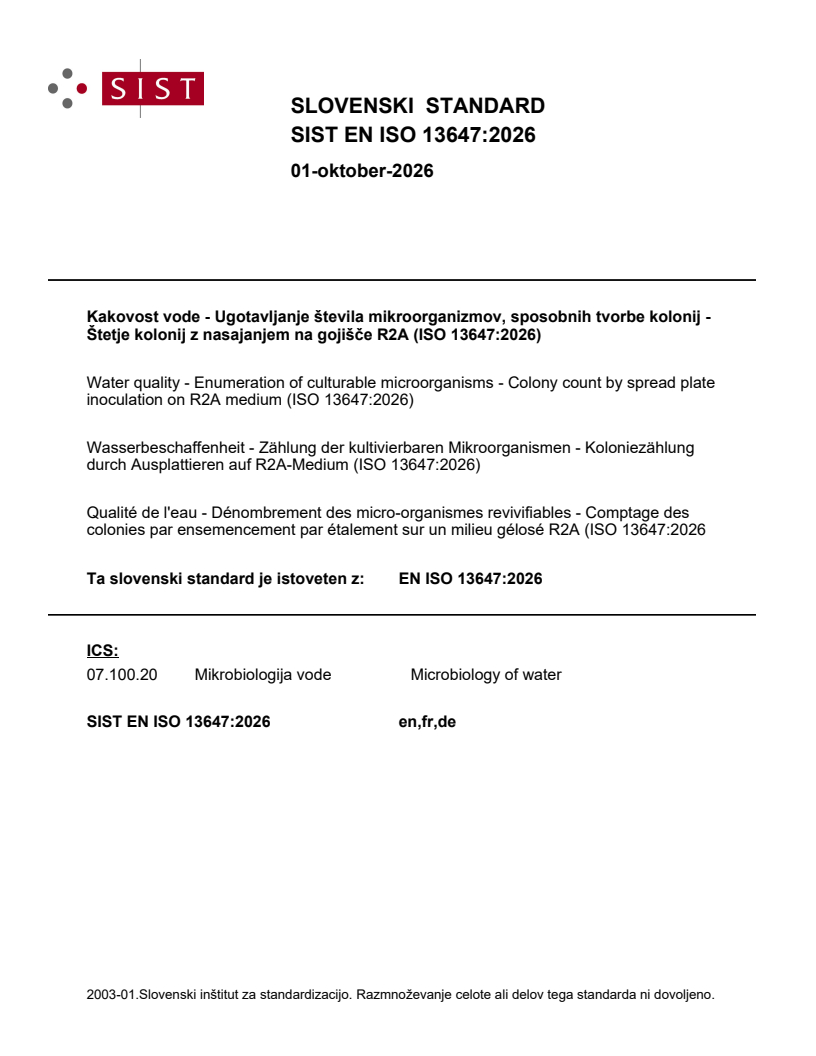
SLOVENSKI STANDARD
01-oktober-2026
Kakovost vode - Ugotavljanje števila mikroorganizmov, sposobnih tvorbe kolonij -
Štetje kolonij z nasajanjem na gojišče R2A (ISO 13647:2026)
Water quality - Enumeration of culturable microorganisms - Colony count by spread plate
inoculation on R2A medium (ISO 13647:2026)
Wasserbeschaffenheit - Zählung der kultivierbaren Mikroorganismen - Koloniezählung
durch Ausplattieren auf R2A-Medium (ISO 13647:2026)
Qualité de l'eau - Dénombrement des micro-organismes revivifiables - Comptage des
colonies par ensemencement par étalement sur un milieu gélosé R2A (ISO 13647:2026
Ta slovenski standard je istoveten z: EN ISO 13647:2026
ICS:
07.100.20 Mikrobiologija vode Microbiology of water
2003-01.Slovenski inštitut za standardizacijo. Razmnoževanje celote ali delov tega standarda ni dovoljeno.
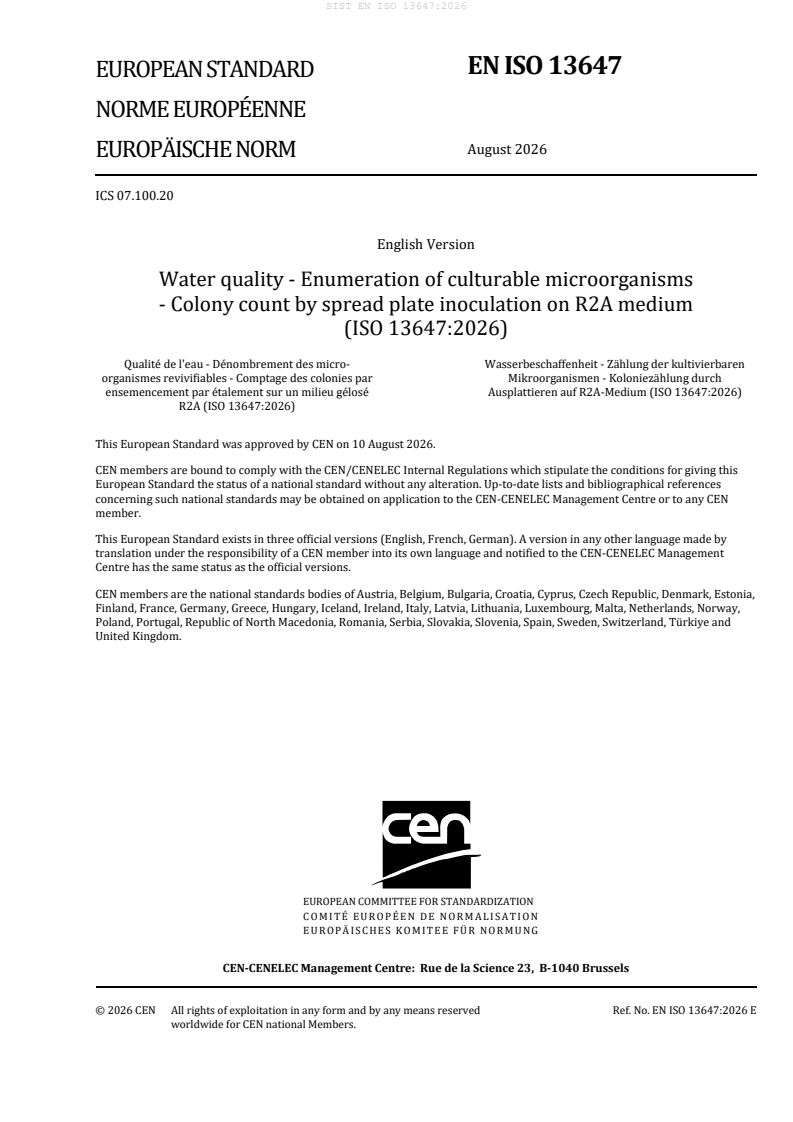
EN ISO 13647
EUROPEAN STANDARD
NORME EUROPÉENNE
August 2026
EUROPÄISCHE NORM
ICS 07.100.20
English Version
Water quality - Enumeration of culturable microorganisms
- Colony count by spread plate inoculation on R2A medium
(ISO 13647:2026)
Qualité de l'eau - Dénombrement des micro- Wasserbeschaffenheit - Zählung der kultivierbaren
organismes revivifiables - Comptage des colonies par Mikroorganismen - Koloniezählung durch
ensemencement par étalement sur un milieu gélosé Ausplattieren auf R2A-Medium (ISO 13647:2026)
R2A (ISO 13647:2026)
This European Standard was approved by CEN on 10 August 2026.
CEN members are bound to comply with the CEN/CENELEC Internal Regulations which stipulate the conditions for giving this
European Standard the status of a national standard without any alteration. Up-to-date lists and bibliographical references
concerning such national standards may be obtained on application to the CEN-CENELEC Management Centre or to any CEN
member.
This European Standard exists in three official versions (English, French, German). A version in any other language made by
translation under the responsibility of a CEN member into its own language and notified to the CEN-CENELEC Management
Centre has the same status as the official versions.
CEN members are the national standards bodies of Austria, Belgium, Bulgaria, Croatia, Cyprus, Czech Republic, Denmark, Estonia,
Finland, France, Germany, Greece, Hungary, Iceland, Ireland, Italy, Latvia, Lithuania, Luxembourg, Malta, Netherlands, Norway,
Poland, Portugal, Republic of North Macedonia, Romania, Serbia, Slovakia, Slovenia, Spain, Sweden, Switzerland, Türkiye and
United Kingdom.
EUROPEAN COMMITTEE FOR STANDARDIZATION
COMITÉ EUROPÉEN DE NORMALISATION
EUROPÄISCHES KOMITEE FÜR NORMUNG
CEN-CENELEC Management Centre: Rue de la Science 23, B-1040 Brussels
© 2026 CEN All rights of exploitation in any form and by any means reserved Ref. No. EN ISO 13647:2026 E
worldwide for CEN national Members.
Contents Page
European foreword . 3
European foreword
This document (EN ISO 13647:2026) has been prepared by Technical Committee ISO/TC 147 "Water
quality" in collaboration with Technical Committee CEN/TC 230 “Water analysis” the secretariat of
which is held by DIN.
This European Standard shall be given the status of a national standard, either by publication of an
identical text or by endorsement, at the latest by February 2027, and conflicting national standards
shall be withdrawn at the latest by February 2027.
Attention is drawn to the possibility that some of the elements of this document may be the subject of
patent rights. CEN shall not be held responsible for identifying any or all such patent rights.
Any feedback and questions on this document should be directed to the users’ national standards
body/national committee. A complete listing of these bodies can be found on the CEN website.
According to the CEN-CENELEC Internal Regulations, the national standards organizations of the
following countries are bound to implement this European Standard: Austria, Belgium, Bulgaria,
Croatia, Cyprus, Czech Republic, Denmark, Estonia, Finland, France, Germany, Greece, Hungary, Iceland,
Ireland, Italy, Latvia, Lithuania, Luxembourg, Malta, Netherlands, Norway, Poland, Portugal, Republic of
North Macedonia, Romania, Serbia, Slovakia, Slovenia, Spain, Sweden, Switzerland, Türkiye and the
United Kingdom.
Endorsement notice
The text of ISO 13647:2026 has been approved by CEN as EN ISO 13647:2026 without any modification.
International
Standard
ISO 13647
First edition
Water quality — Enumeration
2026-08
of culturable microorganisms
— Colony count by spread plate
inoculation on R2A medium
Qualité de l'eau — Dénombrement des micro-organismes
revivifiables — Comptage des colonies par ensemencement par
étalement sur un milieu gélosé R2A
Reference number
ISO 13647:2026(en) © ISO 2026
ISO 13647:2026(en)
© ISO 2026
All rights reserved. Unless otherwise specified, or required in the context of its implementation, no part of this publication may
be reproduced or utilized otherwise in any form or by any means, electronic or mechanical, including photocopying, or posting on
the internet or an intranet, without prior written permission. Permission can be requested from either ISO at the address below
or ISO’s member body in the country of the requester.
ISO copyright office
CP 401 • Ch. de Blandonnet 8
CH-1214 Vernier, Geneva
Phone: +41 22 749 01 11
Email: copyright@iso.org
Website: www.iso.org
Published in Switzerland
ii
ISO 13647:2026(en)
Contents Page
Foreword .iv
Introduction .v
1 Scope . 1
2 Normative references . 1
3 Terms and definitions . 1
4 Principle . 2
5 Culture medium and diluents . 2
6 Equipment and consumables . 2
7 Sampling, transport and storage . . 3
8 Procedure . 3
8.1 Preparation of the sample .3
8.2 Inoculation .3
8.3 Incubation and counting of colonies .3
9 Expression of results . 3
10 Test report . 4
11 Quality assurance . 4
Annex A (normative) Composition, preparation and performance testing of culture medium . 5
Annex B (informative) Performance characteristics . 7
Annex C (informative) Additional information about colony counting methods for heterotrophic
plate counting . 8
Annex D (informative) Determination of acceptable time between sampling and analysis . 9
Bibliography .11
iii
ISO 13647:2026(en)
Foreword
ISO (the International Organization for Standardization) is a worldwide federation of national standards
bodies (ISO member bodies). The work of preparing International Standards is normally carried out through
ISO technical committees. Each member body interested in a subject for which a technical committee
has been established has the right to be represented on that committee. International organizations,
governmental and non-governmental, in liaison with ISO, also take part in the work. ISO collaborates closely
with the International Electrotechnical Commission (IEC) on all matters of electrotechnical standardization.
The procedures used to develop this document and those intended for its further maintenance are described
in the ISO/IEC Directives, Part 1. In particular, the different approval criteria needed for the different types
of ISO document should be noted. This document was drafted in accordance with the editorial rules of the
ISO/IEC Directives, Part 2 (see www.iso.org/directives).
ISO draws attention to the possibility that the implementation of this document may involve the use of (a)
patent(s). ISO takes no position concerning the evidence, validity or applicability of any claimed patent
rights in respect thereof. As of the date of publication of this document, ISO had not received notice of (a)
patent(s) which may be required to implement this document. However, implementers are cautioned that
this may not represent the latest information, which may be obtained from the patent database available at
www.iso.org/patents. ISO shall not be held responsible for identifying any or all such patent rights.
Any trade name used in this document is information given for the convenience of users and does not
constitute an endorsement.
For an explanation of the voluntary nature of standards, the meaning of ISO specific terms and expressions
related to conformity assessment, as well as information about ISO's adherence to the World Trade
Organization (WTO) principles in the Technical Barriers to Trade (TBT), see www.iso.org/iso/foreword.html.
This document was prepared by Technical Committee ISO/TC 147, Water quality, Subcommittee SC 4,
Microbiological methods, in collaboration with the European Committee for Standardization (CEN) Technical
Committee CEN/TC 230, Water analysis, in accordance with the Agreement on technical cooperation between
ISO and CEN (Vienna Agreement).
Any feedback or questions on this document should be directed to the user’s national standards body. A
complete listing of these bodies can be found at www.iso.org/members.html.
iv
ISO 13647:2026(en)
Introduction
Treated drinking water contains a variety of microorganisms derived from various sources, such as raw
water resource, different treatment steps within drinking water production and drinking water distribution
networks.
Enumeration of the overall colony count of culturable microorganisms provides useful information for the
assessment and surveillance of water quality. Colony counts are useful for assessing the raw water quality
and efficiency of water treatment processes and provide an indication of the cleanliness and integrity of the
drinking water distribution systems.
However, the main value of colony counts lies in the detection of changes from the expected values, based
on representative monitoring. The change in colony counts can be caused for various reasons like biofilm
formation, increase in water temperature, presence of microbially available nutrients or decrease in chlorine
concentration. Any substantial increase in count can also be either a warning of potential treatment failure
or contamination.
Nutrient rich tryptone yeast extract agar medium has been used for long time in water microbiology.
ISO 6222 provides a monitoring method for heterotrophic plate counts in tap water quality verification.
However, ISO 6222 only applies to the detection of microorganisms in nutrient rich conditions at 22 °C in 3 d
or at 36 °C in 2 d.
Reasoner’s 2 agar (R2A) medium, which has a low-nutrient composition and long incubation time (7 d at
22 °C), enables the determination of micro-organisms forming colonies after a longer incubation time.
Furthermore, the low level of nutrients in the medium minimizes the colony size and overgrowth. Therefore,
the R2A method is especially suitable for providing more information on the enumeration of heterotrophic
colony counts in water with low colony counts.
The method is well suited for monitoring water for human consumption which is low in nutrients and is
distributed in temperatures below 20 °C (see Reference [1]), for example, to measure the operational
efficiency of the treatment process of public drinking water supplies. The low-nutrient agar specified in this
document for enumeration of culturable microorganisms usually gives higher colony counts from water
samples than typically used nutrient-rich formulations of culture media (see References [2], [3] and [4]).
v
International Standard ISO 13647:2026(en)
Water quality — Enumeration of culturable microorganisms
— Colony count by spread plate inoculation on R2A medium
WARNING — Persons using this document should be familiar with normal laboratory practice. This
document does not purport to address all of the safety concerns, if any, associated with its use. It is
the responsibility of the user to establish appropriate safety and health practices.
IMPORTANT — The tests in this document shall be carried out by suitably qualified staff.
1 Scope
This document specifies a method for the enumeration of culturable microorganisms in water by counting
colonies on a low-nutrient agar culture medium by spread plate inoculation after incubation at 22 °C for 7 d.
This document is applicable to:
— water from the treatment process of public drinking water supplies (e.g. process water in the waterworks);
— chlorinated and non-chlorinated tap water in distribution systems and containers;
— bottled water;
— well water intended for human consumption.
For detailed information on the performance characteristics, see Annex B.
This document can be applied to other water matrices if the appropriate validation of performance of this
method has been undertaken by the laboratory prior to use.
2 Normative references
The following documents are referred to in the text in such a way that some or all of their content constitutes
requirements of this document. For dated references, only the edition cited applies. For undated references,
the latest edition of the referenced document (including any amendments) applies.
ISO 5667-5, Water quality — Sampling — Part 5: Guidance on sampling of drinking water from treatment works
and piped distribution systems
ISO 8199:2018, Water quality — General requirements and guidance for microbiological examinations by culture
ISO 11133, Microbiology of food, animal feed and water — Preparation, production, storage and performance
testing of culture media
ISO 19458, Water quality — Sampling for microbiological analysis
3 Terms and definitions
For the purposes of this document, the following terms and definitions apply.
ISO and IEC maintain terminology databases for use in standardization at the following addresses:
— ISO Online browsing platform: available at https:// www .iso .org/ obp
— IEC Electropedia: available at https:// www .electropedia .org/
ISO 13647:2026(en)
3.1
culturable microorganism
aerobic bacteria, yeast or mould capable of forming colonies on a culture medium
4 Principle
A test portion of the sample or dilutions of the sample are inoculated on the surface of a specified culture
medium (see Annex A) in Petri dishes by spread plate technique.
Plates are incubated at (22 ± 2) °C for (164 ± 4) h.
All visible colonies are counted using a magnifying equipment as culturable microorganisms. The colony
forming unit (cfu) per millilitre (ml) of the sample is calculated from the number of colonies counted.
NOTE 1 The spread plate technique causes no heat shock and all colonies are on top of the agar surface where they
can be distinguished readily from particles and bubbles.
NOTE 2 The low-nutrient agar in use in this document prevents the plates from becoming overgrown by faster
growing microorganisms and allows the slower growing microorganisms to become apparent due to the longer
incubation time.
NOTE 3 For certain purposes such as for waters with very low nutrient content such as de-ionised, distilled or
reverse osmosis waters (see References [5], [6] and [7]), colony counting can be done with the pour plate technique or
membrane filtration instead of the spread plate technique. For more information, see Annex C and ISO 8199.
5 Culture medium and diluents
Follow good laboratory practices in accordance with ISO 8199. Use ingredients of uniform quality and
chemicals of analytical grade. For composition, preparation and performance testing of culture medium,
follow the instructions given in Annex A and ISO 11133. Alternatively, use commercially available medium
which conforms with the composition given in Annex A and strictly follow the manufacturer’s instructions.
NOTE This document describes the use of R2A medium (see Refer
...