

oSIST prEN ISO 8102-20:2026
(Main)Electrical requirements for lifts, escalators and moving walks - Part 20: Cybersecurity (ISO/DIS 8102-20:2026)
General Information
- Abstract
This document specifies cybersecurity requirements for new lifts, escalators and moving walks, referred to in this document as “equipment under control (EUC)”, designed in accordance with the ISO 8100 series. It is also applicable with other lift, escalator and moving walk standards that specify similar requirements, and to other lift-related equipment connected to the EUC.
This document specifies product and system requirements related to cybersecurity threats in the following lifecycle steps:
— product development (process and product requirements);
— manufacturing;
— installation;
— operation and maintenance;
— decommissioning.
This document addresses the roles of product supplier and system integrator as shown in IEC 62443-4-1:2018, Figure 2, for the EUC.
This document does not address the role of asset owner as shown in IEC 62443-4-1:2018, Figure 2, but defines requirements for the product supplier and system integrator of the EUC to establish documentation allowing the asset owner, referred to as the “EUC owner” in this document, to achieve and maintain the security of the EUC.
This document specifies the minimum cybersecurity requirements for:
— essential functions;
— safety functions;
— alarm functions.
This document is applicable to EUCs that are capable of connectivity to external systems such as building networks, cloud services, or service tools. The capability to connectivity can exist through equipment permanently available on site, or equipment temporarily brought to the location during the installation, operation and maintenance, or decommissioning steps.
EUC interfaces to external systems and services are in the scope of this document. External systems and services as such are out of the scope of this document.
This document does not apply to EUC that are installed before the date of its publication.
- Status
- Not Published
- Public Enquiry End Date
- 21-Jun-2026
- Technical Committee
- DTN - Lift and transport appliances
- Current Stage
- 4020 - Public enquire (PE) (Adopted Project)
- Start Date
- 15-Apr-2026
- Due Date
- 02-Sep-2026
- Completion Date
- 08-Jul-2026

Overview
oSIST prEN ISO 8102-20:2026:2026 – Electrical requirements for lifts, escalators and moving walks - Part 20: Cybersecurity (ISO/DIS 8102-20:2026) is a draft European and international standard developed by CEN and ISO. This standard specifies minimum cybersecurity requirements for new lifts, escalators, and moving walks, collectively referred to as equipment under control (EUC). These requirements address the entire product lifecycle, including development, manufacturing, installation, operation, maintenance, and decommissioning, to protect against cybersecurity threats. The standard applies to equipment designed in accordance with the ISO 8100 series and EUC with capabilities for connectivity to external systems such as building networks, service tools, or cloud services.
oSIST prEN ISO 8102-20:2026:2026 outlines the responsibilities of both product suppliers and system integrators, ensuring robust cybersecurity processes and documentation are in place for the benefit of EUC owners.
Key Topics
Lifecycle Cybersecurity
The standard covers cybersecurity requirements at each stage of the product lifecycle:- Product development, including both process and product aspects
- Manufacturing security considerations
- Secure installation practices
- Operational and maintenance security
- Secure decommissioning
Product and System-Level Security
- Requirements are set for both individual product components and integrated systems.
- Emphasis on essential, safety, and alarm functions which are vital for maintaining operational safety and compliance.
Roles and Responsibilities
- Focuses on product suppliers and system integrators as per the IEC 62443-4-1 model.
- Provides documentation necessary for the EUC owner to maintain and achieve ongoing cybersecurity.
Connectivity and Interfaces
- Applies to EUC with connectivity to external systems (on-site or remote).
- Covers security requirements for EUC interfaces to external services, while the external systems themselves fall outside the scope.
Secure Development Lifecycle
- Aligns with best practices and references IEC 62443 for secure product development processes, continuous improvement, and risk management.
- Specifies guidelines for secure by design, secure implementation, threat modeling, vulnerability handling, and security verification.
Applications
Lift and Escalator Manufacturers
Manufacturers must implement secure development processes, ensuring their products meet the minimum cybersecurity requirements specified in this standard.System Integrators
Integrators are responsible for maintaining cybersecurity during system assembly and installation, as well as ensuring compliance in interconnected environments.Building Owners and Facility Managers
Although requirements for asset owners are not directly specified, the standard mandates that product suppliers and integrators provide sufficient documentation so that building or facility owners (EUC owners) can achieve and maintain the security of lifts, escalators, and moving walks.Service and Maintenance Providers
Service providers must use secure practices, especially when interfacing with or updating systems connected to external networks.Regulatory Compliance
The standard supports regulatory compliance in line with the latest EU regulations, addressing essential cybersecurity and safety requirements for passenger and goods lifts, escalators, and moving walks.
Related Standards
ISO 8100 Series
Covers general requirements for lifts, escalators, and moving walks, establishing the safety and performance framework into which cybersecurity is integrated.IEC 62443 Series
Industry-leading standards for industrial automation and control systems security. oSIST prEN ISO 8102-20:2026 references IEC 62443-4-1 (secure product development lifecycle), 62443-3-2 (security risk assessment), and related standards for terminology and system requirements.Other Lift and Escalator Standards
The standard is applicable alongside other relevant lift, escalator, and moving walk standards, provided they specify similar cybersecurity requirements.
By complying with oSIST prEN ISO 8102-20:2026:2026, stakeholders across the lift and escalator industry can ensure robust protection of critical infrastructure against evolving cybersecurity threats, supporting safe and secure operation throughout the lifecycle of their equipment.
Relations
- Effective Date
- 28-Jan-2026
Get Certified
Connect with accredited certification bodies for this standard

BSI Group
BSI (British Standards Institution) is the business standards company that helps organizations make excellence a habit.

Bureau Veritas
Bureau Veritas is a world leader in laboratory testing, inspection and certification services.

DNV
DNV is an independent assurance and risk management provider.
Sponsored listings
Frequently Asked Questions
oSIST prEN ISO 8102-20:2026 is a draft published by the Slovenian Institute for Standardization (SIST). Its full title is "Electrical requirements for lifts, escalators and moving walks - Part 20: Cybersecurity (ISO/DIS 8102-20:2026)". This standard covers: This document specifies cybersecurity requirements for new lifts, escalators and moving walks, referred to in this document as “equipment under control (EUC)”, designed in accordance with the ISO 8100 series. It is also applicable with other lift, escalator and moving walk standards that specify similar requirements, and to other lift-related equipment connected to the EUC. This document specifies product and system requirements related to cybersecurity threats in the following lifecycle steps: — product development (process and product requirements); — manufacturing; — installation; — operation and maintenance; — decommissioning. This document addresses the roles of product supplier and system integrator as shown in IEC 62443-4-1:2018, Figure 2, for the EUC. This document does not address the role of asset owner as shown in IEC 62443-4-1:2018, Figure 2, but defines requirements for the product supplier and system integrator of the EUC to establish documentation allowing the asset owner, referred to as the “EUC owner” in this document, to achieve and maintain the security of the EUC. This document specifies the minimum cybersecurity requirements for: — essential functions; — safety functions; — alarm functions. This document is applicable to EUCs that are capable of connectivity to external systems such as building networks, cloud services, or service tools. The capability to connectivity can exist through equipment permanently available on site, or equipment temporarily brought to the location during the installation, operation and maintenance, or decommissioning steps. EUC interfaces to external systems and services are in the scope of this document. External systems and services as such are out of the scope of this document. This document does not apply to EUC that are installed before the date of its publication.
This document specifies cybersecurity requirements for new lifts, escalators and moving walks, referred to in this document as “equipment under control (EUC)”, designed in accordance with the ISO 8100 series. It is also applicable with other lift, escalator and moving walk standards that specify similar requirements, and to other lift-related equipment connected to the EUC. This document specifies product and system requirements related to cybersecurity threats in the following lifecycle steps: — product development (process and product requirements); — manufacturing; — installation; — operation and maintenance; — decommissioning. This document addresses the roles of product supplier and system integrator as shown in IEC 62443-4-1:2018, Figure 2, for the EUC. This document does not address the role of asset owner as shown in IEC 62443-4-1:2018, Figure 2, but defines requirements for the product supplier and system integrator of the EUC to establish documentation allowing the asset owner, referred to as the “EUC owner” in this document, to achieve and maintain the security of the EUC. This document specifies the minimum cybersecurity requirements for: — essential functions; — safety functions; — alarm functions. This document is applicable to EUCs that are capable of connectivity to external systems such as building networks, cloud services, or service tools. The capability to connectivity can exist through equipment permanently available on site, or equipment temporarily brought to the location during the installation, operation and maintenance, or decommissioning steps. EUC interfaces to external systems and services are in the scope of this document. External systems and services as such are out of the scope of this document. This document does not apply to EUC that are installed before the date of its publication.
oSIST prEN ISO 8102-20:2026 is classified under the following ICS (International Classification for Standards) categories: 35.030 - IT Security; 91.140.90 - Lifts. Escalators. The ICS classification helps identify the subject area and facilitates finding related standards.
oSIST prEN ISO 8102-20:2026 has the following relationships with other standards: It is inter standard links to SIST EN ISO 6185-3:2024. Understanding these relationships helps ensure you are using the most current and applicable version of the standard.
oSIST prEN ISO 8102-20:2026 is associated with the following European legislation: EU Directives/Regulations: 2014/33/EU, 2023/1230; Standardization Mandates: M/605, M/622. When a standard is cited in the Official Journal of the European Union, products manufactured in conformity with it benefit from a presumption of conformity with the essential requirements of the corresponding EU directive or regulation.
oSIST prEN ISO 8102-20:2026 is available in PDF format for immediate download after purchase. The document can be added to your cart and obtained through the secure checkout process. Digital delivery ensures instant access to the complete standard document.
Standards Content (Sample)
SLOVENSKI STANDARD
01-junij-2026
Električne zahteve za dvigala (lifte), tekoče stopnice in tekoče steze - 20. del:
Kibernetska varnost (ISO/DIS 8102-20:2026)
Electrical requirements for lifts, escalators and moving walks - Part 20: Cybersecurity
(ISO/DIS 8102-20:2026)
Elektrische Anforderungen für Aufzüge, Fahrtreppen und Fahrsteige - Teil 20:
Cybersicherheit (ISO/DIS 8102-20:2026)
Exigences électriques pour les ascenseurs, les escaliers mécaniques et les trottoirs
roulants - Partie 20 : Cybersécurité (ISO/DIS 8102-20:2026)
Ta slovenski standard je istoveten z: prEN ISO 8102-20
ICS:
35.030 Informacijska varnost IT Security
91.140.90 Dvigala. Tekoče stopnice Lifts. Escalators
2003-01.Slovenski inštitut za standardizacijo. Razmnoževanje celote ali delov tega standarda ni dovoljeno.
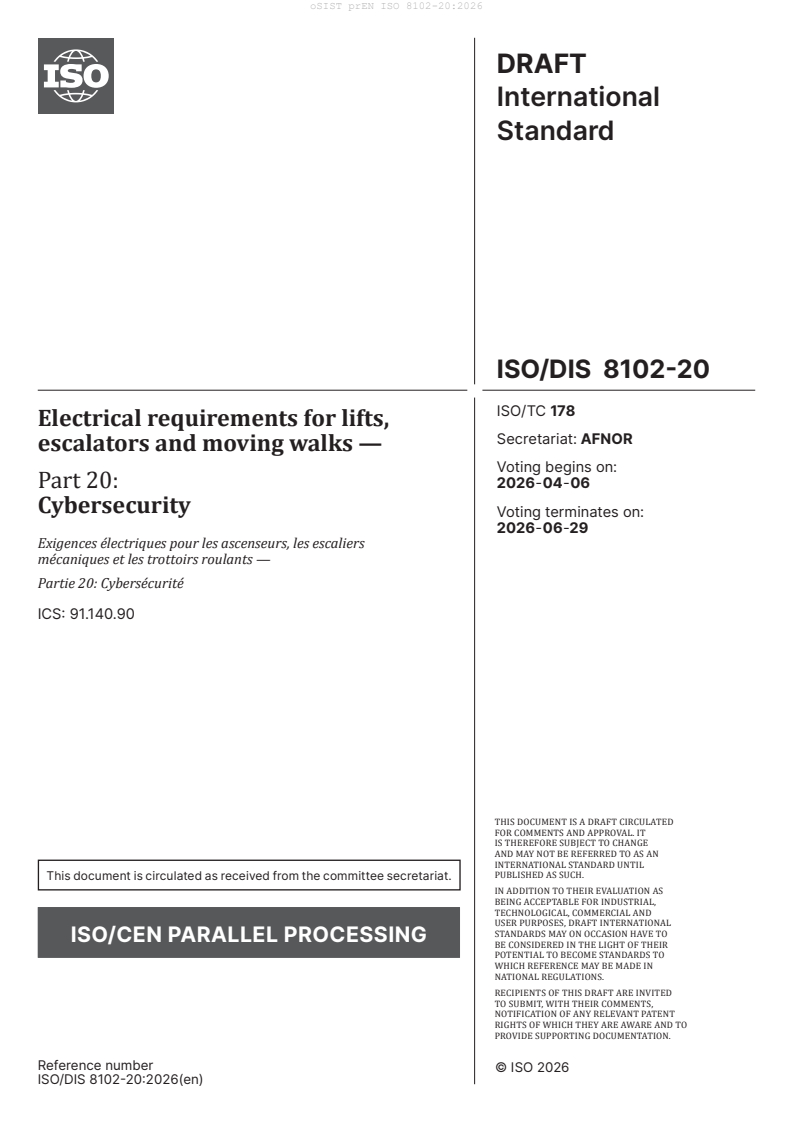
DRAFT
International
Standard
ISO/DIS 8102-20
ISO/TC 178
Electrical requirements for lifts,
Secretariat: AFNOR
escalators and moving walks —
Voting begins on:
Part 20: 2026-04-06
Cybersecurity
Voting terminates on:
2026-06-29
Exigences électriques pour les ascenseurs, les escaliers
mécaniques et les trottoirs roulants —
Partie 20: Cybersécurité
ICS: 91.140.90
THIS DOCUMENT IS A DRAFT CIRCULATED
FOR COMMENTS AND APPROVAL. IT
IS THEREFORE SUBJECT TO CHANGE
AND MAY NOT BE REFERRED TO AS AN
INTERNATIONAL STANDARD UNTIL
PUBLISHED AS SUCH.
This document is circulated as received from the committee secretariat.
IN ADDITION TO THEIR EVALUATION AS
BEING ACCEPTABLE FOR INDUSTRIAL,
TECHNOLOGICAL, COMMERCIAL AND
USER PURPOSES, DRAFT INTERNATIONAL
STANDARDS MAY ON OCCASION HAVE TO
ISO/CEN PARALLEL PROCESSING
BE CONSIDERED IN THE LIGHT OF THEIR
POTENTIAL TO BECOME STANDARDS TO
WHICH REFERENCE MAY BE MADE IN
NATIONAL REGULATIONS.
RECIPIENTS OF THIS DRAFT ARE INVITED
TO SUBMIT, WITH THEIR COMMENTS,
NOTIFICATION OF ANY RELEVANT PATENT
RIGHTS OF WHICH THEY ARE AWARE AND TO
PROVIDE SUPPORTING DOCUMENTATION.
Reference number
ISO/DIS 8102-20:2026(en)
DRAFT
ISO/DIS 8102-20:2026(en)
International
Standard
ISO/DIS 8102-20
ISO/TC 178
Electrical requirements for lifts,
Secretariat: AFNOR
escalators and moving walks —
Voting begins on:
Part 20:
Cybersecurity
Voting terminates on:
Exigences électriques pour les ascenseurs, les escaliers
mécaniques et les trottoirs roulants —
Partie 20: Cybersécurité
ICS: 91.140.90
THIS DOCUMENT IS A DRAFT CIRCULATED
FOR COMMENTS AND APPROVAL. IT
IS THEREFORE SUBJECT TO CHANGE
AND MAY NOT BE REFERRED TO AS AN
INTERNATIONAL STANDARD UNTIL
PUBLISHED AS SUCH.
This document is circulated as received from the committee secretariat.
IN ADDITION TO THEIR EVALUATION AS
BEING ACCEPTABLE FOR INDUSTRIAL,
© ISO 2026
TECHNOLOGICAL, COMMERCIAL AND
USER PURPOSES, DRAFT INTERNATIONAL
All rights reserved. Unless otherwise specified, or required in the context of its implementation, no part of this publication may
STANDARDS MAY ON OCCASION HAVE TO
ISO/CEN PARALLEL PROCESSING
be reproduced or utilized otherwise in any form or by any means, electronic or mechanical, including photocopying, or posting on
BE CONSIDERED IN THE LIGHT OF THEIR
the internet or an intranet, without prior written permission. Permission can be requested from either ISO at the address below
POTENTIAL TO BECOME STANDARDS TO
WHICH REFERENCE MAY BE MADE IN
or ISO’s member body in the country of the requester.
NATIONAL REGULATIONS.
ISO copyright office
RECIPIENTS OF THIS DRAFT ARE INVITED
CP 401 • Ch. de Blandonnet 8
TO SUBMIT, WITH THEIR COMMENTS,
CH-1214 Vernier, Geneva
NOTIFICATION OF ANY RELEVANT PATENT
Phone: +41 22 749 01 11
RIGHTS OF WHICH THEY ARE AWARE AND TO
PROVIDE SUPPORTING DOCUMENTATION.
Email: copyright@iso.org
Website: www.iso.org
Published in Switzerland Reference number
ISO/DIS 8102-20:2026(en)
ii
ISO/DIS 8102-20:2026(en)
Contents Page
Foreword .vi
Introduction .vii
1 Scope . 1
2 Normative references . 1
3 Terms, definitions and abbreviated terms . 2
3.1 Terms and definitions .2
3.2 Abbreviated terms .3
4 Secure development lifecycle . 3
4.1 General .3
4.2 Security management .4
4.2.1 Development process .4
4.2.2 Identification of responsibilities .4
4.2.3 Identification of applicability .4
4.2.4 Security expertise .4
4.2.5 Process scoping .4
4.2.6 File integrity .4
4.2.7 Development environment security .4
4.2.8 Controls for private keys .4
4.2.9 Security requirements for externally provided components .4
4.2.10 Custom developed components from third-party suppliers .4
4.2.11 Assessing and addressing security-related issues .4
4.2.12 Process verification .5
4.2.13 Continuous improvement .5
4.3 Specification of security requirements .5
4.3.1 Product security context . .5
4.3.2 Threat model .5
4.3.3 Product security requirements .5
4.3.4 Product security requirements content .5
4.3.5 Security requirements review .5
4.4 Secure by design .5
4.4.1 Secure design principles.5
4.4.2 Defense in depth design .5
4.4.3 Security design review .5
4.4.4 Secure design best practices .5
4.5 Secure implementation .5
4.5.1 Security implementation review .5
4.5.2 Secure coding standards .6
4.6 Security verification and validation testing .6
4.6.1 Security requirements testing .6
4.6.2 Threat mitigation testing .6
4.6.3 Vulnerability testing .6
4.6.4 Penetration testing .6
4.6.5 Independence of testers .6
4.7 Management of security-related issues.6
4.7.1 Receiving notifications of security-related issues .6
4.7.2 Reviewing security-related issues .6
4.7.3 Assessing security-related issues .6
4.7.4 Addressing security-related issues .6
4.7.5 Disclosing security-related issues .6
4.7.6 Periodic review of security defect management practice .6
4.8 Security update management .7
4.8.1 Security update qualification .7
4.8.2 Security update documentation .7
4.8.3 Dependent component or operating system security update documentation.7
iii
ISO/DIS 8102-20:2026(en)
4.8.4 Security update delivery .7
4.8.5 Timely delivery of security patches .7
4.9 Security guidelines .7
4.9.1 Product defense in depth .7
4.9.2 Defense in depth measures expected in the environment .7
4.9.3 Security hardening guidelines .7
4.9.4 Secure disposal guidelines .7
4.9.5 Secure operation guidelines.8
4.9.6 Account management guidelines .8
4.9.7 Documentation review .8
5 EUC requirements . 8
5.1 General .8
5.2 Foundational requirements .8
5.3 Domains of the EUC functions .8
5.4 EUC security level requirements .8
5.5 Support of essential functions .9
5.6 Compensating countermeasures . .9
5.7 Least privilege .10
5.8 Software development process . .10
5.9 Software Updates .10
5.9.1 General .10
5.9.2 Initiation .10
5.9.3 Delivery.10
5.9.4 Protection of persons .10
5.9.5 Compatibility check .11
5.9.6 Activation .11
5.9.7 Validation .11
5.9.8 Completion of software update . 12
5.9.9 Recovery from validation failure . 12
5.9.10 Auditing and reporting . 12
6 Information for use .13
6.1 General . 13
6.2 Instructions to achieve and maintain security .14
6.3 Instructions for software update .14
7 Additional security requirements .15
7.1 General . 15
7.2 Software bill of materials . 15
7.3 Reset of the EUC to secure by default configuration . 15
7.4 Factory reset of EUC components . 15
7.5 Data minimisation .16
7.6 Impact on availability of external services .16
7.7 Opt-out mechanism .16
7.8 Additional information for use . .16
Annex A (informative) Additional information on secure development lifecycle for lifts,
escalators and moving walks . 17
Annex B (informative) Additional information on security risk assessment .28
Annex C (informative) List of security practices .31
Annex D (informative) Guidance for evaluating internal and external EUC interfaces .33
Annex E (informative) Example of a software update sequence .36
Annex F (informative) Relationship between this European Standard and the essential
cybersecurity requirements of Regulation (EU) 2024/2847 .38
Annex ZA (informative) Relationship between this European Standard and the essential
requirements of Regulation (EU) 2023/1230 aimed to be covered .44
iv
ISO/DIS 8102-20:2026(en)
Bibliography .45
v
ISO/DIS 8102-20:2026(en)
Foreword
ISO (the International Organization for Standardization) is a worldwide federation of national standards
bodies (ISO member bodies). The work of preparing International Standards is normally carried out through
ISO technical committees. Each member body interested in a subject for which a technical committee
has been established has the right to be represented on that committee. International organizations,
governmental and non-governmental, in liaison with ISO, also take part in the work. ISO collaborates closely
with the International Electrotechnical Commission (IEC) on all matters of electrotechnical standardization.
The procedures used to develop this document and those intended for its further maintenance are described
in the ISO/IEC Directives, Part 1. In particular, the different approval criteria needed for the different types
of ISO documents should be noted. This document was drafted in accordance with the editorial rules of the
ISO/IEC Directives, Part 2 (see www.iso.org/directives).
Attention is drawn to the possibility that some of the elements of this document may be the subject of patent
rights. ISO shall not be held responsible for identifying any or all such patent rights. Details of any patent
rights identified during the development of the document will be in the Introduction and/or on the ISO list of
patent declarations received (see www.iso.org/patents).
Any trade name used in this document is information given for the convenience of users and does not
constitute an endorsement.
For an explanation of the voluntary nature of standards, the meaning of ISO specific terms and expressions
related to conformity assessment, as well as information about ISO's adherence to the World Trade
Organization (WTO) principles in the Technical Barriers to Trade (TBT), see www.iso.org/iso/foreword.html.
This document was prepared by Technical Committee ISO/TC 178, Lifts, escalators and moving walks.
A list of all parts in the ISO 8102 series can be found on the ISO website.
Any feedback or questions on this document should be directed to the user’s national standards body. A
complete listing of these bodies can be found at www.iso.org/members.html.
vi
ISO/DIS 8102-20:2026(en)
Introduction
This document is a product security publication (see IEC Guide 120:2018).
This document has been developed in response to market requirements and enhanced cybersecurity
awareness. The state of the art cybersecurity standard for operational technology is the IEC 62443 series.
This document addresses the requirements specific to lifts, escalators and moving walks when applying the
IEC 62443 series. The term "lifts" includes:
— lifts for the transport of persons and goods;
— lifts for the transport of goods only;
— special lifts (lifting appliances) for the transport of persons and goods.
The fundamental principle of cybersecurity is a strong cybersecurity process lifecycle. This lifecycle needs
to include adequate training, tools, resources, and processes to develop, harden and maintain the resiliency
of the equipment under control (EUC) against cyber-attacks. The lifecycle approach is also a fundamental
premise of best practices utilized for various cybersecurity standards and approaches.
vii
DRAFT International Standard ISO/DIS 8102-20:2026(en)
Electrical requirements for lifts, escalators and moving
walks —
Part 20:
Cybersecurity
1 Scope
This document specifies cybersecurity requirements for new lifts, escalators and moving walks, referred
to in this document as “equipment under control (EUC)”, designed in accordance with the ISO 8100 series,
as well as the required information for use. It is also applicable with other lift, escalator and moving walk
standards that specify similar requirements, and can be applied to EUC components or to other EUC-related
equipment connected to the EUC.
This document specifies requirements related to cybersecurity in the following lifecycle steps:
— product development (process and product requirements);
— manufacturing;
— installation;
— operation and maintenance;
— decommissioning.
This document addresses EUC requirements relevant to the roles of product supplier and system integrator
as shown in IEC 62443-4-1:2018, Figure 2.
This document does not address the role of asset owner as shown in IEC 62443-4-1:2018, Figure 2, but
defines requirements for the information for use of the EUC which is relevant to the asset owner to achieve
and maintain the security of the EUC.
This document is applicable to EUCs that are capable of connectivity to external systems such as building
networks, cloud services, or service tools. The capability of connectivity can exist through equipment
permanently available on site, or equipment temporarily brought to the location during the installation,
operation and maintenance, or decommissioning steps.
EUC interfaces to external systems and services are in the scope of this document. External systems and
services as such are out of the scope of this document.
This document does not apply to EUC that are installed before the date of its publication.
2 Normative references
The following documents are referred to in the text in such a way that some or all of their content constitutes
requirements of this document. For dated references, only the edition cited applies. For undated references,
the latest edition of the referenced document (including any amendments) applies.
IEC 62443-3-2:2020, Security for industrial automation and control systems — Part 3-2: Security risk
assessment for system design
IEC 62443-3-3:2013, Industrial communication networks — Network and system security — Part 3-3: System
security requirements and security levels
ISO/DIS 8102-20:2026(en)
IEC 62443-4-1:2018, Security for industrial automation and control systems — Part 4-1: Secure product
development lifecycle requirements
IEC 62443-4-2:2019, Security for industrial automation and control systems — Part 4-2: Technical security
requirements for IACS components
IEC/TS 62443-1-1:2009, Industrial communication networks — Network and system security — Part 1-1:
Terminology, concepts and models
3 Terms, definitions and abbreviated terms
3.1 Terms and definitions
For the purposes of this document, the terms and definitions given in IEC/TS 62443-1-1:2009 and
IEC 62443-3-2:2020 and the following apply.
ISO and IEC maintain terminology databases for use in standardization at the following addresses:
— ISO Online browsing platform: available at https:// www .iso .org/ obp
— IEC Electropedia: available at https:// www .electropedia .org/
3.1.1
cybersecurity
measures taken to protect a computer or computer system against unauthorized access or attack
Note 1 to entry: In this document, the term "security" includes cybersecurity.
[SOURCE: IEC 62443-3-2:2020, 3.1.7, modified — Note 1 replaced.]
3.1.2
software
executable code and/or configuration parameters
Note 1 to entry: Both the change of the value of a configuration parameter as well as the change of executable code
typically impact the behaviour of a component or a system.
3.1.3
software update
process of updating software (3.1.2)
3.1.4
software package
collection of software (3.1.2) and information necessary for the software update (3.1.3)
3.1.5
important function
function or capability belonging to the domains SIL-rated, essential or alarm
3.1.6
activation
step in the software update (3.1.3) when an executable code becomes executable on an EUC and/or
configuration parameter(s) become active on an EUC
3.1.7
on-site
at the site of the EUC installation with physical access to the EUC
ISO/DIS 8102-20:2026(en)
3.2 Abbreviated terms
CCSC common component security constraint
DM defect management
EDR embedded device requirement
EUC equipment under control
FR foundational requirement
HDR host device requirement
IACS industrial automation and control systems
NDR network device requirement
RACI responsible, accountable, consulted and informed
RE requirement enhancement
SAR software application requirement
SD secure design
SG security guideline
SI secure implementation
SIL safety integrity level
SL security level
SL-C security level capability
SL-T security level target
SM security management
SR security requirement
SUM security update management
SVV security verification and validation
4 Secure development lifecycle
4.1 General
The requirements of this clause shall apply to component development and system integration. See Annex A
for additional information on secure development lifecycle, Annex B for additional information on security
risk assessment and Annex C for a list of security practices.
The secure development lifecycle covers the development of the initial product as well as the development
of product updates including successive software updates. Software updates can include security, safety or
other functional updates.
Change of a configuration parameter value shall be considered as a new software development if the impact
to the behavior of the EUC or its components has not been evaluated earlier during the software development
process.
ISO/DIS 8102-20:2026(en)
4.2 Security management
4.2.1 Development process
The requirements of IEC 62443-4-1:2018, SM-1: Development process, shall apply.
4.2.2 Identification of responsibilities
The requirements of IEC 62443-4-1:2018, SM-2: Identification of responsibilities, shall apply.
4.2.3 Identification of applicability
The requirements of IEC 62443-4-1:2018, SM-3: Identification of applicability, shall apply.
4.2.4 Security expertise
The requirements of IEC 62443-4-1:2018, SM-4: Security expertise, shall apply.
In addition to cybersecurity, training programmes shall also include EUC-specific safety expertise.
NOTE ISO/TR 22100-4:2018 gives machine manufacturers guidance on potential security aspects in relation to
safety of machinery.
4.2.5 Process scoping
The requirements of IEC 62443-4-1:2018, SM-5: Process scoping, shall apply.
4.2.6 File integrity
The requirements of IEC 62443-4-1:2018, SM-6: File integrity, shall apply.
The information for use shall indicate the means to verify the integrity for all scripts, executables and other
important files included in a product.
4.2.7 Development environment security
The requirements of IEC 62443-4-1:2018, SM-7: Development environment security, shall apply.
4.2.8 Controls for private keys
The requirements of IEC 62443-4-1:2018, SM-8: Controls for private keys, shall apply.
4.2.9 Security requirements for externally provided components
The requirements of IEC 62443-4-1:2018, SM-9: Security requirements for externally provided components,
shall apply.
The information for use shall indicate the need to identify and manage the security risks of all externally
provided components used within the product.
4.2.10 Custom developed components from third-party suppliers
The requirements of IEC 62443-4-1:2018, SM-10: Custom developed components from third-party suppliers,
shall apply.
4.2.11 Assessing and addressing security-related issues
The requirements of IEC 62443-4-1:2018, SM-11: Assessing and addressing security-related issues, shall
apply.
ISO/DIS 8102-20:2026(en)
4.2.12 Process verification
The requirements of IEC 62443-4-1:2018, SM-12: Process verification, shall apply.
4.2.13 Continuous improvement
The requirements of IEC 62443-4-1:2018, SM-13: Continuous improvement, shall apply.
4.3 Specification of security requirements
4.3.1 Product security context
The requirements of IEC 62443-4-1:2018, SR-1: Product security context, shall apply.
The information for use shall indicate assumptions about the utilization of the EUC.
4.3.2 Threat model
The requirements of IEC 62443-4-1:2018, SR-2: Threat model, shall apply.
The threat model shall consider the complete lifecycle of the EUC.
4.3.3 Product security requirements
The requirements of IEC 62443-4-1:2018, SR-3: Product security requirements, shall apply.
4.3.4 Product security requirements content
The requirements of IEC 62443-4-1:2018, SR-4: Product security requirements content, shall apply.
4.3.5 Security requirements review
The requirements of IEC 62443-4-1:2018, SR-5: Security requirements review, shall apply.
4.4 Secure by design
4.4.1 Secure design principles
The requirements of IEC 62443-4-1:2018, SD-1: Secure design principles, shall apply.
4.4.2 Defense in depth design
The requirements of IEC 62443-4-1:2018, SD-2: Defense in depth design, shall apply.
4.4.3 Security design review
The requirements of IEC 62443-4-1:2018, SD-3: Security design review, shall apply.
4.4.4 Secure design best practices
The requirements of IEC 62443-4-1:2018, SD-4: Secure design best practices, shall apply.
4.5 Secure implementation
4.5.1 Security implementation review
The requirements of IEC 62443-4-1:2018, SI-1: Security implementation review, shall apply.
ISO/DIS 8102-20:2026(en)
4.5.2 Secure coding standards
The requirements of IEC 62443-4-1:2018, SI-2: Secure coding standards, shall apply.
4.6 Security verification and validation testing
4.6.1 Security requirements testing
The requirements of IEC 62443-4-1:2018, SVV-1: Security requirements testing, shall apply.
4.6.2 Threat mitigation testing
The requirements of IEC 62443-4-1:2018, SVV-2: Threat mitigation testing, shall apply.
4.6.3 Vulnerability testing
The requirements of IEC 62443-4-1:2018, SVV-3: Vulnerability testing, shall apply.
4.6.4 Penetration testing
The requirements of IEC 62443-4-1:2018, SVV-4: Penetration testing, shall apply.
4.6.5 Independence of testers
The requirements of IEC 62443-4-1:2018, SVV-5: Independence of testers, shall apply.
4.7 Management of security-related issues
4.7.1 Receiving notifications of security-related issues
The requirements of IEC 62443-4-1:2018, DM-1: Receiving notifications of security-related issues, shall
apply.
The information for use shall indicate the means to report security-related issues, including vulnerabilities.
4.7.2 Reviewing security-related issues
The requirements of IEC 62443-4-1:2018, DM-2: Reviewing security-related issues, shall apply.
4.7.3 Assessing security-related issues
The requirements of IEC 62443-4-1:2018, DM-3: Assessing security-related issues, shall apply.
4.7.4 Addressing security-related issues
The requirements of IEC 62443-4-1:2018, DM-4: Addressing security-related issues, shall apply.
The information for use shall indicate the need to address security-related issues over the full life-cycle of
the EUC.
4.7.5 Disclosing security-related issues
The requirements of IEC 62443-4-1:2018, DM-5: Disclosing security-related issues, shall apply.
4.7.6 Periodic review of security defect management practice
The requirements of IEC 62443-4-1:2018, DM-6: Periodic review of security defect management practice,
shall apply.
ISO/DIS 8102-20:2026(en)
4.8 Security update management
4.8.1 Security update qualification
The requirements of IEC 62443-4-1:2018, SUM-1: Security update qualification, shall apply.
4.8.2 Security update documentation
The requirements of IEC 62443-4-1:2018, SUM-2: Security update documentation, shall apply.
The information for use shall indicate the means to obtain information on security updates.
4.8.3 Dependent component or operating system security update documentation
The requirements of IEC 62443-4-1:2018, SUM-3: Dependent component or operating system security
update documentation, shall apply.
4.8.4 Security update delivery
The requirements of IEC 62443-4-1:2018, SUM-4: Security update delivery, shall apply.
The information for use shall indicate the means to verify security patch authenticity.
4.8.5 Timely delivery of security patches
The requirements of IEC 62443-4-1:2018, SUM-5: Timely delivery of security patches, shall apply.
The information for use shall indicate the means to apply security patches.
4.9 Security guidelines
4.9.1 Product defense in depth
The requirements of IEC 62443-4-1:2018, SG-1: Product defense in depth, shall apply.
The information for use shall give an overview of the security defense in depth strategy to the extent
required to maintain the security of the EUC.
4.9.2 Defense in depth measures expected in the environment
The requirements of IEC 62443-4-1:2018, SG-2: Defense in depth measures expected in the environment,
shall apply.
The information for use shall indicate the conditions for use of the EUC to achieve and maintain the security
of the EUC.
4.9.3 Security hardening guidelines
The requirements of IEC 62443-4-1:2018, SG-3: Security hardening guidelines, shall apply.
The information for use shall include guidelines for hardening the EUC during installation and maintenance.
4.9.4 Secure disposal guidelines
The requirements of IEC 62443-4-1:2018, SG-4: Secure disposal guidelines, shall apply.
The information for use shall include cybersecurity guidelines for removing the EUC from use.
ISO/DIS 8102-20:2026(en)
4.9.5 Secure operation guidelines
The requirements of IEC 62443-4-1:2018, SG-5: Secure operation guidelines, shall apply.
The information for use shall include cybersecurity guidelines for operating the EUC.
4.9.6 Account management guidelines
The requirements of IEC 62443-4-1:2018, SG-6: Account management guidelines, shall apply.
The information for use shall document the management accounts, permissions and privileges required for
operating the EUC.
4.9.7 Documentation review
The requirements of IEC 62443-4-1:2018, SG-7: Documentation review, shall apply.
5 EUC requirements
5.1 General
IEC 62443-3-3:2013 and IEC 62443-4-2:2019 are the reference security publications for the security
requirements specified in this document. IEC 62443-3-3:2013 applies to the EUC and IEC 62443-4-2:2019
applies to the components of the EUC.
Software update of the EUC and its components shall comply with 5.9.
5.2 Foundational requirements
IEC/TS 62443-1-1:2009 defines seven FRs, which are applied to the EUC functions, as specified in 5.3 and
5.8. The FRs which apply to the EUC functions are applied to the EUC component(s) where the functions are
implemented.
5.3 Domains of the EUC functions
Each of the EUC functions shall be classified into one of the domains of "SIL-rated", "Essential", "Alarm"
or "Other". An EUC function belonging to the SIL-rated, essential or alarm function is called important
function. Functions which do not belong to the mentioned domains are classified as "Other". The domains
are described in Table 1.
Table 1 — Domains of the EUC functions
Domain Description
SIL-rated SIL-rated control functions.
Essential Functions that are required to ensure the availability of the EUC and its com-
Important func- pliance to safety regulations, and which do not belong to SIL-rated or Alarm
tion function domains.
Alarm Functions used to verify entrapment, to call for help and to rescue passen-
gers in case of entrapment.
Other Additional functions not related to SIL-rated, essential or alarm domains.
5.4 EUC security level requirements
The EUC shall provide the security measures defined in
...