

SIST EN 18120-3:2026
(Main)Packaging - Design for recycling of plastic packaging - Part 3: Evaluation processes for the sortability of plastic packaging
General Information
- Abstract
This document provides testing procedures and requirements on the evaluation processes for the sortability of plastic packaging with regard to compatibility of the design with state-of-the-art collecting and sorting processes for the plastic used.
This document covers any packaging predominantly made of plastic and separate packaging components predominantly made of plastic, both in case they undergo sorting processes.
- Status
- Published
- Public Enquiry End Date
- 01-Nov-2024
- Publication Date
- 04-May-2026
- Technical Committee
- EPO - Packaging - sales and grouped
- Current Stage
- 6060 - National Implementation/Publication (Adopted Project)
- Start Date
- 23-Apr-2026
- Due Date
- 28-Jun-2026
- Completion Date
- 05-May-2026

Overview
SIST EN 18120-3:2026, published by CEN, defines standardized requirements and testing procedures to evaluate the sortability of plastic packaging for recycling. The document is a crucial part of the EN 18120 series, which focuses on design for recycling of all plastic packaging types. This standard specifically addresses the ability of plastic packaging - both rigid and flexible, and their components - to be effectively identified and sorted within state-of-the-art automated collection and sorting processes as found in Material Recovery Facilities (MRF) and Plastic Recovery Facilities (PRF) across Europe.
Progress towards a circular economy for plastics depends on the efficient mechanical recycling of plastic packaging. SIST EN 18120-3:2026 establishes a harmonized approach to assess whether packaging designs are compatible with technologies like optical sorting, magnetic separation, windshifters, and other recognized best practices in recycling facilities.
Key Topics
- Sortability of Plastic Packaging: The core focus is on the 'sortability' - the ability of packaging to be properly identified and directed into target recycling streams (e.g., PET bottles, PE films, PP rigids).
- Testing Procedures: The standard sets out detailed testing protocols, applicable to both pilot and industrial scale facilities, to experimentally determine how different packaging items perform through typical recycling plant operations.
- Unit Operations: Describes state-of-the-art sorting equipment and techniques: sieving (trommel screens), windshifting, magnetic and eddy current separation, ballistic separation, and optical sorters utilizing near-infrared (NIR) and visual spectrum (VIS) detection.
- Evaluation Criteria: Focuses on maximizing sortability yield and minimizing misdirection or contamination of recycling streams.
- Design-for-Recycling Guidance: Provides direction on how specific design choices (e.g., labels, closures, material combinations) may enable or impede the detection and sorting of packaging into high-value recycled fractions.
Applications
- Packaging Manufacturers and Designers: By following SIST EN 18120-3:2026, packaging producers can validate that new plastic packaging concepts are compatible with current recycling infrastructure, meeting both regulatory requirements and sustainability commitments.
- Recyclers and Recovery Facilities: MRFs and PRFs utilize the standard to benchmark and improve sorting processes and to identify problematic packaging formats that hinder operational efficiency or output quality.
- Brand Owners and Retailers: Helps companies adopt packaging that supports a circular economy, aligns with eco-design principles, and delivers compliance with EU plastic recycling directives.
- Testing Laboratories: Guides independent labs in conducting standardized sortability tests to generate reliable, comparable results for the packaging industry.
- Regulatory Authorities: Provides a harmonized reference for policy implementation and supports ecodesign, extended producer responsibility (EPR) schemes, and waste reduction goals.
Related Standards
SIST EN 18120-3:2026 is closely linked with other standards in the EN 18120 series, including:
- EN 18120-1: Definitions and general principles for design-for-recycling of plastic packaging.
- EN 18120-2: Processes for evaluating the recyclability of plastic packaging.
- EN 18120-4 to EN 18120-15: Specific guidelines and protocols for different plastic materials and packaging types (e.g., PET bottles, PE/PP rigids, flexible packaging, PS and EPS packaging).
It aligns with wider ISO and CEN standards on recycling, packaging, and plastics, supporting the transition to circular and sustainable packaging solutions.
By adopting SIST EN 18120-3:2026, stakeholders can design, test, and select plastic packaging with optimized sortability for high-quality recycling, advancing environmental goals and regulatory compliance across the packaging value chain. This standard is essential for any organization aiming to future-proof their plastic packaging within Europe's evolving recycling landscape.
Relations
- Effective Date
- 27-May-2026
- Effective Date
- 27-May-2026
- Effective Date
- 27-May-2026
- Effective Date
- 27-May-2026
- Effective Date
- 27-May-2026
- Effective Date
- 27-May-2026
- Effective Date
- 27-May-2026
Get Certified
Connect with accredited certification bodies for this standard

DIN CERTCO
DIN Group product certification.
BRCGS (Brand Reputation Compliance Global Standards)
Global food safety and quality standards owner.
CIS Institut d.o.o.
Personal Protective Equipment (PPE) certification body. Notified Body NB-2890 for EU Regulation 2016/425 PPE.
Sponsored listings
Frequently Asked Questions
SIST EN 18120-3:2026 is a standard published by the Slovenian Institute for Standardization (SIST). Its full title is "Packaging - Design for recycling of plastic packaging - Part 3: Evaluation processes for the sortability of plastic packaging". This standard covers: This document provides testing procedures and requirements on the evaluation processes for the sortability of plastic packaging with regard to compatibility of the design with state-of-the-art collecting and sorting processes for the plastic used. This document covers any packaging predominantly made of plastic and separate packaging components predominantly made of plastic, both in case they undergo sorting processes.
This document provides testing procedures and requirements on the evaluation processes for the sortability of plastic packaging with regard to compatibility of the design with state-of-the-art collecting and sorting processes for the plastic used. This document covers any packaging predominantly made of plastic and separate packaging components predominantly made of plastic, both in case they undergo sorting processes.
SIST EN 18120-3:2026 is classified under the following ICS (International Classification for Standards) categories: 13.030.50 - Recycling; 55.020 - Packaging and distribution of goods in general; 83.080.20 - Thermoplastic materials. The ICS classification helps identify the subject area and facilitates finding related standards.
SIST EN 18120-3:2026 has the following relationships with other standards: It is inter standard links to SIST EN 18120-4:2026, SIST EN 18120-9:2026, SIST EN 18120-7:2026, SIST EN 18120-8:2026, SIST EN 18120-1:2026, SIST EN 18120-5:2026, SIST EN 18120-6:2026. Understanding these relationships helps ensure you are using the most current and applicable version of the standard.
SIST EN 18120-3:2026 is associated with the following European legislation: Standardization Mandates: M/584. When a standard is cited in the Official Journal of the European Union, products manufactured in conformity with it benefit from a presumption of conformity with the essential requirements of the corresponding EU directive or regulation.
SIST EN 18120-3:2026 is available in PDF format for immediate download after purchase. The document can be added to your cart and obtained through the secure checkout process. Digital delivery ensures instant access to the complete standard document.
Standards Content (Sample)
SLOVENSKI STANDARD
01-junij-2026
Embalaža - Načrtovanje za recikliranje plastične embalaže - 3. del: Postopek za
ocenjevanje zmožnosti sortiranja plastične embalaže
Packaging - Design for recycling of plastic packaging - Part 3: Evaluation processes for
the sortability of plastic packaging
Verpackung - Recyclingorientierte Gestaltung von Kunststoffverpackungsprodukten - Teil
3: Evaluierungsprozess zur Sortierfähigkeit von Kunststoffverpackungen
Emballages - Conception des emballages plastiques en vue de leur recyclage - Partie 3 :
Processus d’évaluation de la triabilité des emballages plastiques
Ta slovenski standard je istoveten z: EN 18120-3:2026
ICS:
13.030.50 Recikliranje Recycling
55.020 Pakiranje in distribucija blaga Packaging and distribution of
na splošno goods in general
83.080.20 Plastomeri Thermoplastic materials
2003-01.Slovenski inštitut za standardizacijo. Razmnoževanje celote ali delov tega standarda ni dovoljeno.
EN 18120-3
EUROPEAN STANDARD
NORME EUROPÉENNE
April 2026
EUROPÄISCHE NORM
ICS 13.030.50; 55.020
English Version
Packaging - Design for recycling of plastic packaging - Part
3: Evaluation processes for the sortability of plastic
packaging
Emballages - Conception des emballages plastiques en Verpackung - Recyclingorientierte Gestaltung von
vue de leur recyclage - Partie 3 : Processus d'évaluation Kunststoffverpackungsprodukten - Teil 3:
de la triabilité des emballages plastiques Evaluierungsprozess zur Sortierfähigkeit von
Kunststoffverpackungen
This European Standard was approved by CEN on 9 February 2026.
CEN members are bound to comply with the CEN/CENELEC Internal Regulations which stipulate the conditions for giving this
European Standard the status of a national standard without any alteration. Up-to-date lists and bibliographical references
concerning such national standards may be obtained on application to the CEN-CENELEC Management Centre or to any CEN
member.
This European Standard exists in three official versions (English, French, German). A version in any other language made by
translation under the responsibility of a CEN member into its own language and notified to the CEN-CENELEC Management
Centre has the same status as the official versions.
CEN members are the national standards bodies of Austria, Belgium, Bulgaria, Croatia, Cyprus, Czech Republic, Denmark, Estonia,
Finland, France, Germany, Greece, Hungary, Iceland, Ireland, Italy, Latvia, Lithuania, Luxembourg, Malta, Netherlands, Norway,
Poland, Portugal, Republic of North Macedonia, Romania, Serbia, Slovakia, Slovenia, Spain, Sweden, Switzerland, Türkiye and
United Kingdom.
EUROPEAN COMMITTEE FOR STANDARDIZATION
COMITÉ EUROPÉEN DE NORMALISATION
EUROPÄISCHES KOMITEE FÜR NORMUNG
CEN-CENELEC Management Centre: Rue de la Science 23, B-1040 Brussels
© 2026 CEN All rights of exploitation in any form and by any means reserved Ref. No. EN 18120-3:2026 E
worldwide for CEN national Members.
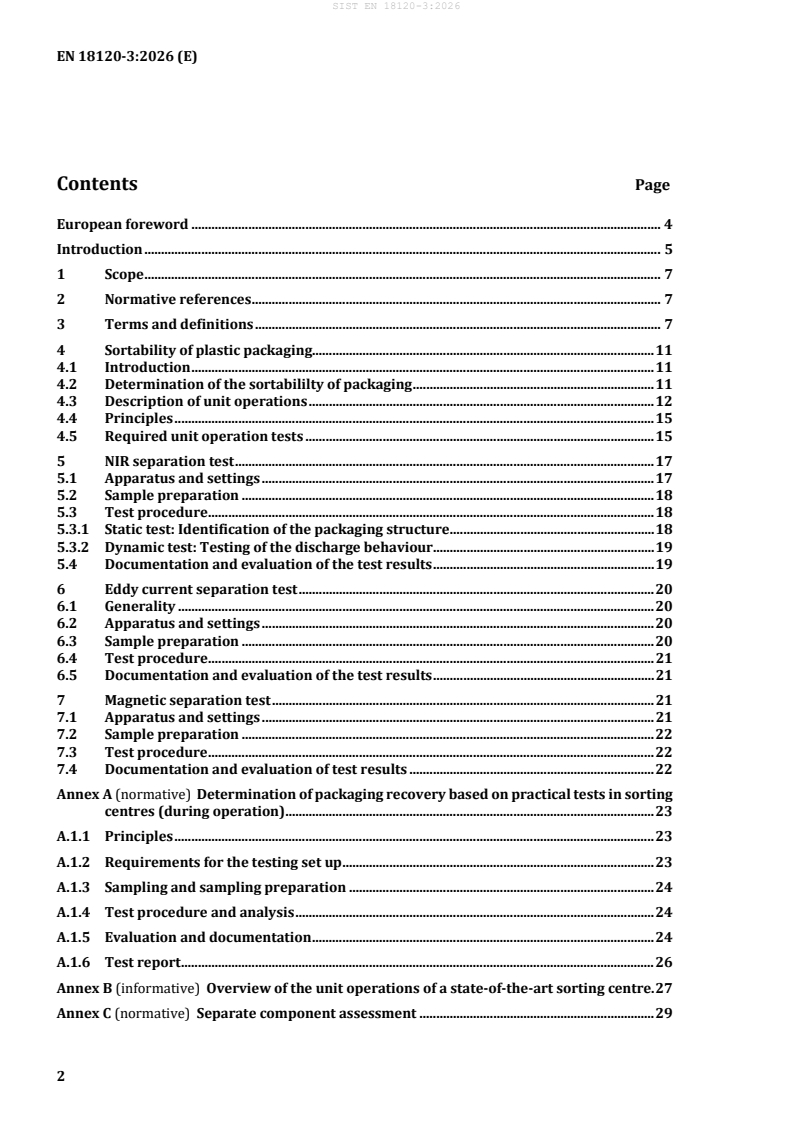
Contents Page
European foreword . 4
Introduction . 5
1 Scope . 7
2 Normative references . 7
3 Terms and definitions . 7
4 Sortability of plastic packaging. 11
4.1 Introduction . 11
4.2 Determination of the sortabililty of packaging . 11
4.3 Description of unit operations . 12
4.4 Principles . 15
4.5 Required unit operation tests . 15
5 NIR separation test . 17
5.1 Apparatus and settings . 17
5.2 Sample preparation . 18
5.3 Test procedure . 18
5.3.1 Static test: Identification of the packaging structure . 18
5.3.2 Dynamic test: Testing of the discharge behaviour . 19
5.4 Documentation and evaluation of the test results . 19
6 Eddy current separation test . 20
6.1 Generality . 20
6.2 Apparatus and settings . 20
6.3 Sample preparation . 20
6.4 Test procedure . 21
6.5 Documentation and evaluation of the test results . 21
7 Magnetic separation test . 21
7.1 Apparatus and settings . 21
7.2 Sample preparation . 22
7.3 Test procedure . 22
7.4 Documentation and evaluation of test results . 22
Annex A (normative) Determination of packaging recovery based on practical tests in sorting
centres (during operation) . 23
A.1.1 Principles . 23
A.1.2 Requirements for the testing set up . 23
A.1.3 Sampling and sampling preparation . 24
A.1.4 Test procedure and analysis . 24
A.1.5 Evaluation and documentation . 24
A.1.6 Test report . 26
Annex B (informative) Overview of the unit operations of a state-of-the-art sorting centre. 27
Annex C (normative) Separate component assessment . 29
C.1 Principle . 29
C.2 Scope . 29
C.3 Test procedure - consumer behaviour . 29
C.4 Test procedure - mechanical stress . 30
C.5 Evaluation and documentation . 31
C.6 Test report . 32
Annex D (informative) Separate component assessment (for packaging with low market
share) . 33
D.1 Principle . 33
D.2 Sample preparation . 33
Bibliography . 34
European foreword
This document (EN 18120-3:2026) has been prepared by Technical Committee CEN/TC 261 “Packaging”,
the secretariat of which is held by AFNOR.
This European Standard shall be given the status of a national standard, either by publication of an
identical text or by endorsement, at the latest by October 2026, and conflicting national standards shall
be withdrawn at the latest by October 2026.
Attention is drawn to the possibility that some of the elements of this document may be the subject of
patent rights. CEN shall not be held responsible for identifying any or all such patent rights.
This document has been prepared under a standardization request addressed to CEN by the European
Commission. The Standing Committee of the EFTA States subsequently approves these requests for its
Member States.
Any feedback and questions on this document should be directed to the users’ national standards body.
A complete listing of these bodies can be found on the CEN website.
According to the CEN-CENELEC Internal Regulations, the national standards organisations of the
following countries are bound to implement this European Standard: Austria, Belgium, Bulgaria, Croatia,
Cyprus, Czech Republic, Denmark, Estonia, Finland, France, Germany, Greece, Hungary, Iceland, Ireland,
Italy, Latvia, Lithuania, Luxembourg, Malta, Netherlands, Norway, Poland, Portugal, Republic of North
Macedonia, Romania, Serbia, Slovakia, Slovenia, Spain, Sweden, Switzerland, Türkiye and the United
Kingdom.
Introduction
The EN 18120 series, under the general title Packaging — Design for recycling of plastic packaging, which
aims via a series of guidelines and protocols to establish consistency and improvement for the design for
recycling of household, industrial and commercial plastic packaging, consists of the following parts:
— Part 1: Definitions and principles for design-for-recycling of plastic packaging
— Part 3: Evaluation processes for the sortability of plastic packaging
— Part 4: Guideline for PET bottles
— Part 5: Guideline for PET rigid packaging (except bottles)
— Part 6: Guideline for PE and PP rigid packaging
— Part 7: Guideline for PE and PP flexible packaging
— Part 8: Guideline for PS and XPS rigid packaging
— Part 9: Guideline for EPS packaging
— Part 10: Recyclability evaluation process for plastic packaging — Protocols for PET bottles
— Part 11: Recyclability evaluation process for plastic packaging — Protocols for PET rigid packaging
(except bottles)
— Part 12: Recyclability evaluation process for plastic packaging — Protocols for PE and PP rigid
packaging
— Part 13: Recyclability evaluation process for plastic packaging — Protocols for PE and PP flexible
packaging
— Part 14: Recyclability evaluation process for plastic packaging — Protocols for PS and XPS rigid
packaging
— Part 15: Recyclability evaluation process for plastic packaging — Protocols for EPS packaging
Design for recycling guidelines are a common way of evaluating the compatibility with plastic-packaging
collection, sorting and recycling which enables the use of secondary raw materials that are of sufficient
quality when compared to the original material, in state-of-the-art facilities.
They provide guidance on the level of compatibility, defined as:
— green: packaging constituents and components with full compatibility with state-of-the-art
collection, sorting and recycling;
— yellow: packaging constituents and components with limited compatibility with state-of-the-art
collection, sorting and recycling;
— red: packaging constituents and components which are not compatible with state-of-the-art
collection, sorting and recycling.
The design for recycling guidelines provided in the EN 18120 series cover the design for recycling based
on the knowledge available at the time of the development of this document and are representative of the
state-of-the-art. They consider packaging waste collection, sorting and recycling, so that the recycled
plastic can substitute primary raw materials in packaging application or other applications. Compliance
with the design guidelines in the EN 18120 series does not guarantee that the recycled plastic quality will
be fit for purpose for a specific targeted end application or compliant with applicable regulations.
Packaging recyclability is the combination of design of recycling, proven collection, sorting and recycling
in practice.
1 Scope
This document provides testing procedures and requirements on the evaluation processes for the
sortability of plastic packaging with regard to compatibility of the design with state-of-the-art collecting
and sorting processes for the plastic used.
This document covers any packaging predominantly made of plastic and separate packaging components
predominantly made of plastic, both in case they undergo sorting processes.
2 Normative references
The following documents are referred to in the text in such a way that some or all of their content
constitutes requirements of this document. For dated references, only the edition cited applies. For
undated references, the latest edition of the referenced document (including any amendments) applies.
EN 18120-1:2026, Packaging — Design for recycling of plastic packaging — Part 1: Definitions and
principles for design-for-recycling of plastic packaging
EN 18120-4, Packaging — Design for recycling of plastic packaging — Part 4: Guideline for PET bottles
EN 18120-5, Packaging — Design for recycling of plastic packaging — Part 5: Guideline for PET rigid
packaging (except bottles)
EN 18120-6, Packaging — Design for recycling of plastic packaging — Part 6: Guideline for PE and PP rigid
packaging
EN 18120-7, Packaging — Design for recycling of plastic packaging — Part 7: Guideline for PE and PP
flexible packaging
EN 18120-8, Packaging — Design for recycling of plastic packaging — Part 8: Guideline for PS and XPS
rigid packaging
EN 18120-9, Packaging — Design for recycling of plastic packaging — Part 9: Guideline for EPS packaging
3 Terms and definitions
For the purposes of this document, the terms and definitions given in EN 18120-1 and the following apply.
ISO and IEC maintain terminology databases for use in standardization at the following addresses:
— ISO Online browsing platform: available at https://www.iso.org/obp/
— IEC Electropedia: available at https://www.electropedia.org/
3.1
ballistic separator
device that employs a vibrating inclined surface for the separation of objects of different impact
behaviour
Note 1 to entry: In the application for sorting plastic packaging, the separation of flexible and rigid packaging is
intended.
3.2
commercial and industrial packaging waste
C & I waste
waste typically (but not limited to) collected from retailers and businesses
3.3
eddy current
electric current induced in a conductive material by a varying magnetic field
3.4
eddy current separator
device intended for the separation of materials made of or containing non-ferromagnetic metals
Note 1 to entry: Eddy current separators will also attract ferromagnetic materials if they are part of the input.
However, as this is unwanted and can potentially lead to equipment damage, eddy current separators are typically
used in combination with an over-band magnet, which first removes ferromagnetic metals.
Note 2 to entry: Eddy current separators are generally used behind an over-band magnet. The over band-magnet
removes ferrous metals.
[SOURCE: EN ISO 12718:2019, 3.1.12, modified – Note 1 and Note 2 added]
3.5
ferromagnetic
term applied to materials that can be magnetized or strongly attracted by a magnetic field
[SOURCE: EN ISO 15463:2003, 4.1.40]
3.6
material recovery facility
MRF
plant for sorting and pre-processing materials from comingled waste for resource recovery
Note 1 to entry: A Material Recovery Facility (MRF) typically receives the input from a separate collection scheme
for consumer packaging (including out-of-home collection) and utilizes a series of sorting steps, allowing to
separate on a packaging level the collected packaging waste into a different type of bales (per material type and/or
colour), which will subsequently be sent to either a PRF or reprocessor.
Note 2 to entry: A MRF is generally a facility that sorts and prepares collected household plastic packaging waste
into (target) fractions suitable for onward dispatch to a PRF and/or reprocessor.
3.7
near infrared spectroscopy
NIR spectroscopy
spectroscopic method for measuring spectra using the NIR region of the electromagnetic spectrum (from
780 nm to 2 500 nm)
Note 1 to entry: The spectral range of typical commercial NIR sensors is from 900 nm to 1 700 nm.
[SOURCE: ISO 21543:2020, 3.1]
3.8
optical sorter
sensor-based sorting
device intended for the separation of packaging waste based on spectroscopy in the NIR and/or VIS range,
detecting and classifying objects based on their material and/or colour
3.9
(over-band) magnet
device intended for the separation of packaging waste made of or containing ferromagnetic metals
3.10
plastic packaging test sample
plastic packaging under investigation, to be assessed or tested with this series of document
Note 1 to entry: A plastic packaging test sample can be packages in market use as well as innovative packaging
developments not placed on the market yet.
3.11
plastic recovery facility
PRF
facility that sorts and prepares mixed plastic packaging waste fractions into separate (target) fractions
for further use at reprocessors
Note 1 to entry: A Plastic Recovery Facility (PRF) further separates mixed plastic packaging streams on a packaging
article level into more fractions (material type and/or colour) than typically created by a MRF.
3.12
pre-concentrate
intermediate packaging waste stream in which the packaging of a target fraction has been enriched but
the desired purity has not been achieved
3.13
Rougher-Cleaner-Scavenger processes
RCS processes
multiple sorting operations for the same sorting task under partial recirculation system used to maximise
purity and recovery
Note 1 to entry: Designed with at least 3 separation stages with different selectivity settings (Rougher: medium;
Cleaner: high, Scavenger: low).
3.14
reprocessor
business that takes materials which have been sorted (e.g. at a MRF) and uses them to produce secondary
raw materials
Note 1 to entry: A reprocessor (sometimes also called a recycler) typically receives pre-sorted bales from MRF’s
and/or PRFs and uses a reprocessing process (mechanical or advanced recycling including but not limited to
dissolution recycling, depolymerization, pyrolysis, gasification) to convert the materials typically into recycled
pellets, that can be used again in plastic applications (within or outside packaging), replacing virgin resin.
Reprocessors can also have a series of devices to pre-sort the packaging (on a packaging article level) prior feeding
it into a reprocessing system.
Note 2 to entry: Sorting equipment at a reprocessor which is different from that at a MRF/PRF (e.g. PET Bottle
guidelines EN 18120-4 in the case of delabellers).
3.15
sieve
device intended for the separation of packaging waste based on differences in size
Note 1 to entry: The main types of screens used for sorting packaging are drum screens, circular vibration screens
and linear vibration screens.
3.16
sortability
ability of a packaging to be separated from a packaging waste stream in terms of compatibility for the
design with state-of-the-art sorting processes for a designated packaging or material fraction for further
reprocessing
Note 1 to entry: Measured as percentage in wt % of a packaging or separate component reported in the target
fraction with reference to the amount of material in feed.
3.17
target fraction
sorting fraction in which the packaging to be examined complies with sorting specifications
Note 1 to entry: Specific definition for EN 18120-3.
3.18
test facility
location where testing according to this document is executed
Note 1 to entry: Differentiation is made between:
— lab scale testing facilities (including single unit operation testing): facility that have one or few unit
operation tests in place (using industrial sized equipment), typically not connected by each other with conveyer
belts;
— pilot scale testing facilities (facility having multiple industrial equipment in place that are connected but
only being used for testing);
— industrial scale testing facilities: commercial automated MRF/PRF.
3.19
visible spectrum
VIS
band of electromagnetic radiation that human eyes can detect
Note 1 to entry: This ranges from wavelengths of approximately 380 to approximately 780 nanometers (nm).
Note 2 to entry: Used for the colour sorting of plastic packaging waste.
Note 3 to entry: Some optical sorters combine VIS detection with NIR detection.
[SOURCE: ISO 19262:2015, 3.273, modified – Note 2 to entry and note 3 to entry added]
3.20
windshifter
device intended for the separation of packaging waste into a “light” fraction and a “heavy” fraction
Note 1 to entry: A typical use of wind-shifting in waste sorting is to separate films from other packaging types.
Note 2 to entry: The fractions are also commonly referred to as “lift” and “drop”
Note 3 to entry: The actual outcome of wind shifting in waste sorting is not necessarily a pure separation of flexible
and rigid packaging; certain flexible packaging designs may predominantly drop in a wind shifting operation.
4 Sortability of plastic packaging
4.1 Introduction
This document provides a protocol for testing and evaluating the sortability of plastic packaging to
determine compatibility of the design with state-of-the-art collecting and sorting processes for the given
plastic packaging. This document covers any packaging predominantly made of plastic packaging and
separate packaging components predominantly made of plastic material, both in case they undergo
sorting processes.
In the following, the plastic packaging test sample refers to a) the plastic packaging predominantly made
of plastic with its integrated components, such as tethered caps, labels or sleeves or (b) separate
components predominantly made of plastics, that are distinct from the main body of the packaging unit
and is typically discarded prior to and separately from the main body of the packaging unit, or that are
separated from the main body of the packaging unit simply through mechanical stress during collection,
transportation or preparation for sorting (see Annex C to demonstrate a separation and Annex D for
information).
Advanced sorting technologies (including but not limited to tracer/marker-based, computer vision-based
object recognition such as artificial intelligence and digital watermarks) which are currently not
considered state-of-the-art, are out of scope (see Table 1 of EN 18120-1:2026).
Sorting processes for plastic packaging typically occur in an automated state-of-the-art MRF (Material
Recovery Facility), PRF (Plastic Recovery Facility), at a reprocessor or a combination thereof (some
operations include handpicking which is not part of this document). This document only focuses on
sorting at MRFs. Annex A provides guidance to operate part of the protocol in an operational MRF.
4.2 Determination of the sortabililty of packaging
Sortability is mainly determined by the material composition of packaging. All key unit operations in
sorting exploit differences in the physical properties of materials, such as reflection behaviour,
magnetisability and electrical conductivity. Certain design parameters such as adhesives, tie-layer,
format and size, as well as residue emptying capability, have no influence on the sortability of packaging.
All unit operations in sorting are designed according to the state-of-the-art so that the deflection force is
a multiple of individual packaging weights including typical residual contents. Specifically for flexible
plastic packaging, contamination with product residuals even improve the sorting success (NIR
detection).
Packaging or separate packaging components shall be designed to be sortable. In principle, this packaging
property is fulfilled for plastic packaging or separate plastic components, if all these four main criteria
are met:
1) the predominant material of the main body can be clearly identified by NIR reflection measurement
in such a way that separation into the target fraction is possible. The target fraction can be any
fraction in which the predominant material of the main body is classified as valuable material;
2) the plastic packaging or the separate plastic component does not contain any integrated components
or individual constituents that lead to systematic false discharge via NIR reflection separation into
sorting fractions in which the main material is not classified as valuable material;
3) the plastic packaging or the separate plastic component does not contain any integrated non-ferrous
metal components that lead to a systematic false discharge into the non-ferrous metal fraction;
4) the plastic packaging or the separate plastic component does not contain any integrated
ferromagnetic components that lead to a systematic false discharge into the ferrous metal fraction.
Sortability shall be tested according to the-state-of-the-art and be carried out on (sorting) unit operations
that corresponds to this state-of-the-art. Every country and packaging recovery organization and waste
operator has their own strategy in terms of setting up their sorting facilities. Even within countries there
can be large differences, making it difficult to specify specific settings of machinery and/or work with a
single European representative layout of a MRF/PRF. The choice of unit operations and process
sequences at a given MRF/PRF depends on the input waste composition, machine settings and
contractual requirements. Therefore, this document describes only those unit operations which shall be
used to measure sortability based on the individual packaging characteristics. This document describes
the framework conditions and the evaluation of the measurement results for conducting sortability tests
in laboratory scale testing facilities/pilot scale testing facilities and from industrial scale testing facilities
(MRF).
This document distinguishes between individual unit operations that serve to prepare for sorting and the
unit operations that lead to the generation of the sorting fractions (see Table 1). In established sorting
processes, separation operations carried out in preparation for sorting include sieving, wind shifting and
ballistic separation. Based on the current state-of-the-art, no design-related packaging losses will occur
in these separation operations if the process is carried out appropriately by recirculating waste material
flows. The unit operations for generating sorting fractions are:
1) NIR separator for paper and plastic-based packaging;
2) eddy current separator for aluminium-based packaging and non-ferrous metal-based packaging;
3) magnetic separation for steel packaging.
When evaluating the results, it shall be considered that the individual operations for sorting out non-
metallic fractions are carried out in several stages and that missorted packaging items or packaging
components can be partially compensated for by cleaning stages (RCS processes).
4.3 Description of unit operations
This document only describes sorting processes that take place in sorting plants. If subsequent sorting
processes at the reprocessor may influence the classification of the packaging materials, packaging
components or individual constituents, these are considered in the applicable design-for-recycling
guidance part of this series of documents. Unit operations, typically used for various functions in sorting
plants are shown in Table 1. The flow in an exemplary state-of-the-art automated sorting centre is shown
just for reference in Figure B.1.
Table 1 — List of unit operations in a state-of-the-art automated sorting process
Function in a sorting
Unit operation Description of the operation
plant
Sieve Preparation for sorting Device intended for the separation based on
differences in size.
(drum sieve,
vibrating screen)
Primary function: Size separation.
Secondary function: Emptying bags,
homogenizing the material flow, distribution
into multiple material flows, improvement
of the technical conditions for subsequent
sorting operations.
NOTE One option to capture small
packaging formats, such as closures, tubes,
coffee capsules, is the subsequent use of
vibrating screens (flat screens); recovering
small items and returning them into the
sorting process.
Windshifter Preparation for sorting Device intended for the separation of the
material stream into a light fraction (“lift”)
and a heavy fraction (“drop”).
Primary function: Film separation to
preconcentrate and to equalize the
conveying properties of the material
streams.
Determining properties of separation are
mass, size and air resistance of the
individual packaging waste item.
NOTE A high variability of results can
occur, depending on machine designs and
machine settings.
Magnetic separator Sorting Device for separating by magnetic
properties, intended for the separation of
ferrous metals and ferrous metals
containing packaging.
The document type used in sorting of
packaging is an over-belt magnet in a
longitudinal orientation.
When windshifters are used in sorting (standard for sorting mixed waste without high paper content), they are
combined with ballistic separators in state-of-the-art systems (similar task, but different mode of operation).
Function in a sorting
Unit operation Description of the operation
plant
Eddy current Sorting Device for separating waste items by their
separator electrical conductivity, intended for the
separation of non-ferrous metals and non-
ferrous metal containing packaging.
NOTE Eddy current separators would
attract ferromagnetic materials if they were
part of the input material. As this is
unwanted and can lead to equipment
damage, eddy current separators are
generally used behind an over-belt magnetic
separator.
Ballistic separator Preparation for sorting Device that employs a vibrating inclined
surface (vibrating in circular motion) for the
separation of objects with different impact
behaviour (elasticity).
Primary function: Separation of waste into
rigids, flexibles and by difference in size (if
paddles with individual segments/meshes
are used).
NOTE The actual outcome of ballistic
separation is not necessarily tied to the two-
or three-dimensional nature of the
packaging structure; the stiffness is a
decisive factor. Due to the materials with
different stiffness moving in opposite
directions on the inclined plane, the
separation performance is highly dependent
on the loading level of the plane (and thus
from the throughput).
Ballistic separators can be used in a pure
sieving function depending on the angle of
inclination (e.g. standard unit in paper
sorting).
Sensor based Sorting Device for separating waste by differences
sorting device in the NIR reflection spectrum, intended for
the separation of plastic packaging or fibre-
based packaging by material type or
NIR separator
category.
Primary function: Production of sorting
fractions by material type or category.
Secondary function: subsequent cleaning of
pre-concentrates (scavenger function).
Function in a sorting
Unit operation Description of the operation
plant
Sensor based Sorting Device for separating waste by differences
sorting device in the NIR reflection and the visual
spectrum, intended for the separation of
plastic packaging and fibre-based packaging
NIR separator
by material type or category and by colour.
+ VIS
Primary function: Production of sorting
fractions by material type and colour.
Secondary function: subsequent cleaning of
pre-concentrates, scavenger function,
suppression of NIR detection using colour
information).
4.4 Principles
EN 18120-1, EN 18120-4, EN 18120-5, EN 18120-6, EN 18120-7, EN 18120-8 and EN 18120-9 shall be
consulted first to determine whether a sortability test is required.
If a constituent or integrated component of a plastic packaging or a separate plastic packaging component
requires a sortability test, the following principle applies: if all criteria for determining the sortability of
plastic packaging are met (see 4.2), the plastic packaging or the separate plastic component is considered
sortable. The criteria 1-4 are met if the plastic packaging or the separate plastic component does not
contain any of the design parameters listed in 4.5. If the plastic packaging or the separate plastic
component contains one or more of the design parameters listed in 4.5, a test to determine sortability is
required.
4.5 Required unit operation tests
If a sortability test is required, either because it is stated in EN 18120-4, EN 18120-5, EN 18120-6,
EN 18120-7, EN 18120-8 and EN 18120-9 or if an integrated component or constituent is present in the
packaging design which is not covered by this list of standards, the following unit operations shall be
tested, depending on the nature of the integrated component or constituent.
If a sortability test is required, a NIR-test is required if:
— innovative packaging to be assigned to an existing sorting fraction for plastic packaging;
— packaging with innovative plastic material as the predominant material, which is not yet part of a
sorting specification
— for bottles ≥ 0,5 l with labels or sleeves, taking up > 70 % of one of the projected surfaces, made from
different materials (including different types of plastic) than the main component of the packaging:
— for all plastic packaging, except bottles ≥ 0,5 l, with labels, taking up > 50 % of one of the projected
surfaces, made from different materials (including different types of plastic) than the main
component of the packaging;
If the packaging is innovative, reference spectra shall be created for this material type/plastic type beforehand
— for all plastic packaging, except bottles ≥ 0,5 l, with sleeves, taking up > 50 % of one of the projected
surfaces (perforated and non-perforated) where sleeve material is made from different materials
(including different types of plastic) than the main component of the packaging;
— multi-layer structure from different polymer types (excluding PE/EVOH, PP/EVOH). Tie-layer and
adhesives are not layers within the meaning of this requirement;
— mass-coloured plastics with carbon black-based pigments;
— > 50 % fully printed with carbon black containing inks, excluding fine print features / patterns such
as 1D barcodes, QR codes, 2D Data matrix, text, line graphics;
— metallized layer in the main body;
— metallized labels, taking up > 50 % of one of the projected surfaces;
— metal pigments or metal effects obtained from metallic inks, cold foil stamping or hot foil stamping
making up > 50 % of one of the projected surfaces;
— presence of different materials for different projected surfaces (e.g. top/bottom).
Design parameters that require eddy-current separator testing
— All packaging structures with aluminium foil as a layer in the main body.
— Aluminium screw cap or twist lock on jars.
— Aluminium foil with sealed edge that remains sealed during use (e.g. coffee capsules, tea capsules).
Eddy current separator tests are explicitly not required:
— for metallised films;
— for cups with aluminium foil lids (e.g. yoghurt pots).
Design parameters that require magnetic separator testing
— Ferromagnetic component(s)/constituents exceeding 5 weight %.
No measurement is required for small integrated ferromagnetic parts, such as valve balls, springs, hinges,
clips, etc.
5 NIR separation test
5.1 Apparatus and settings
— High spatial resolution NIR detector (minimum resolution 1 000 pixels/dm at 1 m/s).
— Conveyor belt with variable adjustable conveyor belt speed (at least 0,5 m/s, 1,0 m/s, 1,5 m/s and
3,0 m/s.
— Valve bar (12,5 mm or 16,5 mm valve distance).
— Compressor (min. 7,5 bar operating pressure).
— The distance between the scanner and the valve bar in the direction of transport shall be a maximum
of 400 mm.
— Software.
— Readout option for reference spectra shall include PE, PP, PS, PET, PA, POM, PLA, PVC, EPS, PUR, ABS,
PC, LPC (liquid packaging carton), Paper/Cardboard). For the standard packaging polymers (target
fraction), several reference spectra shall be created for the different packaging and material types
(e.g. PET bottles, PET trays, PE-LD, PE-HD, etc.).
— Readout option for the number of pixels classified as each material and unidentified pixels.
— Superimposed display option for reference and measurement spectrum.
— Display of reflection intensities.
— Display of control valve signals.
— Operational software programs (classifier) for all sorting fractions.
— Variable adjustable splitter.
Before starting a series of measurements, the correct functioning of the equipment shall be adjusted
according to the manufacturer's specifications. This shall include at least:
— calibration (white balance);
— valve test;
— position control of the valve bar;
— compressor performance;
— synchronisation between the belt speed and the valve control.
At the various belt speeds, it is necessary to ensure that 10 out of 10 PE bottle caps or PP bottle caps are
reliably ejected via the compressed air blast. The control shall be confirmed in the test report.
5.2 Sample preparation
The series of measurements are always carried out on the unfilled but final packaging samples (incl.
labels, print, closures, etc.). For flexible transparent packaging, at least one measurement is to be carried
out with a completely empty or emptied packaging if the presence of filling residues cannot be excluded.
If there is an influence observed, the measurement shall be repeated with emptied packaging.
If the result of the detection depends on the surface that the packaging faces towards the sensor, each
possible orientation shall be tested in an independent measurement. The probability of a specific
positioning is theoretically determined for clear cases (e.g. top/bottom, front/rear) (e.g. 0,5 in each case).
For more complex geometries, suitable preliminary tests shall be carried out by dropping the packaging
items onto a conveyor belt accelerated to 3,0 m/s. If unfilled packages are not identifiable, they shall be
additionally tested in a waste-like condition (e.g. by crumpling, compressing, or folding, or by
contaminating). These measures shall be documented with pictures and in writing.
Each individual measurement for the discharge behaviour shall comprise at least 10 samples.
5.3 Test procedure
5.3.1 Static test: Identification of the packaging structure
The static test serves to clarify whether packaging is clearly identifiable. It is essentially based on a
comparison of the packaging structure with the existing reference spectra. If the packaging is innovative,
reference spectra shall be created for this material type/plastic type beforehand.
In the first step, the classification is carried out at high spatial resolution. In this case, the conveyor belt
is set to a low speed (e.g. 0,5 m/s or 1,0 m/s). The NIR sorter software program used for the analysis shall
be documented.
At least one classification image shall be taken. Optionally an intensity image and the translation into the
control signal (valve control) may be taken. If the valve image is determined, adapted classifiers
(programs) shall be used and documented, e.g.:
— fine grid for small packaging (e.g. for sample sizes from 20 mm to140 mm);
— coarse grid for large packaging (e.g. for sample sizes from 140 mm to 320 mm).
If a dynamic discharge test is not carried out, the measurement of intensities and the control signals to
the valves at 1,5 m/s and 3,0 m/s belt speed is mandatory.
Supplementary to the image analyses a numerical analysis of the classification by pixel count shall be
documented. The analysis shall include both the absolute pixel numbers and the relative share and shall
include pixels that are classified as ‘unknown’ and number of pixels of a full-
...