

SIST EN 300 392-12-16 V1.4.1:2026
(Main)Terrestrial Trunked Radio (TETRA) - Voice plus Data (V+D) - Part 12: Supplementary services stage 3 - Sub-part 16: Pre-emptive Priority Call (PPC)
- Abstract
The present document defines the stage 3 specifications of the Supplementary Service Pre-emptive Priority Call (SS-PPC) for the Terrestrial Trunked Radio (TETRA). SS-PPC enables a user to have preferential access to the network resources in a TETRA system in times of congestion including pre-emption of calls. SS-PPC is applicable for pre-emptive priorities including the emergency priority. SS-PPC includes the capability to pre-empt resources needed for higher priority calls and the capability to pre-empt users from ongoing calls in order to move them to higher priority calls. SS-PPC specifies the definition, activation, deactivation and interrogation for the usage of pre-emptive call priorities in the TETRA system. The Switching and Management Infrastructure (SwMI) applies the SS-PPC priorities when it allocates the resources for calls. The SS-PPC operations are defined for the SwMI and for the Mobile Station (MS). SS-PPC is defined to subscribers of one TETRA system, but the subscribers may be located in several TETRA systems and the information flows may be delivered over the Inter System Interface (ISI). SS-PPC is invoked for calls within one TETRA system or for calls that extend over ISI to several TETRA systems. Man-Machine Interface (MMI) and charging principles are outside the scope of the present document. Supplementary Service stage 3 specification is preceded by the stage 1 and the stage 2 specifications of the service. Stage 1 describes the functional capabilities from the user's point of view. Stage 2 defines the functional behaviour in terms of Functional Entities (FEs) and information flows. Stage 3 gives a precise description of the supplementary service from the implementation point of view. It defines the protocol for the service and the encoding rules for the information flows. It defines the processes for the FEs and their behaviour. The described protocols and behaviour apply to the SwMI, for the MS and may be applied over the ISI between TETRA systems. Aspects relating to all supplementary services are detailed in ETSI EN 300 392-9 [3].
- Status
- Published
- Public Enquiry End Date
- 31-May-2026
- Publication Date
- 06-Jul-2026
- Technical Committee
- MOC - Mobile Communications
- Current Stage
- 6060 - National Implementation/Publication (Adopted Project)
- Start Date
- 06-Jul-2026
- Due Date
- 10-Sep-2026
- Completion Date
- 07-Jul-2026
Buy Documents
ETSI EN 300 392-12-16 V1.4.0 (2026-03) - Terrestrial Trunked Radio (TETRA); Voice plus Data (V+D); Part 12: Supplementary services stage 3; Sub-part 16: Pre-emptive Priority Call (PPC)
ETSI EN 300 392-12-16 V1.4.1 (2026-07) - Terrestrial Trunked Radio (TETRA); Voice plus Data (V+D); Part 12: Supplementary services stage 3; Sub-part 16: Pre-emptive Priority Call (PPC)

SIST EN 300 392-12-16 V1.4.1:2026 is the Slovenian adoption of ETSI EN 300 392-12-16 V1.4.1, published by SIST. It specifies the stage 3 protocol for the Terrestrial Trunked Radio (TETRA) Supplementary Service Pre-emptive Priority Call (SS-PPC), which gives selected users priority access to network resources and allows lower-priority calls to be pre-empted during congestion. The document is written for implementers of TETRA Mobile Station (MS) and Switching and Management Infrastructure (SwMI) functions, and for anyone defining, activating, withdrawing or interrogating PPC behavior in a TETRA system.
What does SIST EN 300 392-12-16 V1.4.1:2026 specify?
SIST EN 300 392-12-16 V1.4.1:2026 specifies the stage 3 specification of SS-PPC for TETRA Voice plus Data (V+D). It focuses on implementation behavior: the protocol, encoding of information flows, and the processes used by the relevant Functional Entities (FEs).
The scope covers preferential access in congestion, pre-emption of resources for higher-priority calls, and pre-emption of users from ongoing calls. It applies to calls within one TETRA system and to calls that extend over the Inter System Interface (ISI) between systems.
The document excludes Man-Machine Interface (MMI) and charging principles. It is organized into scope, references, terms and abbreviations, service primitives, protocol description, FE behavior, inter-working considerations, and three informative annexes.
| Annex | What it covers |
|---|---|
| Annex A | Mapping of SS-PPC priorities received from the user application to priorities in basic service PDUs for the MS |
| Annex B | Bibliography, including the stage 2 PPC part |
| Annex C | Change requests relative to ETS 300 392-12-16 Ed.1 |
What are the key requirements of SIST EN 300 392-12-16 V1.4.1:2026?
SIST EN 300 392-12-16 V1.4.1:2026 defines SS-PPC as an optional supplementary service for TETRA V+D layer 3. In practice, that means a network or terminal implements it only if it supports this service, but once supported it has defined service primitives, protocol behavior, and information coding.
Service access and control points
Clause 4 says SS-PPC services are offered over the TNSS-SAP and TNCC-SAP. This matters because the standard separates supplementary-service signaling from call-control signaling, so implementers know where definition, interrogation, invocation, and pre-emption messages belong.
Definition, assignment, interrogation and withdrawal
Clause 4.2 defines the service primitives for FE1, FE3, FE5, FE8 and FE9. The main operations are DEFINE, ASSIGN, INTERROGATE, REMOVE, WITHDRAW, IMPENDING-PRE-EMPTION, and USER-PRE-EMPTED. In practice, this is the control set for provisioning PPC values, checking them, and notifying users before or after pre-emption.
The standard distinguishes between the authorized user, the served user, and the user application responses. It also allows acknowledgements to be requested or not requested, which means implementations need to handle both confirmed and unconfirmed service workflows.
Call setup and pre-emption behavior
Clause 4.3 ties SS-PPC to call control using PRIORITY1, PRIORITY2 and PRE-EMPTION. PRIORITY1 acts as invocation during call setup, while PRIORITY2 carries the applied priority back to the user and called parties. Pre-emption is reported by the basic call release sequence with the disconnect cause "Pre-emptive use of resource".
This matters in operation because the call may start at one requested priority and be set up at another applied priority. Terminals and user applications therefore need to accept a possibly changed priority and react to it.
Priority values and basic service mapping
Clause 4.4 and clause 5.5.12 define the SS-PPC priority values, including pre-emptive priority 1 to 4, with pre-emptive priority 4 identified as Emergency. The document also notes the relationship to SS-PC priority values used elsewhere in TETRA.
Annex A explains how the MS should map user application priorities to basic service PDUs. For implementers, the practical point is that the priority entered by the user application is not always the exact value carried unchanged through the network.
Protocol states and FE behavior
Clause 5 defines the protocol states for FE1, FE21, FE25, FE3, FE5 and FE8, and for the corresponding CCA and CC entities. The key implementation point is that the normal states are IDLE, with specific transitions for receiving definitions, interrogations, calls, pre-emption requests and call setup confirmations.
Clause 6 uses SDL-style process figures to show how those entities exchange information flows. This helps terminal and network vendors align the signaling sequence with the expected call-control behavior, especially when calls are pre-empted or when an ongoing call must be cleared.
Inter-system operation
Clause 6.12 states that to extend SS-PPC over the ISI, FE2s in different TETRA systems must be able to send and receive SS information flows over the ISI. That is the practical requirement for multi-system operation: pre-emption and priority handling must still work when a call crosses system boundaries.
What terms does SIST EN 300 392-12-16 V1.4.1:2026 define?
- Supplementary Service Pre-emptive Priority Call (SS-PPC) - A TETRA supplementary service that gives a call preferential access to resources and allows pre-emption of lower-priority activity.
- Switching and Management Infrastructure (SwMI) - The TETRA network infrastructure that allocates resources and applies SS-PPC priorities.
- Functional Entity (FE) - A functional sub-entity used to describe how SS-PPC behaves in the Mobile Station or SwMI.
- Call Control Agent (CCA) - The call-control sub-entity in the Mobile Station that handles SS-PPC-related call setup and release behavior.
- Mobile Station (MS) - The user terminal side of TETRA that receives, saves and acknowledges SS-PPC information.
- Inter System Interface (ISI) - The interface used when SS-PPC information flows between TETRA systems.
- Emergency priority - The highest pre-emptive priority level defined by the document.
Who uses SIST EN 300 392-12-16 V1.4.1:2026?
SIST EN 300 392-12-16 V1.4.1:2026 is used by TETRA equipment suppliers, SwMI vendors, MS manufacturers, and system integrators who implement or test priority-call behavior. It is also used by network operators and technical authorities that need to define how priority access and pre-emption work in a TETRA network.
Typical tasks include:
- implementing SS-PPC in terminals and infrastructure
- configuring priority definitions for subscribers or groups
- handling invocation, interrogation, activation and withdrawal
- deciding how terminals behave when a call is pre-empted
- validating signaling over the ISI for multi-system calls
What changed in SIST EN 300 392-12-16 V1.4.1:2026 from the previous edition?
The document states that it contains changes since ETS 300 392-12-16 Ed.1. The listed changes are:
- emergency call user pre-emption was addressed
- editorial improvements were made throughout
- the presence rules for information elements in the Pre-empted party information element were clarified
- WITHDRAW PDU encoding was corrected
- mandatory and optional definition behavior was clarified
- references to the Call priority element in 5.4.12.1 to 5.4.12.3 were corrected
Which standards are used with SIST EN 300 392-12-16 V1.4.1:2026?
- ETSI EN 300 392-2 - Provides the TETRA Air Interface and the base call-control procedures that SS-PPC extends.
- ETSI EN 300 392-1 - Provides general TETRA network design and the TETRA Subscriber Identity structure used in subscriber identity coding.
- ETSI EN 300 392-9 - Provides the general requirements for supplementary services and the shared rules used by SS-PPC.
- ETSI EN 300 392-3-1 - Provides the general design for interworking at the Inter System Interface.
- Recommendation ITU-T Z.100 - Provides the SDL-2010 overview used for the behavioral descriptions.
- ETSI EN 300 392-12-10 - Provides the Priority Call stage 3 part that is referenced for related priority values and coding.
- ETSI EN 300 392-11-16 - Listed in the bibliography as the stage 2 counterpart for Pre-emptive Priority Call.
What does the SIST EN 300 392-12-16 V1.4.1:2026 document contain?
The document contains service primitive tables for DEFINE, ASSIGN, INTERROGATE, REMOVE, WITHDRAW, IMPENDING-PRE-EMPTION and USER-PRE-EMPTED, along with the corresponding acknowledgements. It also contains PDU definitions, information element coding tables, and the priority-value mappings used on the air interface and in the MS.
Clause 5 includes protocol-state descriptions, procedure descriptions, and coding rules for fields such as range type, result values, subscriber identity, and time to pre-emption. Clause 6 includes SDL-style figures that illustrate FE behavior for the MS and SwMI entities during definition, interrogation, call setup, pre-emption, and release.
Annex A gives the practical mapping approach for the MS, Annex B points to the related bibliography, and Annex C lists the change requests behind the revision history.
Buy Documents
ETSI EN 300 392-12-16 V1.4.0 (2026-03) - Terrestrial Trunked Radio (TETRA); Voice plus Data (V+D); Part 12: Supplementary services stage 3; Sub-part 16: Pre-emptive Priority Call (PPC)
ETSI EN 300 392-12-16 V1.4.1 (2026-07) - Terrestrial Trunked Radio (TETRA); Voice plus Data (V+D); Part 12: Supplementary services stage 3; Sub-part 16: Pre-emptive Priority Call (PPC)
Get Certified
Connect with accredited certification bodies for this standard

ANCE
Mexican certification and testing association.

Intertek Slovenia
Intertek testing, inspection, and certification services in Slovenia.

LNE (Laboratoire National de Métrologie et d'Essais)
French national laboratory for metrology and testing.
Sponsored listings
Frequently Asked Questions
SIST EN 300 392-12-16 V1.4.1:2026 is a standard published by the Slovenian Institute for Standardization (SIST). Its full title is "Terrestrial Trunked Radio (TETRA) - Voice plus Data (V+D) - Part 12: Supplementary services stage 3 - Sub-part 16: Pre-emptive Priority Call (PPC)". This standard covers: The present document defines the stage 3 specifications of the Supplementary Service Pre-emptive Priority Call (SS-PPC) for the Terrestrial Trunked Radio (TETRA). SS-PPC enables a user to have preferential access to the network resources in a TETRA system in times of congestion including pre-emption of calls. SS-PPC is applicable for pre-emptive priorities including the emergency priority. SS-PPC includes the capability to pre-empt resources needed for higher priority calls and the capability to pre-empt users from ongoing calls in order to move them to higher priority calls. SS-PPC specifies the definition, activation, deactivation and interrogation for the usage of pre-emptive call priorities in the TETRA system. The Switching and Management Infrastructure (SwMI) applies the SS-PPC priorities when it allocates the resources for calls. The SS-PPC operations are defined for the SwMI and for the Mobile Station (MS). SS-PPC is defined to subscribers of one TETRA system, but the subscribers may be located in several TETRA systems and the information flows may be delivered over the Inter System Interface (ISI). SS-PPC is invoked for calls within one TETRA system or for calls that extend over ISI to several TETRA systems. Man-Machine Interface (MMI) and charging principles are outside the scope of the present document. Supplementary Service stage 3 specification is preceded by the stage 1 and the stage 2 specifications of the service. Stage 1 describes the functional capabilities from the user's point of view. Stage 2 defines the functional behaviour in terms of Functional Entities (FEs) and information flows. Stage 3 gives a precise description of the supplementary service from the implementation point of view. It defines the protocol for the service and the encoding rules for the information flows. It defines the processes for the FEs and their behaviour. The described protocols and behaviour apply to the SwMI, for the MS and may be applied over the ISI between TETRA systems. Aspects relating to all supplementary services are detailed in ETSI EN 300 392-9 [3].
The present document defines the stage 3 specifications of the Supplementary Service Pre-emptive Priority Call (SS-PPC) for the Terrestrial Trunked Radio (TETRA). SS-PPC enables a user to have preferential access to the network resources in a TETRA system in times of congestion including pre-emption of calls. SS-PPC is applicable for pre-emptive priorities including the emergency priority. SS-PPC includes the capability to pre-empt resources needed for higher priority calls and the capability to pre-empt users from ongoing calls in order to move them to higher priority calls. SS-PPC specifies the definition, activation, deactivation and interrogation for the usage of pre-emptive call priorities in the TETRA system. The Switching and Management Infrastructure (SwMI) applies the SS-PPC priorities when it allocates the resources for calls. The SS-PPC operations are defined for the SwMI and for the Mobile Station (MS). SS-PPC is defined to subscribers of one TETRA system, but the subscribers may be located in several TETRA systems and the information flows may be delivered over the Inter System Interface (ISI). SS-PPC is invoked for calls within one TETRA system or for calls that extend over ISI to several TETRA systems. Man-Machine Interface (MMI) and charging principles are outside the scope of the present document. Supplementary Service stage 3 specification is preceded by the stage 1 and the stage 2 specifications of the service. Stage 1 describes the functional capabilities from the user's point of view. Stage 2 defines the functional behaviour in terms of Functional Entities (FEs) and information flows. Stage 3 gives a precise description of the supplementary service from the implementation point of view. It defines the protocol for the service and the encoding rules for the information flows. It defines the processes for the FEs and their behaviour. The described protocols and behaviour apply to the SwMI, for the MS and may be applied over the ISI between TETRA systems. Aspects relating to all supplementary services are detailed in ETSI EN 300 392-9 [3].
SIST EN 300 392-12-16 V1.4.1:2026 is classified under the following ICS (International Classification for Standards) categories: 33.070.10 - Terrestrial Trunked Radio (TETRA). The ICS classification helps identify the subject area and facilitates finding related standards.
SIST EN 300 392-12-16 V1.4.1:2026 is available in PDF format for immediate download after purchase. The document can be added to your cart and obtained through the secure checkout process. Digital delivery ensures instant access to the complete standard document.
Standards Content (Sample)
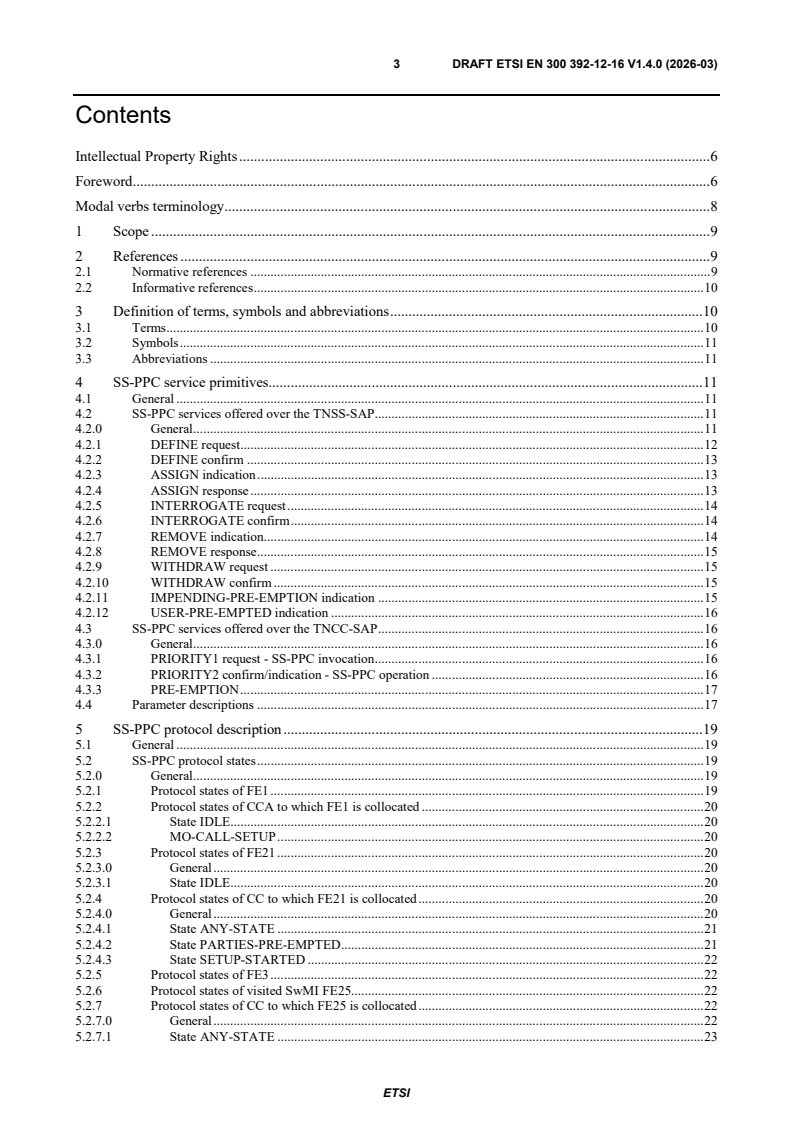
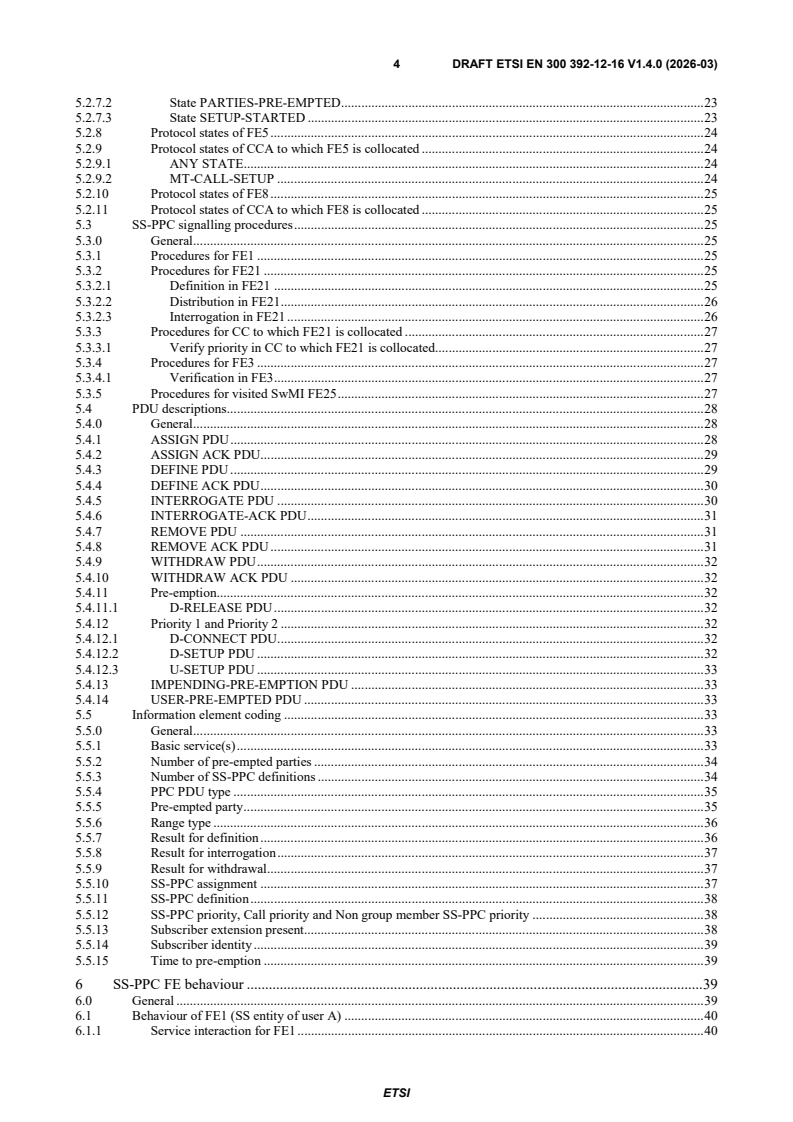
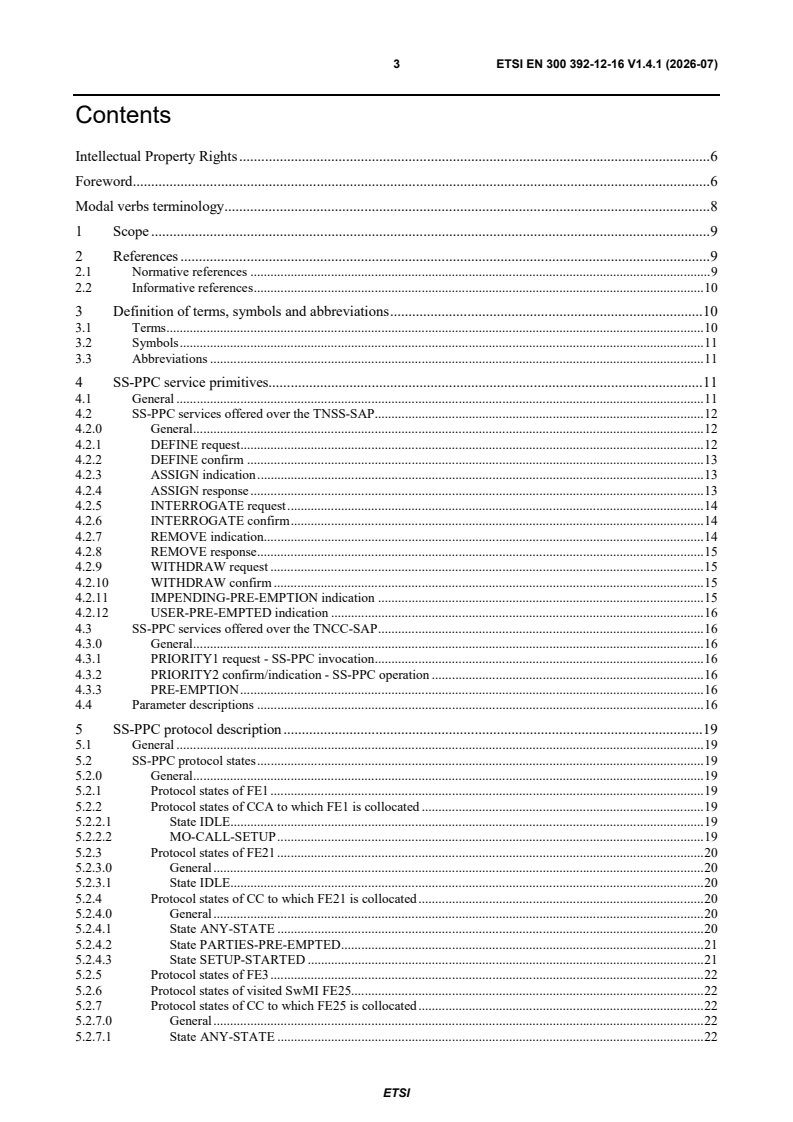
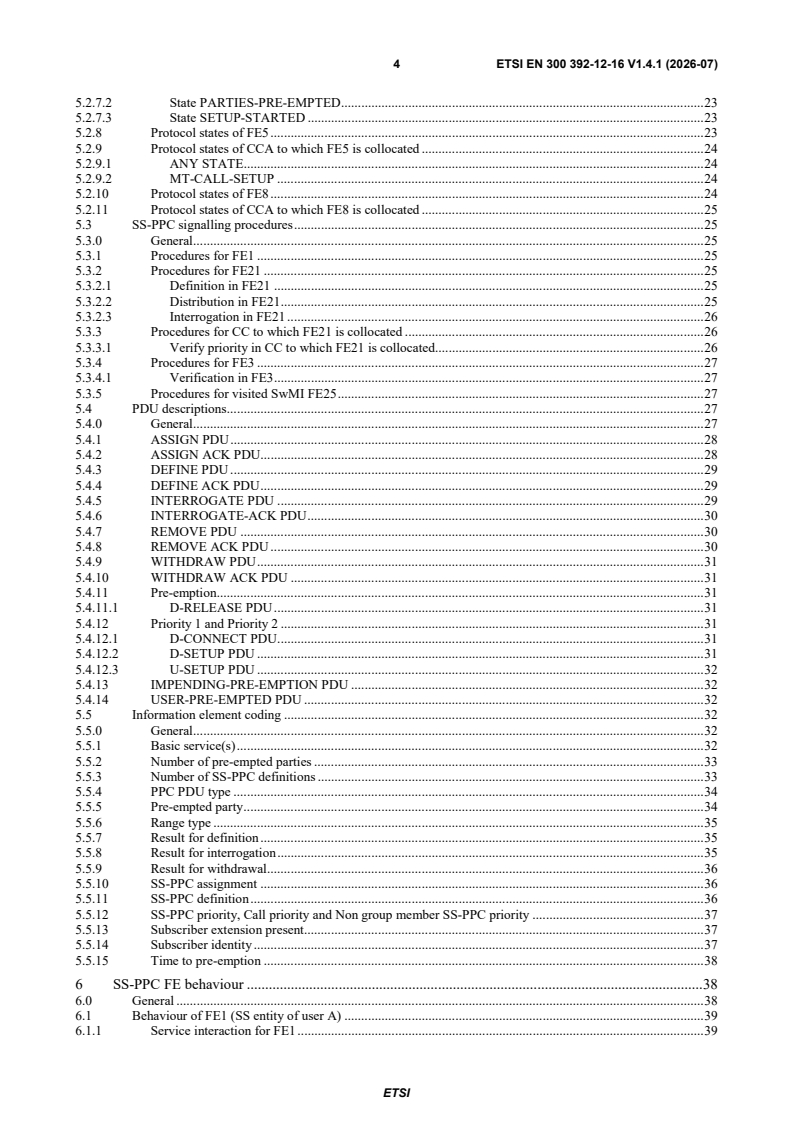
Contents
- 1 Scope
- 2 References
- 2.1 Normative references
- 10 DRAFT ETSI EN 300 392-12-16 V1.4.0 (2026-03)
- 2.2 Informative references
- 3 Definition of terms, symbols and abbreviations
- 3.1 Terms
- 11 DRAFT ETSI EN 300 392-12-16 V1.4.0 (2026-03)
- 3.2 Symbols
- 3.3 Abbreviations
- 4 SS-PPC service primitives
- 4.1 General
- 4.2 SS-PPC services offered over the TNSS-SAP
- 12 DRAFT ETSI EN 300 392-12-16 V1.4.0 (2026-03)
- 13 DRAFT ETSI EN 300 392-12-16 V1.4.0 (2026-03)
- 14 DRAFT ETSI EN 300 392-12-16 V1.4.0 (2026-03)
- 15 DRAFT ETSI EN 300 392-12-16 V1.4.0 (2026-03)
- 16 DRAFT ETSI EN 300 392-12-16 V1.4.0 (2026-03)
- 4.3 SS-PPC services offered over the TNCC-SAP
- 17 DRAFT ETSI EN 300 392-12-16 V1.4.0 (2026-03)
- 4.4 Parameter descriptions
- 18 DRAFT ETSI EN 300 392-12-16 V1.4.0 (2026-03)
- 19 DRAFT ETSI EN 300 392-12-16 V1.4.0 (2026-03)
- 5 SS-PPC protocol description
- 5.1 General
- 5.2 SS-PPC protocol states
- 20 DRAFT ETSI EN 300 392-12-16 V1.4.0 (2026-03)
- 21 DRAFT ETSI EN 300 392-12-16 V1.4.0 (2026-03)
- 22 DRAFT ETSI EN 300 392-12-16 V1.4.0 (2026-03)
- 23 DRAFT ETSI EN 300 392-12-16 V1.4.0 (2026-03)
- 24 DRAFT ETSI EN 300 392-12-16 V1.4.0 (2026-03)
- 25 DRAFT ETSI EN 300 392-12-16 V1.4.0 (2026-03)
- 5.3 SS-PPC signalling procedures
- 26 DRAFT ETSI EN 300 392-12-16 V1.4.0 (2026-03)
- 27 DRAFT ETSI EN 300 392-12-16 V1.4.0 (2026-03)
- 28 DRAFT ETSI EN 300 392-12-16 V1.4.0 (2026-03)
- 5.4 PDU descriptions
- 1 Acknowledgement not requested
- 29 DRAFT ETSI EN 300 392-12-16 V1.4.0 (2026-03)
- 1 Deactivated
- 1 Not to be delivered
- 1 Acknowledgement not requested
- 30 DRAFT ETSI EN 300 392-12-16 V1.4.0 (2026-03)
- 1 Deactivated
- 31 DRAFT ETSI EN 300 392-12-16 V1.4.0 (2026-03)
- 1 Deactivated
- 1 Not delivered
- 1 Acknowledgement not requested
- 32 DRAFT ETSI EN 300 392-12-16 V1.4.0 (2026-03)
- 1 Not to be delivered
- 1 Acknowledgement not requested
- 33 DRAFT ETSI EN 300 392-12-16 V1.4.0 (2026-03)
- 5.5 Information element coding
- 01 Circuit mode speech
- 10 Circuit mode data
- 11 Reserved
- 34 DRAFT ETSI EN 300 392-12-16 V1.4.0 (2026-03)
- 11 Reserved
- 35 DRAFT ETSI EN 300 392-12-16 V1.4.0 (2026-03)
- 36 DRAFT ETSI EN 300 392-12-16 V1.4.0 (2026-03)
- 37 DRAFT ETSI EN 300 392-12-16 V1.4.0 (2026-03)
- 38 DRAFT ETSI EN 300 392-12-16 V1.4.0 (2026-03)
- 1 Subscriber extension present
- 39 DRAFT ETSI EN 300 392-12-16 V1.4.0 (2026-03)
- 6 SS-PPC FE behaviour
- 6.0 General
- 40 DRAFT ETSI EN 300 392-12-16 V1.4.0 (2026-03)
- 6.1 Behaviour of FE1 (SS entity of user A)
- 41 DRAFT ETSI EN 300 392-12-16 V1.4.0 (2026-03)
- 42 DRAFT ETSI EN 300 392-12-16 V1.4.0 (2026-03)
- 6.2 Behaviour of CCA to which FE1 is collocated
- 43 DRAFT ETSI EN 300 392-12-16 V1.4.0 (2026-03)
- 44 DRAFT ETSI EN 300 392-12-16 V1.4.0 (2026-03)
- 45 DRAFT ETSI EN 300 392-12-16 V1.4.0 (2026-03)
- 46 DRAFT ETSI EN 300 392-12-16 V1.4.0 (2026-03)
- 6.4 Behaviour of CC to which FE21 is collocated
- 47 DRAFT ETSI EN 300 392-12-16 V1.4.0 (2026-03)
- 48 DRAFT ETSI EN 300 392-12-16 V1.4.0 (2026-03)
- 49 DRAFT ETSI EN 300 392-12-16 V1.4.0 (2026-03)
- 50 DRAFT ETSI EN 300 392-12-16 V1.4.0 (2026-03)
1 Scope
The present document defines the stage 3 specifications of the Supplementary Service Pre-emptive Priority Call (SS-PPC) for the Terrestrial Trunked Radio (TETRA).
SS-PPC enables a user to have preferential access to the network resources in a TETRA system in times of congestion including pre-emption of calls. SS-PPC is applicable for pre-emptive priorities including the emergency priority. SS-PPC includes the capability to pre-empt resources needed for higher priority calls and the capability to pre-empt users from ongoing calls in order to move them to higher priority calls. SS-PPC specifies the definition, activation, deactivation and interrogation for the usage of pre-emptive call priorities in the TETRA system. The Switching and Management Infrastructure (SwMI) applies the SS-PPC priorities when it allocates the resources for calls. The SS-PPC operations are defined for the SwMI and for the Mobile Station (MS). SS-PPC is defined to subscribers of one TETRA system, but the subscribers may be located in several TETRA systems and the information flows may be delivered over the Inter System Interface (ISI). SS-PPC is invoked for calls within one TETRA system or for calls that extend over ISI to several TETRA systems. Man-Machine Interface (MMI) and charging principles are outside the scope of the present document. Supplementary Service stage 3 specification is preceded by the stage 1 and the stage 2 specifications of the service. Stage 1 describes the functional capabilities from the user's point of view. Stage 2 defines the functional behaviour in terms of Functional Entities (FEs) and information flows. Stage 3 gives a precise description of the supplementary service from the implementation point of view. It defines the protocol for the service and the encoding rules for the information flows. It defines the processes for the FEs and their behaviour. The described protocols and behaviour apply to the SwMI, for the MS and may be applied over the ISI between TETRA systems. Aspects relating to all supplementary services are detailed in ETSI EN 300 392-9 [3].
2 References
2.1 Normative references
References are either specific (identified by date of publication and/or edition number or version number) or non-specific. For specific references, only the cited version applies. For non-specific references, the latest version of the referenced document (including any amendments) applies.
Referenced documents which are not found to be publicly available in the expected location might be found in the ETSI docbox.
NOTE 1: While any hyperlinks included in this clause were valid at the time of publication, ETSI cannot guarantee their long-term validity.
NOTE 2: Note that for the TETRA standards, the reference is always to a European Standard (ETSI EN 300 xxx) if such has been published, but the latest version of that standard can be either an EN or a Technical Specification (ETSI TS 100 xxx), even if this is not visible in the reference list. The following referenced documents are necessary for the application of the present document. [1] ETSI EN 300 392-2: "Terrestrial Trunked Radio (TETRA); Voice plus Data (V+D); Part 2: Air Interface (AI)".
[2] ETSI EN 300 392-1 (V1.2.1): "Terrestrial Trunked Radio (TETRA); Voice plus Data (V+D); Part 1: General network design".
[3] ETSI EN 300 392-9: "Terrestrial Trunked Radio (TETRA); Voice plus Data (V+D); Part 9: General requirements for supplementary services".
[4] ETSI EN 300 392-3-1: "Terrestrial Trunked Radio (TETRA); Voice plus Data (V+D); Part 3: Interworking at the Inter-System Interface (ISI); Sub-part 1: General design". [5] Recommendation ITU-T Z.100: "Specification and Description Language - Overview of SDL-2010".
ETSI
10 DRAFT ETSI EN 300 392-12-16 V1.4.0 (2026-03)
[6] ETSI EN 300 392-12-10: "Terrestrial Trunked Radio (TETRA); Voice plus Data (V+D); Part 12: Supplementary services stage 3; Sub-part 10: Priority Call (PC)".
2.2 Informative references
References are either specific (identified by date of publication and/or edition number or version number) or non-specific. For specific references, only the cited version applies. For non-specific references, the latest version of the referenced document (including any amendments) applies.
NOTE 1: While any hyperlinks included in this clause were valid at the time of publication, ETSI cannot guarantee their long-term validity.
NOTE 2: Note that for the TETRA standards, the reference is always to a European Standard (ETSI EN 300 xxx) if such has been published, but the latest version of that standard can be either an EN or a Technical Specification (ETSI TS 100 xxx), even if this is not visible in the reference list. The following referenced documents may be useful in implementing an ETSI deliverable or add to the reader's understanding, but are not required for conformance to the present document. Not applicable.
3 Definition of terms, symbols and abbreviations
3.1 Terms
For the purposes of the present document, the following terms apply:
authorized user: user who is authorized to define, activate, deactivate and interrogate SS-PPC Call Control Agent (CCA): Call Control sub-entity for Supplementary Service Pre-emptive Priority Call in Circuit Mode Control Entity in Mobile Station emergency priority: highest pre-emptive priority level Functional Entity (FE): functional characteristics of the SS sub-entity within an MS or a SwMI related to an SS-PPC action, e.g. definition or invocation SS-PPC call: basic service (call) to which the defined SS-PPC priority is applied SS-PPC invocation: sending of priority request to infrastructure NOTE: The SS-PPC invocation is done with the basic service invocation request. SS-PPC operation: usage of SS-PPC priority for and in a basic service set-up SS-PPC pre-emption: exclusion of one or more parties from an ongoing basic service due an SS-PPC operation for another basic service NOTE: The pre-emption may be done due to the lack of resources or due to the need to join a called party to a higher priority pre-emptive call.
SS-PPC priority: any pre-emptive priority invoked and operated for an SS-PPC call user A: calling party, the party that invokes or generates invocation of SS-PPC user B: called party in a call in which SS-PPC is operated user C: pre-empted user, a user that is involved in a call, which is pre-empted due to lack of resources for a SS-PPC NOTE: There may be one, two or more pre-empted users due to a pre-empted call. user D: remaining user or users in a call from which a user or users have been pre-empted ETSI
11 DRAFT ETSI EN 300 392-12-16 V1.4.0 (2026-03)
visited SwMI: TETRA system of which the Mobile Network Identity (MNI) is not equal to the MNI of the user
3.2 Symbols
Void.
3.3 Abbreviations
For the purposes of the present document, the following abbreviations apply:
CC Call Control sub-entity for SS-PPC in CMCE in SwMI CCA Call Control Agent CMCE Circuit Mode Control Entity FE Functional Entity GTSI Group TETRA Subscriber Identity ISI Inter System Interface ITSI Individual TETRA Subscriber Identity MCC Mobile Country Code MNC Mobile Network Code MNI Mobile Network Identity MS Mobile Station PDU Protocol Data Unit SS Supplementary Service sub-entity within CMCE SSI Short Subscriber Identity SS-PPC Supplementary Service Pre-emptive Priority Call SwMI Switching and Management Infrastructure TETRA TErrestrial Trunked RAdio TNCC-SAP TETRA Network layer Call Control Service Access Point TNSS-SAP TETRA Network layer Supplementary Service Service Access Point TSI TETRA Subscriber Identity
4 SS-PPC service primitives
4.1 General
This clause describes the SS-PPC services offered by Supplementary Service (SS) and call control sub entities of CMCE of the TETRA voice plus data layer 3 service boundary in the MS. The SS-PPC services shall be offered at the Supplementary Service Service Access Point (TNSS-SAP) and the Call Control Service Access Point (TNCC-SAP). The SS-PPC services described in this clause shall be applicable for the MS. NOTE: The SS-PPC services within the SwMI are outside the scope of the present document. The SS-PPC services specified in the present document shall complement the Supplementary services and Call control services specified in ETSI EN 300 392-2 [1], clauses 12 and 11 respectively and the Supplementary Services general design standard ETSI EN 300 392-9 [3]. The SS-PPC services shall act as sub-services within the general supplementary services and call control services.
SS-PPC shall be an optional supplementary service for TETRA voice plus data layer 3. If SS-PPC is supported, this clause shall specify the services and their availability.
4.2 SS-PPC services offered over the TNSS-SAP
4.2.0 General
When the optional SS-PPC definition, user definition, activation, deactivation, interrogation, impending pre-emption indication and pre-empted party indication are supported, they shall be provided at TNSS-SAP. ETSI
12 DRAFT ETSI EN 300 392-12-16 V1.4.0 (2026-03)
NOTE: As the present document only deals with the SS-PPC all the service primitives have been shown without a TNSS-PPC-prefix e.g. the TNSS-PPC-ASSIGN request is shortened into an ASSIGN request. The SS-PPC primitives for the user A (FE1) at the MS TNSS-SAP shall be:
a) INTERROGATE request; b) INTERROGATE indication; c) ASSIGN indication; d) ASSIGN response.
The SS-PPC primitives for the authorized user (FE3) at the MS TNSS-SAP shall be:
a) DEFINE request; b) DEFINE indication; c) INTERROGATE request; d) INTERROGATE indication.
The SS-PPC primitives for the pre-empted called user (FE5) at the MS TNSS-SAP shall be:
a) IMPENDING-PRE-EMPTION indication.
The SS-PPC primitives for the pre-empted user (FE8) at the MS TNSS-SAP shall be:
a) IMPENDING-PRE-EMPTION indication.
The SS-PPC primitives for the user (FE9) remaining in a call after pre-emption at the MS TNSS-SAP shall be:
a) USER-PRE-EMPTED indication.
The activation and deactivation shall be done with the DEFINE request; the acknowledgement for activation and deactivation shall be done with DEFINE indication.
The information contained in the following primitive description tables correspond to the following key:
- Remark: comment;
- C: conditional;
- O: optional;
- M: mandatory.
4.2.1 DEFINE request
Optional DEFINE request primitive may be offered from the user application to FE3 over TNSS-SAP. The primitive shall contain the SS-PPC information parameters listed in table 1. The subscriber identity parameter(s) shall indicate the subscriber identities on which the following definition shall be made.
ETSI
13 DRAFT ETSI EN 300 392-12-16 V1.4.0 (2026-03)
Table 1: DEFINE request contents Parameter Request Remark Subscriber identity M Repeatable Activated/deactivated M Note 1 Basic service M Repeatable SS-PPC priority M Repeatable Delivered to user A(s) M Acknowledgement from user A(s) C Note 2 NOTE 1: Shall be used to indicate whether or not this PDU is used to activate a new PPC value or to deactivate an existing PPC value. When a PPC value is de-activated, a pre-programmed default value may then apply.
NOTE 2: Conditional on the information element "Delivered to user A(s)".
4.2.2 DEFINE confirm
If DEFINE request primitive is supported, then DEFINE confirm primitive shall be offered from FE3 to the user application over TNSS-SAP as an acknowledgement to a previously made definition request. The primitive shall contain the SS-PPC information parameters listed in table 2.
The Result for definition parameter shall indicate the result for all listed subscriber numbers and all basic service types. NOTE 1: If the acknowledgements are different for different subscriber identities, FE3 may deliver several DEFINE confirm primitives to the user application.
NOTE 2: If the result for definition/activation/deactivation is "accepted, but some values changed by SwMI", the interrogation can be used to interrogate the values.
Table 2: DEFINE confirm contents Parameter Indication Remark Subscriber identity M Repeatable Activated/deactivated M Result for definition M
4.2.3 ASSIGN indication
Optional ASSIGN indication primitive may be offered from FE1 to the user application over TNSS-SAP. The primitive shall contain the SS-PPC information parameters listed in table 3. FE1 shall only consider definitions made to a group number of which the subscriber is a member. Table 3: ASSIGN indication contents Parameter Indication Remark Subscriber identity M Activated/deactivated M Basic service M Repeatable SS-PPC priority M Repeatable Acknowledgement from user A(s) M Note NOTE: Parameter shall indicate if FE1 shall acknowledge the reception of the definition.
4.2.4 ASSIGN response
If ASSIGN indication primitive is supported, then ASSIGN response primitive shall be offered from the user application to FE1 over TNSS-SAP as an acknowledgement to a previously received ASSIGN request, if acknowledgement was requested. The primitive shall contain the SS-PPC information parameters listed in table 4. ETSI
14 DRAFT ETSI EN 300 392-12-16 V1.4.0 (2026-03)
Table 4: ASSIGN response contents Parameter Response Remark Subscriber identity M Activated/deactivated M Basic service M SS-PPC priority M Result for definition M
4.2.5 INTERROGATE request
Optional INTERROGATE request primitive may be offered from the user application to FE1 or FE3 over TNSS-SAP and it shall be used to interrogate SS-PPC definitions. INTERROGATE request primitive shall contain the SS-PPC information parameters listed in table 5.
Table 5: INTERROGATE request contents Parameter Request Remark Subscriber identity M Repeatable
4.2.6 INTERROGATE confirm
If INTERROGATE request primitive is supported, then INTERROGATE confirm primitive shall be offered from FE1 or FE3 to the user application over TNSS-SAP as a response to a previously sent interrogation request. INTERROGATE confirm primitive shall contain the SS-PPC information parameters listed in table 6. If the Subscriber identity parameter is repeated, the definition(s) shall be valid for all given numbers. The delivered to user A(s) and acknowledgement from user A(s) parameters shall indicate if these have been requested with the last successful definition request. The result for interrogation shall indicate, if the definition has been distributed to user A(s) and if user A(s) have acknowledged the distribution.
NOTE: If definitions/responses are different for different subscriber identity parameters FE3 may send several INTERROGATE confirm primitives to the user application.
Table 6: INTERROGATE confirm contents Parameter Indication Remark Subscriber identity M Repeatable Result for interrogation M Activated/deactivated C Note Basic service C Repeatable SS-PPC priority C Repeatable Delivered to user A(s) C MS/LS-subscribers, note Acknowledgement from user A(s) C Note NOTE: The parameter shall appear only if the "Result for interrogation" has the value "accepted", "accepted, but request to user A(s) pending in the SwMI" or "accepted, but user A(s) could not accept the request/ user A(s) was not reached".
4.2.7 REMOVE indication
Optional REMOVE indication primitive may be offered from FE1 to the user application over TNSS-SAP. This primitive shall be used to withdraw the SS-PPC service from a subscriber. The primitive shall contain the SS-PPC information parameters listed in table 7.
ETSI
15 DRAFT ETSI EN 300 392-12-16 V1.4.0 (2026-03)
Table 7: REMOVE indication contents Parameter Indication Remark Subscriber identity M Acknowledgement from user A(s) M Note NOTE: Parameter shall indicate if FE1 shall acknowledge the reception of the removal.
4.2.8 REMOVE response
If REMOVE indication parameter is supported, then REMOVE response primitive shall be offered from the user application to FE1 over TNSS-SAP as an acknowledgement to a previously received REMOVE request, if acknowledgement was requested. The primitive shall contain the SS-PPC information parameters listed in table 8. Table 8: REMOVE response contents Parameter Response Remark Subscriber identity M Result for withdrawal M
4.2.9 WITHDRAW request
Optional WITHDRAW request primitive may be offered from the user application to FE3 over TNSS-SAP and it shall be used to withdraw the PPC service from a subscriber. WITHDRAW request primitive shall contain the SS-PPC information parameters listed in table 9.
Table 9: WITHDRAW request contents Parameter Request Remark Subscriber identity M Repeatable Delivery to user A(s) M MS/LS-subscribers Acknowledgement from user A(s) M
4.2.10 WITHDRAW confirm
If WITHDRAW request primitive is supported, then WITHDRAW confirm primitive shall be offered from FE3 to the user application over TNSS-SAP as an acknowledgement to a previously received WITHDRAW request. The primitive shall contain the SS-PPC information parameters listed in table 10. NOTE: If the acknowledgements are different for different subscriber identities, FE3 may deliver several WITHDRAW confirm primitives to the user application.
Table 10: WITHDRAW confirm contents Parameter Indication Remark Subscriber identity M Repeatable Result for withdrawal M
4.2.11 IMPENDING-PRE-EMPTION indication
Optional IMPENDING-PRE-EMPTION indication may be offered from FE8 or FE5 to the user application to inform of a forthcoming pre-emption. IMPENDING-PRE-EMPTION indication primitive shall contain the SS-PPC information parameters listed in table 11.
ETSI
16 DRAFT ETSI EN 300 392-12-16 V1.4.0 (2026-03)
Table 11: IMPENDING-PRE-EMPTION indication contents Parameter Indication Remark Impending pre-emption M Time to pre-emption O (In seconds)
4.2.12 USER-PRE-EMPTED indication
Optional USER-PRE-EMPTED indication may be offered from FE9 to the user application to inform that one or more parties have been pre-empted from the ongoing call. USER-PRE-EMPTED indication primitive shall contain the SS-PPC information parameters listed in table 12.
Table 12: USER-PRE-EMPTED indication contents Parameter Indication Remark Subscribers pre-empted M Subscriber identity O Pre-empted party
4.3 SS-PPC services offered over the TNCC-SAP
4.3.0 General
When the SS-PPC invocation, operation and pre-emption are supported they shall be provided at TNCC-SAP.
4.3.1 PRIORITY1 request - SS-PPC invocation
PRIORITY1 shall act as the invocation of SS-PPC and the invoked SS-PPC priority shall be included within the TNCC-SETUP request primitive offered over the TNCC-SAP.
The service user, e.g. user A, invokes SS-PPC by requesting a certain SS-PPC priority with a call invocation. The user application may verify that the priority is within the allowed range for a pre-emptive priority value and if not, change it, before passing the priority to CC. The user application shall pass the invoked Call priority within TNCC-SETUP to CC.
4.3.2 PRIORITY2 confirm/indication - SS-PPC operation
PRIORITY2 shall act as the operation of SS-PPC and the SwMI shall send the applied SS-PPC priority to user A and user B(s). The CC within user A and B(s) shall include the received SS-PPC priority to the TNCC-SETUP confirm and indication primitives and offer them over TNCC-SAP to the user application. The user application may indicate the SS-PPC priority to the service user.
NOTE: If the TNCC-SETUP indication is sent to a party that is already engaged in a call, a separate TNCC-RELEASE indication is not sent. The user application is responsible for releasing the lower priority call within the MS, if the MS joins an SS-PPC call when it is already engaged in another call. ETSI
17 DRAFT ETSI EN 300 392-12-16 V1.4.0 (2026-03)
4.3.3 PRE-EMPTION
The pre-emption shall be indicated to the pre-empted party (FE8 or FE5) by existing basic call release sequence with the disconnect cause "Pre-emptive use of resource" ("9").
...
Contents
- 1 Scope
- 2 References
- 2.1 Normative references
- 10 ETSI EN 300 392-12-16 V1.4.1 (2026-07)
- 2.2 Informative references
- 3 Definition of terms, symbols and abbreviations
- 3.1 Terms
- 11 ETSI EN 300 392-12-16 V1.4.1 (2026-07)
- 3.2 Symbols
- 3.3 Abbreviations
- 4 SS-PPC service primitives
- 4.1 General
- 12 ETSI EN 300 392-12-16 V1.4.1 (2026-07)
- 4.2 SS-PPC services offered over the TNSS-SAP
- 13 ETSI EN 300 392-12-16 V1.4.1 (2026-07)
- 14 ETSI EN 300 392-12-16 V1.4.1 (2026-07)
- 15 ETSI EN 300 392-12-16 V1.4.1 (2026-07)
- 16 ETSI EN 300 392-12-16 V1.4.1 (2026-07)
- 4.3 SS-PPC services offered over the TNCC-SAP
- 4.4 Parameter descriptions
- 17 ETSI EN 300 392-12-16 V1.4.1 (2026-07)
- 18 ETSI EN 300 392-12-16 V1.4.1 (2026-07)
- 19 ETSI EN 300 392-12-16 V1.4.1 (2026-07)
- 5 SS-PPC protocol description
- 5.1 General
- 5.2 SS-PPC protocol states
- 20 ETSI EN 300 392-12-16 V1.4.1 (2026-07)
- 21 ETSI EN 300 392-12-16 V1.4.1 (2026-07)
- 22 ETSI EN 300 392-12-16 V1.4.1 (2026-07)
- 23 ETSI EN 300 392-12-16 V1.4.1 (2026-07)
- 24 ETSI EN 300 392-12-16 V1.4.1 (2026-07)
- 25 ETSI EN 300 392-12-16 V1.4.1 (2026-07)
- 5.3 SS-PPC signalling procedures
- 26 ETSI EN 300 392-12-16 V1.4.1 (2026-07)
- 27 ETSI EN 300 392-12-16 V1.4.1 (2026-07)
- 5.4 PDU descriptions
- 28 ETSI EN 300 392-12-16 V1.4.1 (2026-07)
- 1 Acknowledgement not requested
- 1 Deactivated
- 29 ETSI EN 300 392-12-16 V1.4.1 (2026-07)
- 1 Not to be delivered
- 1 Acknowledgement not requested
- 1 Deactivated
- 30 ETSI EN 300 392-12-16 V1.4.1 (2026-07)
- 1 Deactivated
- 1 Not delivered
- 1 Acknowledgement not requested
- 31 ETSI EN 300 392-12-16 V1.4.1 (2026-07)
- 1 Not to be delivered
- 1 Acknowledgement not requested
- 32 ETSI EN 300 392-12-16 V1.4.1 (2026-07)
- 5.5 Information element coding
- 01 Circuit mode speech
- 10 Circuit mode data
- 11 Reserved
- 33 ETSI EN 300 392-12-16 V1.4.1 (2026-07)
- 11 Reserved
- 34 ETSI EN 300 392-12-16 V1.4.1 (2026-07)
- 35 ETSI EN 300 392-12-16 V1.4.1 (2026-07)
- 36 ETSI EN 300 392-12-16 V1.4.1 (2026-07)
- 37 ETSI EN 300 392-12-16 V1.4.1 (2026-07)
- 1 Subscriber extension present
- 38 ETSI EN 300 392-12-16 V1.4.1 (2026-07)
- 6 SS-PPC FE behaviour
- 6.0 General
- 39 ETSI EN 300 392-12-16 V1.4.1 (2026-07)
- 6.1 Behaviour of FE1 (SS entity of user A)
- 40 ETSI EN 300 392-12-16 V1.4.1 (2026-07)
- 41 ETSI EN 300 392-12-16 V1.4.1 (2026-07)
- 6.2 Behaviour of CCA to which FE1 is collocated
- 42 ETSI EN 300 392-12-16 V1.4.1 (2026-07)
- 43 ETSI EN 300 392-12-16 V1.4.1 (2026-07)
- 44 ETSI EN 300 392-12-16 V1.4.1 (2026-07)
- 45 ETSI EN 300 392-12-16 V1.4.1 (2026-07)
- 6.4 Behaviour of CC to which FE21 is collocated
- 46 ETSI EN 300 392-12-16 V1.4.1 (2026-07)
- 47 ETSI EN 300 392-12-16 V1.4.1 (2026-07)
- 48 ETSI EN 300 392-12-16 V1.4.1 (2026-07)
- 49 ETSI EN 300 392-12-16 V1.4.1 (2026-07)
- 6.5 Behaviour of FE3 (SS entity of authorized user)
1 Scope
The present document defines the stage 3 specifications of the Supplementary Service Pre-emptive Priority Call (SS-PPC) for the Terrestrial Trunked Radio (TETRA).
SS-PPC enables a user to have preferential access to the network resources in a TETRA system in times of congestion including pre-emption of calls. SS-PPC is applicable for pre-emptive priorities including the emergency priority. SS-PPC includes the capability to pre-empt resources needed for higher priority calls and the capability to pre-empt users from ongoing calls in order to move them to higher priority calls. SS-PPC specifies the definition, activation, deactivation and interrogation for the usage of pre-emptive call priorities in the TETRA system. The Switching and Management Infrastructure (SwMI) applies the SS-PPC priorities when it allocates the resources for calls. The SS-PPC operations are defined for the SwMI and for the Mobile Station (MS). SS-PPC is defined to subscribers of one TETRA system, but the subscribers may be located in several TETRA systems and the information flows may be delivered over the Inter System Interface (ISI). SS-PPC is invoked for calls within one TETRA system or for calls that extend over ISI to several TETRA systems. Man-Machine Interface (MMI) and charging principles are outside the scope of the present document. Supplementary Service stage 3 specification is preceded by the stage 1 and the stage 2 specifications of the service. Stage 1 describes the functional capabilities from the user's point of view. Stage 2 defines the functional behaviour in terms of Functional Entities (FEs) and information flows. Stage 3 gives a precise description of the supplementary service from the implementation point of view. It defines the protocol for the service and the encoding rules for the information flows. It defines the processes for the FEs and their behaviour. The described protocols and behaviour apply to the SwMI, for the MS and may be applied over the ISI between TETRA systems. Aspects relating to all supplementary services are detailed in ETSI EN 300 392-9 [3].
2 References
2.1 Normative references
References are either specific (identified by date of publication and/or edition number or version number) or non-specific. For specific references, only the cited version applies. For non-specific references, the latest version of the referenced document (including any amendments) applies.
Referenced documents which are not found to be publicly available in the expected location might be found in the ETSI docbox.
NOTE 1: While any hyperlinks included in this clause were valid at the time of publication, ETSI cannot guarantee their long-term validity.
NOTE 2: Note that for the TETRA standards, the reference is always to a European Standard (ETSI EN 300 xxx) if such has been published, but the latest version of that standard can be either an EN or a Technical Specification (ETSI TS 100 xxx), even if this is not visible in the reference list. The following referenced documents are necessary for the application of the present document. [1] ETSI EN 300 392-2: "Terrestrial Trunked Radio (TETRA); Voice plus Data (V+D); Part 2: Air Interface (AI)".
[2] ETSI EN 300 392-1 (V1.2.1): "Terrestrial Trunked Radio (TETRA); Voice plus Data (V+D); Part 1: General network design".
[3] ETSI EN 300 392-9: "Terrestrial Trunked Radio (TETRA); Voice plus Data (V+D); Part 9: General requirements for supplementary services".
[4] ETSI EN 300 392-3-1: "Terrestrial Trunked Radio (TETRA); Voice plus Data (V+D); Part 3: Interworking at the Inter-System Interface (ISI); Sub-part 1: General design". [5] Recommendation ITU-T Z.100: "Specification and Description Language - Overview of SDL-2010".
ETSI
10 ETSI EN 300 392-12-16 V1.4.1 (2026-07)
[6] ETSI EN 300 392-12-10: "Terrestrial Trunked Radio (TETRA); Voice plus Data (V+D); Part 12: Supplementary services stage 3; Sub-part 10: Priority Call (PC)".
2.2 Informative references
References are either specific (identified by date of publication and/or edition number or version number) or non-specific. For specific references, only the cited version applies. For non-specific references, the latest version of the referenced document (including any amendments) applies.
NOTE 1: While any hyperlinks included in this clause were valid at the time of publication, ETSI cannot guarantee their long-term validity.
NOTE 2: Note that for the TETRA standards, the reference is always to a European Standard (ETSI EN 300 xxx) if such has been published, but the latest version of that standard can be either an EN or a Technical Specification (ETSI TS 100 xxx), even if this is not visible in the reference list. The following referenced documents may be useful in implementing an ETSI deliverable or add to the reader's understanding, but are not required for conformance to the present document. Not applicable.
3 Definition of terms, symbols and abbreviations
3.1 Terms
For the purposes of the present document, the following terms apply:
authorized user: user who is authorized to define, activate, deactivate and interrogate SS-PPC Call Control Agent (CCA): Call Control sub-entity for Supplementary Service Pre-emptive Priority Call in Circuit Mode Control Entity in Mobile Station emergency priority: highest pre-emptive priority level Functional Entity (FE): functional characteristics of the SS sub-entity within an MS or a SwMI related to an SS-PPC action, e.g. definition or invocation SS-PPC call: basic service (call) to which the defined SS-PPC priority is applied SS-PPC invocation: sending of priority request to infrastructure NOTE: The SS-PPC invocation is done with the basic service invocation request. SS-PPC operation: usage of SS-PPC priority for and in a basic service set-up SS-PPC pre-emption: exclusion of one or more parties from an ongoing basic service due an SS-PPC operation for another basic service NOTE: The pre-emption may be done due to the lack of resources or due to the need to join a called party to a higher priority pre-emptive call.
SS-PPC priority: any pre-emptive priority invoked and operated for an SS-PPC call user A: calling party, the party that invokes or generates invocation of SS-PPC user B: called party in a call in which SS-PPC is operated user C: pre-empted user, a user that is involved in a call, which is pre-empted due to lack of resources for a SS-PPC NOTE: There may be one, two or more pre-empted users due to a pre-empted call. user D: remaining user or users in a call from which a user or users have been pre-empted ETSI
11 ETSI EN 300 392-12-16 V1.4.1 (2026-07)
visited SwMI: TETRA system of which the Mobile Network Identity (MNI) is not equal to the MNI of the user
3.2 Symbols
Void.
3.3 Abbreviations
For the purposes of the present document, the following abbreviations apply:
CC Call Control sub-entity for SS-PPC in CMCE in SwMI CCA Call Control Agent CMCE Circuit Mode Control Entity FE Functional Entity GTSI Group TETRA Subscriber Identity ISI Inter System Interface ITSI Individual TETRA Subscriber Identity LS Line connected Station MCC Mobile Country Code MNC Mobile Network Code MNI Mobile Network Identity MO Mobile station Originating MS Mobile Station MT Mobile station Terminating PDU Protocol Data Unit SS Supplementary Service sub-entity within CMCE SSI Short Subscriber Identity SS-PC Supplementary Service Priority Call SS-PPC Supplementary Service Pre-emptive Priority Call SwMI Switching and Management Infrastructure TETRA TErrestrial Trunked RAdio TNCC-SAP TETRA Network layer Call Control Service Access Point TNSS-SAP TETRA Network layer Supplementary Service Service Access Point TSI TETRA Subscriber Identity
4 SS-PPC service primitives
4.1 General
This clause describes the SS-PPC services offered by Supplementary Service (SS) and call control sub entities of CMCE of the TETRA voice plus data layer 3 service boundary in the MS. The SS-PPC services shall be offered at the Supplementary Service Service Access Point (TNSS-SAP) and the Call Control Service Access Point (TNCC-SAP). The SS-PPC services described in this clause shall be applicable for the MS. NOTE: The SS-PPC services within the SwMI are outside the scope of the present document. The SS-PPC services specified in the present document shall complement the Supplementary services and Call control services specified in ETSI EN 300 392-2 [1], clauses 12 and 11 respectively and the Supplementary Services general design standard ETSI EN 300 392-9 [3]. The SS-PPC services shall act as sub-services within the general supplementary services and call control services.
SS-PPC shall be an optional supplementary service for TETRA voice plus data layer 3. If SS-PPC is supported, this clause shall specify the services and their availability.
ETSI
12 ETSI EN 300 392-12-16 V1.4.1 (2026-07)
4.2 SS-PPC services offered over the TNSS-SAP
4.2.0 General
When the optional SS-PPC definition, user definition, activation, deactivation, interrogation, impending pre-emption indication and pre-empted party indication are supported, they shall be provided at TNSS-SAP. NOTE: As the present document only deals with the SS-PPC all the service primitives have been shown without a TNSS-PPC-prefix e.g. the TNSS-PPC-ASSIGN request is shortened into an ASSIGN request. The SS-PPC primitives for the user A (FE1) at the MS TNSS-SAP shall be:
a) INTERROGATE request; b) INTERROGATE indication; c) ASSIGN indication; d) ASSIGN response.
The SS-PPC primitives for the authorized user (FE3) at the MS TNSS-SAP shall be:
a) DEFINE request; b) DEFINE indication; c) INTERROGATE request; d) INTERROGATE indication.
The SS-PPC primitives for the pre-empted called user (FE5) at the MS TNSS-SAP shall be:
a) IMPENDING-PRE-EMPTION indication.
The SS-PPC primitives for the pre-empted user (FE8) at the MS TNSS-SAP shall be:
a) IMPENDING-PRE-EMPTION indication.
The SS-PPC primitives for the user (FE9) remaining in a call after pre-emption at the MS TNSS-SAP shall be:
a) USER-PRE-EMPTED indication.
The activation and deactivation shall be done with the DEFINE request; the acknowledgement for activation and deactivation shall be done with DEFINE indication.
The information contained in the following primitive description tables correspond to the following key:
- Remark: comment;
- C: conditional;
- O: optional;
- M: mandatory.
4.2.1 DEFINE request
Optional DEFINE request primitive may be offered from the user application to FE3 over TNSS-SAP. The primitive shall contain the SS-PPC information parameters listed in table 1. The subscriber identity parameter(s) shall indicate the subscriber identities on which the following definition shall be made.
ETSI
13 ETSI EN 300 392-12-16 V1.4.1 (2026-07)
Table 1: DEFINE request contents Parameter Request Remark Subscriber identity M Repeatable Activated/deactivated M Note 1 Basic service M Repeatable SS-PPC priority M Repeatable Delivered to user A(s) M Acknowledgement from user A(s) C Note 2 NOTE 1: Shall be used to indicate whether or not this PDU is used to activate a new PPC value or to deactivate an existing PPC value. When a PPC value is de-activated, a pre-programmed default value may then apply.
NOTE 2: Conditional on the information element "Delivered to user A(s)".
4.2.2 DEFINE confirm
If DEFINE request primitive is supported, then DEFINE confirm primitive shall be offered from FE3 to the user application over TNSS-SAP as an acknowledgement to a previously made definition request. The primitive shall contain the SS-PPC information parameters listed in table 2.
The Result for definition parameter shall indicate the result for all listed subscriber numbers and all basic service types. NOTE 1: If the acknowledgements are different for different subscriber identities, FE3 may deliver several DEFINE confirm primitives to the user application.
NOTE 2: If the result for definition/activation/deactivation is "accepted, but some values changed by SwMI", the interrogation can be used to interrogate the values.
Table 2: DEFINE confirm contents Parameter Indication Remark Subscriber identity M Repeatable Activated/deactivated M Result for definition M
4.2.3 ASSIGN indication
Optional ASSIGN indication primitive may be offered from FE1 to the user application over TNSS-SAP. The primitive shall contain the SS-PPC information parameters listed in table 3. FE1 shall only consider definitions made to a group number of which the subscriber is a member. Table 3: ASSIGN indication contents Parameter Indication Remark Subscriber identity M Activated/deactivated M Basic service M Repeatable SS-PPC priority M Repeatable Acknowledgement from user A(s) M Note NOTE: Parameter shall indicate if FE1 shall acknowledge the reception of the definition.
4.2.4 ASSIGN response
If ASSIGN indication primitive is supported, then ASSIGN response primitive shall be offered from the user application to FE1 over TNSS-SAP as an acknowledgement to a previously received ASSIGN request, if acknowledgement was requested. The primitive shall contain the SS-PPC information parameters listed in table 4. ETSI
14 ETSI EN 300 392-12-16 V1.4.1 (2026-07)
Table 4: ASSIGN response contents Parameter Response Remark Subscriber identity M Activated/deactivated M Basic service M SS-PPC priority M Result for definition M
4.2.5 INTERROGATE request
Optional INTERROGATE request primitive may be offered from the user application to FE1 or FE3 over TNSS-SAP and it shall be used to interrogate SS-PPC definitions. INTERROGATE request primitive shall contain the SS-PPC information parameters listed in table 5.
Table 5: INTERROGATE request contents Parameter Request Remark Subscriber identity M Repeatable
4.2.6 INTERROGATE confirm
If INTERROGATE request primitive is supported, then INTERROGATE confirm primitive shall be offered from FE1 or FE3 to the user application over TNSS-SAP as a response to a previously sent interrogation request. INTERROGATE confirm primitive shall contain the SS-PPC information parameters listed in table 6. If the Subscriber identity parameter is repeated, the definition(s) shall be valid for all given numbers. The delivered to user A(s) and acknowledgement from user A(s) parameters shall indicate if these have been requested with the last successful definition request. The result for interrogation shall indicate, if the definition has been distributed to user A(s) and if user A(s) have acknowledged the distribution.
NOTE: If definitions/responses are different for different subscriber identity parameters FE3 may send several INTERROGATE confirm primitives to the user application.
Table 6: INTERROGATE confirm contents Parameter Indication Remark Subscriber identity M Repeatable Result for interrogation M Activated/deactivated C Note Basic service C Repeatable SS-PPC priority C Repeatable Delivered to user A(s) C MS/LS-subscribers, note Acknowledgement from user A(s) C Note NOTE: The parameter shall appear only if the "Result for interrogation" has the value "accepted", "accepted, but request to user A(s) pending in the SwMI" or "accepted, but user A(s) could not accept the request/ user A(s) was not reached".
4.2.7 REMOVE indication
Optional REMOVE indication primitive may be offered from FE1 to the user application over TNSS-SAP. This primitive shall be used to withdraw the SS-PPC service from a subscriber. The primitive shall contain the SS-PPC information parameters listed in table 7.
ETSI
15 ETSI EN 300 392-12-16 V1.4.1 (2026-07)
Table 7: REMOVE indication contents Parameter Indication Remark Subscriber identity M Acknowledgement from user A(s) M Note NOTE: Parameter shall indicate if FE1 shall acknowledge the reception of the removal.
4.2.8 REMOVE response
If REMOVE indication parameter is supported, then REMOVE response primitive shall be offered from the user application to FE1 over TNSS-SAP as an acknowledgement to a previously received REMOVE request, if acknowledgement was requested. The primitive shall contain the SS-PPC information parameters listed in table 8. Table 8: REMOVE response contents Parameter Response Remark Subscriber identity M Result for withdrawal M
4.2.9 WITHDRAW request
Optional WITHDRAW request primitive may be offered from the user application to FE3 over TNSS-SAP and it shall be used to withdraw the PPC service from a subscriber. WITHDRAW request primitive shall contain the SS-PPC information parameters listed in table 9.
Table 9: WITHDRAW request contents Parameter Request Remark Subscriber identity M Repeatable Delivery to user A(s) M MS/LS-subscribers Acknowledgement from user A(s) M
4.2.10 WITHDRAW confirm
If WITHDRAW request primitive is supported, then WITHDRAW confirm primitive shall be offered from FE3 to the user application over TNSS-SAP as an acknowledgement to a previously received WITHDRAW request. The primitive shall contain the SS-PPC information parameters listed in table 10. NOTE: If the acknowledgements are different for different subscriber identities, FE3 may deliver several WITHDRAW confirm primitives to the user application.
Table 10: WITHDRAW confirm contents Parameter Indication Remark Subscriber identity M Repeatable Result for withdrawal M
4.2.11 IMPENDING-PRE-EMPTION indication
Optional IMPENDING-PRE-EMPTION indication may be offered from FE8 or FE5 to the user application to inform of a forthcoming pre-emption. IMPENDING-PRE-EMPTION indication primitive shall contain the SS-PPC information parameters listed in table 11.
ETSI
16 ETSI EN 300 392-12-16 V1.4.1 (2026-07)
Table 11: IMPENDING-PRE-EMPTION indication contents Parameter Indication Remark Impending pre-emption M Time to pre-emption O (In seconds)
4.2.12 USER-PRE-EMPTED indication
Optional USER-PRE-EMPTED indication may be offered from FE9 to the user application to inform that one or more parties have been pre-empted from the ongoing call. USER-PRE-EMPTED indication primitive shall contain the SS-PPC information parameters listed in table 12.
Table 12: USER-PRE-EMPTED indication contents Parameter Indication Remark Subscribers pre-empted M Subscriber identity O Pre-empted party
4.3 SS-PPC services offered over the TNCC-SAP
4.3.0 General
When the SS-PPC invocation, operation and pre-emption are supported they shall be provided at TNCC-SAP.
4.3.1 PRIORITY1 request - SS-PPC invocation
PRIORITY1 shall act as the invocation of SS-PPC and the invoked SS-PPC priority shall be included within the TNCC-SETUP request primitive offered over the TNCC-SAP.
The service user, e.g. user A, invokes SS-PPC by requesting a certain SS-PPC priority with a call invocation. The user application may verify that the priority is within the allowed range for a pre-emptive priority value and if not, change it, before passing the priority to CC. The user application shall pass the invoked Call priority within TNCC-SETUP to CC.
4.3.2 PRIORITY2 confirm/indication - SS-PPC operation
PRIORITY2 shall act as the operation of SS-PPC and the SwMI shall send the applied SS-PPC priority to user A and user B(s). The CC within user A and B(s) shall include the received SS-PPC priority to the TNCC-SETUP confirm and indication primitives and offer them over TNCC-SAP to the user application. The user application may indicate the SS-PPC priority to the service user.
NOTE: If the TNCC-SETUP indication is sent to a party that is already engaged in a call, a separate TNCC-RELEASE indication is not sent. The user application is responsible for releasing the lower priority call within the MS, if the MS joins an SS-PPC call when it is already engaged in another call.
4.3.3 PRE-EMPTION
The pre-emption shall be indicated to the pre-empted party (FE8 or FE5) by existing basic call release sequence with the disconnect cause "Pre-emptive use of resource" ("9").
...
Contents
- 1 Scope
- 2 References
- 2.1 Normative references
- 10 ETSI EN 300 392-12-16 V1.4.1 (2026-07)
- 2.2 Informative references
- 3 Definition of terms, symbols and abbreviations
- 3.1 Terms
- 11 ETSI EN 300 392-12-16 V1.4.1 (2026-07)
- 3.2 Symbols
- 3.3 Abbreviations
- 4 SS-PPC service primitives
- 4.1 General
- 12 ETSI EN 300 392-12-16 V1.4.1 (2026-07)
- 4.2 SS-PPC services offered over the TNSS-SAP
- 13 ETSI EN 300 392-12-16 V1.4.1 (2026-07)
- 14 ETSI EN 300 392-12-16 V1.4.1 (2026-07)
- 15 ETSI EN 300 392-12-16 V1.4.1 (2026-07)
- 16 ETSI EN 300 392-12-16 V1.4.1 (2026-07)
- 4.3 SS-PPC services offered over the TNCC-SAP
- 4.4 Parameter descriptions
- 17 ETSI EN 300 392-12-16 V1.4.1 (2026-07)
- 18 ETSI EN 300 392-12-16 V1.4.1 (2026-07)
- 19 ETSI EN 300 392-12-16 V1.4.1 (2026-07)
- 5 SS-PPC protocol description
- 5.1 General
- 5.2 SS-PPC protocol states
- 20 ETSI EN 300 392-12-16 V1.4.1 (2026-07)
- 21 ETSI EN 300 392-12-16 V1.4.1 (2026-07)
- 22 ETSI EN 300 392-12-16 V1.4.1 (2026-07)
- 23 ETSI EN 300 392-12-16 V1.4.1 (2026-07)
- 24 ETSI EN 300 392-12-16 V1.4.1 (2026-07)
- 25 ETSI EN 300 392-12-16 V1.4.1 (2026-07)
- 5.3 SS-PPC signalling procedures
- 26 ETSI EN 300 392-12-16 V1.4.1 (2026-07)
- 27 ETSI EN 300 392-12-16 V1.4.1 (2026-07)
- 5.4 PDU descriptions
- 28 ETSI EN 300 392-12-16 V1.4.1 (2026-07)
- 1 Acknowledgement not requested
- 1 Deactivated
- 29 ETSI EN 300 392-12-16 V1.4.1 (2026-07)
- 1 Not to be delivered
- 1 Acknowledgement not requested
- 1 Deactivated
- 30 ETSI EN 300 392-12-16 V1.4.1 (2026-07)
- 1 Deactivated
- 1 Not delivered
- 1 Acknowledgement not requested
- 31 ETSI EN 300 392-12-16 V1.4.1 (2026-07)
- 1 Not to be delivered
- 1 Acknowledgement not requested
- 32 ETSI EN 300 392-12-16 V1.4.1 (2026-07)
- 5.5 Information element coding
- 01 Circuit mode speech
- 10 Circuit mode data
- 11 Reserved
- 33 ETSI EN 300 392-12-16 V1.4.1 (2026-07)
- 11 Reserved
- 34 ETSI EN 300 392-12-16 V1.4.1 (2026-07)
- 35 ETSI EN 300 392-12-16 V1.4.1 (2026-07)
- 36 ETSI EN 300 392-12-16 V1.4.1 (2026-07)
- 37 ETSI EN 300 392-12-16 V1.4.1 (2026-07)
- 1 Subscriber extension present
- 38 ETSI EN 300 392-12-16 V1.4.1 (2026-07)
- 6 SS-PPC FE behaviour
- 6.0 General
- 39 ETSI EN 300 392-12-16 V1.4.1 (2026-07)
- 6.1 Behaviour of FE1 (SS entity of user A)
- 40 ETSI EN 300 392-12-16 V1.4.1 (2026-07)
- 41 ETSI EN 300 392-12-16 V1.4.1 (2026-07)
- 6.2 Behaviour of CCA to which FE1 is collocated
- 42 ETSI EN 300 392-12-16 V1.4.1 (2026-07)
- 43 ETSI EN 300 392-12-16 V1.4.1 (2026-07)
- 44 ETSI EN 300 392-12-16 V1.4.1 (2026-07)
- 45 ETSI EN 300 392-12-16 V1.4.1 (2026-07)
- 6.4 Behaviour of CC to which FE21 is collocated
- 46 ETSI EN 300 392-12-16 V1.4.1 (2026-07)
- 47 ETSI EN 300 392-12-16 V1.4.1 (2026-07)
- 48 ETSI EN 300 392-12-16 V1.4.1 (2026-07)
- 49 ETSI EN 300 392-12-16 V1.4.1 (2026-07)
- 6.5 Behaviour of FE3 (SS entity of authorized user)
1 Scope
The present document defines the stage 3 specifications of the Supplementary Service Pre-emptive Priority Call (SS-PPC) for the Terrestrial Trunked Radio (TETRA).
SS-PPC enables a user to have preferential access to the network resources in a TETRA system in times of congestion including pre-emption of calls. SS-PPC is applicable for pre-emptive priorities including the emergency priority. SS-PPC includes the capability to pre-empt resources needed for higher priority calls and the capability to pre-empt users from ongoing calls in order to move them to higher priority calls. SS-PPC specifies the definition, activation, deactivation and interrogation for the usage of pre-emptive call priorities in the TETRA system. The Switching and Management Infrastructure (SwMI) applies the SS-PPC priorities when it allocates the resources for calls. The SS-PPC operations are defined for the SwMI and for the Mobile Station (MS). SS-PPC is defined to subscribers of one TETRA system, but the subscribers may be located in several TETRA systems and the information flows may be delivered over the Inter System Interface (ISI). SS-PPC is invoked for calls within one TETRA system or for calls that extend over ISI to several TETRA systems. Man-Machine Interface (MMI) and charging principles are outside the scope of the present document. Supplementary Service stage 3 specification is preceded by the stage 1 and the stage 2 specifications of the service. Stage 1 describes the functional capabilities from the user's point of view. Stage 2 defines the functional behaviour in terms of Functional Entities (FEs) and information flows. Stage 3 gives a precise description of the supplementary service from the implementation point of view. It defines the protocol for the service and the encoding rules for the information flows. It defines the processes for the FEs and their behaviour. The described protocols and behaviour apply to the SwMI, for the MS and may be applied over the ISI between TETRA systems. Aspects relating to all supplementary services are detailed in ETSI EN 300 392-9 [3].
2 References
2.1 Normative references
References are either specific (identified by date of publication and/or edition number or version number) or non-specific. For specific references, only the cited version applies. For non-specific references, the latest version of the referenced document (including any amendments) applies.
Referenced documents which are not found to be publicly available in the expected location might be found in the ETSI docbox.
NOTE 1: While any hyperlinks included in this clause were valid at the time of publication, ETSI cannot guarantee their long-term validity.
NOTE 2: Note that for the TETRA standards, the reference is always to a European Standard (ETSI EN 300 xxx) if such has been published, but the latest version of that standard can be either an EN or a Technical Specification (ETSI TS 100 xxx), even if this is not visible in the reference list. The following referenced documents are necessary for the application of the present document. [1] ETSI EN 300 392-2: "Terrestrial Trunked Radio (TETRA); Voice plus Data (V+D); Part 2: Air Interface (AI)".
[2] ETSI EN 300 392-1 (V1.2.1): "Terrestrial Trunked Radio (TETRA); Voice plus Data (V+D); Part 1: General network design".
[3] ETSI EN 300 392-9: "Terrestrial Trunked Radio (TETRA); Voice plus Data (V+D); Part 9: General requirements for supplementary services".
[4] ETSI EN 300 392-3-1: "Terrestrial Trunked Radio (TETRA); Voice plus Data (V+D); Part 3: Interworking at the Inter-System Interface (ISI); Sub-part 1: General design". [5] Recommendation ITU-T Z.100: "Specification and Description Language - Overview of SDL-2010".
ETSI
SIST EN 300 392-12-16 V1.4.1:2026
10 ETSI EN 300 392-12-16 V1.4.1 (2026-07)
[6] ETSI EN 300 392-12-10: "Terrestrial Trunked Radio (TETRA); Voice plus Data (V+D); Part 12: Supplementary services stage 3; Sub-part 10: Priority Call (PC)".
2.2 Informative references
References are either specific (identified by date of publication and/or edition number or version number) or non-specific. For specific references, only the cited version applies. For non-specific references, the latest version of the referenced document (including any amendments) applies.
NOTE 1: While any hyperlinks included in this clause were valid at the time of publication, ETSI cannot guarantee their long-term validity.
NOTE 2: Note that for the TETRA standards, the reference is always to a European Standard (ETSI EN 300 xxx) if such has been published, but the latest version of that standard can be either an EN or a Technical Specification (ETSI TS 100 xxx), even if this is not visible in the reference list. The following referenced documents may be useful in implementing an ETSI deliverable or add to the reader's understanding, but are not required for conformance to the present document. Not applicable.
3 Definition of terms, symbols and abbreviations
3.1 Terms
For the purposes of the present document, the following terms apply:
authorized user: user who is authorized to define, activate, deactivate and interrogate SS-PPC Call Control Agent (CCA): Call Control sub-entity for Supplementary Service Pre-emptive Priority Call in Circuit Mode Control Entity in Mobile Station emergency priority: highest pre-emptive priority level Functional Entity (FE): functional characteristics of the SS sub-entity within an MS or a SwMI related to an SS-PPC action, e.g. definition or invocation SS-PPC call: basic service (call) to which the defined SS-PPC priority is applied SS-PPC invocation: sending of priority request to infrastructure NOTE: The SS-PPC invocation is done with the basic service invocation request. SS-PPC operation: usage of SS-PPC priority for and in a basic service set-up SS-PPC pre-emption: exclusion of one or more parties from an ongoing basic service due an SS-PPC operation for another basic service NOTE: The pre-emption may be done due to the lack of resources or due to the need to join a called party to a higher priority pre-emptive call.
SS-PPC priority: any pre-emptive priority invoked and operated for an SS-PPC call user A: calling party, the party that invokes or generates invocation of SS-PPC user B: called party in a call in which SS-PPC is operated user C: pre-empted user, a user that is involved in a call, which is pre-empted due to lack of resources for a SS-PPC NOTE: There may be one, two or more pre-empted users due to a pre-empted call. user D: remaining user or users in a call from which a user or users have been pre-empted ETSI
SIST EN 300 392-12-16 V1.4.1:2026
11 ETSI EN 300 392-12-16 V1.4.1 (2026-07)
visited SwMI: TETRA system of which the Mobile Network Identity (MNI) is not equal to the MNI of the user
3.2 Symbols
Void.
3.3 Abbreviations
For the purposes of the present document, the following abbreviations apply:
CC Call Control sub-entity for SS-PPC in CMCE in SwMI CCA Call Control Agent CMCE Circuit Mode Control Entity FE Functional Entity GTSI Group TETRA Subscriber Identity ISI Inter System Interface ITSI Individual TETRA Subscriber Identity LS Line connected Station MCC Mobile Country Code MNC Mobile Network Code MNI Mobile Network Identity MO Mobile station Originating MS Mobile Station MT Mobile station Terminating PDU Protocol Data Unit SS Supplementary Service sub-entity within CMCE SSI Short Subscriber Identity SS-PC Supplementary Service Priority Call SS-PPC Supplementary Service Pre-emptive Priority Call SwMI Switching and Management Infrastructure TETRA TErrestrial Trunked RAdio TNCC-SAP TETRA Network layer Call Control Service Access Point TNSS-SAP TETRA Network layer Supplementary Service Service Access Point TSI TETRA Subscriber Identity
4 SS-PPC service primitives
4.1 General
This clause describes the SS-PPC services offered by Supplementary Service (SS) and call control sub entities of CMCE of the TETRA voice plus data layer 3 service boundary in the MS. The SS-PPC services shall be offered at the Supplementary Service Service Access Point (TNSS-SAP) and the Call Control Service Access Point (TNCC-SAP). The SS-PPC services described in this clause shall be applicable for the MS. NOTE: The SS-PPC services within the SwMI are outside the scope of the present document. The SS-PPC services specified in the present document shall complement the Supplementary services and Call control services specified in ETSI EN 300 392-2 [1], clauses 12 and 11 respectively and the Supplementary Services general design standard ETSI EN 300 392-9 [3]. The SS-PPC services shall act as sub-services within the general supplementary services and call control services.
SS-PPC shall be an optional supplementary service for TETRA voice plus data layer 3. If SS-PPC is supported, this clause shall specify the services and their availability.
ETSI
SIST EN 300 392-12-16 V1.4.1:2026
12 ETSI EN 300 392-12-16 V1.4.1 (2026-07)
4.2 SS-PPC services offered over the TNSS-SAP
4.2.0 General
When the optional SS-PPC definition, user definition, activation, deactivation, interrogation, impending pre-emption indication and pre-empted party indication are supported, they shall be provided at TNSS-SAP. NOTE: As the present document only deals with the SS-PPC all the service primitives have been shown without a TNSS-PPC-prefix e.g. the TNSS-PPC-ASSIGN request is shortened into an ASSIGN request. The SS-PPC primitives for the user A (FE1) at the MS TNSS-SAP shall be:
a) INTERROGATE request; b) INTERROGATE indication; c) ASSIGN indication; d) ASSIGN response.
The SS-PPC primitives for the authorized user (FE3) at the MS TNSS-SAP shall be:
a) DEFINE request; b) DEFINE indication; c) INTERROGATE request; d) INTERROGATE indication.
The SS-PPC primitives for the pre-empted called user (FE5) at the MS TNSS-SAP shall be:
a) IMPENDING-PRE-EMPTION indication.
The SS-PPC primitives for the pre-empted user (FE8) at the MS TNSS-SAP shall be:
a) IMPENDING-PRE-EMPTION indication.
The SS-PPC primitives for the user (FE9) remaining in a call after pre-emption at the MS TNSS-SAP shall be:
a) USER-PRE-EMPTED indication.
The activation and deactivation shall be done with the DEFINE request; the acknowledgement for activation and deactivation shall be done with DEFINE indication.
The information contained in the following primitive description tables correspond to the following key:
- Remark: comment;
- C: conditional;
- O: optional;
- M: mandatory.
4.2.1 DEFINE request
Optional DEFINE request primitive may be offered from the user application to FE3 over TNSS-SAP. The primitive shall contain the SS-PPC information parameters listed in table 1. The subscriber identity parameter(s) shall indicate the subscriber identities on which the following definition shall be made.
ETSI
SIST EN 300 392-12-16 V1.4.1:2026
13 ETSI EN 300 392-12-16 V1.4.1 (2026-07)
Table 1: DEFINE request contents Parameter Request Remark Subscriber identity M Repeatable Activated/deactivated M Note 1 Basic service M Repeatable SS-PPC priority M Repeatable Delivered to user A(s) M Acknowledgement from user A(s) C Note 2 NOTE 1: Shall be used to indicate whether or not this PDU is used to activate a new PPC value or to deactivate an existing PPC value. When a PPC value is de-activated, a pre-programmed default value may then apply.
NOTE 2: Conditional on the information element "Delivered to user A(s)".
4.2.2 DEFINE confirm
If DEFINE request primitive is supported, then DEFINE confirm primitive shall be offered from FE3 to the user application over TNSS-SAP as an acknowledgement to a previously made definition request. The primitive shall contain the SS-PPC information parameters listed in table 2.
The Result for definition parameter shall indicate the result for all listed subscriber numbers and all basic service types. NOTE 1: If the acknowledgements are different for different subscriber identities, FE3 may deliver several DEFINE confirm primitives to the user application.
NOTE 2: If the result for definition/activation/deactivation is "accepted, but some values changed by SwMI", the interrogation can be used to interrogate the values.
Table 2: DEFINE confirm contents Parameter Indication Remark Subscriber identity M Repeatable Activated/deactivated M Result for definition M
4.2.3 ASSIGN indication
Optional ASSIGN indication primitive may be offered from FE1 to the user application over TNSS-SAP. The primitive shall contain the SS-PPC information parameters listed in table 3. FE1 shall only consider definitions made to a group number of which the subscriber is a member. Table 3: ASSIGN indication contents Parameter Indication Remark Subscriber identity M Activated/deactivated M Basic service M Repeatable SS-PPC priority M Repeatable Acknowledgement from user A(s) M Note NOTE: Parameter shall indicate if FE1 shall acknowledge the reception of the definition.
4.2.4 ASSIGN response
If ASSIGN indication primitive is supported, then ASSIGN response primitive shall be offered from the user application to FE1 over TNSS-SAP as an acknowledgement to a previously received ASSIGN request, if acknowledgement was requested. The primitive shall contain the SS-PPC information parameters listed in table 4. ETSI
SIST EN 300 392-12-16 V1.4.1:2026
14 ETSI EN 300 392-12-16 V1.4.1 (2026-07)
Table 4: ASSIGN response contents Parameter Response Remark Subscriber identity M Activated/deactivated M Basic service M SS-PPC priority M Result for definition M
4.2.5 INTERROGATE request
Optional INTERROGATE request primitive may be offered from the user application to FE1 or FE3 over TNSS-SAP and it shall be used to interrogate SS-PPC definitions. INTERROGATE request primitive shall contain the SS-PPC information parameters listed in table 5.
Table 5: INTERROGATE request contents Parameter Request Remark Subscriber identity M Repeatable
4.2.6 INTERROGATE confirm
If INTERROGATE request primitive is supported, then INTERROGATE confirm primitive shall be offered from FE1 or FE3 to the user application over TNSS-SAP as a response to a previously sent interrogation request. INTERROGATE confirm primitive shall contain the SS-PPC information parameters listed in table 6. If the Subscriber identity parameter is repeated, the definition(s) shall be valid for all given numbers. The delivered to user A(s) and acknowledgement from user A(s) parameters shall indicate if these have been requested with the last successful definition request. The result for interrogation shall indicate, if the definition has been distributed to user A(s) and if user A(s) have acknowledged the distribution.
NOTE: If definitions/responses are different for different subscriber identity parameters FE3 may send several INTERROGATE confirm primitives to the user application.
Table 6: INTERROGATE confirm contents Parameter Indication Remark Subscriber identity M Repeatable Result for interrogation M Activated/deactivated C Note Basic service C Repeatable SS-PPC priority C Repeatable Delivered to user A(s) C MS/LS-subscribers, note Acknowledgement from user A(s) C Note NOTE: The parameter shall appear only if the "Result for interrogation" has the value "accepted", "accepted, but request to user A(s) pending in the SwMI" or "accepted, but user A(s) could not accept the request/ user A(s) was not reached".
4.2.7 REMOVE indication
Optional REMOVE indication primitive may be offered from FE1 to the user application over TNSS-SAP. This primitive shall be used to withdraw the SS-PPC service from a subscriber. The primitive shall contain the SS-PPC information parameters listed in table 7.
ETSI
SIST EN 300 392-12-16 V1.4.1:2026
15 ETSI EN 300 392-12-16 V1.4.1 (2026-07)
Table 7: REMOVE indication contents Parameter Indication Remark Subscriber identity M Acknowledgement from user A(s) M Note NOTE: Parameter shall indicate if FE1 shall acknowledge the reception of the removal.
4.2.8 REMOVE response
If REMOVE indication parameter is supported, then REMOVE response primitive shall be offered from the user application to FE1 over TNSS-SAP as an acknowledgement to a previously received REMOVE request, if acknowledgement was requested. The primitive shall contain the SS-PPC information parameters listed in table 8. Table 8: REMOVE response contents Parameter Response Remark Subscriber identity M Result for withdrawal M
4.2.9 WITHDRAW request
Optional WITHDRAW request primitive may be offered from the user application to FE3 over TNSS-SAP and it shall be used to withdraw the PPC service from a subscriber. WITHDRAW request primitive shall contain the SS-PPC information parameters listed in table 9.
Table 9: WITHDRAW request contents Parameter Request Remark Subscriber identity M Repeatable Delivery to user A(s) M MS/LS-subscribers Acknowledgement from user A(s) M
4.2.10 WITHDRAW confirm
If WITHDRAW request primitive is supported, then WITHDRAW confirm primitive shall be offered from FE3 to the user application over TNSS-SAP as an acknowledgement to a previously received WITHDRAW request. The primitive shall contain the SS-PPC information parameters listed in table 10. NOTE: If the acknowledgements are different for different subscriber identities, FE3 may deliver several WITHDRAW confirm primitives to the user application.
Table 10: WITHDRAW confirm contents Parameter Indication Remark Subscriber identity M Repeatable Result for withdrawal M
4.2.11 IMPENDING-PRE-EMPTION indication
Optional IMPENDING-PRE-EMPTION indication may be offered from FE8 or FE5 to the user application to inform of a forthcoming pre-emption. IMPENDING-PRE-EMPTION indication primitive shall contain the SS-PPC information parameters listed in table 11.
ETSI
SIST EN 300 392-12-16 V1.4.1:2026
16 ETSI EN 300 392-12-16 V1.4.1 (2026-07)
Table 11: IMPENDING-PRE-EMPTION indication contents Parameter Indication Remark Impending pre-emption M Time to pre-emption O (In seconds)
4.2.12 USER-PRE-EMPTED indication
Optional USER-PRE-EMPTED indication may be offered from FE9 to the user application to inform that one or more parties have been pre-empted from the ongoing call. USER-PRE-EMPTED indication primitive shall contain the SS-PPC information parameters listed in table 12.
Table 12: USER-PRE-EMPTED indication contents Parameter Indication Remark Subscribers pre-empted M Subscriber identity O Pre-empted party
4.3 SS-PPC services offered over the TNCC-SAP
4.3.0 General
When the SS-PPC invocation, operation and pre-emption are supported they shall be provided at TNCC-SAP.
4.3.1 PRIORITY1 request - SS-PPC invocation
PRIORITY1 shall act as the invocation of SS-PPC and the invoked SS-PPC priority shall be included within the TNCC-SETUP request primitive offered over the TNCC-SAP.
The service user, e.g. user A, invokes SS-PPC by requesting a certain SS-PPC priority with a call invocation. The user application may verify that the priority is within the allowed range for a pre-emptive priority value and if not, change it, before passing the priority to CC. The user application shall pass the invoked Call priority within TNCC-SETUP to CC.
4.3.2 PRIORITY2 confirm/indication - SS-PPC operation
PRIORITY2 shall act as the operation of SS-PPC and the SwMI shall send the applied SS-PPC priority to user A and user B(s). The CC within user A and B(s) shall include the received SS-PPC priority to the TNCC-SETUP confirm and indication primitives and offer them over TNCC-SAP to the user application. The user application may indicate the SS-PPC priority to the service user.
...