

SIST EN 300 392-3-12 V1.4.1:2026
(Main)Terrestrial Trunked Radio (TETRA) - Voice plus Data (V+D) - Part 3: Interworking at the Inter-System Interface (ISI) - Sub-part 12: Transport layer independent Additional Network Feature Individual Call (ANF-ISIIC)
- Abstract
The present document defines the Terrestrial Trunked Radio (TETRA) system supporting Voice plus Data (V+D). It specifies:
• the interworking of individual calls between TETRA networks;
• the supplementary services interaction with individual calls between TETRA networks.
The TETRA V+D interworking - basic operation part defines the interworking between TETRA networks over the corresponding interface: the Inter-System Interface (ISI). It comprises the following sub-parts:
• Transport layer independent General design [2];
• General Design, PSS1 over E.1 [i.10];
• General Design, SIP/IP [i.11];
• Transport layer independent Additional Network Feature - ISI Individual Call (ANF-ISIIC) (the present document);
• Transport layer independent Additional Network Feature - ISI Group Call (ANF-ISIGC) [5];
• Transport layer independent Additional Network Feature - ISI Short Data service (ANF-ISISDS) [i.8];
• Transport layer independent Additional Network Feature - ISI Mobility Management (ANF-ISIMM) [6];
• Generic Speech Format Implementation [i.7].
The present document is the ANF-ISIIC sub-part. Like all other Additional Network Feature (ANF) specifications, those of ANF-ISIIC are produced in three stages, according to the method described in Recommendation ITU-T I.130 [i.4]. The present document contains the stage 1 and 2 descriptions of ANF-ISIIC, and stage 3 description. The stage 1 description specifies the ANF as seen by its users, which are essentially the individual call control entities in both TETRA networks. The stage 2 description identifies the functional entities involved in the ANF and the information flows between them. And the stage 3 description of ANF-ISIIC specifies its protocol. NOTE 1: According to Recommendation ITU-T I.130 [i.4], the stage 3 description of a bearer or tele-service addresses the network implementation aspects. Consequently, it comprises two steps: the specifications of all protocols at the various reference points involved in any of the service procedures (notably the service operation) are the first step of the stage 3 description, and the specifications of the functions of the corresponding network entities are its second step. NOTE 2: The SDL diagrams have not been provided since they can be derived from the specification of the functional entity actions in the stage 2 description. The present document applies to TETRA networks which support inter-TETRA individual calls. More specifically, it applies to their Circuit Mode Control Entities (CMCE), as defined in clause 14.2 of ETSI EN 300 392-2 [1], and to their ANF-ISIIC entities defined in the stage 2 description. The relation between the ANF-ISIIC and the transport layer protocol is described in the General Design documents [2], [i.10] and [i.11].
- Status
- Published
- Public Enquiry End Date
- 31-May-2026
- Publication Date
- 19-Aug-2026
- Technical Committee
- MOC - Mobile Communications
- Current Stage
- 6060 - National Implementation/Publication (Adopted Project)
- Start Date
- 03-Aug-2026
- Due Date
- 08-Oct-2026
- Completion Date
- 20-Aug-2026
Buy Documents
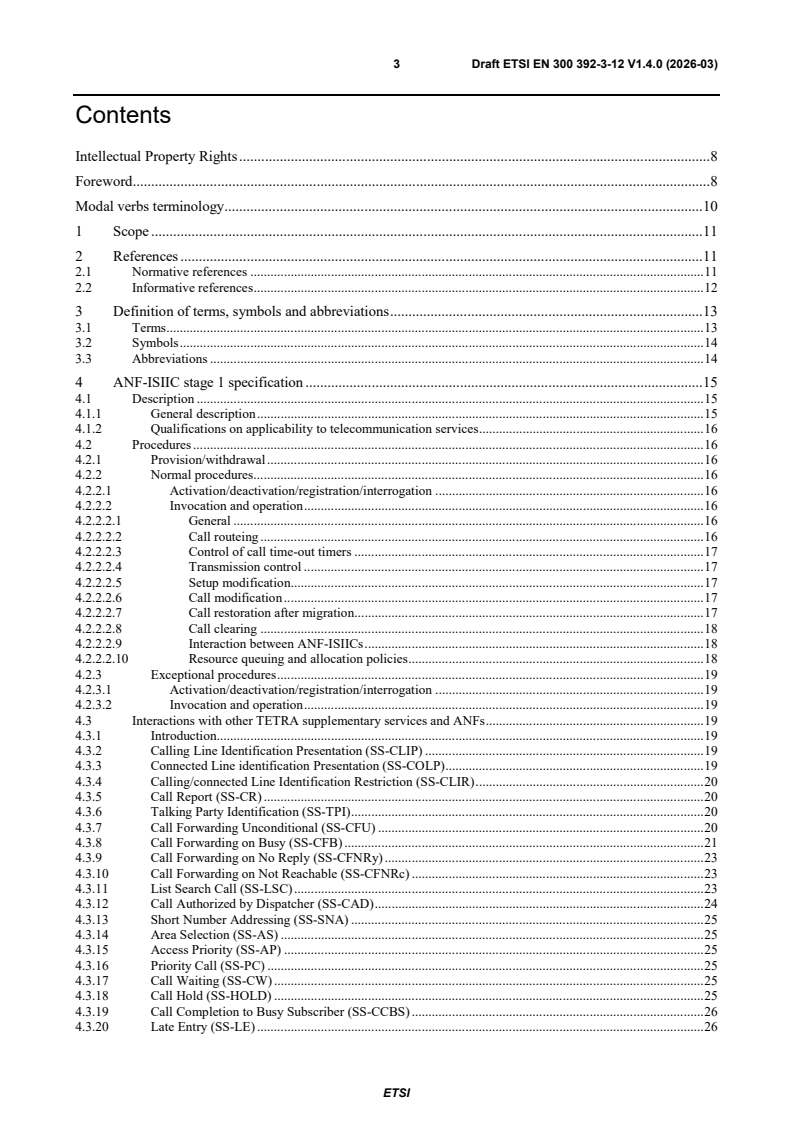
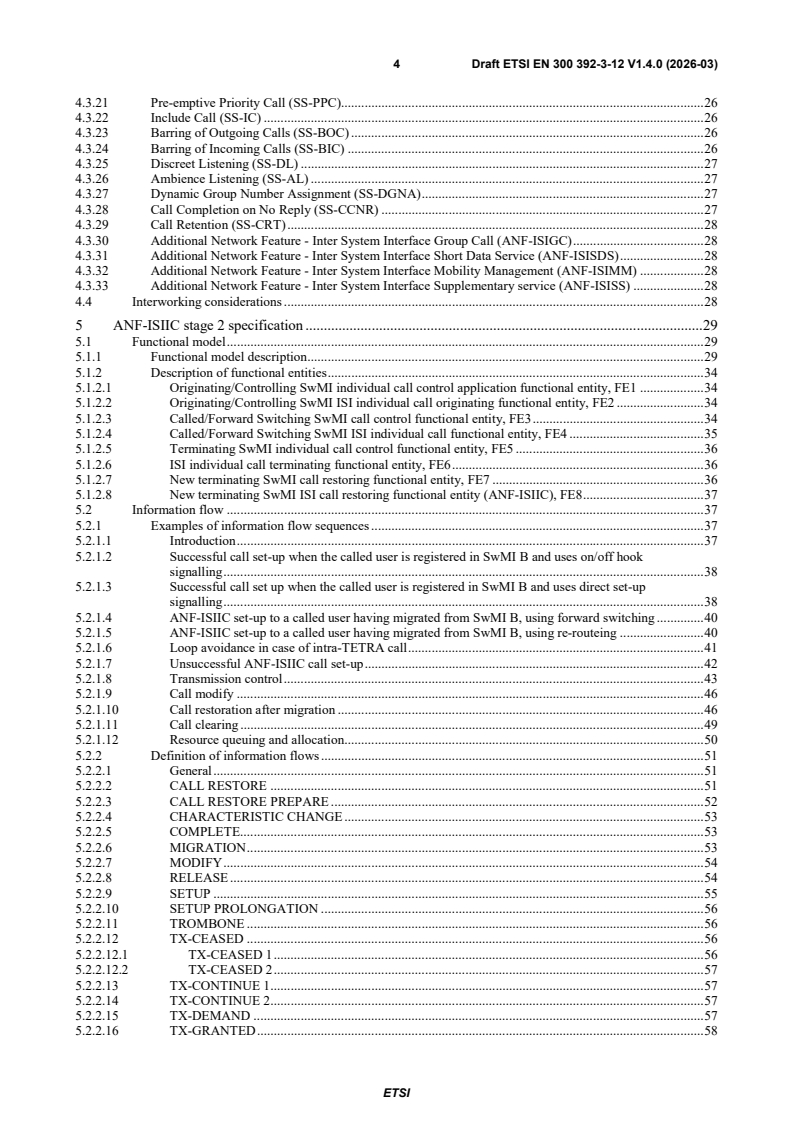
ETSI EN 300 392-3-12 V1.4.0 (2026-03) - Terrestrial Trunked Radio (TETRA); Voice plus Data (V+D); Part 3: Interworking at the Inter-System Interface (ISI); Sub-part 12: Transport layer independent Additional Network Feature Individual Call (ANF-ISIIC)
ETSI EN 300 392-3-12 V1.4.1 (2026-07) - Terrestrial Trunked Radio (TETRA); Voice plus Data (V+D); Part 3: Interworking at the Inter-System Interface (ISI); Sub-part 12: Transport layer independent Additional Network Feature Individual Call (ANF-ISIIC)

SIST EN 300 392-3-12 V1.4.1:2026 is the Slovenian adoption of ETSI EN 300 392-3-12 V1.4.1 (2026-07). It specifies transport layer independent Additional Network Feature Individual Call (ANF-ISIIC) for Terrestrial Trunked Radio (TETRA) Voice plus Data (V+D), covering how individual calls are interworked between TETRA networks over the Inter-System Interface (ISI) and how supplementary services interact with those calls.
What does SIST EN 300 392-3-12 V1.4.1:2026 specify?
SIST EN 300 392-3-12 V1.4.1:2026 specifies the interworking of individual calls between TETRA networks and the interaction of supplementary services with those individual calls. It is the ANF-ISIIC sub-part within the TETRA V+D interworking basic operation series, and it applies to TETRA networks that support inter-TETRA individual calls.
The document follows the ITU-T I.130 three-stage method. In practice, that means it first describes the service as users see it, then the functional entities and information flows, and then the protocol coding and signalling procedures.
| Annex | What it covers |
|---|---|
| Annex A | Interactions of SS-CFU with ANF-ISIIC, including cases where forwarding is active in the called user home SwMI and in a local SwMI |
The main structure is:
- Clause 1 - scope
- Clause 2 - references
- Clause 3 - terms, symbols and abbreviations
- Clause 4 - ANF-ISIIC stage 1 specification
- Clause 5 - ANF-ISIIC stage 2 specification
- Clause 6 - ANF-ISIIC stage 3 specification
- Annex A - informative interaction material for SS-CFU
What are the key requirements of SIST EN 300 392-3-12 V1.4.1:2026?
SIST EN 300 392-3-12 V1.4.1:2026 defines how a TETRA individual call is established, routed, maintained, restored after migration, and cleared across SwMIs. The practical focus is on keeping a call usable when users move between networks and when supplementary services change the route.
Call establishment and routing
Clause 4 and clause 6 require ANF-ISIIC to manage the first call attempt across the ISI and to choose between re-routeing and forward switching. The routing choice is carried in signalling so the involved SwMIs know whether the call stays on the original path or is handed over through an intermediate network.
Clause 6.1 defines the main PDUs such as ISI-SETUP, ISI-PROGRESS, ISI-REDIRECT, ISI-FORWARD SWITCH, ISI-ALERTING and ISI-CONNECT. For implementers, this means the call control application and the ISI entity must generate and interpret a defined message set, not an ad hoc call flow.
Migration and call restoration
Clause 4.2.2.2.7 and clause 6.3.3 describe call restoration after migration of the calling or connected user. When a user registers in a new TETRA network during an established call, the old SwMI is informed and restoration signalling is used so the call can continue in the new location.
Clause 5 models this with dedicated functional entities for restoration, and clause 6.1.2.15 defines the related restore prepare and restoration PDUs. In practice, network equipment must preserve enough call context - such as identity, security-related data and call status - to rebuild the call in the new SwMI.
Interaction with supplementary services
Clause 4.3 and clause 6.5 define how ANF-ISIIC interacts with supplementary services such as SS-CLIP, SS-COLP, SS-CLIR, SS-CFU, SS-CFB, SS-CFNRy, SS-CFNRc, SS-CAD, SS-CW, SS-HOLD, SS-CCBS, SS-CCNR, SS-BIC, SS-AS, SS-PC, SS-PPC and SS-CRT. The practical effect is that call routing, presentation of identities, barring, diversion, waiting and priority handling must stay consistent across networks.
Clause 4.3.7 and Annex A are especially important for SS-CFU. The document explains how a forwarded call is handled when the called user has migrated, including local SS-CFU activation in the visited network and the need to avoid loop connections.
Clause 4.3.12 and clause 6.5.3 cover SS-CAD. In practice, a dispatcher-authorized call may need different routing behaviour, including special handling when a call is diverted to a dispatcher and when a distant dispatcher authorizes the call.
Transmission control, call modification and half-duplex behaviour
Clause 5.2.1.8 and clause 6.1.2.11 to 6.1.2.14 define transmission control procedures. The standard uses explicit messages for requesting transmission, granting it, interrupting it, pausing it and continuing it, which is what lets half-duplex individual calls work across multiple SwMIs.
Clause 4.2.2.2.6 and clause 6.3.3.2 define call modification. A change in call characteristics must be reflected in the user information coding when the data rate or service type changes, so the call control side must keep the signalling aligned with the actual speech or data mode in use.
Resource queuing and allocation
Clause 5.2.1.12 and clause 6.3.2.4 define how resources are queued and allocated when one or more SwMIs cannot reserve resources immediately. The protocol uses ISI-QUEUING and ISI-RESOURCE messages to report reservation status and to decide whether resources may be released while waiting.
This matters operationally because the originating, forward switching and terminating SwMIs must coordinate resource ownership. The standard distinguishes temporary and permanent setup resource allocation, so implementers need logic that matches the policy in each network segment.
Protocol coding and data fields
Clause 6.1.2 and clause 6.1.3 define the PDU contents and information element coding. The standard specifies items such as routeing method choice, call priority, security level at air interface, presentation indicators, SS-CF invocation counter, resource indicator and call identification data.
For practice, this is the part that drives interoperability testing. Two vendors must encode the same call state and service data in the same way, otherwise a call can be accepted by one SwMI and rejected or misrouted by another.
What terms does SIST EN 300 392-3-12 V1.4.1:2026 define?
- Additional Network Feature (ANF) - A network feature carried over the ISI, here focused on individual calls between TETRA networks.
- Inter-System Interface (ISI) - The interface used for interworking between TETRA networks.
- Switching and Management Infrastructure (SwMI) - The TETRA network infrastructure that controls call handling and mobility-related actions.
- Circuit Mode Control Entities (CMCE) - The call control entities in ETSI EN 300 392-2 that this standard specifically applies to.
- Functional Entity (FE) - A logical function used in the stage 2 model to show how call control and ISI behaviour is split between network roles.
- Protocol Data Unit (PDU) - The encoded message exchanged over the ISI in stage 3.
- Individual TETRA Subscriber Identity (ITSI) - The identity of a TETRA subscriber used to identify users across networks.
- Mobile Network Identity (MNI) - The part of the ITSI that identifies the home network.
Who uses SIST EN 300 392-3-12 V1.4.1:2026?
SIST EN 300 392-3-12 V1.4.1:2026 is used by TETRA network operators, SwMI vendors, gateway vendors, and system integrators that need inter-network individual calling to work consistently. It is also used by protocol engineers, conformance testers and lab teams that validate call setup, diversion, migration, restoration and supplementary service interactions.
For buyers and quality managers, the standard is useful when checking whether an implementation supports cross-network call routing, half-duplex transmission control, call forwarding behaviour and interworking with PSTN, PABX and ISDN gateways. For service designers, it gives the signalling model needed to document how user identity, presentation and barring behave across network boundaries.
Which standards are used with SIST EN 300 392-3-12 V1.4.1:2026?
| Standard | What it contributes |
|---|---|
| ETSI EN 300 392-2 | Air interface rules, CMCE context, call modification, disconnect causes and other base TETRA V+D behaviour |
| ETSI EN 300 392-3-9 | General design for ISI and shared terminology for the interworking part |
| ETSI EN 300 392-3-13 | Companion ISI part for group call behaviour |
| ETSI EN 300 392-3-14 | Companion ISI part for short data service |
| ETSI EN 300 392-3-8 | Generic Speech Format Implementation used with ISI speech handling |
| ETSI EN 300 392-7 | Security-related definitions, including the air interface security level referenced in coding |
| ETSI EN 300 395-2 | TETRA speech codec reference for speech service coding and support |
| Recommendation ITU-T I.130 | Three-stage method for describing telecommunications services |
| ETSI TR 102 300-5 | Guidance on numbering and addressing, including fleet specific short numbers |
| ETSI EN 300 392-3-2 | Earlier ANF-ISIIC reference named in the document’s informative references |
What does the SIST EN 300 392-3-12 V1.4.1:2026 document contain?
SIST EN 300 392-3-12 V1.4.1:2026 contains stage 1, stage 2 and stage 3 descriptions of ANF-ISIIC. It uses clause text, functional models, information flow examples and protocol coding tables to show how the service works end to end.
The document includes:
- Functional entity models for originating, called, terminating, forward switching and restoration roles
- Message sequence examples for successful setup, migration, loop avoidance, transmission control, restoration and clearing
- PDU coding tables for ISI-SETUP, ISI-REDIRECT, ISI-CONNECT, ISI-QUEUING, ISI-RESOURCE and related messages
- Information element definitions for routing, presentation, call priority, security, resource handling and migration
- A timer value section for ANF-ISIIC parameter values
- Annex A, which gives a worked interaction context for SS-CFU
For implementation work, this is the part that turns the service description into testable signalling behaviour. For certification or interoperability testing, the tables and figures are the main reference for verifying what each PDU should contain and how each call scenario should progress.
Buy Documents
ETSI EN 300 392-3-12 V1.4.0 (2026-03) - Terrestrial Trunked Radio (TETRA); Voice plus Data (V+D); Part 3: Interworking at the Inter-System Interface (ISI); Sub-part 12: Transport layer independent Additional Network Feature Individual Call (ANF-ISIIC)
ETSI EN 300 392-3-12 V1.4.1 (2026-07) - Terrestrial Trunked Radio (TETRA); Voice plus Data (V+D); Part 3: Interworking at the Inter-System Interface (ISI); Sub-part 12: Transport layer independent Additional Network Feature Individual Call (ANF-ISIIC)
Get Certified
Connect with accredited certification bodies for this standard

BSI Group
BSI (British Standards Institution) is the business standards company that helps organizations make excellence a habit.

NYCE
Mexican standards and certification body.

ANCE
Mexican certification and testing association.
Sponsored listings
Frequently Asked Questions
SIST EN 300 392-3-12 V1.4.1:2026 is a standard published by the Slovenian Institute for Standardization (SIST). Its full title is "Terrestrial Trunked Radio (TETRA) - Voice plus Data (V+D) - Part 3: Interworking at the Inter-System Interface (ISI) - Sub-part 12: Transport layer independent Additional Network Feature Individual Call (ANF-ISIIC)". This standard covers: The present document defines the Terrestrial Trunked Radio (TETRA) system supporting Voice plus Data (V+D). It specifies: • the interworking of individual calls between TETRA networks; • the supplementary services interaction with individual calls between TETRA networks. The TETRA V+D interworking - basic operation part defines the interworking between TETRA networks over the corresponding interface: the Inter-System Interface (ISI). It comprises the following sub-parts: • Transport layer independent General design [2]; • General Design, PSS1 over E.1 [i.10]; • General Design, SIP/IP [i.11]; • Transport layer independent Additional Network Feature - ISI Individual Call (ANF-ISIIC) (the present document); • Transport layer independent Additional Network Feature - ISI Group Call (ANF-ISIGC) [5]; • Transport layer independent Additional Network Feature - ISI Short Data service (ANF-ISISDS) [i.8]; • Transport layer independent Additional Network Feature - ISI Mobility Management (ANF-ISIMM) [6]; • Generic Speech Format Implementation [i.7]. The present document is the ANF-ISIIC sub-part. Like all other Additional Network Feature (ANF) specifications, those of ANF-ISIIC are produced in three stages, according to the method described in Recommendation ITU-T I.130 [i.4]. The present document contains the stage 1 and 2 descriptions of ANF-ISIIC, and stage 3 description. The stage 1 description specifies the ANF as seen by its users, which are essentially the individual call control entities in both TETRA networks. The stage 2 description identifies the functional entities involved in the ANF and the information flows between them. And the stage 3 description of ANF-ISIIC specifies its protocol. NOTE 1: According to Recommendation ITU-T I.130 [i.4], the stage 3 description of a bearer or tele-service addresses the network implementation aspects. Consequently, it comprises two steps: the specifications of all protocols at the various reference points involved in any of the service procedures (notably the service operation) are the first step of the stage 3 description, and the specifications of the functions of the corresponding network entities are its second step. NOTE 2: The SDL diagrams have not been provided since they can be derived from the specification of the functional entity actions in the stage 2 description. The present document applies to TETRA networks which support inter-TETRA individual calls. More specifically, it applies to their Circuit Mode Control Entities (CMCE), as defined in clause 14.2 of ETSI EN 300 392-2 [1], and to their ANF-ISIIC entities defined in the stage 2 description. The relation between the ANF-ISIIC and the transport layer protocol is described in the General Design documents [2], [i.10] and [i.11].
The present document defines the Terrestrial Trunked Radio (TETRA) system supporting Voice plus Data (V+D). It specifies: • the interworking of individual calls between TETRA networks; • the supplementary services interaction with individual calls between TETRA networks. The TETRA V+D interworking - basic operation part defines the interworking between TETRA networks over the corresponding interface: the Inter-System Interface (ISI). It comprises the following sub-parts: • Transport layer independent General design [2]; • General Design, PSS1 over E.1 [i.10]; • General Design, SIP/IP [i.11]; • Transport layer independent Additional Network Feature - ISI Individual Call (ANF-ISIIC) (the present document); • Transport layer independent Additional Network Feature - ISI Group Call (ANF-ISIGC) [5]; • Transport layer independent Additional Network Feature - ISI Short Data service (ANF-ISISDS) [i.8]; • Transport layer independent Additional Network Feature - ISI Mobility Management (ANF-ISIMM) [6]; • Generic Speech Format Implementation [i.7]. The present document is the ANF-ISIIC sub-part. Like all other Additional Network Feature (ANF) specifications, those of ANF-ISIIC are produced in three stages, according to the method described in Recommendation ITU-T I.130 [i.4]. The present document contains the stage 1 and 2 descriptions of ANF-ISIIC, and stage 3 description. The stage 1 description specifies the ANF as seen by its users, which are essentially the individual call control entities in both TETRA networks. The stage 2 description identifies the functional entities involved in the ANF and the information flows between them. And the stage 3 description of ANF-ISIIC specifies its protocol. NOTE 1: According to Recommendation ITU-T I.130 [i.4], the stage 3 description of a bearer or tele-service addresses the network implementation aspects. Consequently, it comprises two steps: the specifications of all protocols at the various reference points involved in any of the service procedures (notably the service operation) are the first step of the stage 3 description, and the specifications of the functions of the corresponding network entities are its second step. NOTE 2: The SDL diagrams have not been provided since they can be derived from the specification of the functional entity actions in the stage 2 description. The present document applies to TETRA networks which support inter-TETRA individual calls. More specifically, it applies to their Circuit Mode Control Entities (CMCE), as defined in clause 14.2 of ETSI EN 300 392-2 [1], and to their ANF-ISIIC entities defined in the stage 2 description. The relation between the ANF-ISIIC and the transport layer protocol is described in the General Design documents [2], [i.10] and [i.11].
SIST EN 300 392-3-12 V1.4.1:2026 is classified under the following ICS (International Classification for Standards) categories: 33.070.10 - Terrestrial Trunked Radio (TETRA); 35.100.40 - Transport layer. The ICS classification helps identify the subject area and facilitates finding related standards.
SIST EN 300 392-3-12 V1.4.1:2026 is available in PDF format for immediate download after purchase. The document can be added to your cart and obtained through the secure checkout process. Digital delivery ensures instant access to the complete standard document.
Standards Content (Sample)
Draft ETSI EN 300 392-3-12 V1.4.0 (2026-03)
EUROPEAN STANDARD
Terrestrial Trunked Radio (TETRA);
Voice plus Data (V+D);
Part 3: Interworking at the Inter-System Interface (ISI);
Sub-part 12: Transport layer independent
Additional Network Feature Individual Call (ANF-ISIIC)
2 Draft ETSI EN 300 392-3-12 V1.4.0 (2026-03)
Reference
REN/TCCE-03279
Keywords
ANF, interworking, TETRA, V+D
ETSI
650 Route des Lucioles
F-06921 Sophia Antipolis Cedex - FRANCE
Tel.: +33 4 92 94 42 00 Fax: +33 4 93 65 47 16
Siret N° 348 623 562 00017 - APE 7112B
Association à but non lucratif enregistrée à la
Sous-Préfecture de Grasse (06) N° w061004871
Important notice
The present document can be downloaded from the
ETSI Search & Browse Standards application.
The present document may be made available in electronic versions and/or in print. The content of any electronic and/or
print versions of the present document shall not be modified without the prior written authorization of ETSI. In case of any
existing or perceived difference in contents between such versions and/or in print, the prevailing version of an ETSI
deliverable is the one made publicly available in PDF format on ETSI deliver repository.
Users should be aware that the present document may be revised or have its status changed,
this information is available in the Milestones listing.
If you find errors in the present document, please send your comments to
the relevant service listed under Committee Support Staff.
If you find a security vulnerability in the present document, please report it through our
Coordinated Vulnerability Disclosure (CVD) program.
Notice of disclaimer & limitation of liability
The information provided in the present deliverable is directed solely to professionals who have the appropriate degree of
experience to understand and interpret its content in accordance with generally accepted engineering or
other professional standard and applicable regulations.
No recommendation as to products and services or vendors is made or should be implied.
In no event shall ETSI be held liable for loss of profits or any other incidental or consequential damages.
Any software contained in this deliverable is provided "AS IS" with no warranties, express or implied, including but not
limited to, the warranties of merchantability, fitness for a particular purpose and non-infringement of intellectual property
rights and ETSI shall not be held liable in any event for any damages whatsoever (including, without limitation, damages
for loss of profits, business interruption, loss of information, or any other pecuniary loss) arising out of or related to the use
of or inability to use the software.
Copyright Notification
No part may be reproduced or utilized in any form or by any means, electronic or mechanical, including photocopying and
microfilm except as authorized by written permission of ETSI.
The content of the PDF version shall not be modified without the written authorization of ETSI.
The copyright and the foregoing restriction extend to reproduction in all media.
© ETSI 2026.
All rights reserved.
ETSI
3 Draft ETSI EN 300 392-3-12 V1.4.0 (2026-03)
Contents
Intellectual Property Rights . 8
Foreword . 8
Modal verbs terminology . 10
1 Scope . 11
2 References . 11
2.1 Normative references . 11
2.2 Informative references . 12
3 Definition of terms, symbols and abbreviations . 13
3.1 Terms . 13
3.2 Symbols . 14
3.3 Abbreviations . 14
4 ANF-ISIIC stage 1 specification . 15
4.1 Description . 15
4.1.1 General description . 15
4.1.2 Qualifications on applicability to telecommunication services . 16
4.2 Procedures . 16
4.2.1 Provision/withdrawal . 16
4.2.2 Normal procedures . 16
4.2.2.1 Activation/deactivation/registration/interrogation . 16
4.2.2.2 Invocation and operation . 16
4.2.2.2.1 General . 16
4.2.2.2.2 Call routeing . 16
4.2.2.2.3 Control of call time-out timers . 17
4.2.2.2.4 Transmission control . 17
4.2.2.2.5 Setup modification. 17
4.2.2.2.6 Call modification . 17
4.2.2.2.7 Call restoration after migration . 17
4.2.2.2.8 Call clearing . 18
4.2.2.2.9 Interaction between ANF-ISIICs . 18
4.2.2.2.10 Resource queuing and allocation policies . 18
4.2.3 Exceptional procedures . 19
4.2.3.1 Activation/deactivation/registration/interrogation . 19
4.2.3.2 Invocation and operation . 19
4.3 Interactions with other TETRA supplementary services and ANFs . 19
4.3.1 Introduction. 19
4.3.2 Calling Line Identification Presentation (SS-CLIP) . 19
4.3.3 Connected Line identification Presentation (SS-COLP) . 19
4.3.4 Calling/connected Line Identification Restriction (SS-CLIR) . 20
4.3.5 Call Report (SS-CR) . 20
4.3.6 Talking Party Identification (SS-TPI) . 20
4.3.7 Call Forwarding Unconditional (SS-CFU) . 20
4.3.8 Call Forwarding on Busy (SS-CFB) . 21
4.3.9 Call Forwarding on No Reply (SS-CFNRy) . 23
4.3.10 Call Forwarding on Not Reachable (SS-CFNRc) . 23
4.3.11 List Search Call (SS-LSC) . 23
4.3.12 Call Authorized by Dispatcher (SS-CAD) . 24
4.3.13 Short Number Addressing (SS-SNA) . 25
4.3.14 Area Selection (SS-AS) . 25
4.3.15 Access Priority (SS-AP) . 25
4.3.16 Priority Call (SS-PC) . 25
4.3.17 Call Waiting (SS-CW) . 25
4.3.18 Call Hold (SS-HOLD) . 25
4.3.19 Call Completion to Busy Subscriber (SS-CCBS) . 26
4.3.20 Late Entry (SS-LE) . 26
ETSI
4 Draft ETSI EN 300 392-3-12 V1.4.0 (2026-03)
4.3.21 Pre-emptive Priority Call (SS-PPC) . 26
4.3.22 Include Call (SS-IC) . 26
4.3.23 Barring of Outgoing Calls (SS-BOC) . 26
4.3.24 Barring of Incoming Calls (SS-BIC) . 26
4.3.25 Discreet Listening (SS-DL) . 27
4.3.26 Ambience Listening (SS-AL) . 27
4.3.27 Dynamic Group Number Assignment (SS-DGNA) . 27
4.3.28 Call Completion on No Reply (SS-CCNR) . 27
4.3.29 Call Retention (SS-CRT) . 28
4.3.30 Additional Network Feature - Inter System Interface Group Call (ANF-ISIGC) . 28
4.3.31 Additional Network Feature - Inter System Interface Short Data Service (ANF-ISISDS) . 28
4.3.32 Additional Network Feature - Inter System Interface Mobility Management (ANF-ISIMM) . 28
4.3.33 Additional Network Feature - Inter System Interface Supplementary service (ANF-ISISS) . 28
4.4 Interworking considerations . 28
5 ANF-ISIIC stage 2 specification . 29
5.1 Functional model . 29
5.1.1 Functional model description . 29
5.1.2 Description of functional entities . 34
5.1.2.1 Originating/Controlling SwMI individual call control application functional entity, FE1 . 34
5.1.2.2 Originating/Controlling SwMI ISI individual call originating functional entity, FE2 . 34
5.1.2.3 Called/Forward Switching SwMI call control functional entity, FE3 . 34
5.1.2.4 Called/Forward Switching SwMI ISI individual call functional entity, FE4 . 35
5.1.2.5 Terminating SwMI individual call control functional entity, FE5 . 36
5.1.2.6 ISI individual call terminating functional entity, FE6 . 36
5.1.2.7 New terminating SwMI call restoring functional entity, FE7 . 36
5.1.2.8 New terminating SwMI ISI call restoring functional entity (ANF-ISIIC), FE8 . 37
5.2 Information flow . 37
5.2.1 Examples of information flow sequences . 37
5.2.1.1 Introduction . 37
5.2.1.2 Successful call set-up when the called user is registered in SwMI B and uses on/off hook
signalling . 38
5.2.1.3 Successful call set up when the called user is registered in SwMI B and uses direct set-up
signalling . 38
5.2.1.4 ANF-ISIIC set-up to a called user having migrated from SwMI B, using forward switching . 40
5.2.1.5 ANF-ISIIC set-up to a called user having migrated from SwMI B, using re-routeing . 40
5.2.1.6 Loop avoidance in case of intra-TETRA call . 41
5.2.1.7 Unsuccessful ANF-ISIIC call set-up . 42
5.2.1.8 Transmission control . 43
5.2.1.9 Call modify . 46
5.2.1.10 Call restoration after migration . 46
5.2.1.11 Call clearing . 49
5.2.1.12 Resource queuing and allocation . 50
5.2.2 Definition of information flows . 51
5.2.2.1 General . 51
5.2.2.2 CALL RESTORE . 51
5.2.2.3 CALL RESTORE PREPARE . 52
5.2.2.4 CHARACTERISTIC CHANGE . 53
5.2.2.5 COMPLETE. 53
5.2.2.6 MIGRATION . 53
5.2.2.7 MODIFY . 54
5.2.2.8 RELEASE . 54
5.2.2.9 SETUP . 55
5.2.2.10 SETUP PROLONGATION . 56
5.2.2.11 TROMBONE . 56
5.2.2.12 TX-CEASED . 56
5.2.2.12.1 TX-CEASED 1 . 56
5.2.2.12.2 TX-CEASED 2 . 57
5.2.2.13 TX-CONTINUE 1 . 57
5.2.2.14 TX-CONTINUE 2 . 57
5.2.2.15 TX-DEMAND . 57
5.2.2.16 TX-GRANTED . 58
ETSI
5 Draft ETSI EN 300 392-3-12 V1.4.0 (2026-03)
5.2.2.17 TX-INTERRUPT . 58
5.2.2.18 TX-WAIT. 58
5.3 Functional entity actions . 59
5.4 Allocation of functional entities to physical equipment/SwMIs. 59
6 ANF-ISIIC stage 3 specification . 61
6.1 ANF-ISIIC coding requirements . 61
6.1.1 General . 61
6.1.2 TETRA PDUs . 61
6.1.2.1 General encoding rule . 61
6.1.2.2 ISI-SETUP PDU message sent by the originating or the forward switching SwMI . 61
6.1.2.3 ISI-PROGRESS PDU used to give information about the call progress . 63
6.1.2.4 ISI-REDIRECT PDU sent by the called SwMI when it is not the terminating SwMI because of
migration or SS-CF invocation . 63
6.1.2.5 ISI-FORWARD SWITCH PDU sent by the originating or the forward switching SwMI to
request forward switching . 65
6.1.2.6 ISI-ALERTING PDU sent by the terminating or the forward switching SwMI to give
information about the connected party alerted . 65
6.1.2.7 ISI-CONNECT PDU sent by the terminating or the forward switching SwMI to give information
that the connected party has answered the call . 65
6.1.2.8 ISI-CALL PROCEEDING sent by the terminating SwMI before the ISI-ALERTING or ISI-
CONNECT message . 67
6.1.2.9 ISI-SETUP PROLONGATION PDU sent to prolong the call setup time . 67
6.1.2.10 ISI CONNECT ACKNOWLEDGE PDU sent by the originating SwMI . 67
6.1.2.11 Transmission control PDUs sent by the controlling SwMI . 68
6.1.2.12 ISI-TX WAIT PDU possibly sent by either the controlling or the terminating SwMI. 69
6.1.2.13 ISI-INFO DEMAND and ISI-INFO REPLY PDU possibly sent by either the originating or the
terminating SwMI . 69
6.1.2.14 Transmission control PDUs sent by the terminating SwMI . 70
6.1.2.15 TETRA PDUs to restore the call after the calling or the connected user has migrated in a new
S wMI . 71
6.1.2.15.1 Case where no connection between the old SwMI and the new SwMI already exists or has
not been identified . 71
6.1.2.15.2 Cases where no new connection is needed between the old SwMI and the new SwMI . 73
6.1.2.16 ISI-DISCONNECT PDU sent by a SwMI in case of call clearing or call rejection . 75
6.1.2.17 TETRA PDUs specific for interaction with supplementary service protocol sent to the
originating SwMI . 75
6.1.2.18 ISI-QUEUING PDUs sent towards the terminating SwMI . 76
6.1.2.19 ISI-RESOURCE PDU sent towards the Terminating SwMI . 77
6.1.2.20 ISI-RESOURCE RESPONSE PDUs sent towards the Called or Originating SwMI after the call
has connected . 77
6.1.3 TETRA PDU information element coding . 77
6.1.3.1 Introduction . 77
6.1.3.2 Specific ISI definition of some information elements already defined for air interface messages . 78
6.1.3.2.1 Basic service information . 78
6.1.3.2.2 Call status . 78
6.1.3.2.3 Call time-out, set-up phase . 78
6.1.3.2.4 Disconnect cause information element . 79
6.1.3.2.5 PDU type . 80
6.1.3.3 New information elements used at the ISI . 80
6.1.3.3.1 Call diverted to a dispatcher . 80
6.1.3.3.2 Call has been forward switched . 81
6.1.3.3.3 Call identified as fleet call . 81
6.1.3.3.4 Called/forwarded-to external subscriber number. 81
6.1.3.3.5 Called/forwarded-to party extension . 81
6.1.3.3.6 Called/forwarded-to party SSI . 81
6.1.3.3.7 Called/forwarded-to party fleet number SSI . 81
6.1.3.3.8 Called/forwarded-to user having migrated . 81
6.1.3.3.9 Calling external subscriber number . 82
6.1.3.3.10 Calling external subscriber number parameters . 82
6.1.3.3.11 Calling party fleet number SSI . 82
6.1.3.3.12 Calling party presentation indicator. 82
ETSI
6 Draft ETSI EN 300 392-3-12 V1.4.0 (2026-03)
6.1.3.3.13 Cause for PDU addressed to originating SwMI . 82
6.1.3.3.14 Connected external subscriber number . 82
6.1.3.3.15 Connected external subscriber number parameters . 83
6.1.3.3.16 Connected party presentation indicator . 83
6.1.3.3.17 Connected party extension. 83
6.1.3.3.18 Connected party SSI . 83
6.1.3.3.19 Connected party fleet number SSI . 83
6.1.3.3.20 Controlling SwMI . 83
6.1.3.3.21 Incoming call barring status . 83
6.1.3.3.22 Forwarded-to external subscriber number . 84
6.1.3.3.23 Forwarded-to user extension . 84
6.1.3.3.24 Forwarded-to user SSI . 84
6.1.3.3.25 Last Forwarding SwMI MNI . 84
6.1.3.3.26 Modify accepted . 84
6.1.3.3.27 Modify request . 84
6.1.3.3.28 MSISDN present as external subscriber number . 84
6.1.3.3.29 New SwMI MNI . 84
6.1.3.3.30 Number of digits in called/forwarded-to external subscriber number . 85
6.1.3.3.31 Number of digits in calling external subscriber number . 85
6.1.3.3.32 Number of digits in connected external subscriber number . 85
6.1.3.3.33 Number of digits in forwarded-to external subscriber number . 85
6.1.3.3.34 Number of digits in visited/forwarded-to SwMI PISN number . 85
6.1.3.3.35 Originating SwMI MNI . 85
6.1.3.3.36 Other end SwMI MNI . 85
6.1.3.3.37 Override SS-CAD invocation . 86
6.1.3.3.38 PDU addressed to originating SwMI . 86
6.1.3.3.39 Possible ISI trombone or loop connection detected . 86
6.1.3.3.40 Restoring party extension . 86
6.1.3.3.41 Restoring party SSI . 86
6.1.3.3.42 Resource release permission . 86
6.1.3.3.43 Resource release signalling support. 87
6.1.3.3.44 Resource indicator . 87
6.1.3.3.45 Routeing method choice . 87
6.1.3.3.46 Routeing method response. 87
6.1.3.3.47 Security level at air interface . 88
6.1.3.3.48 Setup resource allocation . 88
6.1.3.3.49 Speech service requested/chosen/used . 88
6.1.3.3.50 Speech services supported . 88
6.1.3.3.51 SS-CF invocation counter . 88
6.1.3.3.52 SS-CF invoked . 89
6.1.3.3.53 SS-CLIR invoked for other party . 89
6.1.3.3.54 Terminating SwMI MNI . 89
6.1.3.3.55 Visited/forwarded-to SwMI MNI . 89
6.1.3.3.56 Visited/forwarded-to SwMI PISN number . 89
6.2 ANF-ISIIC state definitions . 89
6.3 ANF-ISIIC signalling procedures . 89
6.3.1 General . 89
6.3.2 Call establishment . 89
6.3.2.1 Call request and call proceeding . 89
6.3.2.2 Called user migration . 90
6.3.2.2.1 Introduction . 90
6.3.2.2.2 Called user having migrated in SwMI C different from SwMI A . 90
6.3.2.2.3 Called user having migrated in SwMI C coinciding with SwMI A . 92
6.3.2.3 Call characteristics and set-up time negotiation by the terminating SwMI . 93
6.3.2.4 Call through connection . 94
6.3.2.4.1 Call confirmation indication by the terminating SwMI . 94
6.3.2.4.2 Resource queuing and different resource allocation policies when no forward switching
SwMIs involved. 95
6.3.2.4.3 Resource queuing and different resource allocation policies if forward switching SwMIs are
involved . 96
6.3.2.5 Failure of call establishment . 98
6.3.3 Call maintenance procedures . 98
ETSI
7 Draft ETSI EN 300 392-3-12 V1.4.0 (2026-03)
6.3.3.1 Transmission control procedures . 98
6.3.3.2 Call modification . 99
6.3.3.3 Call restoration . 100
6.3.3.3.1 General call restoration procedure . 100
6.3.3.3.2 Specific call restoration procedure in a SwMI already on the path of the call . 101
6.3.4 DTMF procedures . 102
6.3.5 ANF-ISIIC clearing . 102
6.4 ANF-ISIIC impact of interworking with ISDN/PISN/PSTN . 103
6.5 Protocol interactions between ANF-ISIIC and supplementary services and other ANFs . 103
6.5.1 Interaction with SS-CLIR . 103
6.5.2 Interactions with SS-CF . 104
6.5.2.1 Interaction with SS-CF at call establishment . 104
6.5.2.2 Specific interaction with SS-CFNRy at call establishment . 105
6.5.2.3 Interaction with SS-CF at call restoration . 105
6.5.3 Interaction with SS-CAD . 105
6.5.3.1 Invocation of a specific ANF-ISIIC . 105
6.5.3.2 Interception of an already invoked ANF-ISIIC . 105
6.5.3.3 Call authorization by a distant dispatcher . 106
6.5.3.4 Completion of call establishment . 106
6.5.3.4.1 Call not diverted to dispatcher . 106
6.5.3.4.2 Call diverted to dispatcher . 106
6.5.4 Interactions with SS-PC, SS-PPC and SS-CRT . 107
6.5.5 Interaction with SS-CW . 107
6.5.6 Interaction with SS-HOLD . 107
6.5.7 Interaction with SS-CCBS and SS-CCNR . 107
6.5.8 Interaction with SS-BIC . 107
6.5.9 Area Selection (SS-AS) and selected area number . 108
6.5.10 Interactions with other supplementary services . 108
6.6 ANF-ISIIC parameter values (timers) . 108
Annex A (informative): Interactions of SS-CFU with ANF-ISIIC . 109
A.1 Possible SS-CFU activation . 109
A.2 Invocation and operation . 109
A.2.1 Invocation . 109
A.2.2 Called user home SwMI being SwMI A . 109
A.2.3 Called user home SwMI being SwMI B . 109
A.2.3.1 Introduction. 109
A.2.3.2 Forwarded-to user with home SwMI being SwMI B, being registered in its home SwMI . 110
A.2.3.3 Forwarded-to user with home SwMI being SwMI B, having migrated . 111
A.2.3.4 Forwarded-to user with home SwMI different from SwMI B, being registered in its home SwMI . 111
A.2.3.5 Forwarded-to user with home SwMI different from SwMI B, having migrated . 111
Annex B (informative): Change Requests . 114
History . 115
ETSI
8 Draft ETSI EN 300 392-3-12 V1.4.0 (2026-03)
Intellectual Property Rights
Essential pa
...
EUROPEAN STANDARD
Terrestrial Trunked Radio (TETRA);
Voice plus Data (V+D);
Part 3: Interworking at the Inter-System Interface (ISI);
Sub-part 12: Transport layer independent
Additional Network Feature Individual Call (ANF-ISIIC)
2 ETSI EN 300 392-3-12 V1.4.1 (2026-07)
Reference
REN/TCCE-03279
Keywords
ANF, interworking, TETRA, V+D
ETSI
650 Route des Lucioles
F-06921 Sophia Antipolis Cedex - FRANCE
Tel.: +33 4 92 94 42 00 Fax: +33 4 93 65 47 16
Siret N° 348 623 562 00017 - APE 7112B
Association à but non lucratif enregistrée à la
Sous-Préfecture de Grasse (06) N° w061004871
Important notice
The present document can be downloaded from the
ETSI Search & Browse Standards application.
The present document may be made available in electronic versions and/or in print. The content of any electronic and/or
print versions of the present document shall not be modified without the prior written authorization of ETSI. In case of any
existing or perceived difference in contents between such versions and/or in print, the prevailing version of an ETSI
deliverable is the one made publicly available in PDF format on ETSI deliver repository.
Users should be aware that the present document may be revised or have its status changed,
this information is available in the Milestones listing.
If you find errors in the present document, please send your comments to
the relevant service listed under Committee Support Staff.
If you find a security vulnerability in the present document, please report it through our
Coordinated Vulnerability Disclosure (CVD) program.
Notice of disclaimer & limitation of liability
The information provided in the present deliverable is directed solely to professionals who have the appropriate degree of
experience to understand and interpret its content in accordance with generally accepted engineering or
other professional standard and applicable regulations.
No recommendation as to products and services or vendors is made or should be implied.
In no event shall ETSI be held liable for loss of profits or any other incidental or consequential damages.
Any software contained in this deliverable is provided "AS IS" with no warranties, express or implied, including but not
limited to, the warranties of merchantability, fitness for a particular purpose and non-infringement of intellectual property
rights and ETSI shall not be held liable in any event for any damages whatsoever (including, without limitation, damages
for loss of profits, business interruption, loss of information, or any other pecuniary loss) arising out of or related to the use
of or inability to use the software.
Copyright Notification
No part of this document may be reproduced in any form, by any means and in any media, without the prior written
authorization of ETSI and except as expressly permitted below.
By way of exception and when the document is a normative deliverable (European Standard (EN),
Technical Specification (TS), Group Specification (GS) or ETSI Standard (ES)), ETSI authorizes to reproduce
and incorporate into products, services and technical documentation only those extracts (e.g. templates) that are strictly
necessary for the technical implementation of the normative deliverable, to ensure compliance with the latter.
Nothing in this notice shall be construed as limiting any mandatory exceptions to copyright provided by applicable law.
© ETSI 2026.
All rights reserved.
ETSI
3 ETSI EN 300 392-3-12 V1.4.1 (2026-07)
Contents
Intellectual Property Rights . 8
Foreword . 8
Modal verbs terminology . 10
1 Scope . 11
2 References . 11
2.1 Normative references . 11
2.2 Informative references . 12
3 Definition of terms, symbols and abbreviations . 13
3.1 Terms . 13
3.2 Symbols . 14
3.3 Abbreviations . 14
4 ANF-ISIIC stage 1 specification . 16
4.1 Description . 16
4.1.1 General description . 16
4.1.2 Qualifications on applicability to telecommunication services . 16
4.2 Procedures . 16
4.2.1 Provision/withdrawal . 16
4.2.2 Normal procedures . 16
4.2.2.1 Activation/deactivation/registration/interrogation . 16
4.2.2.2 Invocation and operation . 17
4.2.2.2.1 General . 17
4.2.2.2.2 Call routeing . 17
4.2.2.2.3 Control of call time-out timers . 17
4.2.2.2.4 Transmission control . 17
4.2.2.2.5 Setup modification. 17
4.2.2.2.6 Call modification . 18
4.2.2.2.7 Call restoration after migration . 18
4.2.2.2.8 Call clearing . 18
4.2.2.2.9 Interaction between ANF-ISIICs . 19
4.2.2.2.10 Resource queuing and allocation policies . 19
4.2.3 Exceptional procedures . 19
4.2.3.1 Activation/deactivation/registration/interrogation . 19
4.2.3.2 Invocation and operation . 19
4.3 Interactions with other TETRA supplementary services and ANFs . 20
4.3.1 Introduction. 20
4.3.2 Calling Line Identification Presentation (SS-CLIP) . 20
4.3.3 Connected Line identification Presentation (SS-COLP) . 20
4.3.4 Calling/connected Line Identification Restriction (SS-CLIR) . 20
4.3.5 Call Report (SS-CR) . 20
4.3.6 Talking Party Identification (SS-TPI) . 20
4.3.7 Call Forwarding Unconditional (SS-CFU) . 20
4.3.8 Call Forwarding on Busy (SS-CFB) . 22
4.3.9 Call Forwarding on No Reply (SS-CFNRy) . 23
4.3.10 Call Forwarding on Not Reachable (SS-CFNRc) . 24
4.3.11 List Search Call (SS-LSC) . 24
4.3.12 Call Authorized by Dispatcher (SS-CAD) . 24
4.3.13 Short Number Addressing (SS-SNA) . 25
4.3.14 Area Selection (SS-AS) . 25
4.3.15 Access Priority (SS-AP) . 25
4.3.16 Priority Call (SS-PC) . 26
4.3.17 Call Waiting (SS-CW) . 26
4.3.18 Call Hold (SS-HOLD) . 26
4.3.19 Call Completion to Busy Subscriber (SS-CCBS) . 26
4.3.20 Late Entry (SS-LE) . 26
ETSI
4 ETSI EN 300 392-3-12 V1.4.1 (2026-07)
4.3.21 Pre-emptive Priority Call (SS-PPC) . 26
4.3.22 Include Call (SS-IC) . 26
4.3.23 Barring of Outgoing Calls (SS-BOC) . 27
4.3.24 Barring of Incoming Calls (SS-BIC) . 27
4.3.25 Discreet Listening (SS-DL) . 27
4.3.26 Ambience Listening (SS-AL) . 28
4.3.27 Dynamic Group Number Assignment (SS-DGNA) . 28
4.3.28 Call Completion on No Reply (SS-CCNR) . 28
4.3.29 Call Retention (SS-CRT) . 28
4.3.30 Additional Network Feature - Inter System Interface Group Call (ANF-ISIGC) . 28
4.3.31 Additional Network Feature - Inter System Interface Short Data Service (ANF-ISISDS) . 28
4.3.32 Additional Network Feature - Inter System Interface Mobility Management (ANF-ISIMM) . 28
4.3.33 Additional Network Feature - Inter System Interface Supplementary service (ANF-ISISS) . 29
4.4 Interworking considerations . 29
5 ANF-ISIIC stage 2 specification . 29
5.1 Functional model . 29
5.1.1 Functional model description . 29
5.1.2 Description of functional entities . 34
5.1.2.1 Originating/Controlling SwMI individual call control application functional entity, FE1 . 34
5.1.2.2 Originating/Controlling SwMI ISI individual call originating functional entity, FE2 . 34
5.1.2.3 Called/Forward Switching SwMI call control functional entity, FE3 . 35
5.1.2.4 Called/Forward Switching SwMI ISI individual call functional entity, FE4 . 36
5.1.2.5 Terminating SwMI individual call control functional entity, FE5 . 36
5.1.2.6 ISI individual call terminating functional entity, FE6 . 37
5.1.2.7 New terminating SwMI call restoring functional entity, FE7 . 37
5.1.2.8 New terminating SwMI ISI call restoring functional entity (ANF-ISIIC), FE8 . 37
5.2 Information flow . 38
5.2.1 Examples of information flow sequences . 38
5.2.1.1 Introduction . 38
5.2.1.2 Successful call set-up when the called user is registered in SwMI B and uses on/off hook
signalling . 38
5.2.1.3 Successful call set up when the called user is registered in SwMI B and uses direct set-up
signalling . 39
5.2.1.4 ANF-ISIIC set-up to a called user having migrated from SwMI B, using forward switching . 41
5.2.1.5 ANF-ISIIC set-up to a called user having migrated from SwMI B, using re-routeing . 41
5.2.1.6 Loop avoidance in case of intra-TETRA call . 42
5.2.1.7 Unsuccessful ANF-ISIIC call set-up . 43
5.2.1.8 Transmission control . 44
5.2.1.9 Call modify . 47
5.2.1.10 Call restoration after migration . 47
5.2.1.11 Call clearing . 50
5.2.1.12 Resource queuing and allocation . 51
5.2.2 Definition of information flows . 52
5.2.2.1 General . 52
5.2.2.2 CALL RESTORE . 52
5.2.2.3 CALL RESTORE PREPARE . 53
5.2.2.4 CHARACTERISTIC CHANGE . 54
5.2.2.5 COMPLETE. 54
5.2.2.6 MIGRATION . 54
5.2.2.7 MODIFY . 55
5.2.2.8 RELEASE . 55
5.2.2.9 SETUP . 56
5.2.2.10 SETUP PROLONGATION . 57
5.2.2.11 TROMBONE . 57
5.2.2.12 TX-CEASED . 57
5.2.2.12.1 TX-CEASED 1 . 57
5.2.2.12.2 TX-CEASED 2 . 58
5.2.2.13 TX-CONTINUE 1 . 58
5.2.2.14 TX-CONTINUE 2 . 58
5.2.2.15 TX-DEMAND . 58
5.2.2.16 TX-GRANTED . 59
ETSI
5 ETSI EN 300 392-3-12 V1.4.1 (2026-07)
5.2.2.17 TX-INTERRUPT . 59
5.2.2.18 TX-WAIT. 59
5.3 Functional entity actions . 60
5.4 Allocation of functional entities to physical equipment/SwMIs. 60
6 ANF-ISIIC stage 3 specification . 62
6.1 ANF-ISIIC coding requirements . 62
6.1.1 General . 62
6.1.2 TETRA PDUs . 62
6.1.2.1 General encoding rule . 62
6.1.2.2 ISI-SETUP PDU message sent by the originating or the forward switching SwMI . 62
6.1.2.3 ISI-PROGRESS PDU used to give information about the call progress . 64
6.1.2.4 ISI-REDIRECT PDU sent by the called SwMI when it is not the terminating SwMI because of
migration or SS-CF invocation . 64
6.1.2.5 ISI-FORWARD SWITCH PDU sent by the originating or the forward switching SwMI to
request forward switching . 66
6.1.2.6 ISI-ALERTING PDU sent by the terminating or the forward switching SwMI to give
information about the connected party alerted . 66
6.1.2.7 ISI-CONNECT PDU sent by the terminating or the forward switching SwMI to give information
that the connected party has answered the call . 66
6.1.2.8 ISI-CALL PROCEEDING sent by the terminating SwMI before the ISI-ALERTING or ISI-
CONNECT message . 68
6.1.2.9 ISI-SETUP PROLONGATION PDU sent to prolong the call setup time . 68
6.1.2.10 ISI CONNECT ACKNOWLEDGE PDU sent by the originating SwMI . 68
6.1.2.11 Transmission control PDUs sent by the controlling SwMI . 69
6.1.2.12 ISI-TX WAIT PDU possibly sent by either the controlling or the terminating SwMI. 70
6.1.2.13 ISI-INFO DEMAND and ISI-INFO REPLY PDU possibly sent by either the originating or the
terminating SwMI . 70
6.1.2.14 Transmission control PDUs sent by the terminating SwMI . 71
6.1.2.15 TETRA PDUs to restore the call after the calling or the connected user has migrated in a new
S wMI . 72
6.1.2.15.1 Case where no connection between the old SwMI and the new SwMI already exists or has
not been identified . 72
6.1.2.15.2 Cases where no new connection is needed between the old SwMI and the new SwMI . 74
6.1.2.16 ISI-DISCONNECT PDU sent by a SwMI in case of call clearing or call rejection . 76
6.1.2.17 TETRA PDUs specific for interaction with supplementary service protocol sent to the
originating SwMI . 76
6.1.2.18 ISI-QUEUING PDUs sent towards the terminating SwMI . 77
6.1.2.19 ISI-RESOURCE PDU sent towards the Terminating SwMI . 78
6.1.2.20 ISI-RESOURCE RESPONSE PDUs sent towards the Called or Originating SwMI after the call
has connected . 78
6.1.3 TETRA PDU information element coding . 78
6.1.3.1 Introduction . 78
6.1.3.2 Specific ISI definition of some information elements already defined for air interface messages . 79
6.1.3.2.1 Basic service information . 79
6.1.3.2.2 Call status . 79
6.1.3.2.3 Call time-out, set-up phase . 79
6.1.3.2.4 Disconnect cause information element . 80
6.1.3.2.5 PDU type . 81
6.1.3.3 New information elements used at the ISI . 81
6.1.3.3.1 Call diverted to a dispatcher . 81
6.1.3.3.2 Call has been forward switched . 82
6.1.3.3.3 Call identified as fleet call . 82
6.1.3.3.4 Called/forwarded-to external subscriber number. 82
6.1.3.3.5 Called/forwarded-to party extension . 82
6.1.3.3.6 Called/forwarded-to party SSI . 82
6.1.3.3.7 Called/forwarded-to party fleet number SSI . 82
6.1.3.3.8 Called/forwarded-to user having migrated . 82
6.1.3.3.9 Calling external subscriber number . 83
6.1.3.3.10 Calling external subscriber number parameters . 83
6.1.3.3.11 Calling party fleet number SSI . 83
6.1.3.3.12 Calling party presentation indicator. 83
ETSI
6 ETSI EN 300 392-3-12 V1.4.1 (2026-07)
6.1.3.3.13 Cause for PDU addressed to originating SwMI . 83
6.1.3.3.14 Connected external subscriber number . 83
6.1.3.3.15 Connected external subscriber number parameters . 84
6.1.3.3.16 Connected party presentation indicator . 84
6.1.3.3.17 Connected party extension. 84
6.1.3.3.18 Connected party SSI . 84
6.1.3.3.19 Connected party fleet number SSI . 84
6.1.3.3.20 Controlling SwMI . 84
6.1.3.3.21 Incoming call barring status . 84
6.1.3.3.22 Forwarded-to external subscriber number . 85
6.1.3.3.23 Forwarded-to user extension . 85
6.1.3.3.24 Forwarded-to user SSI . 85
6.1.3.3.25 Last Forwarding SwMI MNI . 85
6.1.3.3.26 Modify accepted . 85
6.1.3.3.27 Modify request . 85
6.1.3.3.28 MSISDN present as external subscriber number . 85
6.1.3.3.29 New SwMI MNI . 85
6.1.3.3.30 Number of digits in called/forwarded-to external subscriber number . 86
6.1.3.3.31 Number of digits in calling external subscriber number . 86
6.1.3.3.32 Number of digits in connected external subscriber number . 86
6.1.3.3.33 Number of digits in forwarded-to external subscriber number . 86
6.1.3.3.34 Number of digits in visited/forwarded-to SwMI PISN number . 86
6.1.3.3.35 Originating SwMI MNI . 86
6.1.3.3.36 Other end SwMI MNI . 86
6.1.3.3.37 Override SS-CAD invocation . 87
6.1.3.3.38 PDU addressed to originating SwMI . 87
6.1.3.3.39 Possible ISI trombone or loop connection detected . 87
6.1.3.3.40 Restoring party extension . 87
6.1.3.3.41 Restoring party SSI . 87
6.1.3.3.42 Resource release permission . 87
6.1.3.3.43 Resource release signalling support. 88
6.1.3.3.44 Resource indicator . 88
6.1.3.3.45 Routeing method choice . 88
6.1.3.3.46 Routeing method response. 88
6.1.3.3.47 Security level at air interface . 89
6.1.3.3.48 Setup resource allocation . 89
6.1.3.3.49 Speech service requested/chosen/used . 89
6.1.3.3.50 Speech services supported . 89
6.1.3.3.51 SS-CF invocation counter . 89
6.1.3.3.52 SS-CF invoked . 90
6.1.3.3.53 SS-CLIR invoked for other party . 90
6.1.3.3.54 Terminating SwMI MNI . 90
6.1.3.3.55 Visited/forwarded-to SwMI MNI . 90
6.1.3.3.56 Visited/forwarded-to SwMI PISN number . 90
6.2 ANF-ISIIC state definitions . 90
6.3 ANF-ISIIC signalling procedures . 90
6.3.1 General . 90
6.3.2 Call establishment . 90
6.3.2.1 Call request and call proceeding . 90
6.3.2.2 Called user migration . 91
6.3.2.2.1 Introduction . 91
6.3.2.2.2 Called user having migrated in SwMI C different from SwMI A . 91
6.3.2.2.3 Called user having migrated in SwMI C coinciding with SwMI A . 93
6.3.2.3 Call characteristics and set-up time negotiation by the terminating SwMI . 94
6.3.2.4 Call through connection . 95
6.3.2.4.1 Call confirmation indication by the terminating SwMI . 95
6.3.2.4.2 Resource queuing and different resource allocation policies when no forward switching
SwMIs involved. 96
6.3.2.4.3 Resource queuing and different resource allocation policies if forward switching SwMIs are
involved . 97
6.3.2.5 Failure of call establishment . 99
6.3.3 Call maintenance procedures . 99
ETSI
7 ETSI EN 300 392-3-12 V1.4.1 (2026-07)
6.3.3.1 Transmission control procedures . 99
6.3.3.2 Call modification . 100
6.3.3.3 Call restoration . 101
6.3.3.3.1 General call restoration procedure . 101
6.3.3.3.2 Specific call restoration procedure in a SwMI already on the path of the call . 102
6.3.4 DTMF procedures . 103
6.3.5 ANF-ISIIC clearing . 103
6.4 ANF-ISIIC impact of interworking with ISDN/PISN/PSTN . 104
6.5 Protocol interactions between ANF-ISIIC and supplementary services and other ANFs . 104
6.5.1 Interaction with SS-CLIR . 104
6.5.2 Interactions with SS-CF . 105
6.5.2.1 Interaction with SS-CF at call establishment . 105
6.5.2.2 Specific interaction with SS-CFNRy at call establishment . 106
6.5.2.3 Interaction with SS-CF at call restoration . 106
6.5.3 Interaction with SS-CAD . 106
6.5.3.1 Invocation of a specific ANF-ISIIC . 106
6.5.3.2 Interception of an already invoked ANF-ISIIC . 106
6.5.3.3 Call authorization by a distant dispatcher . 107
6.5.3.4 Completion of call establishment . 107
6.5.3.4.1 Call not diverted to dispatcher . 107
6.5.3.4.2 Call diverted to dispatcher . 107
6.5.4 Interactions with SS-PC, SS-PPC and SS-CRT . 108
6.5.5 Interaction with SS-CW . 108
6.5.6 Interaction with SS-HOLD . 108
6.5.7 Interaction with SS-CCBS and SS-CCNR . 108
6.5.8 Interaction with SS-BIC . 108
6.5.9 Area Selection (SS-AS) and selected area number . 109
6.5.10 Interactions with other supplementary services . 109
6.6 ANF-ISIIC parameter values (timers) . 109
Annex A (informative): Interactions of SS-CFU with ANF-ISIIC . 110
A.1 Possible SS-CFU activation . 110
A.2 Invocation and operation . 110
A.2.1 Invocation . 110
A.2.2 Called user home SwMI being SwMI A . 110
A.2.3 Called user home SwMI being SwMI B . 111
A.2.3.1 Introduction. 111
A.2.3.2 Forwarded-to user with home SwMI being SwMI B, being registered in its home SwMI . 111
A.2.3.3 Forwarded-to user with home SwMI being SwMI B, having migrated . 112
A.2.3.4 Forwarded-to user with home SwMI different from SwMI B, being registered in its home SwMI . 112
A.2.3.5 Forwarded-to user with home SwMI different from SwMI B, having migrated . 112
Annex B (informative): Change Requests .
...
SLOVENSKI STANDARD
01-september-2026
Terrestrial Trunked Radio (TETRA) - Glas plus podatki (V+D) - 3. del: Medsebojno
delovanje na vmesniku med sistemi (ISI) - Poddel 12: Neodvisna transportna plast
Dodatna omrežna funkcija Individualni klic (ANF-ISIIC)
Terrestrial Trunked Radio (TETRA) - Voice plus Data (V+D) - Part 3: Interworking at the
Inter-System Interface (ISI) - Sub-part 12: Transport layer independent Additional
Network Feature Individual Call (ANF-ISIIC)
Ta slovenski standard je istoveten z: ETSI EN 300 392-3-12 V1.4.1 (2026-07)
ICS:
33.070.10 Prizemni snopovni radio Terrestrial Trunked Radio
(TETRA) (TETRA)
35.100.40 Transportni sloj Transport layer
2003-01.Slovenski inštitut za standardizacijo. Razmnoževanje celote ali delov tega standarda ni dovoljeno.
EUROPEAN STANDARD
Terrestrial Trunked Radio (TETRA);
Voice plus Data (V+D);
Part 3: Interworking at the Inter-System Interface (ISI);
Sub-part 12: Transport layer independent
Additional Network Feature Individual Call (ANF-ISIIC)
2 ETSI EN 300 392-3-12 V1.4.1 (2026-07)
Reference
REN/TCCE-03279
Keywords
ANF, interworking, TETRA, V+D
ETSI
650 Route des Lucioles
F-06921 Sophia Antipolis Cedex - FRANCE
Tel.: +33 4 92 94 42 00 Fax: +33 4 93 65 47 16
Siret N° 348 623 562 00017 - APE 7112B
Association à but non lucratif enregistrée à la
Sous-Préfecture de Grasse (06) N° w061004871
Important notice
The present document can be downloaded from the
ETSI Search & Browse Standards application.
The present document may be made available in electronic versions and/or in print. The content of any electronic and/or
print versions of the present document shall not be modified without the prior written authorization of ETSI. In case of any
existing or perceived difference in contents between such versions and/or in print, the prevailing version of an ETSI
deliverable is the one made publicly available in PDF format on ETSI deliver repository.
Users should be aware that the present document may be revised or have its status changed,
this information is available in the Milestones listing.
If you find errors in the present document, please send your comments to
the relevant service listed under Committee Support Staff.
If you find a security vulnerability in the present document, please report it through our
Coordinated Vulnerability Disclosure (CVD) program.
Notice of disclaimer & limitation of liability
The information provided in the present deliverable is directed solely to professionals who have the appropriate degree of
experience to understand and interpret its content in accordance with generally accepted engineering or
other professional standard and applicable regulations.
No recommendation as to products and services or vendors is made or should be implied.
In no event shall ETSI be held liable for loss of profits or any other incidental or consequential damages.
Any software contained in this deliverable is provided "AS IS" with no warranties, express or implied, including but not
limited to, the warranties of merchantability, fitness for a particular purpose and non-infringement of intellectual property
rights and ETSI shall not be held liable in any event for any damages whatsoever (including, without limitation, damages
for loss of profits, business interruption, loss of information, or any other pecuniary loss) arising out of or related to the use
of or inability to use the software.
Copyright Notification
No part of this document may be reproduced in any form, by any means and in any media, without the prior written
authorization of ETSI and except as expressly permitted below.
By way of exception and when the document is a normative deliverable (European Standard (EN),
Technical Specification (TS), Group Specification (GS) or ETSI Standard (ES)), ETSI authorizes to reproduce
and incorporate into products, services and technical documentation only those extracts (e.g. templates) that are strictly
necessary for the technical implementation of the normative deliverable, to ensure compliance with the latter.
Nothing in this notice shall be construed as limiting any mandatory exceptions to copyright provided by applicable law.
© ETSI 2026.
All rights reserved.
ETSI
3 ETSI EN 300 392-3-12 V1.4.1 (2026-07)
Contents
Intellectual Property Rights . 8
Foreword . 8
Modal verbs terminology . 10
1 Scope . 11
2 References . 11
2.1 Normative references . 11
2.2 Informative references . 12
3 Definition of terms, symbols and abbreviations . 13
3.1 Terms . 13
3.2 Symbols . 14
3.3 Abbreviations . 14
4 ANF-ISIIC stage 1 specification . 16
4.1 Description . 16
4.1.1 General description . 16
4.1.2 Qualifications on applicability to telecommunication services . 16
4.2 Procedures . 16
4.2.1 Provision/withdrawal . 16
4.2.2 Normal procedures . 16
4.2.2.1 Activation/deactivation/registration/interrogation . 16
4.2.2.2 Invocation and operation . 17
4.2.2.2.1 General . 17
4.2.2.2.2 Call routeing . 17
4.2.2.2.3 Control of call time-out timers . 17
4.2.2.2.4 Transmission control . 17
4.2.2.2.5 Setup modification. 17
4.2.2.2.6 Call modification . 18
4.2.2.2.7 Call restoration after migration . 18
4.2.2.2.8 Call clearing . 18
4.2.2.2.9 Interaction between ANF-ISIICs . 19
4.2.2.2.10 Resource queuing and allocation policies . 19
4.2.3 Exceptional procedures . 19
4.2.3.1 Activation/deactivation/registration/interrogation . 19
4.2.3.2 Invocation and operation . 19
4.3 Interactions with other TETRA supplementary services and ANFs . 20
4.3.1 Introduction. 20
4.3.2 Calling Line Identification Presentation (SS-CLIP) . 20
4.3.3 Connected Line identification Presentation (SS-COLP) . 20
4.3.4 Calling/connected Line Identification Restriction (SS-CLIR) . 20
4.3.5 Call Report (SS-CR) . 20
4.3.6 Talking Party Identification (SS-TPI) . 20
4.3.7 Call Forwarding Unconditional (SS-CFU) . 20
4.3.8 Call Forwarding on Busy (SS-CFB) . 22
4.3.9 Call Forwarding on No Reply (SS-CFNRy) . 23
4.3.10 Call Forwarding on Not Reachable (SS-CFNRc) . 24
4.3.11 List Search Call (SS-LSC) . 24
4.3.12 Call Authorized by Dispatcher (SS-CAD) . 24
4.3.13 Short Number Addressing (SS-SNA) . 25
4.3.14 Area Selection (SS-AS) . 25
4.3.15 Access Priority (SS-AP) . 25
4.3.16 Priority Call (SS-PC) . 26
4.3.17 Call Waiting (SS-CW) . 26
4.3.18 Call Hold (SS-HOLD) . 26
4.3.19 Call Completion to Busy Subscriber (SS-CCBS) . 26
4.3.20 Late Entry (SS-LE) . 26
ETSI
4 ETSI EN 300 392-3-12 V1.4.1 (2026-07)
4.3.21 Pre-emptive Priority Call (SS-PPC) . 26
4.3.22 Include Call (SS-IC) . 26
4.3.23 Barring of Outgoing Calls (SS-BOC) . 27
4.3.24 Barring of Incoming Calls (SS-BIC) . 27
4.3.25 Discreet Listening (SS-DL) . 27
4.3.26 Ambience Listening (SS-AL) . 28
4.3.27 Dynamic Group Number Assignment (SS-DGNA) . 28
4.3.28 Call Completion on No Reply (SS-CCNR) . 28
4.3.29 Call Retention (SS-CRT) . 28
4.3.30 Additional Network Feature - Inter System Interface Group Call (ANF-ISIGC) . 28
4.3.31 Additional Network Feature - Inter System Interface Short Data Service (ANF-ISISDS) . 28
4.3.32 Additional Network Feature - Inter System Interface Mobility Management (ANF-ISIMM) . 28
4.3.33 Additional Network Feature - Inter System Interface Supplementary service (ANF-ISISS) . 29
4.4 Interworking considerations . 29
5 ANF-ISIIC stage 2 specification . 29
5.1 Functional model . 29
5.1.1 Functional model description . 29
5.1.2 Description of functional entities . 34
5.1.2.1 Originating/Controlling SwMI individual call control application functional entity, FE1 . 34
5.1.2.2 Originating/Controlling SwMI ISI individual call originating functional entity, FE2 . 34
5.1.2.3 Called/Forward Switching SwMI call control functional entity, FE3 . 35
5.1.2.4 Called/Forward Switching SwMI ISI individual call functional entity, FE4 . 36
5.1.2.5 Terminating SwMI individual call control functional entity, FE5 . 36
5.1.2.6 ISI individual call terminating functional entity, FE6 . 37
5.1.2.7 New terminating SwMI call restoring functional entity, FE7 . 37
5.1.2.8 New terminating SwMI ISI call restoring functional entity (ANF-ISIIC), FE8 . 37
5.2 Information flow . 38
5.2.1 Examples of information flow sequences . 38
5.2.1.1 Introduction . 38
5.2.1.2 Successful call set-up when the called user is registered in SwMI B and uses on/off hook
signalling . 38
5.2.1.3 Successful call set up when the called user is registered in SwMI B and uses direct set-up
signalling . 39
5.2.1.4 ANF-ISIIC set-up to a called user having migrated from SwMI B, using forward switching . 41
5.2.1.5 ANF-ISIIC set-up to a called user having migrated from SwMI B, using re-routeing . 41
5.2.1.6 Loop avoidance in case of intra-TETRA call . 42
5.2.1.7 Unsuccessful ANF-ISIIC call set-up . 43
5.2.1.8 Transmission control . 44
5.2.1.9 Call modify . 47
5.2.1.10 Call restoration after migration . 47
5.2.1.11 Call clearing . 50
5.2.1.12 Resource queuing and allocation . 51
5.2.2 Definition of information flows . 52
5.2.2.1 General . 52
5.2.2.2 CALL RESTORE . 52
5.2.2.3 CALL RESTORE PREPARE . 53
5.2.2.4 CHARACTERISTIC CHANGE . 54
5.2.2.5 COMPLETE. 54
5.2.2.6 MIGRATION . 54
5.2.2.7 MODIFY . 55
5.2.2.8 RELEASE . 55
5.2.2.9 SETUP . 56
5.2.2.10 SETUP PROLONGATION . 57
5.2.2.11 TROMBONE . 57
5.2.2.12 TX-CEASED . 57
5.2.2.12.1 TX-CEASED 1 . 57
5.2.2.12.2 TX-CEASED 2 . 58
5.2.2.13 TX-CONTINUE 1 . 58
5.2.2.14 TX-CONTINUE 2 . 58
5.2.2.15 TX-DEMAND . 58
5.2.2.16 TX-GRANTED . 59
ETSI
5 ETSI EN 300 392-3-12 V1.4.1 (2026-07)
5.2.2.17 TX-INTERRUPT . 59
5.2.2.18 TX-WAIT. 59
5.3 Functional entity actions . 60
5.4 Allocation of functional entities to physical equipment/SwMIs. 60
6 ANF-ISIIC stage 3 specification . 62
6.1 ANF-ISIIC coding requirements . 62
6.1.1 General . 62
6.1.2 TETRA PDUs . 62
6.1.2.1 General encoding rule . 62
6.1.2.2 ISI-SETUP PDU message sent by the originating or the forward switching SwMI . 62
6.1.2.3 ISI-PROGRESS PDU used to give information about the call progress . 64
6.1.2.4 ISI-REDIRECT PDU sent by the called SwMI when it is not the terminating SwMI because of
migration or SS-CF invocation . 64
6.1.2.5 ISI-FORWARD SWITCH PDU sent by the originating or the forward switching SwMI to
request forward switching . 66
6.1.2.6 ISI-ALERTING PDU sent by the terminating or the forward switching SwMI to give
information about the connected party alerted . 66
6.1.2.7 ISI-CONNECT PDU sent by the terminating or the forward switching SwMI to give information
that the connected party has answered the call . 66
6.1.2.8 ISI-CALL PROCEEDING sent by the terminating SwMI before the ISI-ALERTING or ISI-
CONNECT message . 68
6.1.2.9 ISI-SETUP PROLONGATION PDU sent to prolong the call setup time . 68
6.1.2.10 ISI CONNECT ACKNOWLEDGE PDU sent by the originating SwMI . 68
6.1.2.11 Transmission control PDUs sent by the controlling SwMI . 69
6.1.2.12 ISI-TX WAIT PDU possibly sent by either the controlling or the terminating SwMI. 70
6.1.2.13 ISI-INFO DEMAND and ISI-INFO REPLY PDU possibly sent by either the originating or the
terminating SwMI . 70
6.1.2.14 Transmission control PDUs sent by the terminating SwMI . 71
6.1.2.15 TETRA PDUs to restore the call after the calling or the connected user has migrated in a new
S wMI . 72
6.1.2.15.1 Case where no connection between the old SwMI and the new SwMI already exists or has
not been identified . 72
6.1.2.15.2 Cases where no new connection is needed between the old SwMI and the new SwMI . 74
6.1.2.16 ISI-DISCONNECT PDU sent by a SwMI in case of call clearing or call rejection . 76
6.1.2.17 TETRA PDUs specific for interaction with supplementary service protocol sent to the
originating SwMI . 76
6.1.2.18 ISI-QUEUING PDUs sent towards the terminating SwMI . 77
6.1.2.19 ISI-RESOURCE PDU sent towards the Terminating SwMI . 78
6.1.2.20 ISI-RESOURCE RESPONSE PDUs sent towards the Called or Originating SwMI after the call
has connected . 78
6.1.3 TETRA PDU information element coding . 78
6.1.3.1 Introduction . 78
6.1.3.2 Specific ISI definition of some information elements already defined for air interface messages . 79
6.1.3.2.1 Basic service information . 79
6.1.3.2.2 Call status . 79
6.1.3.2.3 Call time-out, set-up phase . 79
6.1.3.2.4 Disconnect cause information element . 80
6.1.3.2.5 PDU type . 81
6.1.3.3 New information elements used at the ISI . 81
6.1.3.3.1 Call diverted to a dispatcher . 81
6.1.3.3.2 Call has been forward switched . 82
6.1.3.3.3 Call identified as fleet call . 82
6.1.3.3.4 Called/forwarded-to external subscriber number. 82
6.1.3.3.5 Called/forwarded-to party extension . 82
6.1.3.3.6 Called/forwarded-to party SSI . 82
6.1.3.3.7 Called/forwarded-to party fleet number SSI . 82
6.1.3.3.8 Called/forwarded-to user having migrated . 82
6.1.3.3.9 Calling external subscriber number . 83
6.1.3.3.10 Calling external subscriber number parameters . 83
6.1.3.3.11 Calling party fleet number SSI . 83
6.1.3.3.12 Calling party presentation indicator. 83
ETSI
6 ETSI EN 300 392-3-12 V1.4.1 (2026-07)
6.1.3.3.13 Cause for PDU addressed to originating SwMI . 83
6.1.3.3.14 Connected external subscriber number . 83
6.1.3.3.15 Connected external subscriber number parameters . 84
6.1.3.3.16 Connected party presentation indicator . 84
6.1.3.3.17 Connected party extension. 84
6.1.3.3.18 Connected party SSI . 84
6.1.3.3.19 Connected party fleet number SSI . 84
6.1.3.3.20 Controlling SwMI . 84
6.1.3.3.21 Incoming call barring status . 84
6.1.3.3.22 Forwarded-to external subscriber number . 85
6.1.3.3.23 Forwarded-to user extension . 85
6.1.3.3.24 Forwarded-to user SSI . 85
6.1.3.3.25 Last Forwarding SwMI MNI . 85
6.1.3.3.26 Modify accepted . 85
6.1.3.3.27 Modify request . 85
6.1.3.3.28 MSISDN present as external subscriber number . 85
6.1.3.3.29 New SwMI MNI . 85
6.1.3.3.30 Number of digits in called/forwarded-to external subscriber number . 86
6.1.3.3.31 Number of digits in calling external subscriber number . 86
6.1.3.3.32 Number of digits in connected external subscriber number . 86
6.1.3.3.33 Number of digits in forwarded-to external subscriber number . 86
6.1.3.3.34 Number of digits in visited/forwarded-to SwMI PISN number . 86
6.1.3.3.35 Originating SwMI MNI . 86
6.1.3.3.36 Other end SwMI MNI . 86
6.1.3.3.37 Override SS-CAD invocation . 87
6.1.3.3.38 PDU addressed to originating SwMI . 87
6.1.3.3.39 Possible ISI trombone or loop connection detected . 87
6.1.3.3.40 Restoring party extension . 87
6.1.3.3.41 Restoring party SSI . 87
6.1.3.3.42 Resource release permission . 87
6.1.3.3.43 Resource release signalling support. 88
6.1.3.3.44 Resource indicator . 88
6.1.3.3.45 Routeing method choice . 88
6.1.3.3.46 Routeing method response. 88
6.1.3.3.47 Security level at air interface . 89
6.1.3.3.48 Setup resource allocation . 89
6.1.3.3.49 Speech service requested/chosen/used . 89
6.1.3.3.50 Speech services supported . 89
6.1.3.3.51 SS-CF invocation counter . 89
6.1.3.3.52 SS-CF invoked . 90
6.1.3.3.53 SS-CLIR invoked for other party . 90
6.1.3.3.54 Terminating SwMI MNI . 90
6.1.3.3.55 Visited/forwarded-to SwMI MNI . 90
6.1.3.3.56 Visited/forwarded-to SwMI PISN number . 90
6.2 ANF-ISIIC state definitions . 90
6.3 ANF-ISIIC signalling procedures . 90
6.3.1 General . 90
6.3.2 Call establishment . 90
6.3.2.1 Call request and call proceeding . 90
6.3.2.2 Called user migration . 91
6.3.2.2.1 Introduction . 91
6.3.2.2.2 Called user having migrated in SwMI C different from SwMI A . 91
6.3.2.2.3 Called user having migrated in SwMI C coinciding with SwMI A . 93
6.3.2.3 Call characteristics and set-up time negotiation by the terminating SwMI . 94
6.3.2.4 Call through connection . 95
6.3.2.4.1 Call confirmation indication by the terminating SwMI . 95
6.3.2.4.2 Resource queuing and different resource allocation policies when no forward switching
SwMIs involved. 96
6.3.2.4.3 Resource queuing and different resource allocation policies if forward switching SwMIs are
involved . 97
6.3.2.5 Failure of call establishment . 99
6.3.3 Call maintenance procedures . 99
ETSI
7 ETSI EN 300 392-3-12 V1.4.1 (2026-07)
6.3.3.1 Transmission control procedures . 99
6.3.3.2 Call modification . 100
6.3.3.3 Call restoration . 101
6.3.3.3.1 General call restoration procedure . 101
6.3.3.3.2 Specific call restoration procedure in a SwMI already on the path of the call . 102
6.3.4 DTMF procedures . 103
6.3.5 ANF-ISIIC clearing . 103
6.4 ANF-ISIIC impact of interworking with ISDN/PISN/PSTN . 104
6.5 Protocol interactions between ANF-ISIIC and supplementary services and other ANFs . 104
6.5.1 Interaction with SS-CLIR . 104
6.5.2 Interactions with SS-CF . 105
6.5.2.1 Interaction with SS-CF at call establishment . 105
6.5.2.2 Specific interaction with SS-CFNRy at call establishment . 106
6.5.2.3 Interaction with SS-CF at call restoration . 106
6.5.3 Interaction with SS-CAD . 106
6.5.3.1 Invocation of a specific ANF-ISIIC . 106
6.5.3.2 Interception of an already invoked ANF-ISIIC . 106
6.5.3.3 Call authorization by a distant dispatcher . 107
6.5.3.4 Completion of call establishment . 107
6.5.3.4.1 Call not diverted to dispatcher . 107
6.5.3.4.2 Call diverted to dispatcher . 107
6.5.4 Interactions with SS-PC, SS-PPC and SS-CRT . 108
6.5.5 Interaction with SS-CW . 108
6.5.6 Interaction with SS-HOLD . 108
6.5.7 Interaction with SS-CCBS and SS-CCNR . 108
6.5.8 Interaction with SS-BIC . 108
6.5.9 Area Selection (SS-AS) and selected area number . 109
6.5.10 Interactions with other supplementary services . 109
6.6 ANF-ISIIC parameter values (timers) . 109
Annex A (informative): Interactions of SS-CFU with ANF-ISIIC . 110
A.1 Possible SS-CFU activation . 110
A.2 Invocation and operation .
...