

SIST EN 726-3:2004
(Main)Identification card systems - Telecommunications integrated circuit(s) cards and terminals - Part 3: Application independent card requirements
General Information
- Abstract
This part of EN 726 specifies the application-independent characteristics of multi-application IC-cards and plug-in modules for telecommunication applications in order to ensure interoperability for telecommunication cards with the various systems and terminals. Mono-application cards are considered tobe a subset of multi-application cards. All common characteristics, necessary for the interactions between the card and the external world are defined.
- Status
- Published
- Publication Date
- 30-Apr-2004
- Technical Committee
- BFS - Banking and related financial services
- Current Stage
- 6060 - National Implementation/Publication (Adopted Project)
- Start Date
- 01-May-2004
- Due Date
- 01-May-2004
- Completion Date
- 01-May-2004

Overview
EN 726-3:1994 - “Identification card systems - Telecommunications integrated circuit(s) cards and terminals - Part 3: Application independent card requirements” (CEN) defines the application‑independent characteristics of multi‑application IC‑cards and plug‑in modules for telecommunication use. Its purpose is to ensure interoperability between telecommunications smart cards (IC‑cards) and a variety of terminals and systems by specifying the common, external-facing properties required for reliable interaction. Mono‑application cards are treated as a subset of multi‑application cards under this part.
Key topics and technical requirements
This part focuses on the common, system‑agnostic attributes that govern card–terminal interactions. Core topics include:
- Application‑independent characteristics - the attributes that must be present regardless of the specific applications hosted on the card.
- Card–terminal interfaces - standardized behaviours and expectations that enable cards to interoperate with diverse terminals and plug‑in modules.
- Common data and identification elements - attributes used to recognize and address the card from the external environment.
- Functional interoperability - requirements that help ensure different vendors’ cards and terminals can work together in telecommunication networks.
- Environmental and lifecycle considerations - non‑application specific operational constraints and robustness expectations for telecom IC‑cards.
(EN 726‑3 frames these topics at a system level; implementers should consult complementary technical specifications for electrical, mechanical, or protocol details when required.)
Applications and who uses this standard
EN 726‑3 is practical for organizations involved in the design, production, deployment and certification of telecommunications smart‑card solutions:
- Card manufacturers designing multi‑application IC‑cards and plug‑in modules.
- Terminal and device manufacturers (e.g., telecom terminals, payphones, vending, access devices) ensuring compatibility with telecom IC‑cards.
- Mobile network operators and service providers integrating subscriber identity and multi‑service cards.
- System integrators and solution architects building interoperable telecom ecosystems.
- Test laboratories and certification bodies verifying conformance to application‑independent interoperability requirements.
- Procurement and standards teams specifying interoperable card and terminal requirements.
Benefits include reduced fragmentation, simplified certification, and smoother cross‑vendor integration for telecommunication IC‑card deployments.
Related standards
- Other parts of the EN 726 series (application‑specific parts) and national implementations of EN 726.
- Related international smart‑card and telecommunications specifications (standards families addressing smart‑card interfaces, physical characteristics and telecom system integration).
Keywords: EN 726-3, identification card systems, telecommunications integrated circuit cards, IC-cards, multi-application cards, plug-in modules, interoperability, application-independent card requirements, CEN.
Relations
- Effective Date
- 28-Jan-2026
- Effective Date
- 28-Jan-2026
- Effective Date
- 28-Jan-2026
- Effective Date
- 28-Jan-2026
- Effective Date
- 28-Jan-2026
Get Certified
Connect with accredited certification bodies for this standard

BSI Group
BSI (British Standards Institution) is the business standards company that helps organizations make excellence a habit.

NYCE
Mexican standards and certification body.
Sponsored listings
Frequently Asked Questions
SIST EN 726-3:2004 is a standard published by the Slovenian Institute for Standardization (SIST). Its full title is "Identification card systems - Telecommunications integrated circuit(s) cards and terminals - Part 3: Application independent card requirements". This standard covers: This part of EN 726 specifies the application-independent characteristics of multi-application IC-cards and plug-in modules for telecommunication applications in order to ensure interoperability for telecommunication cards with the various systems and terminals. Mono-application cards are considered tobe a subset of multi-application cards. All common characteristics, necessary for the interactions between the card and the external world are defined.
This part of EN 726 specifies the application-independent characteristics of multi-application IC-cards and plug-in modules for telecommunication applications in order to ensure interoperability for telecommunication cards with the various systems and terminals. Mono-application cards are considered tobe a subset of multi-application cards. All common characteristics, necessary for the interactions between the card and the external world are defined.
SIST EN 726-3:2004 is classified under the following ICS (International Classification for Standards) categories: 35.240.15 - Identification cards. Chip cards. Biometrics. The ICS classification helps identify the subject area and facilitates finding related standards.
SIST EN 726-3:2004 has the following relationships with other standards: It is inter standard links to SIST ENV 14062-1:2018, SIST EN 1546-3:2004, SIST EN 726-7:2004, SIST EN 726-5:2004, SIST ENV 14062-2:2018. Understanding these relationships helps ensure you are using the most current and applicable version of the standard.
SIST EN 726-3:2004 is available in PDF format for immediate download after purchase. The document can be added to your cart and obtained through the secure checkout process. Digital delivery ensures instant access to the complete standard document.
Standards Content (Sample)
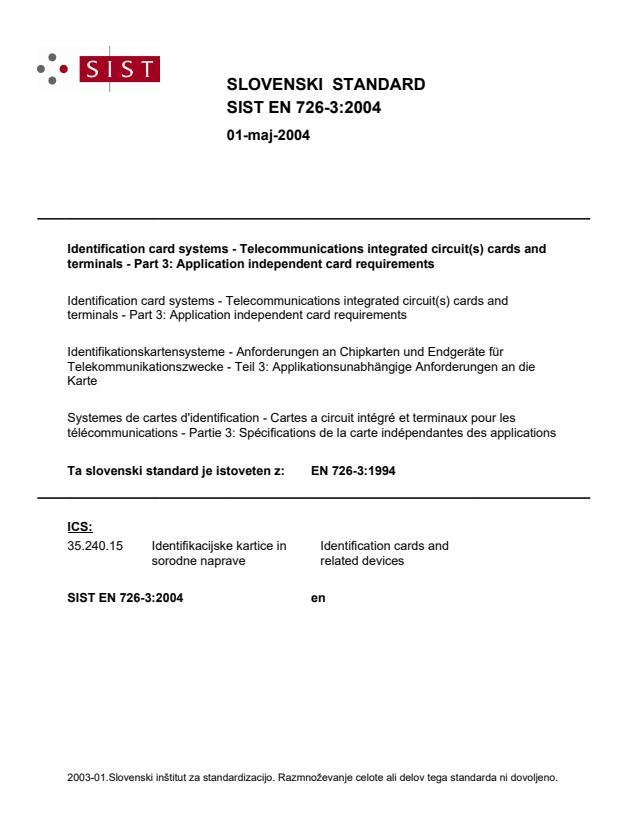
SLOVENSKI STANDARD
01-maj-2004
Identification card systems - Telecommunications integrated circuit(s) cards and
terminals - Part 3: Application independent card requirements
Identification card systems - Telecommunications integrated circuit(s) cards and
terminals - Part 3: Application independent card requirements
Identifikationskartensysteme - Anforderungen an Chipkarten und Endgeräte für
Telekommunikationszwecke - Teil 3: Applikationsunabhängige Anforderungen an die
Karte
Systemes de cartes d'identification - Cartes a circuit intégré et terminaux pour les
télécommunications - Partie 3: Spécifications de la carte indépendantes des applications
Ta slovenski standard je istoveten z: EN 726-3:1994
ICS:
35.240.15 Identifikacijske kartice in Identification cards and
sorodne naprave related devices
2003-01.Slovenski inštitut za standardizacijo. Razmnoževanje celote ali delov tega standarda ni dovoljeno.
SIST EN 726-
...