

SIST EN 1916:2003
(Main)Concrete pipes and fittings, unreinforced, steel fibre and reinforced
General Information
- Abstract
This European Standard specifies performance requirements as defined in table 1 and describes test methods for precast concrete pipes and fittings, unreinforced, steel fibre and reinforced, with flexible joints (with seals either integrated in the units or supplied separately) and nominal sizes not exceeding DN 3200 for units with a circular bore or WN/HN 1400/2100 for units with an egg-shaped bore, for which the main intended use is the conveyance of sewage, rainwater and surface water under gravity or occasionally at low head of pressure, in pipelines that are generally buried.
- Status
- Published
- Publication Date
- 31-Mar-2003
- Technical Committee
- IOVO - Water supply and waste water engineering
- Current Stage
- 6060 - National Implementation/Publication (Adopted Project)
- Start Date
- 01-Apr-2003
- Due Date
- 01-Apr-2003
- Completion Date
- 01-Apr-2003
- Directive
- 305/2011 - Regulation (eu) No 305/2011 of the European Parliament and of the Council of 9 march 2011 laying down harmonised conditions for the marketing of construction products and repealing council directive 89/106/eecOJ Ref: C 259 OJ Date: 08-Aug-2014
89/106/EEC - Construction productsOJ Ref: C 47 OJ Date: 27-Feb-2003

Overview
EN 1916:2002 is a CEN European Standard that specifies performance requirements and test methods for precast concrete pipes and fittings - unreinforced, steel‑fibre and reinforced - with flexible joints. It applies to units used mainly for the conveyance of sewage, rainwater and surface water under gravity or occasionally at low head of pressure in generally buried pipelines. The standard covers nominal circular bores up to DN 3200 and egg‑shaped bores up to WN/HN 1400/2100 and defines joint seal options (integrated or supplied separately).
Key Topics and Technical Requirements
- Material and concrete quality: requirements for concrete materials, water/cement content, chloride limits and water absorption.
- Unit geometry and finish: dimensional and surface finish requirements for precast units.
- Joints and joint seals: definitions and test/calculation methods (Annex A) for flexible joint seals, including hydrostatic and joint assembly tests (Annex E).
- Structural performance:
- Crushing strength test methods and expression of results (Annex C).
- Longitudinal bending moment resistance tests (Annex D).
- Serviceability and durability criteria.
- Special requirements: provisions specific to steel‑fibre concrete, reinforced concrete and jacking pipes (including jacking loads and concrete cover).
- Testing and conformity: initial type testing, factory production control (FPC), further factory sampling and tasks for certification bodies (conformity evaluation).
- Marking: required product identification and traceability information.
Practical Applications
EN 1916:2002 is intended for practical use where reliable, tested precast concrete pipes are required:
- Gravity sewer and stormwater drainage networks
- Surface water conveyance and culverts
- Buried pipeline installations subject to low internal pressure
- Pipe jacking installations (with specific jacking provisions)
This standard ensures products meet minimum structural, watertightness and durability performance for long‑term service.
Who Uses This Standard
- Precast concrete manufacturers and product engineers (production and design)
- Civil and drainage system designers and consulting engineers
- Testing laboratories and certification bodies (initial type tests, FPC)
- Contractors, utilities and municipal authorities specifying products for sewer and stormwater systems
Related standards and governance
EN 1916:2002 is a European Committee for Standardization (CEN) technical standard adopted by national bodies; users should reference relevant national transpositions and complementary standards for materials, installation and environmental exposure where applicable.
Keywords: EN 1916:2002, concrete pipes, precast concrete pipes, unreinforced, steel‑fibre, reinforced, flexible joints, watertightness, crushing strength, pipe jacking.
Relations
- Effective Date
- 28-Jan-2026
- Effective Date
- 28-Jan-2026
- Effective Date
- 28-Jan-2026
- Effective Date
- 28-Jan-2026
- Effective Date
- 28-Jan-2026
- Effective Date
- 28-Jan-2026
- Effective Date
- 28-Jan-2026
- Effective Date
- 28-Jan-2026
- Effective Date
- 28-Jan-2026
- Amended By
SIST EN 1916:2003/AC:2008 - Concrete pipes and fittings, unreinforced, steel fibre and reinforced - Effective Date
- 01-Jul-2008
- Amended By
SIST EN 1916:2003/AC:2004 - Concrete pipes and fittings, unreinforced, steel fibre and reinforced - Effective Date
- 01-May-2004
- Corrected By
SIST EN 1916:2003/AC:2007 - Concrete pipes and fittings, unreinforced, steel fibre and reinforced - Effective Date
- 01-Jul-2007
Get Certified
Connect with accredited certification bodies for this standard

Institut za varilstvo d.o.o. (Welding Institute)
Slovenia's leading welding institute since 1952. ISO 3834, EN 1090, pressure equipment certification, NDT personnel, welder qualification. Only IIW Au
Zavod za gradbeništvo Slovenije (ZAG) - Inšpekcija
ZAG inspection body for construction products, structures, and materials.
Sponsored listings
Frequently Asked Questions
SIST EN 1916:2003 is a standard published by the Slovenian Institute for Standardization (SIST). Its full title is "Concrete pipes and fittings, unreinforced, steel fibre and reinforced". This standard covers: This European Standard specifies performance requirements as defined in table 1 and describes test methods for precast concrete pipes and fittings, unreinforced, steel fibre and reinforced, with flexible joints (with seals either integrated in the units or supplied separately) and nominal sizes not exceeding DN 3200 for units with a circular bore or WN/HN 1400/2100 for units with an egg-shaped bore, for which the main intended use is the conveyance of sewage, rainwater and surface water under gravity or occasionally at low head of pressure, in pipelines that are generally buried.
This European Standard specifies performance requirements as defined in table 1 and describes test methods for precast concrete pipes and fittings, unreinforced, steel fibre and reinforced, with flexible joints (with seals either integrated in the units or supplied separately) and nominal sizes not exceeding DN 3200 for units with a circular bore or WN/HN 1400/2100 for units with an egg-shaped bore, for which the main intended use is the conveyance of sewage, rainwater and surface water under gravity or occasionally at low head of pressure, in pipelines that are generally buried.
SIST EN 1916:2003 is classified under the following ICS (International Classification for Standards) categories: 23.040.50 - Pipes and fittings of other materials; 93.030 - External sewage systems. The ICS classification helps identify the subject area and facilitates finding related standards.
SIST EN 1916:2003 has the following relationships with other standards: It is inter standard links to SIST EN ISO 21920-2:2022, SIST EN 1123-2:2007+A1:2007, SIST EN 681-1:2000, SIST EN ISO 6892-1:2020, SIST EN 12441-6:2004, SIST EN ISO 21920-3:2022, SIST EN 16506:2015, SIST EN 1917:2003, SIST EN ISO 11296-9:2023, SIST EN 1916:2003/AC:2008, SIST EN 1916:2003/AC:2004, SIST EN 1916:2003/AC:2007. Understanding these relationships helps ensure you are using the most current and applicable version of the standard.
SIST EN 1916:2003 is associated with the following European legislation: EU Directives/Regulations: 305/2011, 89/106/EEC, 93/38/EEC; Standardization Mandates: M/118, M/131, M/BC/CEN/88/15. When a standard is cited in the Official Journal of the European Union, products manufactured in conformity with it benefit from a presumption of conformity with the essential requirements of the corresponding EU directive or regulation.
SIST EN 1916:2003 is available in PDF format for immediate download after purchase. The document can be added to your cart and obtained through the secure checkout process. Digital delivery ensures instant access to the complete standard document.
Standards Content (Sample)
2003-01.Slovenski inštitut za standardizacijo. Razmnoževanje celote ali delov tega standarda ni dovoljeno.Concrete pipes and fittings, unreinforced, steel fibre and reinforcedBetonske cevi in fazonski kosi, nearmirani, z jeklenimi vlakni in armiraniTuyaux et pieces complémentaires en béton non armé, béton fibré acier et béton arméRohre und Formstücke aus Beton, Stahlfaserbeton und StahlbetonTa slovenski standard je istoveten z:EN 1916:2002SIST EN 1916:2003en,fr,de93.03023.040.50ICS:SLOVENSKI
STANDARDSIST EN 1916:200301-april-2003
EUROPEAN STANDARDNORME EUROPÉENNEEUROPÄISCHE NORMEN 1916October 2002ICS 23.040.50; 93.030English versionConcrete pipes and fittings, unreinforced, steel fibre andreinforcedTuyaux et pièces complémentaires en béton non armé,béton fibré acier et béton arméRohre und Formstücke aus Beton, Stahlfaserbeton undStahlbetonThis European Standard was approved by CEN on 18 August 2002.CEN members are bound to comply with the CEN/CENELEC Internal Regulations which stipulate the conditions for giving this EuropeanStandard the status of a national standard without any alteration. Up-to-date lists and bibliographical references concerning such nationalstandards may be obtained on application to the Management Centre or to any CEN member.This European Standard exists in three official versions (English, French, German). A version in any other language made by translationunder the responsibility of a CEN member into its own language and notified to the Management Centre has the same status as the officialversions.CEN members are the national standards bodies of Austria, Belgium, Czech Republic, Denmark, Finland, France, Germany, Greece,Iceland, Ireland, Italy, Luxembourg, Malta, Netherlands, Norway, Portugal, Spain, Sweden, Switzerland and United Kingdom.EUROPEAN COMMITTEE FOR STANDARDIZATIONCOMITÉ EUROPÉEN DE NORMALISATIONEUROPÄISCHES KOMITEE FÜR NORMUNGManagement Centre: rue de Stassart, 36
B-1050 Brussels© 2002 CENAll rights of exploitation in any form and by any means reservedworldwide for CEN national Members.Ref. No. EN 1916:2002 E
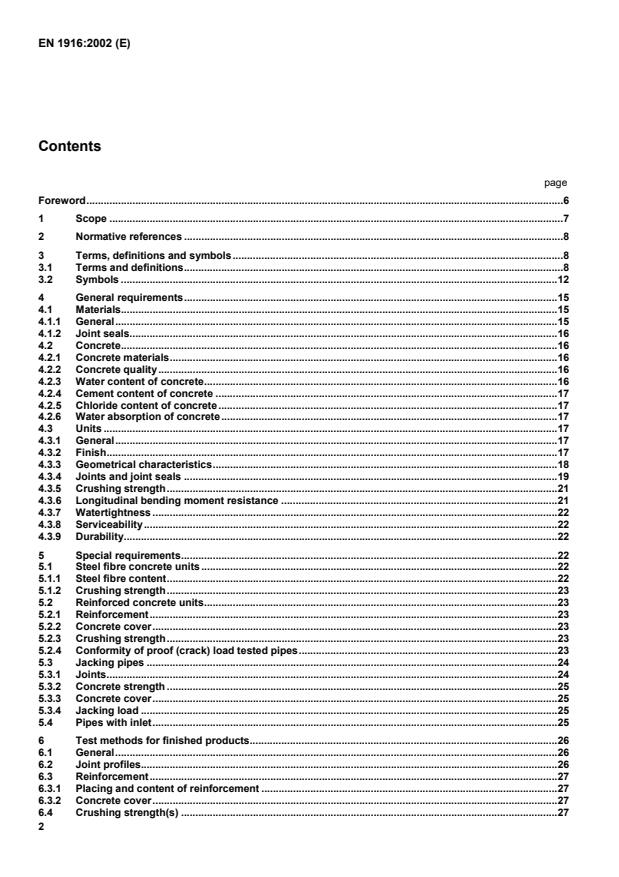
Test and calculation methods for joint seals.30A.1Symbols.30A.2Test methods.31A.2.1Applicability.31A.2.2Principle.31A.2.3Apparatus.31A.2.4Preparation.31A.2.5Procedures.31A.2.6Expression of results.33A.2.7Examples.33A.3Calculation method.37A.3.1Applicability.37A.3.2Basis.37A.3.3Examples.38Annex B (normative)
Structural calculations relative to pipe jacking.43B.1General.43B.2Symbols.43B.3Design criteria.44B.3.1Principles.44B.3.2"Closed joint" situation.45B.3.3"Open joint" situation.46B.4Example.47B.4.1Assumptions for the calculation.47B.4.2Calculation.47Annex C (normative)
Test method for crushing strength.48C.1Principle.48C.2Apparatus.48C.3Preparation.48C.4Procedure.49C.4.1General.49C.4.2Unreinforced concrete pipes.51C.4.3Steel fibre concrete pipes.51C.4.4Reinforced concrete pipes.51C.5Expression of results.52Annex D (normative)
Test method for longitudinal bending moment resistance.53D.1Principle.53D.2Apparatus.53D.3Procedure.53D.3.1General.53D.3.2Four-point loading procedure.53D.3.3Three-point loading procedure.54D.4Expression of results.55D.4.1Four-point loading procedure.55D.4.2Three-point loading procedure.55
Test methods for watertightness.56E.1Principle.56E.2Apparatus.56E.3Preparation.56E.4Procedure (hydrostatic test - routine and initial type tests).56E.5Procedure (joint assembly test).56E.5.1General.56E.5.2Watertightness during angular deflection.56E.5.3Watertightness under shear load.57E.5.4Watertightness during angular deflection under shear load.58E.6Expression of results.58Annex F (normative)
Test method for water absorption.59F.1Principle.59F.2Sample.59F.3Apparatus.59F.4Procedure.59F.4.1Determination of mass of immersed sample m1.59F.4.2Determination of mass of dried sample m2.59F.5Expression of results.60Annex G (normative)
Manufacturer's quality assurance system.61G.1Organization.61G.1.1Responsibility and authority.61G.1.2Management representative for factory production control.61G.1.3Management review.61G.1.4Factory documents.61G.2Factory production control system.62G.3Inspection and testing.62G.3.1General.62G.3.2Inspection and test status.62G.3.3Testing.62G.3.4Inspection and test records.62G.3.5Complaints.62G.4Action required in the case of defectives.63G.4.1Unsatisfactory results.63G.4.2Defectives.63G.4.3Purchaser information.63G.5Handling, storage, packing and delivery of units.63G.5.1General.63G.5.2Handling.63G.5.3Storage.63G.5.4Packing and marking.63G.5.5Traceability.63G.6Training and personnel.63G.7Materials control.64G.8Equipment control.66G.9Process control.67G.10Control of laboratory equipment.68Annex H (normative)
Sampling procedures for inspection of finished products.69Annex I (normative)
Sampling procedures for continuous inspection of crushing strength andwatertightness (hydrostatic).71I.1Inspection rates and interpretation of results.71I.1.1Inspection rates.71I.1.2Interpretation of results.71I.2Operating of switching rules.71I.2.1Tightened to normal inspection.71I.2.2Discontinuation of inspection.71I.2.3Normal to reduced inspection.71I.2.4Reduced to normal inspection.72
Tasks for a product certification body.82J.1Initial inspection of factory and factory production control.82J.2Evaluation and approval of initial type testing of units.82J.3Periodic surveillance, evaluation and approval of factory production control.82J.4Audit testing of samples taken at the factory.82J.5Quality system.83Annex K (normative)
Procedure for unreinforced concrete pipes where routine (continuous)inspection of crushing strength is primarily to minimum crushing load.84Annex ZA (informative)
Clauses of this European Standard addressing essential requirements orother provisions of EU Directives.86ZA.1Scope and relevant characteristics.86ZA.2Procedure(s) for the attestation of conformity of precast concrete pipes and fittings.87ZA.2.1System of attestation of conformity.87ZA.2.2Declaration of conformity.88ZA.3 CE marking.88Bibliography.90
Provisions for the following are also outside the scope of this European Standard:- units with nominal sizes greater than DN 1 750 or WN/HN 1 200/1 800;- units with a bore other than circular or egg-shaped;- lifting facilities;- resistance to high pressure jetting;- circumstances other than those stated;- any receiving inspection by, or on behalf of, the purchaser.
...