

SIST EN ISO 17707:2005
(Main)Footwear - Test methods for outsoles - Flex resistance (ISO 17707:2005)
General Information
- Abstract
ISO 17707:2005 specifies a method for determining the flex resistance of outsoles. This method is intended to assess the effect of sole materials and surface patterns on cut growth. This method is applied to outsoles that have a maximum longitudinal rigidity of 30 N.
- Status
- Published
- Publication Date
- 31-Oct-2005
- Technical Committee
- SS SPL - Technical Board for the general field
- Current Stage
- 6060 - National Implementation/Publication (Adopted Project)
- Start Date
- 01-Nov-2005
- Due Date
- 01-Nov-2005
- Completion Date
- 01-Nov-2005

Overview
EN ISO 17707:2005 - Footwear: Test methods for outsoles - Flex resistance (ISO 17707:2005) is a CEN-adopted ISO method for determining the flex resistance of shoe outsoles. The standard measures how sole materials and surface patterns influence cut growth and crack initiation under repeated bending. It applies to outsoles with a maximum longitudinal rigidity of 30 N (measured at 45° flex).
Key topics and technical requirements
- Scope: Method for assessing cut propagation and crack initiation on outsoles with longitudinal rigidity ≤ 30 N.
- Rigidity test: Outsoles are bent to 45° at (100 ± 10) mm/min and the force (0–50 N sensor, ±1 %) is recorded. Outsoles requiring >30 N at 45° are excluded from flex resistance testing.
- Flex resistance apparatus:
- Mandrel diameter: 30 ± 0.1 mm around which the outsole is flexed.
- Flexing rate: device capable of 135–150 cycles/min, flexing through 90° ± 2° about the mandrel axis.
- Cycle counter and firm end clamps to align the flexing line.
- Test pieces & conditioning:
- Test pieces may be taken from complete footwear or outsole units; attach a standard insole (cellulose board) of 2 ± 0.1 mm thickness and apparent bulk density 0.55 ± 0.05 g/cm³.
- Condition samples 24 h according to EN 12222 (standard atmospheres).
- Cut initiation and measurement:
- A single incision is made with a specified chisel; chisel is lubricated with soap and water.
- Initial cut length L(o) measured in fully flexed position (accuracy 0.1 mm).
- Subject outsole to 30 000 flexes; re-measure cut length L(f). Report cut growth as L(f) − L(o).
- Record additional cracks (number and longest length to 0.5 mm).
- Test report must include results, sample identification, test method reference, test date and any deviations.
Applications and users
- Useful for: footwear manufacturers, material suppliers, test laboratories, R&D teams, quality control and compliance engineers.
- Practical uses:
- Compare outsole compounds and tread patterns for durability against cut growth.
- Evaluate new outsole formulations or cleat designs during product development.
- Provide repeatable, standardised data for marketing claims and regulatory compliance for footwear performance.
Related standards
- EN ISO 20344:2004 - Personal protective equipment: Test methods for footwear (method basis).
- EN 12222 - Standard atmospheres for conditioning and testing of footwear.
- EN ISO 534 - Paper and board thickness/density (for insole specification).
Keywords: footwear test methods, flex resistance, outsoles, ISO 17707, cut growth, outsole rigidity, flexing test, footwear durability.
Relations
- Effective Date
- 28-Jan-2026
- Effective Date
- 28-Jan-2026
- Effective Date
- 28-Jan-2026
- Effective Date
- 28-Jan-2026
- Effective Date
- 28-Jan-2026
- Effective Date
- 28-Jan-2026
Frequently Asked Questions
SIST EN ISO 17707:2005 is a standard published by the Slovenian Institute for Standardization (SIST). Its full title is "Footwear - Test methods for outsoles - Flex resistance (ISO 17707:2005)". This standard covers: ISO 17707:2005 specifies a method for determining the flex resistance of outsoles. This method is intended to assess the effect of sole materials and surface patterns on cut growth. This method is applied to outsoles that have a maximum longitudinal rigidity of 30 N.
ISO 17707:2005 specifies a method for determining the flex resistance of outsoles. This method is intended to assess the effect of sole materials and surface patterns on cut growth. This method is applied to outsoles that have a maximum longitudinal rigidity of 30 N.
SIST EN ISO 17707:2005 is classified under the following ICS (International Classification for Standards) categories: 61.060 - Footwear. The ICS classification helps identify the subject area and facilitates finding related standards.
SIST EN ISO 17707:2005 has the following relationships with other standards: It is inter standard links to SIST EN ISO 534:2012, SIST EN 12222:2000, SIST EN ISO 17709:2018, SIST-TP CEN ISO/TR 20880:2007, SIST EN 1504-10:2004, SIST EN 13400:2004. Understanding these relationships helps ensure you are using the most current and applicable version of the standard.
SIST EN ISO 17707:2005 is available in PDF format for immediate download after purchase. The document can be added to your cart and obtained through the secure checkout process. Digital delivery ensures instant access to the complete standard document.
Standards Content (Sample)
SLOVENSKI STANDARD
01-november-2005
Footwear - Test methods for outsoles - Flex resistance (ISO 17707:2005)
Footwear - Test methods for outsoles - Flex resistance (ISO 17707:2005)
Schuhe - Prüfverfahren für Laufsohlen - Biegeverhalten (ISO 17707:2005)
Chaussures - Méthodes d'essai applicables aux semelles d'usure - Résistance a la
flexion (ISO 17707:2005)
Ta slovenski standard je istoveten z: EN ISO 17707:2005
ICS:
61.060 Obuvala Footwear
2003-01.Slovenski inštitut za standardizacijo. Razmnoževanje celote ali delov tega standarda ni dovoljeno.
EUROPEAN STANDARD
EN ISO 17707
NORME EUROPÉENNE
EUROPÄISCHE NORM
July 2005
ICS 61.060
English version
Footwear - Test methods for outsoles - Flex resistance (ISO
17707:2005)
Chaussures - Méthodes d'essai applicables aux semelles Schuhe - Prüfverfahren für Laufsohlen - Biegeverhalten
d'usure - Résistance à la flexion (ISO 17707:2005) (ISO 17707:2005)
This European Standard was approved by CEN on 2 March 2004.
CEN members are bound to comply with the CEN/CENELEC Internal Regulations which stipulate the conditions for giving this European
Standard the status of a national standard without any alteration. Up-to-date lists and bibliographical references concerning such national
standards may be obtained on application to the Central Secretariat or to any CEN member.
This European Standard exists in three official versions (English, French, German). A version in any other language made by translation
under the responsibility of a CEN member into its own language and notified to the Central Secretariat has the same status as the official
versions.
CEN members are the national standards bodies of Austria, Belgium, Cyprus, Czech Republic, Denmark, Estonia, Finland, France,
Germany, Greece, Hungary, Iceland, Ireland, Italy, Latvia, Lithuania, Luxembourg, Malta, Netherlands, Norway, Poland, Portugal, Slovakia,
Slovenia, Spain, Sweden, Switzerland and United Kingdom.
EUROPEAN COMMITTEE FOR STANDARDIZATION
COMITÉ EUROPÉEN DE NORMALISATION
EUROPÄISCHES KOMITEE FÜR NORMUNG
Management Centre: rue de Stassart, 36 B-1050 Brussels
© 2005 CEN All rights of exploitation in any form and by any means reserved Ref. No. EN ISO 17707:2005: E
worldwide for CEN national Members.
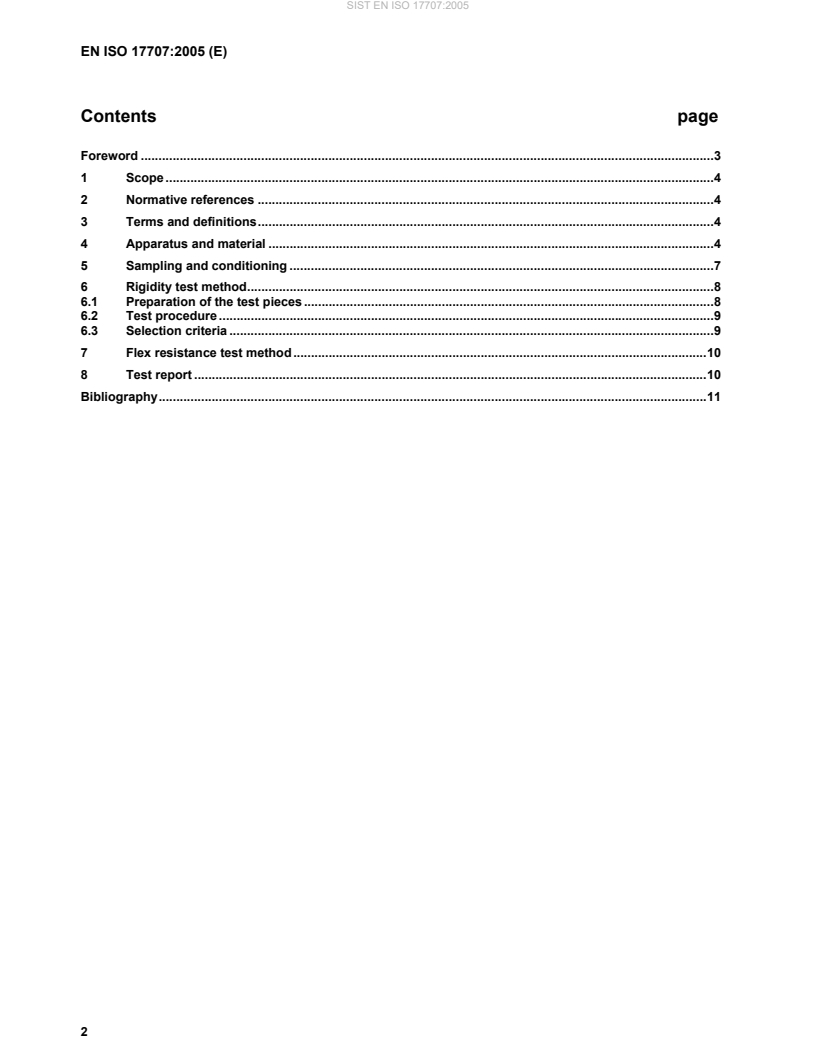
Contents page
Foreword .3
1 Scope .4
2 Normative references .4
3 Terms and definitions.4
4 Apparatus and material .4
5 Sampling and conditioning .7
6 Rigidity test method.8
6.1 Preparation of the test pieces .8
6.2 Test procedure .9
6.3 Selection criteria .9
7 Flex resistance test method.10
8 Test report .10
Bibliography.11
Foreword
This European Standard (EN ISO 17707:2005) has been prepared by Technical Committee CEN /TC 309
"Footwear", the secretariat of which is held by AENOR, in collaboration with Technical Committee ISO/TC 216
"Footwear".
This European Standard shall be given the status of a national standard, either by publication of an identical text or
by endorsement, at the latest by January 2006, and conflicting national standards shall be withdrawn at the latest
by January 2006.
According to the CEN/CENELEC Internal Regulations, the national standards organizations of the following
countries are bound to implement this European Standard: Austria, Belgium, Cyprus, Czech Republic, Denmark,
Estonia, Finland, France, Germany, Greece, Hungary, Iceland, Ireland, Italy, Latvia, Lithuania, Luxembourg, Malta,
Netherlands, Norway, Poland, Portugal, Slovakia, Slovenia, Spain, Sweden, Switzerland and United Kingdom.
1 Scope
This European Standard specifies a method for determining the flex resistance of outsoles. This method is intended
to assess the effect of sole materials and surface patterns on cut growth. This method is applied to outsoles that, in
accordance with the test mentioned in Clause 6, have a maximum longitudinal rigidity of 30 N.
NOTE The method described in this standard is based on the method for the determination of the flex resistance for
outsoles described in EN ISO 20344.
2 Normative references
The following referenced documents are indispensable for the application of this document. For dated references,
only the edition cited applies. For undated references, the latest edition of the referenced document (including any
amendments) applies.
EN 12222, Footwear - Standard atmospheres for conditioning and testing of footwear and components for footwear.
EN ISO 534, Paper and board - Determination of thickness, density and specific volume (ISO 534:2005)
3 Terms and definitions
For the purposes of this European Standard, the following term and definition apply.
flex resistance
number of flexes that cause cut growth and/or initiation of cracks in the outsoles
4 Apparatus and material
4.1 The following apparatus shall be used:
4.2 Device for the measurement of the longitudinal rigidity of outsoles (See Figure 1)
4.2.1 Smooth metal hinged plate, fixed to a rigid base with provision to reduce
...