

SIST EN ISO 22775:2005
(Main)Footwear - Test methods for accessories: Metallic accessories - Corrosion resistance (ISO 22775:2004)
- Abstract
ISO 22775:2004 specifies two methods for determining the propensity of a metal surface to either change visually due to contamination by atmospheric pollution (Method 1: sulfide tarnishing), or to corrode due to the action of salt water (Method 2: salt water corrosion).
- Status
- Published
- Publication Date
- 31-Mar-2005
- Technical Committee
- SS SPL - Technical Board for the general field
- Current Stage
- 6060 - National Implementation/Publication (Adopted Project)
- Start Date
- 01-Apr-2005
- Due Date
- 01-Apr-2005
- Completion Date
- 01-Apr-2005

SIST EN ISO 22775:2005 is the Slovenian adoption of EN ISO 22775:2004 and ISO 22775:2004, published by SIST. It specifies two laboratory test methods for checking the corrosion resistance of metallic accessories used in footwear, so manufacturers, test laboratories, and buyers can compare how metal parts respond to atmospheric sulphide exposure or salt water exposure.
What does SIST EN ISO 22775:2005 specify?
SIST EN ISO 22775:2005 specifies two methods for determining whether a metal surface changes visually because of atmospheric pollution or corrodes because of salt water. In practice, it is a comparative test standard for metallic footwear accessories, using an exposed specimen and an unexposed reference specimen.
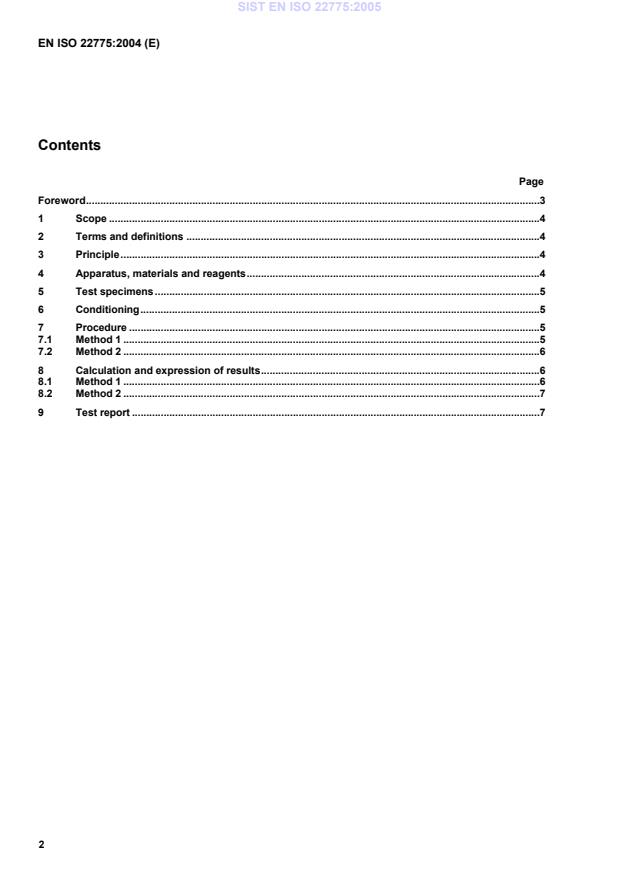
The document is organized into:
- Scope
- Terms and definitions
- Principle
- Apparatus, materials and reagents
- Test specimens
- Conditioning
- Procedure
- Calculation and expression of results
- Test report
That structure matters because the standard combines sample preparation, exposure, visual grading, and reporting in one method-based document.
What are the key requirements of SIST EN ISO 22775:2005?
SIST EN ISO 22775:2005 requires two different exposure methods, and both rely on visual comparison rather than instrumental measurement. The practical result is a graded assessment of visible change, so the user must control specimen handling and inspection conditions carefully.
Method 1 - sulphide tarnishing
Clause 3.1 states that a test specimen is kept for 1 h in a moist atmosphere containing a low concentration of hydrogen sulphide gas, then checked for discoloration. Clause 7.1 requires bright indirect lighting and comparison against an untreated reference specimen.
In practice, this method shows how a metal surface may react to atmospheric pollution. The test is subjective, so the report should describe the damage clearly and, where possible, involve several assessors.
Method 2 - salt water corrosion
Clause 3.2 wraps a specimen in cotton lawn saturated with sodium chloride solution, seals it in a polyethylene (PE) bag, and stores it for 24 h at room temperature. After rinsing and drying, the specimen is compared with a reference specimen and the cotton lawn is checked for staining.
In practice, this method shows whether a metal accessory can resist a wet saline environment. Users need to record both the corrosion grade and any staining of the cotton lawn.
Specimens and preparation
Clause 5 requires two test specimens for each method: one exposed specimen and one reference specimen. If only one component is available, it may be cut so that the least corrosion-resistant part is tested, and cut edges on the exposed portion are sealed with epoxy resin and allowed to harden for at least 24 h.
This matters because the result should represent the weakest area of the component, not just the easiest part to test.
Conditioning and test setup
Clause 6 says the specimens do not need pre-conditioning and the test does not have to be carried out in a standard atmosphere. Clause 4 lists the required apparatus and reagents, including a sealed glass vessel for Method 1 and PE bags, cotton lawn, and sodium chloride solution for Method 2.
That makes the test simpler to run, but also means the user must follow the setup closely to keep the exposure comparable.
Grading and reporting
Clause 8 uses a 5-to-1 visual scale, from no change to very marked change, with separate wording for each method. Clause 9 requires the report to identify the standard, the method used, the specimen description and composition, the grade assigned, the number of assessors, any Method 2 staining, any deviations, and the test date.
For buyers and quality teams, this is the part that makes the result usable in supplier records and product comparisons.
What terms does SIST EN ISO 22775:2005 define?
- Corrosion resistance - the propensity of a metal surface either not to change visually because of atmospheric pollution or not to be altered by salt water.
- Sulphide tarnishing - the visual change a metal surface may show after exposure to hydrogen sulphide in a moist atmosphere.
- Salt water corrosion - the alteration of a metal surface caused by exposure to sodium chloride solution.
- Test specimen - the metal part or piece placed into the test exposure.
- Reference specimen - the untreated specimen used for side-by-side visual comparison.
- Cotton lawn - a desized, bleached, unfinished woven fabric used to hold the salt solution in Method 2.
- PE bag - a sealable polyethylene bag used to contain the wrapped specimen in Method 2.
Who uses SIST EN ISO 22775:2005?
SIST EN ISO 22775:2005 is used by footwear manufacturers, accessory suppliers, and testing laboratories that need to assess metallic parts for tarnishing or corrosion. It is also useful for quality managers and buyers who specify acceptance tests for footwear components and want a documented visual comparison method for metal finishes.
What does the SIST EN ISO 22775:2005 document contain?
SIST EN ISO 22775:2005 contains the full test method for two exposure routes, the required apparatus and reagents, specimen preparation rules, and the visual grading scales. It also includes the step-by-step procedures for hydrogen sulphide exposure and salt water exposure, plus the reporting items that must be captured after testing.
The document is built around practical test work: preparing specimens, exposing them under fixed conditions, comparing them with a reference, and recording the result in a consistent format. For laboratories, the most useful parts are the procedure steps and the result scales; for manufacturers and buyers, the test report section is the part that supports traceable product evaluation.
Relations
- Effective Date
- 28-Jan-2026
Frequently Asked Questions
SIST EN ISO 22775:2005 is a standard published by the Slovenian Institute for Standardization (SIST). Its full title is "Footwear - Test methods for accessories: Metallic accessories - Corrosion resistance (ISO 22775:2004)". This standard covers: ISO 22775:2004 specifies two methods for determining the propensity of a metal surface to either change visually due to contamination by atmospheric pollution (Method 1: sulfide tarnishing), or to corrode due to the action of salt water (Method 2: salt water corrosion).
ISO 22775:2004 specifies two methods for determining the propensity of a metal surface to either change visually due to contamination by atmospheric pollution (Method 1: sulfide tarnishing), or to corrode due to the action of salt water (Method 2: salt water corrosion).
SIST EN ISO 22775:2005 is classified under the following ICS (International Classification for Standards) categories: 61.060 - Footwear. The ICS classification helps identify the subject area and facilitates finding related standards.
SIST EN ISO 22775:2005 has the following relationships with other standards: It is inter standard links to SIST-TP CEN ISO/TR 20572:2007. Understanding these relationships helps ensure you are using the most current and applicable version of the standard.
SIST EN ISO 22775:2005 is available in PDF format for immediate download after purchase. The document can be added to your cart and obtained through the secure checkout process. Digital delivery ensures instant access to the complete standard document.
Standards Content (Sample)
SLOVENSKI STANDARD
01-april-2005
Obutev – Preskusne metode za dodatke: kovinski dodatki - Odpornost proti
koroziji (ISO 22775:2004)
Footwear - Test methods for accessories: Metallic accessories - Corrosion resistance
(ISO 22775:2004)
Schuhe - Prüfverfahren für Zubehör: Zubehör aus Metall - Korrosionsbeständigkeit (ISO
22775:2004)
Chaussures - Méthodes d'essai pour accessoires: accessoires métalliques - Résistance
a la corrosion (ISO 22775:2004)
Ta slovenski standard je istoveten z: EN ISO 22775:2004
ICS:
61.060 Obuvala Footwear
2003-01.Slovenski inštitut za standardizacijo. Razmnoževanje celote ali delov tega standarda ni dovoljeno.
EUROPEAN STANDARD
EN ISO 22775
NORME EUROPÉENNE
EUROPÄISCHE NORM
December 2004
ICS 61.060
English version
Footwear - Test methods for accessories: Metallic accessories -
Corrosion resistance (ISO 22775:2004)
Chaussures - Méthodes d'essai pour accessoires: Schuhe - Prüfverfahren für Zubehör: Zubehör aus Metall -
accessoires métalliques - Résistance à la corrosion (ISO Korrosionsbeständigkeit (ISO 22775:2004)
22775:2004)
This European Standard was approved by CEN on 23 August 2004.
CEN members are bound to comply with the CEN/CENELEC Internal Regulations which stipulate the conditions for giving this European
Standard the status of a national standard without any alteration. Up-to-date lists and bibliographical references concerning such national
standards may be obtained on application to the Central Secretariat or to any CEN member.
This European Standard exists in three official versions (English, French, German). A version in any other language made by translation
under the responsibility of a CEN member into its own language and notified to the Central Secretariat has the same status as the official
versions.
CEN members are the national standards bodies of Austria, Belgium, Cyprus, Czech Republic, Denmark, Estonia, Finland, France,
Germany, Greece, Hungary, Iceland, Ireland, Italy, Latvia, Lithuania, Luxembourg, Malta, Netherlands, Norway, Poland, Portugal, Slovakia,
Slovenia, Spain, Sweden, Switzerland and United Kingdom.
EUROPEAN COMMITTEE FOR STANDARDIZATION
COMITÉ EUROPÉEN DE NORMALISATION
EUROPÄISCHES KOMITEE FÜR NORMUNG
Management Centre: rue de Stassart, 36 B-1050 Brussels
© 2004 CEN All rights of exploitation in any form and by any means reserved Ref. No. EN ISO 22775:2004: E
worldwide for CEN national Members.
Contents
Page
Foreword.3
1 Scope.4
2 Terms and definitions .4
3 Principle.4
4 Apparatus, materials and reagents.4
5 Test specimens.5
6 Conditioning.5
7 Procedure.5
7.1 Method 1.5
7.2 Method 2.6
8 Calculation and expression of results.6
8.1 Method 1.6
8.2 Method 2.7
9 Test report.7
Foreword
This document (EN ISO 22775:2004) has been prepared by Technical Committee CEN/TC 309 "Footwear",
the secretariat of which is held by AENOR, in collaboration with Technical Committee ISO/TC 216 "Footwear".
This European Standard shall be given the status of a national standard, either by publication of an identical
text or by endorsement, at the latest by June 2005, and conflicting national standards shall be withdrawn at
the latest by June 2005.
According to the CEN/CENELEC Internal Regulations, the national standards organizations of the following
countries are bound to implement this European Standard: Austria, Belgium, Cyprus, Czech Republic,
Denmark, Estonia, Finland, France, Germany, Greece, Hungary, Iceland, Ireland, Italy, Latvia, Lithuania,
Luxembourg, Malta, Netherlands, Norway, Poland, Portugal, Slovakia, Slovenia, Spain, Sweden, Switzerland
and United Kingdom.
1 Scope
This document specifies two methods for determining the propensity of a metal surface to either change
visually due to contamination by atmospheric pollution (Method 1: sulphide tarnishing), or to corrode due to
the action of salt water (Method 2: salt water corrosion).
2 Terms and definitions
For the purposes of this document, the following term and definition applies.
corrosion resistance
propensity of a metal surface either not to change visually due to chemical attack by atmospheric pollution, or
not to be altered due to the action of salt water
3 Principle
3.1 Method 1
A test specimen is stored in a moist atmosphere containing a low concentration of hydrogen sulphide gas for 1
h. The specimen is then assessed subjectively for signs of discoloration.
3.2 Method 2
Cotton lawn, saturated with sodium chloride solution, is wrapped around a test specimen. This assembly is
then stored in a sealed bag for 24 h at room temperature. The test specimen is then subjectively assessed for
signs of corrosion and the lawn assessed for staining.
4 Apparatus, materials and reagents
4.1 Method 1
4.1.1 Kipps generator or other hydrogen sulphide source.
WARNING — This equipment should be used only by qualified personnel owing to the extremely
toxicity of hydrogen su
...