

SIST EN 1527:2019+A1:2022
(Main)Building hardware - Hardware for sliding doors and folding doors - Requirements and test methods
General Information
- Abstract
This document specifies requirements for the design manual system sliding doors, sliding corner doors and folding doors of the bi-fold type and multi-panel folding doors but excluding doors and panels. Cycle tests, static load, initial friction and corrosion resistance tests are included for fittings and track only.
This document covers door gear for all industrial, commercial and residential sliding doors and folding doors.
This document does not cover the rollers for horizontal sliding and building hardware for inward or outward sliding folding windows (types N Q, R and S) in accordance with EN 13126-15, building hardware for Lift and Slide windows (type P) in accordance with EN 13126-16 and building hardware for Tilt and Slide windows (type T) in accordance with EN 13126-17.
- Status
- Published
- Publication Date
- 06-Jan-2022
- Technical Committee
- ISTP - Doors and windows
- Current Stage
- 6060 - National Implementation/Publication (Adopted Project)
- Start Date
- 29-Dec-2021
- Due Date
- 05-Mar-2022
- Completion Date
- 07-Jan-2022

Overview
EN 1527:2019+A1:2021 - "Building hardware: Hardware for sliding doors and folding doors - Requirements and test methods" is a CEN European standard that defines performance requirements and test methods for fittings and tracks used in manual sliding doors, sliding corner doors, bi‑fold and multi‑panel folding doors. The standard covers door gear for industrial, commercial and residential applications and focuses on the hardware only (excluding doors and panels). It includes Amendment A1 (2021) and is referenced by national bodies across Europe.
Key Topics
- Scope and exclusions
- Applies to fittings and track for sliding and folding doors (top hangers, top tracks, bottom rollers, pivots, hinges, guides, stops, damping devices, etc.).
- Excludes rollers for horizontal sliding and building hardware for certain window types covered by EN 13126‑15/16/17.
- Test methods included
- Durability / cycle tests (defined test cycles and grades up to 100,000 cycles).
- Static load and horizontal static load tests to verify structural strength.
- Initial friction measurement to limit operating force required to move panels.
- Corrosion resistance testing referenced to EN 1670.
- Slam test for impact resistance.
- Classification system
- Nine‑digit code covering: door category, door mass, test panel size, corrosion class, slam resistance, horizontal static load, static load, initial friction limit, and durability grade.
- Durability grades include: 5,000; 10,000; 25,000; 50,000; 75,000; 100,000 cycles.
- Example classification from the standard: "1 2 2 0 2 3 1 2 6" (explains a sliding door with specific mass, panel size, test results and 100,000 cycle durability).
- Conformity and marking
- Requirements for manufacturer obligations, interchangeability of components, marking and documentation to support specification and installation.
Applications
- Useful for manufacturers of sliding and folding door hardware who need to design, test and certify products to European performance levels.
- Used by specifiers, architects, façade and door system designers to select appropriate hardware for industrial, commercial and residential projects.
- Relevant to testing laboratories and certification bodies performing durability, load and corrosion tests.
- Helpful to installers and maintenance teams to understand expected operating forces, durability and corrosion classes for product selection and lifecycle planning.
Related Standards
- EN 1670 - Building hardware: Corrosion resistance - requirements and test methods (referenced for corrosion classes).
- EN 13126‑15 / EN 13126‑16 / EN 13126‑17 - Building hardware for certain window sliding/tilt & slide types (not covered by EN 1527).
Keywords: EN 1527, sliding doors, folding doors, building hardware, test methods, corrosion resistance, durability, static load, cycle tests, initial friction.
Relations
- Effective Date
- 01-Feb-2022
- Effective Date
- 28-Jan-2026
- Effective Date
- 28-Jan-2026
- Effective Date
- 28-Jan-2026
- Effective Date
- 18-Jan-2023
- Effective Date
- 01-Feb-2022
Get Certified
Connect with accredited certification bodies for this standard

DIBt (Deutsches Institut für Bautechnik)
German Institute for Building Technology.
DIN CERTCO
DIN Group product certification.

Aboma Certification B.V.
Specialized in construction, metal, and transport sectors.
Sponsored listings
Frequently Asked Questions
SIST EN 1527:2019+A1:2022 is a standard published by the Slovenian Institute for Standardization (SIST). Its full title is "Building hardware - Hardware for sliding doors and folding doors - Requirements and test methods". This standard covers: This document specifies requirements for the design manual system sliding doors, sliding corner doors and folding doors of the bi-fold type and multi-panel folding doors but excluding doors and panels. Cycle tests, static load, initial friction and corrosion resistance tests are included for fittings and track only. This document covers door gear for all industrial, commercial and residential sliding doors and folding doors. This document does not cover the rollers for horizontal sliding and building hardware for inward or outward sliding folding windows (types N Q, R and S) in accordance with EN 13126-15, building hardware for Lift and Slide windows (type P) in accordance with EN 13126-16 and building hardware for Tilt and Slide windows (type T) in accordance with EN 13126-17.
This document specifies requirements for the design manual system sliding doors, sliding corner doors and folding doors of the bi-fold type and multi-panel folding doors but excluding doors and panels. Cycle tests, static load, initial friction and corrosion resistance tests are included for fittings and track only. This document covers door gear for all industrial, commercial and residential sliding doors and folding doors. This document does not cover the rollers for horizontal sliding and building hardware for inward or outward sliding folding windows (types N Q, R and S) in accordance with EN 13126-15, building hardware for Lift and Slide windows (type P) in accordance with EN 13126-16 and building hardware for Tilt and Slide windows (type T) in accordance with EN 13126-17.
SIST EN 1527:2019+A1:2022 is classified under the following ICS (International Classification for Standards) categories: 91.190 - Building accessories. The ICS classification helps identify the subject area and facilitates finding related standards.
SIST EN 1527:2019+A1:2022 has the following relationships with other standards: It is inter standard links to SIST EN 1527:2019, SIST EN 1670:2007, SIST EN 17610:2022, SIST EN 14600:2006, SIST EN 1527:2019, SIST EN 1527:2019/oprA1:2021. Understanding these relationships helps ensure you are using the most current and applicable version of the standard.
SIST EN 1527:2019+A1:2022 is available in PDF format for immediate download after purchase. The document can be added to your cart and obtained through the secure checkout process. Digital delivery ensures instant access to the complete standard document.
Standards Content (Sample)
SLOVENSKI STANDARD
01-februar-2022
Nadomešča:
SIST EN 1527:2019
Stavbno okovje - Okovje za drsna in zgibna vrata - Zahteve in preskusne metode
(vključuje dopolnilo A1)
Building hardware - Hardware for sliding doors and folding doors - Requirements and
test methods
Schlösser und Baubeschläge - Beschläge für Schiebetüren/-tore und Falttüren/-tore -
Anforderungen und PrüfverfahrenPrüfverfahren
Quincaillerie du bâtiment - Quincaillerie pour portes coulissantes et portes pliantes -
Exigences et méthodes d'essai
Ta slovenski standard je istoveten z: EN 1527:2019+A1:2021
ICS:
91.190 Stavbna oprema Building accessories
2003-01.Slovenski inštitut za standardizacijo. Razmnoževanje celote ali delov tega standarda ni dovoljeno.
EN 1527:2019+A1
EUROPEAN STANDARD
NORME EUROPÉENNE
December 2021
EUROPÄISCHE NORM
ICS 91.190 Supersedes EN 1527:2019
English Version
Building hardware - Hardware for sliding doors and
folding doors - Requirements and test methods
Quincaillerie du bâtiment - Quincaillerie pour portes Schlösser und Baubeschläge - Beschläge für
coulissantes et portes pliantes - Exigences et méthodes Schiebetüren/-tore und Falttüren/-tore -
d'essai Anforderungen und PrüfverfahrenPrüfverfahren
This European Standard was approved by CEN on 7 July 2019 and includes Amendment 1 approved by CEN on 6 July 2021.
CEN members are bound to comply with the CEN/CENELEC Internal Regulations which stipulate the conditions for giving this
European Standard the status of a national standard without any alteration. Up-to-date lists and bibliographical references
concerning such national standards may be obtained on application to the CEN-CENELEC Management Centre or to any CEN
member.
This European Standard exists in three official versions (English, French, German). A version in any other language made by
translation under the responsibility of a CEN member into its own language and notified to the CEN-CENELEC Management
Centre has the same status as the official versions.
CEN members are the national standards bodies of Austria, Belgium, Bulgaria, Croatia, Cyprus, Czech Republic, Denmark, Estonia,
Finland, France, Germany, Greece, Hungary, Iceland, Ireland, Italy, Latvia, Lithuania, Luxembourg, Malta, Netherlands, Norway,
Poland, Portugal, Republic of North Macedonia, Romania, Serbia, Slovakia, Slovenia, Spain, Sweden, Switzerland, Turkey and
United Kingdom.
EUROPEAN COMMITTEE FOR STANDARDIZATION
COMITÉ EUROPÉEN DE NORMALISATION
EUROPÄISCHES KOMITEE FÜR NORMUNG
CEN-CENELEC Management Centre: Rue de la Science 23, B-1040 Brussels
© 2021 CEN All rights of exploitation in any form and by any means reserved Ref. No. EN 1527:2019+A1:2021 E
worldwide for CEN national Members.
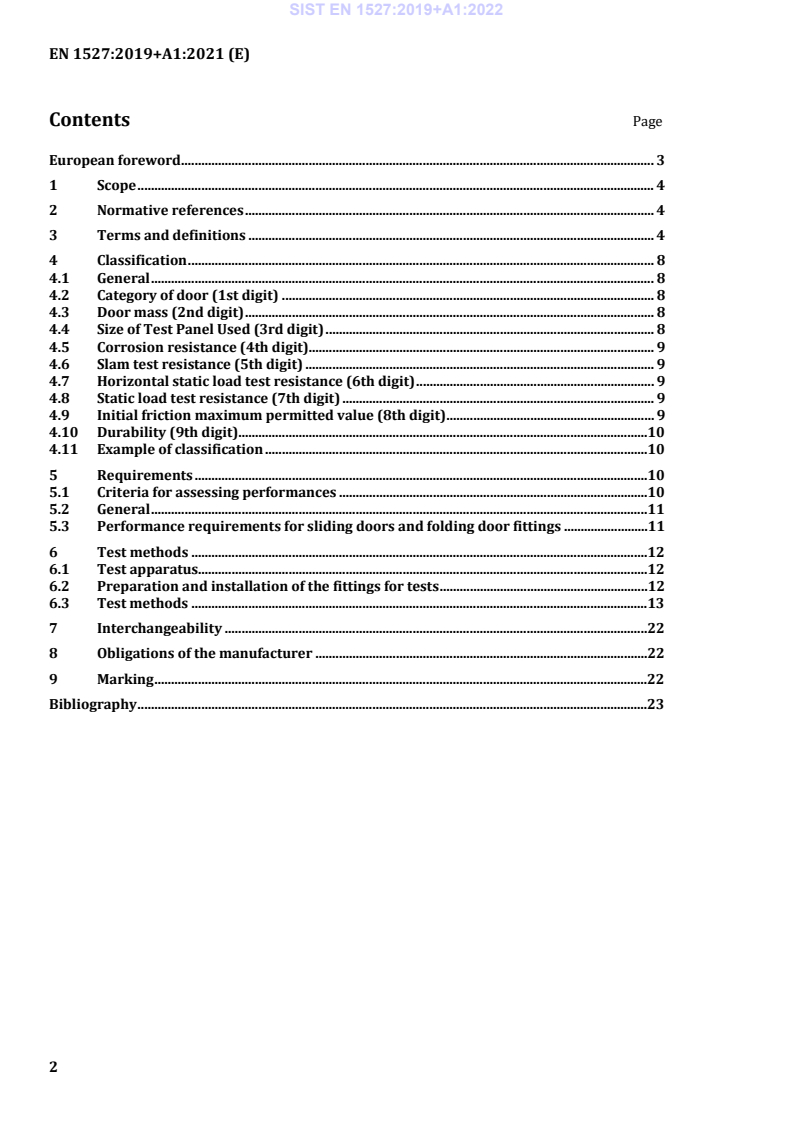
Contents Page
European foreword . 3
1 Scope . 4
2 Normative references . 4
3 Terms and definitions . 4
4 Classification . 8
4.1 General . 8
4.2 Category of door (1st digit) . 8
4.3 Door mass (2nd digit) . 8
4.4 Size of Test Panel Used (3rd digit) . 8
4.5 Corrosion resistance (4th digit). 9
4.6 Slam test resistance (5th digit) . 9
4.7 Horizontal static load test resistance (6th digit) . 9
4.8 Static load test resistance (7th digit) . 9
4.9 Initial friction maximum permitted value (8th digit) . 9
4.10 Durability (9th digit).10
4.11 Example of classification .10
5 Requirements .10
5.1 Criteria for assessing performances .10
5.2 General .11
5.3 Performance requirements for sliding doors and folding door fittings .11
6 Test methods .12
6.1 Test apparatus.12
6.2 Preparation and installation of the fittings for tests .12
6.3 Test methods .13
7 Interchangeability .22
8 Obligations of the manufacturer .22
9 Marking .22
Bibliography .23
European foreword
This document (EN 1527:2019+A1:2021) has been prepared by Technical Committee CEN/TC 33 “Doors,
windows, shutters, building hardware and curtain walling”, the secretariat of which is held by AFNOR.
This European Standard shall be given the status of a national standard, either by publication of an
identical text or by endorsement, at the latest by June 2022, and conflicting national standards shall be
withdrawn at the latest by June 2022.
Attention is drawn to the possibility that some of the elements of this document may be the subject of
patent rights. CEN shall not be held responsible for identifying any or all such patent rights.
This document includes Amendment 1 approved by CEN on 6 July 2021.
This document supersedes !EN 1527:2019".
The start and finish of text introduced or altered by amendment is indicated in the text by tags !".
Compared with EN 1527:2013, the following major change has been made:
— a new category was added: Cantilever gates (Clause 4) and test methods accordingly (Clause 6).
Any feedback and questions on this document should be directed to the users’ national standards body.
A complete listing of these bodies can be found on the CEN website.
According to the CEN-CENELEC Internal Regulations, the national standards organizations of the
following countries are bound to implement this European Standard: Austria, Belgium, Bulgaria, Croatia,
Cyprus, Czech Republic, Denmark, Estonia, Finland, France, Germany, Greece, Hungary, Iceland, Ireland,
Italy, Latvia, Lithuania, Luxembourg, Malta, Netherlands, Norway, Poland, Portugal, Republic of North
Macedonia, Romania, Serbia, Slovakia, Slovenia, Spain, Sweden, Switzerland, Turkey and the United
Kingdom.
1 Scope
This document specifies requirements for the design of manual system sliding doors, sliding corner doors
and folding doors of the bi-fold type and multi-panel folding doors but excluding doors and panels. Cycle
tests, static load, initial friction and corrosion resistance tests are included for fittings and track only.
This document covers door gear for all industrial, commercial and residential sliding doors and folding
doors.
This document does not cover the rollers for horizontal sliding and building hardware for inward or
outward sliding folding windows (types N Q, R and S) in accordance with EN 13126-15, building
hardware for Lift and Slide windows (type P) in accordance with EN 13126-16 and building hardware
for Tilt and Slide windows (type T) in accordance with EN 13126-17.
2 Normative references
The following documents are referred to in the text in such a way that some or all of their content
constitutes requirements of this document. For dated references, only the edition cited applies. For
undated references, the latest edition of the referenced document (including any amendments) applies.
EN 1670, Building hardware — Corrosion resistance — Requirements and test methods
3 Terms and definitions
For the purposes of this document, the following terms and definitions apply.
ISO and IEC maintain terminological databases for use in standardization at the following addresses:
— IEC Electropedia: available at http://www.electropedia.org/
— ISO Online browsing platform: available at http://www.iso.org/obp
3.1
door
building product which closes an opening, moving via the methods described in this specification,
including not limited to doors, gates, garage doors and cantilever gates
3.2
aligner
fitting which retains a folding door in a flat and aligned closed position
Note 1 to entry: See Figure 1, point 8 of the key.
3.3
bottom guide
fitting which, with a bottom guide channel, controls the lateral movement of a sliding or folding top
hanging door
3.4
bottom guide channel
channel section fitted either to the base of a structure or the bottom edge of a door to accommodate the
bottom guide
3.5
bottom pivot
axis fitted to the bottom of a folding door which turns in a bottom pivot socket
Note 1 to entry: See Figure 1, point 6 of the key.
3.6
bottom pivot socket
fixed component in which the bottom pivot of a folding door is located
Note 1 to entry: See Figure 1, point 7 of the key.
3.7
bottom track
track fixed to the base of a structure or floor, on which bottom rollers run
3.8
bottom roller
fitting attached to the bottom of a door which allows it to run on a bottom track
3.9
folding door, bi-fold type
door formed by two panels connected by hinges and operating on pivots running in a top track with guide
3.10
heavy sliding door, bottom rolling
door of mass 100 kg or more with bottom rollers running on a bottom track fixed to the base of the
structure or floor, and with a top guide
3.11
heavy sliding door, top hanging
door of mass 200 kg or more which is suspended by top hangers running in a top track fixed to an
overhead structural component, and with a bottom guide
3.12
hinge
fitting connecting two panels of a folding door
Note 1 to entry: See Figure 1, point 5 of the key.
3.13
light sliding door, top hanging
door of mass less than 200 kg which is suspended by top hangers running in a top track fixed to an
overhead structural component, and with a bottom guide
3.14
light sliding door, bottom rolling
door of mass less than 100 kg with bottom rollers running on a bottom track fixed to the base of the
structure or floor, and with a top guide
3.15
multi-panel folding door
door formed by two or more panels connected by hinges and suspended by top hangers running in a top
track fixed to an overhead structural component, or running on bottom rollers with a top guide in a top
track
3.16
stop
fitting used to stop a sliding door at the end of its run
3.17
damping device
device, with or without additional functions, which allows shocks to be absorbed during the final
movement operation of a sliding door (and which prevents a sliding system being damaged)
3.18
test cycle
all operations from the closed position, to open the test door to the required position and close it again
to the closed position
3.19
bracket
support used to carry a top track and secure it to the structure of a building
Note 1 to entry: Brackets can be side-wall fixing or ceiling fixing, adjustable or non-adjustable.
3.20
top guide
fitting which, with a top guide track, controls the lateral movement of a bottom rolling sliding door
3.21
top guide track
track fixed to the top of the structure in which a top guide runs
3.22
top hanger
roller fixed to a top hanging sliding door which allows it to move laterally
3.23
top pivot
axis fitted to the top of a folding door, which turns in a top pivot socket
Note 1 to entry: See Figure 1, point 4 of the key.
3.24
top pivot socket
fixed component in which the top pivot is located
Note 1 to entry: See Figure 1, point 2 of the key.
3.25
top track
section that carries the hangers of sliding and folding top hanging doors
Note 1 to entry: See Figure 1, point 1 of the key.
3.26
cantilever gate
slide door used outside that is supported from track that is fixed below the structure and hangers that
are fixed to the ground in the cleared part of the bay and with a top guide
3.27
bottom rolling gate
door used outside with bottom rollers fixed below the structure, with a bottom track fixed on the ground,
and a top guide the bottom track is in the bay width
3.28
design system
collection of components from which a “kit” may be created for subsequent installation in the works
Note 1 to entry A “design system” can, for example, be presented in a supplier's catalogue, from which
the purchaser/specifier can make a choice
Note 2 to entry A “design system” can give rise to one or many different “kits” (i.e. construction
products, defined below). A “design system” cannot be a construction product, because it is possible only
to buy one “kit” at a time from the “system”; the “system” itself cannot be bought
Key
1 top track
2 top pivot socket
3 top hanger
4 top pivots
5 hinges
6 bottom pivots
7 bottom pivot sockets
8 aligners
Figure 1 — Definitions
4 Classification
4.1 General
For the purposes of this document, sliding doors and folding doors and their building hardware shall be
classified according to the nine digit coding system described in 4.2 to 4.10.
4.2 Category of door (1st digit)
Three grades are identified for door category:
— grade 1 = sliding door;
— grade 2 = folding door (bi-fold type) and sliding corner door;
— grade 3 = multi-panel folding door (see Figure 8) and sliding door for cantilever gates.
4.3 Door mass (2nd digit)
Four grades are identified for door mass:
— grade 1 = door ≤ 50 kg;
— grade 2 = door > 50 kg;
— grade 3 = door > 100 kg;
— grade 4 = door > 200 kg.
4.4 Size of Test Panel Used (3rd digit)
4.4.1 General
!Five" grades are identified for door panel size:
4.4.2 !For sliding doors and cantilever gates
— grade 0 = cantilever gate. The test panel size shall be 4,5 m wide and 2 m height;
— grade 2 = the test panel size shall be 2 m high by 0,80 m wide;
— grade 4 = the test panel size shall be 2 m high by 2 m wide."
4.4.3 For sliding corner doors and folding doors of the bi-fold type and multi-panel folding
doors
— grade 1 = the test panels size shall be 2 m high by 0,50 m wide;
— grade 2 = the test panel size shall be 2 m high by 0,80 m wide;
— grade 3 = the test panels size shall be 2 m high by 1,00 m wide;
— grade 4 = the test panel size shall be 2 m high by 2 m wide.
4.4.4 For cantilever gate
!Grade 0 =The test panel size of the leaf shall be 2 m high by 4,5 m wide (see Figure 2)."
Figure 2 — Cantilever gate dimensions
4.5 Corrosion resistance (4th digit)
Products shall be classified from 1 to 5 according to the six grades defined in EN 1670. Grade 0 is for
products not tested.
4.6 Slam test resistance (5th digit)
Three grades are identified for slam test resistance:
Grade Grade 1 Grade 2 Grade 3
(mb) 2 kg 3 kg 4 kg
4.7 Horizontal static load test resistance (6th digit)
Three grades are identified for horizontal static load test resistance:
Grade Grade 1 Grade 2 Grade 3
(F) 150 N 200 N 250 N
4.8 Static load test resistance (7th digit)
Products are classified 0 (not tested or not met) or 1 (test requirements met).
4.9 Initial friction maximum permitted value (8th digit)
Three grades are identified, as shown in Table 1.
Table 1 — Initial friction maximum values permitted
Door mass From 0 kg to From 51 kg to From 101 kg to Over 201 kg
50 kg 100 kg 200 kg
Grade 1 50 N 80 N 90 N 5 % of the mass
Grade 2 30 N 50 N 60 N 3 % of the mass
Grade 3 10 N 20 N 30 N 2 % of the mass
4.10 Durability (9th digit)
Six grades of durability are identified for durability:
— grade 1 = 5 000 test cycles;
— grade 2 = 10 000 test cycles;
— grade 3 = 25 000 test cycles;
— grade 4 = 50 000 test cycles;
— grade 5 = 75 000 test cycles;
— grade 6 = 100 000 test cycles.
4.11 Example of classification
1 2 2 0 2 3 1 2 6
This denotes a sliding door with a mass between 51 kg and 100 kg and a panel size of 2 m high and 0,8 m
wide and not tested for corrosion resistance, of which slam test resistance is 3 kg, horizontal static load
test 250 N, static load test requirements are met; initial friction is equal or less than 50 N and tested to
100 000 cycles.
5 Requirements
5.1 Criteria for assessing performances
Performance and finishing requirements for sliding doors and folding door fittings shall be assessed
according to:
— overload resistance capacity;
— static load capacity;
— effort required to overcome initial friction;
— durability of fittings;
— corrosion resistance.
A sample tested according to this document is considered acceptable if it meets the performance
requirements stated in this document.
5.2 General
The door leaf shall satisfy the following requirements for:
— Overload test: slam test, pull-out test, horizontal static load test, static load test (two times rating of
the hangers or bottom rollers);
NOTE Cantilever gate are not concerned by static load test.
— Initial friction test: mass of the door shall be in accordance with the manufacturer's specifications for
hangers or bottom rollers;
— Durability test: mass of the door shall be in accordance with the manufacturer's specifications for
hangers
...