


SIST EN 1300:2019
(Main)Secure storage units - Classification for high security locks according to their resistance to unauthorized opening
Secure storage units - Classification for high security locks according to their resistance to unauthorized opening
This European Standard specifies requirements for high security locks (HSL) for reliability, resistance to burglary and unauthorized opening with methods of testing. It also provides a scheme for classifying HSL in accordance with their assessed resistance to burglary and unauthorized opening.
It applies to mechanical and electronic HSL. The following features may be included as optional subjects but they are not mandatory:
a) recognized code for preventing code altering and/or enabling/disabling parallel codes;
b) recognized code for disabling time set up;
c) integration of alarm components or functions;
d) remote control duties;
e) resistance to attacks with acids;
f) resistance to X-rays;
g) resistance to explosives;
h) time functions.
Wertbehältnisse - Klassifizierung von Hochsicherheitsschlössern nach ihrem Widerstandswert gegen unbefugtes Öffnen
Dieses Dokument legt die Anforderungen an Hochsicherheitsschlösser (HSS) hinsichtlich ihrer Zuverlässigkeit, ihres Widerstandswertes gegen zerstörende Angriffe und gegen unbefugtes Öffnen sowie die Prüfverfahren fest. Sie bietet außerdem ein Schema zur Klassifizierung von Hochsicherheitsschlössern auf der Grundlage einer Bewertung ihres Widerstandswertes gegen zerstörende Angriffe und gegen unbefugtes Öffnen.
Sie gilt für mechanische und elektronische HSS. Die Schlösser können die folgenden Merkmale als Option enthalten, diese sind aber nicht zwingend erforderlich:
a) Berechtigungscode zur Verhinderung einer Codeänderung und/oder der Freigabe/Sperrung eines Parallelcodes;
b) Berechtigungscode zur Freigabe einer Zeitschlossfunktion;
c) Einbau von Bauteilen oder Funktionen einer Alarmanlage;
d) Funktionen zur Fernsteuerung und -überwachung;
e) Widerstand gegen Angriffe mit Säuren;
f) Widerstand gegen Angriffe mit Röntgenstrahlung;
g) Widerstand gegen Angriffe mit Sprengstoffen;
h) Zeitfunktionen.
Unités de stockage en lieu sûr - Classification des serrures haute sécurité en fonction de leur résistance à l'effraction
Varnostne shranjevalne enote - Klasifikacija visoko varnostnih ključavnic po odpornosti proti nepooblaščenemu odpiranju
Ta evropski standard določa zahteve visoko varnostnih ključavnic po zanesljivosti, protivlomni odpornosti in odpornosti proti nepooblaščenemu odpiranju s preskusnimi metodami. Prav tako zagotavlja shemo za klasifikacijo visoko varnostnih ključavnic v skladu z njihovo ocenjeno protivlomno odpornostjo in odpornostjo proti nepooblaščenemu odpiranju.
Velja za mehanske in elektronske visoko varnostne ključavnice. Vključijo se lahko naslednje neobvezne značilnosti:
a) priznana koda, ki onemogoča spreminjanje kode in/ali omogočanje/onemogočanje paralelnih kod;
b) priznana koda za onemogočanje nastavitve časa;
c) integracija komponent in funkcij alarmnega sistema;
d) daljinsko upravljanje;
e) odpornost na napade s kislinami;
f) odpornost na rentgenske žarke;
g) odpornost na eksplozive;
h) funkcije časa.
General Information
- Status
- Withdrawn
- Public Enquiry End Date
- 19-Mar-2017
- Publication Date
- 03-Feb-2019
- Withdrawal Date
- 07-Nov-2023
- Technical Committee
- PPV - Secure storage units and door locks
- Current Stage
- 9900 - Withdrawal (Adopted Project)
- Start Date
- 02-Nov-2023
- Due Date
- 25-Nov-2023
- Completion Date
- 08-Nov-2023
Relations
- Effective Date
- 01-Mar-2019
- Effective Date
- 01-Dec-2023


Frequently Asked Questions
SIST EN 1300:2019 is a standard published by the Slovenian Institute for Standardization (SIST). Its full title is "Secure storage units - Classification for high security locks according to their resistance to unauthorized opening". This standard covers: This European Standard specifies requirements for high security locks (HSL) for reliability, resistance to burglary and unauthorized opening with methods of testing. It also provides a scheme for classifying HSL in accordance with their assessed resistance to burglary and unauthorized opening. It applies to mechanical and electronic HSL. The following features may be included as optional subjects but they are not mandatory: a) recognized code for preventing code altering and/or enabling/disabling parallel codes; b) recognized code for disabling time set up; c) integration of alarm components or functions; d) remote control duties; e) resistance to attacks with acids; f) resistance to X-rays; g) resistance to explosives; h) time functions.
This European Standard specifies requirements for high security locks (HSL) for reliability, resistance to burglary and unauthorized opening with methods of testing. It also provides a scheme for classifying HSL in accordance with their assessed resistance to burglary and unauthorized opening. It applies to mechanical and electronic HSL. The following features may be included as optional subjects but they are not mandatory: a) recognized code for preventing code altering and/or enabling/disabling parallel codes; b) recognized code for disabling time set up; c) integration of alarm components or functions; d) remote control duties; e) resistance to attacks with acids; f) resistance to X-rays; g) resistance to explosives; h) time functions.
SIST EN 1300:2019 is classified under the following ICS (International Classification for Standards) categories: 13.310 - Protection against crime. The ICS classification helps identify the subject area and facilitates finding related standards.
SIST EN 1300:2019 has the following relationships with other standards: It is inter standard links to SIST EN 1300:2014, SIST EN 1300:2023. Understanding these relationships helps ensure you are using the most current and applicable version of the standard.
SIST EN 1300:2019 is available in PDF format for immediate download after purchase. The document can be added to your cart and obtained through the secure checkout process. Digital delivery ensures instant access to the complete standard document.
Standards Content (Sample)
2003-01.Slovenski inštitut za standardizacijo. Razmnoževanje celote ali delov tega standarda ni dovoljeno.Wertbehältnisse - Klassifizierung von Hochsicherheitsschlössern nach ihrem Widerstandswert gegen unbefugtes ÖffnenUnités de stockage en lieu sûr - Classification des serrures haute sécurité en fonction de leur résistance à l'effractionSecure storage units - Classification for high security locks according to their resistance to unauthorized opening13.310Varstvo pred kriminalomProtection against crimeICS:Ta slovenski standard je istoveten z:EN 1300:2018SIST EN 1300:2019en,fr,de01-marec-2019SIST EN 1300:2019SLOVENSKI
STANDARDSIST EN 1300:20141DGRPHãþD
EUROPEAN STANDARD NORME EUROPÉENNE EUROPÄISCHE NORM
EN 1300
December
t r s z ICS
s uä u s r Supersedes EN
s u r rã t r s uEnglish Version
Secure storage units æ Classification for high security locks according to their resistance to unauthorized opening Unités de stockage en lieu sûr æ Classification des serrures haute sécurité en fonction de leur résistance à l 5effraction
Wertbehältnisse æ Klassifizierung von Hochsicherheitsschlössern nach ihrem Widerstandswert gegen unbefugtes Öffnen This European Standard was approved by CEN on
u September
t r s zä
egulations which stipulate the conditions for giving this European Standard the status of a national standard without any alterationä Upætoædate lists and bibliographical references concerning such national standards may be obtained on application to the CENæCENELEC Management Centre or to any CEN memberä
translation under the responsibility of a CEN member into its own language and notified to the CENæCENELEC Management Centre has the same status as the official versionsä
CEN members are the national standards bodies of Austriaá Belgiumá Bulgariaá Croatiaá Cyprusá Czech Republicá Denmarká Estoniaá Finlandá Former Yugoslav Republic of Macedoniaá Franceá Germanyá Greeceá Hungaryá Icelandá Irelandá Italyá Latviaá Lithuaniaá Luxembourgá Maltaá Netherlandsá Norwayá Polandá Portugalá Romaniaá Serbiaá Slovakiaá Sloveniaá Spainá Swedená Switzerlandá Turkey and United Kingdomä
EUROPEAN COMMITTEE FOR STANDARDIZATION COMITÉ EUROPÉEN DE NORMALISATION EUROPÄISCHES KOMITEE FÜR NORMUNG
CEN-CENELEC Management Centre:
Rue de la Science 23,
B-1040 Brussels
t r s z CEN All rights of exploitation in any form and by any means reserved worldwide for CEN national Membersä Refä Noä EN
s u r rã t r s z ESIST EN 1300:2019
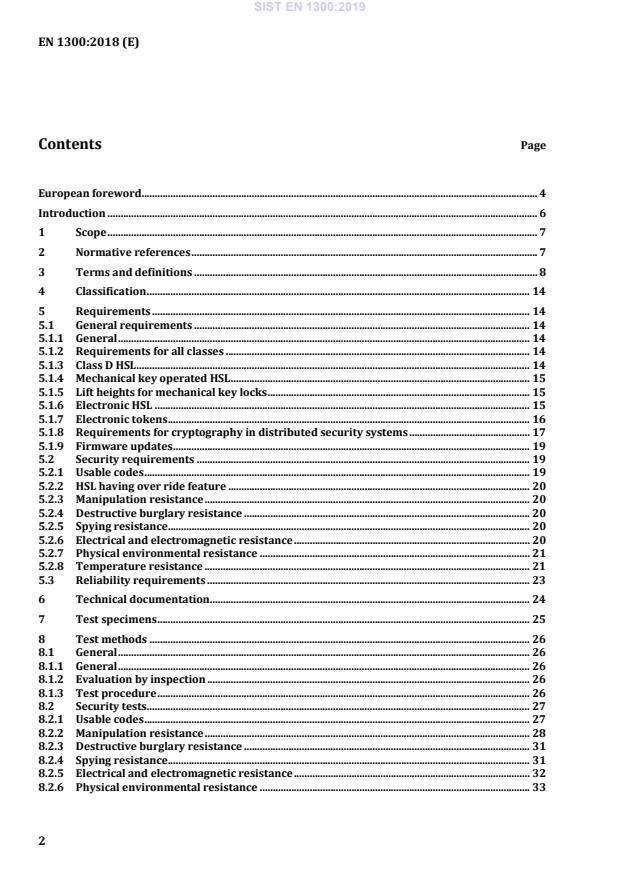
European foreword . 4 Introduction . 6 1 Scope . 7 2 Normative references . 7 3 Terms and definitions . 8 4 Classification . 14 5 Requirements . 14 5.1 General requirements . 14 5.1.1 General . 14 5.1.2 Requirements for all classes . 14 5.1.3 Class D HSL . 14 5.1.4 Mechanical key operated HSL . 15 5.1.5 Lift heights for mechanical key locks . 15 5.1.6 Electronic HSL . 15 5.1.7 Electronic tokens . 16 5.1.8 Requirements for cryptography in distributed security systems . 17 5.1.9 Firmware updates . 19 5.2 Security requirements . 19 5.2.1 Usable codes . 19 5.2.2 HSL having over ride feature . 20 5.2.3 Manipulation resistance . 20 5.2.4 Destructive burglary resistance . 20 5.2.5 Spying resistance . 20 5.2.6 Electrical and electromagnetic resistance . 20 5.2.7 Physical environmental resistance . 21 5.2.8 Temperature resistance . 21 5.3 Reliability requirements . 23 6 Technical documentation . 24 7 Test specimens . 25 8 Test methods . 26 8.1 General . 26 8.1.1 General . 26 8.1.2 Evaluation by inspection . 26 8.1.3 Test procedure . 26 8.2 Security tests . 27 8.2.1 Usable codes . 27 8.2.2 Manipulation resistance . 28 8.2.3 Destructive burglary resistance . 31 8.2.4 Spying resistance . 31 8.2.5 Electrical and electromagnetic resistance . 32 8.2.6 Physical environmental resistance . 33 SIST EN 1300:2019
Parameters for installation and operating instructions . 38 A.1 Installation instructions . 38 A.2 Operating instructions . 39 Annex B (normative)
Determination of manipulation resistance due to the design requirement . 40 B.1 General . 40 B.2 Key locks . 40 B.2.1 General . 40 B.2.2 Gate clearance . 40 B.2.3 Bolt stump . 43 B.2.4 False notches . 43 B.2.5 Additional design requirements . 44 B.3 Mechanical combination locks . 44 B.3.1 General . 44 B.3.2 Fence . 45 B.3.3 Wear test . 46 Annex C (normative)
Manufacturer’s declaration . 47 Annex D (informative)
Typical locking device dimensions . 49 Annex E (normative)
Determination of burglary resistance due to design requirements . 50 E.1 General . 50 E.2 Electronic HSL with separate processing unit not included in the locking device . 50 E.2.1 Scope of design requirement . 50 E.2.2 Design requirement . 50 Annex F (normative)
Firmware declaration . 51 Annex G (informative)
A-deviations . 52 Bibliography . 55
IEC Electropedia: available at http://www.electropedia.org/
ISO Online browsing platform: available at http://www.iso.org/obp 3.1 High Security Lock HSL independent assembly normally fitted to doors of secure storage units Note 1 to entry:
Codes can be entered into an HSL for comparison with memorized codes (processing unit). A correct match of an opening code allows movement of a blocking feature. 3.2 code identification information required which can be entered into a HSL and which, if correct, enables the security status of the HSL to be changed 3.2.1 opening code identification information which allows the HSL to be opened 3.2.2 recognized code identification information which allows access to the processing unit and which may also be an opening code Note 1 to entry: Master codes, manager codes, authorization codes and services codes may fall under recognized codes SIST EN 1300:2019
An electronic token incorporates an integrated circuit containing volatile and non-volatile memory, associated firmware/software and in many cases a microcontroller which communicates with an input unit by contact or contactless means. SIST EN 1300:2019
A blocking feature either secures a door or prevents movement of a boltwork. The bolt of a lock is an example of a blocking feature. 3.11 locking element part of the HSL which enables the blocking feature to be moved EXAMPLES Levers, spindles, wheels, motors, solenoids. 3.12 destructive burglary attack which damages the HSL in such a manner that it is irreversible and cannot be hidden from the authorized user 3.13 reliability ability to function and achieve the security requirements of this standard after a large number of duty cycles 3.14 manipulation method of attack aimed at removing the blocking function without causing damage obvious to the user Note 1 to entry:
A HSL may function after manipulation although its security could be permanently degraded. 3.15 spying attempt to obtain unauthorized information 3.16 usable codes codes or tokens permitted by the manufacturer and conforming to the requirements of this standard Note 1 to entry:
For mechanical HSL the number of usable codes is much less than the total number of codes to which the HSL can be set. 3.17 scrambled condition coding elements are not in the configuration necessary for the HSL to be opened without entering the complete correct code or proper token SIST EN 1300:2019
It shows a calculated result from using a tool with a certain value over a period of time. SIST EN 1300:2019
It is assumed that the transmitted information can be accessed by a third party. A high security lock with components in separate locations is defined as distributed system. A lock system with two input units, one on the safe and the other remote (= distributed input unit) is an example of a distributed system. An electronic lock with a non-accessible transmission system in the sense of 5.1.6.3 of this standard or with a temporary on-site wired connection to a trusted device (e.g. trusted Personal Computer) supervised by an authorized person is not considered as a distributed system. SIST EN 1300:2019
Dedicated lines, wired and wireless public switched networks may be used as the transmission path. 3.38 security relevant information codes according to 3.2, authentications, any code or key transmissions and changes as well as firmware updates of input and processing units 3.39 automatic key exchange cryptographic protocol that allows two components that could have no prior knowledge of each other to jointly establish a shared secret key over an insecure communications channel 3.40 availability proportion of time a system is in functioning condition 3.41 firmware software code that operates the dedicated hardware according to 5.1.8.2.3 or the processing or input units of the HSL 3.42 application software software which can be run on any device such as a PC having additional functions but not containing or storing any security relevant information 3.43 trusted device wire-connected device, on which no unauthorised person will have access to security-relevant information SIST EN 1300:2019
...
Questions, Comments and Discussion
Ask us and Technical Secretary will try to provide an answer. You can facilitate discussion about the standard in here.
Loading comments...