


A Clear Guide to Critical Energy and Heat Standards: Safety, Flexibility, and Demand-Side Management
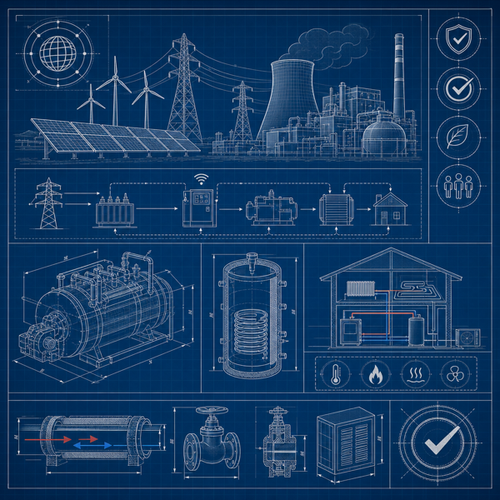
The world of energy and heat transfer is advancing at an unprecedented pace, fueled by innovations in electrical energy storage, renewable energy integration, smart grids, and digital management. Three international standards are at the very heart of this transformation: IEC 62933-5-4:2026, a safety standard for lithium-ion battery energy storage systems; IEC 63552:2026, the specification for switching devices enabling safe islanding of local prosumer systems; and IEC TS 63427:2026, which offers a framework for evaluating the flexibility and adjustment potential of demand-side resources. Understanding and implementing these standards isn’t just about compliance—it’s central to productivity, operational security, and future scalability. In this resource, we explore these documents in detail, highlight their core requirements, and provide guidance for industry professionals eager to lead in energy and heat transfer engineering.
Overview / Introduction
Every business, utility, and household increasingly interacts with modern energy systems—whether by supporting local renewable generation, using battery energy storage, or adapting electricity consumption in real time. These practices, essential for grid resilience and environmental sustainability, demand international standards to ensure safety, interoperability, and performance. Without such guidelines, the risks of system failure, inefficiency, or accidents rise dramatically.
This article will:
- Provide concise, non-technical explanations suitable for the general public and professionals alike.
- Present the business and technical case for each standard covered.
- Show how adopting these standards leads to increased productivity, better risk management, and support for business scaling.
Let’s explore the three focus standards in energy and heat transfer, embedding the most relevant energy and grid management keywords as we proceed.
Detailed Standards Coverage
IEC 62933-5-4:2026 - Safety Test Methods for Grid-Integrated Lithium-Ion ESS
Electrical energy storage (ESS) systems – Part 5-4: Safety test methods and procedures for grid integrated EES systems – Lithium ion battery-based systems
This standard governs the safety testing for lithium ion battery-based electrical energy storage systems (EES), particularly those integrated into the main electricity grid. Lithium ion batteries, renowned for their high energy density, underpin modern battery energy storage systems (BESS) for utility-scale, commercial, and even residential uses.
IEC 62933-5-4:2026 focuses specifically on:
- Actual safety test methodologies and procedures for BESS with lithium-ion batteries.
- Validating protection against short circuits, overcharging, high current charge/discharge, explosion hazards, electromagnetic interference, and system malfunctions.
Key requirements and scope
- Tests are performed on a system that represents real-world BESS deployments, not just theoretical setups.
- Electrical hazards tests include high-current (short-circuit) discharge, overcharge, earth fault, and protection device validation.
- Explosion/hazard tests cover gas detection, ventilation, fire propagation, and management of flammable gases.
- EMC (electromagnetic compatibility) testing ensures BESS does not disrupt nor is it disrupted by nearby electrical devices.
- Tests are based on both physical trials and, where necessary, validated simulations.
Who should comply?
- Battery and system manufacturers, integrators, and operators of grid-connected battery energy storage systems.
- Grid operators, energy providers, and businesses deploying or maintaining on-site energy storage.
Practical implications
- Reduces risks of catastrophic failure (e.g., thermal runaway, electrical fires).
- Ensures systems are safe for personnel, equipment, and the public.
- Establishes trust for broader deployment of ESS in power grids, microgrids, and distributed energy systems.
Notable features
- Real-lab safety tests on representative BESS hardware
- Procedures for validating protective hardware and management systems
- Alignment with the latest editions of related ESS safety standards
Key highlights:
- Critical for certifying safety of lithium-ion grid storage
- Enables large-scale ESS deployment
- Underpins robust emergency and incident protocols
Access the full standard:View IEC 62933-5-4:2026 on iTeh Standards
IEC 63552:2026 - Switching Device for Islanding (SDFI)
Switching device for islanding (SDFI)
As local power generation (solar, wind) and storage become mainstream, buildings and microgrids must sometimes operate independently of the main grid—a condition known as "islanding". IEC 63552:2026 defines the design, functionality, and testing requirements for Switching Devices for Islanding (SDFI), which allow "prosumers"—homes and businesses generating some of their own power—to safely disconnect from or reconnect to the utility grid.
What does the standard address?
- Classification, construction, operational and endurance requirements for SDFI.
- Type-testing protocols for safe transition between grid-connected mode and island mode.
- Interlocking and synchronization mechanisms to prevent dangerous backflow or connection errors.
Key specifications
- SDFI is aimed at low-voltage installations (max 440 VAC, up to 25 kA short-circuit currents).
- Supports both connected mode (grid-supplied) and island mode (independent)
- Must coordinate with other safety devices (overcurrent, interface protection, isolation, etc.)
- Must maintain operation security in the event of grid failures, voltage/frequency deviations, or disturbances.
Who needs to comply?
- Residential and commercial building owners deploying local energy resources and storage
- Manufacturers of switching equipment for smart homes and smart grids
- Installers and integrators of prosumer electrical installations
Practical implications
- Facilitates resilience and continuation of service during grid outages.
- Enables smarter energy management, reduced utility bills, and higher energy autonomy for businesses and homes.
- Crucial for the stability and protection of both local users and the wider grid.
Notable features
- Clear requirements for marking, product information and installation
- EMC (electromagnetic compatibility) testing for robust operation
- Type-tested for endurance and operational safety
Key highlights:
- Empowers prosumers in energy transition
- Protects against accidental grid reconnects
- Enables safe microgrid and backup power operations
Access the full standard:View IEC 63552:2026 on iTeh Standards
IEC TS 63427:2026 - Guidelines for Adjustment Potential Evaluation of Demand Side Resources
Guidelines for the adjustment potential evaluation of demand side resources
Modern electricity grids rely on flexibility—not just supply, but on the ability of users to shift, reduce, or manage loads. IEC TS 63427:2026 delivers a framework to evaluate the "adjustment potential" of demand side resources (DSR): including demand response-ready devices, battery systems, electric vehicles, distributed renewables, and microgrids.
What the standard covers
- Definitions and technical requirements for adjustment potential (ability to change power draw or supply)
- Methodologies for evaluating DSR units’ physical response: availability windows, response time, service duration, power adjustment rate, accuracy, and utilization.
- Provides evaluation indices for diverse applications: peak-load shifting, frequency regulation, voltage control, and congestion management.
- Applicable for energy aggregators, grid operators, VPPs (Virtual Power Plants), and advanced users.
Who should comply?
- Utilities and DSOs (Distribution System Operators)
- Aggregators (combining multiple flexible loads/resources)
- Operators of demand response or distributed energy programs
- Building managers and technology providers
Practical implications
- Provides a standardized way to compare, validate, and select DSR for grid and market integration.
- Supports grid reliability, peak demand management, and renewable integration.
- Enables fair compensation and participation for users in demand response programs.
Notable features
- Transparent, data-driven approach to DSR evaluation
- Focus on measurable, physical characteristics
- Excludes user behavior or market mechanisms, concentrating purely on technical capability
Key highlights:
- Boosts flexibility in modern smart grids
- Facilitates integration of renewables and storage
- Enables smarter, data-driven grid management
Access the full standard:View IEC TS 63427:2026 on iTeh Standards
Industry Impact & Compliance
Standards such as these are more than technical documents—they underpin the safety, efficiency, and business value of the entire energy sector. Adopting internationally recognized requirements for battery safety, system flexibility, and demand management assures that:
- New technology deployments are intrinsically safe and reliable.
- Interoperability is built in, supporting long-term scalability and growth.
- Regulatory compliance is ensured, minimizing risks of penalties or liability.
- Operational risks (such as blackouts, equipment damage, or fire) are drastically reduced.
- Business continuity is protected, even during power disruptions.
Ignoring these standards may lead to severe consequences including increased liability, regulatory penalties, loss of customer trust, and serious safety hazards—especially as grids and buildings become smarter and more interconnected.
Adopting these international energy and heat transfer standards enhances:
- Productivity, by enabling safe integration of advanced energy systems.
- Security, by lowering risks to people and property.
- Scalability, as systems meeting international standards can be expanded or interconnected more easily.
- Market access, thanks to established compliance with global best practices.
Implementation Guidance
Common implementation approaches:
Gap Analysis:
- Assess existing systems and practices against the requirements of IEC 62933-5-4, IEC 63552, or IEC TS 63427 as applicable.
Stakeholder Training:
- Train staff in the standards’ requirements, focusing on practical test procedures, safety practices, and data management.
System Design and Upgrade:
- Select equipment and software that is certified or designed to be compliant.
- Engage with manufacturers and technology partners familiar with international ESS, SDFI, and DSR standards.
Testing and Verification:
- Perform type and routine tests per documented procedures.
- Retain records and test results as proof of compliance.
Continuous Monitoring and Improvement:
- Use monitoring systems to ensure ongoing compliance and capture operational data for continuous optimization.
Best practices:
- Select tested and certified products when upgrading or installing new systems.
- Incorporate standard requirements early in the design cycle to minimize retrofit costs.
- Engage with knowledgeable certification bodies and consult standards platforms such as iTeh Standards for up-to-date documents.
- Foster collaboration between engineering, operations, IT, and management teams.
Resources:
- Official IEC standards documents (obtain latest versions for accuracy)
- Training and certification programs in ESS safety and grid integration
- Solution providers specializing in smart grid, ESS, and DSR technologies
Conclusion / Next Steps
As energy production and consumption patterns evolve, international standards are a must-have for anyone involved in the design, deployment, or operation of modern energy and heat transfer systems. Embracing standards such as IEC 62933-5-4, IEC 63552, and IEC TS 63427 secures competitive advantage: it ensures safety, unlocks flexibility, and supports large-scale, secure, and sustainable business growth.
Key takeaways:
- Proper standards implementation maximizes productivity, fosters business continuity, and builds resilient energy infrastructure.
- Standards compliance is critical for safe, flexible, and scalable energy and heat transfer operations.
- Leveraging these standards enables organizations to meet regulatory demands, reduce risks, and tap into high-value global energy markets.
Recommendation:
- Review your systems and practices today.
- Access and study the full documents for in-depth requirements.
- Consider expert consultation and ongoing education to remain ahead in the fast-changing energy and heat sector.
- Stay updated: standards continue to evolve with technology and new application scenarios.
For more detailed guidance and direct access to the most recent editions, visit iTeh Standards:
https://standards.iteh.ai/catalog/standards/iec/d1d00925-9f26-4f41-9a9b-e47f9759d823/iec-62933-5-4-2026https://standards.iteh.ai/catalog/standards/iec/dd819c17-3de0-476d-b296-530a6d635730/iec-63552-2026https://standards.iteh.ai/catalog/standards/iec/b53cf88f-c54a-42c1-acad-14bae3e655c5/iec-ts-63427-2026
Categories
- Latest News
- New Arrivals
- Generalities
- Services and Management
- Natural Sciences
- Health Care
- Environment
- Metrology and Measurement
- Testing
- Mechanical Systems
- Fluid Systems
- Manufacturing
- Energy and Heat
- Electrical Engineering
- Electronics
- Telecommunications
- Information Technology
- Image Technology
- Precision Mechanics
- Road Vehicles
- Railway Engineering
- Shipbuilding
- Aircraft and Space
- Materials Handling
- Packaging
- Textile and Leather
- Clothing
- Agriculture
- Food technology
- Chemical Technology
- Mining and Minerals
- Petroleum
- Metallurgy
- Wood technology
- Glass and Ceramics
- Rubber and Plastics
- Paper Technology
- Paint Industries
- Construction
- Civil Engineering
- Military Engineering
- Entertainment