

IEC 62933-5-4:2026
(Main)Electrical energy storage (ESS) systems - Part 5-4: Safety test methods and procedures for grid integrated EES systems - Lithium ion battery-based systems
General Information
- Abstract
IEC 62933-5-4:2026 primarily describes the safety test methods and procedures for grid-connected energy storage systems where a lithium ion battery-based subsystem is used.
This document provides test methods and procedures to validate safety issues specifically related to the use of a lithium-ion battery-based subsystem, primarily based on IEC 62933-5-1, which establishes criteria for ensuring the safe applications and use of electrical energy storage systems of any type or size, and IEC 62933-5-2, which further specifies safety provisions arising from the use of an electrochemical storage subsystems in EES systems. All test methods and procedures are based on the requirements of IEC 62933-5-2 Ed 2.0. This standard includes only the test methods specifically related to lithium ion battery-based BESS and is based on by actual tests.
The scope of this document is limited to some representative actual test method and procedure for lithium-ion battery-based BESS, but does not include all tests method and procedure.
- Status
- Published
- Publication Date
- 10-May-2026
- Technical Committee
- TC 120 - Electrical Energy Storage (EES) systems
- Drafting Committee
- WG 5 - TC 120/WG 5
- Current Stage
- PPUB - Publication issued
- Start Date
- 11-May-2026
- Completion Date
- 17-Apr-2026
Buy Documents
IEC 62933-5-4:2026 - Electrical energy storage (ESS) systems - Part 5-4: Safety test methods and procedures for grid integrated EES systems - Lithium ion battery-based systems
Overview
IEC 62933-5-4:2026 is an international standard developed by the International Electrotechnical Commission (IEC) under technical committee 120. This standard specifies the safety test methods and procedures for grid-integrated electrical energy storage (EES) systems using lithium ion battery-based subsystems. Its focus is on validating safety measures and operational protocols for grid-connected battery energy storage systems (BESS), ensuring robust performance and minimizing hazards during operation.
Built upon the requirements of IEC 62933-5-1 and IEC 62933-5-2, this standard addresses unique risk factors associated with lithium-ion chemistry in large-scale grid applications. IEC 62933-5-4:2026 is intended for use by manufacturers, integrators, utilities, and testing bodies to support compliance, enhance safety, and ensure effective management of grid-connected lithium-ion BESS.
Key Topics
Scope and Applicability:
The standard primarily covers representative test methods and procedures to address safety concerns unique to lithium-ion BESS in grid applications. It does not cover every possible configuration or test, but focuses on key, practical tests that are validated by actual field experience and accident investigations.Test Methods for Electrical Hazards:
- Short-circuit protection (AC, DC, switching element, external)
- Overcharge and high current charge protection
- Earth fault protection
Explosion and Fire Hazards Testing:
- Analysis of flammable gases from cells
- Gas detection system performance
- Ventilation capacity and system design
Electromagnetic and Control Hazards:
- Electromagnetic emission and immunity testing
- Evaluation of hazards from auxiliary, control, and communication system malfunctions
Roles and Responsibilities:
The standard defines the roles of different manufacturers and integrators, from battery subsystem suppliers to system integrators and specialist equipment providers for protection and detection devices.Test Configurations and Acceptance Criteria:
The use of representative BESS configurations, minimum required subsystems for testing, and established acceptance criteria based on related standards ensures consistent validation and safety benchmarks.
Applications
IEC 62933-5-4:2026 is designed for application wherever lithium-ion battery-based energy storage systems are connected to the electricity grid. Key practical applications include:
Power Grid Operators and Utilities:
For integrating grid-scale battery storage into energy management, load balancing, frequency regulation, and grid modernization projects.Manufacturers and Integrators:
For the design, construction, and commissioning of BESS, ensuring products meet global safety compliance standards for electrical, explosion, and fire hazards.Testing and Certification Bodies:
For validating system-level safety and interoperability of lithium-ion BESS, ensuring the correct application of protective devices as per industry standards.Project Developers and Engineers:
For risk assessment, site acceptance, and commissioning processes of new energy storage installations.Regulatory Authorities:
For referencing advanced, harmonized test procedures for setting local or national safety codes in the rapidly evolving field of lithium-ion energy storage.
Related Standards
When applying IEC 62933-5-4:2026, several related IEC standards should also be considered:
- IEC 62933-5-1: Safety considerations for grid integrated ESS systems - General specification.
- IEC 62933-5-2: Safety requirements for grid-integrated ESS systems – Electrochemical-based systems.
- IEC 63056: General requirements and test methods for secondary lithium cells and batteries in energy storage.
- IEC 61000 series: Electromagnetic compatibility testing.
- IEC 60079-29: Explosive atmosphere gas detectors.
- IEC 60730-1: General requirements for automatic electrical controls.
Adhering to this suite of standards enhances the overall safety, reliability, and acceptance of lithium-ion battery storage systems worldwide.
Keywords: IEC 62933-5-4:2026, lithium ion battery BESS, energy storage system safety, grid-integrated energy storage, safety test procedures, battery energy storage, IEC standards, electrical hazards, explosion hazards, fire testing, energy storage compliance, BESS manufacturer requirements.
Buy Documents
IEC 62933-5-4:2026 - Electrical energy storage (ESS) systems - Part 5-4: Safety test methods and procedures for grid integrated EES systems - Lithium ion battery-based systems
Get Certified
Connect with accredited certification bodies for this standard

DNV
DNV is an independent assurance and risk management provider.

BSI Group
BSI (British Standards Institution) is the business standards company that helps organizations make excellence a habit.

Bureau Veritas
Bureau Veritas is a world leader in laboratory testing, inspection and certification services.
Sponsored listings
Frequently Asked Questions
IEC 62933-5-4:2026 is a standard published by the International Electrotechnical Commission (IEC). Its full title is "Electrical energy storage (ESS) systems - Part 5-4: Safety test methods and procedures for grid integrated EES systems - Lithium ion battery-based systems". This standard covers: IEC 62933-5-4:2026 primarily describes the safety test methods and procedures for grid-connected energy storage systems where a lithium ion battery-based subsystem is used. This document provides test methods and procedures to validate safety issues specifically related to the use of a lithium-ion battery-based subsystem, primarily based on IEC 62933-5-1, which establishes criteria for ensuring the safe applications and use of electrical energy storage systems of any type or size, and IEC 62933-5-2, which further specifies safety provisions arising from the use of an electrochemical storage subsystems in EES systems. All test methods and procedures are based on the requirements of IEC 62933-5-2 Ed 2.0. This standard includes only the test methods specifically related to lithium ion battery-based BESS and is based on by actual tests. The scope of this document is limited to some representative actual test method and procedure for lithium-ion battery-based BESS, but does not include all tests method and procedure.
IEC 62933-5-4:2026 primarily describes the safety test methods and procedures for grid-connected energy storage systems where a lithium ion battery-based subsystem is used. This document provides test methods and procedures to validate safety issues specifically related to the use of a lithium-ion battery-based subsystem, primarily based on IEC 62933-5-1, which establishes criteria for ensuring the safe applications and use of electrical energy storage systems of any type or size, and IEC 62933-5-2, which further specifies safety provisions arising from the use of an electrochemical storage subsystems in EES systems. All test methods and procedures are based on the requirements of IEC 62933-5-2 Ed 2.0. This standard includes only the test methods specifically related to lithium ion battery-based BESS and is based on by actual tests. The scope of this document is limited to some representative actual test method and procedure for lithium-ion battery-based BESS, but does not include all tests method and procedure.
IEC 62933-5-4:2026 is classified under the following ICS (International Classification for Standards) categories: 27.010 - Energy and heat transfer engineering in general. The ICS classification helps identify the subject area and facilitates finding related standards.
IEC 62933-5-4:2026 is available in PDF format for immediate download after purchase. The document can be added to your cart and obtained through the secure checkout process. Digital delivery ensures instant access to the complete standard document.
Standards Content (Sample)
IEC 62933-5-4 ®
Edition 1.0 2026-05
INTERNATIONAL
STANDARD
Electrical energy storage (ESS) systems -
Part 5-4: Safety test methods and procedures for grid integrated EES systems -
Lithium ion battery-based systems
ICS 27.010 ISBN 978-2-8327-1213-9
All rights reserved. Unless otherwise specified, no part of this publication may be reproduced or utilized in any form or
by any means, electronic or mechanical, including photocopying and microfilm, without permission in writing from either
IEC or IEC's member National Committee in the country of the requester. If you have any questions about IEC copyright
or have an enquiry about obtaining additional rights to this publication, please contact the address below or your local
IEC member National Committee for further information.
IEC Secretariat Tel.: +41 22 919 02 11
3, rue de Varembé info@iec.ch
CH-1211 Geneva 20 www.iec.ch
Switzerland
About the IEC
The International Electrotechnical Commission (IEC) is the leading global organization that prepares and publishes
International Standards for all electrical, electronic and related technologies.
About IEC publications
The technical content of IEC publications is kept under constant review by the IEC. Please make sure that you have the
latest edition, a corrigendum or an amendment might have been published.
IEC publications search - IEC Products & Services Portal - products.iec.ch
webstore.iec.ch/advsearchform Discover our powerful search engine and read freely all the
The advanced search enables to find IEC publications by a publications previews, graphical symbols and the glossary.
variety of criteria (reference number, text, technical With a subscription you will always have access to up to date
committee, …). It also gives information on projects, content tailored to your needs.
replaced and withdrawn publications.
Electropedia - www.electropedia.org
The world's leading online dictionary on electrotechnology,
IEC Just Published - webstore.iec.ch/justpublished
Stay up to date on all new IEC publications. Just Published containing more than 22 500 terminological entries in English
details all new publications released. Available online and and French, with equivalent terms in 25 additional languages.
once a month by email. Also known as the International Electrotechnical Vocabulary
(IEV) online.
IEC Customer Service Centre - webstore.iec.ch/csc
If you wish to give us your feedback on this publication or
need further assistance, please contact the Customer
Service Centre: sales@iec.ch.
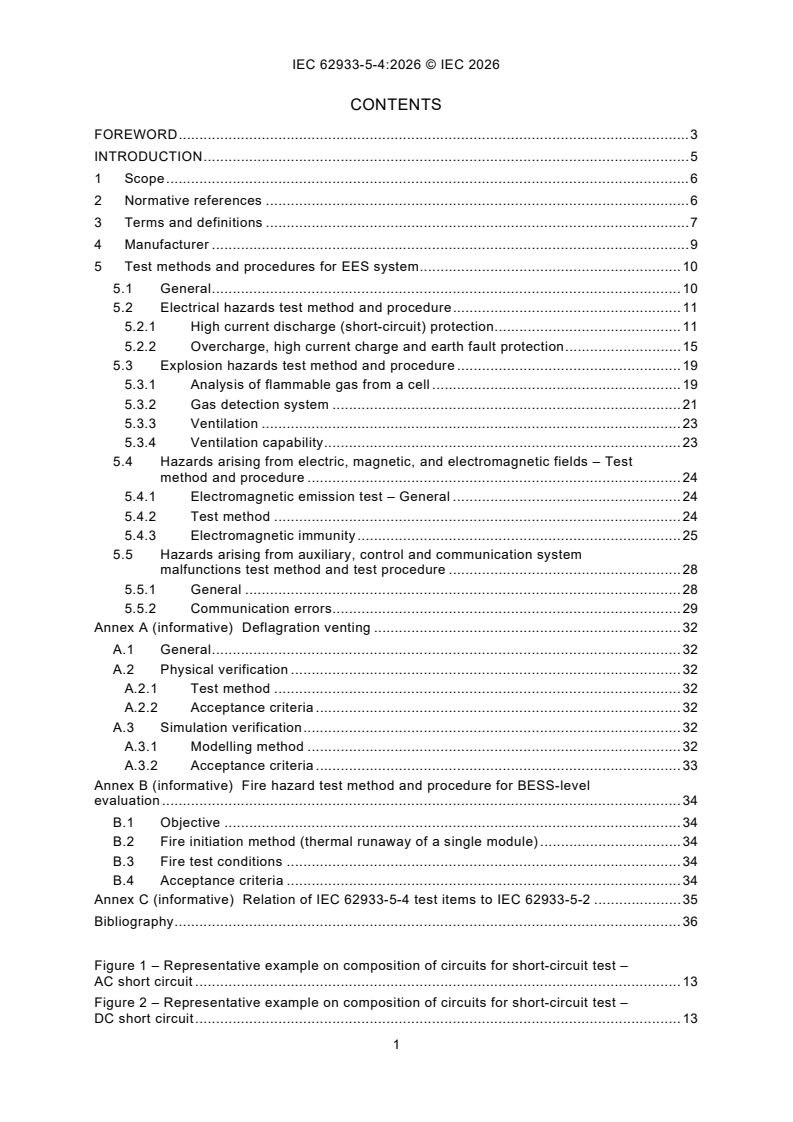
CONTENTS
FOREWORD . 3
INTRODUCTION . 5
1 Scope . 6
2 Normative references . 6
3 Terms and definitions . 7
4 Manufacturer . 9
5 Test methods and procedures for EES system . 10
5.1 General . 10
5.2 Electrical hazards test method and procedure . 11
5.2.1 High current discharge (short-circuit) protection. 11
5.2.2 Overcharge, high current charge and earth fault protection . 15
5.3 Explosion hazards test method and procedure . 19
5.3.1 Analysis of flammable gas from a cell . 19
5.3.2 Gas detection system . 21
5.3.3 Ventilation . 23
5.3.4 Ventilation capability . 23
5.4 Hazards arising from electric, magnetic, and electromagnetic fields – Test
method and procedure . 24
5.4.1 Electromagnetic emission test – General . 24
5.4.2 Test method . 24
5.4.3 Electromagnetic immunity . 25
5.5 Hazards arising from auxiliary, control and communication system
malfunctions test method and test procedure . 28
5.5.1 General . 28
5.5.2 Communication errors. 29
Annex A (informative) Deflagration venting . 32
A.1 General . 32
A.2 Physical verification . 32
A.2.1 Test method . 32
A.2.2 Acceptance criteria . 32
A.3 Simulation verification . 32
A.3.1 Modelling method . 32
A.3.2 Acceptance criteria . 33
Annex B (informative) Fire hazard test method and procedure for BESS-level
evaluation . 34
B.1 Objective . 34
B.2 Fire initiation method (thermal runaway of a single module) . 34
B.3 Fire test conditions . 34
B.4 Acceptance criteria . 34
Annex C (informative) Relation of IEC 62933-5-4 test items to IEC 62933-5-2 . 35
Bibliography . 36
Figure 1 – Representative example on composition of circuits for short-circuit test –
AC short circuit . 13
Figure 2 – Representative example on composition of circuits for short-circuit test –
DC short circuit . 13
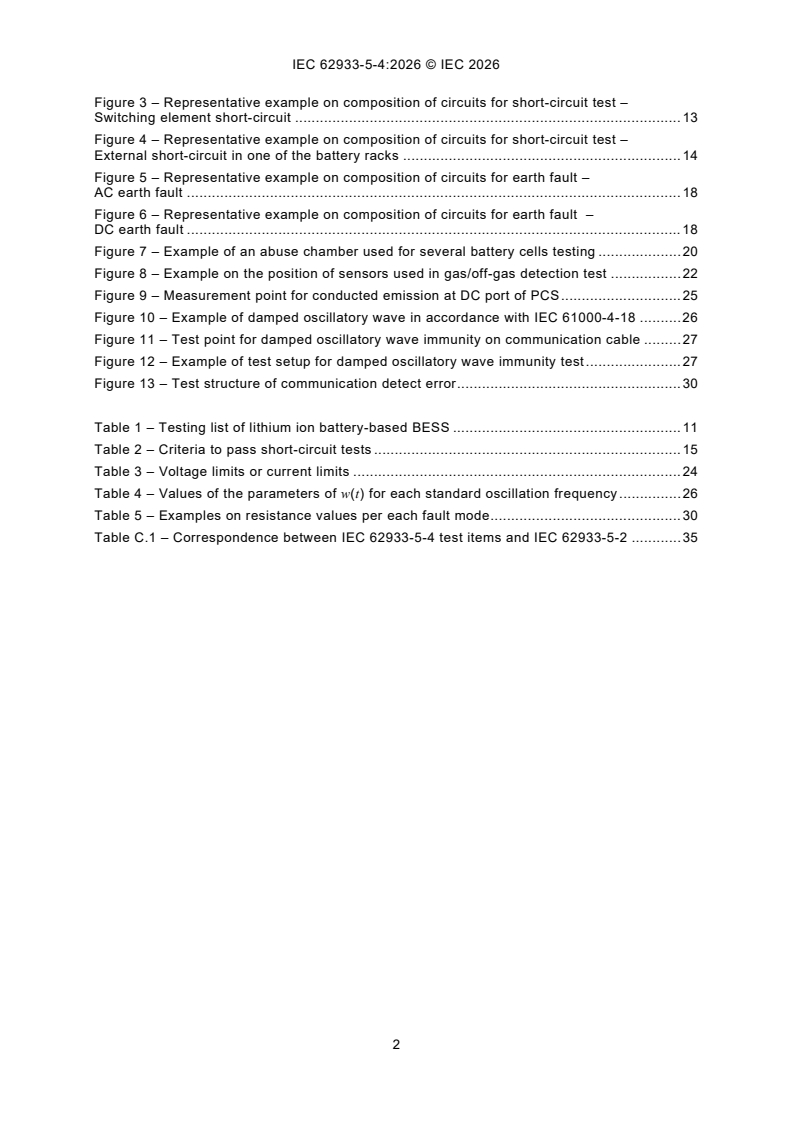
Figure 3 – Representative example on composition of circuits for short-circuit test –
Switching element short-circuit . 13
Figure 4 – Representative example on composition of circuits for short-circuit test –
External short-circuit in one of the battery racks . 14
Figure 5 – Representative example on composition of circuits for earth fault –
AC earth fault . 18
Figure 6 – Representative example on composition of circuits for earth fault –
DC earth fault . 18
Figure 7 – Example of an abuse chamber used for several battery cells testing . 20
Figure 8 – Example on the position of sensors used in gas/off-gas detection test . 22
Figure 9 – Measurement point for conducted emission at DC port of PCS . 25
Figure 10 – Example of damped oscillatory wave in accordance with IEC 61000-4-18 . 26
Figure 11 – Test point for damped oscillatory wave immunity on communication cable . 27
Figure 12 – Example of test setup for damped oscillatory wave immunity test . 27
Figure 13 – Test structure of communication detect error . 30
Table 1 – Testing list of lithium ion battery-based BESS . 11
Table 2 – Criteria to pass short-circuit tests . 15
Table 3 – Voltage limits or current limits . 24
Table 4 – Values of the parameters of w(t) for each standard oscillation frequency . 26
Table 5 – Examples on resistance values per each fault mode . 30
Table C.1 – Correspondence between IEC 62933-5-4 test items and IEC 62933-5-2 . 35
INTERNATIONAL ELECTROTECHNICAL COMMISSION
____________
Electrical energy storage (EES) systems -
Part 5-4: Safety test methods and procedures for
grid integrated EES systems - Lithium ion battery-based systems
FOREWORD
1) The International Electrotechnical Commission (IEC) is a worldwide organization for standardization comprising
all national electrotechnical committees (IEC National Committees). The object of IEC is to promote international
co-operation on all questions concerning standardization in the electrical and electronic fields. To this end and
in addition to other activities, IEC publishes International Standards, Technical Specifications, Technical Reports,
Publicly Available Specifications (PAS) and Guides (hereafter referred to as “IEC Publication(s)”). Their
preparation is entrusted to technical committees; any IEC National Committee interested in the subject dealt with
may participate in this preparatory work. International, governmental and non-governmental organizations liaising
with the IEC also participate in this preparation. IEC collaborates closely with the International Organization for
Standardization (ISO) in accordance with conditions determined by agreement between the two organizations.
2) The formal decisions or agreements of IEC on technical matters express, as nearly as possible, an international
consensus of opinion on the relevant subjects since each technical committee has representation from all
interested IEC National Committees.
3) IEC Publications have the form of recommendations for international use and are accepted by IEC National
Committees in that sense. While all reasonable efforts are made to ensure that the technical content of IEC
Publications is accurate, IEC cannot be held responsible for the way in which they are used or for any
misinterpretation by any end user.
4) In order to promote international uniformity, IEC National Committees undertake to apply IEC Publications
transparently to the maximum extent possible in their national and regional publications. Any divergence between
any IEC Publication and the corresponding national or regional publication shall be clearly indicated in the latter.
5) IEC itself does not provide any attestation of conformity. Independent certification bodies provide conformity
assessment services and, in some areas, access to IEC marks of conformity. IEC is not responsible for any
services carried out by independent certification bodies.
6) All users should ensure that they have the latest edition of this publication.
7) No liability shall attach to IEC or its directors, employees, servants or agents including individual experts and
members of its technical committees and IEC National Committees for any personal injury, property damage or
other damage of any nature whatsoever, whether direct or indirect, or for costs (including legal fees) and
expenses arising out of the publication, use of, or reliance upon, this IEC Publication or any other IEC
Publications.
8) Attention is drawn to the Normative references cited in this publication. Use of the referenced publications is
indispensable for the correct application of this publication.
9) IEC draws attention to the possibility that the implementation of this document may involve the use of (a)
patent(s). IEC takes no position concerning the evidence, validity or applicability of any claimed patent rights in
respect thereof. As of the date of publication of this document, IEC had not received notice of (a) patent(s), which
may be required to implement this document. However, implementers are cautioned that this may not represent
the latest information, which may be obtained from the patent database available at https://patents.iec.ch. IEC
shall not be held responsible for identifying any or all such patent rights.
IEC 62933-5-4 has been prepared by IEC technical committee 120: Electrical Energy Storage
(ESS) systems. It is an International Standard.
This International Standard is to be used in conjunction with IEC 62933-5-2:2025.
The text of this International Standard is based on the following documents:
Draft Report on voting
120/448/FDIS 120/456/RVD
Full information on the voting for its approval can be found in the report on voting indicated in
the above table.
The language used for the development of this International Standard is English.
This document was drafted in accordance with ISO/IEC Directives, Part 2, and developed in
accordance with ISO/IEC Directives, Part 1 and ISO/IEC Directives, IEC Supplement, available
at www.iec.ch/members_experts/refdocs. The main document types developed by IEC are
described in greater detail at www.iec.ch/publications.
A list of all parts in the IEC 62933 series, published under the general title Electrical energy
storage (EES) systems, can be found on the IEC website.
The committee has decided that the contents of this document will remain unchanged until the
stability date indicated on the IEC website under webstore.iec.ch in the data related to the
specific document. At this date, the document will be
– reconfirmed,
– withdrawn, or
– revised.
INTRODUCTION
The general safety requirements for EES systems are provided in IEC 62933-5-1. The safety
requirements for battery energy storage systems (BESS) with subsystems utilizing
electrochemical-based batteries are described in IEC 62933-5-2. In this document, among the
safety provisions specified in IEC 62933-5-2, tests methods and procedures specific to the
safety of BESS using lithium ion batteries in the subsystem are specified. This document is
prepared for the following reasons:
a) To provide additional test methods and procedures specifically for lithium ion battery-based
energy storage systems.
b) This document was developed based on the investigation results of BESS accidents that
occurred over the world.
1 Scope
This part of IEC 62933 primarily describes the safety test methods and procedures for
grid-connected energy storage systems where a lithium ion battery-based subsystem is used.
This document provides test methods and procedures to validate safety issues specifically
related to the use of a lithium ion battery-based subsystem, primarily based on IEC 62933-5-1,
which establishes criteria for ensuring the safe applications and use of electrical energy storage
systems of any type or size, and IEC 62933-5-2, which further specifies safety provisions arising
from the use of an electrochemical storage subsystems in EES systems.
All test methods and procedures are based on the requirements of IEC 62933-5-2. This
document includes only the test methods specifically related to lithium ion battery-based BESS
and is based on actual tests.
2 Normative references
The following documents are referred to in the text in such a way that some or all of their content
constitutes requirements of this document. For dated references, only the edition cited applies.
For undated references, the latest edition of the referenced document (including any
amendments) applies.
IEC 60079-29 (all parts), Explosive atmospheres - Gas detectors
IEC 60730-1, Automatic electrical controls - Part 1: General requirements
IEC 61000-4-18, Electromagnetic compatibility (EMC) - Part 4-18: Testing and measurement
techniques - Damped oscillatory wave immunity test
IEC 61000-6-7, Electromagnetic compatibility (EMC) - Part 6-7: Generic standards - Immunity
requirements for equipment intended to perform functions in a safety-related system (functional
safety) in industrial locations
IEC 62933-1, Electrical energy storage (EES) systems - Part 1: Vocabulary
IEC 62933-5-1, Electrical energy storage (EES) systems - Part 5-1: Safety considerations for
grid integrated EES systems - General specification
IEC 62933-5-2:2025, Electrical energy storage (EES) systems – Part 5-2: Safety requirements
for grid-integrated EES systems – Electrochemical-based systems
IEC 63056, Secondary lithium cells and batteries for use in electrical energy storage systems -
General requirements and methods of test
CISPR 11, Industrial, scientific and medical equipment - Radio-frequency disturbance
characteristics - Limits and methods of measurement
CISPR 16-1-2, Specification for radio disturbance and immunity measuring apparatus and
methods - Part 1-2: Radio disturbance and immunity measuring apparatus - Coupling devices
for conducted disturbance measurements
3 Terms and definitions
For the purposes of this document, the terms and definitions given in IEC 62933-1,
IEC 62933-5-1, IEC 62933-5-2 and the following apply.
ISO and IEC maintain terminology databases for use in standardization at the following
addresses:
– IEC Electropedia: available at https://www.electropedia.org/
– ISO Online browsing platform: available at https://www.iso.org/obp
3.1
state of charge
EESS SOC
amount of stored electric charge (IEV 113-02-10) of the accumulation subsystem, related to the
actual capacity (IEV 482-03-14)
Note 1 to entry: The EESS SOC is frequently intended as a synonym of EESS state of energy and, therefore,
evaluated at EES system level. As defined in IEC 61427-2 and in many other standards the state of charge is related
to electric charge (IEV 113-02-10), usually expressed in coulombs (C) or amperes-hours (Ah) and should be used
only for some storage technologies (e.g. batteries, capacitors).
[SOURCE: IEC 61427-2:2015, 3.42, modified – original definition has been particularized for
the EES system, the notes to entry have been removed and a new note has been added.]
3.2
state of energy
EESS SOE
ratio between the available energy from an EES system and the actual energy storage capacity
Note 1 to entry: The state of energy is generally expressed in percentage. ESS system empty implies EESS SOE
= 0 % (empty state of energy) and EES system full implies EESS SOE = 100 % (full state of energy).
Note 2 to entry: The state of energy can be linked to accessible energy storage capacity or effective energy storage
capacity. The relation with effective energy storage capacity is different. In the case of state of energy related to
accessible energy storage capacity, fixed energy reserves are present on both sides (below the empty state of energy
and above the full state of energy); for example, by considering the above-mentioned state of charge, its range
related to accessible energy storage capacity is 0 % ÷ 100 %, so the range linked to effective energy storage capacity
can be -20 % ÷ 120 %.
Note 3 to entry: In the calculation of EESS SOE linked to accessible energy storage capacity (SOE ), the actual
US
energy storage capacity linked to accessible energy storage capacity with the used energy storage capacity is used.
In the calculation of EESS SOE linked to effective energy storage capacity (SOE ), the actual energy storage
EFF
capacity linked to effective energy storage capacity with the used energy storage capacity is used. In the calculation
of EESS SOE linked to output energy storage capacity (SOE ), the actual energy storage capacity linked to output
OUT
energy storage capacity with the available energy during discharge is used. In the calculation of EESS SOE linked
to input energy storage capacity (SOE ), the actual energy storage capacity linked to input energy storage capacity
IN
with the available energy during discharge is used.
E E E E
A,SDE A,SDE A,DIS A,DIS
SOE SOE SOE SOE
US EFF IN OUT
E E EE
C,ACT,US C,ACT,EFF C,IN C,OUT
Only SOE and SOE can reach the entire interval 0 % ÷ 100 %, SOE (because of the non useful energy) and
US OUT EFF
SOE (because of energy losses) cannot reach the 100 %.
IN
3.3
short-circuit
accidental or intentional conductive path between two or more conductive parts forcing the
electric potential differences between these conductive parts to be equal to or close to zero
[SOURCE: IEC 60050-151:2001, 151-12-04]
====
3.4
AC short-circuit
accidental or intentional conductive path between two or more conductive parts of the grid and
power conversion subsystem (PCS) forcing the electric potential differences between these
conductive parts to be equal to or close to zero
3.5
DC short-circuit
accidental or intentional conductive path between two or more conductive parts of the power
conversion subsystem (PCS) and electrochemical accumulation subsystem forcing the electric
potential differences between these conductive parts to be equal to or close to zero
3.6
switching element short-circuit
accidental or intentional conductive path between two or more conductive parts of the upper-
arm and lower-arm of the power conversion subsystem (PCS) switching element forcing the
electric potential differences between these conductive parts to be equal to or close to zero
3.7
earth fault
occurrence of an accidental conductive path between a live conductor and the earth
[SOURCE: IEC 60050-194:2021,195-04-14, modified – “ground fault” has been removed from
the term, “part” has been replaced with “conductor” and the note has been removed.]
3.8
AC earth fault
occurrence of an accidental conductive path between a live conductor and the earth at a point
between the grid and power conversion subsystem (PCS)
3.9
DC earth fault
occurrence of an accidental conductive path between a live conductor and the earth at a point
between power conversion subsystem (PCS) and electrochemical accumulation subsystem
3.10
venting
release of excessive internal pressure from a cell, module, battery pack, or battery system in a
manner intended by design to preclude rupture or explosion
[SOURCE: IEC 62619:2022, 3.14]
3.11
battery management system
BMS
electronic system associated with a battery which has functions to control current in case of
overcharge, overcurrent, overdischarge, and overheating and which monitors and/or manages
the battery's state, calculates secondary data, reports that data and/or controls its environment
to influence the battery's safety, performance and/or service life
[SOURCE: IEC 62619:2022, 3.12, modified – The notes have been removed.]
3.12
power management system
PMS
system that monitors the status information of PCS and protects BESS from abnormal
conditions, and delivers information necessary for charge/discharge control to PCS
3.13
rated current
current value determined under specified conditions and declared by the BESS system
manufacturer
3.14
DC contactor
electrically controlled device designed to switch current on and off
3.15
upper limit charging voltage
highest charging voltage in the cell operating region specified by the cell manufacturer
[SOURCE: IEC 62619:2022, 3.19]
3.16
ground fault device
GFD
device which prevents current from following any unintended paths during a ground fault
3.17
insulation monitoring device
IMD
device which monitors the ungrounded system between an active phase conductor and earth
3.18
PCS internal protection function
protection mechanisms embedded in the power conversion system (PCS) that are designed to
interrupt charging/discharging or shut down operation in response to overcurrent, overvoltage,
undervoltage, overheating, or loss of communication
4 Manufacturer
In this document, the term manufacturer refers to different responsible parties depending on
the context. The roles and responsibilities of each type of manufacturer are defined as follows:
a) BESS system manufacturer or integrator
The organization responsible for the overall design, functional integration, and configuration
of the battery energy storage system (BESS). This entity coordinates the interaction
between subsystems (e.g. PCS, BMS, PMS, HVAC, gas detection), defines system-level
protective functions, and serves as the primary contact for system-level testing and
acceptance criteria.
b) PCS manufacturer
The manufacturer of the power conversion system (PCS), responsible for defining the
electrical ratings, operating limits, and internal protection mechanisms of the PCS.
c) Battery subsystem manufacturer
The organization that provides the battery modules, racks, or cells used within the BESS.
This includes specifications for the state of charge (SOC), state of energy (SOE), voltage
thresholds, temperature limits, and the integrated battery management system (BMS).
d) BMS or PMS manufacturer
The party responsible for supplying the battery management system (BMS) or power
management system (PMS), which monitors, communicates with, and protects the battery
subsystem or the entire BESS. This manufacturer defines communication diagnostics,
response time thresholds, and protective function triggers.
e) Protection device manufacturer
The manufacturer of protective components such as circuit breakers, fuses, contactors, and
relays. These components are selected according to their rated capacity and application in
both system operation and test facility protection.
f) Gas detection device manufacturer (GFD/IMD)
The manufacturer of ground fault detection (GFD) devices or insulation monitoring devices
(IMD) used to detect abnormal gas emissions or electrical insulation failure. This
manufacturer defines device sensitivity, detection delay, and resistance configuration
settings.
NOTE In this document, the unqualified term “manufacturer” is generally used in relation to the BESS system
manufacturer, unless otherwise specified in the context.
5 Test methods and procedures for EES system
5.1 General
The tests shall be conducted on a complete BESS representative of production or on a
representative configuration of the complete BESS.
Representative configuration for the test shall be indicative of the complete BESS in terms of
scalability and design of critical components so that test results can be accurately extrapolated
to demonstrate the safety of the complete BESS.
The minimum representative configuration for the tests shall consist of one PCS and the
corresponding battery racks.
NOTE 1 If a BESS with a maximum energy storage capacity of 1 MWh is divided into a total of four parts based on
four PCSs, a test with a representative BESS can be performed with several battery racks (e.g. 3 to 4 racks) with a
maximum energy storage capacity of about 250 kWh connected to a single PCS. Depending on the test objective
and BESS architecture, the representative configuration can include other subsystems as necessary (e.g. PCS,
battery racks, auxiliary systems). The specific configuration for testing can be selected to represent the most critical
case for system safety validation.
Table 1 provides an overview of lithium ion battery-based BESS testing with reference to
IEC 62933-5-2:2025, 8.1, Table 4.
NOTE 2 Only testing lists related to lithium ion-based BESS covered in this document are listed; other testing lists
are excluded.
NOTE 3 Clause 5 describes system-level validation of lithium-ion-based BESS. In practice, equivalent tests
conducted in accordance with IEC 62933-5-2 sometimes cover part of these requirements, and their results are
occasionally used for the system under evaluation to avoid unnecessary duplication of test efforts. At the system
level, consistency and integrity of evaluation are considered to be ensured when the procedures described in this
document are applied. For detailed correspondence, see Annex C.
Informative guidance on fire hazard test methods and procedures for BESS-level evaluation is
provided in Annex B.
Table 1 – Testing list of lithium ion battery-based BESS
Required tests at subsystem Required tests/checks at system
level level
Testing list
Type test Routine test FAT SAT
Electrical hazards
Short circuit protection T - R -
Overcharge protection T - R R
High current charge protection T - R R
Earth fault protection T - R R
Explosion hazards
Analysis of flammable gas T - R R
Gas detection T - R R
Ventilation T - R R
Hazards arising from electric,
magnetic, and electromagnetic T - - -
fields
Hazards arising from auxiliary,
control and communication system T - R R
malfunctions on the subsystems
Hazards arising from auxiliary,
control and communication system T - R R
malfunctions on the BESS
Key
T = Test using real lab instrumentations
R = Repeated test (about the agreement between customer and BESS’s system manufacturer/supplier)
FAT = Factory acceptance test
SAT = Site acceptance test
NOTE This document specifies physical test methods. In some cases where product-level testing is impractical or
not feasible, validated simulations or equivalent technical assessments may be considered as supporting evidence.
However, such simulations are not intended to replace the tests specified in this document.
5.2 Electrical hazards test method and procedure
5.2.1 High current discharge (short-circuit) protection
5.2.1.1 General
Protective devices, such as fuses or circuit breakers, should be installed in accordance with
Figure 1 to Figure 4 within the BESS to protect the testing facilities prior to conducting the high
current discharge (short-circuit) protection test. The protective devices of the facility shall have
a rating and trip speed equal to or comparable with the rating specified by the BESS system
manufacturer or integrator and shall represent the protective devices that would be utilized in
this specific installation, as referenced in Figure 1 to Figure 4. The rating, location and type of
the protective devices shall be documented within the test report.
The BESS shall be in a normal operating state at an ambient temperature of 25 °C ± 5 °C. The
BESS battery should be discharged to the end of the discharge voltage specified by the
accumulation subsystem manufacturer and then charged to the maximum SOC in accordance
with the same manufacturer’s specification.
NOTE 1 The number of high current discharge (short-circuit) tests is often agreed with the BESS system
manufacturer.
NOTE 2 The ambient temperature specified in this document (e.g. 25 °C ± 5 °C) is intended for laboratory-based
type tests under controlled conditions. Actual environmental conditions at the installation site vary depending on
geographic and climatic context and are addressed under commissioning or operational standards, which are outside
the scope of this document.
5.2.1.2 Test method
a) The short-circuit test device should be connected at the designated AC short-circuit point in
accordance with Figure 1 to Figure 4.
b) The connected short-circuit test device should have resistance values such that the short-
circuit current generated during the test is greater than ten times the rated current. The
resistance values of the connected short-circuit test device shall comply with the system
manufacturer’s specifications of the BESS. If these values are not specified, the total
external resistance shall be less than 100 mΩ, in accordance with IEC 63056.
c) The BESS battery shall be charged to the maximum state of charge (SOC) specified by the
accumulation subsystem manufacturer.
d) The short-circuit test shall be conducted in discharge mode using the short-circuit test
device installed as described in step a) during the charging process.
e) Following step d), the temperature rise of critical components shall be monitored for
approximately 1 h to determine whether the battery or other components are affected.
f) Steps c), d) and e) shall be repeated with the BESS in discharge mode, unless the BESS is
designed or intended to operate only in one direction (e.g. charge-only or discharge-only).
In such cases, justification shall be provided to omit testing under the non-applicable mode.
NOTE 1 For unidirectional BESS designs, such as charge-only or discharge-only configurations, tests are typically
conducted only in the applicable operating mode. In such cases, documentation is often provided to justify the
omission of the other mode.
g) Based on agreement with the BESS system manufacturer, the DC short-circuit test,
switching element short-circuit test and the external short-circuit of a single battery rack can
be conducted following steps a) to f).
NOTE 2 While switching element short-circuit protection is often verified at the PCS subsystem level, this system-
level test is intended to confirm that internal faults do not propagate and compromise the safety of the entire BESS.
The protection functions shall operate as designed and intended by the the system
manufacturer of BESS. The BESS under the test shall comply with the criteria to pass the short-
circuit tests in accordance with Table 2.
NOTE Figure 1 to Figure 4 illustrate representative inverter and circuit topologies for the short-circuit test setup.
Alternative converter configurations (e.g. NPC, T-type) are also applicable. Equivalent test setups can be used
depending on the converter structure under test.
Figure 1 – Representative example on composition of circuits for short-circuit test –
AC short circuit
NOTE Figure 1 to Figure 4 illustrate representative inverter and circuit topologies for the short-circuit test setup.
Alternative converter configurations (e.g. NPC, T-type) are also applicable. Equivalent test setups can be used
depending on the converter structure under test.
Figure 2 – Representative example on composition of circuits for short-circuit test –
DC short circuit
NOTE Figure 1 to Figure 4 illustrate representative inverter and circuit topologies for the short-circuit test setup.
Alternative converter configurations (e.g. NPC, T-type) are also applicable. Equivalent test setups can be used
depending on the converter structure under test.
Figure 3 – Representative example on composition of circuits for short-circuit test –
Switching element short-circuit
NOTE Figure 1 to Figure 4 illustrate representative inverter and circuit topologies for the short-circuit test setup.
Alternative converter configurations (e.g. NPC, T-type) are also applicable. Equivalent test setups can be used
depending on the converter structure under test.
Figure 4 – Representative example on composition of circuits for short-circuit test –
External short-circuit in one of the battery racks
5.2.1.3 Acceptance criteria
The result of the short-circuit test shall comply with IEC 62933-5-2:2025, 8.2.1.1.
NOTE 1 IEC 62933-5-2:2025, 8.2.1.1, requires that all system insulation and functionality be maintained. In the
context of this test, “functionality” refers to the ability of the BESS to resume operation after the replacement or reset
of the protection device (e.g., fuse or breaker), not necessarily uninterrupted operation during the fault event.
Additionally, the test shall result in no explosion, fire, exposure of hazardous parts accessible
to users, or release of gases harmful to human body. Specifically, components such as DC
contactors shall not cause explosions or fires that could affect the safety of the BESS.
If a protective device, such as a fuse or circuit breaker, is installed between the PCS and the
battery system, or between the PCS and the AC terminals, it shall operate as required to protect
the BESS by interrupting the faulted circuit.
The charging (or discharging) operation of the BESS shall safely terminate.
NOTE 2 The charging (or discharging) operation is typically terminated through the gate blocking function of the
PCS switching device, the DC overcurrent or undervoltage stop function, or other protection mechanisms
implemented by the system.
Secondary protective measures shall operate as specified in Table 2, which outlines the criteria
required to pass the short-circuit tests.
Table 2 – Criteria to pass short-circuit tests
Short-circuit
Criteria to pass short-circuit tests
points
The gate block function of the PCS switching device and the AC low voltage shutdown
function shall operate to ensure that the charging or discharging of the BESS is safely
AC short-circuit
stopped. Protective devices positioned between the testing facilities and the short-circuit
device, or between the short-circuit device and the PCS, shall operate as designed.
The gate block function of the PCS switching element shall activate to ensure the safe
stopping of the BESS charging or discharging process. Protective devices located between
DC short-circuit
the PCS and the short-circuit device, or between the short-circuit device and the battery
systems, shall operate as designed.
In the event of a short-circuit related to the switching elements within the PCS, the
protective devices between the PCS and the accumulation subsystem (DC side), and the
protective devices between the PCS and the point of connection (AC side), shall activate to
safely deactivate and physically isolate the PCS from both the DC terminals and the AC
Switching
terminals. No explosion, fire, or propagation of failure to the battery system shall occur
element short-
NOTE “Physically isolate” in this context refers to achieving an open electrical state that
circuit
prevents energy propagation into or out of the PCS. On the DC side, this isolation can occur
between the PCS and the battery system, typically by means of a main contactor or
equivalent device. On the AC side, all phases between the PCS and the point of connection
(POC) can be disconnected, not just the faulted phase.
External short-
Protective devices, such as fuses installed within the battery racks, shall activate to protect
circuit in one of
the battery systems.
the battery racks
5.2.2 Overcharge, high current charge and earth fault protection
5.2.2.1 Overcharge (voltage)
5.2.2.1.1 General
The protection systems related to overcharge (voltage) shall be identified by the the system
manufacturer of the BESS. If the BESS is equipped with a PCS or PMS protection system, each
system shall be evaluated in accordance with the procedures below. For safety purposes, the
PMS software can be adjusted, with relevant subsystem manufacturer support, to lower the
overcharge protection limit prior to the overcharge (voltage) test.
5.2.2.1.2 Test method
a) The test shall be conducted at an ambient temperature of 25 °C ± 5 °C and under normal
operating conditions.
NOTE 1 The ambient temperature specified in this document (e.g. 25 °C ± 5 °C) is intended for laboratory-based
type tests under controlled conditions. Actual environmental conditions at the installation site vary depending on
geographic and climatic context and are addressed under commissioning or operational standards, which are outside
the scope of this document.
b) The protection systems shall be identified by the system manufacturer of BESS.
c) If the BESS includes a PMS protection system, the PMS setting shall be configured to
activate when the BESS enters an overcharge condition.
NOTE 2 For safety, this trigger value can be set slightly lower than the original protection threshold to simulate an
overcharge condition in a controlled manner. This allows the PMS protection system to be activated during normal
charging without subjecting the system to an actual overcharge risk.
d) The BESS can be charged at the maximum current specified by the recommended charger,
with the voltage set above the upper limit charging voltage specified by the accumulation
subsystem manufacturer.
NOTE 3 In practice, appropriate methods, such as constant current (CC) or constant power (CP), are used during
the charging or discharging of the BESS for this test.
e) The test shall continue until the PMS protection system terminates the charging process.
f) If the PMS protection system fails to terminate charging, the test shall be stopped for safety
reasons, for example, when the charging voltage reaches 110 % of the upper limit charging
voltage or 1 min. after exceeding the upper limit charging voltage.
g) After evaluating the PMS protection system, if the BESS includes other protection systems,
such as PMS or PCS internal protection function, each system shall be evaluated In
accordance with the steps a) to f).
5.2.2.1.3 Acceptance criteria
As a result of the overcharge (voltage) test, compliance with IEC 62933-5-2:2025, 8.2.1.2 shall
be ensured.
Additionally, when the charging voltage reaches the upper limit charging voltage and enters an
overcharging state, the protection system identified for testing shall detect the overcharging
condition, issuing an alarm or signal, and activating protective devices to stop charging.
The protection system shall safely shut down the PCS and the battery rack system as designed
and intended by the system or protection system manufacturer of BESS.
A battery rack reaching the upper limit charging voltage shall not cause damage to other battery
racks, and the protective systems shall function as designed and intended by the PMS or
BESS’s system manufacturer to protect the remaining battery racks in the system.
5.2.2.2 High current charge (overcharge current)
5.2.2.2.1 General
The protection systems relate
...