

IEC 63552:2026
(Main)Switching device for islanding (SDFI)
- Abstract
IEC 63552:2026 applies to switching device for islanding, hereafter referred to as SDFI, for household and similar uses, primarily intended to be used for energy efficiency (EE) purposes with local production or local storage of energy, or with both.
SDFI are intended to be installed in low voltage prosumer electrical installations (PEI) able to operate in island mode as defined in IEC 60364-8-82, so called islandable PEI.
SDFI are used to disconnect the PEI from the grid to allow operating the PEI in island mode and further reconnect the PEI to the grid.
- Status
- Published
- Publication Date
- 01-Jun-2026
- Technical Committee
- SC 23K - Electrical Energy Efficiency products
- Drafting Committee
- WG 1 - TC 23/SC 23K/WG 1
- Current Stage
- PPUB - Publication issued
- Start Date
- 02-Jun-2026
- Completion Date
- 19-Jun-2026
Buy Documents
IEC 63552:2026 - Switching device for islanding (SDFI)
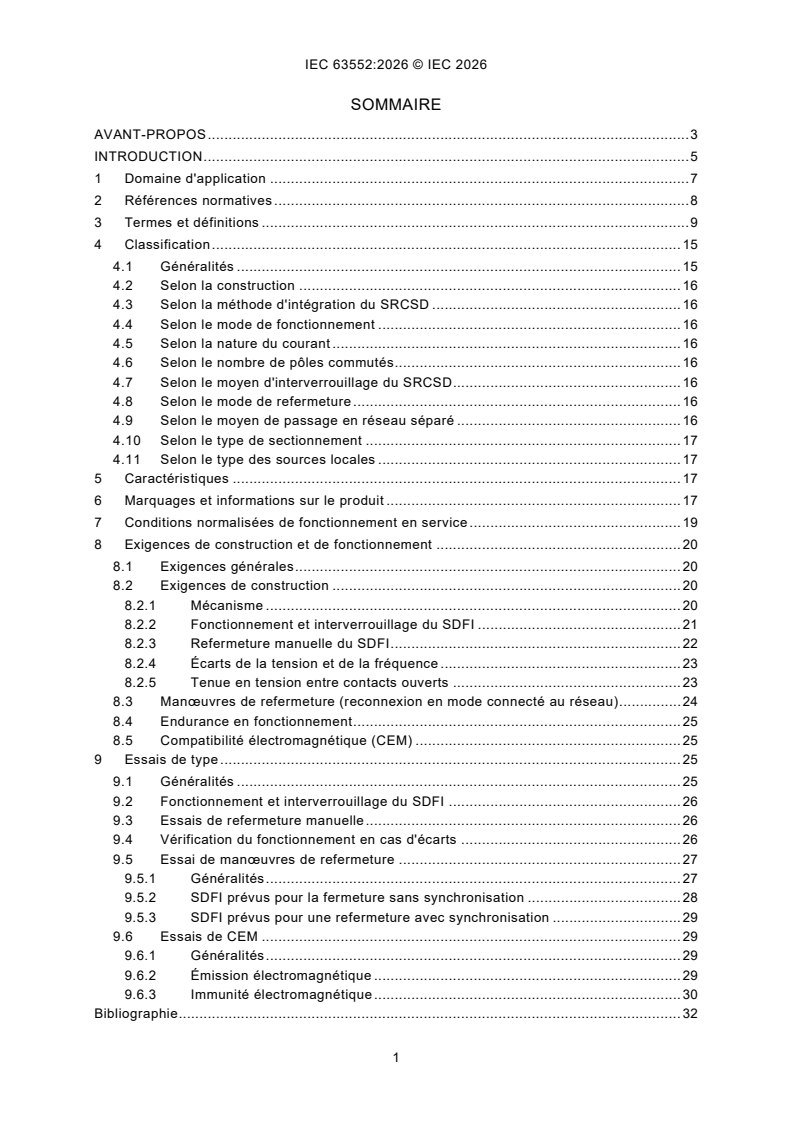
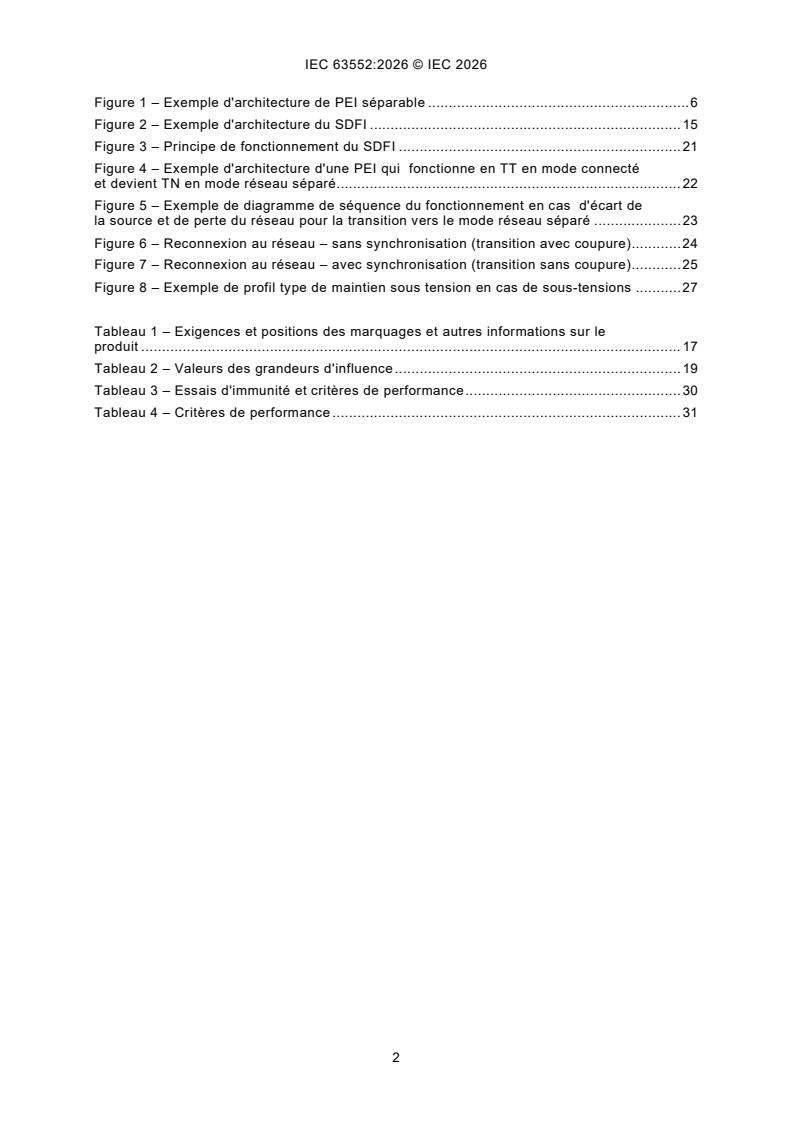
IEC 63552:2026 - Appareil de connexion pour le passage en réseau séparé (SDFI)
IEC 63552:2026 is an International Standard from IEC for switching device for islanding (SDFI) used in household and similar low-voltage prosumer electrical installations. It specifies how an SDFI disconnects an islandable PEI from the grid, operates in island mode, and reconnects it, for manufacturers, installers, test labs, and buyers of the device.
What does IEC 63552:2026 specify?
IEC 63552:2026 applies to SDFI for household and similar uses, mainly where local production or local storage of energy is used for energy efficiency (EE). The standard is aimed at low-voltage prosumer electrical installations (PEI) that can operate in island mode.
An SDFI is used to separate the PEI from the distribution network so the installation can run in island mode, then link it back to the grid. The scope covers AC single- or multiphase main circuits up to 440 V AC, at 50 Hz, 60 Hz, or 50/60 Hz, and installations with prospective short-circuit currents up to 25 000 A.
The document is organized into Clause 1 Scope, Clause 2 Normative references, Clause 3 Terms and definitions, Clause 4 Classification, Clause 5 Characteristics, Clause 6 Markings and product information, Clause 7 Standard conditions for operation in service, Clause 8 Requirements for construction and operation, and Clause 9 Type tests.
A few important limits are part of the scope. DC operation is not covered in this edition. The main overcurrent protective device of a dwelling or similar islandable PEI is not to be used as the SDFI. SDFI are part of the electrical installation, are installed by instructed or skilled persons, are used by ordinary persons, and do not require maintenance.
What are the key requirements of IEC 63552:2026?
IEC 63552:2026 focuses on how the SDFI is built, identified, and verified so it can switch safely between grid-connected mode and island mode. The key point for practice is that the manufacturer must declare the exact SDFI variant, and the tests and markings then follow that declaration.
Classification drives the design and verification
Clause 4 classifies SDFI by construction, integration of the system referencing conductor switching device (SRCSD), method of operation, kind of current, number of switched poles, interlocking means, reclosing mode, islanding means, isolation suitability, and type of local sources. In practice, this means a device based on switches is treated differently from one based on circuit-breakers, and an electrically controlled device is different from a manually controlled one.
Clause 4 also distinguishes open transition and closed transition reclosing. That matters because an open-transition SDFI must disconnect local sources before reclosing, while a closed-transition SDFI must reclose only when sources are synchronized.
The switching unit and control unit have different roles
Clause 5 treats the switching unit (SU) and control unit (CU) separately. The SU characteristics come from the relevant product standard for the chosen construction, while the CU and auxiliary circuits follow IEC 62991:2022, with additional requirements for voltage and frequency deviation limits and control-circuit ratings.
Clause 5 also requires the maximum number of operating cycles to be declared. The document gives preferred cycle counts and sets 4 000 as the requested minimum value. For users, this is the endurance figure to compare when selecting a device for frequent islanding and reconnection.
Markings and documentation must support safe installation
Clause 6 requires markings and product information to match the declared classification and Table 1. Key items include manufacturer identification, type designation, reference to the product standard, ratings, reclosing mode, isolation suitability, local-source suitability, wiring diagram, control-circuit data, and indication of source and load terminals.
This matters because installers need to wire the device correctly and panel builders need the right information when the SDFI is delivered as separate parts. Markings must be legible, durable, and indelible, and information for embedded functions covered by other standards must also be identified.
Service conditions are defined for normal installation use
Clause 7 gives the standard operating environment. It includes ambient temperature from -5 °C to +40 °C, altitude up to 2 000 m, relative humidity guidance, overvoltage category III, pollution degree 2, rated frequency tolerance, and sinusoidal wave distortion limits.
For a buyer or designer, this means the device is specified for ordinary indoor electrical installation conditions, not for every severe environment. If the site is hotter, higher, or more humid, additional measures may be needed.
Construction requirements focus on safe switching between modes
Clause 8 requires the SDFI to be safe for users and the environment, with reliable open and closed positions and reliable position indication locally and remotely. If the control supply is lost or restored, the contact position must not change unexpectedly.
If grid voltage is lost and the SDFI remains closed, the design must provide a way to disconnect all local sources. If the SDFI is interlocked with an SRCSD, simultaneous closing must be prevented. Manual reclosing is controlled differently depending on whether local sources include generators or only inverter-based sources.
Clause 8 also covers automatic islanding on voltage or frequency deviations, voltage withstand between open contacts, and reclosing. For synchronized reclosing, the SDFI may reclose only when voltage, frequency, and phase angle are within the declared limits, and the maximum reclosing time is 200 ms.
Type tests prove the declared behavior
Clause 9 defines the type tests that verify operation and interlocking, manual reclosing, response to source deviations, reclosing behavior, and EMC performance. The tests are performed on one sample, with the SU tested to the relevant product standard and with the control circuits connected as declared by the manufacturer.
For practical use, this is the evidence package for design validation, certification, and incoming product assessment. It checks that the SDFI opens when it should, does not recluse under unsafe conditions, and keeps correct contact status indication after each operation.
What terms does IEC 63552:2026 define?
- Switching device for islanding (SDFI) - A device dedicated to changing an islandable PEI from grid-connected mode to island mode and back again.
- Prosumer's electrical installation (PEI) - A low-voltage installation that can both use and produce electrical energy, with local supply or storage, or both.
- Islandable PEI - A PEI intended to operate either connected to the distribution network or disconnected from it.
- System referencing conductor switching device (SRCSD) - A device connected between the system referencing conductor and the local earthing arrangement of the PEI.
- Customer Energy Manager (CEM) - An internal automation function that optimizes energy consumption, production, and storage in the premises.
- Control unit (CU) - The part of the SDFI that manages switching operations, including operating means and related control functions.
- Closed transition - A make-before-break transfer where two synchronized sources are briefly connected in parallel.
- Open transition - A break-before-make transfer where one source is disconnected before the other is connected.
Who uses IEC 63552:2026?
IEC 63552:2026 is used by manufacturers of SDFI, switches, circuit-breakers, and control units for islandable PEI. It is also used by panel builders and installers who assemble or wire these devices in distribution boards.
Testing and certification laboratories use it for type testing, especially for operation, interlocking, reclosing, and EMC verification. Buyers, specifiers, and quality managers use it to compare declared device types, ratings, markings, and service conditions before selecting equipment for a project.
It is also relevant to designers of PEI, energy management systems, and interface protection arrangements, because the SDFI must work with the broader islanding architecture and any declared SRCSD or control system.
Which standards are used with IEC 63552:2026?
IEC 63552:2026 is built around IEC 60364-8-82, which defines the PEI context, island mode, and the role of the SDFI. IEC 63445:2025 contributes the requirements for the SRCSD and the interlocking and test provisions that the SDFI must coordinate with.
IEC 62991:2022 provides the source switching equipment framework used for the CU and auxiliary circuit characteristics, and IEC TS 62786-1:2023 is used for interface protection and interface switch context. IEC 63402-1:2025 and the IEC 63402 series are referenced for the Customer Energy Manager and Energy Management Gateway functions.
For the switching unit, IEC 63552:2026 points to IEC 60669-2-4, IEC 60898-1, IEC 60898-2, IEC 60947-2, IEC 60947-3, and IEC 60947-10, depending on construction. For EMC and immunity, it uses CISPR 14-1 and IEC 61000-4-2, -3, -4, -5, -6, -8, and -11, with IEC 61000-6-1 as the residential, commercial, and light-industrial immunity context.
What does the IEC 63552:2026 document contain?
The document includes an example architecture of an islandable PEI, an SDFI architecture, operation principle figures, and sequence diagrams for deviation-triggered islanding and grid reconnection. It also includes tables for markings and product information, service-condition values, and EMC immunity tests and performance criteria.
Those tables and figures support design review, installation instructions, conformity assessment, and test setup. They show how the SDFI sits in the PEI, what information must appear on the product and in documentation, and how the declared functions are verified in type tests.
Buy Documents
IEC 63552:2026 - Switching device for islanding (SDFI)
IEC 63552:2026 - Appareil de connexion pour le passage en réseau séparé (SDFI)
Get Certified
Connect with accredited certification bodies for this standard

DNV
DNV is an independent assurance and risk management provider.

Lloyd's Register
Lloyd's Register is a global professional services organisation specialising in engineering and technology.
DNV Energy Systems
Energy and renewable energy certification.
Sponsored listings
Frequently Asked Questions
IEC 63552:2026 is a standard published by the International Electrotechnical Commission (IEC). Its full title is "Switching device for islanding (SDFI)". This standard covers: IEC 63552:2026 applies to switching device for islanding, hereafter referred to as SDFI, for household and similar uses, primarily intended to be used for energy efficiency (EE) purposes with local production or local storage of energy, or with both. SDFI are intended to be installed in low voltage prosumer electrical installations (PEI) able to operate in island mode as defined in IEC 60364-8-82, so called islandable PEI. SDFI are used to disconnect the PEI from the grid to allow operating the PEI in island mode and further reconnect the PEI to the grid.
IEC 63552:2026 applies to switching device for islanding, hereafter referred to as SDFI, for household and similar uses, primarily intended to be used for energy efficiency (EE) purposes with local production or local storage of energy, or with both. SDFI are intended to be installed in low voltage prosumer electrical installations (PEI) able to operate in island mode as defined in IEC 60364-8-82, so called islandable PEI. SDFI are used to disconnect the PEI from the grid to allow operating the PEI in island mode and further reconnect the PEI to the grid.
IEC 63552:2026 is classified under the following ICS (International Classification for Standards) categories: 27.015 - Energy efficiency. Energy conservation in general; 29.020 - Electrical engineering in general. The ICS classification helps identify the subject area and facilitates finding related standards.
IEC 63552:2026 is available in PDF format for immediate download after purchase. The document can be added to your cart and obtained through the secure checkout process. Digital delivery ensures instant access to the complete standard document.
Standards Content (Sample)
IEC 63552 ®
Edition 1.0 2026-06
INTERNATIONAL
STANDARD
Switching device for islanding (SDFI)
ICS 27.015; 29.020 ISBN 978-2-8327-1264-1
All rights reserved. Unless otherwise specified, no part of this publication may be reproduced or utilized in any form or
by any means, electronic or mechanical, including photocopying and microfilm, without permission in writing from either
IEC or IEC's member National Committee in the country of the requester. If you have any questions about IEC copyright
or have an enquiry about obtaining additional rights to this publication, please contact the address below or your local
IEC member National Committee for further information.
IEC Secretariat Tel.: +41 22 919 02 11
3, rue de Varembé info@iec.ch
CH-1211 Geneva 20 www.iec.ch
Switzerland
About the IEC
The International Electrotechnical Commission (IEC) is the leading global organization that prepares and publishes
International Standards for all electrical, electronic and related technologies.
About IEC publications
The technical content of IEC publications is kept under constant review by the IEC. Please make sure that you have the
latest edition, a corrigendum or an amendment might have been published.
IEC publications search - IEC Products & Services Portal - products.iec.ch
webstore.iec.ch/advsearchform Discover our powerful search engine and read freely all the
The advanced search enables to find IEC publications by a publications previews, graphical symbols and the glossary.
variety of criteria (reference number, text, technical With a subscription you will always have access to up to date
committee, …). It also gives information on projects, content tailored to your needs.
replaced and withdrawn publications.
Electropedia - www.electropedia.org
The world's leading online dictionary on electrotechnology,
IEC Just Published - webstore.iec.ch/justpublished
Stay up to date on all new IEC publications. Just Published containing more than 22 500 terminological entries in English
details all new publications released. Available online and and French, with equivalent terms in 25 additional languages.
once a month by email. Also known as the International Electrotechnical Vocabulary
(IEV) online.
IEC Customer Service Centre - webstore.iec.ch/csc
If you wish to give us your feedback on this publication or
need further assistance, please contact the Customer
Service Centre: sales@iec.ch.
CONTENTS
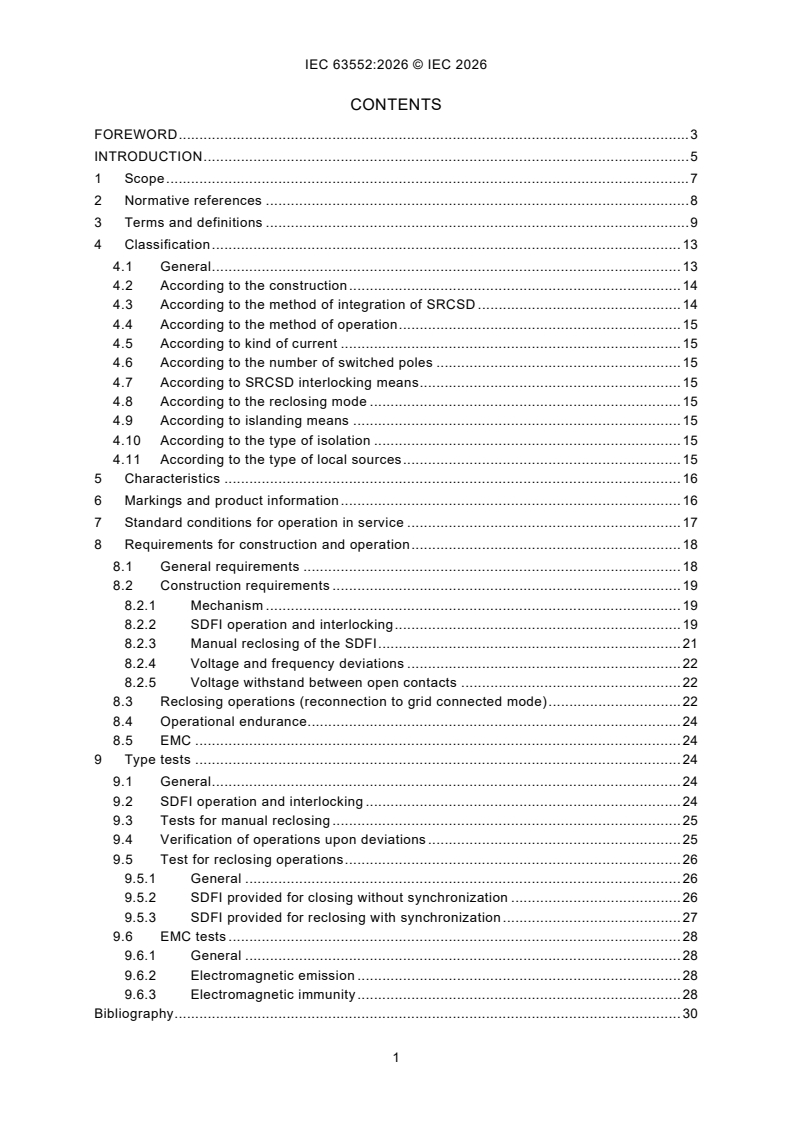
FOREWORD . 3
INTRODUCTION . 5
1 Scope . 7
2 Normative references . 8
3 Terms and definitions . 9
4 Classification . 13
4.1 General . 13
4.2 According to the construction . 14
4.3 According to the method of integration of SRCSD . 14
4.4 According to the method of operation . 15
4.5 According to kind of current . 15
4.6 According to the number of switched poles . 15
4.7 According to SRCSD interlocking means . 15
4.8 According to the reclosing mode . 15
4.9 According to islanding means . 15
4.10 According to the type of isolation . 15
4.11 According to the type of local sources . 15
5 Characteristics . 16
6 Markings and product information . 16
7 Standard conditions for operation in service . 17
8 Requirements for construction and operation . 18
8.1 General requirements . 18
8.2 Construction requirements . 19
8.2.1 Mechanism . 19
8.2.2 SDFI operation and interlocking . 19
8.2.3 Manual reclosing of the SDFI . 21
8.2.4 Voltage and frequency deviations . 22
8.2.5 Voltage withstand between open contacts . 22
8.3 Reclosing operations (reconnection to grid connected mode) . 22
8.4 Operational endurance . 24
8.5 EMC . 24
9 Type tests . 24
9.1 General . 24
9.2 SDFI operation and interlocking . 24
9.3 Tests for manual reclosing . 25
9.4 Verification of operations upon deviations . 25
9.5 Test for reclosing operations . 26
9.5.1 General . 26
9.5.2 SDFI provided for closing without synchronization . 26
9.5.3 SDFI provided for reclosing with synchronization . 27
9.6 EMC tests . 28
9.6.1 General . 28
9.6.2 Electromagnetic emission . 28
9.6.3 Electromagnetic immunity . 28
Bibliography . 30
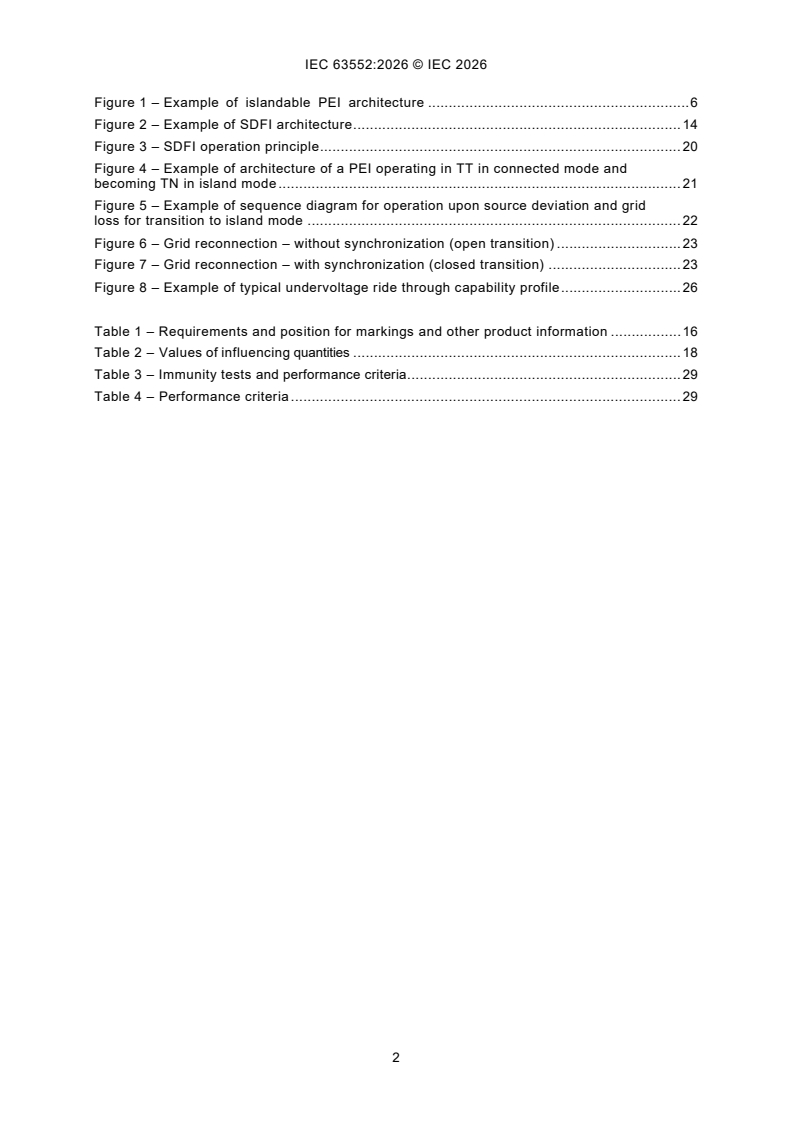
Figure 1 – Example of islandable PEI architecture . 6
Figure 2 – Example of SDFI architecture . 14
Figure 3 – SDFI operation principle . 20
Figure 4 – Example of architecture of a PEI operating in TT in connected mode and
becoming TN in island mode . 21
Figure 5 – Example of sequence diagram for operation upon source deviation and grid
loss for transition to island mode . 22
Figure 6 – Grid reconnection – without synchronization (open transition) . 23
Figure 7 – Grid reconnection – with synchronization (closed transition) . 23
Figure 8 – Example of typical undervoltage ride through capability profile . 26
Table 1 – Requirements and position for markings and other product information . 16
Table 2 – Values of influencing quantities . 18
Table 3 – Immunity tests and performance criteria . 29
Table 4 – Performance criteria . 29
INTERNATIONAL ELECTROTECHNICAL COMMISSION
____________
Switching device for islanding (SDFI)
FOREWORD
1) The International Electrotechnical Commission (IEC) is a worldwide organization for standardization comprising
all national electrotechnical committees (IEC National Committees). The object of IEC is to promote international
co-operation on all questions concerning standardization in the electrical and electronic fields. To this end and
in addition to other activities, IEC publishes International Standards, Technical Specifications, Technical Reports,
Publicly Available Specifications (PAS) and Guides (hereafter referred to as "IEC Publication(s)"). Their
preparation is entrusted to technical committees; any IEC National Committee interested in the subject dealt with
may participate in this preparatory work. International, governmental and non-governmental organizations liaising
with the IEC also participate in this preparation. IEC collaborates closely with the International Organization for
Standardization (ISO) in accordance with conditions determined by agreement between the two organizations.
2) The formal decisions or agreements of IEC on technical matters express, as nearly as possible, an international
consensus of opinion on the relevant subjects since each technical committee has representation from all
interested IEC National Committees.
3) IEC Publications have the form of recommendations for international use and are accepted by IEC National
Committees in that sense. While all reasonable efforts are made to ensure that the technical content of IEC
Publications is accurate, IEC cannot be held responsible for the way in which they are used or for any
misinterpretation by any end user.
4) In order to promote international uniformity, IEC National Committees undertake to apply IEC Publications
transparently to the maximum extent possible in their national and regional publications. Any divergence between
any IEC Publication and the corresponding national or regional publication shall be clearly indicated in the latter.
5) IEC itself does not provide any attestation of conformity. Independent certification bodies provide conformity
assessment services and, in some areas, access to IEC marks of conformity. IEC is not responsible for any
services carried out by independent certification bodies.
6) All users should ensure that they have the latest edition of this publication.
7) No liability shall attach to IEC or its directors, employees, servants or agents including individual experts and
members of its technical committees and IEC National Committees for any personal injury, property damage or
other damage of any nature whatsoever, whether direct or indirect, or for costs (including legal fees) and
expenses arising out of the publication, use of, or reliance upon, this IEC Publication or any other IEC
Publications.
8) Attention is drawn to the Normative references cited in this publication. Use of the referenced publications is
indispensable for the correct application of this publication.
9) IEC draws attention to the possibility that the implementation of this document may involve the use of (a)
patent(s). IEC takes no position concerning the evidence, validity or applicability of any claimed patent rights in
respect thereof. As of the date of publication of this document, IEC had not received notice of (a) patent(s), which
may be required to implement this document. However, implementers are cautioned that this may not represent
the latest information, which may be obtained from the patent database available at https://patents.iec.ch. IEC
shall not be held responsible for identifying any or all such patent rights.
IEC 63552 has been prepared by subcommittee 23K: Electrical energy efficiency products, of
IEC technical committee 23: Electrical accessories. It is an International Standard.
The text of this International Standard is based on the following documents:
Draft Report on voting
23K/133/FDIS 23K/135/RVD
Full information on the voting for its approval can be found in the report on voting indicated in
the above table.
The language used for the development of this International Standard is English.
This document was drafted in accordance with ISO/IEC Directives, Part 2, and developed in
accordance with ISO/IEC Directives, Part 1 and ISO/IEC Directives, IEC Supplement, available
at www.iec.ch/members_experts/refdocs. The main document types developed by IEC are
described in greater detail at www.iec.ch/publications.
In this document, the following print types are used:
– conformity statements: in italic type.
The committee has decided that the contents of this document will remain unchanged until the
stability date indicated on the IEC website under webstore.iec.ch in the data related to the
specific document. At this date, the document will be
– reconfirmed,
– withdrawn, or
– revised.
INTRODUCTION
IEC 60364-8-82 aims to ensure that low-voltage electrical installations are compatible with both
current and future methods for safely and effectively delivering electrical energy to current-
using equipment, regardless of whether the energy comes from Distribution System Operator
(DSO) or local generation. IEC 60364-8-82 provides requirements and recommendations for to
low-voltage electrical installations, whether or not they are connected to a distribution network,
and are capable of operating:
– with either local power supplies,
– or with local storage units,
– or with both,
and that monitors and controls the energy from the locally connected sources delivering it to:
– either current-using equipment,
– or local storage units,
– or distribution networks.
Such electrical installations are designated as prosumer's electrical installations (PEIs) by
IEC 60364-8-82 which defines specific devices (or functions) to ensure the correct and safe
operation of PEI depending on their operating mode. In the case of an islandable PEI,
IEC 60364-8-82 defines a "Switching Device For islanding (SDFI)", identified as device 4 in
Figure 1.
Key
1 Distribution network 8 Non-sheddable loads (sensitive loads)
2 Point of connection (POC) 9 Sheddable loads (adjustable loads)
3 Main switching device 10 Solar generator
4 Switching device for islanding (SDFI) 11 Electrical energy storage system
5 System referencing conductor switching device 12 Other generator (wind, etc.)
6 Source switching device 13 Main distribution board
7 Load switching device
SOURCE: IEC 60364-8-82:2022, Figure 4.
Figure 1 – Example of islandable PEI architecture
The objectives of this document is to define the functions, requirements and tests of a SDFI in
line with the requirements stated in IEC 60364-8-82.
1 Scope
This document applies to switching device for islanding, hereafter referred to as SDFI, for
household and similar uses, primarily intended to be used for energy efficiency (EE) purposes
with local production or local storage of energy, or with both.
SDFI are intended to be installed in low voltage prosumer electrical installations (PEI) able to
operate in island mode as defined in IEC 60364-8-82, so called islandable PEI.
SDFI are used to disconnect the PEI from the grid to allow operating the PEI in island mode
and further reconnect the PEI to the grid.
They are intended to be used in islandable PEI which operate:
– in connected mode (direct feeding mode or reverse feeding mode), and
– in island mode,
as defined in IEC 60364-8-82.
NOTE 1 See definitions 3.10 and 3.13 of island mode and for connected mode respectively.
NOTE 2 Switching of a PEI to island mode can be subject to local regulations (grid codes) or to specific agreement
with system operators. Reverse feeding is also usually subject to local regulations (grid codes).
SDFI are part of the electrical installation.
This document applies to SDFI for operation in AC single or multiphase main circuits with rated
voltages not exceeding 440 V AC, frequencies of 50 Hz, 60 Hz or 50/60 Hz. They are intended
to be used in installations with prospective short circuit currents not exceeding 25 000 A.
NOTE 3 DC operations are not covered by this edition and are kept under consideration for a future revision of this
document.
The SDFI is composed at least of one switching unit (SU) and a control unit (CU) to monitor its
switching operations from grid connected to island mode and reverse wise.
The SDFI can be provided with a communication interface for exchange with external systems
such as the Customer Energy Manager (CEM) defined in IEC 63402 series.
According to the intended use, the SDFI can be interlocked with a system referencing conductor
switching device (SRCSD) according to IEC 63445 or it can be integrated with a SRCSD in a
single unit.
NOTE 4 According to its intended use, the SDFI can also be used as an interface switch with the interface protection
(integrated or not). See 3.19 and 3.20.
SDFI are intended for use in circuits where protection against electrical shock and overcurrent
is provided according to installation rules for low voltage electrical installations, unless the SDFI
already contains such protective function. SDFI are not requested to provide isolation function
and overcurrent protection according to IEC 60364-8-82. However, the isolation function can
be provided by a SDFI fulfilling the requirements of the relevant product standards.
SDFI are installed by instructed persons (IEC 60050-195:2021, 195-04-02) or skilled persons
(IEC 60050-195:2021, 195-04-01). They are intended to be used by ordinary persons
(IEC 60005-195:2021, 195-04-03) and do not require maintenance.
It is important to note that the main overcurrent protective device of installations cannot be used
as a SDFI in single dwellings or similar islandable PEI (see Clause D.5 of IEC 60364-8-82:2022)
2 Normative references
The following documents are referred to in the text in such a way that some or all of their content
constitutes requirements of this document. For dated references, only the edition cited applies.
For undated references, the latest edition of the referenced document (including any
amendments) applies.
IEC 60364-8-82:2022, Low-voltage electrical installations - Part 8-82: Functional aspects -
Prosumer's low-voltage electrical installations
IEC 60669-2-4, Switches for household and similar fixed electrical installations - Part 2-4:
Particular requirements - Isolating switches
IEC 60898-1:2015, Electrical accessories - Circuit-breakers for overcurrent protection for
household and similar installations - Part 1: Circuit-breakers for a.c. operation
IEC 60898-2, Electrical accessories - Circuit-breakers for overcurrent protection for household
and similar installations - Part 2: Circuit-breakers for AC and DC operation
IEC 60947-2, Low-voltage switchgear and controlgear - Part 2: Circuit-breakers
IEC 60947-3, Low-voltage switchgear and controlgear - Part 3: Switches, disconnectors, switch-
disconnectors and fuse-combination units
IEC 60947-10, Low-voltage switchgear and controlgear - Part 10: Semiconductor circuit-
breakers
IEC 61000-4-2, Electromagnetic compatibility (EMC) - Part 4-2: Testing and measurement
techniques - Electrostatic discharge immunity test
IEC 61000-4-3, Electromagnetic compatibility (EMC) - Part 4-3: Testing and measurement
techniques - Radiated, radio-frequency, electromagnetic field immunity test
IEC 61000-4-4, Electromagnetic compatibility (EMC) - Part 4-4: Testing and measurement
techniques - Electrical fast transient/burst immunity test
IEC 61000-4-5, Electromagnetic compatibility (EMC) - Part 4-5: Testing and measurement
techniques - Surge immunity test
IEC 61000-4-6, Electromagnetic compatibility (EMC) - Part 4-6: Testing and measurement
techniques - Immunity to conducted disturbances, induced by radio-frequency fields
IEC 61000-4-8, Electromagnetic compatibility (EMC) - Part 4-8: Testing and measurement
techniques - Power frequency magnetic field immunity test
IEC 61000-4-11, Electromagnetic compatibility (EMC) - Part 4-11: Testing and measurement
techniques - Voltage dips, short interruptions and voltage variations immunity tests for
equipment with input current up to 16 A per phase
IEC 61000-6-1, Electromagnetic compatibility (EMC) - Part 6-1: Generic standards - Immunity
standard for residential, commercial and light-industrial environments
___________
Under preparation. Stage at the time of publication: IEC FDIS 60947-10:2025.
IEC 62991:2022, Particular requirements for source switching equipment (SSE)
IEC 63445:2025, System referencing conductor switching device
CISPR 14-1, Electromagnetic compatibility - Requirements for household appliances, electric
tools and similar apparatus - Part 1: Emission
3 Terms and definitions
For the purposes of this document, the following terms and definitions apply.
ISO and IEC maintain terminology databases for use in standardization at the following
addresses:
– IEC Electropedia: available at https://www.electropedia.org/
– ISO Online browsing platform: available at https://www.iso.org/obp
3.1
electrical energy management system
EEMS
system monitoring, operating, controlling and managing energy resources and loads of the
installations
Note 1 to entry: The EEMS can be a dedicated system or part of an integrated system, such as a home and building
electronic system (HBES) or building management system (BMS or BACS) or other similar management system.
[SOURCE: IEC 60364-8-82:2022, 82.3.7]
3.2
Customer Energy Manager
CEM
internal automation function for optimizing the energy consumption, production and storage
within the premises according to the preferences of the customer using internal flexibilities and
typically based on external information received through the Energy Management Gateway and
possibly other data sources
Note 1 to entry: A EEMS as defined in 3.1 of this document and in 3.2.1 of IEC 60364-8-1:2019 provides the same
function as a CEMS except that the EEMS is limited to electrical energy management.
[SOURCE: IEC 63402-1:2025, 3.1.1, modified – Note 1 to entry added.]
3.3
Energy Management Gateway
EMG
access point (functional entity) sending and receiving smart grid related information and
commands between an actor in the grid and the CEM, letting the CEM decide how to process
the events
Note 1 to entry: The communication is often ensured through an internet connection.
[SOURCE: IEC 63402-1:2025, 3.1.3]
3.4
switching device for islanding
SDFI
device dedicated to the change from grid connected mode to island mode and from island mode
to connected mode for an islandable PEI, functionally speaking, to separate/link the local
sources from/to the distribution network
Note 1 to entry: See also 3.20.
[SOURCE: IEC 60364-8-82:2022, 1st paragraph of 82.6.3.4.3]
3.5
system referencing conductor switching devices
SRCSD
device connected between the system referencing conductor and the local earthing
arrangement of the PEI
[SOURCE: IEC 63445:2025, 3.3]
3.6
source switching equipment
SSE
equipment able to select (power) sources when certain conditions are met or following human
intervention
Note 1 to entry: For example, SSE for back-up applications may contain one or more switching devices and all
associated control means for disconnecting load circuits from one source and reconnecting them to another source
when certain conditions are met.
Note 2 to entry: For example, SSE for grid connected PEI defined in IEC 60364-8-82:2022 may contain one or more
switching devices and associated control means for switching load circuits from one normal source to another source,
when certain conditions are met, maintaining the loads always energized.
[SOURCE: IEC 62991:2022, 3.1.28]
3.7
prosumer
entity or party which can be both a producer and a consumer of electrical energy
[SOURCE: IEC 60364-8-82:2022, 82.3.5]
3.8
prosumer's electrical installation
PEI
low-voltage electrical installation connected or not to a distribution network able to operate:
– with local power supplies, and/or
– with local storage units,
and that monitors and controls the energy from the connected sources delivering it to:
– current-using equipment, and/or
– local storage units, and/or
– distribution network.
[SOURCE: IEC 60364-8-82:2022, 82.3.6]
3.9
islandable PEI
PEI intended for operating either being connected to a distribution network or being
disconnected from the distribution network
Note 1 to entry: An islandable PEI is in a connected mode or an intentionally island mode.
[SOURCE: IEC 60364-8-82:2022, 82.3.15]
3.10
island mode
operating mode in which the PEI is disconnected from the distribution network
Note 1 to entry: An island mode can be either the result of the action of automatic protections or the result of a
deliberate action.
[SOURCE: IEC 60050-692:2017, 692-02-11, modified – The term "electric island" has been
replaced with "island mode", the definition has been adapted to the PEI and Note 2 to entry has
been deleted.]
3.11
direct feeding mode
operating mode in which the distribution network supplies the PEI
Note 1 to entry: Local storage units can supply current-using equipment or be charged by local power supplies
and/or the distribution system.
[SOURCE: IEC 60364-8-82:2022, 82.3.9]
3.12
reverse feeding mode
operating mode in which the PEI supplies the distribution network
Note 1 to entry: Local storage units can supply current-using equipment and/or the distribution system or be
charged by local power supplies.
[SOURCE: IEC 60364-8-82:2022, 82.3.10]
3.13
connected mode
operating mode in which the PEI is connected to the distribution network
EXAMPLE Direct feeding mode, reverse feeding mode or no feeding mode (i.e. without any energy exchange
between the PEI and the distribution network).
[SOURCE: IEC 60364-8-82:2022, 82.3.11]
3.14
interlock
means to prevent simultaneous closing of SRCSD and SDFI,
under all conditions
[SOURCE: IEC 63445:2025, 3.11]
3.15
synchronization
condition of an electrical system intentionally allowing the connection of two voltage sources in
parallel for a short duration
Note 1 to entry: The local power source when set in grid forming mode is a voltage source.
[SOURCE: IEC 62991:2022, 3.1.17, modified – Replacing "different power" with "voltage",
addition of "condition of an" in the definition and addition of Note 1 to entry.]
3.16
open transition
break before make transfer operation that intentionally breaks the load current from one source
for a period of time prior to making it to the other source
Note 1 to entry: SSE with open transition may operate with a time delay e.g. for power backup application.
[SOURCE: IEC 60947-6-1:2021, 3.4.7, modified – Note 1 to entry has been added.]
3.17
closed transition
make before break transfer operation that intentionally makes the load current of a second
synchronized source for a short period of time before breaking it from the first source
[SOURCE: IEC 60947-6-1:2021, 3.4.9]
3.18
isolation
isolating function
function intended to cut off the supply from all or a discrete section of the installation by
separating the installation from every source of electrical energy for reasons of safety
[SOURCE: IEC 60898-1:2015, 3.6.10]
3.19
interface protection
combination of protection relay functions which open the interface switch of a generating unit
and prevents its closure, whichever is appropriate, in the case of:
– a fault on the electric power distribution network;
– an unintentional islanding situation;
– voltage and/or frequency being outside the tolerance of their operating ranges for
continuous operation.
[SOURCE: IEC TS 62786-1:2023, 3.1.14, modified - "distribution" added in the first indent.]
3.20
interface switch
switch (circuit breaker, switch or contactor) installed in the prosumer's electrical installation, for
separating the part(s) of the prosumer's electrical installation that contains at least one
generation unit from the network
Note 1 to entry: See also Figure 1 of IEC TS 62786-1:2023.
Note 2 to entry: In some situations, the interface switch can be used to enable island operation of part of the
prosumer's electrical installation, if technically feasible.
[SOURCE: IEC TS 62786-1:2023, 3.1.33, modified - Reference to the IEC standard adding and
replaced "producer's network" by "prosumer's electrical installation".]
3.21
voltage source deviation
change in voltage level from the nominal voltage of the monitored source
Note 1 to entry: In this document, the term is often used stating only the term "source deviation".
[SOURCE: IEC 60947-6-1:2021, 3.4.3, modified – Replacing "supply" by "source" and adding
the note.]
3.22
frequency source deviation
change in frequency from the nominal operating frequency of the monitored source
Note 1 to entry: In this document, the term is often used stating only the term "source".
[SOURCE: IEC 60947-6-1:2021, 3.4.4, modified – Replacing "supply" by "source" and adding
the note.]
3.23
point of connection
POC
reference point where the prosumer's electrical installation is connected to the distribution
network
Note 1 to entry: A PEI can have several points of connection for resilience.
Note 2 to entry: In IEC 60364 (all parts), the concept of origin of the installation is also used, origin of the installation
meaning the point at which energy is delivered to the electrical installation. The POC is a specific origin of the
installation, the one connected to the distribution network. Other origins of the installation can be the connection to
the local power supply, to the storage system.
Note 3 to entry: Connection or disconnection of the prosumer electrical installation from the distribution network
generally occurs at the POC.
[SOURCE: IEC 60050-617:2009, 617-04-01 modified – The definition has been adapted to the
PEI and the notes to entry have been added.]
3.24
control unit
all part(s) intended for managing the operation(s) of the switching unit (of the
SDFI) including the operating means
Note 1 to entry: Depending on the type of SDFI, the control unit may include different features such as manual
operating means, sensing, interlock, synchronization, control of settings, etc. For the purposes of this document,
control means do not include means intended for purposes other than controls, e.g. local or remote signalling.
[SOURCE: IEC 62991:2020, 3.1.35, modified – replacing "SSE" by "SDFI" in the definition and
in the note, and removing notes 2, 3 and 4.]
4 Classification
4.1 General
The architecture of the SDFI is shown Figure 2.
Key
1 Switching device for islanding (SDFI) 6 Electrical Energy Management (EEM) or the
Customer Energy Manager (CEM)
2 Control unit (CU)
7 Grid
3 Switching unit (SU)
8 Local source(s)
4 System referencing conductor switching device
(SRCSD) 9 Loads
5 Interlock (of the SRCSD with SDFI) 10 Earth
Figure 2 – Example of SDFI architecture
The control unit (CU) with or without sensing means (also called measurement circuits).
The sensing means can be part of the SDFI (e.g. part of the control unit) or the overall CEM
system (CEMS or EEMS).
According to this document, the CU is supposed to integrate control means for the operations
(e.g. synchronization check before reclosing) and the interlock with the SRCSD.
The control unit, sensing unit and any connecting accessories can be delivered assembled
together in the factory with the switching unit or assembled on site.
The switching unit (SU) allows the islanding and reconnecting operations in safe conditions as
requested in IEC 60364-8-82. This can require the interlocking with an SRCSD according to
IEC 60364-8-82.
The SDFI shall be classified according to 4.2 to 4.11.
4.2 According to the construction
SDFI with a switching unit (SU) based on:
– switches complying with the IEC 60669-2-4 or IEC 60947-3;
– circuit-breakers complying with IEC 60898-1, IEC 60898-2, IEC 60947-2 or IEC 60947-10.
4.3 According to the method of integration of SRCSD
– SDFI with the SRCSD not integrated in a single device;
– SDFI with the SRCSD integrated in a single device.
NOTE SDFI can be based on separate devices or with all devices assembled together into a single device but with
the switching unit based on 4.2. See Figure 2.
4.4 According to the method of operation
– electrically controlled: SDFI with an integrated control unit (CU) for managing its switching
operations. This may or may not include automatic islanding function upon voltage or
frequency deviations;
– manually (non-electrically) controlled;
– or both electrically controlled and manually (non-electrically) controlled.
When manual mode is available and if the SDFI is used as the interface switch, it shall be
ensured that the manual mode does not prevent the SDFI from opening upon orders received
from the interface protection.
NOTE The SDFI can also have communication interfaces for SDFI remotely controlled by the CEM.
4.5 According to kind of current
– for AC use;
– for DC use (under consideration).
4.6 According to the number of switched poles
– two-pole SDFI;
– three-pole SDFI;
– four-pole SDFI.
4.7 According to SRCSD interlocking means
– SDFI without interlocking;
– SDFI with mechanical or electrical interlocking means.
NOTE When the SDFI is integrated with the SRCSD according to 4.1 in a single device, the interlock is also
integrated.
4.8 According to the reclosing mode
– SDFI without synchronization (open transition);
– SDFI with synchronized reclosing (closed transition).
4.9 According to islanding means
– SDFI without automatic islanding means;
– SDFI with automatic islanding means.
NOTE Operation of the SDFI with automatic islanding means is based on voltage and frequency source deviations.
4.10 According to the type of isolation
– SDFI not suitable for isolation;
– SDFI suitable for isolation.
NOTE IEC 60364-8-82:2022 does not require isolation for the SDFI.
4.11 According to the type of local sources
– SDFI suitable for use with inverter-based sources only (i.e. excluding generators);
– SDFI suitable for use with any kind of local sources including generators.
5 Characteristics
The characteristics of the switching unit of an SDFI are covered by:
– IEC 60669-2-4 or IEC 60947-3 for SDFI based on switches;
– IEC 60898-1, IEC 60898-2, IEC 60947-2 or IEC 60947-10 for SDFI based on circuit-
breakers.
The characteristics of the control unit and auxiliary circuits are covered by IEC 62991:2022,
5.4.
In addition, the following characteristics apply to the control unit and auxiliary circuits:
– the voltage and frequency deviation limits;
– the characteristics of control circuits and auxiliary circuits (e.g. rated voltage and currents,
limits) if any.
The maximum number of operating cycles shall be declared. The preferred number of operating
cycles is: 4 000, 6 000, 12 000 and 25 000, where 4 000 is the requested minimum value.
6 Markings and product information
Identification of the SDFI shall comply with relevant IEC product standards according to
manufacturer's declaration based on Clause 4 and relevant items of Table 1.
Table 1 – Requirements and position for markings and other product information
a a a
Marking or information item Markings Documentation
b
a Manufacturer's name or trademark
V X
b
b Type designation, catalogue number or serial number
V X
c Reference to product standard X X
d Method of construction (4.2) X
e Method of SRCSD integration (4.3) X
f Method of operation (4.4) X
g Number of switched poles (4.6) X
h Method for SRCSD interlocking (4.7) X
i Reclosing mode (4.8) X
j Type of islanding means (4.9) X
k Suitability for isolation (4.10) X
l SDFI suitability with local sources (4.11) X
c
m Rated voltage(s) and symbol for nature of supply(ies) X
X
c
n Rated frequency(ies) X
X
o Voltage and frequency source deviations, phase angle(s)
X
limits, if applicable
p Rated current(s) (I )
X
n
q Rated making and breaking capacity in amperes (I )
X
m
r Rated conditional short circuit current (I )
X
nc
s SCPD characteristics X
t Utilization categories and corresponding current(s), if
X
applicable
a a a
Marking or information item Markings Documentation
u Number of operating cycles (Clause 5) X
v Reclosing time delay, if applicable X
w Rated impulse withstand voltage X
x Degree of protection X
y Position and orientation of use, if necessary X
z Indication of switch(es) positions X
c
aa Wiring diagram, unless correct connection mode is evident X
X
ab Length of insulation to be removed before the insertion of
c
the conductor into the screwless type terminal, if X X
applicable
ac Type of terminals and symbol "r" for the suitability to
c
X
X
accept rigid conductors only
ad Rated control circuit supply voltage(s), rated control circuit
b
supply current(s), rated control circuit supply frequency
V X
and symbol for the nature of the supply, as applicable
X: applies. V: visible once installed.
a
Apply to the control unit and other auxiliaries (e.g. interlock), as relevant. For the switching unit, requirements
for markings and documentation as defined in the relevant IEC product standard apply according to the method
of construction (see 4.2)
b
If, for small devices, the available space is insufficient, these markings may not be visible.
c
Markings apply specifically to the control unit and to the interlock, if provided (see 4.7)
If the SDFI is provided with embedded functions or units covered by other standards,
identification of such functions shall comply with the relevant IEC product standard according
to Clause 4. Relevant standards shall be stated by manufacturers in the technical
documentation.
Correct indication of the terminals for the source and load sides shall be provided, e.g. "in" and
"out"(standing for input and output terminals), or "source" and "load", etc.
If the SDFI is delivered as individual devices to be assembled together on site when integrated
in a distribution board (e.g. by the installer or the panel builder), all relevant information for the
assembling and the characteristics of the different units shall be provided by the manufacturer
for proper assembling and commissioning to ensure the correct operation of the SDFI.
Markings shall be easily legible, durable and indelible. They shall not be placed on screws,
washers or other removable parts.
Compliance is checked by inspection and by the tests of 9.3 of IEC 63445:2025. Markings made
by impression, moulding, engraving or laser printing are not subject to this test.
7 Standard conditions for operation in service
SDFI shall be capable of operating under the standard conditions of Table 2. Additional
requirements can be necessary for devices intended for use in locations having more severe
environmental conditions.
Table 2 – Values of influencing quantities
f
Influencing quantity Preferred range of application Reference value
Test tolerances
a g b
20 °C ±5 °C
Ambient temperature -5 °C to +40 °C
c
Altitude
Not exceeding 2 000 m
d
Relative humidity maximum
50 %
value at 40 °C
Position As stated by the manufacturer with a As stated by the 2 ° in any direction
e
manufacturer
tolerance of 5 ° in any direction
Overvoltage category and OVC III - Pollution degree 2
pollution degree
f
Frequency Rated value ±2 %
Reference value ±5 %
Sinusoidal wave distortion Not exceeding 5 % Zero 5 %
a
The maximum value of the mean daily temperature is +35 °C.
b
Values outside the range are admissible where more severe climatic conditions prevail, subject to agreement
between manufacturer and user.
c
For higher altitudes, it is necessary to take into account the reduction of the dielectric strength and the cooling
effect of the air. Therefore, the increased clearances and creepage distances shall be considered and the
manufacturer shall provide additional information about technical data for use at higher altitudes.
d
Higher relative humidifies are admitted at lower temperatures (for example 90 % at 20 °C).
e
The device shall be fixed in such a way that it does not cause deformation liable to impair its functions.
f
The tolerance given apply unless otherwise specified in the relevant test.
g
Extreme limits of -20 °C and +60 °C are admissible during storage and transportation and should be taken into
account in the design of the device.
8 Requirements for construction and operation
8.1 General requirements
The SDFI shall be designed and constructed so that its use is safe and without danger to the
user or to the environment.
SDFI shall comply with all requirements of Clause 8 taking into consideration its classification
according to Clause 4.
Except from the requirements defined in this Clause 8, other requirements for construction and
operation of the SDFI are considered as covered by:
– relevant IEC product standards according to 4.2 for the switching unit (SU);
– and, if the control unit is not integrated within the SDFI, construction requirement of Clause 8
taking into account Table D.1 of IEC 62991:2022 apply to the control unit and any
connecting accessories (e.g. interlock means).
NOTE 1 These exceptions aim to prevent conducting
...
IEC 63552 ®
Edition 1.0 2026-06
NORME
INTERNATIONALE
Appareil de connexion pour le passage en réseau séparé (SDFI)
ICS 27.015; 29.020 ISBN 978-2-8327-1264-1
Droits de reproduction réservés. Sauf indication contraire, aucune partie de cette publication ne peut être reproduite ni
utilisée sous quelque forme que ce soit et par aucun procédé, électronique ou mécanique, y compris la photocopie et
les microfilms, sans l'accord écrit de l'IEC ou du Comité national de l'IEC du pays du demandeur. Si vous avez des
questions sur le copyright de l'IEC ou si vous désirez obtenir des droits supplémentaires sur cette publication, utilisez
les coordonnées ci-après ou contactez le Comité national de l'IEC de votre pays de résidence.
IEC Secretariat Tel.: +41 22 919 02 11
3, rue de Varembé info@iec.ch
CH-1211 Geneva 20 www.iec.ch
Switzerland
A propos de l'IEC
La Commission Electrotechnique Internationale (IEC) est la première organisation mondiale qui élabore et publie des
Normes internationales pour tout ce qui a trait à l'électricité, à l'électronique et aux technologies apparentées.
A propos des publications IEC
Le contenu technique des publications IEC est constamment revu. Veuillez vous assurer que vous possédez l’édition la
plus récente, un corrigendum ou amendement peut avoir été publié.
Recherche de publications IEC - IEC Products & Services Portal - products.iec.ch
webstore.iec.ch/advsearchform Découvrez notre puissant moteur de recherche et consultez
La recherche avancée permet de trouver des publications gratuitement tous les aperçus des publications, symboles
IEC en utilisant différents critères (numéro de référence, graphiques et le glossaire. Avec un abonnement, vous aurez
texte, comité d’études, …). Elle donne aussi des toujours accès à un contenu à jour adapté à vos besoins.
informations sur les projets et les publications remplacées
ou retirées. Electropedia - www.electropedia.org
Le premier dictionnaire d'électrotechnologie en ligne au
IEC Just Published - webstore.iec.ch/justpublished monde, avec plus de 22 500 articles terminologiques en
Restez informé sur les nouvelles publications IEC. Just anglais et en français, ainsi que les termes équivalents
dans 25 langues additionnelles. Egalement appelé
Published détaille les nouvelles publications parues.
Disponible en ligne et une fois par mois par email. Vocabulaire Electrotechnique International (IEV) en ligne.
Service Clients - webstore.iec.ch/csc
Si vous désirez nous donner des commentaires sur cette
publication ou si vous avez des questions contactez-
nous: sales@iec.ch.
SOMMAIRE
AVANT-PROPOS . 3
INTRODUCTION . 5
1 Domaine d'application . 7
2 Références normatives . 8
3 Termes et définitions . 9
4 Classification . 15
4.1 Généralités . 15
4.2 Selon la construction . 16
4.3 Selon la méthode d'intégration du SRCSD . 16
4.4 Selon le mode de fonctionnement . 16
4.5 Selon la nature du courant . 16
4.6 Selon le nombre de pôles commutés . 16
4.7 Selon le moyen d'interverrouillage du SRCSD . 16
4.8 Selon le mode de refermeture . 16
4.9 Selon le moyen de passage en réseau séparé . 16
4.10 Selon le type de sectionnement . 17
4.11 Selon le type des sources locales . 17
5 Caractéristiques . 17
6 Marquages et informations sur le produit . 17
7 Conditions normalisées de fonctionnement en service . 19
8 Exigences de construction et de fonctionnement . 20
8.1 Exigences générales . 20
8.2 Exigences de construction . 20
8.2.1 Mécanisme . 20
8.2.2 Fonctionnement et interverrouillage du SDFI . 21
8.2.3 Refermeture manuelle du SDFI . 22
8.2.4 Écarts de la tension et de la fréquence . 23
8.2.5 Tenue en tension entre contacts ouverts . 23
8.3 Manœuvres de refermeture (reconnexion en mode connecté au réseau) . 24
8.4 Endurance en fonctionnement . 25
8.5 Compatibilité électromagnétique (CEM) . 25
9 Essais de type . 25
9.1 Généralités . 25
9.2 Fonctionnement et interverrouillage du SDFI . 26
9.3 Essais de refermeture manuelle . 26
9.4 Vérification du fonctionnement en cas d'écarts . 26
9.5 Essai de manœuvres de refermeture . 27
9.5.1 Généralités . 27
9.5.2 SDFI prévus pour la fermeture sans synchronisation . 28
9.5.3 SDFI prévus pour une refermeture avec synchronisation . 29
9.6 Essais de CEM . 29
9.6.1 Généralités . 29
9.6.2 Émission électromagnétique . 29
9.6.3 Immunité électromagnétique . 30
Bibliographie . 32
Figure 1 – Exemple d'architecture de PEI séparable . 6
Figure 2 – Exemple d'architecture du SDFI . 15
Figure 3 – Principe de fonctionnement du SDFI . 21
Figure 4 – Exemple d'architecture d'une PEI qui fonctionne en TT en mode connecté
et devient TN en mode réseau séparé. 22
Figure 5 – Exemple de diagramme de séquence du fonctionnement en cas d'écart de
la source et de perte du réseau pour la transition vers le mode réseau séparé . 23
Figure 6 – Reconnexion au réseau – sans synchronisation (transition avec coupure). 24
Figure 7 – Reconnexion au réseau – avec synchronisation (transition sans coupure). 25
Figure 8 – Exemple de profil type de maintien sous tension en cas de sous-tensions . 27
Tableau 1 – Exigences et positions des marquages et autres informations sur le
produit . 17
Tableau 2 – Valeurs des grandeurs d'influence . 19
Tableau 3 – Essais d'immunité et critères de performance . 30
Tableau 4 – Critères de performance . 31
COMMISSION ÉLECTROTECHNIQUE INTERNATIONALE
____________
Appareil de connexion pour le passage en réseau séparé (SDFI)
AVANT-PROPOS
1) La Commission Électrotechnique Internationale (IEC) est une organisation mondiale de normalisation composée
de l'ensemble des comités électrotechniques nationaux (Comités nationaux de l'IEC). L'IEC a pour objet de
favoriser la coopération internationale pour toutes les questions de normalisation dans les domaines de
l'électricité et de l'électronique. À cet effet, l'IEC – entre autres activités – publie des Normes internationales,
des Spécifications techniques, des Rapports techniques, des Spécifications accessibles au public (PAS) et des
Guides (ci-après dénommés "Publication(s) de l'IEC"). Leur élaboration est confiée à des comités d'études, aux
travaux desquels tout Comité national intéressé par le sujet traité peut participer. Les organisations
internationales, gouvernementales et non gouvernementales, en liaison avec l'IEC, participent également aux
travaux. L'IEC collabore étroitement avec l'Organisation Internationale de Normalisation (ISO), selon des
conditions fixées par accord entre les deux organisations.
2) Les décisions ou accords officiels de l'IEC concernant les questions techniques représentent, dans la mesure du
possible, un accord international sur les sujets étudiés, étant donné que les Comités nationaux de l'IEC intéressés
sont représentés dans chaque comité d'études.
3) Les Publications de l'IEC se présentent sous la forme de recommandations internationales et sont agréées
comme telles par les Comités nationaux de l'IEC. Tous les efforts raisonnables sont entrepris afin que l'IEC
s'assure de l'exactitude du contenu technique de ses publications; l'IEC ne peut pas être tenue responsable de
l'éventuelle mauvaise utilisation ou interprétation qui en est faite par un quelconque utilisateur final.
4) Dans le but d'encourager l'uniformité internationale, les Comités nationaux de l'IEC s'engagent, dans toute la
mesure possible, à appliquer de façon transparente les Publications de l'IEC dans leurs publications nationales
et régionales. Toutes divergences entre toutes Publications de l'IEC et toutes publications nationales ou
régionales correspondantes doivent être indiquées en termes clairs dans ces dernières.
5) L'IEC elle-même ne fournit aucune attestation de conformité. Des organismes de certification indépendants
fournissent des services d'évaluation de conformité et, dans certains secteurs, accèdent aux marques de
conformité de l'IEC. L'IEC n'est responsable d'aucun des services effectués par les organismes de certification
indépendants.
6) Tous les utilisateurs doivent s'assurer qu'ils sont en possession de la dernière édition de cette publication.
7) Aucune responsabilité ne doit être imputée à l'IEC, à ses administrateurs, employés, auxiliaires ou mandataires,
y compris ses experts particuliers et les membres de ses comités d'études et des Comités nationaux de l'IEC,
pour tout préjudice causé en cas de dommages corporels et matériels, ou de tout autre dommage de quelque
nature que ce soit, directe ou indirecte, ou pour supporter les coûts (y compris les frais de justice) et les dépenses
découlant de la publication ou de l'utilisation de cette Publication de l'IEC ou de toute autre Publication de l'IEC,
ou au crédit qui lui est accordé.
8) L'attention est attirée sur les références normatives citées dans cette publication. L'utilisation de publications
référencées est obligatoire pour une application correcte de la présente publication.
9) L'IEC attire l'attention sur le fait que la mise en application du présent document peut entraîner l'utilisation d'un
ou de plusieurs brevets. L'IEC ne prend pas position quant à la preuve, à la validité et à l'applicabilité de tout
droit de brevet revendiqué à cet égard. À la date de publication du présent document, l'IEC n'avait pas reçu
notification qu'un ou plusieurs brevets pouvaient être nécessaires à sa mise en application. Toutefois, il y a lieu
d'avertir les responsables de la mise en application du présent document que des informations plus récentes
sont susceptibles de figurer dans la base de données de brevets, disponible à l'adresse https://patents.iec.ch.
L'IEC ne saurait être tenue pour responsable de ne pas avoir identifié de tels droits de brevets.
L'IEC 63552 a été établie par le sous-comité 23K: Produits pour l'efficacité énergétique
électrique, du comité d'études 23 de l'IEC: Petit appareillage. Il s'agit d'une Norme
internationale.
Le texte de cette Norme internationale est issu des documents suivants:
Projet Rapport de vote
23K/133/FDIS 23K/135/RVD
Le rapport de vote indiqué dans le tableau ci-dessus donne toute information sur le vote ayant
abouti à son approbation.
La langue employée pour l'élaboration de cette Norme internationale est l'anglais.
Ce document a été rédigé selon les Directives ISO/IEC, Partie 2, il a été développé selon les
Directives ISO/IEC, Partie 1 et les Directives ISO/IEC, Supplément IEC, disponibles sous
www.iec.ch/members_experts/refdocs. Les principaux types de documents développés par
l'IEC sont décrits plus en détail sous www.iec.ch/publications
Dans le présent document, les caractères d'imprimerie suivants sont utilisés:
– déclarations de conformité: caractères italiques.
Le comité a décidé que le contenu de ce document ne sera pas modifié avant la date de stabilité
indiquée sur le site web de l'IEC sous webstore.iec.ch dans les données relatives au document
recherché. À cette date, le document sera
– reconduit,
– supprimé, ou
– révisé.
INTRODUCTION
L'IEC 60364-8-82 vise à s'assurer que les installations électriques à basse tension sont
compatibles avec les méthodes, actuelles et futures, de fourniture de l'énergie électrique au
matériel d'utilisation, en toute sécurité et fonctionnalité, quelle que soit la provenance de cette
énergie (DSO ou production locale). L'IEC 60364-8-82 fournit les exigences et
recommandations pour les installations électriques à basse tension, connectées ou non à un
réseau de distribution, qui est capable de fonctionner:
– avec des alimentations électriques locales;
– ou avec des unités de stockage locales;
– ou les deux.
et qui surveille et commande l'énergie délivrée par les sources connectées localement afin
d'alimenter:
– des matériels d'utilisation;
– ou des unités de stockage locales;
– ou des réseaux de distribution.
Ces installations électriques sont appelées installations électriques du prosommateur (PEI,
Prosumer's Electrical Installations) par l'IEC 60364-8-82 qui définit des appareils (ou fonctions)
spécifiques pour assurer le fonctionnement correct et en toute sécurité des PEI selon leur mode
de fonctionnement. Dans le cas d'une PEI séparable, l'IEC 60364-8-82 définit un appareil de
connexion pour le passage en réseau séparé (SDFI, Switching Device For Islanding), identifié
comme l'appareil 4 sur la Figure 1.
Légende
1 réseau de distribution 8 charges non délestables (charges sensibles)
2 point de connexion (POC, Point Of Connection) 9 charges délestables (charges non sensibles)
3 appareil de connexion principal 10 générateur solaire
4 appareil de connexion pour le passage en réseau 11 système de stockage de l'énergie électrique
séparé (SDFI)
5 appareil de connexion du conducteur de référence du 12 autre générateur (éolien, etc.)
système
6 appareil de connexion de source 13 tableau de distribution principal
7 appareil de connexion de charge
SOURCE: IEC 60364-8-82:2022, Figure 4.
Figure 1 – Exemple d'architecture de PEI séparable
L'objet du présent document est de définir les fonctions, les exigences et les essais d'un SDFI
conforme aux exigences énoncées dans l'IEC 60364-8-82.
1 Domaine d'application
Le présent document s'applique à l'appareil de connexion pour le passage en réseau séparé,
ci-après appelé SDFI, à usages domestiques et analogues, principalement destiné à être utilisé
à des fins d'efficacité énergétique (EE) avec production locale ou stockage local de l'énergie,
ou les deux.
Les SDFI sont destinés à être installés dans les installations électriques du prosommateur (PEI)
à basse tension capables de fonctionner en mode réseau séparé comme cela est défini dans
l'IEC 60364-8-82, appelées PEI séparables.
Les SDFI sont utilisés pour déconnecter la PEI du réseau afin de permettre le fonctionnement
de celle-ci en mode réseau séparé, puis pour reconnecter la PEI au réseau.
Ils sont destinés à être utilisés dans les PEI séparables qui fonctionnent:
– en mode connecté (mode d'alimentation directe ou mode d'alimentation inversée); et
– en mode réseau séparé.
selon les définitions fournies dans l'IEC 60364-8-82.
NOTE 1 Voir les définitions 3.10 et 3.13 pour respectivement le mode réseau séparé et le mode connecté.
NOTE 2 Le passage d'une PEI en mode réseau séparé peut être soumis à des réglementations locales (codes de
réseau) ou à un accord spécifique avec les opérateurs de réseau. L'alimentation inverse est aussi généralement
soumise à des réglementations locales (codes de réseau).
Les SDFI font partie de l'installation électrique.
Le présent document s'applique aux SDFI prévus pour fonctionner dans des circuits principaux
monophasés ou polyphasés en courant alternatif avec des tensions assignées
qui ne dépassent pas 440 V en courant alternatif, à des fréquences de 50 Hz, 60 Hz ou
50/60 Hz. Ils sont destinés à être utilisés dans des installations dont les courants de court-
circuit présumés ne dépassent pas 25 000 A.
NOTE 3 Le fonctionnement en courant continu n'est pas couvert par la présente édition et est encore à l'étude pour
une future révision du présent document.
Le SDFI se compose au moins d'une unité de coupure (SU, Switching Unit) et d'une unité de
commande (CU, Control Unit) pour surveiller ses manœuvres de commutation du mode
connecté au réseau au mode réseau séparé et inversement.
Le SDFI peut être équipé d'une interface de communication pour échanger avec des systèmes
externes tels que le gestionnaire d'énergie client (CEM, Customer Energy Manager) défini dans
la série IEC 63402.
Selon l'utilisation prévue, le SDFI peut être interverrouillé avec un appareil de connexion du
conducteur de référence du système (SRCSD, System Referencing Conductor Switching
Device) conformément à l'IEC 63445 ou il peut être intégré avec un SRCSD dans une même
unité.
NOTE 4 Selon l'utilisation prévue, le SDFI peut également être utilisé comme commutateur d'interface avec la
protection d'interface (intégrée ou non). Voir le 3.19 et le 3.20.
Les SDFI sont destinés à être utilisés dans des circuits où la protection contre les chocs
électriques et les surintensités est procurée conformément aux règles d'installation pour les
installations électriques à basse tension, sauf si le SDFI comporte déjà une telle fonction de
protection. Les SDFI ne sont pas tenus d'assurer une fonction de sectionnement ni de procurer
une protection contre les surintensités selon l'IEC 60364-8-82. Toutefois, la fonction de
sectionnement peut être assurée par un SDFI qui satisfait aux exigences des normes de
produits applicables.
Les SDFI sont installés par des personnes averties (IEC 60050-195:2021, 195-04-02) ou des
personnes qualifiées (IEC 60050-195:2021, 195-04-01). Ils sont destinés à être utilisés par des
personnes ordinaires (IEC 60005-195:2021, 195-04-03) et n'exigent aucune maintenance.
Il est important de noter que le dispositif principal de protection contre les surintensités des
installations ne peut pas être utilisé comme SDFI dans des PEI séparables pour logements
individuels ou applications analogues (voir l'Article D.5 de l'IEC 60364-8-82:2022).
2 Références normatives
Les documents suivants sont cités dans le texte de sorte qu'ils constituent, pour tout ou partie
de leur contenu, des exigences du présent document. Pour les références datées, seule
l'édition citée s'applique. Pour les références non datées, la dernière édition du document de
référence s'applique (y compris les éventuels amendements).
IEC 60364-8-82:2022, Installations électriques à basse tension - Partie 8-82: Aspects
fonctionnels - Installations électriques à basse tension du prosommateur
IEC 60669-2-4, Interrupteurs pour installations électriques fixes domestiques et analogues -
Partie 2-4: Exigences particulières - Interrupteurs-sectionneurs
IEC 60898-1:2015, Petit appareillage électrique - Disjoncteurs pour la protection contre les
surintensités pour installations domestiques et analogues - Partie 1: Disjoncteurs pour le
fonctionnement en courant alternatif
IEC 60898-2, Petit appareillage électrique - Disjoncteurs pour la protection contre les
surintensités pour installations domestiques et analogues - Partie 2: Disjoncteurs pour le
fonctionnement en courant alternatif et en courant continu
IEC 60947-2, Appareillage à basse tension - Partie 2: Disjoncteurs
IEC 60947-3, Appareillage à basse tension - Partie 3: Interrupteurs, sectionneurs,
interrupteurs-sectionneurs et combinés-fusibles
IEC 60947-10, Low-voltage switchgear and controlgear - Part 10: Semiconductor
circuit-breakers (disponible en anglais seulement)
IEC 61000-4-2, Compatibilité électromagnétique (CEM) - Partie 4-2: Techniques d'essai et de
mesure - Essai d'immunité aux décharges électrostatiques
IEC 61000-4-3, Compatibilité électromagnétique (CEM) - Partie 4-3: Techniques d'essai et de
mesure - Essai d'immunité aux champs électromagnétiques rayonnés aux fréquences
radioélectriques
___________
En cours d'élaboration. Stade au moment de la publication: IEC FDIS 60947-10:2025.
IEC 61000-4-4, Compatibilité électromagnétique (CEM) - Partie 4-4: Techniques d'essai et de
mesure - Essai d'immunité aux transitoires électriques rapides en salves
IEC 61000-4-5, Compatibilité électromagnétique (CEM) - Partie 4-5: Techniques d'essai et de
mesure - Essai d'immunité aux ondes de choc
IEC 61000-4-6, Compatibilité électromagnétique (CEM) - Partie 4-6: Techniques d'essai et de
mesure - Immunité aux perturbations conduites, induites par les champs radioélectriques
IEC 61000-4-8, Compatibilité électromagnétique (CEM) - Partie 4-8: Techniques d'essai et de
mesure - Essai d'immunité au champ magnétique à la fréquence du réseau
IEC 61000-4-11, Compatibilité électromagnétique (CEM) - Partie 4-11: Techniques d'essai et
de mesure - Essais d'immunité aux creux de tension, coupures brèves et variations de tension
pour les appareils à courant d'entrée inférieur ou égal à 16 A par phase
IEC 61000-6-1, Compatibilité électromagnétique (CEM) - Partie 6-1: Normes génériques -
Norme d'immunité pour les environnements résidentiels, commerciaux et de l'industrie légère
IEC 62991:2022, Exigences particulières relatives au matériel de commutation de source (SSE)
IEC 63445:2025, Appareil de connexion du conducteur de référence du système
CISPR 14-1, Compatibilité électromagnétique - Exigences pour les appareils
électrodomestiques, outillages électriques et appareils analogues - Partie 1: Émission
3 Termes et définitions
Pour les besoins du présent document, les termes et définitions suivants s'appliquent.
L'ISO et l'IEC tiennent à jour des bases de données terminologiques destinées à être utilisées
en normalisation, consultables aux adresses suivantes:
– IEC Electropedia: disponible à l'adresse https://www.electropedia.org/
– ISO Online browsing platform: disponible à l'adresse https://www.iso.org/obp
3.1
système de gestion de l'énergie électrique
EEMS
système qui surveille, fonctionne, commande et gère les ressources énergétiques et les
charges des installations
Note 1 à l'article: Le système EEMS peut être un système spécifique ou faire partie d'un système intégré, tel qu'un
système électronique pour les foyers domestiques et les bâtiments (HBES, Home and Building Electronic System)
ou un système de gestion de bâtiments (BMS, Building Management System) ou un autre système de gestion
analogue.
Note 2 à l'article: L'abréviation "EEMS" est dérivée du terme anglais développé correspondant "electrical energy
management system".
[SOURCE: IEC 60364-8-82:2022, 82.3.7]
3.2
gestionnaire d'énergie client
CEM
fonction d'automatisation interne destinée à l'optimisation de la consommation, de la production
et du stockage d'énergie dans les locaux selon les préférences du client faisant usage des
marges de manœuvre internes et reposant habituellement sur des informations externes
obtenues par le biais de la passerelle de gestion d'énergie et éventuellement d'autres sources
de données
Note 1 à l'article: Un EEMS tel que défini au 3.1 du présent document et au 3.2.1 de l'IEC 60364-8-1:2019 assure
la même fonction qu'un système CEM, sauf que l'EEMS se limite à la gestion de l'énergie électrique.
Note 2 à l'article: L'abréviation "CEM" est dérivée du terme anglais développé correspondant "customer energy
manager".
[SOURCE: IEC 63402-1:2025, 3.1.1, modifié – La Note 1 à l'article a été ajoutée.]
3.3
passerelle de gestion d'énergie
EMG
point d'accès (entité fonctionnelle) qui envoie et réceptionne des informations et des
commandes relatives au réseau intelligent entre un acteur du réseau et le CEM, laissant à ce
dernier le choix des décisions concernant le processus de traitement des événements
Note 1 à l'article: La communication est souvent assurée par une connexion Internet.
Note 2 à l'article: L'abréviation "EMG" est dérivée du terme anglais développé correspondant "energy management
gateway".
[SOURCE: IEC 63402-1:2025, 3.1.3]
3.4
appareil de connexion pour le passage en réseau séparé
SDFI
appareil destiné au passage du mode connecté au réseau au mode réseau séparé, et du mode
réseau séparé au mode connecté au réseau pour une PEI séparable, sur le plan fonctionnel,
pour séparer les sources locales du réseau de distribution/les relier à celui-ci
Note 1 à l'article: Voir également le 3.20.
Note 2 à l'article: L'abréviation "SDFI" est dérivée du terme anglais développé correspondant "switching device for
islanding".
er
[SOURCE: IEC 60364-8-82:2022, 1 alinéa du 82.6.3.4.3]
3.5
appareil de connexion du conducteur de référence du système
SRCSD
appareil connecté entre le conducteur de référence du système et l'installation de mise à la
terre locale de la PEI
Note 1 à l'article: L'abréviation "SRCSD" est dérivée du terme anglais développé correspondant "system
referencing conductor switching device".
[SOURCE: IEC 63445:2025, 3.3]
3.6
matériel de commutation de source
SSE
matériel capable de sélectionner des sources (d'alimentation) lorsque certaines conditions sont
satisfaites ou après une intervention humaine
Note 1 à l'article: Par exemple, un SSE destiné aux applications de secours peut contenir un ou plusieurs appareils
de connexion et tous les moyens de commande associés pour déconnecter les circuits de charge d'une source et
les reconnecter à une autre source lorsque certaines conditions sont satisfaites.
Note 2 à l'article: Par exemple, un SSE destiné à une PEI connectée au réseau et défini dans l'IEC 60364-82022
peut contenir un ou plusieurs appareils de connexion et des moyens de commande associés pour commuter les
circuits de charge entre une source normale et une autre source, lorsque certaines conditions sont satisfaites, en
maintenant toujours les charges sous tension.
Note 3 à l'article: L'abréviation "SSE" est dérivée du terme anglais développé correspondant "source switching
equipment".
[SOURCE: IEC 62991:2022, 3.1.28]
3.7
prosommateur
entité ou partie qui peut être à la fois un producteur et un consommateur
d'énergie électrique
[SOURCE: IEC 60364-8-82:2022, 82.3.5]
3.8
installation électrique du prosommateur
PEI
installation électrique à basse tension raccordée ou non à un réseau de distribution, qui est
capable de fonctionner:
– avec des alimentations électriques locales; et/ou
– avec des unités de stockage locales;
et qui surveille et commande l'énergie délivrée par les sources connectées afin d'alimenter:
– des matériels d'utilisation; et/ou
– des unités de stockage locales; et/ou
– des réseaux de distribution.
Note 1 à l'article: L'abréviation "PEI" est dérivée du terme anglais développé correspondant "prosumer's electrical
installation".
[SOURCE: IEC 60364-8-82:2022, 82.3.6]
3.9
PEI séparable
PEI destinée à fonctionner soit en étant connectée à un réseau de distribution, soit en étant
déconnectée du réseau de distribution
Note 1 à l'article: Les PEI séparables sont en mode connecté ou en mode réseau séparé intentionnel.
[SOURCE: IEC 60364-8-82:2022, 82.3.15]
3.10
mode réseau séparé
mode de fonctionnement dans lequel la PEI est déconnectée du réseau de distribution
Note 1 à l'article: Le mode réseau séparé peut résulter de l'action de protections automatiques ou d'une action
délibérée.
[SOURCE: IEC 60050-692:2017, 692-02-11, modifié – Le terme "réseau séparé" a été remplacé
par "mode réseau séparé", la définition a été adaptée à la PEI et la Note 2 à l'article a été
supprimée.]
3.11
mode d'alimentation directe
mode de fonctionnement dans lequel le réseau de distribution alimente la PEI
Note 1 à l'article: Les unités de stockage locales peuvent alimenter le matériel d'utilisation ou être chargées par
les alimentations électriques locales et/ou le réseau de distribution.
[SOURCE: IEC 60364-8-82:2022, 82.3.9]
3.12
mode d'alimentation inverse
mode de fonctionnement dans lequel la PEI alimente le réseau de distribution
Note 1 à l'article: Les unités de stockage locales peuvent alimenter le matériel d'utilisation et/ou le réseau de
distribution ou être chargées par les alimentations électriques locales.
[SOURCE: IEC 60364-8-82:2022, 82.3.10]
3.13
mode connecté
mode de fonctionnement dans lequel la PEI est connectée au réseau de distribution
EXEMPLE Mode d'alimentation directe, mode d'alimentation inverse ou aucun mode d'alimentation (c'est-à-dire
qu'il n'y a aucun échange d'énergie entre la PEI et le réseau de distribution).
[SOURCE: IEC 60364-8-82:2022, 82.3.11]
3.14
verrouillage
moyen permettant d'empêcher la fermeture simultanée d'un
SRCSD et d'un SDFI, dans toutes les conditions
[SOURCE: IEC 63445:2025, 3.11]
3.15
synchronisation
condition d'un système électrique permettant de connecter deux sources de tension en parallèle
de façon volontaire, pendant une courte durée
Note 1 à l'article: La source locale, lorsqu'elle est réglée en mode maître, est une source de tension.
[SOURCE: IEC 62991:2022, 3.1.17, modifié – "d'alimentation distinctes" a été remplacé par "de
tension", "condition d'un" a été ajouté dans la définition et la Note 1 à l'article a été ajoutée.]
3.16
transition avec coupure
manœuvre de transfert sans chevauchement qui coupe intentionnellement le courant de charge
d'une source pendant un certain laps de temps avant de l'établir sur l'autre source
Note 1 à l'article: Le SSE à transition avec coupure peut fonctionner avec une temporisation, par exemple pour une
application d'alimentation de secours.
[SOURCE: IEC 60947-6-1:2021, 3.4.7, modifié – La Note 1 à l'article a été ajoutée.]
3.17
transition sans coupure
manœuvre de transfert avec chevauchement qui établit intentionnellement le courant de charge
d'une seconde source synchronisée pendant un court laps de temps avant de le couper sur la
première source
[SOURCE: IEC 60947-6-1:2021, 3.4.9]
3.18
sectionnement
fonction de sectionnement
fonction destinée à assurer la mise hors tension de tout ou partie d'une installation en séparant
l'installation de toute source d'énergie électrique, pour des raisons de sécurité
[SOURCE: IEC 60898-1:2015, 3.6.10]
3.19
protection d'interface
combinaison de fonctions de relais de protection qui ouvrent le commutateur d'interface d'une
unité de production et empêchent sa fermeture, si cela est approprié, en cas de:
– panne sur le réseau de distribution d'énergie électrique;
– situation non intentionnelle de passage en réseau séparé;
– tension et/ou fréquence en dehors de la tolérance de leurs plages de fonctionnement pour
un fonctionnement continu
[SOURCE: IEC TS 62786-1:2023, 3.1.14, modifié – "de distribution" a été ajouté au premier
tiret.]
3.20
commutateur d'interface
commutateur (disjoncteur, interrupteur ou contacteur) installé dans l'installation électrique du
prosommateur, pour isoler du réseau la ou les parties de l'installation électrique du
prosommateur qui contiennent au moins une unité de production
Note 1 à l'article: Voir aussi la Figure 1 de l'IEC TS 62786-1:2023.
Note 2 à l'article: Dans certaines situations, le commutateur d'interface peut être utilisé pour permettre le
fonctionnement en réseau séparé d'une partie de l'installation électrique du prosommateur, si cela est techniquement
possible.
[SOURCE: IEC TS 62786-1:2023, 3.1.33, modifiée – La référence à la norme IEC a été ajoutée
et "réseau du producteur" a été remplacé par "installation électrique du prosommateur".]
3.21
écart de la tension de la source
variation du niveau de tension par rapport à la tension nominale de la source surveillée
Note 1 à l'article: Dans le présent document, le terme est souvent utilisé en ne mentionnant que le terme "écart de
la source".
[SOURCE: IEC 60947-6-1:2021, 3.4.3, modifié – "d'alimentation" a été remplacé par "de la
source" et la note a été ajoutée.]
3.22
écart de la fréquence de la source
variation de fréquence par rapport à la fréquence nominale de fonctionnement de la source
surveillée
Note 1 à l'article: Dans le présent document, le terme est souvent utilisé en ne mentionnant que le terme "source".
[SOURCE: IEC 60947-6-1:2021, 3.4.4, modifié – "d'alimentation" a été remplacé par "de la
source" et la note a été ajoutée.]
3.23
point de connexion
POC
point de référence où l'installation électrique du prosommateur est raccordée au réseau de
distribution
Note 1 à l'article: Une PEI peut avoir plusieurs points de connexion pour la résilience.
Note 2 à l'article: Dans l'IEC 60364 (toutes les parties), le concept d'origine de l'installation est également utilisé,
l'origine de l'installation désignant le point où l'énergie est fournie à l'installation électrique. Le POC est une origine
spécifique de l'installation, celle qui est raccordée au réseau de distribution. D'autres origines de l'installation
peuvent être la connexion à l'alimentation électrique locale, au système de stockage.
Note 3 à l'article: La connexion ou la déconnexion de l'installation électrique du prosommateur du réseau de
distribution a généralement lieu au POC.
Note 4 à l'article: L'abréviation "POC" est dérivée du terme anglais développé correspondant "point of connection".
[SOURCE: IEC 60050-617:2009, 617-04-01, modifié – La définition a été adaptée à la PEI, et
les notes à l'article ont été ajoutées.]
3.24
unité de commande
ensemble des pièces destinées à la gestion de la ou des manœuvres de l'unité de
coupure (du SDFI), y compris les moyens de manœuvre
Note 1 à l'article: Selon le type de SDFI, l'unité de commande peut inclure différentes fonctions telles que des
moyens manuels de manœuvre, la détection, l'interverrouillage, la synchronisation, la commande des réglages, etc.
Pour les besoins du présent document, les moyens de commande ne comprennent pas les moyens prévus à d'autres
fins que les commandes (la signalisation locale ou à distance, par exemple).
[SOURCE: IEC 62991:2020, 3.1.35, modifié – "SSE" a été remplacé par "SDFI" dans la
définition et dans la note, et les notes 2, 3 et 4 ont été supprimées.]
4 Classification
4.1 Généralités
La construction du SDFI est représentée à la Figure 2.
Légende
1 appareil de connexion pour le passage en réseau 6 gestion de l'énergie électrique (EEM) ou
séparé (SDFI) gestionnaire d'énergie client (CEM)
2 unité de commande (CU) 7 réseau
3 unité de coupure (SU) 8 source(s) locale(s)
4 appareil de connexion du conducteur de référence 9 charges
du système (SRCSD)
10 terre
5 interverrouillage (du SRCSD avec le SDFI)
Figure 2 – Exemple d'architecture du SDFI
Unité de commande (CU) avec ou sans moyens de détection (également appelés circuits de
mesure).
Les moyens de détection peuvent faire partie du SDFI (partie de l'unité de commande, par
exemple) ou du système CEM global (CEMS ou EEMS).
Selon le présent document, la CU est réputée intégrer des moyens de commande pour les
manœuvres (vérification de la synchronisation avant la refermeture, par exemple) et
l'interverrouillage avec le SRCSD.
L'unité de commande, l'unité de détection et les éventuels accessoires de connexion peuvent
être livrés assemblés en usine avec l'unité de coupure ou assemblés sur site.
L'unité de coupure (SU) permet de réaliser le passage en réseau séparé et la reconnexion en
toute sécurité, conformément à l'IEC 60364-8-82. Cela peut exiger un interverrouillage avec un
SRCSD conformément à l'IEC 60364-8-82.
Le SDFI doit être classé conformément aux 4.2 à 4.11.
4.2 Selon la construction
SDFI avec une unité de coupure (SU) qui repose sur:
– des interrupteurs conformes à l'IEC 60669-2-4 ou l'IEC 60947-3;
– des disjoncteurs conformes à l'IEC 60898-1, l'IEC 60898-2, l'IEC 60947-2 ou
l'IEC 60947-10.
4.3 Selon la méthode d'intégration du SRCSD
– SDFI avec le SRCSD non intégré dans un même appareil.
– SDFI avec le SRCSD intégré dans un même appareil.
NOTE Un SDFI peut être fondé sur des appareils distincts, ou avec tous les appareils assemblés en un même
appareil, mais avec l'unité de coupure selon le 4.2. Voir la Figure 2.
4.4 Selon le mode de fonctionnement
– Commande électrique: SDFI avec une unité de commande intégrée (CU) pour gérer ses
manœuvres de commutation. Cela peut ou non inclure une fonction de passage automatique
en réseau séparé en cas d'écarts de la tension ou de la fréquence.
– Commande manuelle (non électrique).
– Ou commande électrique et commande manuelle (non électrique).
Lorsque le mode manuel est disponible et si le SDFI est utilisé comme commutateur d'interface,
il doit être assuré que le mode manuel n'empêche pas le SDFI de s'ouvrir sur les ordres reçus
de la protection d'interface.
NOTE Les SDFI peuvent aussi disposer d'interfaces de communication pour les SDFI commandés à distance par
le CEM.
4.5 Selon la nature du courant
– Pour utilisation en courant alternatif;
– Pour utilisation en courant continu (à l'étude).
4.6 Selon le nombre de pôles commutés
– SDFI bipolaire;
– SDFI tripolaire;
– SDFI tétrapolaire.
4.7 Selon le moyen d'interverrouillage du SRCSD
– SDFI sans interverrouillage.
– SDFI avec moyen d'interverouillage mécanique ou électrique.
NOTE Lorsque le SDFI est intégré avec le SRCSD selon le 4.1 dans un même appareil, l'interverrouillage est
également intégré.
4.8 Selon le mode de refermeture
– SDFI sans synchronisation (transition avec coupure).
– SDFI avec refermeture synchronisée (transition sans coupure).
4.9 Selon le moyen de passage en réseau séparé
– SDFI sans moyen de passage automatique en réseau séparé.
– SDFI avec moyen de passage automatique en réseau séparé.
NOTE Le fonctionnement du SDFI avec moyen de passage automatique en réseau séparé est fondé sur les écarts
de la tension et de la fréquence de la source.
4.10 Selon le type de sectionnement
– SDFI non apte au sectionnement.
– SDFI apte au sectionnement.
NOTE L'IEC 60364-8-82:2022 n'exige pas le sectionnement pour les SDFI.
4.11 Selon le type des sources locales
– SDFI adaptés à une utilisation avec des sources à onduleur uniquement (c'est-à-dire à
l'exception des générateurs).
– SDFI adaptés à une utilisation avec tous les types de sources locales, y compris les
générateurs.
5 Caractéristiques
Les caractéristiques de l'unité de coupure d'un SDFI sont couvertes par:
– l'IEC 60669-2-4 ou l'IEC 60947-3 pour les SDFI fondés sur des interrupteurs;
– l'IEC 60898-1, l'IEC 60898-2, l'IEC 60947-2 ou l'IEC 60947-10 pour les SDFI fondés sur des
disjoncteurs.
Les caractéristiques de l'unité de commande et des circuits auxiliaires sont couvertes par
l'IEC 62991:2022, 5.4.
En outre, les caractéristiques suivantes s'appliquent à l'unité de commande et aux circuits
auxiliaires:
– les limites des écarts de la tension et de la fréquence;
– les caractéristiques des circuits de commande et des circuits auxiliaires (par exemple, la
tension et les courants assignés, les limites), le cas échéant.
Le nombre maximal de cycles de manœuvre doit être déclaré. Le nombre préférentiel de cycles
de manœuvre est: 4 000, 6 000, 12 000 et 25 000, où 4 000 la valeur minimale exigée.
6 Marquages et informations sur le produit
L'identification du SDFI doit être conforme aux normes de produits IEC applicables selon la
déclaration du fabricant fondée sur l'Article 4 et les éléments pertinents du Tableau 1.
Tableau 1 – Exigences et positions des marquages et autres informations sur le produit
a a a
Marquage ou élément d'information Marquages Documentation
b
a Nom ou marque commerciale du fabricant X
V
b Désignation du type, numéro de catalogue ou numéro de
b
X
V
série
c Référence à la norme de produit X X
d Méthode de construction (4.2) X
e Méthode d'intégration du SRCSD (4.3) X
f Mode de fonctionnement (4.4) X
g Nombre de pôles commutés (4.6) X
h Mode d'interverouillage du SRCSD (4.7) X
i Mode de refermeture (4.8) X
j Type de moyen de passage en réseau séparé (4.9) X
k Aptitude au sectionnement (4
...