


Cereals and Pulses: Key International Standards for Quality, Productivity, and Food Safety
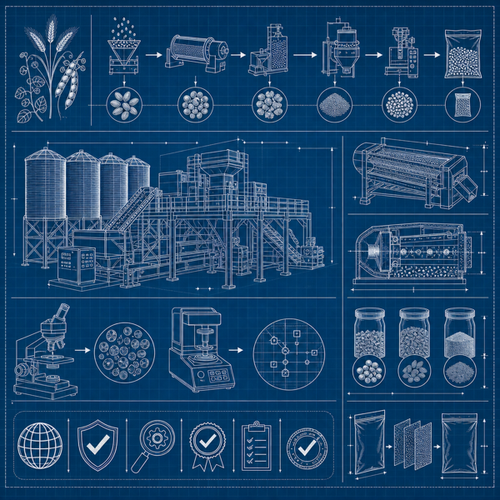
In today’s globalized food industry, the safe production, consistent quality, and transparent assessment of cereals, pulses, and their derived products are not just regulatory requirements—they are critical for business success, consumer trust, and public health. With increasing trade, heightened consumer awareness, and stricter market regulations, implementing robust international food technology standards such as those published by the International Organization for Standardization (ISO) is now a must for stakeholders across the grain value chain. This article explores three foundational standards—ISO 18390:2025, ISO 21415-2:2026, and ISO 5530-1:2026—each vital for sampling, quality assessment, and product consistency in cereals, pulses, wheat, and flours. Whether you’re a producer, processor, trader, laboratory, or importer, understanding and applying these standards ensures heightened food safety, productivity, scaling opportunities, and security throughout your operations.
Overview / Introduction
Cereals and pulses (such as wheat, maize, barley, oats, lentils, and beans) form the nutritional and commercial backbone of global food systems. From bulk grain shipments to finished cereal products on supermarket shelves, ensuring product safety, consistency, and quality is a complex task involving many actors and processes. In this tightly regulated landscape, international standards provide the common language and benchmark methodologies that allow businesses to:
- Demonstrate compliance and meet legal requirements
- Mitigate food safety risks
- Ensure accurate, reproducible measurements and quality parameters
- Enhance productivity, efficiency, and traceability
- Scale safely to new markets and meet customer expectations
This comprehensive guide covers three essential ISO standards used in the food grains industry: sampling procedures, gluten content and index analysis, and dough rheology measurement. You’ll gain accessible, actionable insights into what each standard covers, its requirements, and how adopting these guidelines can transform business operations—including boosting productivity, enhancing product security, and enabling safe scaling.
Detailed Standards Coverage
ISO 18390:2025 - Simplified Routine Sampling for Cereals, Pulses and Cereal Products
Cereals, pulses and cereal products — Sampling — Simplified routine method
Scope and Purpose
ISO 18390:2025 is the pivotal standard for daily, practical sampling of bulk and packaged cereals, pulses, and cereal products. Sampling is the foundation for checking quality, safety, and regulatory compliance—ensuring that laboratory test results actually reflect the characteristics of the full grain lot. Incorrect or inconsistent sampling can result in inaccurate quality assessments, financial disputes, and potentially unsafe food reaching consumers.
This standard specifies easy-to-follow yet effective procedures for dynamic (flowing) and static (stationary) sampling by both manual and mechanical means. Applicable in the field, silos, and processing facilities, its focus is on representativity, simplicity, and protective measures throughout the sampling chain. Importantly, it covers sampling for both homogenously distributed quality parameters (e.g., protein, moisture) and heterogeneously distributed contaminants (e.g., mycotoxins, chemical residues).
Key Requirements and Specifications
- Defines terms: incremental sample, aggregate sample, laboratory sample, homogenization, lot, sampling error
- Outlines general requirements: sample increment selection, homogenization, reduction to laboratory sample, ensuring representativity
- Statistical requirements for number and mass of increments and aggregate samples, depending on lot size and state (bulk/static, pre-packaged)
- Equipment hygiene, sample packaging, and sample transportation guidelines to prevent contamination or changes prior to testing
- Special procedures for flowing versus static bulk sampling (e.g., cross-cut samplers, manual probes, vacuum samplers)
- Excludes insect infestation testing and seed sampling, which are covered by other standards
- Reporting and documentation: requires a complete sampling report for traceability and dispute resolution
Who Needs to Comply?
- Grain traders, storage operators, millers, food manufacturers
- Quality assurance laboratories and inspectors
- Importers/exporters, regulatory agencies
- Anyone responsible for determining compliance or product acceptability in grains, pulses, and their products
Practical Implications
- Supports rapid, daily routine sampling without complex logistics
- Helps assure product integrity, detect contaminants, and enables informed buying/selling decisions
- Can be integrated with broader quality management systems, forming a core part of food safety/HACCP plans
Key highlights:
- Step-by-step practical sampling protocols for field and industrial settings
- Focused on representative sampling and minimizing sampling error
- Stresses equipment cleanliness, proper labelling, and documentation
Access the full standard:View ISO 18390:2025 on iTeh Standards
ISO 21415-2:2026 - Gluten Content Determination in Wheat and Flour
Wheat and wheat flour — Gluten content — Part 2: Determination of wet gluten and gluten index by mechanical means
Scope and Purpose
Gluten—the viscoelastic protein complex in wheat—is critical for bread and pasta quality, affecting dough structure, elasticity, and final product texture. ISO 21415-2:2026 establishes a precise method for determining both the wet gluten content and the gluten index of wheat flours (Triticum aestivum L. and Triticum durum Desf.) using mechanical equipment. These parameters are fundamental not only for bakers and food processors but also for regulatory compliance and international trade, where minimum or maximum gluten levels may be specified by law.
The standard applies to wheat flour and, with conditions, to ground whole wheat. It ensures accurate, repeatable, and reproducible gluten analysis—which supports product development, blending, and quality control.
Key Requirements and Specifications
- Defines wet gluten (hydrated protein matrix of gliadin and glutenin) and gluten index (proportion remaining on sieve after centrifugation)
- Describes mechanical extraction and washing procedures using standardized solutions, automatic extraction units (e.g., Glutomatic), sieves, and centrifuges
- Precise instructions for sample weighing, washing, separation, and measurement—including volumes, times, and equipment tolerances
- Differentiates between results for flour and ground wheat; requires adherence to granulometry specifications when testing whole wheat
- Calls for at least duplicate measurements for reliability and sets limits for repeatability and reproducibility
- Requires all deviations, instrument brands, and test-specific parameters to be recorded in the test report for traceability
Who Needs to Comply?
- Flour mills, wheat processors, bakeries
- Food laboratories conducting quality or legal compliance tests
- Traders, import/export houses, and regulatory authorities
- R&D and procurement teams formulating wheat-based products
Practical Implications
- Provides standardized, internationally recognized gluten measurement—boosting process control and finished product consistency
- Enables comparison of flour qualities across batches and suppliers, supporting better sourcing and process optimization
- Underpins claims (e.g., bread flour, high/low gluten) and ensures labelling accuracy
Key highlights:
- Reproducible, mechanical method for wet gluten and gluten index assessment
- Integral to wheat and flour quality management systems
- Supports laboratory accreditation and product certification
Access the full standard:View ISO 21415-2:2026 on iTeh Standards
ISO 5530-1:2026 - Dough Water Absorption & Rheological Properties with a Farinograph
Wheat flour — Physical characteristics of doughs — Part 1: Determination of water absorption and rheological properties using a farinograph
Scope and Purpose
The ability of wheat flour to absorb water and the mixing properties of dough are key quality parameters affecting baking performance—especially for bread, cakes, pastas, and other flour-based foods. ISO 5530-1:2026 outlines a standardized method using a farinograph (a specific laboratory mixer) to determine:
- Water absorption of flour
- Dough consistency and development time
- Stability (mixer tolerance)
- Degree of softening
- Farinograph quality number (FQN)
By analyzing these properties, producers and buyers can predict processing behaviour and end-product performance—critical for high-speed bakeries and exporters targeting demanding markets. This standard enables both constant flour mass and constant dough mass procedures, fitting a wide range of flour types.
Key Requirements and Specifications
- Specifies farinograph equipment requirements: mixing speed, torque, temperature controls, recording system
- Two core test approaches: constant flour mass and constant dough mass (calculations provided)
- Procedures for adjusting water dosage to reach target consistency (usually 500 farinograph units)
- Definitions and calculations for dough development time (DDT), stability, degree of softening, and FQN
- Requirements for duplicate determinations and data averaging
- Statistical parameters for repeatability and reproducibility
- Test reports must include all conditions (temperature, sample mass, equipment used) and any deviations
Who Needs to Comply?
- Flour mills, industrial bakeries, pasta and noodle manufacturers
- R&D labs, quality testing laboratories
- Ingredient suppliers, exporters/importers
Practical Implications
- Enables consistent evaluation of dough handling properties—reduces production failures, waste, and downtime
- Supports product development for specific applications (e.g., strong wheat for bread, medium for cakes)
- Underpins customer specifications, contract acceptance, and market differentiation
Key highlights:
- Reliable, repeatable method for bakeries and processors worldwide
- Helps optimize formulations, reduce ingredient costs, and maintain product quality
- Essential for supplier audits and flour acceptance testing
Access the full standard:View ISO 5530-1:2026 on iTeh Standards
Industry Impact & Compliance
Adopting and maintaining compliance with these international standards offers tangible value and mitigates substantial risks for organizations dealing with cereals, pulses, and derived products. Here’s how:
Regulatory Compliance and Market Access
- Meet national and international market regulations, including food safety laws
- Fulfill contractual obligations with buyers, importers, and government agencies
- Avoid legal penalties, rejections, and costly recalls
Productivity, Efficiency, and Scaling
- Standardized methods boost throughput and reduce retesting, making scale-up easier
- Repeatable procedures reduce training overhead and support multi-site operations
- Enables automation and digitalization, increasing overall productivity
Food Safety and Security
- Systematic, representative sampling identifies hazards before reaching consumers
- Reliable analytical results help maintain traceability, support HACCP/FSMS systems
- Reduces contamination risks, product adulteration, and spoilage
Market Differentiation and Reputation
- Demonstrate commitment to quality and safety with recognized certifications
- Increase customer trust, win new contracts, and support premium branding
Risks of Non-Compliance
- Batch failures, trade disputes, regulatory scrutiny
- Recalled shipments, reputational damage, financial losses
- Potential health issues leading to litigation or shutdowns
Implementation Guidance
Common Approaches
- Internal Training: Invest in staff training on the practical aspects of sampling, laboratory preparation, and equipment use as specified in each ISO standard.
- Equipment Calibration: Regularly maintain and calibrate mechanical samplers, gluten extraction units, and farinographs to ensure results meet accuracy and repeatability specifications.
- Quality Management Integration: Embed these standards into broader quality assurance, HACCP, and food safety management systems for end-to-end compliance.
- Documentation and Traceability: Maintain thorough procedural records, including sampling reports, test conditions, and any deviations—essential for traceability and audits.
- External Validation: Where needed, participate in laboratory proficiency testing, and consider third-party audits or ISO certification to reinforce credibility.
Best Practices
- Use only trained personnel for sample collection and handling
- Adhere to statistical requirements for number and type of increments—do not under-sample
- Keep equipment clean, dry, and odor-free to avoid cross-contamination
- Store and transport samples in sealed, labelled containers promptly to avoid deterioration
- Record all relevant information (date, method version, operator, equipment) to facilitate repeatability and dispute resolution
- Review procedures regularly in line with new editions or regulatory changes
Resources for Organizations
- Official ISO standards and supporting annexes (obtain current versions via iTeh Standards)
- Manufacturer’s manuals for specified equipment (Glutomatic, farinograph, etc.)
- National standardization bodies and food industry associations
- Training workshops, webinars, and proficiency testing schemes
Conclusion / Next Steps
The rigorous application of ISO 18390:2025, ISO 21415-2:2026, and ISO 5530-1:2026 forms the backbone of scientific, safe, and scalable grain and flour quality assurance in today’s food industry. These standards provide the structure and confidence needed for organizations—from farm to bakery shelf—to:
- Streamline operations and boost productivity
- Safeguard food safety and protect consumer health
- Secure competitive, cross-border market access
- Build trust with partners and regulatory agencies
Organizations are strongly encouraged to review these standards in detail, train relevant teams, and consult authoritative resources to ensure comprehensive compliance and to remain competitive in a fast-evolving food landscape.
Explore the full range of international standards for cereals, pulses, and derived products on iTeh Standards. Stay informed, stay compliant, and pave the way for reliable, quality-driven food production at scale.
Categories
- Latest News
- New Arrivals
- Generalities
- Services and Management
- Natural Sciences
- Health Care
- Environment
- Metrology and Measurement
- Testing
- Mechanical Systems
- Fluid Systems
- Manufacturing
- Energy and Heat
- Electrical Engineering
- Electronics
- Telecommunications
- Information Technology
- Image Technology
- Precision Mechanics
- Road Vehicles
- Railway Engineering
- Shipbuilding
- Aircraft and Space
- Materials Handling
- Packaging
- Textile and Leather
- Clothing
- Agriculture
- Food technology
- Chemical Technology
- Mining and Minerals
- Petroleum
- Metallurgy
- Wood technology
- Glass and Ceramics
- Rubber and Plastics
- Paper Technology
- Paint Industries
- Construction
- Civil Engineering
- Military Engineering
- Entertainment