


May 2026: New Automotive Standards on Steer-by-Wire Safety and CAN High-Speed Networks
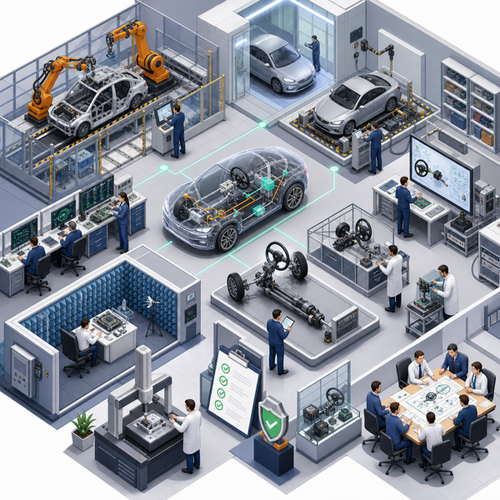
Automotive engineering continues to evolve rapidly, with May 2026 seeing the publication of pivotal new international standards focused on road vehicle safety and electronic communication. Whether dealing with next-generation steering systems or advanced vehicle networks, these updates will have wide-reaching effects. This month’s releases cover two authoritative ISO standards, establishing system safety guidelines for steer-by-wire (SbW) technology and strengthening requirements for high-speed Controller Area Network (CAN) physical medium attachments. For professionals and organizations in the automotive and road vehicle sectors, these developments mark critical steps toward safer and more robust vehicle technologies.
Overview / Introduction
The automotive and road vehicles industry stands at the crossroads of heightened safety demands and revolutionary connectivity advancements. As manufacturers roll out more sophisticated electronic control systems, the need for standardized approaches to safety and interoperability have never been greater. Standards ensure confidence in vehicle reliability, allow seamless integration of new technologies, and provide a consistent framework for compliance, testing, and certification. In this article, you’ll gain actionable insights into two new international standards:
- ISO 19725:2026 – Establishing comprehensive system safety guidelines for steer-by-wire steering in passenger cars and light commercial vehicles.
- ISO 11898-2:2026 – Updating and clarifying technical requirements for high-speed CAN network physical layers in road vehicles.
Read on for detailed coverage of each standard, practical compliance strategies, and a look at how these developments will impact the automotive engineering landscape.
Detailed Standards Coverage
ISO 19725:2026 – Steer-By-Wire System Safety Guidelines
Road vehicles — Steer-by-wire systems — System safety guidelines
Published in May 2026, ISO 19725:2026 marks a significant advancement in ensuring the safety of new-generation electronically-controlled steering systems. Steer-by-wire (SbW) removes the traditional mechanical link between the steering wheel and the road wheels, instead relying on electrical signals and actuator responses. This shift enables new interior vehicle designs and lays the foundation for advanced driver-assist and automation features, but introduces unique safety challenges.
Scope and Application:
- Applies to the use of SbW systems in passenger cars and light commercial vehicles for mass production.
- Provides necessary safety requirements for scenarios where the driver is physically holding the steering wheel (manual driving) but does not address hands-free or automated lateral control.
- The requirements specifically cover systems with a road wheel actuator (RWA), hand wheel actuator (HWA), and a driver’s steering wheel interface. Other system architectures require additional analysis.
Key Requirements & Specifications:
- Complements, but does not replace, safety analysis and measures required by the ISO 26262 functional safety series.
- Establishes a minimum framework of safety goals targeting SbW system failure scenarios such as self-steering, loss of steerability or feedback torque, blocking, and loss of synchronization.
- Provides technical definitions, acceptance criteria, and fault response protocols for component and system-level failures.
- Introduces the “degradation concept,” outlining permissible system transitions and fallback modes following a detected fault or loss of function, including the requirement for automated reduction of vehicle speed and clear driver warnings.
- Outlines specific testing procedures (dynamic maneuver assessments) and subjective/objective controllability thresholds.
Who Must Comply:
- Automotive manufacturers, system suppliers, and integrators developing or implementing steer-by-wire technology in passenger cars or light commercial vehicles.
- Compliance teams and functional safety engineers responsible for system validation and safety case documentation.
Practical Implications for Implementation:
- Enhanced risk management for new electronic steering architectures, enabling manufacturers to anticipate, contain, and communicate system faults more effectively.
- Demands robust system redundancy, built-in test and warning systems, and clear protocols for achieving and maintaining a “safe state” after detection of a fault.
- Supports vehicle homologation and alignment with regulatory frameworks (such as UNECE Regulation 79 for steering), especially in global markets pushing toward higher automation levels.
Notable Changes from Previous Practice:
- First international standard to collect and formalize minimum SbW-specific safety aspects across manufacturers and suppliers.
- Introduces the concept of degradation stages with defined transitions and warnings, as well as prescriptive maneuver-based testing for controllability.
- Explicitly defines and allocates five critical safety goals (ASIL D/B ratings per ISO 26262 context), with corresponding technical acceptance criteria.
Key highlights:
- Minimum safety requirements for SbW system failure modes (self-steering, loss of steerability, feedback loss, blocking, asynchronization)
- Strict protocols for achieving safe state and warning the driver
- Purpose-built framework for validating SbW system availability and controllability using real-world maneuvers
Access the full standard:View ISO 19725:2026 on iTeh Standards
ISO 11898-2:2026 – High-Speed CAN Physical Medium Attachment (PMA) Requirements
Road vehicles — Controller area network (CAN) — Part 2: High-speed physical medium attachment (PMA) sublayer
With vehicles relying on more electronic control units (ECUs) than ever, internal networking speed and reliability are mission-critical. ISO 11898-2:2026 provides an essential update to the physical layer specifications for high-speed CAN, the backbone of automotive in-vehicle networking, particularly important for powertrain, chassis, safety, and body electronics.
Scope and Application:
- Defines the high-speed CAN physical medium attachment layer (HS-PMA), covering both normal power and low-power modes, and supporting features like selective wake-up and signal improvement capabilities (SIC) that are crucial for modern vehicle architectures.
- Provides detailed requirements for all high-speed CAN nodes, including those supporting SIC mode (reducing network ringing/interference) and future-ready FAST mode implementations.
- Excludes the physical medium dependent (PMD) sublayer, focusing on standardized attachment design and conformance.
Key Requirements & Specifications:
- Rigorous electrical parameters and timing characteristics for CAN_H and CAN_L signals: voltage levels, driver symmetry, output current, impedance, and leakage.
- Enhanced static and dynamic receiver input criteria, allowing greater tolerance for differential voltage swings and disturbance, improving electromagnetic compatibility (EMC) and network robustness.
- Prescribes timing protocols for transmitter/receiver symmetry and maximum propagation delays, ensuring reliable high-speed communication (bit rates up to 1 Mbit/s and higher in FAST/SIC modes).
- Specifies advanced wake-up mechanisms, including support for selective frame-based wake-up and bus pattern-based signaling (key for partial networking and low-power architectures).
- Annexes document configurations for SIC and FAST mode operation, as well as guidance for real-world network and ECU integration.
Who Must Comply:
- ECU manufacturers, transceiver designers, automotive networking architects, and vehicle OEMs deploying high-speed CAN networks in road vehicles.
- Testing and verification engineers developing compliance and conformance regimes for vehicle networking hardware.
Practical Implications for Implementation:
- Improved network reliability and safety in increasingly complex electronic architectures, supporting partial networking and energy efficiency strategies.
- Enables greater scalability, noise immunity, and interoperability between network nodes from different suppliers.
- Future-proofs vehicle network designs for anticipated advancements in in-vehicle data rates, signal integrity, and automated driving demands.
Notable Changes from Previous Editions:
- Extended common mode range for receiver specification (+/- 8 V differential)
- New clarifications, updated test figures, and bug fixes to ensure design accuracy
- Fully supports modern selective wake-up and SIC functionality per the latest application requirements
Key highlights:
- Comprehensive, updated reference for high-speed CAN physical layer design (HS-PMA)
- Expanded dynamic and static parameters to boost signal reliability
- Powerful support for selective wake-up, partial networking, and low-power vehicle systems
Access the full standard:View ISO 11898-2:2026 on iTeh Standards
Industry Impact & Compliance
Effects on Automotive Businesses
The adoption of these new ISO standards marks a fundamental strengthening of vehicle system safety and connectivity. For OEMs and suppliers, early alignment offers advantages such as:
- Demonstrable commitment to vehicle safety and reliability
- Simplified type-approval and market homologation, especially in jurisdictions with increasing regulatory oversight
- Reduced warranty risks and improved public perception through adherence to best-practice safety and network standards
Compliance Timelines & Considerations
- Organizations should interpret these standards as minimum requirements; in many cases, end-user safety or regional regulations will require even stricter practices.
- New projects or vehicle platforms launching from mid-2026 onward should plan conformance as part of product development, integration, and validation cycles.
- Suppliers of both steering and network components should update technical requirements, procurement specs, and testing processes now to ensure readiness.
Benefits of Adoption
- Enhanced functional safety and robustness in newly-designed or updated vehicle models
- Lower costs related to field failures or recall due to clarified/standardized design and verification
- Streamlined supplier selection and project planning with universally-agreed upon technical baselines
Risks of Non-Compliance
- Regulatory approval delays or outright rejection for non-conforming systems
- Increased liability in the event of safety or network-related vehicle incidents
- Higher remediation costs if design flaws are discovered late or in series production
Technical Insights
Common Technical Requirements Across the Standards
- Emphasis on robust electronic system design, redundancy, and maintainability
- Systematic safety analysis and validation through formalized test regimes (maneuver-based and laboratory)
- Standardized network node behavior to guarantee interoperability and resilience to faults/noise
Implementation Best Practices
Integrate Safety Early: Build system safety and fault tolerance into both steering and networking architectures from initial concept phases.
Perform End-to-End Testing: Apply the prescribed maneuver, dynamic, and network compliance tests to verify real-world system performance—ensure lateral controllability, warning systems, and wake-up behaviors are validated in final vehicle conditions.
Document All Compliance Evidence: Maintain clear safety cases, fault trees, and network conformance reports as required for regulatory and organizational audit readiness.
Leverage Redundancy: Implement redundant control channels, power supplies, and fallback modes per SbW guidelines; use selective wake-up to support energy-saving modes without network communication loss.
Collaborative Development: Engage suppliers and development partners in upfront compliance planning, ensuring interfaces between components and systems are clearly specified to meet the standards.
Testing & Certification Considerations
- Utilize ISO-compliant test equipment and maneuvers as described in both ISO 19725:2026 (for vehicle/steering systems) and ISO 11898-2:2026 (for high-speed CAN interface validation).
- Certification should be obtained via independent laboratories or internal test houses accredited for road vehicle component verification.
- Verification should include documentation of failure modes, warning presentations, safe state achievement, and proper network recovery after faults or wake-up events.
Conclusion / Next Steps
The May 2026 publication of ISO 19725 and ISO 11898-2 sets a new benchmark for automotive system safety and electronic communications. For organizations in the automotive and road vehicles industry, these standards are vital tools for:
- Ensuring that next-generation vehicles are both safer and more interoperable
- Supporting reliable integration of new electronic systems while meeting strict international compliance demands
- Reducing risk, improving quality management, and streamlining the path to market
Recommendations:
- Begin reviewing current steering and network designs for alignment with these new standards
- Update in-house engineering guidelines, supplier requirements, and type-approval documentation
- Engage with compliance and testing partners early to achieve and validate conformance
Stay ahead in automotive engineering by exploring the complete standards and incorporating their guidance into your next vehicle platform or system update. For further details, direct access to ISO standards, and regular updates on automotive compliance, visit iTeh Standards.
Categories
- Latest News
- New Arrivals
- Generalities
- Services and Management
- Natural Sciences
- Health Care
- Environment
- Metrology and Measurement
- Testing
- Mechanical Systems
- Fluid Systems
- Manufacturing
- Energy and Heat
- Electrical Engineering
- Electronics
- Telecommunications
- Information Technology
- Image Technology
- Precision Mechanics
- Road Vehicles
- Railway Engineering
- Shipbuilding
- Aircraft and Space
- Materials Handling
- Packaging
- Textile and Leather
- Clothing
- Agriculture
- Food technology
- Chemical Technology
- Mining and Minerals
- Petroleum
- Metallurgy
- Wood technology
- Glass and Ceramics
- Rubber and Plastics
- Paper Technology
- Paint Industries
- Construction
- Civil Engineering
- Military Engineering
- Entertainment