


June 2026: Key Information Technology Standards Released for Industrial Networks and EV Charging
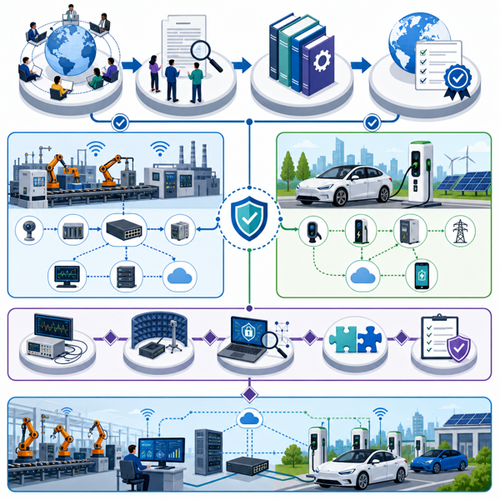
June 2026: Key Information Technology Standards Released for Industrial Networks and EV Charging
The Information Technology sector welcomes a wave of innovation and interoperability this June, following the publication of three significant international standards. Covering industrial automation networks and smart electric vehicle (EV) charging systems, these releases from the IEC and ISO/IEC are poised to set the benchmark for quality, security, and seamless interoperability across industrial and consumer technology landscapes. For organizations designing, integrating, or procuring IT systems—particularly in industrial automation or home energy management—these standards define the requirements for tomorrow’s intelligent, interconnected systems.
Overview / Introduction
The rapidly evolving field of Information Technology and Office Equipment thrives on precision, secure communication, and interoperability—especially as digital automation extends from industrial plants to consumer homes. International standards play a fundamental role in ensuring that diverse products and systems can communicate, function safely, and offer reliability at scale. This article provides an in-depth look at the three latest standards published in June 2026:
- IEC/IEEE 60802:2026 – The cornerstone for time-sensitive networking in industrial automation.
- ISO/IEC 14543-4-303:2026 – Focused on application protocols for EV supply equipment (EVSE) chargers and controllers.
- ISO/IEC 14543-4-304:2026 – Expanding application protocols to support bidirectional (charge/discharge) EVSE functionality.
By examining the scope, requirements, technical implications, and industry impact of these standards, this article guides professionals through their adoption and compliance journey, ensuring competitive advantage and risk mitigation.
Detailed Standards Coverage
IEC/IEEE 60802:2026 – Time-Sensitive Networking Profile for Industrial Automation
Time-sensitive networking profile for industrial automation
The IEC/IEEE 60802:2026 standard defines comprehensive time-sensitive networking (TSN) profiles tailored for industrial automation environments. Designed jointly by IEC and IEEE, it brings deterministic real-time communication to industrial Ethernet networks, enabling converged traffic with guaranteed low latency, high reliability, and robust security.
Scope and Coverage: IEC/IEEE 60802:2026 selects and refines features, protocols, and procedures—including configuration and protocol defaults—for bridges, end stations, and local area networks (LANs) in industrial networks. It addresses:
- TSN features required for industrial control loops and synchronized applications
- Protocols and YANG modules for both online and offline management (i.e., digital data sheet capabilities)
- Security models and remote management procedures
- Network topology discovery and device identity validation
Key Requirements and Specifications:
- Adoption of IEEE 802.1 TSN mechanisms for guaranteed time-sensitive data flow
- Mandatory support for YANG-based device management, configuration, and diagnostics
- Precise synchronization mechanisms using (g)PTP profiles (e.g., multiple clock domains)
- Cybersecurity baseline: secure configuration, device identity verification, and access control based on IDevID/LDevID structures
- Conformance and testing requirements for network components (bridges, end stations, and IA-stations)
Who Needs to Comply:
- Industrial automation vendors (controllers, I/O, robots, sensors, actuators)
- System integrators designing factory or process automation networks
- Operators of industrial communication infrastructure
- Test laboratories and certifying bodies
Implications and Implementation: Adopting IEC/IEEE 60802:2026 ensures that automation networks can support mission-critical, time-sensitive processes and coexist with unrelated data streams without interference. The specification’s robust management and security features facilitate digital transformation and Industry 4.0 initiatives, paving the way for scalable, safe, and interoperable networks. Notable revisions include expanded YANG module support, improved security models, and updated conformance requirements for real-time operation.
Key highlights:
- Unified profile for time-sensitive industrial Ethernet
- Digital data sheet (device self-description) via YANG modules
- Built-in security for management and network access
Access the full standard:View IEC/IEEE 60802:2026 on iTeh Standards
ISO/IEC 14543-4-303:2026 – Application Protocol for EVSE Chargers and Controllers
Information technology - Home Electronic System (HES) architecture - Part 4-303: Application protocol for electric vehicle supply equipment (EVSE) chargers and controllers
ISO/IEC 14543-4-303:2026 targets interoperability in smart energy and e-mobility spaces. It prescribes an application-layer protocol for communication between EVSE chargers and controllers, ensuring products from different vendors work seamlessly together.
Scope and Coverage:
- Specifies the use of the Network Enhanced Communications Device (NECD) protocol (ISO/IEC 14543-4-3) as the communication backbone
- Defines protocol message structure and procedures for EVSE chargers and controllers, especially for homes and residential settings (HES Class 1)
- Communication occurs primarily over UDP with IPv4 or IPv6 (TCP is optional)
Key Requirements and Specifications:
- Devices must support NECD read and write operations, notifications, and response handling
- Mandates certain NECD objects and properties for both chargers and controllers, including:
- Device status, fault indication, operation parameters, and manufacturer ID
- Functions for querying and controlling charging status
- EVSE chargers must implement device profile and operation objects as per IEC 62394
Who Needs to Comply:
- Manufacturers of home EV charging equipment
- Developers of smart energy controllers, energy management systems
- System integrators for home electronic systems
Implications and Implementation: With this standard, residential EV charging becomes more interoperable and manageable. Controllers (including home energy management systems) can reliably interact with chargers, regardless of brand, supporting key energy management services, remote control, status checking, and notification of faults. By supporting both IPv4 and IPv6 as well as UDP and optionally TCP, the standard enables future-proof scalability and straightforward integration across diverse network environments.
Key highlights:
- Ensures cross-vendor interoperability for home EV chargers/controllers
- Clear definition of mandatory commands and device properties
- Enables smart energy automation and remote management
Access the full standard:View ISO/IEC 14543-4-303:2026 on iTeh Standards
ISO/IEC 14543-4-304:2026 – Application Protocol for EVSE Charger and Dischargers and Controllers
Information technology - Home Electronic System (HES) architecture - Part 4-304: Application protocol for electric vehicle supply equipment (EVSE) charger and dischargers and controllers
ISO/IEC 14543-4-304:2026 expands on its predecessor by incorporating support for bidirectional EVSE devices—those capable of both charging and discharging (vehicle-to-home or vehicle-to-grid).
Scope and Coverage:
- Defines application-layer interoperability for EVSE units that manage two-way power flow
- Builds upon the NECD protocol architecture, using UDP/IPv4 or IPv6 (optionally TCP)
- Specifies device objects and procedures for both charging and discharging scenarios
Key Requirements and Specifications:
- Standardizes required NECD objects for bi-directional EVSEs (charger/discharger profiles)
- Supports commands for reading, setting, and notifying about both charging and discharging parameters
- Introduces new device properties relating to dischargeable capacity, charge/discharge state, and dual-operational status
- Ensures compatibility with controllers and energy management systems
Who Needs to Comply:
- EVSE vendors offering bidirectional charging (V2H, V2G, V2X)
- Smart grid and home automation system developers
- Residential energy storage and prosumer solution providers
- Integrators of renewable and distributed energy resources
Implications and Implementation: This standard is designed for the next wave of smart energy innovation, where electric vehicles act as flexible storage for homes and grids. Organizations implementing 14543-4-304 can develop systems that not only charge EVs efficiently but also provide energy back to the home or grid, enhancing resilience and optimizing energy costs. The specification’s flexible command structure and protocol stack make it suitable for both legacy and emerging home automation environments.
Key highlights:
- Enables true bidirectional energy management with EVs
- Support for advanced energy automation and demand response
- Ensures detailed status reporting and secure remote control
Access the full standard:View ISO/IEC 14543-4-304:2026 on iTeh Standards
Industry Impact & Compliance
Business Impact and Strategic Opportunities
The integration of these new standards will have profound effects on both operational technology (OT) and consumer IT landscapes:
- Accelerated digital transformation in industrial automation, with networks capable of robust, deterministic communications to deliver critical control functions efficiently.
- Harmonized energy management and smart home ecosystems, enabling seamless interoperability between charging systems, energy management controllers, and renewable energy sources.
- Increased opportunities for cross-vendor and cross-domain integration, supporting smart factories, prosumer households, and grid-interactive communities.
Compliance Considerations
- Timelines: Adoption of these standards should begin promptly, with conformance assessments and integration planning prioritized, especially for new product development and system upgrades.
- Certification: Testing and qualification processes (including YANG validation and NECD object compliance) must be factored into product lifecycles.
- Risks: Failure to align with these standards risks incompatibility, security vulnerabilities, and market exclusion, particularly as regulators and procurement guidelines increasingly mandate standards compliance for automation and energy solutions.
Benefits of Adoption
- Future-proofing: Strong alignment with global best practices and technical evolution
- Cost reduction: Lower integration and maintenance costs through standardized interfaces and protocols
- Security and resilience: Enhanced with robust identity, management, and network communication schemes
- Expanded market access: By meeting international procurement and certification requirements
Technical Insights
Common Technical Requirements
- Device and Network Management: All three standards emphasize remote management and automation via standardized data models (YANG or NECD objects).
- Security: Secure communication and device management are embedded, with requirements for identity verification, access control, and secure configuration exchange.
- Protocol Agility: Support for both IPv4/IPv6 and UDP (with optional TCP) brings flexibility to networking infrastructure, allowing for gradual migration to new IP standards without compatibility loss.
- Testing and Certification: Adherence requires formal conformance statements and robust testing processes, focusing on functional validation, security, and operational scenarios.
Best Practices for Implementation
- Gap Analysis: Review legacy systems and compare with new standard requirements for protocol, security, and management.
- Phased Integration: Prioritize upgrades starting with network infrastructure, then devices and controllers.
- Interoperability Testing: Use multi-vendor benches to validate integration, especially for home energy and automation.
- Training: Equip engineering, IT, and field service teams with training on updated protocols and management methods.
- Certification Planning: Engage with accredited test labs early to ensure a smooth path to certification.
Conclusion / Next Steps
June 2026 marks a pivotal moment for Information Technology professionals, as international standards further converge industrial and consumer technologies. By adopting IEC/IEEE 60802:2026 and the latest ISO/IEC 14543 protocols, organizations ensure their systems are secure, interoperable, and primed for future innovation—including seamless EV integration and digital automation across all domains.
Key Takeaways:
- Standards-based networks are foundational for reliable industrial automation and smart energy solutions
- The move toward unified protocols supports both current market needs and future digital expansion
- Early compliance offers strategic advantage and future-ready infrastructure
Recommendations:
- Assess product portfolios and infrastructure for alignment with the new standards
- Engage technical teams in training and compliance planning
- Explore the detailed specifications and access the standards directly
Stay ahead—explore the full texts of these standards on iTeh Standards and ensure your systems lead the way in secure, interoperable Information Technology.
Categories
- Latest News
- New Arrivals
- Generalities
- Services and Management
- Natural Sciences
- Health Care
- Environment
- Metrology and Measurement
- Testing
- Mechanical Systems
- Fluid Systems
- Manufacturing
- Energy and Heat
- Electrical Engineering
- Electronics
- Telecommunications
- Information Technology
- Image Technology
- Precision Mechanics
- Road Vehicles
- Railway Engineering
- Shipbuilding
- Aircraft and Space
- Materials Handling
- Packaging
- Textile and Leather
- Clothing
- Agriculture
- Food technology
- Chemical Technology
- Mining and Minerals
- Petroleum
- Metallurgy
- Wood technology
- Glass and Ceramics
- Rubber and Plastics
- Paper Technology
- Paint Industries
- Construction
- Civil Engineering
- Military Engineering
- Entertainment