

ISO/IEC 14543-4-303:2026
(Main)Information technology - Home Electronic System (HES) architecture - Part 4-303: Application protocol for electric vehicle supply equipment (EVSE) chargers and controllers
- Abstract
ISO/IEC 14543-4-303:2026 specifies an application-layer protocol important for ensuring interoperability among the products of various manufacturers regarding communications between electric vehicle supply equipment (EVSE) chargers and controllers. It uses the network enhanced communications device (NECD) protocol specified in ISO/IEC 14543-4-3. This protocol is based on UDP using IPv4 or IPv6 (TCP is optional).
- Status
- Published
- Publication Date
- 28-Jun-2026
- Technical Committee
- ISO/IEC JTC 1/SC 25 - Interconnection of information technology equipment
- Drafting Committee
- WG 1 - ISO/IEC JTC 1/SC 25/WG 1
- Current Stage
- PPUB - Publication issued
- Start Date
- 29-Jun-2026
- Completion Date
- 27-Jul-2026
Buy Documents
ISO/IEC 14543-4-303:2026 - Information technology - Home Electronic System (HES) architecture - Part 4-303: Application protocol for electric vehicle supply equipment (EVSE) chargers and controllers
ISO/IEC 14543-4-303:2026 is an International Standard published by IEC for the Home Electronic System (HES) architecture. It specifies the application-layer protocol for communications between electric vehicle supply equipment (EVSE) chargers and controllers, so products from different manufacturers can exchange NECD messages over UDP on IPv4 or IPv6. The document is for implementers of EVSE chargers, controllers, and related energy-management systems that need interoperable application behavior.
What does ISO/IEC 14543-4-303:2026 specify?
ISO/IEC 14543-4-303:2026 specifies the application-layer behavior for EVSE charger and controller communications in HES Class 1. It defines how the NECD protocol is used for message exchange, including start-up, status queries, control actions, timing, and fault notification.
The scope is limited to the communication between EVSE chargers and controllers. It does not specify the connector, data, or electricity between the EV and the EVSE, and it assumes lower-layer connection processing is already complete.
The document is organized into clauses for scope, references, terms, conformance, configuration, application-layer objects and services, normal operation, remote control, and controller considerations. It also includes three informative annexes.
| Annex | What it covers |
|---|---|
| Annex A | Terms correspondence between ISO/IEC 14543-4-3 and IEC 62394, plus the NECD protocol frame format |
| Annex B | The communication link between EVSE charger and CEM in IEC 63380-1 |
| Annex C | The relationship between ISO/IEC 14543-4 series and the HES gateway based on ISO/IEC 15045 and ISO/IEC 18012 |
What are the key requirements of ISO/IEC 14543-4-303:2026?
ISO/IEC 14543-4-303:2026 requires EVSE chargers and controllers to use the NECD protocol at the application layer and to support the mandatory functions of ISO/IEC 14543-4-3. In practice, implementers need to provide the expected NECD objects, services, property handling, and message sequences so different products can interoperate.
Application objects and services
Clause 6.2 requires EVSE chargers and controllers to support the NECD objects listed for each role. EVSE chargers use the electric vehicle charger object and the node profile object, while controllers use the controller object and the node profile object. This matters because each node must expose the correct object set before it can be discovered and managed.
Clause 6.3 lists the NECD services that must be supported, including property value read, write, response, and notification services. The document distinguishes between controller-initiated requests and EVSE charger responses, so both sides know who sends each message and when.
Clause 6.4 identifies the required NECD properties for device objects. Some properties are mandatory, some are optional, and some are only required in specific charger types or operating situations. For implementers, this means the property set depends on the EVSE charger’s function and the information available from the EV.
Start-up, discovery, and attribute exchange
Clause 7.2 defines the start-up flow. After the lower-layer network is connected, devices send instance list notifications, and controllers are expected to recognize the devices they will manage. If a notification is missed, controllers shall search for EVSE chargers by multicast Get requests.
After discovery, controllers request NECD attribute information such as standard version information and property maps, then request EVSE charger attributes such as identification number, rated charge capacity, and charger type. In practice, this is the point where a controller learns what the charger supports before attempting control actions.
Timing and request handling
Clause 6.5.2 and 6.5.3 require controllers to respect a response wait time of at least 20 s between a request and the expected response from an EVSE charger. Clause 6.5.4 adds that a request shall not be retransmitted with the same TID if the response does not arrive in time. This prevents duplicate processing and helps avoid overloading the charger.
Clause 6.5.5 requires EVSE chargers to handle OPC values of 4 or more and to keep the response property order the same as the request. For engineers, this affects parser design and how multi-property messages are built and checked.
Write, read, and status behavior
Clause 6.5.6 states that EVSE chargers send Set_Res as an acceptance response even if the set value is not within the defined IEC 62394 range. Controllers therefore need to verify the resulting state with a follow-up Get request rather than assuming the setting was applied as intended.
Clause 6.5.7 defines cases where EVSE chargers shall return Get_SNA for some battery-capacity-related properties, especially when there is no EV connection or when the chargeable status is undetermined under certain DC charging-only charger types. This matters because the controller must handle unavailable EV data as part of normal operation.
Normal charging control, faults, and remote control
Clause 7.3 covers occasional operation such as checking vehicle connection and chargeable status, sending Operating mode setting, and reading vehicle data such as Vehicle ID and battery-capacity-related properties. It also requires EVSE chargers to send INF updates when vehicle connection or operating mode changes, within three minutes after the change.
Clause 7.4 requires EVSE chargers to change the Fault status property when a fault occurs and when it is cleared, and to notify the controller of the change. Clause 8 adds special handling for remote control from outside the home, including the use of Remote control setting and unique identification of the EVSE charger when needed.
What terms does ISO/IEC 14543-4-303:2026 define?
ISO/IEC 14543-4-303:2026 defines the main actors and protocol terms used in the application protocol.
- controller - A NECD node that sends Get and SetC requests to another NECD node.
- device object - A NECD object other than a node profile object; in this document, it means the electric vehicle charger object.
- electric vehicle (EV) - A vehicle powered by an electric motor that draws electricity from a battery and can be charged from an external source.
- electric vehicle supply equipment (EVSE) - A device that transfers electricity between an electric vehicle and home or grid.
- electric vehicle supply equipment charger (EVSE charger) - An EVSE that includes a NECD communications interface and manages power transfer from home or grid to EV.
- NECD protocol - The protocol used in network enhanced control device communications.
- response wait time - The time between a controller request and the EVSE charger response.
- remote control - Control from outside the home.
Who uses ISO/IEC 14543-4-303:2026?
ISO/IEC 14543-4-303:2026 is used by EVSE charger manufacturers, controller and EMS developers, and system integrators who need interoperable communications for charging control. It is also relevant to quality teams and interoperability test labs that verify object support, timing, request sequences, and fault reporting.
The document is especially useful where EVSE chargers are connected to local energy management systems or customer energy managers, because it defines the application behavior needed for discovery, monitoring, and control. It also matters to buyers comparing vendor products, since conformance depends on the specified objects, services, and sequences.
Which standards are used with ISO/IEC 14543-4-303:2026?
ISO/IEC 14543-4-303:2026 cites two normative references.
- IEC 62394 - Provides the detailed service diagnostic interface implementation for ECHONET and supplies the detailed EVSE charger class property definitions used by this document.
- ISO/IEC 14543-4-3 - Defines the NECD application layer interface to lower communications layers and the general NECD message structure and services on which this part is based.
The document also points readers to related standards and parts for implementation context.
- IEC 63380-1 - Gives the CEM link used in Annex B.
- ISO/IEC 14543-4-302:2023 - Supplies related NECD terms and property definitions referenced in the definitions.
- ISO/IEC 14543-4-304 - Covers EVSE charger and discharger behavior for bidirectional energy flow.
- IEC 62196-3 - Appears in the bibliography for connector compatibility context.
- ISO/IEC 15045 and ISO/IEC 18012 - Provide the HES gateway and interoperability guidance used in Annex C.
- ISO/IEC 18012-3 - Provides the HES gateway lexicon used for the translations in Annex C.
- ISO/IEC 15067-3 - Gives the HES energy management model mentioned in the definitions and notes.
What does the ISO/IEC 14543-4-303:2026 document contain?
ISO/IEC 14543-4-303:2026 contains tables for NECD objects, services, properties, and controller timing, plus sequences for start-up, discovery, status checking, charging control, fault notification, and remote control. It uses Figures 1 to 10 to show the protocol relationship, physical configuration, network stack, and message sequences.
Annex A provides the terminology mapping between ISO/IEC 14543-4-3 and IEC 62394 and reproduces the NECD protocol frame format. Annex C adds translation tables and measurement-point figures that help map EVSE charger information to the HES gateway lexicon for integration and interoperability work.
Buy Documents
ISO/IEC 14543-4-303:2026 - Information technology - Home Electronic System (HES) architecture - Part 4-303: Application protocol for electric vehicle supply equipment (EVSE) chargers and controllers
Get Certified
Connect with accredited certification bodies for this standard

BSI Group
BSI (British Standards Institution) is the business standards company that helps organizations make excellence a habit.

NYCE
Mexican standards and certification body.
Sponsored listings
Frequently Asked Questions
ISO/IEC 14543-4-303:2026 is a standard published by the International Electrotechnical Commission (IEC). Its full title is "Information technology - Home Electronic System (HES) architecture - Part 4-303: Application protocol for electric vehicle supply equipment (EVSE) chargers and controllers". This standard covers: ISO/IEC 14543-4-303:2026 specifies an application-layer protocol important for ensuring interoperability among the products of various manufacturers regarding communications between electric vehicle supply equipment (EVSE) chargers and controllers. It uses the network enhanced communications device (NECD) protocol specified in ISO/IEC 14543-4-3. This protocol is based on UDP using IPv4 or IPv6 (TCP is optional).
ISO/IEC 14543-4-303:2026 specifies an application-layer protocol important for ensuring interoperability among the products of various manufacturers regarding communications between electric vehicle supply equipment (EVSE) chargers and controllers. It uses the network enhanced communications device (NECD) protocol specified in ISO/IEC 14543-4-3. This protocol is based on UDP using IPv4 or IPv6 (TCP is optional).
ISO/IEC 14543-4-303:2026 is classified under the following ICS (International Classification for Standards) categories: 35.020 - Information technology (IT) in general. The ICS classification helps identify the subject area and facilitates finding related standards.
ISO/IEC 14543-4-303:2026 is available in PDF format for immediate download after purchase. The document can be added to your cart and obtained through the secure checkout process. Digital delivery ensures instant access to the complete standard document.
Standards Content (Sample)
ISO/IEC 14543-4-303
Edition 1.0 2026-06
INTERNATIONAL
STANDARD
Information technology - Home Electronic System (HES) architecture -
Part 4-303: Application protocol for electric vehicle supply equipment (EVSE)
chargers and controllers
ICS 35.020 ISBN 978-2-8327-1344-0
ISO/IEC 14543-4-303: 2026-06(en)
All rights reserved. Unless otherwise specified, no part of this publication may be reproduced or utilized in any form or
by any means, electronic or mechanical, including photocopying and microfilm, without permission in writing from either
IEC or IEC's member National Committee in the country of the requester. If you have any questions about IEC copyright
or have an enquiry about obtaining additional rights to this publication, please contact the address below or your local
IEC member National Committee for further information.
IEC Secretariat Tel.: +41 22 919 02 11
3, rue de Varembé info@iec.ch
CH-1211 Geneva 20 www.iec.ch
Switzerland
About the IEC
The International Electrotechnical Commission (IEC) is the leading global organization that prepares and publishes
International Standards for all electrical, electronic and related technologies.
About IEC publications
The technical content of IEC publications is kept under constant review by the IEC. Please make sure that you have the
latest edition, a corrigendum or an amendment might have been published.
IEC publications search - IEC Products & Services Portal - products.iec.ch
webstore.iec.ch/advsearchform Discover our powerful search engine and read freely all the
The advanced search enables to find IEC publications by a publications previews, graphical symbols and the glossary. With
variety of criteria (reference number, text, technical a subscription you will always have access to up to date content
committee, …). It also gives information on projects, replaced tailored to your needs.
and withdrawn publications.
Electropedia - www.electropedia.org
The world's leading online dictionary on electrotechnology,
IEC Just Published - webstore.iec.ch/justpublished
Stay up to date on all new IEC publications. Just Published containing more than 22 500 terminological entries in English
details all new publications released. Available online and and French, with equivalent terms in 25 additional languages.
once a month by email. Also known as the International Electrotechnical Vocabulary
(IEV) online.
IEC Customer Service Centre - webstore.iec.ch/csc
If you wish to give us your feedback on this publication or need
further assistance, please contact the Customer Service
Centre: sales@iec.ch.
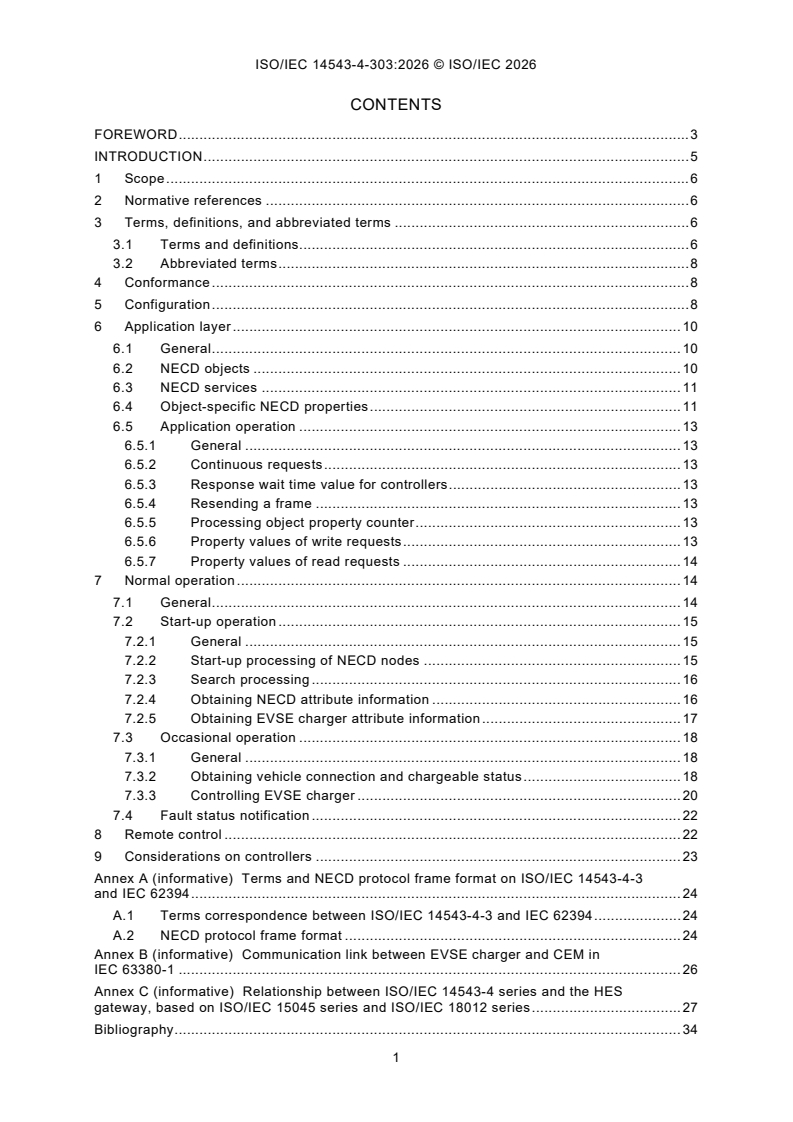
CONTENTS
FOREWORD . 3
INTRODUCTION . 5
1 Scope . 6
2 Normative references . 6
3 Terms, definitions, and abbreviated terms . 6
3.1 Terms and definitions. 6
3.2 Abbreviated terms . 8
4 Conformance . 8
5 Configuration . 8
6 Application layer . 10
6.1 General . 10
6.2 NECD objects . 10
6.3 NECD services . 11
6.4 Object-specific NECD properties . 11
6.5 Application operation . 13
6.5.1 General . 13
6.5.2 Continuous requests . 13
6.5.3 Response wait time value for controllers . 13
6.5.4 Resending a frame . 13
6.5.5 Processing object property counter . 13
6.5.6 Property values of write requests . 13
6.5.7 Property values of read requests . 14
7 Normal operation . 14
7.1 General . 14
7.2 Start-up operation . 15
7.2.1 General . 15
7.2.2 Start-up processing of NECD nodes . 15
7.2.3 Search processing . 16
7.2.4 Obtaining NECD attribute information . 16
7.2.5 Obtaining EVSE charger attribute information . 17
7.3 Occasional operation . 18
7.3.1 General . 18
7.3.2 Obtaining vehicle connection and chargeable status . 18
7.3.3 Controlling EVSE charger . 20
7.4 Fault status notification . 22
8 Remote control . 22
9 Considerations on controllers . 23
Annex A (informative) Terms and NECD protocol frame format on ISO/IEC 14543-4-3
and IEC 62394 . 24
A.1 Terms correspondence between ISO/IEC 14543-4-3 and IEC 62394 . 24
A.2 NECD protocol frame format . 24
Annex B (informative) Communication link between EVSE charger and CEM in
IEC 63380-1 . 26
Annex C (informative) Relationship between ISO/IEC 14543-4 series and the HES
gateway, based on ISO/IEC 15045 series and ISO/IEC 18012 series . 27
Bibliography . 34
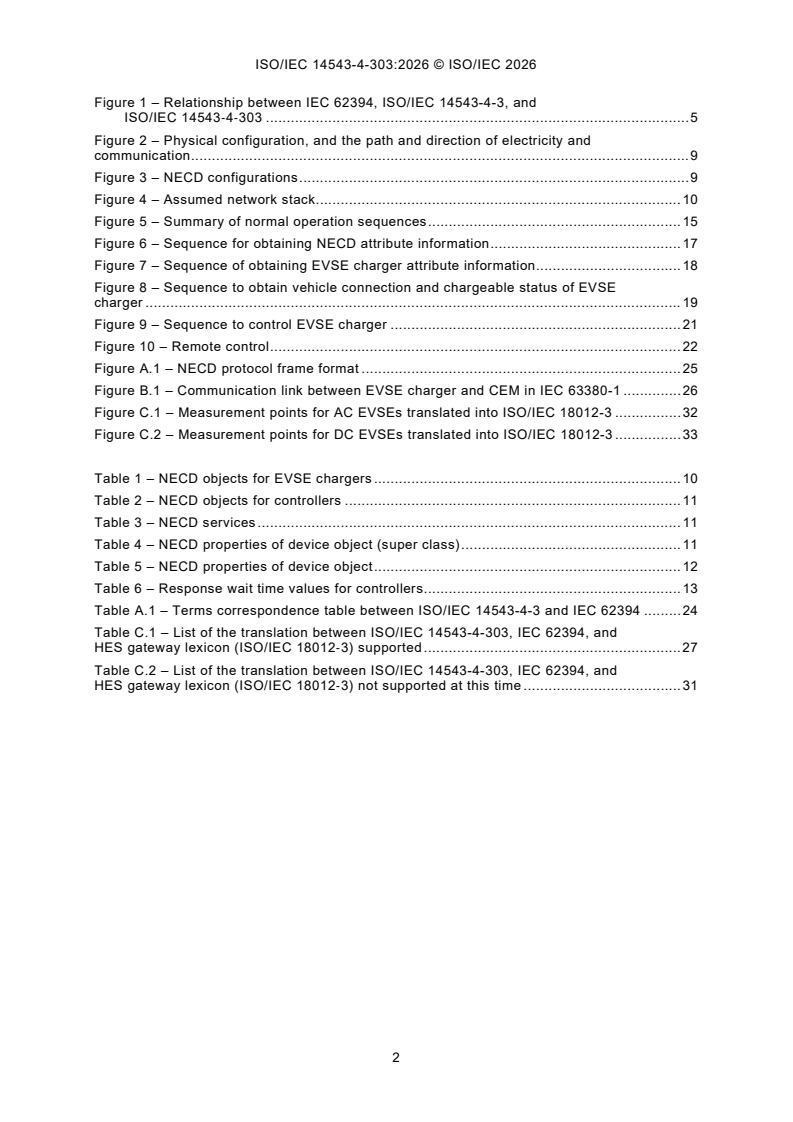
Figure 1 – Relationship between IEC 62394, ISO/IEC 14543-4-3, and
ISO/IEC 14543‑4‑303 . 5
Figure 2 – Physical configuration, and the path and direction of electricity and
communication . 9
Figure 3 – NECD configurations . 9
Figure 4 – Assumed network stack. 10
Figure 5 – Summary of normal operation sequences . 15
Figure 6 – Sequence for obtaining NECD attribute information . 17
Figure 7 – Sequence of obtaining EVSE charger attribute information . 18
Figure 8 – Sequence to obtain vehicle connection and chargeable status of EVSE
charger . 19
Figure 9 – Sequence to control EVSE charger . 21
Figure 10 – Remote control . 22
Figure A.1 – NECD protocol frame format . 25
Figure B.1 – Communication link between EVSE charger and CEM in IEC 63380-1 . 26
Figure C.1 – Measurement points for AC EVSEs translated into ISO/IEC 18012-3 . 32
Figure C.2 – Measurement points for DC EVSEs translated into ISO/IEC 18012-3 . 33
Table 1 – NECD objects for EVSE chargers . 10
Table 2 – NECD objects for controllers . 11
Table 3 – NECD services . 11
Table 4 – NECD properties of device object (super class) . 11
Table 5 – NECD properties of device object . 12
Table 6 – Response wait time values for controllers . 13
Table A.1 – Terms correspondence table between ISO/IEC 14543-4-3 and IEC 62394 . 24
Table C.1 – List of the translation between ISO/IEC 14543-4-303, IEC 62394, and
HES gateway lexicon (ISO/IEC 18012‑3) supported . 27
Table C.2 – List of the translation between ISO/IEC 14543-4-303, IEC 62394, and
HES gateway lexicon (ISO/IEC 18012‑3) not supported at this time . 31
Information technology -
Home Electronic System (HES) architecture -
Part 4-303: Application protocol for electric vehicle
supply equipment (EVSE) chargers and controllers
FOREWORD
1) ISO (the International Organization for Standardization) and IEC (the International Electrotechnical Commission)
form the specialized system for worldwide standardization. National bodies that are members of ISO or IEC
participate in the development of International Standards through technical committees established by the
respective organization to deal with particular fields of technical activity. ISO and IEC technical committees
collaborate in fields of mutual interest. Other international organizations, governmental and non-governmental,
in liaison with ISO and IEC, also take part in the work.
2) The formal decisions or agreements of IEC and ISO on technical matters express, as nearly as possible, an
international consensus of opinion on the relevant subjects since each technical committee has representation
from all interested IEC and ISO National bodies.
3) IEC and ISO documents have the form of recommendations for international use and are accepted by IEC and
ISO National bodies in that sense. While all reasonable efforts are made to ensure that the technical content of
IEC and ISO documents is accurate, IEC and ISO cannot be held responsible for the way in which they are used
or for any misinterpretation by any end user.
4) In order to promote international uniformity, IEC and ISO National bodies undertake to apply IEC and
ISO documents transparently to the maximum extent possible in their national and regional publications. Any
divergence between any IEC and ISO document and the corresponding national or regional publication shall be
clearly indicated in the latter.
5) IEC and ISO do not provide any attestation of conformity. Independent certification bodies provide conformity
assessment services and, in some areas, access to IEC and ISO marks of conformity. IEC and ISO are not
responsible for any services carried out by independent certification bodies.
6) All users should ensure that they have the latest edition of this document.
7) No liability shall attach to IEC and ISO or their directors, employees, servants or agents including individual
experts and members of its technical committees and IEC and ISO National bodies for any personal injury,
property damage or other damage of any nature whatsoever, whether direct or indirect, or for costs (including
legal fees) and expenses arising out of the publication, use of, or reliance upon, this ISO/IEC document or any
other IEC and ISO documents.
8) Attention is drawn to the Normative references cited in this document. Use of the referenced publications is
indispensable for the correct application of this document.
9) IEC and ISO draw attention to the possibility that the implementation of this document may involve the use of (a)
patent(s). IEC and ISO take no position concerning the evidence, validity or applicability of any claimed patent
rights in respect thereof. As of the date of publication of this document, IEC and ISO had not received notice of
(a) patent(s), which may be required to implement this document. However, implementers are cautioned that this
may not represent the latest information, which may be obtained from the patent database available at
https://patents.iec.ch and www.iso.org/patents. IEC and ISO shall not be held responsible for identifying any or
all such patent rights.
ISO/IEC 14543-4-303 has been prepared by subcommittee 25: Interconnection of information
technology equipment, of ISO/IEC joint technical committee 1: Information technology. It is an
International Standard.
The text of this International Standard is based on the following documents:
Draft Report on voting
JTC1-SC25/3321/CDV JTC1-SC25/3346A/RVC
Full information on the voting for its approval can be found in the report on voting indicated in
the above table.
The language used for the development of this International Standard is English.
The list of all currently available parts of the ISO/IEC 14543 series, under the general title
Information technology - Home Electronic System (HES) architecture, can be found on the IEC
website and ISO website.
This document was drafted in accordance with ISO/IEC Directives, Part 2, and developed in
accordance with ISO/IEC Directives, Part 1, available at
www.iec.ch/members_experts/refdocs and www.iso.org/directives.
INTRODUCTION
The ISO/IEC 14543 series provides networking capability for a wide range of appliances,
equipment, sensors, etc. in the home, including lighting, heating, and cooling. This part of
ISO/IEC 14543 specifies the detailed procedures and behaviours of both electric vehicle supply
equipment (EVSE) chargers and controllers at the application level of communications based
on ISO/IEC 14543-4-3. This document specifies the message structure, sequences, and
protocol of the application layer for networked enhanced control devices (NECDs) used in the
Home Electronic System (HES). Some services are targeted for communications between
devices. Other services are exclusively reserved for management purposes. Some services can
be used for both management and run-time communications. This document is applicable for
energy management services involving EVSE chargers and related devices.
Figure 1 shows the relationship between IEC 62394, ISO/IEC 14543-4-3 and
ISO/IEC 14543-4-303. ISO/IEC 14543-4-3 specifies the message structure, sequences and
protocol for general-purpose communications used in network enhanced control devices of the
Home Electronic System (HES) Class 1. ISO/IEC 14543-4-3 provides the common interfaces
for the use-level process and the services such as energy management, remote maintenance,
and other services for easily building a system consisting of multi-vendor devices and
equipment. IEC 62394 specifies the detailed lists of control commands on NECD objects (see
ISO/IEC 14543-4-3). Annex A shows terms and NECD protocol frame format on
ISO/IEC 14543-4-3 and IEC 62394.
Application protocol:
ISO/IEC 14543-4-303
specified for each device class
Application layer
Control commands IEC 62394
NECD Protocol ISO/IEC 14543-4-3
Transport layer
Network layer
MAC layer
PHY layer
Figure 1 – Relationship between IEC 62394, ISO/IEC 14543-4-3, and ISO/IEC 14543‑4‑303
ISO/IEC 14543-4-3 is a general-purpose communications specification that applies to a variety
of devices. ISO/IEC 14543-4-3 is the basis for this document, which specifies detailed
procedures and behaviours for pre-packaged system solutions that include EVSE chargers and
related devices. The procedures and behaviours specified in this document can be used for
energy flow inside a home or energy flow between the grid and a home.
In order to enhance interoperability, it is important to specify how to implement
ISO/IEC 14543-4-3 for each device and controller at the application level such as command
sequences, timeout requirements, required combinations of acceptable commands, minimum
subset of IEC 62394 properties, etc.
This document applies to the communication link in yellow between charging station (EVSE
charger) and energy management system (EMS) as shown in Annex B.
For an EVSE that is capable of transferring electricity both from home or grid to EV and from
EV to home or grid, see ISO/IEC 14543-4-304.
1 Scope
This part of ISO/IEC 14543 specifies an application-layer protocol important for ensuring
interoperability among the products of various manufacturers regarding communications
between electric vehicle supply equipment (EVSE) chargers and controllers. It uses the network
enhanced communications device (NECD) protocol specified in ISO/IEC 14543-4-3. This
protocol is based on UDP using IPv4 or IPv6 (TCP is optional).
2 Normative references
The following documents are referred to in the text in such a way that some or all of their content
constitutes requirements of this document. For dated references, only the edition cited applies.
For undated references, the latest edition of the referenced document (including any
amendments) applies.
IEC 62394, Service diagnostic interface for consumer electronics products and networks -
Implementation for ECHONET
ISO/IEC 14543-4-3, Information technology - Home Electronic System (HES) architecture -
Part 4-3: Application layer interface to lower communications layers for network enhanced
control devices of HES Class 1
3 Terms, definitions, and abbreviated terms
3.1 Terms and definitions
For the purposes of this document the following terms and definitions apply.
ISO and IEC maintain terminology databases for use in standardization at the following
addresses:
– IEC Electropedia: available at https://www.electropedia.org/
– ISO Online browsing platform: available at https://www.iso.org/obp
3.1.1
controller
network enhanced control device (NECD) node that sends NECD requests (Get and SetC) to
another NECD node
Note 1 to entry: A controller in this document can be used as a part of a customer energy manager (CEM) specified
in IEC 63380-1.
Note 2 to entry: A controller in this document can be used with an energy management agent (EMA) specified in
ISO/IEC 15067-3.
3.1.2
device object
network enhanced control device (NECD) object other than a node profile object
Note 1 to entry: In this document, "device object" refers to electric vehicle charger object only.
[SOURCE: ISO/IEC 14543-4-302:2023, 3.1.3, modified – In Note 1 to entry, "storage battery"
has been replaced with "electric vehicle charger".]
3.1.3
electric vehicle
EV
vehicle that is powered by an electric motor that draws electricity from a battery and is capable
of being charged from an external source
Note 1 to entry: In this document, "electric vehicle" refers to both a vehicle that is only powered by an electric motor
that draws electricity from a battery and a vehicle that is powered by an electric motor that draws electricity from a
battery and by an internal combustion engine.
Note 2 to entry: In this document, "electric vehicle" refers to both a vehicle that contains a device that converts
alternating current (AC) voltage to direct current (DC) voltage (e.g. inverter) and a vehicle that does not contain a
device that converts AC voltage to DC voltage.
3.1.4
electric vehicle supply equipment
EVSE
device that transfers electricity between electric vehicle and home or grid
Note 1 to entry: In this document, "electric vehicle supply equipment" refers to both a device that contains a device
that converts alternating current (AC) voltage to direct current (DC) voltage (e.g. inverter) and a device that does not
contain a device that converts AC voltage to DC voltage.
Note 2 to entry: In this document, "electric vehicle supply equipment" refers to a device that supports primarily
single-family residential applications.
3.1.5
electric vehicle supply equipment charger
EVSE charger
electric vehicle supply equipment that includes a communications interface of NECD protocol
and is capable of managing the transfer of electricity from home or grid to electric vehicle (EV)
and includes a communications interface to receive network enhanced control device (NECD)
messages
Note 1 to entry: In this document, "electric vehicle supply equipment charger" refers primarily to an EVSE that is
not capable of transferring electricity from an EV to home or grid using the NECD protocol.
3.1.6
NECD protocol
protocol used in network enhanced control device (NECD) communications
[SOURCE: ISO/IEC 14543-4-302:2023, 3.1.5]
3.1.7
node profile
description of objects implemented in each node
[SOURCE: ISO/IEC 14543-4-302:2023, 3.1.6]
3.1.8
remote control
control from outside the home
[SOURCE: ISO/IEC 14543-4-302:2023, 3.1.9]
3.1.9
response wait time
time between a controller request to an electric vehicle supply equipment (EVSE) charger and
the response from an electric vehicle supply equipment charger
3.1.10
super class
properties that are inherited and implemented in all device objects
[SOURCE: ISO/IEC 14543-4-302:2023, 3.1.11]
3.2 Abbreviated terms
AC alternating current
DC direct current
DNOJ destination NECD object
EV electric vehicle
EVSE electric vehicle supply equipment
IP internet protocol
NDATA NECD data
NDT NECD property value data
NECD network enhanced control device
NHD NECD header
NPC NECD property code
NSV NECD service
OPC object property counter
PDC property data counter
SNOJ source NECD object
TID transaction ID
UDP user datagram protocol
4 Conformance
EVSE chargers and controllers of HES Class 1 that claim conformance to this document shall:
– send, receive and process sequences and procedures as specified in Clause 7.
– provide application services and properties specified in 6.2, 6.3, and 6.4 as needed by EVSE
chargers and controllers for which the application is intended.
5 Configuration
This document is necessary for ensuring interoperability between the products of different
manufacturers in connection with application communications between EVSE chargers and
controllers, using the NECD protocol as an application protocol via UDP (TCP) and IPv6
communications.
Figure 2 shows the physical configuration in this document and the path and direction of
electricity and communication. As shown in Figure 2, this document considers the electricity
that is transferred from home or grid to EV only. This document does not specify any
requirement about the connector, data, and electricity between electric vehicle (EV) and EVSE.
Any type of connector, data, and electricity can be used between EV and EVSE that are referred
to in this document.
Figure 2 – Physical configuration, and the path and direction
of electricity and communication
Figure 3 shows the NECD configurations assumed in this document.
a
"Electric vehicle charger class object" is a device object specified in IEC 62394.
Figure 3 – NECD configurations
The upper illustration in Figure 3 shows the case where a single device object is installed in a
single node. The lower illustration shows the case where multiple device objects are installed
in a single node. The latter case occurs when multiple EVSE charger units are attached to a
single communications unit. In this case, there are multiple electric vehicle charger class objects
in a single EVSE charger node (i.e. at a single IP address). Controllers shall support nodes that
configure multiple device objects in a single node.
Controllers shall be capable of handling multiple nodes and objects. The maximum number of
nodes and objects to be handled is implementation-dependent on the controllers. In the
environment where multiple controllers exist on the same network, an EVSE charger shall
respond to the latest command from any controller.
Figure 4 shows the assumed network stack for operating the NECD protocol in this document.
NECD protocol operation is assumed as an application protocol on UDP(TCP) and IPv6.
TCP installation is optional. As a rule, the stack uses IPv6; however, IPv4 is allowed depending
on the market trends for migration from IPv4 to IPv6.
ISO/IEC 14543-4-303
Application layer IEC 62394
ISO/IEC14543-4-3
Transport layer UDP(TCP)
Network layer IPv6 or IPv4
a
(Adaptation layer) (6LoWPAN )
MAC layer (No specific MAC layer assumed)
PHY layer (No specific PHY layer assumed)
a
Depends on transmission media using IPv6.
Figure 4 – Assumed network stack
Connection processing specific to each lower layer communications medium that is necessary
in advance of the start of NECD communications is out of the scope of this document. In this
document, application communications using the NECD protocol are specified on the
assumption that connection processing specific to those communications media is complete.
6 Application layer
6.1 General
The NECD protocol shall be used at the application layer. All nodes that conform to this
document shall support all mandatory functions specified in ISO/IEC 14543-4-3.
6.2 NECD objects
EVSE chargers shall have the NECD objects shown in Table 1. Controllers shall have the NECD
objects shown in Table 2.
Table 1 – NECD objects for EVSE chargers
Class group
NECD object Class code Class name Instance code
code
0x02 0xA1 Electric vehicle charger 0x01 to 0x7F
EVSE charger
0x0E 0xF0 Node profile 0x01
NOTE 1 Instance code 0x00 is designated to specify all instances of the same class in a node.
Table 2 – NECD objects for controllers
Class group
NECD object Class code Class name Instance code
code
0x05 0xFF Controller 0x01 to 0x7F
Controller
0x0E 0xF0 Node profile 0x01
NOTE 2 Instance code 0x00 is designated to specify all instances of the same class in a node.
6.3 NECD services
EVSE chargers and controllers shall support the NECD services shown in Table 3.
Table 3 – NECD services
NSV code NECD service content Symbol Sender
0x51 Property value write "response-not-possible" response SetC_SNA EVSE charger
0x52 Property value read "response-not-possible" response Get_SNA EVSE charger
0x61 Property value write request (response required) SetC Controller
0x62 Property value read request Get Controller
0x71 Property value write response Set_Res EVSE charger
0x72 Property value read response Get_Res EVSE charger
0x73 Property value notification INF Controller and
EVSE charger
6.4 Object-specific NECD properties
EVSE chargers shall install the NECD properties of a device object shown in Table 4 and
Table 5. NECD properties of a node profile object shall support at least the mandatory
properties.
Controllers shall send requests to the device object properties shown in Table 4 and Table 5.
Table 4 – NECD properties of device object (super class)
Access rule
Announcement at
Property name NPC Units Remarks
status change
Get Set
Installation location 0x81 - M M M
Standard version information 0x82 - M - -
Identification number 0x83 - O - -
Fault status 0x88 - M - M
Manufacturer code 0x8A - M - -
Status change announcement
- - -
0x9D M
property map
Set property map 0x9E - M - -
Get property map 0x9F - M - -
M: mandatory, O: optional, -: not supported
Table 5 – NECD properties of device object
Access rule
Announcement at
Property name NPC Units Remarks
status change
Get Set
Operation status 0x80 - M - M
a
Rated charge capacity 0xC5 W M - -
Vehicle connection and chargeable
0xC7 - M - M
status
Charger type 0xCC - M - -
b
- - -
Vehicle connection confirmation 0xCD M
Chargeable capacity of vehicle
a, c
0xCE Wh M - -
mounted battery
Remaining chargeable capacity of
a, c
0xCF Wh M - -
vehicle mounted battery
Used capacity of vehicle-mounted
a, c, e, f
0xD0 Wh M - -
battery 1
Operating mode setting 0xDA - M M M
Remaining stored electricity of vehicle-
a, d, e
0xE2 Wh M - -
mounted battery 1
Remaining stored electricity of vehicle-
d, e
0xE4 % M - -
mounted battery 3
Vehicle ID 0xE6 M - -
M: mandatory, -: not supported
a
These properties are calculated as AC.
b
This property is mandatory only when property value of "Charger type" property [0xCC] is "DC_type AA
(charging only)" (0x21).
c
These properties are mandatory only when applicable information is provided by the EV that connects to the
EVSE charger. When the EVSE charger cannot reply, the EVSE charger shall reply Get_SNA [0x52].
d
One of them is mandatory when applicable information is provided by the EV that connects to the EVSE
charger.
e
The number at the end of the property name (1 or 3) does not express the difference of the physical battery
but expresses the difference of the unit. "1" is expressed in watt-hours (Wh) and "3" is expressed as a
percentage (%).
f
"Used capacity" is the same as "useable capacity".
The details of the properties shown in Table 4 and Table 5 are specified in IEC 62394 "Electric
vehicle charger class specifications". If a discrepancy between IEC 62394 and this document
exists, the description in this
...