


July 2026: Key Standards for Mechanical Components—Fasteners and Rolling Bearings Update
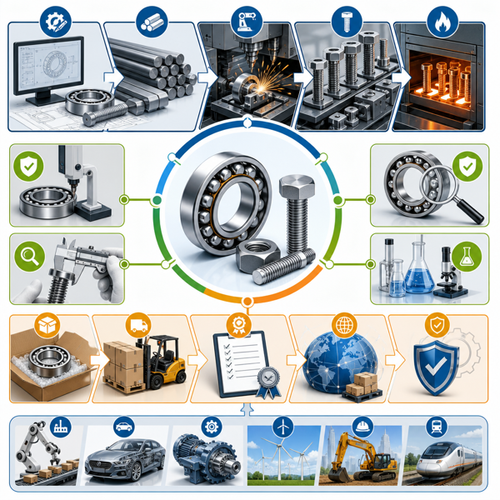
July 2026 Brings Major Advances in Mechanical Component Standards
July 2026 marks a significant milestone in the field of Mechanical Systems and Components for General Use with the publication of two pivotal international standards. These new ISO standards bring essential updates to fastener bolt/nut assembly calculations and rolling bearing subassemblies—setting new benchmarks for safety, reliability, and interoperability. For industry professionals, engineers, and compliance leaders, understanding these standards now is key to future-ready operations.
Overview
Mechanical systems and components are the unsung heroes of every modern industry, from automotive and manufacturing to infrastructure and energy. Rigorous standards are foundational in this sector, ensuring that parts such as fasteners and bearings function safely and interchangeably, even under demanding conditions. With evolving technologies and stricter regulatory climates, updated standards like those issued in July 2026 help stakeholders:
- Minimize failures and costly downtime
- Bolster product quality and consistency
- Accelerate market access and global trade
This article explores:
- The scope and requirements of ISO 16224:2026 and ISO 19457:2026
- Who should implement these standards and the practical implications
- Key changes and how they impact your compliance strategies
Detailed Standards Coverage
ISO 16224:2026 – Fasteners — Calculation Methods for Bolt/Nut Assemblies — Nut Design
Fasteners — Calculation methods for bolt/nut assemblies — Nut design
This international standard defines calculation methods for nuts designed to mate with bolts, screws, and studs (per ISO 898-1), focusing on bolted joints subjected to tensile loads, tension, and torsion. The document covers three main failure modes: bolt breaking, bolt thread stripping, and nut thread stripping. By detailing precise calculation formulas and influencing factors, it provides both theoretical rigor and practical guidance for engineers.
Key applicable nut types include:
- Steel hexagon nuts with ISO metric threads (fine and coarse pitches)
- Diameters 5 mm to 39 mm (including some outside ISO 898-2 via Annex C)
The standard also covers non-standard nuts or internally threaded parts with ISO metric threads, and addresses the impact of dimensional specifics and tolerances on joint performance.
Major technical provisions:
- Calculation methods: Explicit formulas for fracture loads—including bolt breaking, bolt thread stripping, and nut thread stripping—as functions of nut geometry, material properties, and thread design.
- Critical nut height: Criteria derived from Alexander’s theory ensuring the stripping load of an assembly matches or exceeds the bolt’s breaking load, thereby reducing undetectable failures.
- Influencing variables: Annex A details impact of aspects like nut width across flats, flange shape, and thread tolerances.
- Test and proof loads: Procedures and criteria for proof load testing using hardened mandrels and defined hardness minima (Vickers hardness HV). Includes conversion formulas for material strength and hardness.
- Coverage: Both standard (ISO 898-2) and non-standard nut sizes/styles for broad industrial application.
Who needs to comply:
- Mechanical and structural engineers designing bolted joints
- Manufacturers of fasteners and assembled components
- Quality managers ensuring joint reliability under load
- Industrial users in sectors like automotive, construction, and machinery
Implementation and impact: The new, formal International Standard (previously a Technical Report) gives clearer traceability to nut design, testing, and safety verification. It also specifies requirements for establishing minimum nut height or hardness based on bolt property class and loads. Improved formulas and explicit calculation methods mean easier compliance checks and more robust joint assemblies.
Key highlights:
- New, detailed calculation methods based on updated formulas
- Design rules to avoid undetectable thread stripping failures
- Expanded coverage for nuts outside traditional ISO 898-2 range
Access the full standard:View ISO 16224:2026 on iTeh Standards
ISO 19457:2026 – Rolling Bearings — Roller Blocks as Subassemblies for Linear Motion Rolling Bearings — Boundary Dimensions and Tolerance Values
Rolling bearings — Roller blocks as subassemblies for linear motion rolling bearings — Boundary dimensions and tolerance values
Part of the larger domain of linear motion rolling bearings, ISO 19457:2026 provides the global reference for the precise boundary dimensions and tolerances for roller block subassemblies (Types A-D). Roller blocks are critical components in linear bearings, comprising a body with recirculating rollers for smooth, precise movement along rails or guideways. This standard ensures consistency for spare parts, retrofits, and new mechanical assemblies worldwide.
Covered subassembly types:
- Types A to D: Complete technical definitions, drawings, and tolerance charts included
- Types E & F: Provided in Annex A, pending broader manufacturer adoption
Core requirements and features:
- Boundary dimensions: Specifications for width, height, length, and mounting surfaces of roller blocks, per standardized nomenclature and symbols (referencing ISO 15241 and ISO 24393)
- Tolerance values: Clearly defined permissible variances for each critical dimension to guarantee interchangeability and consistent function
- Design variants: Visual diagrams and distinctions for Types A-F, illustrating mounting surfaces, rolling paths, and geometric interfaces
- Terminology: Definitions and illustrations clarifying roller block construction, mounting, and functional surfaces
- Supplementary guidance: Annexes cover rarely produced designs (Types E and F), configuration options, and practical mounting recommendations
Who needs to comply:
- OEMs and suppliers of linear bearings and motion components
- Maintenance and procurement teams handling system replacements or repairs
- Engineers specifying linear motion equipment in machinery and automation
Implementation and implications: This standard remedies previous inconsistencies in spare-part sizing and tolerance management, providing a crucial baseline for global sourcing and maintenance logistics. By formalizing consistent boundary and tolerance requirements, it reduces the risk of fit or functional issues during installation or operation, especially in legacy systems.
Key highlights:
- Unified global criteria for roller block dimensions and tolerances
- Coverage of both prevalent (A–D) and emerging (E, F) designs
- Enhanced guidance for mounting and spare-part selection
Access the full standard:View ISO 19457:2026 on iTeh Standards
Industry Impact & Compliance
Why these standards matter:
Robust, harmonized standards for mechanical components drive quality, safety, and global market access across sectors. Adopting ISO 16224:2026 and ISO 19457:2026 enables organizations to:
- Reduce failure rates: By using validated design and verification methods—minimizing costly downtime and liability
- Streamline procurement: With clear, referenced specifications, supply-chain partners can more confidently source interchangeable parts
- Fulfill regulatory and customer requirements: Global customers increasingly demand ISO-aligned documentation for bids, tenders, and project work
Compliance considerations:
- Transition period: Assess your existing component stock and drawings for compliance gaps—prioritize high-risk applications first
- Documentation: Update technical files, product catalogs, and supplier contracts to reference the new standards
- Testing and certification: If required, coordinate with accredited labs to validate fastener performance and roller block tolerances per new criteria
Timelines can vary; immediate adoption is recommended for new design projects, with phased transition for legacy inventory and in-field components.
Benefits of proactive adoption:
- Enhanced design integrity and reduced warranty claims
- Faster market approvals, especially in international trade
- Confidence when specifying or sourcing critical components
Risks of non-compliance:
- Increased failure rates or performance inconsistencies
- Rejection from regulated markets or by major OEM customers
- Higher long-term costs due to redesigns, retrofits, or unplanned outages
Technical Insights
Common Requirements & Best Practices
Both standards exemplify ISO's approach to clarity, precision, and global interoperability:
- Emphasis on failure prevention: Both address critical failure modes—either mechanical strip-out in fasteners or dimensional nonconformity in roller blocks.
- Explicit calculation and tolerance methods: Formula-driven approaches make requirements auditable and repeatable.
- Interchangeability and system reliability: Broad, detailed coverage ensures that new and replacement parts can function together seamlessly, critical for globalized operations.
Implementation Guidance
- Audit Your Designs: Cross-check that all new joints and assemblies reference the correct calculation and tolerance clauses from the updated standards.
- Supplier Engagement: Confirm your vendors are aware of, and can comply with, the new requirements—particularly for non-standard nuts or rare roller block sizes.
- Training: Provide engineering and quality teams a technical briefing on the main changes—especially the calculation steps and new dimensioning rules.
- Testing: For fasteners, ensure correct proof load and stripping load testing. For roller blocks, use the prescribed symbols and nominal/tolerance values in quality control.
Certification tips:
- Update quality management system (QMS) documentation
- Maintain records of material certifications and test reports
- Reference the specific 2026 edition in all technical correspondence
Conclusion & Next Steps
Key takeaways:
The two new standards—ISO 16224:2026 for fasteners and ISO 19457:2026 for linear bearing roller block subassemblies—usher in a new era of precision, safety, and interoperability for mechanical systems. Whether you're designing new equipment, sourcing critical parts, or ensuring legacy system compatibility, these documents are indispensable references.
Recommendations:
- Review and integrate these new standards into your engineering and procurement workflows immediately
- Train staff and update documentation to reflect the latest requirements
- Leverage iTeh Standards for access to the full texts, supporting interpretations, and additional resources
For the most current, authoritative content on mechanical component standards and implementation strategies, continue to explore iTeh Standards.
Categories
- Latest News
- New Arrivals
- Generalities
- Services and Management
- Natural Sciences
- Health Care
- Environment
- Metrology and Measurement
- Testing
- Mechanical Systems
- Fluid Systems
- Manufacturing
- Energy and Heat
- Electrical Engineering
- Electronics
- Telecommunications
- Information Technology
- Image Technology
- Precision Mechanics
- Road Vehicles
- Railway Engineering
- Shipbuilding
- Aircraft and Space
- Materials Handling
- Packaging
- Textile and Leather
- Clothing
- Agriculture
- Food technology
- Chemical Technology
- Mining and Minerals
- Petroleum
- Metallurgy
- Wood technology
- Glass and Ceramics
- Rubber and Plastics
- Paper Technology
- Paint Industries
- Construction
- Civil Engineering
- Military Engineering
- Entertainment