


August 2026: New Tool Interface Standards Advance Manufacturing Engineering
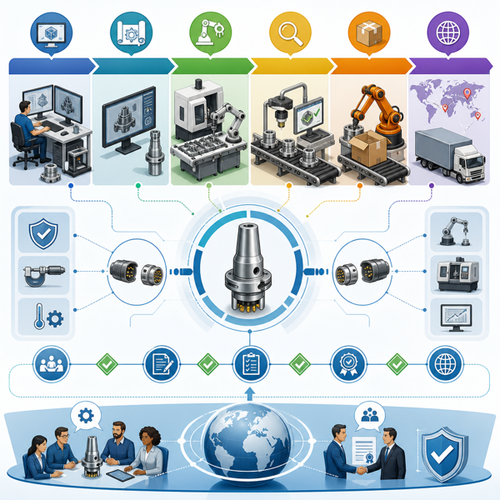
The manufacturing engineering sector takes a significant leap forward this August 2026, with two newly released international standards that further define interoperability and automation across advanced machine tools. The latest entries in the ISO 26622 series focus on modular taper interfaces with ball track systems employing four locking elements—a vital innovation supporting efficient and reliable tool changes in modern manufacturing environments.
These paired standards—ISO 26622-3:2026 and ISO 26622-4:2026—provide detailed dimensional requirements for shanks and receivers, ensuring seamless integration across a wide array of lathe, milling, drilling, and combined machine centers. Professionals across the manufacturing industry should take notice, as these standards pave the way for improved productivity, higher quality, and global alignment in tooling interfaces.
Overview / Introduction
Precision and flexibility are the cornerstones of modern manufacturing, where machine tools must adapt quickly to changing production needs. International standards play a critical role in this landscape, offering unified specifications that promote seamless component interchangeability, automated tool exchange, and reduced downtime. For manufacturers, compliance with these standards is more than a regulatory requirement—it's a strategic advantage.
In this article, you’ll find a practical breakdown of the two latest standards published in August 2026 for modular taper interface systems. We detail what each covers, highlight essential requirements, and explain what they mean for your business’s compliance, performance, and competitiveness.
Detailed Standards Coverage
ISO 26622-3:2026 - Modular Taper Interface Ball Track System – Shanks with Four Locking Elements
Modular taper interface with ball track system — Part 3: Dimensions of shanks for interface utilizing four locking elements
ISO 26622-3:2026 establishes comprehensive dimensional requirements for tapered shanks used in modular taper interfaces featuring ball track systems with four locking elements. These shanks are vital for both automatic and manual tool exchange across a broad spectrum of machine tools, including lathes, drilling, milling, and turn/milling centers.
Standard scope and technical requirements:
- Specifies a range of shank sizes, adapted for different machine tool applications.
- Details flange design with integrated groove—enabling reliable engagement in automatic tool changers, while also allowing manual operation when needed.
- Addresses critical features for coolant management (sealing tubes and O-rings), with reference to Annex A and B for high-pressure fluid applications.
- Requires strict adherence to geometrical tolerances per ISO 8015 and ISO 22081 for accuracy and repeatability.
- Stipulates surface profiles, material selection, heat treatment, and balancing requirements to ensure long-term durability and safety.
- Emphasizes standardized locking ball sizes to simplify tool integration and servicing.
Who needs to comply?
- Machine tool OEMs and system integrators
- Manufacturers of modular tooling systems
- Precision engineering workshops using automated CNC equipment
- Quality and procurement teams specifying tooling interfaces
Practical implications: Implementing this standard ensures consistent performance in tool exchange systems, reduces setup and verification times, and enables global sourcing of compatible modular tooling. For organizations striving to meet Industry 4.0 objectives, strict compliance with dimensional and material requirements facilitates real-time tool management and predictive maintenance strategies.
Key highlights:
- Unified dimensional standards for a wide range of machine tool shank sizes
- Enhanced reliability in automated and manual tool exchange
- Comprehensive guidance on coolant sealing and tolerance management
Access the full standard:View ISO 26622-3:2026 on iTeh Standards
ISO 26622-4:2026 - Modular Taper Interface Ball Track System – Receivers with Four Locking Elements
Modular taper interface with ball track system — Part 4: Dimensions of receivers for interface utilizing four locking elements
ISO 26622-4:2026 complements Part 3 by specifying the critical dimensions for tapered receivers used in the same class of modular taper interface systems. The receiver is the interface component installed in the spindle or machine head that mates with standardized shanks—ensuring positive engagement, accurate torque transmission, and consistency across tool changes.
Standard scope and technical requirements:
- Details dimensional parameters for several receiver sizes, aligning with the shank sizes defined in Part 3.
- Defines features for both automatic and manual tool exchange systems, including specific design tolerances and clamping force specifications.
- Places a strong focus on friction and locking ball element engagement, supporting robust torque transfer without slippage.
- Prescribes suitable materials and heat treatments to ensure conformity, reliability, and safety under industrial conditions.
- Offers recommendations on balancing and maintenance to maximize equipment longevity.
Who needs to comply?
- Machine tool builders, spindle manufacturers, and automation solution providers
- Engineering firms developing new CNC platforms
- Maintenance departments aiming to upgrade or retrofit existing equipment
Practical implications: Adopting this standard ensures ongoing compatibility of new or replacement receivers with emerging modular tooling systems. By maintaining alignment with global receiver and shank specifications, users enjoy streamlined procurement, rapid tool swaps, and improved line availability—critical for high-mix, low-volume production environments.
Key highlights:
- Complete specification of receiver dimensions for modular interfaces
- Validation of frictional and mechanical locking systems
- Guidance on robust design, material, and balancing requirements
Access the full standard:View ISO 26622-4:2026 on iTeh Standards
Industry Impact & Compliance
For businesses engaged in advanced machining or equipment supply, compliance with ISO 26622-3:2026 and ISO 26622-4:2026 is rapidly becoming a necessity rather than a choice. As global supply chains align around these standards, organizations will benefit from:
- Faster changeover times: Standardized tool and receiver dimensions speed up both manual and automated tool exchange, reducing costly downtime.
- Simplified quality management: Shared interface definitions simplify incoming inspection, QA documentation, and traceability.
- Enhanced global sourcing: Universally defined shanks and receivers allow users to select from a wider supplier base, supporting procurement flexibility and cost reduction.
Compliance considerations:
- Review current machine tool and tooling interface inventory against the new dimension requirements.
- Update procurement and design specifications to mandate compliance with ISO 26622-3:2026 and ISO 26622-4:2026.
- Train engineering, procurement, and maintenance staff on changes introduced by the new standards.
- Create or update maintenance schedules to reflect recommendations on balancing, lubrication, and inspection.
Timelines:
- ISO standards are globally recognized from the publication date; organizations should plan transition within 6–12 months, or as dictated by customer or regulatory demands.
Risks of non-compliance:
- Inefficient or incompatible tool exchange, leading to increased setup times and reduced productivity
- Higher risk of mechanical failures or safety incidents due to mismatched or improperly dimensioned interfaces
- Barriers to entering new markets or losing contractual opportunities where compliance is required
Technical Insights
Both standards share a technical vision: delivering robust, reliable, and interoperable tooling solutions for highly automated or mixed-manual machining environments.
Common technical requirements include:
- Stringent dimensional tolerances, referencing ISO 8015 and ISO 22081, for both shanks and receivers to guarantee repeatable fit and alignment
- Material and heat treatment guidelines that prevent premature wear, deformation, or loss of clamping force
- Surface finish and geometric accuracy standards to reduce interface friction and maximize lifespan
- Unified locking element dimensions to ensure universal compatibility
Implementation best practices:
- Update engineering drawings and CAD models to reflect the dimensional data and tolerances outlined in both standards.
- Develop supplier qualification processes that require evidence of compliance with ISO 26622-3:2026 and ISO 26622-4:2026.
- Leverage digital technologies such as data chip provisions (see Part 3) for real-time monitoring, predictive maintenance, and rapid identification during tool exchanges.
- Install regular balancing and wear checks on both shank and receiver components to maintain system performance.
Testing and certification considerations:
- Verify all tooling and spindle interfaces against the standard’s dimensional tables.
- Implement acceptance testing for new or incoming components per the relevant ISO guidance.
- Maintain documentation of conformity for audits, regulatory review, or customer assurance.
Conclusion / Next Steps
The August 2026 release of ISO 26622-3:2026 and ISO 26622-4:2026 marks a pivotal moment for the manufacturing engineering community. These harmonized standards enable consistent automated and manual tool exchanges, enhance equipment flexibility, and simplify global supply chains for machine tooling components.
Key takeaways:
- Adherence to these standards drives productivity, safety, and interoperability in machine shops of all sizes.
- Proactive compliance enables smoother procurement, faster integration, and more predictable quality across operations.
- Organizations should immediately review their current practices, update internal documentation, and plan staff training to maximize benefits from these international specifications.
Stay ahead of the curve: Visit iTeh Standards to access the full text of these and related standards. Keep your team informed and your operations compliant as manufacturing engineering continues to evolve.
Categories
- Latest News
- New Arrivals
- Generalities
- Services and Management
- Natural Sciences
- Health Care
- Environment
- Metrology and Measurement
- Testing
- Mechanical Systems
- Fluid Systems
- Manufacturing
- Energy and Heat
- Electrical Engineering
- Electronics
- Telecommunications
- Information Technology
- Image Technology
- Precision Mechanics
- Road Vehicles
- Railway Engineering
- Shipbuilding
- Aircraft and Space
- Materials Handling
- Packaging
- Textile and Leather
- Clothing
- Agriculture
- Food technology
- Chemical Technology
- Mining and Minerals
- Petroleum
- Metallurgy
- Wood technology
- Glass and Ceramics
- Rubber and Plastics
- Paper Technology
- Paint Industries
- Construction
- Civil Engineering
- Military Engineering
- Entertainment