

ISO 26622-4:2026
(Main)Modular taper interface with ball track system — Part 4: Dimensions of receivers for interface utilizing four locking elements
- Abstract
This document specifies dimensions of tapered receivers for modular taper interfaces with ball track system with four locking elements for automatic and manual tool exchange to be applied on machine tools (e.g. lathe machines, drilling machines, milling machines and turn/milling machine centres). A range of receiver sizes is specified. The torque is transmitted by friction and locking elements.
- Status
- Published
- Publication Date
- 02-Aug-2026
- Current Stage
- 6060 - International Standard published
- Start Date
- 03-Aug-2026
- Due Date
- 28-Dec-2025
- Completion Date
- 03-Aug-2026
Buy Documents
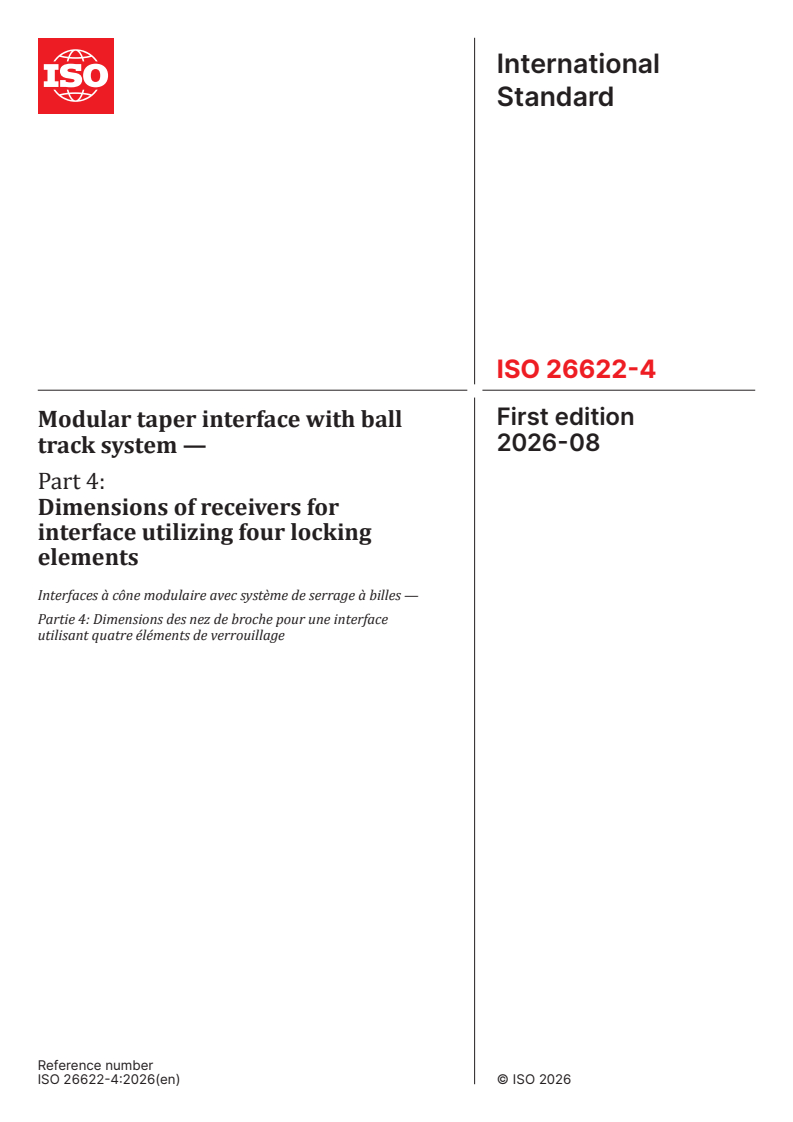
ISO 26622-4:2026 - Modular taper interface with ball track system — Part 4: Dimensions of receivers for interface utilizing four locking elements
ISO 26622-4:2026 - Interfaces à cône modulaire avec système de serrage à billes — Partie 4: Dimensions des nez de broche pour une interface utilisant quatre éléments de verrouillage
ISO 26622-4:2026 is an International Standard from ISO for modular taper interfaces with ball track system. It specifies the dimensions and design features of tapered receivers with four locking elements for automatic and manual tool exchange on machine tools, where torque is transmitted by friction and locking elements.
This part is the receiver side of the interface used on lathes, drilling machines, milling machines and turn/milling machine centres. It gives manufacturers, machine tool builders and inspectors a common basis for sizing, tolerancing, designation and practical application.
What does ISO 26622-4:2026 specify?
ISO 26622-4:2026 specifies the tapered receivers for modular taper interfaces with ball track system using four locking elements. The document is focused on the receiver geometry, the associated design rules and a designation method for the receiver sizes covered.
The document is organized into clauses for scope, normative references, terms and definitions, dimensions, design and designation, followed by an informative annex and a bibliography. Annex A gives application guidance rather than mandatory requirements.
| Annex | What it covers |
|---|---|
| Annex A | Recommendation for use and application, including clamping forces and information on speeds, torque transmitting capacities, bending loads and stiffness |
What are the key requirements of ISO 26622-4:2026?
ISO 26622-4:2026 combines geometric tolerancing, fixed receiver dimensions, clamping performance and material requirements. In practice, that means the receiver must be manufactured, checked and identified in a controlled way so it mates correctly with the matching shank.
General tolerances and geometry
Clause 4.1 states that tolerances follow ISO 8015 and ISO 22081. The document also sets a surface profile condition relative to primary datum A, and it directs the user to Tables 1 and 2 for unspecified linear and angular deviations. For a manufacturer, this means the receiver cannot be treated as a free-form part - its general size and shape limits are part of the standard.
Receiver dimensions
Clause 4.2 says the tapered receiver dimensions shall conform to Figure 1 and Table 3. The standardized receiver sizes are identified by the TS4X designation, with the nominal sizes listed in the table. For design and procurement, this gives a defined family of receivers instead of custom one-off dimensions.
Clamping action
Clause 5.1 requires the clamping system to provide sufficient force to seat the face of the receiver against the shank flange and to seat the taper by elastic deformation. Annex A adds guidance on clamping-force ranges. In practice, the interface has to lock the tool securely enough for the intended machining load, not just fit geometrically.
Material and heat treatment
Clause 5.2 requires TS4X receivers to be made from either tempering steel or case hardening steel, with minimum core strength and surface hardness after hardening, tempering and finish grinding. This matters because the receiver must resist wear and maintain clamping behavior over repeated tool changes.
Designation
Clause 6 gives the designation format for a modular taper receiver with ball track system. The designation combines the product name, the reference to ISO 26622-4:2026, the TS4X symbol and the nominal size. This helps drawings, purchase orders and inspection records identify the exact receiver type without ambiguity.
Who uses ISO 26622-4:2026?
ISO 26622-4:2026 is used by machine tool manufacturers, spindle and tooling designers, and suppliers of modular taper receivers and related interfaces. It is also relevant to quality managers, inspection teams and buyers who need to specify or check compatibility for tool exchange systems.
Typical tasks include defining receiver sizes for a new machine, checking conformance of machined parts, setting up incoming inspection, and writing procurement requirements for compatible tooling. The document is especially relevant where tool exchange must work consistently in automatic and manual systems.
Which standards are used with ISO 26622-4:2026?
- ISO 8015, Geometrical product specifications (GPS) - Fundamentals - Concepts, principles and rules - used for the tolerancing principles applied in Clause 4.
- ISO 22081, Geometrical product specifications (GPS) - Geometrical tolerancing - General geometrical specifications and general size specifications - used for the general tolerances and size rules in Clause 4.
- ISO 26622-3, Modular taper interface with ball track system - Part 3: Dimensions of shanks, four locking elements - the companion part for the matching shank side of the interface.
What does the ISO 26622-4:2026 document contain?
The document contains a scope, normative references, terms and definitions, dimensional requirements, design rules, designation rules, an informative annex and a bibliography. Clause 4 includes a figure for the internal taper and tables for tolerances and receiver dimensions. Clause 5 covers clamping forces and material and heat treatment, while Annex A provides recommended clamping-force ranges and application notes on speed, torque, bending loads and stiffness.
For design work, the tables and figure define the receiver geometry. For testing and inspection, the tolerances and material requirements provide the basis for checking conformance. For application planning, Annex A helps users match clamping force and operating load.
Buy Documents
ISO 26622-4:2026 - Modular taper interface with ball track system — Part 4: Dimensions of receivers for interface utilizing four locking elements
ISO 26622-4:2026 - Interfaces à cône modulaire avec système de serrage à billes — Partie 4: Dimensions des nez de broche pour une interface utilisant quatre éléments de verrouillage
Get Certified
Connect with accredited certification bodies for this standard

DVS-ZERT GmbH
German welding certification society.
CARES (UK Certification Authority for Reinforcing Steels)
UK certification for reinforcing steels and construction.
EWF/IIW (European/International Welding Federation)
International welding personnel certification.
Sponsored listings
Frequently Asked Questions
ISO 26622-4:2026 is a standard published by the International Organization for Standardization (ISO). Its full title is "Modular taper interface with ball track system — Part 4: Dimensions of receivers for interface utilizing four locking elements". This standard covers: This document specifies dimensions of tapered receivers for modular taper interfaces with ball track system with four locking elements for automatic and manual tool exchange to be applied on machine tools (e.g. lathe machines, drilling machines, milling machines and turn/milling machine centres). A range of receiver sizes is specified. The torque is transmitted by friction and locking elements.
This document specifies dimensions of tapered receivers for modular taper interfaces with ball track system with four locking elements for automatic and manual tool exchange to be applied on machine tools (e.g. lathe machines, drilling machines, milling machines and turn/milling machine centres). A range of receiver sizes is specified. The torque is transmitted by friction and locking elements.
ISO 26622-4:2026 is classified under the following ICS (International Classification for Standards) categories: 25.060.20 - Dividing and tool-workpiece holding devices. The ICS classification helps identify the subject area and facilitates finding related standards.
ISO 26622-4:2026 is available in PDF format for immediate download after purchase. The document can be added to your cart and obtained through the secure checkout process. Digital delivery ensures instant access to the complete standard document.
Standards Content (Sample)
International
Standard
ISO 26622-4
First edition
Modular taper interface with ball
2026-08
track system —
Part 4:
Dimensions of receivers for
interface utilizing four locking
elements
Interfaces à cône modulaire avec système de serrage à billes —
Partie 4: Dimensions des nez de broche pour une interface
utilisant quatre éléments de verrouillage
Reference number
© ISO 2026
All rights reserved. Unless otherwise specified, or required in the context of its implementation, no part of this publication may
be reproduced or utilized otherwise in any form or by any means, electronic or mechanical, including photocopying, or posting on
the internet or an intranet, without prior written permission. Permission can be requested from either ISO at the address below
or ISO’s member body in the country of the requester.
ISO copyright office
CP 401 • Ch. de Blandonnet 8
CH-1214 Vernier, Geneva
Phone: +41 22 749 01 11
Email: copyright@iso.org
Website: www.iso.org
Published in Switzerland
ii
Contents Page
Foreword .iv
1 Scope . 1
2 Normative references . 1
3 Terms and definitions . 1
4 Dimensions . 1
4.1 General .1
4.2 Tapered receiver .2
5 Design . 3
5.1 Clamping forces .3
5.2 Material and heat treatment .3
6 Designation . 3
Annex A (informative) Recommendation for use and application . 4
Bibliography . 5
iii
Foreword
ISO (the International Organization for Standardization) is a worldwide federation of national standards
bodies (ISO member bodies). The work of preparing International Standards is normally carried out through
ISO technical committees. Each member body interested in a subject for which a technical committee
has been established has the right to be represented on that committee. International organizations,
governmental and non-governmental, in liaison with ISO, also take part in the work. ISO collaborates closely
with the International Electrotechnical Commission (IEC) on all matters of electrotechnical standardization.
The procedures used to develop this document and those intended for its further maintenance are described
in the ISO/IEC Directives, Part 1. In particular, the different approval criteria needed for the different types
of ISO documents should be noted. This document was drafted in accordance with the editorial rules of the
ISO/IEC Directives, Part 2 (see https://www.iso.org/obp).
ISO draws attention to the possibility that the implementation of this document may involve the use of (a)
patent(s). ISO takes no position concerning the evidence, validity or applicability of any claimed patent
rights in respect thereof. As of the date of publication of this document, ISO had not received notice of (a)
patent(s) which may be required to implement this document. However, implementers are cautioned that
this may not represent the latest information, which may be obtained from the patent database available at
www.iso.org/patents. ISO shall not be held responsible for identifying any or all such patent rights.
Any trade name used in this document is information given for the convenience of users and does not
constitute an endorsement.
For an explanation of the voluntary nature of standards, the meaning of ISO specific terms and expressions
related to conformity assessment, as well as information about ISO's adherence to the World Trade
Organization (WTO) principles in the Technical Barriers to Trade (TBT), see www.iso.org/iso/foreword.html.
This document was prepared by Technical
...
Norme
internationale
ISO 26622-4
Première édition
Interfaces à cône modulaire avec
2026-08
système de serrage à billes —
Partie 4:
Dimensions des nez de broche
pour une interface utilisant quatre
éléments de verrouillage
Modular taper interface with ball track system —
Part 4: Dimensions of receivers for interface utilizing four locking
elements
Numéro de référence
DOCUMENT PROTÉGÉ PAR COPYRIGHT
© ISO 2026
Tous droits réservés. Sauf prescription différente ou nécessité dans le contexte de sa mise en œuvre, aucune partie de cette
publication ne peut être reproduite ni utilisée sous quelque forme que ce soit et par aucun procédé, électronique ou mécanique,
y compris la photocopie, ou la diffusion sur l’internet ou sur un intranet, sans autorisation écrite préalable. Une autorisation peut
être demandée à l’ISO à l’adresse ci-après ou au comité membre de l’ISO dans le pays du demandeur.
ISO copyright office
Case postale 401 • Ch. de Blandonnet 8
CH-1214 Vernier, Genève
Tél.: +41 22 749 01 11
E-mail: copyright@iso.org
Web: www.iso.org
Publié en Suisse
ii
Sommaire Page
Avant-propos .iv
1 Domaine d’application . 1
2 Références normatives . 1
3 Termes et définitions . 1
4 Dimensions . 1
4.1 Généralités .1
4.2 Nez de broche conique .2
5 Conception . 4
5.1 Efforts de serrage . .4
5.2 Matériaux et traitement thermique .4
6 Désignation . 4
Annexe A (informative) Recommandations pour l’utilisation et l’application . 5
Bibliographie . 6
iii
Avant-propos
L'ISO (Organisation internationale de normalisation) est une fédération mondiale d'organismes nationaux
de normalisation (comités membres de l'ISO). L'élaboration des Normes internationales est en général
confiée aux comités techniques de l'ISO. Chaque comité membre intéressé par une étude a le droit de faire
partie du comité technique créé à cet effet. Les organisations internationales, gouvernementales et non
gouvernementales, en liaison avec l'ISO participent également aux travaux. L'ISO collabore étroitement avec
la Commission électrotechnique internationale (IEC) en ce qui concerne la normalisation électrotechnique.
Les procédures utilisées pour élaborer le présent document et celles destinées à sa mise à jour sont
décrites dans les Directives ISO/IEC, Partie 1. Il convient, en particulier, de prendre note des différents
critères d'approbation requis pour les différents types de documents ISO. Le présent document a
été rédigé conformément aux règles de rédaction données dans les Directives ISO/IEC, Partie 2 (voir
www.iso.org/directives).
L’ISO attire l’attention sur le fait que la mise en application du présent document peut entraîner l’utilisation
d’un ou de plusieurs brevets. L’ISO ne prend pas position quant à la preuve, à la validité et à l’applicabilité de
tout droit de propriété revendiqué à cet égard. À la date de publication du présent document, l’ISO n'avait pas
reçu notification qu’un ou plusieurs brevets pouvaient être nécessaires à sa mise en application. Toutefois,
il y a lieu d’avertir les responsables de la mise en application du présent document que des informations
plus récentes sont susceptibles de figurer dans la base de données de brevets, disponible à l'adresse
www.iso.org/brevets. L’ISO ne saurait être tenue pour responsable de ne pas avoir identifié tout ou partie de
tels droits de propriété.
Les appellations commerciales éventuellement mentionnées dans le présent document sont données pour
information, par souci de commodité, à l’intention des utilisateurs et ne sauraient constituer un engagement.
Pour une explication de la nature volontaire des normes, la signification des termes et expressions
spécifiques de l'ISO liés à l'évaluation de la conformité, ou pour toute information au sujet de l'adhésion de
l'ISO aux principes de l’Organisation mondiale du commerce (OMC) concernant les obstacles techniques au
commerce (OTC), voir www.iso.org/avant-propos.
Le présent document a été élaboré par le comité technique ISO/TC 29, Petit outillage, sous-comité SC 9, Outils
à arêtes de coupe définies, éléments coupants, porte-outils, éléments relatifs aux attachements et interfaces.
Une liste de toutes les parties de la série ISO 26622 se trouve sur le site web de l’ISO.
Il convient que l’utilisateur adresse tout retour d’information ou toute question concernant le présent
document à l’organisme na
...