


Key Standards for Road Vehicle Electrical and Electronic Equipment: Ensuring Safety, Connectivity, and Innovation
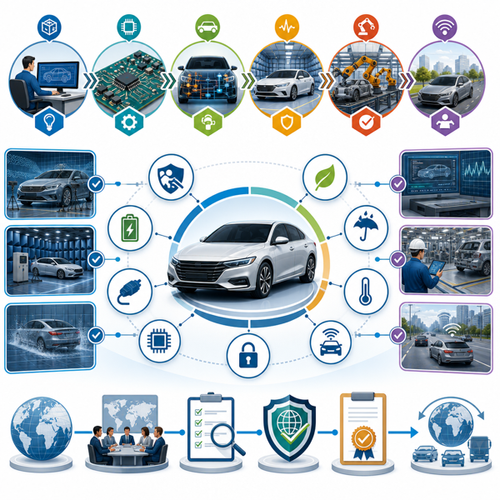
As road vehicles rapidly evolve with innovative technologies—from advanced diagnostics to robust overcurrent protection devices—having a structured, internationally recognized foundation for electrical and electronic systems is not just advantageous, but essential. Businesses, manufacturers, and innovators in the automotive sector are compelled to meet the highest standards of safety, interoperability, and reliability to remain competitive. Here, we present a comprehensive overview of four pivotal ISO standards, providing insights into their scope, requirements, and the tangible benefits they offer for productivity, security, and scalable innovation in road vehicle systems.
Overview / Introduction
The automotive industry's technological landscape is in a period of dynamic transition, integrating complex electronics and smart connectivity into virtually every part of modern road vehicles. Electrical and electronic equipment is now the backbone of advanced driver assistance systems, infotainment, EV powertrains, diagnostics, and much more. Without uniform standards, achieving consistent performance, safety, and regulatory compliance across diverse global markets would be nearly impossible.
That's where international standards—such as ISO 10924-1:2025, ISO 10924-3:2025, ISO 13400-2:2025, and ISO 8820-3:2026—play a critical role. These guidelines not only set baseline expectations for product development and system integration but also empower businesses to:
- Safely scale new technologies
- Enhance product interoperability and user safety
- Streamline regulatory approval processes
- Minimize risks and costly recalls
- Plan for sustainable, connected, and secure mobility
In this article, you'll gain an accessible, in-depth understanding of four key ISO standards shaping the future of electrical and electronic equipment in road vehicles.
Detailed Standards Coverage
ISO 10924-1:2025 - Road Vehicles Circuit Breakers: Definitions and General Test Requirements
Road vehicles — Circuit breakers — Part 1: Definitions and general test requirements
ISO 10924-1:2025 serves as the foundation for all circuit breaker standards applied in modern road vehicles. It defines the terminology and provides comprehensive general test requirements for circuit breakers used in 12 V, 24 V, 48 V, and high-voltage 450 V direct current systems. The standard clarifies the scope of application (excluding holders like fuse-holders), making it relevant for the vast range of vehicles from passenger cars to heavy-duty commercial trucks—including new electric and hybrid models.
Key Requirements & Specifications:
- Standardizes terms such as absolute breaking capacity, rated current, dielectric strength, and more
- Specifies marking, labelling, and colour coding requirements for clear identification
- Lays out rigorous performance tests for voltage drop, housing temperature, environmental exposure (mechanical, climatic, chemical), endurance, and dielectric strength
- Sets out cycling and reset mechanisms (automatic, manual, electric reset, switchable)
Who Needs to Comply?
- Automotive OEMs and suppliers manufacturing or integrating electrical protection devices
- EV and hybrid vehicle engineers seeking to manage higher voltage DC circuits
- Diagnostics and service providers dealing with circuit protection in modern vehicle architectures
Practical Implications: Adherence to ISO 10924-1:2025 is vital for demonstrating product reliability and safety, reducing the risk of electrical failures, and ensuring vehicles pass homologation and regulatory reviews. It provides the essential framework upon which more specialized circuit breaker standards are built.
Notable Features:
- Comprehensive terminology for global alignment
- Universal applicability across voltages from 12 V to 450 V DC
- Robust environmental and mechanical test criteria
Access the full standard:View ISO 10924-1:2025 on iTeh Standards
ISO 10924-3:2025 - Miniature Circuit Breakers with Tabs (Blade Type), Form CB11
Road vehicles — Circuit breakers — Part 3: Miniature circuit breakers with tabs (Blade type), Form CB11
Expanding upon the general principles of Part 1, ISO 10924-3:2025 focuses on miniature blade-type circuit breakers, which have become critical for compact, high-performance vehicle electrical systems. It details the precise requirements for Form CB11 blade-type circuit breakers operating at 12 V and 24 V, with rated current up to 30 A and breaking capacity of 2,000 A.
Key Requirements & Specifications:
- Defines current ratings, test procedures (voltage drop, housing temperature, dielectric strength), and essential dimensions
- Covers various reset and operation types: electric reset, automatic reset, manual, and switchable
- Requires clear marking and colour coding for easy identification
- Establishes performance distinctions compared to similar miniature fuse-links (per ISO 8820-3)
Who Needs to Comply?
- Component suppliers and OEMs producing or sourcing blade-type circuit breakers
- Automotive electrical design engineers responsible for selecting and installing overcurrent protection devices
Practical Implications: This standard ensures that circuit breakers used as alternatives to fuses in tight spaces deliver reliable, consistent performance under the demanding conditions faced in vehicles—protecting sensitive electronics and high-value systems from overcurrent damage.
Notable Features:
- Focused specification for blade-type, plug-in circuit breakers
- Support for up to 30 A, ideal for most low- and mid-power automotive circuits
- Includes electric, manual, auto reset, and switchable functionalities
Access the full standard:View ISO 10924-3:2025 on iTeh Standards
ISO 13400-2:2025 - Diagnostic Communication over Internet Protocol (DoIP): Transport Protocol and Network Layer Services
Road vehicles — Diagnostic communication over Internet Protocol (DoIP) — Part 2: Transport protocol and network layer services
Connectivity is now essential in vehicles, enabling advanced diagnostic, update, and telematics functions. ISO 13400-2:2025 defines the requirements for secure and unsecured diagnostic communication between external clients (such as dealer tools or remote maintenance systems) and in-vehicle networks using IP protocols (both TCP and UDP). The standard governs how vehicles announce themselves, assign IP addresses, handle vehicle discovery, manage concurrent connection attempts, and route data. It defines both mandatory and optional features that allow integration into modern, connected automotive landscapes.
Key Requirements & Specifications:
- Mandates features such as IP address assignment, vehicle discovery, status information retrieval, robust connection management, and error handling
- Optional features include status monitoring, transport layer security (TLS), and firewall capabilities
- Provides layer-by-layer descriptions: Application (APP), Service Interface, Application Layer (AL), Transport Layer (TCP/UDP), Network Layer (IP/ARP/ICMP/IPv6), and Data Link Layer (MAC)
- Defines communication protocols and message sequence charts for practical implementation
Who Needs to Comply?
- Automotive manufacturers and suppliers implementing DoIP-based diagnostics
- Service tool developers and diagnostic equipment manufacturers
- Cybersecurity teams responsible for vehicular data and secure remote access
Practical Implications: By supporting secure, high-speed, and future-proof diagnostic communication, this standard ensures that vehicles are ready for over-the-air updates, remote troubleshooting, and seamless integration into smart transportation ecosystems.
Notable Features:
- Essential for remote diagnostics and ethernet-based vehicle networks
- Enables both secure (TLS) and standard diagnostic channels
- Supports multiple vehicle and subcomponent discovery and concurrent connections
Access the full standard:View ISO 13400-2:2025 on iTeh Standards
ISO 8820-3:2026 - Fuse-Links with Tabs (Blade Type): Type C (Medium), Type E (High Current), and Type F (Miniature)
Road vehicles — Fuse-links — Part 3: Fuse-links with tabs (blade type) Type C (medium), Type E (high current) and Type F (miniature)
ISO 8820-3:2026 defines the specifications for the core range of blade-type fuse-links in modern road vehicles. Covering Type C (medium), Type E (high current), and Type F (miniature), the standard sets out current ratings up to 100 A and breaking capacities up to 1,000 A for systems operating at 32 V or 58 V. This high degree of specificity ensures that fuse-links perform reliably under both normal and extreme electrical conditions.
Key Requirements & Specifications:
- Establishes rated currents, voltage classes, performance and environmental test criteria
- Sets forth marking, labelling, colour coding, and dimension requirements for each fuse type
- Offers detailed procedures for voltage drop, transient current cycling, temperature rise, strength of terminals, and endurance
Who Needs to Comply?
- Fuse manufacturers, automotive parts suppliers, and OEMs
- Electrical and electronic engineers in vehicle system design
- Service, repair, and diagnostic tool providers addressing overcurrent protection
Practical Implications: Adhering to ISO 8820-3:2026 increases the reliability of vehicle power distribution, helps prevent electrical failures and fires, and supports standardization in module design—crucial for vehicles with modular or distributed electrical systems.
Notable Features:
- Includes all major blade fuse types used in today’s vehicles
- Updated temperature limits to suit modern vehicle electrical loads
- Ensures compatibility and interchangeability across global automotive supply chains
Access the full standard:View ISO 8820-3:2026 on iTeh Standards
Industry Impact & Compliance
Modern vehicles depend on integrated electrical and electronic systems for safety, environmental performance, user experience, and legal compliance. These four standards address foundational aspects of the automotive electrical ecosystem:
- Safety & Reliability: Standard-compliant circuit breakers and fuse-links reduce the risk of electrical fires, signal loss, and catastrophic system failures—saving lives and preventing costly recalls.
- Interoperability: With harmonized definitions and test procedures, components manufactured and tested to these standards work predictably across different vehicle platforms, reducing integration costs.
- Regulatory Readiness: International standards are often used as benchmarks in regulatory approvals worldwide, simplifying the path to market in multiple geographies.
- Support for New Technology: As vehicles become more connected and software-driven, robust diagnostic communication protocols (like DoIP) are indispensable for remote maintenance, real-time vehicle monitoring, and cybersecurity.
Risks of Non-Compliance:
- Regulatory delays and market access restrictions
- Increased warranty costs due to inconsistent performance or safety failures
- Difficulty in supporting advanced electronics, smart diagnostics, and customer expectations for connectivity
Implementation Guidance
Implementing these standards need not be intimidating. Here’s how leading automotive organizations ensure effective compliance:
1. Early Integration:
- Engage engineering teams with standards documentation from the design phase.
- Choose compliant components early to prevent redesigns and delays.
2. Supplier Collaboration:
- Specify ISO compliance in procurement contracts with component suppliers.
- Require supporting documentation and regular audits.
3. Testing and Validation:
- Use accredited facilities for mandatory test procedures (voltage drop, breaking capacity, endurance, etc.).
- Validate diagnostic communication channels with both secure and unsecured modes per DoIP guidelines.
4. Staying Informed:
- Monitor updates to key standards (ISO maintains revision cycles to address new tech and market needs).
- Use platforms like iTeh Standards for access to the latest versions, guidance documents, and support.
5. Training and Documentation:
- Develop internal best-practice documentation and staff training programs on standards-based electrical system design and diagnostics.
- Create a culture of proactive compliance to minimize risks and maximize long-term value.
Conclusion / Next Steps
Comprehensive international standards for road vehicle electrical and electronic components are the backbone of safe, scalable, and future-proof mobility. The ISO standards reviewed here—ISO 10924-1:2025, ISO 10924-3:2025, ISO 13400-2:2025, and ISO 8820-3:2026—offer universally applicable specifications that reduce the complexity of innovation and compliance. By adopting these standards, organizations achieve not only regulatory peace of mind, but also real gains in product quality, customer trust, and operational efficiency.
Key takeaways:
- Each standard addresses a critical domain—protection (circuit breakers, fuse-links) and connectivity (diagnostic protocols)
- Compliance enhances safety, supports advanced technology integration, and aligns with global market requirements
- Best practices in implementation can turn standards adoption into a competitive advantage
Next Steps:
- Evaluate current product portfolios and engineering processes for standards alignment
- Explore and access the latest international automotive standards at iTeh Standards
- Stay updated on evolving requirements to remain a leader in the automotive market
For more insights, access to documents, and detailed support on standards implementation, visit iTeh Standards Road Vehicle Systems Collection.
Categories
- Latest News
- New Arrivals
- Generalities
- Services and Management
- Natural Sciences
- Health Care
- Environment
- Metrology and Measurement
- Testing
- Mechanical Systems
- Fluid Systems
- Manufacturing
- Energy and Heat
- Electrical Engineering
- Electronics
- Telecommunications
- Information Technology
- Image Technology
- Precision Mechanics
- Road Vehicles
- Railway Engineering
- Shipbuilding
- Aircraft and Space
- Materials Handling
- Packaging
- Textile and Leather
- Clothing
- Agriculture
- Food technology
- Chemical Technology
- Mining and Minerals
- Petroleum
- Metallurgy
- Wood technology
- Glass and Ceramics
- Rubber and Plastics
- Paper Technology
- Paint Industries
- Construction
- Civil Engineering
- Military Engineering
- Entertainment