

ISO 8820-3:2026
(Main)Road vehicles — Fuse-links — Part 3: Fuse-links with tabs (blade type) Type C (medium), Type E (high current) and Type F (miniature)
- Abstract
This document specifies fuse-links with tabs (blade-type) Type C (medium), Type E (high current) and Type F (miniature) for use in road vehicles. It establishes the rated current, test procedures, performance requirements and dimensions for these fuse-link types. This document is applicable for fuse-links with a rated voltage of 32 V or 58 V, a current rating of ≤100 A and a breaking capacity of 1 000 A intended for use in road vehicles. This document is intended to be used in conjunction with ISO 8820-1 and ISO 8820-2[1]. The numbering of its clauses corresponds to that of ISO 8820-1, whose requirements are applicable, except where modified by requirements particular to this document.
- Status
- Published
- Publication Date
- 06-Jul-2026
- Current Stage
- 6060 - International Standard published
- Start Date
- 07-Jul-2026
- Due Date
- 28-Mar-2026
- Completion Date
- 07-Jul-2026
ISO 8820-3:2026 is an ISO International Standard for road-vehicle fuse-links with tabs, also called blade-type fuse-links. It specifies the rated current, test procedures, performance requirements and dimensions for Type C (medium), Type E (high current) and Type F (miniature) fuse-links. It is written for manufacturers, test laboratories, vehicle engineers, quality managers and buyers who need a common specification for 32 V or 58 V fuse-links up to 100 A and 1 000 A breaking capacity.
What does ISO 8820-3:2026 specify?
ISO 8820-3:2026 specifies blade-type fuse-links with tabs for use in road vehicles, and it is intended to be used with ISO 8820-1 and ISO 8820-2. The clause numbering follows ISO 8820-1, and ISO 8820-1 remains applicable except where this part changes the requirements.
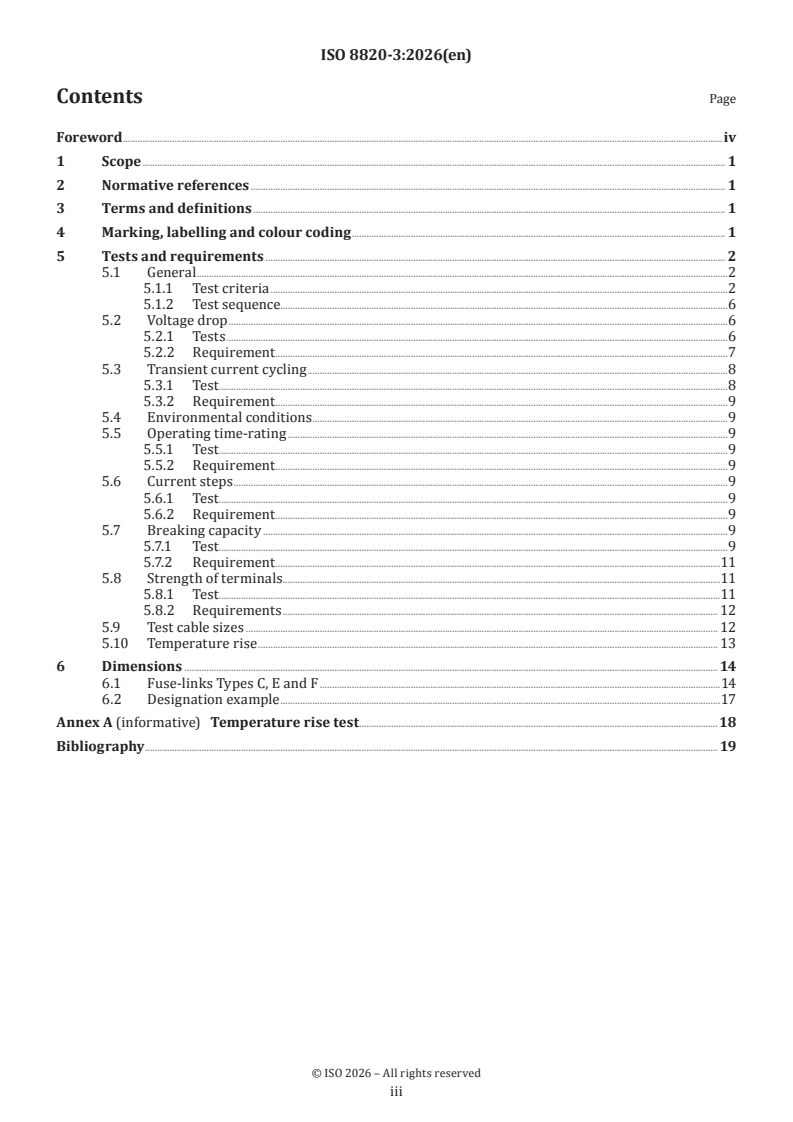
The document is organized into Clauses 1 to 6, plus one informative annex.
- Clause 1 - Scope
- Clause 2 - Normative references
- Clause 3 - Terms and definitions
- Clause 4 - Marking, labelling and colour coding
- Clause 5 - Tests and requirements
- Clause 6 - Dimensions
- Annex A - Informative temperature rise test
In practice, that structure tells you where to look for identification, test methods, pass criteria and dimensional data. Annex A gives a separate temperature-rise method that can be used alongside the main clauses.
What are the key requirements of ISO 8820-3:2026?
Identification and colour coding
Clause 4 and Table 1 assign colour coding to the supported current ratings for Type C, Type F and Type E fuse-links. Transparent bodies are treated as “white” when no colour is added to the plastic material, and the same colour is not allowed for 25 A and 80 A Type E.
For users, this means the fuse-link body colour is part of the identification system. It helps prevent mix-ups at receiving, assembly and service.
Test sequence and test fixtures
Clause 5.1 requires testing in the sequence given in Table 2, with sample groups containing at least 10 fuse-links for each rated current. It also requires visible evidence of an open-fuse element, so a blown fuse can be recognized by inspection.
Clause 5.1.1 also controls the test fixture design, fixture resistance and probe seats. In practice, the test setup is not left to the lab’s discretion, because the fixture itself can affect voltage drop, thermal behaviour and repeatability.
Voltage drop and transient current cycling
Clause 5.2 measures voltage drop across the fuse-link tabs at specified measuring points, and Table 3 sets the maximum voltage drop by rating. This matters because high voltage drop can indicate unwanted losses and heating in service.
Clause 5.3 covers transient current cycling. The fuse-link is exposed to a defined cycling profile, which checks how it behaves under repeated short-duration current loads. That is useful for vehicle circuits that see frequent load changes rather than steady current only.
Operating time-rating and current steps
Clause 5.5 covers operating time-rating and Clause 5.6 covers current steps. After activation, the current through the fuse-link shall not exceed 0.5 mA at the rated voltage of the fuse-link.
That requirement matters because a fuse that has opened must not continue to conduct more than a negligible current. Clause 5.5 also notes a special test duration for rated current and states that the operating time-rating tests are not required for the 100 A fuse-link.
Breaking capacity and interruption performance
Clause 5.7 tests breaking capacity at 1 000 A, using the cable sizes from Table 6 and a suitable test dummy from Figures 4 to 6. After the test, the current through the fuse-link shall not exceed 0.5 mA at the rated voltage.
For users, this is the fault-interruption check. It shows whether the fuse-link can open safely under the specified high current without leaving an unintended conducting path.
Mechanical strength, test cables and dimensions
Clause 5.8 applies force to the tabs and requires the force to be held for 2 s without abrupt application. After the test, deformation must stay within limits, the insulator must remain intact, and the terminals must not be removed from the insulator.
Clause 5.9 fixes the test cable sizes and states that they are for comparative testing, not necessarily for vehicle installation. Clause 6 and Figures 8 to 10 define the geometry of Types C, E and F, and Table 7 gives the dimensional data. Clause 6.2 also gives a designation example for a Type C fuse-link.
Temperature rise
Annex A gives an informative temperature rise test. It uses the vehicle manufacturer’s fuse holders and connections, a 60 °C ambient oven, and a test current of 0.7 I_R, with temperature measured where the terminals protrude from the insulator base.
The practical result is a check on how hot the connection area becomes in a realistic test arrangement. The annex requires the connection temperature not to exceed 125 °C after thermal equilibrium is reached.
What terms does ISO 8820-3:2026 define?
ISO 8820-3:2026 states that the terms and definitions in ISO 8820-1 apply. The following terms are central to using this part:
- Fuse-link - the protective element covered by the standard, designed for road vehicles and supplied in Type C, Type E or Type F form.
- Rated current - the current rating used to classify the fuse-link and to set the test conditions and marking.
- Breaking capacity - the ability of the fuse-link to interrupt a specified fault current without continuing to conduct.
- Voltage drop - the electrical drop measured across the fuse-link tabs during the voltage-drop test.
- Transient current cycling - repeated current loading used to check endurance under changing electrical demand.
- Operating time-rating - the time-related behaviour of the fuse-link at specified overcurrents before activation.
- Open-fuse element - the visible condition required after the fuse-link has operated.
Who uses ISO 8820-3:2026?
ISO 8820-3:2026 is used by fuse-link manufacturers, vehicle manufacturers, test laboratories and component suppliers working on road-vehicle electrical systems. Quality managers and buyers use it to specify product form, colour coding, test evidence and dimensional compatibility.
It is especially useful when teams need to compare products from different suppliers, set up laboratory tests, or check whether a blade-type fuse-link fits a vehicle holder and performs consistently in service.
What changed in ISO 8820-3:2026 from the previous edition?
ISO 8820-3:2026 cancels and replaces ISO 8820-3:2015, and the foreword says it has been technically revised. The stated changes are:
- updated test fixture definitions and drawings in 5.1.1
- updated temperature limit in the temperature rise test in Clause A.2
- changed dimension b on the Type C fuse drawing from 3.0 min to 2.5 min in 6.1
Which standards are used with ISO 8820-3:2026?
- ISO 8820-1 - provides the definitions and general test requirements that apply throughout ISO 8820-3 unless this part changes them.
- ISO 8820-2 - user guidelines named in the scope as a companion part for applying ISO 8820-3.
- ISO 19642-3 - specifies the dimensions and requirements for the single-core copper conductor cables used as test cables.
What does the ISO 8820-3:2026 document contain?
The document contains Table 1 for colour coding, Table 2 for test sequencing across sample groups, and Tables 3 to 7 for voltage-drop limits, operating-time limits, terminal forces, test cable sizes and dimensions. It also includes Figures 1 to 10, which show the test fixtures, the voltage-drop arrangement, the transient-current profile, the breaking-capacity dummies and the terminal-force application.
Annex A gives the temperature rise test setup and acceptance criterion, while Clause 6.2 gives a designation example for procurement and documentation. Together, these parts support design checks, laboratory testing, product qualification and dimensional verification for road-vehicle blade-type fuse-links.
Relations
- Effective Date
- 02-Jul-2022
Get Certified
Connect with accredited certification bodies for this standard

TÜV Rheinland
TÜV Rheinland is a leading international provider of technical services.

TÜV SÜD
TÜV SÜD is a trusted partner of choice for safety, security and sustainability solutions.

DEKRA Certification Inc.
DEKRA US certification services.
Sponsored listings
Frequently Asked Questions
ISO 8820-3:2026 is a standard published by the International Organization for Standardization (ISO). Its full title is "Road vehicles — Fuse-links — Part 3: Fuse-links with tabs (blade type) Type C (medium), Type E (high current) and Type F (miniature)". This standard covers: This document specifies fuse-links with tabs (blade-type) Type C (medium), Type E (high current) and Type F (miniature) for use in road vehicles. It establishes the rated current, test procedures, performance requirements and dimensions for these fuse-link types. This document is applicable for fuse-links with a rated voltage of 32 V or 58 V, a current rating of ≤100 A and a breaking capacity of 1 000 A intended for use in road vehicles. This document is intended to be used in conjunction with ISO 8820-1 and ISO 8820-2[1]. The numbering of its clauses corresponds to that of ISO 8820-1, whose requirements are applicable, except where modified by requirements particular to this document.
This document specifies fuse-links with tabs (blade-type) Type C (medium), Type E (high current) and Type F (miniature) for use in road vehicles. It establishes the rated current, test procedures, performance requirements and dimensions for these fuse-link types. This document is applicable for fuse-links with a rated voltage of 32 V or 58 V, a current rating of ≤100 A and a breaking capacity of 1 000 A intended for use in road vehicles. This document is intended to be used in conjunction with ISO 8820-1 and ISO 8820-2[1]. The numbering of its clauses corresponds to that of ISO 8820-1, whose requirements are applicable, except where modified by requirements particular to this document.
ISO 8820-3:2026 is classified under the following ICS (International Classification for Standards) categories: 43.040.10 - Electrical and electronic equipment. The ICS classification helps identify the subject area and facilitates finding related standards.
ISO 8820-3:2026 has the following relationships with other standards: It is inter standard links to ISO 8820-3:2015. Understanding these relationships helps ensure you are using the most current and applicable version of the standard.
ISO 8820-3:2026 is available in PDF format for immediate download after purchase. The document can be added to your cart and obtained through the secure checkout process. Digital delivery ensures instant access to the complete standard document.
Standards Content (Sample)
International
Standard
ISO 8820-3
Fifth edition
Road vehicles — Fuse-links —
2026-07
Part 3:
Fuse-links with tabs (blade type)
Type C (medium), Type E (high
current) and Type F (miniature)
Véhicules routiers — Liaisons fusibles —
Partie 3: Liaisons fusibles cavalier (Type à lame), Type C (moyen),
Type E (courant élevé) et Type F (miniature)
Reference number
© ISO 2026
All rights reserved. Unless otherwise specified, or required in the context of its implementation, no part of this publication may
be reproduced or utilized otherwise in any form or by any means, electronic or mechanical, including photocopying, or posting on
the internet or an intranet, without prior written permission. Permission can be requested from either ISO at the address below
or ISO’s member body in the country of the requester.
ISO copyright office
CP 401 • Ch. de Blandonnet 8
CH-1214 Vernier, Geneva
Phone: +41 22 749 01 11
Email: copyright@iso.org
Website: www.iso.org
Published in Switzerland
ii
Contents Page
Foreword .iv
1 Scope . 1
2 Normative references . 1
3 Terms and definitions . 1
4 Marking, labelling and colour coding . 1
5 Tests and requirements . 2
5.1 General .2
5.1.1 Test criteria .2
5.1.2 Test sequence.6
5.2 Voltage drop .6
5.2.1 Tests .6
5.2.2 Requirement .7
5.3 Transient current cycling .8
5.3.1 Test . . .8
5.3.2 Requirement .9
5.4 Environmental conditions .9
5.5 Operating time-rating .9
5.5.1 Test . . .9
5.5.2 Requirement .9
5.6 Current steps .9
5.6.1 Test . . .9
5.6.2 Requirement .9
5.7 Breaking capacity .9
5.7.1 Test . . .9
5.7.2 Requirement .11
5.8 Strength of terminals.11
5.8.1 Test . . .11
5.8.2 Requirements . 12
5.9 Test cable sizes . 12
5.10 Temperature rise . 13
6 Dimensions . 14
6.1 Fuse-links Types C, E and F .14
6.2 Designation example .17
Annex A (informative) Temperature rise test.18
Bibliography . 19
iii
Foreword
ISO (the International Organization for Standardization) is a worldwide federation of national standards
bodies (ISO member bodies). The work of preparing International Standards is normally carried out through
ISO technical committees. Each member body interested in a subject for which a technical committee
has been established has the right to be represented on that committee. International organizations,
governmental and non-governmental, in liaison with ISO, also take part in the work. ISO collaborates closely
with the International Electrotechnical Commission (IEC) on all matters of electrotechnical standardization.
The procedures used to develop this document and those intended for its further maintenance are described
in the ISO/IEC Directives, Part 1. In particular, the different approval criteria needed for the different types
of ISO document should be noted. This document was drafted in accordance with the editorial rules of the
ISO/IEC Directives, Part 2 (see www.iso.org/directives).
ISO draws attention to the possibility that the implementation of this document may involve the use of (a)
patent(s). ISO takes no position concerning the evidence, validity or applicability of any claimed patent
rights in respect thereof. As of the date of publication of this document, ISO had not received notice of (a)
patent(s) which may be required to implement this document. However, implementers are cautioned that
this may not represent the latest information, which may be obtained from the patent database available at
www.iso.org/patents. ISO shall not be held responsible for identifying any or all such patent rights.
Any trade name used in this document is information given for the convenience of users and does not
constitute an endorsement. For an explanation of the voluntary nature of standards, the meaning of ISO
specific terms and expressions related to conformity assessment, as well as information about ISO's
adherence to the World Trade Organization (WTO) principles in the Technical Barriers to Trade (TBT), see
www.iso.org/iso/foreword.html.
This document was prepared by Technical Committee ISO/TC 22, Road vehicles, Subcommittee SC 32,
Electrical and electronic components and general system aspects.
This fifth edition cancels and replaces the fourth edition (ISO 8820-3:2015), which has been technically
revised.
The main changes are as follows:
— updated test fixture definitions and drawings (see 5.1.1);
— updated temperature limit on Temperature Rise Test (see Clause A.2);
— changed dimension b on type "C" fuse drawing from 3,0 min to 2,5 min (see 6.1).
A list of all parts in the ISO 8820 series can be found on the ISO website.
Any feedback or questions on this document should be directed to the user’s national standards body. A
complete listing of these bodies can be found at www.iso.org/members.html.
iv
International Standard ISO 8820-3:2026(en)
Road vehicles — Fuse-links —
Part 3:
Fuse-links with tabs (blade type) Type C (medium), Type E
(high current) and Type F (miniature)
1 Scope
This document specifies fuse-links with tabs (blade-type) Type C (medium), Type E (high current) and
Type F (miniature) for use in road vehicles. It establishes the rated current, test procedures, performance
requirements and dimensions for these fuse-link types.
This document is applicable for fuse-links with a rated voltage of 32 V or 58 V, a current rating of ≤100 A and
a breaking capacity of 1 000 A intended for use in road vehicles.
[1]
This document is intended to be used in conjunction with ISO 8820-1 and ISO 8820-2 . The numbering of
its clauses corresponds to that of ISO 8820-1, whose requirements are applicable, except where modified by
requirements particular to this document.
2 Normative references
The following documents are referred to in the text in such a way that some or all of their content constitutes
requirements of this document. For dated references, only the edition cited applies. For undated references,
the latest edition of the referenced document (including any amendments) applies.
ISO 19642-3, Road vehicles — Automotive cables — Part 3: Dimensions and requirements for 30 V a.c. or 60 V
d.c. single core copper conductor cables
ISO 8820-1, Road vehicles — Fuse-links — Part 1: D
...